spare wheel MERCEDES-BENZ A-CLASS HATCHBACK 2008 User Guide
[x] Cancel search | Manufacturer: MERCEDES-BENZ, Model Year: 2008, Model line: A-CLASS HATCHBACK, Model: MERCEDES-BENZ A-CLASS HATCHBACK 2008Pages: 305, PDF Size: 5.43 MB
Page 256 of 305
Flat tyre
253Flat tyre
Flat tyre equipment variants
Your vehicle may be equipped with:
R a TIREFIT kit (Y page 200)
R a "Minispare" emergency spare
wheel* (Y page 201)
R a spare wheel* (Y page 201)
R the MOExtended run-flat sys-
tem* (Y page 262) Preparing the vehicle
i Vehicle preparation is not necessary on
vehicles with MOE tyres*.
X Stop your vehicle as far away from traffic
as possible on solid, non-slippery, level
ground.
X Switch on the hazard warning lamps.
X Apply the handbrake.
Vehicles with manual transmission X
Shift to either first or reverse gear. Vehicles with AUTOTRONIC* X
Move the selector lever to P.
For all vehicles X
All occupants must get out of the vehicle.
Make sure that they are not endangered as
they do so.
X Make sure that no one is near the danger
area whilst a wheel is being changed. Any-
one who is not directly assisting in the
wheel change should, for example, stand
behind the barrier.
X Switch off the engine.
X Remove the key from the ignition lock.
X Get out of the vehicle.
X Close the driver’s door.
X Place the warning triangle (Y page 200) at
a suitable distance. Observe legal require-
ments. Using the TIREFIT kit
You can use the TIREFIT kit to seal small
punctures, particularly those in the tyre tread.
You can use TIREFIT in outdoor temperatures
down to -20 °C. G
Risk of accident
In the following situations, your safety is at
particular risk and tyre sealant is unable to
provide breakdown assistance:
R if there are cuts or punctures in the tyre
greater than 4 mm
R if the wheel rim is damaged
R if you have driven at very low tyre pres-
sures or on a flat tyre
Do not drive any further. Consult a qualified
specialist workshop which has the neces-
sary specialist knowledge and tools to carry
out the work required.
Mercedes-Benz recommends that you use
a Mercedes-Benz Service Centre for this
purpose. In particular, work relevant to
safety or on safety-related systems must be
carried out at a qualified specialist work-
shop. Practical advice
* optional
169_AKB; 2; 4, en-GB
wdomann,
Version: 2.10.6 2008-07-16T08:52:06+02:00 - Seite 253 ZDateiname: 6515_0315_02_buchblock.pdf; preflight
Page 262 of 305
Flat tyre
259Changing a wheel/fitting the spare
wheel*
G
Risk of accident
The wheel dimensions and tyre size of the
"Minispare" emergency spare wheel* may
differ from those of the standard wheels.
Your vehicle's handling characteristics will
change when a "Minispare" emergency
spare wheel* is fitted. Adapt your style of
driving accordingly.
The "Minispare" emergency spare wheel*
may only be used for a short time. Do not
exceed the maximum speed of 80 km/h
and do not deactivate ESP ®
.
Never drive the vehicle with more than one
"Minispare" emergency spare wheel* fit-
ted. G
Risk of accident
Have the "Minispare" emergency spare
wheel* or the spare wheel* replaced with
a new wheel as soon as possible at a quali-
fied specialist workshop which has the nec-
essary specialist knowledge and tools to
carry out the work required. Mercedes-
Benz recommends that you use a
Mercedes-Benz Service Centre for this pur- pose. In particular, work relevant to safety
or on safety-related systems must be car-
ried out at a qualified specialist workshop.
Preparing the vehicle X
Prepare the vehicle as described
(Y page 253).
X If a trailer is coupled, uncouple it.
X Place the wheels in the straight-ahead posi-
tion.
X Take the "Minispare" emergency spare
wheel* or the spare wheel* out of the stow-
age well under the luggage compartment
floor.
X Take the following out of the left-hand
stowage compartment in the luggage com-
partment
R
the vehicle tool kit
R the wheel chock
R the jack
X Secure the vehicle to prevent it from rolling
away.
On level ground: place chocks or similar
items under the front and rear of the wheel
that is diagonally opposite the wheel you
wish to change. X
On downhill gradients: place chocks or
similar behind both wheels of the other
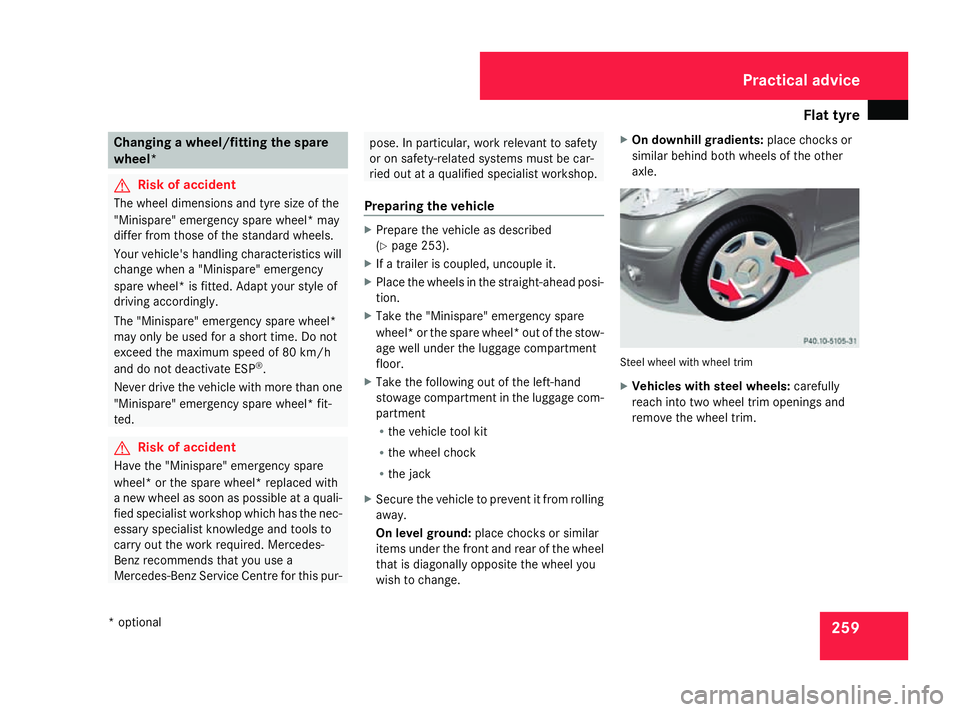
axle. Steel wheel with wheel trim
X
Vehicles with steel wheels: carefully
reach into two wheel trim openings and
remove the wheel trim. Practical advice
* optional
169_AKB; 2; 4, en-GB
wdomann, Version: 2.10.6 2008-07-16T08:52:06+02:00 - Seite 259 ZDateiname: 6515_0315_02_buchblock.pdf; preflight
Page 264 of 305
Flat tyre
261
X
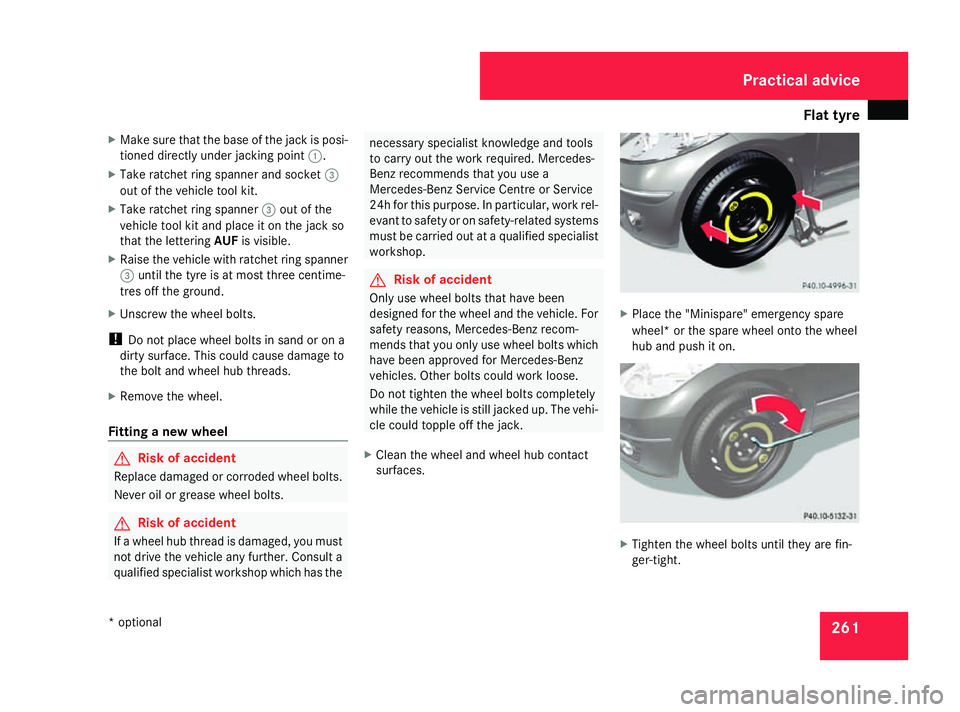
Make sure that the base of the jack is posi-
tioned directly under jacking point 1.
X Take ratchet ring spanner and socket 3
out of the vehicle tool kit.
X Take ratchet ring spanner 3out of the
vehicle tool kit and place it on the jack so
that the lettering AUFis visible.
X Raise the vehicle with ratchet ring spanner
3 until the tyre is at most three centime-
tres off the ground.
X Unscrew the wheel bolts.
! Do not place wheel bolts in sand or on a
dirty surface. This could cause damage to
the bolt and wheel hub threads.
X Remove the wheel.
Fit ting a new wheel G
Risk of accident
Replace damaged or corroded wheel bolts.
Never oil or grease wheel bolts. G
Risk of accident
If a wheel hub thread is damaged, you must
not drive the vehicle any further. Consult a
qualified specialist workshop which has the necessary specialist knowledge and tools
to carry out the work required. Mercedes-
Benz recommends that you use a
Mercedes-Benz Service Centre or Service
24h for this purpose. In particular, work rel-
evant to safety or on safety-related systems
must be carried out at a qualified specialist
workshop. G
Risk of accident
Only use wheel bolts that have been
designed for the wheel and the vehicle. For
safety reasons, Mercedes-Benz recom-
mends that you only use wheel bolts which
have been approved for Mercedes-Benz
vehicles. Other bolts could work loose.
Do not tighten the wheel bolts completely
while the vehicle is still jacked up. The vehi-
cle could topple off the jack.
X Clean the wheel and wheel hub contact
surfaces. X
Place the "Minispare" emergency spare
wheel* or the spare wheel onto the wheel
hub and push it on. X
Tighten the wheel bolts until they are fin-
ger-tight. Practical advice
* optional
169_AKB; 2; 4, en-GB
wdomann
,V ersion: 2.10.6
2008-07-16T08:52:06+02:00 - Seite 261 ZDateiname: 6515_0315_02_buchblock.pdf; preflight
Page 265 of 305
Flat tyre
262
Lowe
ring the vehicle X
Place the ratchet ring spanner onto the
hexagon nut of the jack so that the lettering
AB is visible.
X Lower the vehicle by turning the ratchet
ring spanner until the vehicle is once again
standing firmly on the ground.
X Place the jack to one side. 1
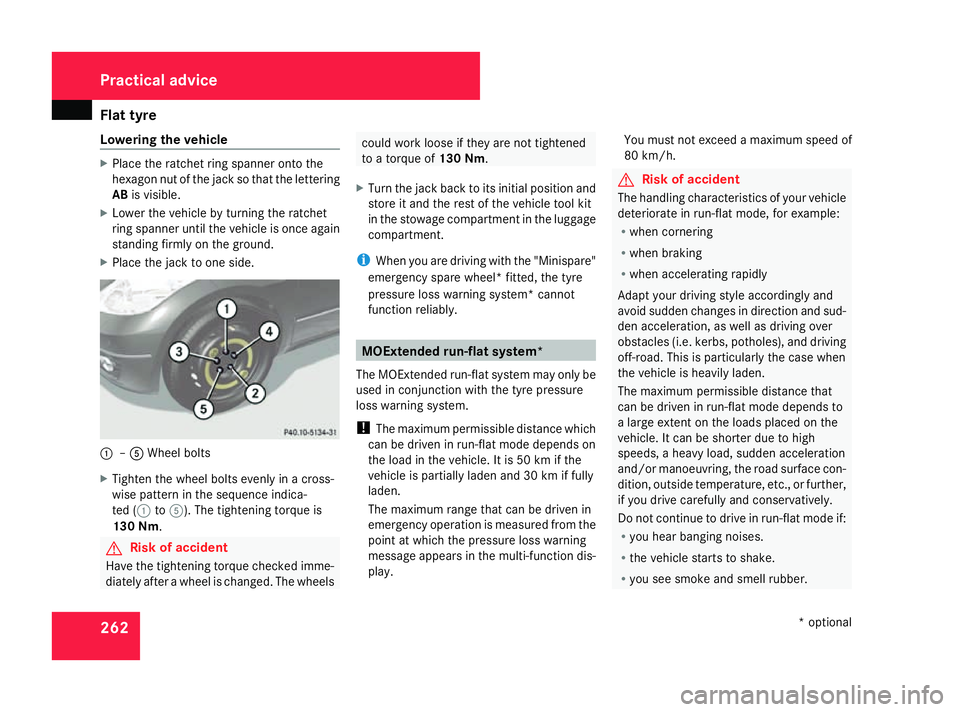
–5 Wheel bolts
X Tighten the wheel bolts evenly in a cross-
wise pattern in the sequence indica-
ted (1 to5). The tightening torque is
130 Nm . G
Risk of accident
Have the tightening torque checked imme-
diately after a wheel is changed. The wheels could work loose if they are not tightened
to a torque of 130 Nm.
X Turn the jack back to its initial position and
store it and the rest of the vehicle tool kit
in the stowage compartment in the luggage
compartment.
i When you are driving with the "Minispare"
emergency spare wheel* fitted, the tyre
pressure loss warning system* cannot
function reliably. MOExtended run-flat system*
The MOExtended run-flat system may only be
used in conjunction with the tyre pressure
loss warning system.
! The maximum permissible distance which
can be driven in run-flat mode depends on
the load in the vehicle. It is 50 km if the
vehicle is partially laden and 30 km if fully
laden.
The maximum range that can be driven in
emergency operation is measured from the
point at which the pressure loss warning
message appears in the multi-function dis-
play. You must not exceed a maximum speed of
80 km/h. G
Risk of accident
The handling characteristics of your vehicle
deteriorate in run-flat mode, for example:
R when cornering
R when braking
R when accelerating rapidly
Adapt your driving style accordingly and
avoid sudden changes in direction and sud-
den acceleration, as well as driving over
obstacles (i.e. kerbs, potholes), and driving
off-road. This is particularly the case when
the vehicle is heavily laden.
The maximum permissible distance that
can be driven in run-flat mode depends to
a large extent on the loads placed on the
vehicle. It can be shorter due to high
speeds, a heavy load, sudden acceleration
and/or manoeuvring, the road surface con-
dition, outside temperature, etc., or further,
if you drive carefully and conservatively.
Do not continue to drive in run-flat mode if:
R you hear banging noises.
R the vehicle starts to shake.
R you see smoke and smell rubber. Practical advice
* optional
169_AKB; 2; 4, en-GB
wdomann
,V ersion: 2.10.6
2008-07-16T08:52:06+02:00 - Seite 262 Dateiname: 6515_0315_02_buchblock.pdf; preflight
Page 266 of 305
Battery
263R
ESP ®
is intervening constantly.
R there are tears in the sidewalls of the
tyre.
After driving in run-flat mode, you must
have the wheel(s) checked for damage at a
qualified specialist workshop which has the
necessary specialist knowledge and tools
to carry out the work required. The faulty
tyre must be replaced in every case.
Mercedes-Benz recommends that you use
a Mercedes-Benz Service Centre for this
purpose. In particular, work relevant to
safety or on safety-related systems must be
carried out at a qualified specialist work-
shop.
i On a vehicle with MOExtended tyres, only
use MOExtended spare tyres. These must
be of the size specified for the vehicle. Battery
Notes on the vehicle battery
In order for the battery to achieve the maxi-
mum possible service life, it must always be
sufficiently charged.
Have the battery charge checked more fre-
quently if you use the vehicle mainly for short
trips or if you leave it standing idle for a
lengthy period.
To prevent damage from corrosion, only
replace the battery with one that has a central
ventilation cover.
Consult a Mercedes-Benz Service Centre if
you wish to leave your vehicle parked up for
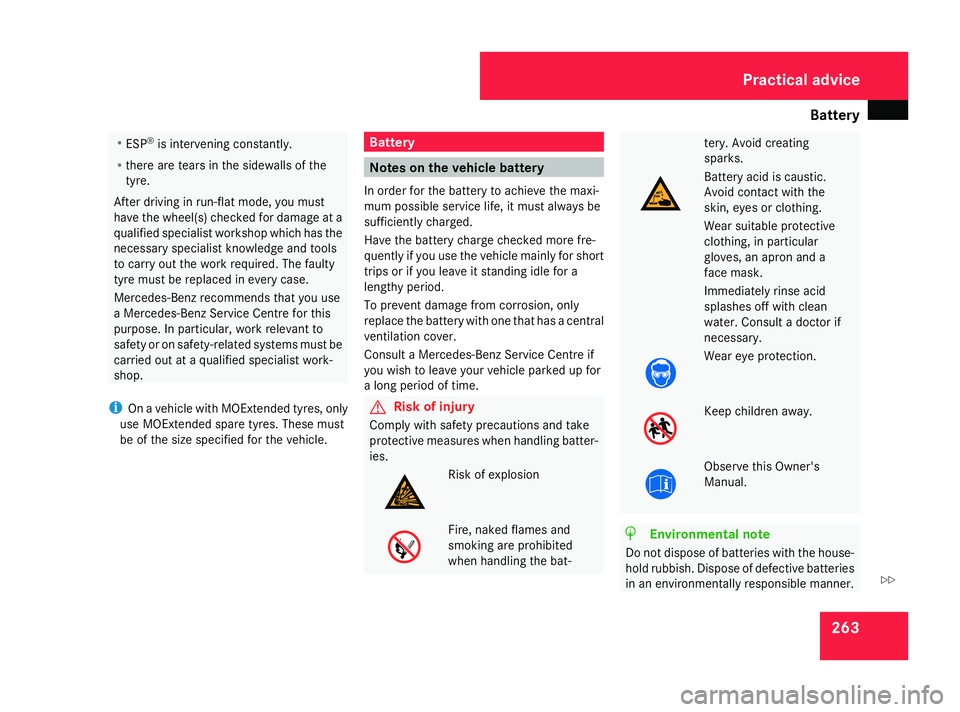
a long period of time. G
Risk of injury
Comply with safety precautions and take
protective measures when handling batter-
ies. Risk of explosion
Fire, naked flames and
smoking are prohibited
when handling the bat- tery. Avoid creating
sparks.
Battery acid is caustic.
Avoid contact with the
skin, eyes or clothing.
Wear suitable protective
clothing, in particular
gloves, an apron and a
face mask.
Immediately rinse acid
splashes off with clean
water. Consult a doctor if
necessary.
Wear eye protection.
Keep children away.
Observe this Owner's
Manual.
H
Environmental note
Do not dispose of batteries with the house-
hold rubbish. Dispose of defective batteries
in an environmentally responsible manner. Practical advice
169_AKB; 2; 4, en-GB
wdomann, Version: 2.10.6 2008-07-16T08:52:06+02:00 - Seite 263 ZDateiname: 6515_0315_02_buchblock.pdf; preflight
Page 288 of 305
Tyres and wheels
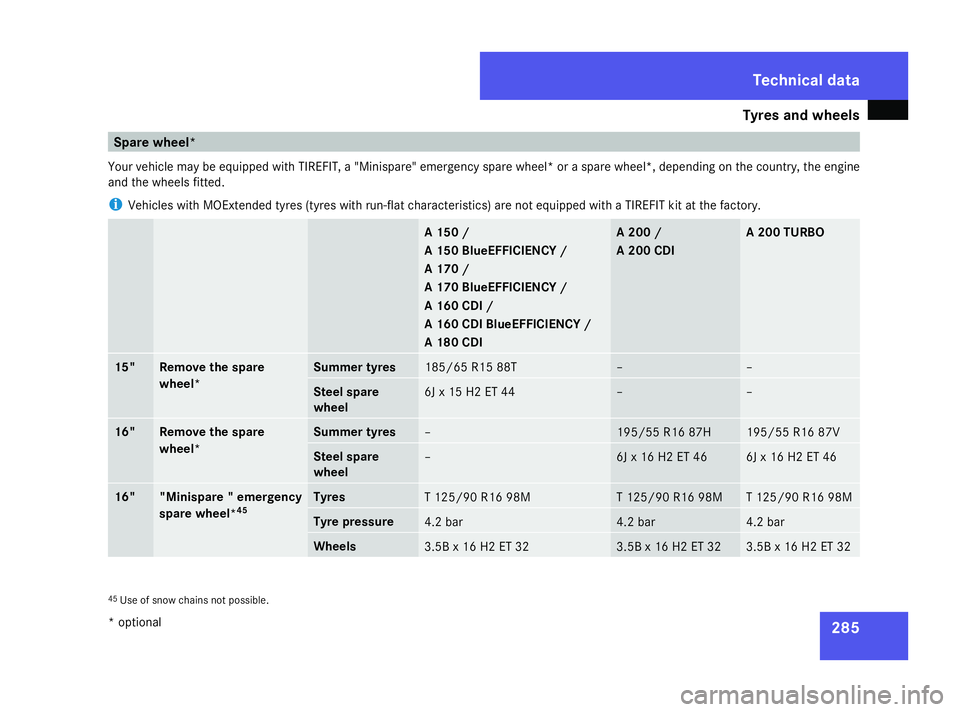
285Spare wheel*
Your vehicle may be equipped with TIREFIT, a "Minispare" emergency spare wheel* or a spare wheel*, depending on the country, the engine
and the wheels fitted.
i Vehicles with MOExtended tyres (tyres with run-flat characteristics) are not equipped with a TIREFIT kit at the factory. A 150 /
A 150 BlueEFFICIENCY /
A 170 /
A 170 BlueEFFICIENCY /
A 160 CDI /
A 160 CDI BlueEFFICIENCY /
A 180 CDI A 200 /
A 200 CDI A 200 TURBO
15" Remove the spare
wheel* Summer tyres
185/65 R15 88T – –
Steel spare
wheel
6J x 15 H2 ET 44 – –
16" Remove the spare
wheel* Summer tyres
– 195/55 R16 87H 195/55 R16 87V
Steel spare
wheel
– 6J x 16 H2 ET 46 6J x 16 H2 ET 46
16" "Minispare " emergency
spare wheel*
45 Tyres
T 125/90 R16 98M T 125/90 R16 98M T 125/90 R16 98M
Tyre pressure
4.2 bar 4.2 bar 4.2 bar
Wheels
3.5B x 16 H2 ET 32 3.5B x 16 H2 ET 32 3.5B x 16 H2 ET 32
45
Use of snow chains not possible. Techni
cal data
* optional
169_AKB; 2; 4, en-GB
wdomann,
Version: 2.10.6
2008-07-16T08:52:06+02:00 - Seite 285 ZDateiname: 6515_0315_02_buchblock.pdf; preflight