tow MERCEDES-BENZ A-CLASS HATCHBACK 2008 User Guide
[x] Cancel search | Manufacturer: MERCEDES-BENZ, Model Year: 2008, Model line: A-CLASS HATCHBACK, Model: MERCEDES-BENZ A-CLASS HATCHBACK 2008Pages: 305, PDF Size: 5.43 MB
Page 34 of 305
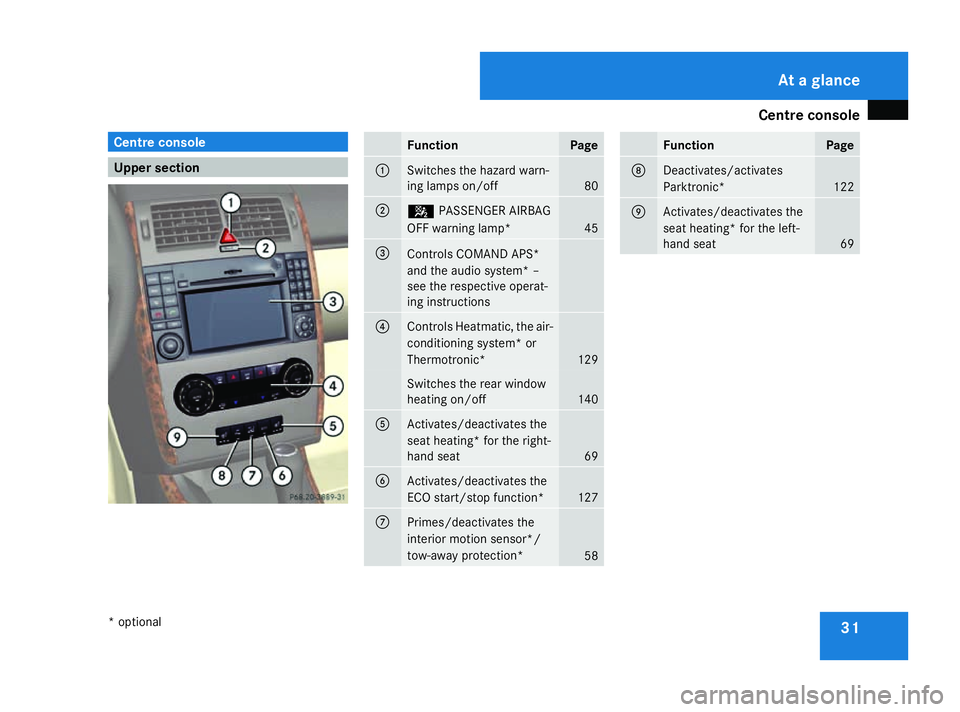
Centre console
31Centre console
Upper section Function Page
1
Switches the hazard warn-
ing lamps on/off
80
2
5
PASSENGER AIRBAG
OFF warning lamp* 45
3
Controls COMAND APS*
and the audio system* –
see the respective operat-
ing instructions
4
Controls Heatmatic, the air-
conditioning system* or
Thermotronic*
129
Switches the rear window
heating on/off
140
5
Activates/deactivates the
seat heating* for the right-
hand seat
69
6
Activates/deactivates the
ECO start/stop function*
127
7
Primes/deactivates the
interior motion sensor*/
tow-away protection*
58 Function Page
8
Deactivates/activates
Parktronic*
122
9
Activates/deactivates the
seat heating* for the left-
hand seat
69At a glance
* optional
169_AKB; 2; 4, en-GB
wdomann,
Version: 2.10.6 2008-07-16T08:52:06+02:00 - Seite 31Dateiname: 6515_0315_02_buchblock.pdf; preflight
Page 35 of 305

Centre console
32 Lower section
Function Page
1
Opens the stowage com-
partment
160
Socket 163
Opens the ashtray* 162
Cigarette lighter 163
2
Manual transmission: gear
lever
92
AUTOTRONIC*: selector
lever
94
3
Selects the drive program* 94
4
Parking brake 90
5
Adjusts the armrest* and
opens the stowage com-
partment*
67
6
Opens the stowage com-
partment/telephone com-
partment*
160
7
Cup holder 144At a glance
* optional
169_AKB; 2; 4, en-GB
wdomann,
Version: 2.10.6 2008-07-16T08:52:06+02:00 - Seite 32Dateiname: 6515_0315_02_buchblock.pdf; preflight
Page 39 of 305
Occupant safety
36 Occupant safety
Notes on occupant safety
Seat belts, together with belt tensioners, belt
force limiters and airbags, are coordinated
restraint systems. They reduce the risk of
injury in defined accident situations and
thereby increase occupant safety. However,
seat belts and airbags generally do not pro-
tect against objects penetrating the vehicle
from the outside.
To ensure that the restraint systems can
deliver their full potential protection, you
should ensure that:
R the seat and head restraint are adjusted
properly (Y page 63)
R the seat belt has been fastened properly
(Y page 73)
R the airbags can inflate properly if they are
deployed (Y page 39)
R the steering wheel is adjusted properly
(Y page 70)
R the restraint systems have not been modi-
fied
i An airbag increases the protection of
vehicle occupants wearing a seat belt.
However, airbags are only an additional restraint system which complements, but
does not replace, the seat belt. All vehicle
occupants must wear their seat belt cor-
rectly at all times, even if the vehicle is
equipped with airbags. This is because - on
the one hand - airbags are not deployed in
all types of accident, as in some situations
airbag deployment would not increase the
protection afforded to vehicle occupants,
provided they are wearing their seat belt
correctly. On the other hand, airbag deploy-
ment only provides increased protection if
the seat belt is worn correctly because:
R
the seat belt helps to keep the vehicle
occupant in the best position in relation
to the airbag
R for example, in a head-on collision, the
seat belt can more adequately prevent
the occupant from being propelled
towards the force of the impact, and is
thus better suited to prevent injury
Therefore, in accident situations where an
airbag is deployed, it only provides protec-
tion in addition to the seat belt if the seat
belt is being worn correctly. G
Risk of accident and injury
Always have maintenance work carried out
at a qualified specialist workshop which has the necessary specialist knowledge
and tools to carry out the work required.
Mercedes-Benz recommends that you use
a Mercedes-Benz Service Centre for this
purpose.
In particular, work relevant to safety or on
safety-related systems must be carried out
at a qualified specialist workshop. If this
work is not carried out correctly, the oper-
ating safety of your vehicle may be affec-
ted. There is a risk of an accident and injury.
G
Risk of injury
The restraint system may not work as inten-
ded if the following components have been
modified or work on these components has
not been performed correctly:
R restraint system, consisting of the seat
belts and anchorages, belt tensioners,
belt force limiters, airbags
R wiring
R networked electronic systems
Airbags or belt tensioners could then fail,
e.g. in the event of an accident in which the
deceleration force would normally be high
enough to trigger the systems, or they
could be triggered unintentionally. Never Safety
169_AKB; 2; 4, en-GB
wdomann
,V ersion: 2.10.6
2008-07-16T08:52:06+02:00 - Seite 36 Dateiname: 6515_0315_02_buchblock.pdf; preflight
Page 41 of 305

Occupant safety
38airbag deployment must take place during
the impact and must be adapted to provide
calculated, additional protection for the
vehicle occupants. Not all airbags are
deployed in an accident.
The different airbag systems work inde-
pendently of each other. However, the
deployment of each individual system will
depend on the type of accident determined
by the control system in the first stages of
the collision (head-on collision, side impact
and overturn) and the extent of the acci-
dent (in particular, the vehicle's rate of
deceleration or acceleration).
The rate of vehicle deceleration or accelera-
tion and the direction of the force are basi-
cally determined by:
R the distribution of forces during the colli-
sion
R the collision angle
R the deformation characteristics of the vehi-
cle
R the characteristics of the object with which
the vehicle has collided, e.g. the other vehi-
cle
Factors which can only be seen and measured
after a collision has occurred do not play a decisive role in the deployment of an airbag,
nor do they provide an indication of it.
The vehicle may be deformed significantly,
e. g. on the bonnet or the wing, without an
airbag being deployed. This is the case if only
parts which are relatively easily deformed are
affected and the necessary deceleration does
not occur. Conversely, airbags may be
deployed even though the vehicle suffers only
minor deformations. This is the case if, for
example, very rigid vehicle parts such as lon-
gitudinal body members are affected and suf-
ficient deceleration occurs as a result.
Belt tensioners, belt force limiters
The front seat belts and the outer seat belts
in the rear are equipped with belt tensioners.
If the seat belt is also equipped with a belt
force limiter, the force exerted by the seat
belt on the seat occupant is reduced.
Belt tensioners tighten the seat belts in an
accident, pulling them close against the body.
i
Belt tensioners do not correct incorrect
seat positions or incorrectly fastened seat
belts.
Belt tensioners do not pull occupants back
towards the backrest. The front belt force limiters are synchronised
with the front airbags, which distribute the
forces exerted by the belt force limiters on
the occupant over a greater area.
When the ignition is switched on, the belt ten-
sioner is triggered:
R
only if the restraint systems are operational
(the 1 warning lamp lights up after the
ignition is switched on and goes out once
the engine is running) (Y page 37)
R in the event of a head-on or rear-end colli-
sion if the vehicle decelerates or acceler-
ates rapidly in a longitudinal direction dur-
ing the initial stages of impact
If the airbags are deployed, you will hear a
bang and a small amount of powder may also
be released. Only in rare cases will the bang
affect your hearing. The powder that escapes
does not generally constitute a health hazard.
The 1 warning lamp lights up. G
Risk of injury
If the seat belt tensioners have been trig-
gered, they provide no additional protec-
tion in the event of another accident. There-
fore, have belt tensioners which have been
triggered replaced at a qualified specialist
workshop. Safety
169_AKB; 2; 4, en-GB
wdomann
,V ersion: 2.10.6
2008-07-16T08:52:06+02:00 - Seite 38 Dateiname: 6515_0315_02_buchblock.pdf; preflight
Page 56 of 305

Occupant safety
53
!
Make sure that the padded table is not
trapped or damaged, for example when
you:
R close the doors
R adjust the seat
R store the padded table or transport
heavy objects
Fitting the padded table 1
Head restraint
2 Padded table
3 Seat belt guide points 4
Hook
5 Left leg
6 Integrated child seat
7 Right leg
X Fold out integrated child seat 6
(Y page 50).
X Place the child on integrated child seat
6.
X Fold both legs 5and 7down.
X Place padded table 2over integrated child
seat 6. G
Risk of injury
Ensure that:
R the belt is routed as described below
R the belt is not twisted
R the padded table is close to the child's
body
R the belt is routed through the hook
R the belt strap is not trapped or twisted
and does not rub against any sharp edges
It would otherwise not be possible to
restrain the child in the event of an acci-
dent, sudden braking or abrupt change in
direction and this could result in serious or
even fatal injury to the child. X
Pull the belt smoothly from the inertia reel.
X Guide the lower section of the belt through
hook 4.
X Attach the lower and upper sections of the
belt in left seat belt guide point 3.
X Guide both sections of the belt to right seat
belt guide point 3and attach.
X Engage the seat belt tongue in the belt
buckle.
X Slide padded table 2close to the child's
body.
X Pull both parts of the belt tight. Ensure that
the belt is not twisted.
X Adjust the head restraint (Y page 66)
Storing the padded table G
Risk of injury
The padded table must be secured in the
vehicle correctly or stowed securely in the
luggage compartment. It could otherwise
become loose in the event of an accident,
sudden braking or abrupt change in direc-
tion and could injure vehicle occupants or
cause damage to the vehicle.
X Fold in both legs 5and 7. Safety
169_AKB; 2; 4, en-GB
wdomann
,V ersion: 2.10.6
2008-07-16T08:52:06+02:00 - Seite 53 ZDateiname: 6515_0315_02_buchblock.pdf; preflight
Page 59 of 305

Driving safety sys
tems56 G
Risk of accident
If BAS has malfunctioned, the braking sys-
tem remains available with full brake boost-
ing effect. However, braking force is not
automatically increased in emergency
braking situations and the stopping dis-
tance may increase. Adaptive brake lamps
i Adaptive brake lamps are only available in
certain countries.
If you brake sharply from a speed of more
than 50 km/h or if braking is assisted by BAS,
the brake lamps flash rapidly. In this way,
traffic travelling behind you is warned in an
even more noticeable manner.
If you brake sharply from a speed of more
than 70 km/h to a standstill, the hazard warn-
ing lamps are activated automatically. If the
brakes are applied again, the brake lamps
light up continuously. The hazard warning
lamps switch off automatically if you travel
faster than 10 km/h. You can also switch off
the hazard warning lamps using the hazard
warning switch button ( Ypage 80). ESP
®
(Electronic Stability Program)
ESP ®
monitors driving stability and traction,
i.e. power transmission between tyres and
the road surface.
ESP ®
detects when a wheel spins or the vehi-
cle starts to skid. ESP ®
stabilises the vehicle
by targeted braking of individual wheels and
by limiting engine power. It assists you when
pulling away on wet or slippery roads. ESP ®
also stabilises the vehicle during braking.
When ESP ®
intervenes, the vwarning
lamp flashes in the instrument cluster. G
Risk of accident
If the v warning lamp in the instrument
cluster flashes, proceed as follows:
R only depress the accelerator pedal as far
as necessary when pulling away.
R adapt your driving style to suit the pre-
vailing road and weather conditions.
The vehicle could otherwise go into a skid.
ESP ®
cannot reduce the risk of an accident
if you drive too fast. ESP ®
cannot override
the laws of physics.
! The ignition must be switched off (key in
position 0or 1in the ignition lock), if: R
the parking brake is being tested using a
dynamometer
R the vehicle is being towed with the front
axle raised
Application of the brakes by ESP ®
could
otherwise destroy the brake system on the
front axle.
i Only use wheels with the recommended
tyre sizes. Only then will ESP ®
function
properly. Steering assistant STEER CONTROL
The steering assistant STEER CONTROL helps
you by transmitting a noticeable steering
force to the steering wheel in the direction
required for vehicle stabilisation. This steer-
ing assistance is provided in particular if:
R both right wheels or both left wheels are on
a wet or slippery road surface when you
brake
R the vehicle starts to skid
You have control over the steering at all
times. G
Risk of accident
If there is an ESP ®
malfunction, you will not
receive any steering assistance from the Safety
169_AKB; 2; 4, en-GB
wdomann,
Version: 2.10.6
2008-07-16T08:52:06+02:00 - Seite 56 Dateiname: 6515_0315_02_buchblock.pdf; preflight
Page 61 of 305
Anti-theft syste
ms58 Tow-away protection* and interior
motion sensor*
When tow-away protection and the interior
motion sensor have been primed, a visual and
audible alarm is triggered, if:
R motion is detected in the vehicle interior,
e.g. if the side windows of the vehicle are
smashed.
R the inclination of your vehicle changes, e.g.
if one end of your vehicle is raised.
Priming tow-away protection and inte-
rior motion sensor X
Make sure that:
R the side windows are closed
R the panorama louvred sliding sunroof* is
closed.
R there are no objects, e.g. mascots, hanging
on the rear-view mirror or on the grab han-
dles on the roof trim.
This will prevent false alarms.
X Lock the vehicle using the key.
Tow-away protection and the interior
motion sensor are primed after approxi-
mately 30 seconds. Deactivating tow-away protection and
interior motion sensor To prevent a false alarm, deactivate the tow-
away protection and the interior motion sen-
sor if your vehicle:
R
is being transported or towed
R is being loaded, e.g. onto a ferry or car
transporter
R is parked on a movable surface, e.g. split-
level garages
R is locked while persons or animals remain
inside
R is locked while the side windows remain
open
R is locked and the panorama louvred sliding
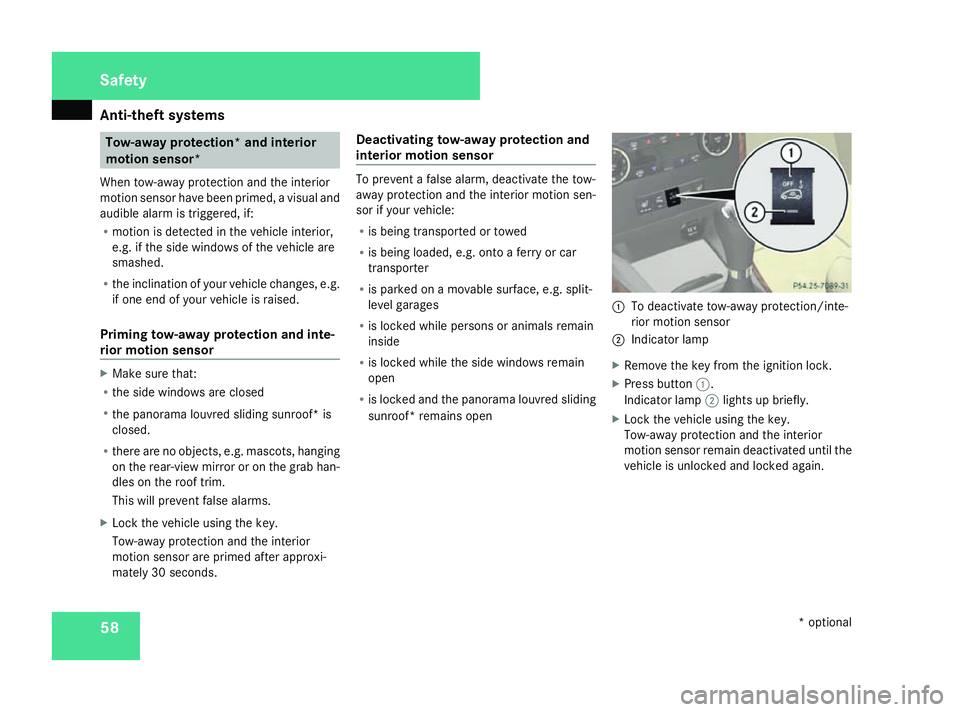
sunroof* remains open 1
To deactivate tow-away protection/inte-
rior motion sensor
2 Indicator lamp
X Remove the key from the ignition lock.
X Press button 1.
Indicator lamp 2lights up briefly.
X Lock the vehicle using the key.
Tow-away protection and the interior
motion sensor remain deactivated until the
vehicle is unlocked and locked again. Safety
* optional
169_AKB; 2; 4, en-GB
wdomann,
Version: 2.10.6
2008-07-16T08:52:06+02:00 - Seite 58 Dateiname: 6515_0315_02_buchblock.pdf; preflight
Page 62 of 305
59
Opening and closing
...........................60
Key positions ....................................... 62
Seats .................................................... 63
Steering wheel .................................... 70
Mirrors ................................................. 70
Seat belts ............................................. 73
Lights ................................................... 77
Windscreen wipers .............................83
Side windows ...................................... 84Driving and parking
............................87
Transmission ....................................... 92
Instrument cluster ..............................97
On-board computer .............................98
Driving systems ................................ 115
Air conditioning ................................. 129
Roof .................................................... 142
Loading and stowing ........................144
Features ............................................. 162 Controls
169_AKB; 2; 4, en-GB
wdomann,
Version: 2.10.6 2008-07-16T08:52:06+02:00 - Seite 59Dateiname: 6515_0315_02_buchblock.pdf; preflight
Page 70 of 305

Seats
671
Release catch
X Fold the rear seat backrest forwards
slightly in order to remove the head
restraint.
X To remove: pull the head restraint up to
the stop.
X Press release catch 1and pull the head
restraint out of the guides.
X To refit: insert the head restraint so that
the notches on the bar are on the left when
viewed in the direction of travel.
X Push the head restraint down until you hear
it click into place. Armrest* between the front seats
You can slide the armrest forwards or back-
wards. G
Risk of injury
There is a risk of entrapment when you
move the armrest.
i There is a small stowage compartment
underneath the armrest at the rear. This
becomes accessible after you have moved
the armrest forwards. 1
Armrest
Moving the armrest X
Slide armrest 1into the desired position. Folding the front seat backrests for-
wards/EASY-ENTRY feature (3-door
vehicle) 1
Seat release
i For easier access to the rear, you can
slide the seat further forwards once you
have folded the backrest forwards, as long
as the seat is in the rear half of the adjust-
ment range. Controls
* optional
169_AKB; 2; 4, en-GB
wdomann,
Version: 2.10.6 2008-07-16T08:52:06+02:00 - Seite 67 ZDateiname: 6515_0315_02_buchblock.pdf; preflight
Page 78 of 305

Seat belts
75
X
Route the belt over the centre of the shoul-
der without twisting it.
X Engage belt tongue 2into buckle 3.
X 5-door vehicle: if necessary, adjust the
belt to the appropriate height
(Y page 75).
X 3-door vehicles: make sure that swivelling
belt guide 5is in the correct position.
X All: if necessary, pull upwards on the shoul-
der section of the belt to tighten the belt
across your body.
Routing the belt X
Press release button 4and guide belt
tongue 2back towards belt sash guide
1. Belt warning for driver and front
passenger
The < seat belt warning lamp in the instru-
ment cluster reminds you that all passengers
should fasten their seat belts. It may light up
continuously or flash. Additionally, there may
be a warning tone.
The < seat belt warning lamp goes out and
the acoustic signal ceases as soon as the
driver and passenger have fastened their seat
belts.
For certain countries only: regardless of
whether the driver or the front passenger
already have their seat belt fastened, the
< seat belt warning lamp lights up for six
seconds after the engine has been started. It
then goes out when the driver and front
passenger have already fastened their seat
belts.
i Further information about the
5-door vehicles only: you can adjust the
seat belt height on the driver's seat and front-
passenger seat.
Adjust the belt to a height that allows it to be
routed across the middle of your shoulder. 1
Release catch
X To raise: slide the belt sash guide upwards.
The belt sash guide engages in various posi-
tions.
X To lower: press and hold release button
1.
X Slide the belt sash guide downwards.
X Let go of release button 1and make sure
that the belt sash guide has engaged. Controls
169_AKB; 2; 4, en-GB
wdomann,
Version: 2.10.6
2008-07-16T08:52:06+02:00 - Seite 75 ZDateiname: 6515_0315_02_buchblock.pdf; preflight