fuel MERCEDES-BENZ A-CLASS HATCHBACK 2008 Owner's Guide
[x] Cancel search | Manufacturer: MERCEDES-BENZ, Model Year: 2008, Model line: A-CLASS HATCHBACK, Model: MERCEDES-BENZ A-CLASS HATCHBACK 2008Pages: 305, PDF Size: 5.43 MB
Page 232 of 305
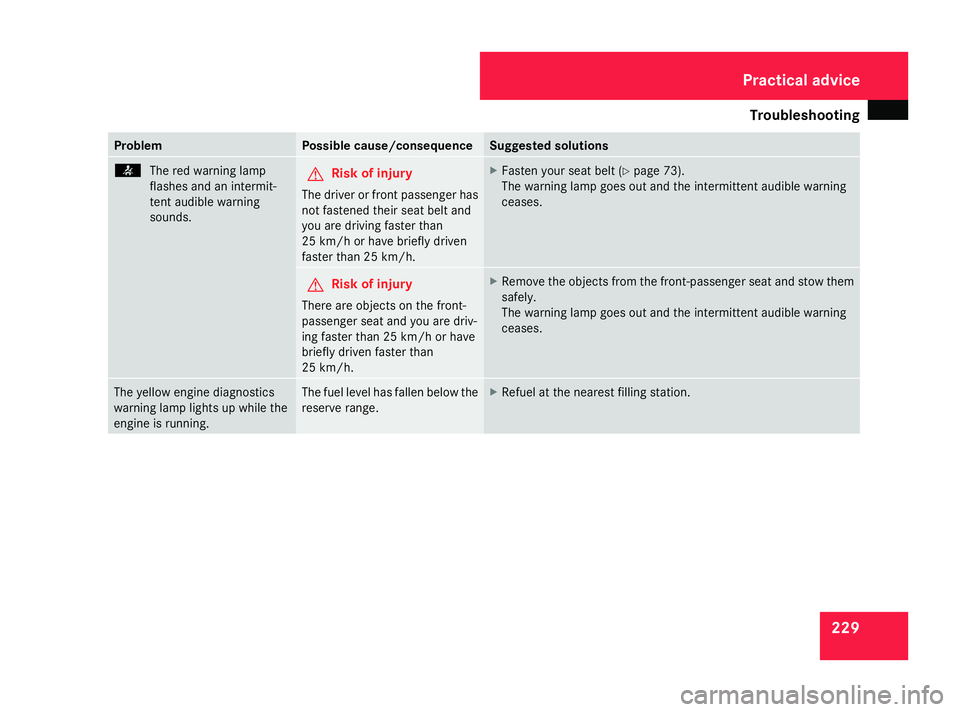
Troubleshooting
229Problem Possible cause/consequence Suggested solutions
<
The red warning lamp
flashes and an intermit-
tent audible warning
sounds. G
Risk of injury
The driver or front passenger has
not fastened their seat belt and
you are driving faster than
25 km/h or have briefly driven
faster than 25 km/h. X
Fasten your seat belt ( Ypage 73).
The warning lamp goes out and the intermittent audible warning
ceases. G
Risk of injury
There are objects on the front-
passenger seat and you are driv-
ing faster than 25 km/h or have
briefly driven faster than
25 km/h. X
Remove the objects from the front-passenger seat and stow them
safely.
The warning lamp goes out and the intermittent audible warning
ceases. The yellow engine diagnostics
warning lamp lights up while the
engine is running. The fuel level has fallen below the
reserve range. X
Refuel at the nearest filling station. Practical advice
169_AKB; 2; 4, en-GB
wdomann
,V ersion: 2.10.6
2008-07-16T08:52:06+02:00 - Seite 229 ZDateiname: 6515_0315_02_buchblock.pdf; preflight
Page 234 of 305
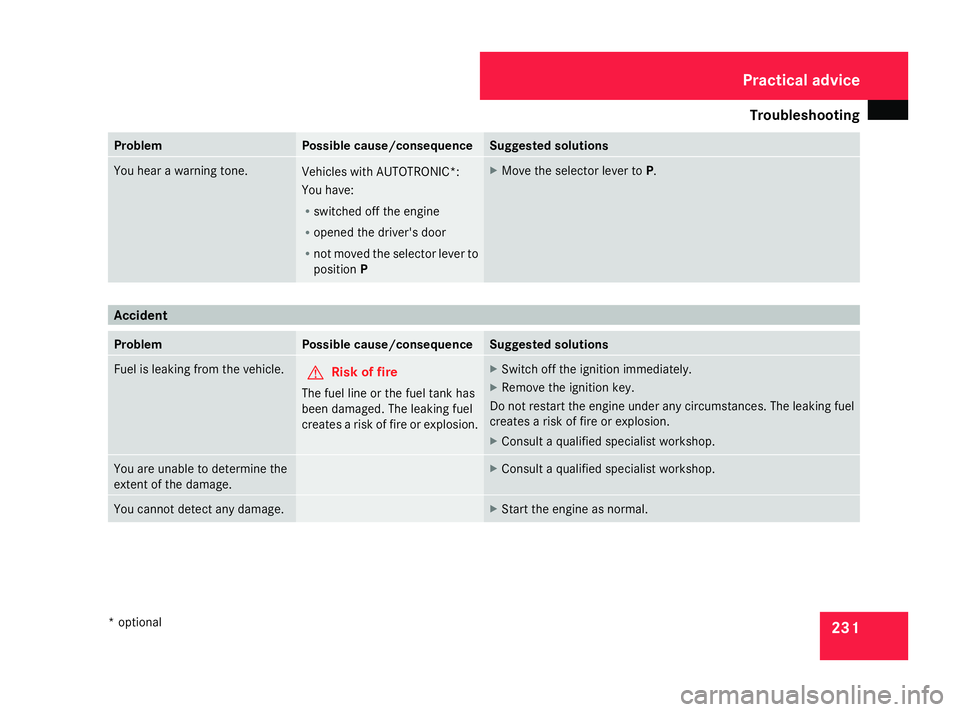
Troubleshooting
231Problem Possible cause/consequence Suggested solutions
You hear a warning tone.
Vehicles with AUTOTRONIC*:
You have:
R
switched off the engine
R opened the driver's door
R not moved the selector lever to
position P X
Move the selector lever to P.Accident
Problem Possible cause/consequence Suggested solutions
Fuel is leaking from the vehicle.
G
Risk of fire
The fuel line or the fuel tank has
been damaged. The leaking fuel
creates a risk of fire or explosion. X
Switch off the ignition immediatel y.
X Remove the ignition key.
Do not restart the engine under any circumstances. The leaking fuel
creates a risk of fire or explosion.
X Consult a qualified specialist workshop. You are unable to determine the
extent of the damage. X
Consult a qualified specialist workshop. You cannot detect any damage. X
Start the engine as normal. Practical advice
* optional
169_AKB; 2; 4, en-GB
wdomann
,V ersion: 2.10.6
2008-07-16T08:52:06+02:00 - Seite 231 ZDateiname: 6515_0315_02_buchblock.pdf; preflight
Page 235 of 305
Troubleshooting
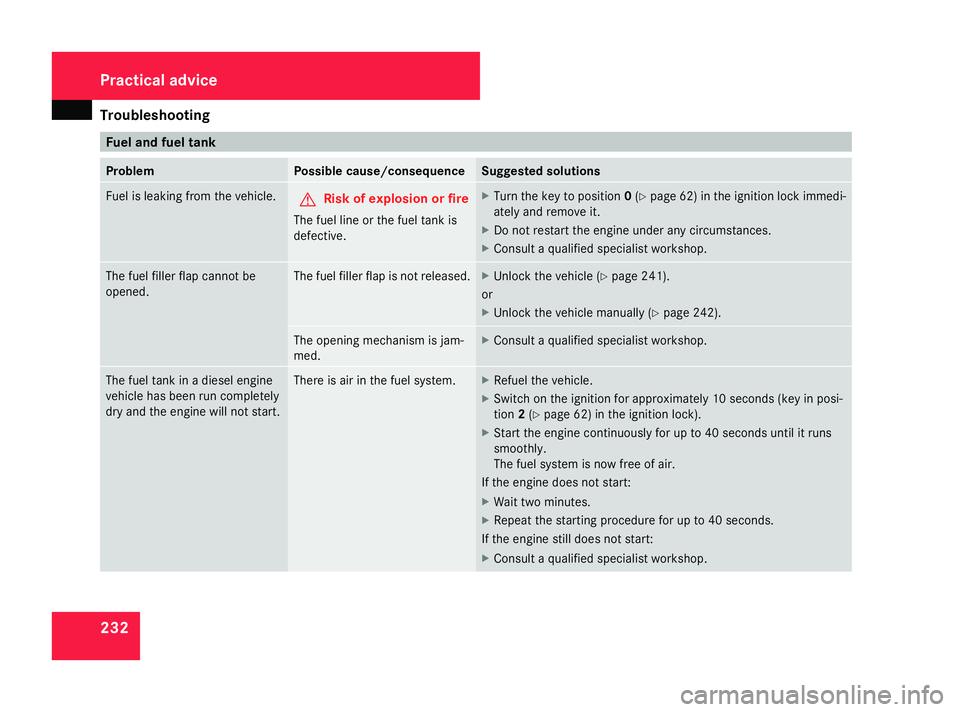
232 Fuel and fuel tank
Problem Possible cause/consequence Suggested solutions
Fuel is leaking from the vehicle.
G
Risk of explosion or fire
The fuel line or the fuel tank is
defective. X
Turn the key to position 0(Y page 62) in the ignition lock immedi-
atel y and remove it.
X Do not restart the engine under any circumstances.
X Consult a qualified specialist workshop. The fuel filler flap cannot be
opened. The fuel filler flap is not released. X
Unlock the vehicle (Y page 241).
or
X Unlock the vehicle manually (Y page 242). The opening mechanism is jam-
med. X
Consult a qualified specialist workshop. The fuel tank in a diesel engine
vehicle has been run completely
dry and the engine will not start. There is air in the fuel system. X
Refuel the vehicle.
X Switch on the ignition for approximately 10 seconds (key in posi-
tion 2(Y page 62) in the ignition lock).
X Start the engine continuously for up to 40 seconds until it runs
smoothly.
The fuel system is now free of air.
If the engine does not start:
X Wait two minutes.
X Repeat the starting procedure for up to 40 seconds.
If the engine still does not start:
X Consult a qualified specialist workshop. Practical advice
169_AKB; 2; 4, en-GB
wdomann
,V ersion: 2.10.6
2008-07-16T08:52:06+02:00 - Seite 232 Dateiname: 6515_0315_02_buchblock.pdf; preflight
Page 236 of 305
Troubleshooting
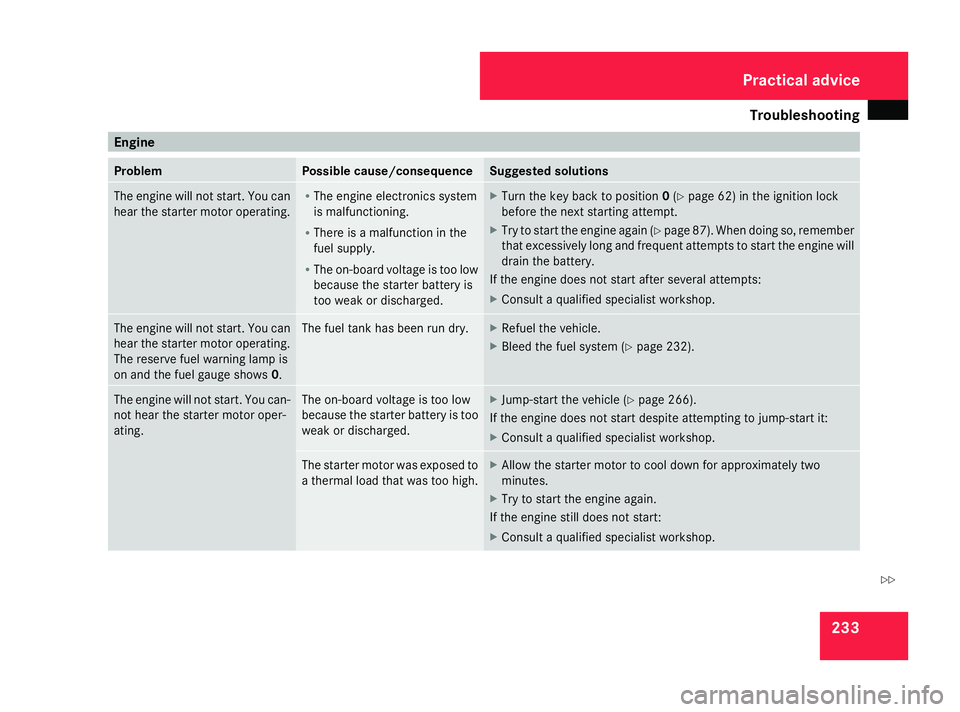
233Engine
Problem Possible cause/consequence Suggested solutions
The engine will not start. You can
hear the starter motor operating. R
The engine electronics system
is malfunctioning.
R There is a malfunction in the
fuel supply.
R The on-board voltage is too low
because the starter batter y is
too weak or discharged. X
Turn the key back to position 0(Y page 62) in the ignition lock
before the next starting attempt.
X Try to start the engine again (Y page 87). When doing so, remember
that excessively long and frequent attempts to start the engine will
drain the battery.
If the engine does not start after several attempts:
X Consult a qualified specialist workshop. The engine will not start. You can
hear the starter motor operating.
The reserve fuel warning lamp is
on and the fuel gauge shows 0. The fuel tank has been run dry. X
Refuel the vehicle.
X Bleed the fuel system (Y page 232).The engine will not start. You can-
not hear the starter motor oper-
ating. The on-board voltage is too low
because the starter battery is too
weak or discharged. X
Jump-start the vehicle (Y page 266).
If the engine does not start despite attempting to jump-start it:
X Consult a qualified specialist workshop. The starter motor was exposed to
a thermal load that was too high. X
Allow the starter motor to cool down for approximately two
minutes.
X Try to start the engine again.
If the engine still does not start:
X Consult a qualified specialist workshop. Practical advice
169_AKB; 2; 4, en-GB
wdomann
,V ersion: 2.10.6
2008-07-16T08:52:06+02:00 - Seite 233 ZDateiname: 6515_0315_02_buchblock.pdf; preflight
Page 237 of 305
Troubleshooting
234 Problem Possible cause/consequence Suggested solutions
Vehicles with a petrol engine:
The engine is not running
smoothly and is misfiring. There is a malfunction in the
engine electronics or a mechani-
cal component of the engine con-
trol unit. X
Onl y depress the accelerator pedal slightly.
X Have the cause rectified immediately at a qualified specialist work-
shop.
Otherwise, non-combusted fuel may get into the catalytic converter
and damage it. A coolant temperature of over
120 °C is displayed. The coolant
warning lamp may also be on and
a warning tone may sound
(Y page 97). The coolant level is too low. The
coolant is too hot and the engine
is no longer being cooled suffi-
ciently. X
Stop as soon as possible and allow the engine and the coolant to
cool down.
X Check the coolant level (Y page 175). Observe the warning notes
as you do so and top up the coolant if necessary. If the coolant level is correct, the
radiator fan may be faulty. The
coolant is too hot and the engine
is no longer being cooled suffi-
ciently. X
If the coolant temperature is less than 120 °C, you can continue
driving to the nearest qualified specialist workshop.
X Avoid heavy loads on the engine as you do so, e.g. driving on
mountain roads and stop/start driving. Practical advice
169_AKB; 2; 4, en-GB
wdomann
,V ersion: 2.10.6
2008-07-16T08:52:06+02:00 - Seite 234 Dateiname: 6515_0315_02_buchblock.pdf; preflight
Page 244 of 305
Locking/unlocking in an emergency
241Locking/unlocking in an emergency
Emergency key
If the vehicle can no longer be locked or
unlocked with the key, use the emergency
key element.
If you use the emergency key element to
unlock and open the driver's door, the anti-
theft alarm system* will be triggered
(Y page 57).
There are several ways to turn off the alarm:
X Press the korj button on the key.
or
X Insert the key into the ignition lock.
If you unlock the vehicle using the emergency
key element, the fuel filler flap will not be
unlocked automatically.
X To unlock the fuel filler flap: insert the
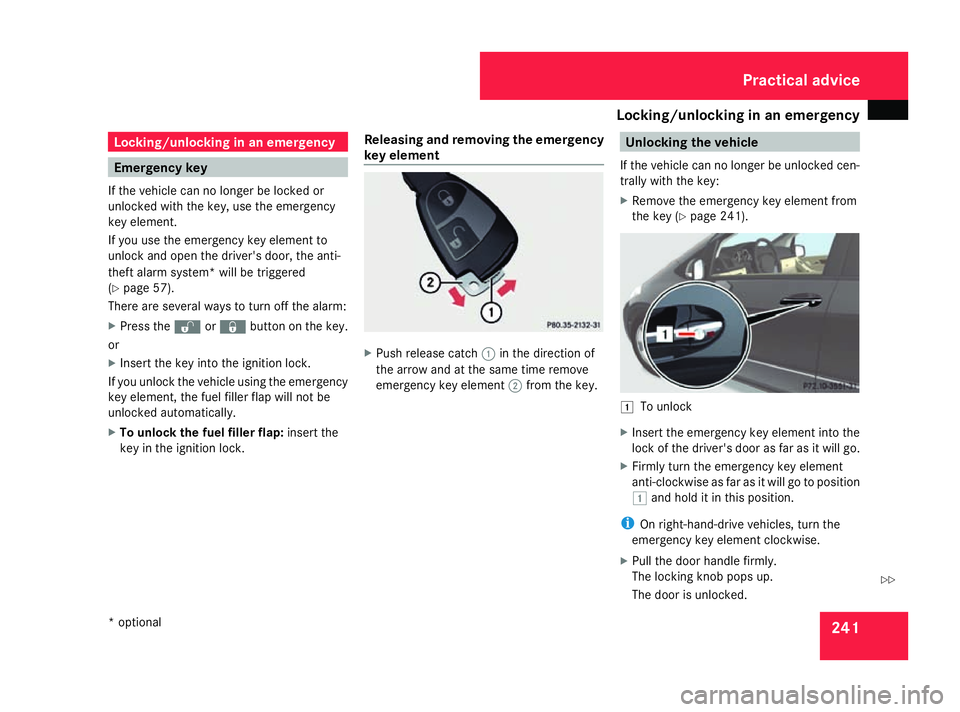
key in the ignition lock. Releasing and removing the emergency
key element X
Push release catch 1in the direction of
the arrow and at the same time remove
emergency key element 2from the key. Unlocking the vehicle
If the vehicle can no longer be unlocked cen-
trally with the key:
X Remove the emergency key element from
the key (Y page 241). $
To unlock
X Insert the emergency key element into the
lock of the driver's door as far as it will go.
X Firmly turn the emergency key element
anti-clockwise as far as it will go to position
$ and hold it in this position.
i On right-hand-drive vehicles, turn the
emergency key element clockwise.
X Pull the door handle firmly.
The locking knob pops up.
The door is unlocked. Practical advice
* optional
169_AKB; 2; 4, en-GB
wdomann, Version: 2.10.6 2008-07-16T08:52:06+02:00 - Seite 241 ZDateiname: 6515_0315_02_buchblock.pdf; preflight
Page 245 of 305
Locking/unlocking in an emergency
242
X
Turn the emergency key element back and
remove it.
X Pull the door handle again. Locking the vehicle
If the vehicle can no longer be locked cen-
trally with the key:
5-door X
Close the front-passenger door, the rear
door on the front-passenger side and the
tailgate.
X Open the driver’s door and the rear door on
the driver’s side.
X Press the locking button on the driver’s
door (Y page 61).
The locking knobs in the front-passenger
door and in the rear doors drop down.
X Press the locking knobs in the front-
passenger and rear doors down manually,
if necessary.
X Close the driver's door from the outside.
X Press down the locking knob in the driver's
door by reaching through the open rear
door. i
Make sure that you have the key with you
and have not left it in the vehicle.
X Close the rear door on the driver’s side.
The vehicle is locked.
3-door X
Close the front-passenger door.
X Open the driver's door and the tailgate.
X Press the locking button on the driver’s
door (Y page 61).
The locking knob in the front-passenger
door moves down.
X Press down the locking knob manually, if
necessary.
X Close the driver's door from the outside.
X Press down the locking knob in the driver's
door by reaching through the open tailgate.
i Make sure that you have the key with you
and have not left it in the vehicle.
X Close the tailgate.
The vehicle is locked. Emergency fuel filler flap release
G
Risk of injury
The corners of the vehicle walls may be
sharp-edged. You could injure yourself
while carrying out an emergency release of
the fuel filler flap. Avoid contact with the
edges of the vehicle walls.
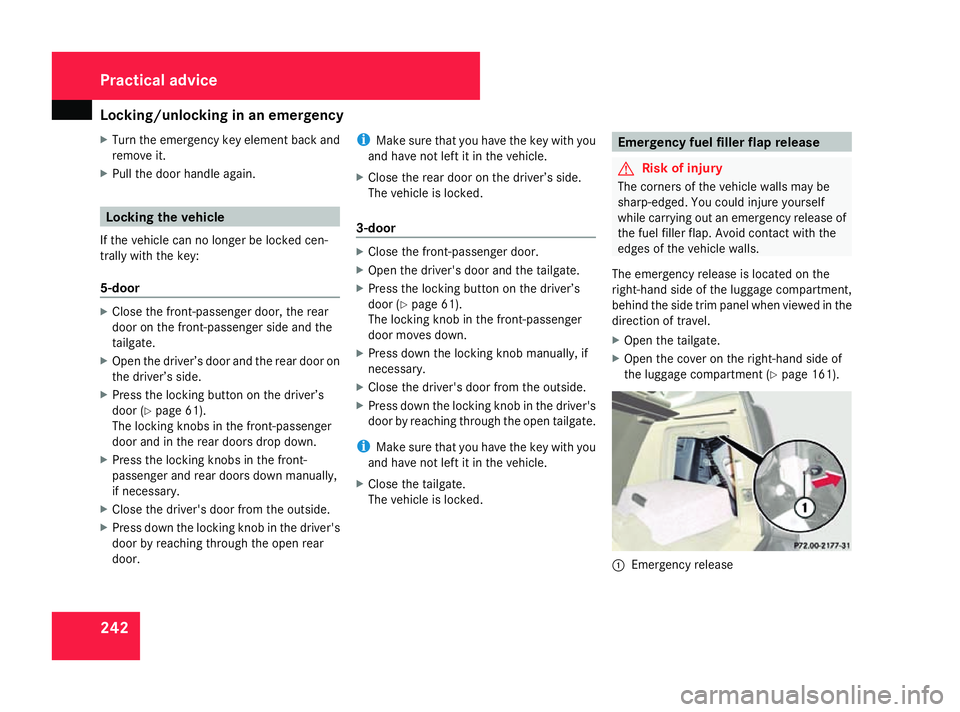
The emergency release is located on the
right-hand side of the luggage compartment,
behind the side trim panel when viewed in the
direction of travel.
X Open the tailgate.
X Open the cover on the right-hand side of
the luggage compartment (Y page 161). 1
Emergency release Practical advice
169_AKB; 2; 4, en-GB
wdomann,
Version: 2.10.6 2008-07-16T08:52:06+02:00 - Seite 242Dateiname: 6515_0315_02_buchblock.pdf; preflight
Page 246 of 305
Locking/unlocking in an emergency
243
X
Pull emergency release 1in the direction
of the arrow.
The fuel filler flap is unlocked.
X Open the fuel filler flap. Releasing the parking lock manually
on vehicles with AUTOTRONIC*
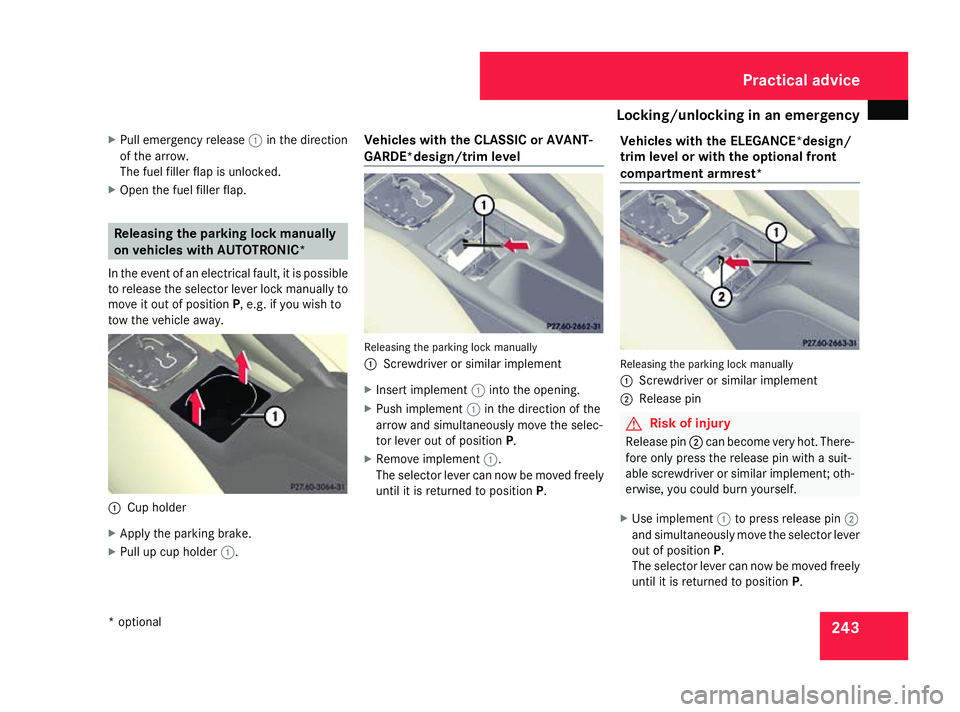
In the event of an electrical fault, it is possible
to release the selector lever lock manually to
move it out of position P, e.g. if you wish to
tow the vehicle away. 1
Cup holder
X Apply the parking brake.
X Pull up cup holder 1. Vehicles with the CLASSIC or AVANT-
GARDE*design/trim level
Releasing the parking lock manually
1
Screwdriver or similar implement
X Insert implement 1into the opening.
X Push implement 1in the direction of the
arrow and simultaneously move the selec-
tor lever out of position P.
X Remove implement 1.
The selector lever can now be moved freely
until it is returned to position P.Vehicles with the ELEGANCE*design/
trim level or with the optional front
compartment armrest* Releasing the parking lock manually
1
Screwdriver or similar implement
2 Release pin G
Risk of injury
Release pin 2can become very hot. There-
fore only press the release pin with a suit-
able screwdriver or similar implement; oth-
erwise, you could burn yourself.
X Use implement 1to press release pin 2
and simultaneously move the selector lever
out of position P.
The selector lever can now be moved freely
until it is returned to position P. Practical advice
* optional
169_AKB; 2; 4, en-GB
wdomann,
Version: 2.10.6 2008-07-16T08:52:06+02:00 - Seite 243 ZDateiname: 6515_0315_02_buchblock.pdf; preflight
Page 259 of 305
Flat tyre
256 ommends that you use a Mercedes-Benz
Service Centre for this purpose. In particu-
lar, work relevant to safety or on safety-
related systems must be carried out at a
qualified specialist workshop.
If a tyre pressure of 1.8 bar is reached:
X Press on/off switch 4on the electric air
pump to 0.
The electric air pump is switched off.
X Disconnect the electric air pump and stow
it away.
X Fold up the warning triangle and stow it
away.
X Pull away immediately.
This distributes the TIREFIT more evenly
around the tyre.
X Stop after driving for approximately ten
minutes and check the tyre pressure with
the electric air pump. G
Risk of accident
If the tyre pressure is now lower than
1.3 bar, the tyre is too badly damaged. Do
not drive any further. Consult a qualified
specialist workshop which has the neces-
sary specialist knowledge and tools to carry
out the work required. Mercedes-Benz rec-
ommends that you use a Mercedes-Benz Service Centre for this purpose. In particu-
lar, work relevant to safety or on safety-
related systems must be carried out at a
qualified specialist workshop.
X If the tyre pressure is still at least 1.3 bar,
correct it (see fuel filler flap for values).
To increase the tyre pressure: switch on
the electric air pump.
To reduce the tyre pressure: open pres-
sure release screw aon pressure
gauge b.
X Drive to the nearest workshop and have the
tyre changed there.
X Have the TIREFIT kit replaced as soon as
possible at a qualified specialist workshop,
e.g. at a Mercedes-Benz Service Centre. G
Risk of accident
Do not exceed the maximum speed of
80 km/h.
The "max. 80 km/h "sticker must be affixed
within the driver's field of vision.
The vehicle's handling characteristics may
be affected. H
Environmental note
Have the used TIREFIT kit disposed of pro-
fessionally, e.g. at a Mercedes-Benz
Service Centre.
X Have the TIREFIT kit replaced every four
years at a qualified specialist workshop,
e.g. a Mercedes-Benz Service Centre.
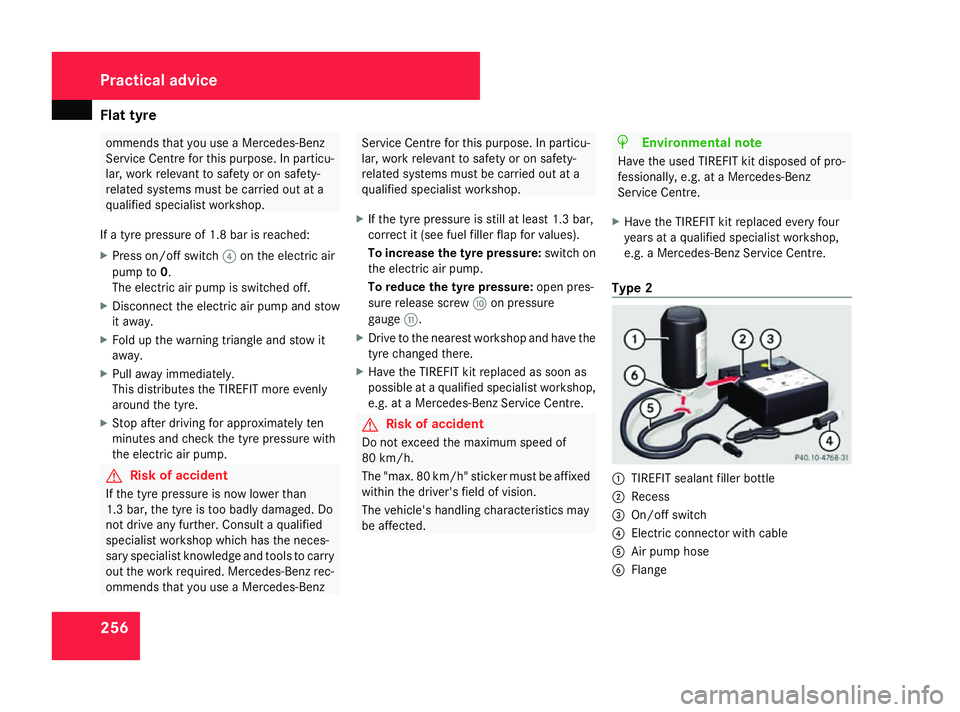
Type 2 1
TIREFIT sealant filler bottle
2 Recess
3 On/off switch
4 Electric connector with cable
5 Air pump hose
6 Flange Practical advice
169_AKB; 2; 4, en-GB
wdomann,
Version: 2.10.6 2008-07-16T08:52:06+02:00 - Seite 256Dateiname: 6515_0315_02_buchblock.pdf; preflight
Page 261 of 305
Flat tyre
258
X
Fold up the warning triangle and stow it
away.
X Pull away immediately.
This distributes the TIREFIT more evenly
around the tyre.
X Stop after driving for approximately ten
minutes and check the tyre pressure with
the electric air pump. G
Risk of accident
If the tyre pressure is now lower than
1.3 bar, the tyre is too badly damaged. Do
not drive any further. Consult a qualified
specialist workshop which has the neces-
sary specialist knowledge and tools to carry
out the work required. Mercedes-Benz rec-
ommends that you use a Mercedes-Benz
Service Centre for this purpose. In particu-
lar, work relevant to safety or on safety-
related systems must be carried out at a
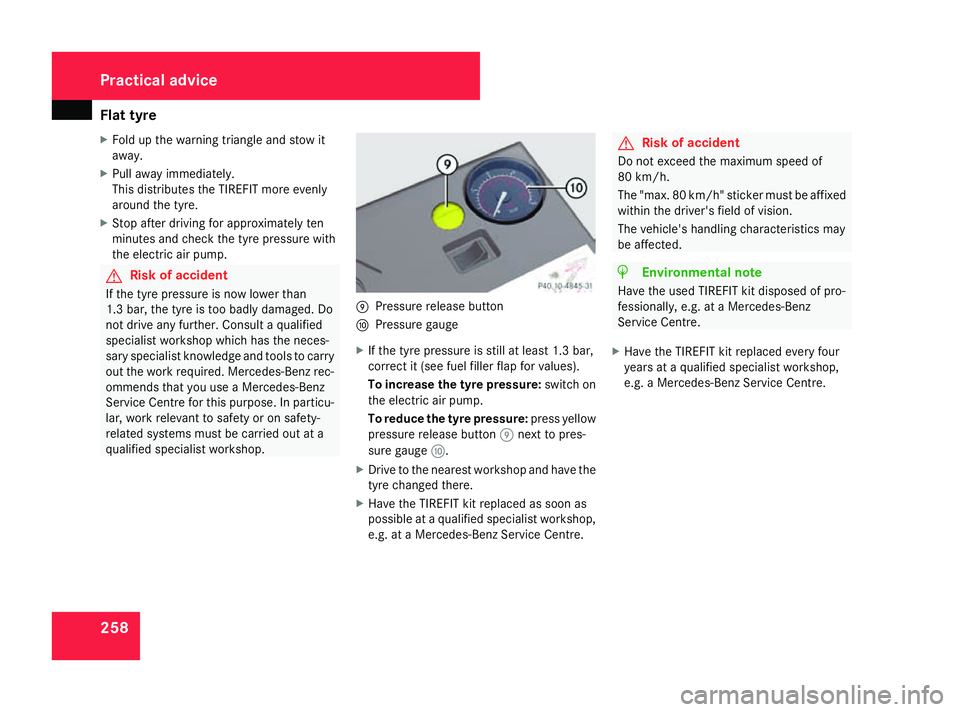
qualified specialist workshop. 9
Pressure release button
a Pressure gauge
X If the tyre pressure is still at least 1.3 bar,
correct it (see fuel filler flap for values).
To increase the tyre pressure: switch on
the electric air pump.
To reduce the tyre pressure: press yellow
pressure release button 9next to pres-
sure gauge a.
X Drive to the nearest workshop and have the
tyre changed there.
X Have the TIREFIT kit replaced as soon as
possible at a qualified specialist workshop,
e.g. at a Mercedes-Benz Service Centre. G
Risk of accident
Do not exceed the maximum speed of
80 km/h.
The "max. 80 km/h "sticker must be affixed
within the driver's field of vision.
The vehicle's handling characteristics may
be affected. H
Environmental note
Have the used TIREFIT kit disposed of pro-
fessionally, e.g. at a Mercedes-Benz
Service Centre.
X Have the TIREFIT kit replaced every four
years at a qualified specialist workshop,
e.g. a Mercedes-Benz Service Centre. Practical advice
169_AKB; 2; 4, en-GB
wdomann,
Version: 2.10.6
2008-07-16T08:52:06+02:00 - Seite 258 Dateiname: 6515_0315_02_buchblock.pdf; preflight