wheel MERCEDES-BENZ A-CLASS HATCHBACK 2012 User Guide
[x] Cancel search | Manufacturer: MERCEDES-BENZ, Model Year: 2012, Model line: A-CLASS HATCHBACK, Model: MERCEDES-BENZ A-CLASS HATCHBACK 2012Pages: 357, PDF Size: 11.61 MB
Page 25 of 357
Do not install accessories such as audio
systems in these areas. Do not carry out
repairs or welding. You could impair the
operating efficiency of the restraint sys-
tems.
Have accessories retrofitted at a qualified
specialist workshop.
If you use parts, tyres and wheels as well as
accessories relevant to safety which have not been approved by Mercedes, the operating
safety of the vehicle could be jeopardised.
This could lead to malfunctions in safety-rel-
evant systems, e.g. the brake system. Only
use genuine Mercedes-Benz parts or parts of
equal quality. Only use tyres, wheels and
accessories that have been specifically
approved for your vehicle.
Mercedes-Benz tests genuine parts and con-
version parts and accessories that have been specifically approved for your vehicle for their
reliability, safety and suitability. Despite
ongoing market research, Mercedes-Benz is
unable to assess other parts. Mercedes-Benz accepts no responsibility for the use of such
parts in Mercedes-Benz vehicles, even if they
have been independently or officially
approved.
In Germany, certain parts are only officially
approved for installation or modification if
they comply with legal requirements. This
also applies to some other countries. All gen- uine Mercedes-Benz parts meet the approval
requirements. The use of non-approved parts
may invalidate the vehicle's general operating
permit.
This is the case:
R if they cause a change of the vehicle type
from that for which the vehicle's general
operating permit was granted
R if other road users could be endangered
R if the emission or noise levels are adversely
affected
Always specify the vehicle identification num-
ber (VIN) (Y page 338) and the engine num-
ber (Y page 338) when ordering genuine
Mercedes-Benz parts. Owner's Manual
General notes
Before you first drive off, read this Owner's
Manual carefully and familiarise yourself with
your vehicle.
For your own safety and a longer vehicle life,
follow the instructions and warning notices in this manual. Disregarding them may lead to
damage to the vehicle or personal injury. Vehicle equipment
This Owner's Manual describes all models
and all standard and optional equipment
available for your vehicle at the time of pub-
lication of the Owner's Manual. Country-spe-
cific differences are possible. Note that your
vehicle may not be fitted with all features
described. This is also the case for systems
and functions relevant to safety. Therefore,
the equipment on your vehicle may differ from
that in the descriptions and illustrations.
The original purchase contract documenta-
tion for your vehicle contains a list of all of the systems in your vehicle.
Should you have any questions concerning
equipment and operation, please consult a
Mercedes-Benz Service Centre.
The Owner's Manual and Service Booklet are
important documents and should kept in the
vehicle. Operating safety
Important safety notes
G
WARNING
If you do not have the prescribed service/
maintenance work or necessary repairs car-
ried out, this could result in malfunctions or
system failures. There is a risk of an accident.
Always have the prescribed service/mainte-
nance work as well as necessary repairs car-
ried out at a qualified specialist workshop. 22
Introduction
Page 26 of 357

G
WARNING
If you switch off the ignition while driving,
safety-relevant functions are only available
with limitations, or not at all. This could affect, for example, the power steering and the brake
boosting effect. You will require considerably
more effort to steer and brake. There is a risk of an accident.
Do not switch off the ignition while driving. G
WARNING
Modifications to electronic components, their software as well as wiring could effect their
function and/or the operation of other net-
worked components. This could in particular
also be the case for systems relevant to
safety. They might not function properly any
more and/or jeopardise the operational
safety of the vehicle. There is an increased
risk of an accident and injury.
Do not attempt to modify the wiring as well as
electronic components or their software.
Always have work on electrical and electronic components carried out at a qualified special-
ist workshop.
There is a risk of damage to the vehicle if:
R the vehicle becomes stuck, e.g. on a high
kerb or an unpaved road
R you drive too fast over an obstacle, e.g. a
kerb or a hole in the road
R a heavy object strikes the undercarriage or
parts of the chassis.
In situations like this, the body, the undercar- riage, chassis parts, wheels or tyres could be
damaged without the damage being visible.
Components damaged in this way can unex-
pectedly fail or, in the case of an accident, no
longer withstand the strain they are designed
to.
If the underbody panelling is damaged, com-
bustible materials such as leaves, grass or
twigs can gather between the underbody and the underbody panelling. If these materials
come in contact with hot parts of the exhaust system for an extended period, they can
catch fire.
Have the vehicle checked and repaired imme-
diately at a qualified specialist workshop. If on
continuing your journey you notice that driv-
ing safety is impaired, pull over and stop the
vehicle immediately, paying attention to road and traffic conditions. In such cases, visit a
qualified specialist workshop. Declarations of conformity
Wireless vehicle components The following information applies to all com-
ponents of the vehicle and the COMAND sys-
tem which receive and/or transmit radio
waves:
The components of this vehicle which receive
and/or transmit radio waves are compliant
with the basic requirements and other rele-
vant provisions of Directive 1999/5/EC. You can obtain further information from any
Mercedes-Benz Service Centre.
Electromagnetic compatibility The electromagnetic compatibility of the vehi-
cle components has been checked and certi-
fied according to the currently valid version of Directive 72/245/EE Cor the equivalent ECE
Regulation ECE-R 10. Diagnostics connection
The diagnostics connection is only intended
for the connection of diagnostic equipment at
a qualified specialist workshop. G
WARNING
If you connect equipment to a diagnostics
connection in the vehicle, it can affect the
operation of the vehicle systems. This may
affect the operating safety of the vehicle.
There is a risk of an accident.
Do not connect any equipment to a diagnos-
tics connection in the vehicle. Introduction
23 Z
Page 28 of 357
Data stored in the vehicle
A number of electronic components in your
vehicle contain data memories.
These data memories temporarily or perma-
nently store technical information about:
R the vehicle's operating state
R events
R faults
This technical information generally docu-
ments the condition of a component, a mod-
ule, a system or an environment.
These are, for example:
R operating conditions of system compo-
nents. This includes, e.g. fluid levels.
R status messages from the vehicle and from
individual vehicle components. This
includes, e.g. number of wheel revolu-
tions/speed, deceleration, lateral acceler-
ation.
R malfunctions and faults in important sys-
tem components. This includes, e.g. lights,
brakes.
R reactions of the vehicle in special driving
situations. This includes, e.g. deployment
of an airbag, intervention of stability control
systems.
R environmental conditions. This includes,
e.g. the outside temperature.
This data is exclusively technical in nature
and is used to:
R assist in the detection and rectification of
faults and defects
R optimise vehicle functions
The data cannot be used to trace the vehicle's movements over distances travelled.
When your vehicle is serviced, this technical
information can be read out from the event
and fault memory.
Services include:
R repairs
R service processes R
warranty claims
R quality assurance
The information is read out by authorised
employees of the service network (including
manufacturers) using special diagnostic devi-
ces. You can find more information there if
necessary.
After a fault has been rectified, the informa-
tion in the fault memory is deleted or consec- utively overwritten.
In normal vehicle operation, situations may
arise in which this technical data could
become personal in nature in conjunction
with other information and, if necessary, on
consultation of an approval official.
Examples include:
R accident reports
R vehicle damage
R witness testimonies
Further additional features which are con-
tractually agreed with the customer likewise
allow specific vehicle data to be obtained
from the vehicle. Such additional features
include vehicle locating in an emergency, for
example. Copyright information
General notes
You can find information on licences for free
and open-source software used in your vehi-
cle and its electronic components on the fol- lowing website:
http://www.mercedes-benz.com/
opensource Int
roduction
25 Z
Page 30 of 357

Cockpit
................................................. 28
Instrument cluster ..............................30
Multifunction steering wheel .............33
Centre console .................................... 34
Overhead control panel ......................36
Door control panel .............................. 37 27At a glance
Page 31 of 357

Cockpit
Function Page
:
Steering wheel gearshift
paddles
156
;
Combination switch 107
=
Instrument cluster 30
?
Horn
A
DIRECT SELECT lever 151
B
PARKTRONIC warning dis-
play
182
C
Overhead control panel 36
D
Climate control systems 122 Function Page
E
Ignition lock 143
F
Adjusting the steering
wheel
98
G
Cruise control lever 169
H
Electric parking brake 163
I
Light switch 105
J
Diagnostics connection 23
K
Opening the bonnet 28528
CockpitAt a glance
Page 32 of 357

Function Page
:
Overhead control panel 36
;
PARKTRONIC warning dis-
play 182
=
Combination switch 107
?
Instrument cluster 30
A
Horn
B
DIRECT SELECT lever 151
C
Steering wheel gearshift
paddles
156
D
Light switch 105 Function Page
E
Electric parking brake 163
F
Opening the bonnet 285
G
Diagnostics connection 23
H
Ignition lock 143
I
Adjusting the steering
wheel
98
J
Cruise control lever 169
K
Climate control systems 122Cockpit
29At a glance
Page 36 of 357

Multifunction steering wheel
Function Page
:
Multifunction display 210
;
Audio/COMAND display;
see the separate operating
instructions = ?
Switches on LINGUA-
TRONIC; see the separate
operating instructions ? ~
Rejects or ends a call 215
Exits telephone book/
redial memory
6
Makes or accepts a call
Switches to the redial mem-
ory WX
Adjusts the volume
8
Mute Function Page
A =;
Selects a menu 209
9:
Selects a submenu or
scrolls through lists
209
a
Confirms the selection 209
Hiding display messages 229
B %
Back 209
Switches off LINGUA-
TRONIC; see the separate
operating instructionsMultifunction steering wheel
33At a glance
Page 43 of 357
Useful information
i This Owner's Manual describes all mod-
els, series and optional equipment for your
vehicle that were available at the time of
going to press. National variations are pos- sible. Note that your vehicle may not be
equipped with all of the functions descri-
bed. This is also the case for systems and
functions relevant to safety.
i Read the information on qualified special-
ist workshops: (Y page 24). Occupant safety
Important safety notes
G
WARNING
If service work is not carried out correctly, the operating safety of your vehicle may be affec-
ted. This could cause you to lose control of
your vehicle and cause an accident. More-
over, the safety systems may no longer be
able to protect you or others as they are
designed to do.
Always have service work carried out at a
qualified specialist workshop. G
WARNING
Modifications to or work performed incor-
rectly on the following parts can result in the
restraint systems not functioning as intended:
R the restraint system, consisting of seat
belts and their anchorage points, belt ten-
sioners, belt force limiters and airbags
R the wiring
R networked electronic systems
Airbags and belt tensioners could fail to
deploy or be triggered in an accident despite
the deceleration force being sufficient to trig-
ger the systems, or could be triggered unin-
tentionally. For this reason, never make any
modifications to the restraint systems.
Therefore, you must not tamper with elec-
tronic components or their software. The seat belts, together with SRS (Supple-
mental Restraint System), are complemen-
tary, co-ordinated restraint systems
(Y
page 41). They reduce the risk of injury in
specific, pre-defined types of accident situa-
tions and thereby increase occupant safety.
However, seat belts and airbags generally do
not protect against objects penetrating the
vehicle from the outside.
To ensure that the restraint systems can
deliver their full potential protection, make
sure that:
R the seat and head restraint are adjusted
properly (Y page 92)
R the seat belt has been fastened properly
(Y page 46)
R the airbags can inflate unrestricted if
deployed (Y page 42)
R the steering wheel is adjusted properly
(Y page 98)
R the restraint systems have not been modi-
fied
An airbag increases the protection of vehicle
occupants wearing a seat belt. However, air-
bags are only an additional restraint system
which complements, but does not replace,
the seat belt. All vehicle occupants must wear their seat belt correctly at all times, even if thevehicle is equipped with airbags. The airbags
are not deployed in all types of accidents. For example, if the protective capacity of cor-
rectly fastened seat belts is not increased by
deploying the airbags, the airbags will not
deploy.
Airbag deployment only provides increased
protection if the seat belt is worn correctly.
The seat belt helps, firstly, to keep the vehicle
occupant in the best position in relation to the airbag. Secondly, in a head-on collision, for
example, the seat belt prevents the vehicle
occupant from being propelled towards the
point of impact. 40
Occupant safetySafety
Page 46 of 357

R
do not lean forwards, e.g. over the cover of
the driver's/front-passenger front airbag,
particularly when the vehicle is in motion.
R do not put your feet on the dashboard.
R only hold the steering wheel on the outside.
This allows the airbag to be fully deployed.
You could be injured if the airbag is
deployed and you are holding the inside of
the steering wheel.
R do not lean on the doors from inside the
vehicle.
R make sure that there are no people, ani-
mals or objects between the vehicle occu-
pants and the area where the airbags are
deployed.
R do not place any objects between the seat
backrest and the door.
R do not hang any hard objects, e.g. coat
hangers, on the grab handles or coat hooks.
R do not attach accessories, e.g. cup holders,
to the doors.
It is not possible to rule out a risk of injury
being caused by an airbag, due to the high
speed at which the airbag must be deployed. G
WARNING
Airbag functionality can only be assured if the following parts are not covered and no badgesor stickers are attached to them:
R padded steering wheel boss
R kneebag cover below the steering column
R front-passenger airbag cover
R outer side of front seat bolsters
R side trim next to the rear seat backrest
R roof frame cover between the front A-pillar
and the C-pillar in the rear compartment G
WARNING
When an airbag deploys, a small amount of
powder is released. The powder may cause
short-term breathing difficulties to persons
suffering from asthma or other pulmonary
conditions. In order to prevent potential breathing diffi-
culties, you should leave the vehicle as soon
as it is safe to do so. You can also open the
window to allow fresh air to enter the vehicle
interior. The powder does not constitute a
health hazard and does not indicate that there
is a fire in the vehicle. G
WARNING
The airbag parts are hot after the airbag has
been deployed. Do not touch them as you
could burn yourself.
Have the airbags replaced at a qualified spe-
cialist workshop. Otherwise, occupants are
not protected by the airbags in the event of
another accident.
Airbag deployment slows down and restricts
the movement of the vehicle occupant.
If the airbags are deployed, you will hear a
bang and a small amount of powder may also
be released. Only in rare cases will the bang
affect your hearing. The powder that is
released generally does not constitute a
health hazard. The 6SRS warning lamp
lights up.
The airbag installation locations are identified
by the AIRBAG symbol.
Front airbags !
Do not place heavy objects on the front-
passenger seat. The system may then
detect that the seat is occupied and if there
is an accident, the restraint systems on the front-passenger side could be deployed.
Have restraint systems that have been trig-
gered replaced. Occupant safety
43Safety Z
Page 47 of 357
Driver's airbag
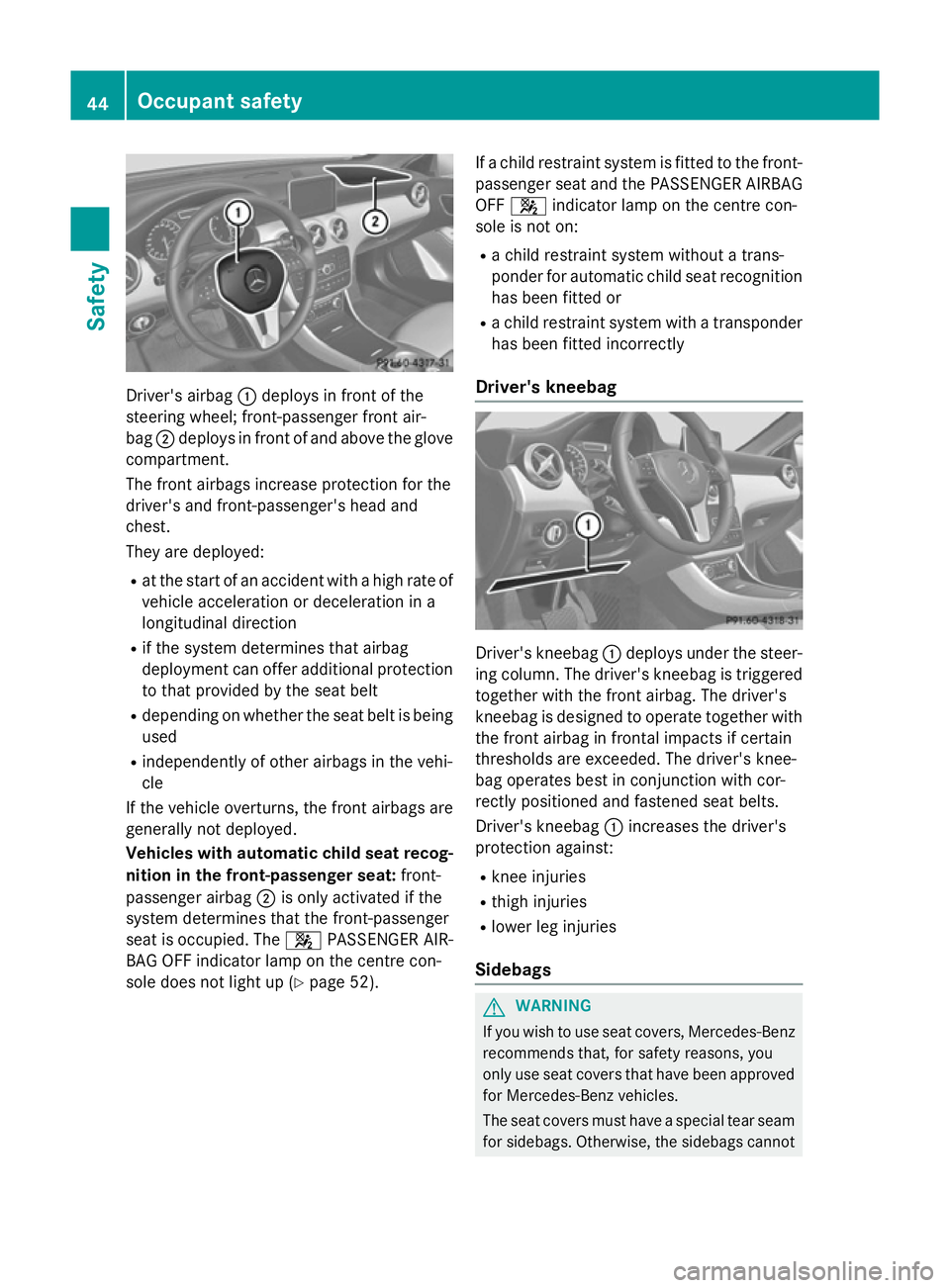
:deploys in front of the
steering wheel; front-passenger front air-
bag ;deploys in front of and above the glove
compartment.
The front airbags increase protection for the
driver's and front-passenger's head and
chest.
They are deployed:
R at the start of an accident with a high rate of
vehicle acceleration or deceleration in a
longitudinal direction
R if the system determines that airbag
deployment can offer additional protection to that provided by the seat belt
R depending on whether the seat belt is being
used
R independently of other airbags in the vehi-
cle
If the vehicle overturns, the front airbags are
generally not deployed.
Vehicles with automatic child seat recog-
nition in the front-passenger seat: front-
passenger airbag ;is only activated if the
system determines that the front-passenger
seat is occupied. The 4PASSENGER AIR-
BAG OFF indicator lamp on the centre con-
sole does not light up (Y page 52).If a child restraint system is fitted to the front-
passenger seat and the PASSENGER AIRBAG
OFF 4 indicator lamp on the centre con-
sole is not on:
R a child restraint system without a trans-
ponder for automatic child seat recognition
has been fitted or
R a child restraint system with a transponder
has been fitted incorrectly
Driver's kneebag Driver's kneebag
:deploys under the steer-
ing column. The driver's kneebag is triggered
together with the front airbag. The driver's
kneebag is designed to operate together with the front airbag in frontal impacts if certain
thresholds are exceeded. The driver's knee-
bag operates best in conjunction with cor-
rectly positioned and fastened seat belts.
Driver's kneebag :increases the driver's
protection against:
R knee injuries
R thigh injuries
R lower leg injuries
Sidebags G
WARNING
If you wish to use seat covers, Mercedes-Benz recommends that, for safety reasons, you
only use seat covers that have been approved for Mercedes-Benz vehicles.
The seat covers must have a special tear seam
for sidebags. Otherwise, the sidebags cannot 44
Occupant safetySafety