tow MERCEDES-BENZ A-CLASS HATCHBACK 2015 User Guide
[x] Cancel search | Manufacturer: MERCEDES-BENZ, Model Year: 2015, Model line: A-CLASS HATCHBACK, Model: MERCEDES-BENZ A-CLASS HATCHBACK 2015Pages: 417, PDF Size: 11.91 MB
Page 21 of 417
Selecting ........................................ 195
Storing the current speed .............. 195
Variabl e......................................... 195
SPEEDTRONIC (variable)
Storing the current speed and
calling up the last stored speed ..... 195
SPORT handling mode
Deactivating/activating
(Mercedes-AMG vehicles) ................ 75
Warning lamp ................................. 298
Start-off assist
Activating ....................................... 206
Important safety notes .................. 206
Start/Stop button
Removing ....................................... 159
Starting the engine ........................ 160
Start/stop function
see ECO start/stop function
Starting (engine) ................................ 159
STEER CONTROL .................................. 77
Steering
Display message ............................ 290
Steering assistant STEER CON-
TROL
see STEER CONTROL
Steering wheel
Adjusting (manually) ...................... 112
Button overview ............................... 32
Buttons (on-board computer) ......... 239
Cleaning ......................................... 334
Gearshift paddle s........................... 177
Important safety notes .................. 112
Steering wheel gearshift paddles .... 177
Stopwatch (RACETIMER) ................... 254
Stowage compartment
Map pockets .................................. 309
Stowage compartments
Armrest (front) ............................... 308
Armrest (under) ............................. 308
Centre console .............................. 307
Centre console (rear) ..................... 309
Cup holde r..................................... 313
Glove compartment ....................... 307
Important safety information ......... 307
Spectacles compartment ............... 307
Under driver's seat/front-
passenger sea t.............................. 308 Stowage net
....................................... 309
Stowage space
Stowage net ................................... 309
Summer tyres .................................... 360
Sun visor ............................................ 315
Suspension
Adaptive Damping System ............. 208
Suspension settings
AMG RIDE CONTROL sports sus-
pension .......................................... 207 T
Tail lamps see Lights
Tailgate
Display message ............................ 288
Emergency unlocking ....................... 93
Important safety notes .................... 92
Opening dimensions ...................... 404
Opening/closing (from outside) ....... 93
Tank
see Fuel tank
Technical data
Capacities ...................................... 396
Emergency spare wheel ................. 392
Information .................................... 394
Trailer load s................................... 406
Tyres/wheels ................................. 372
Vehicle data ................................... 404
Telephone
Accepting a call (multifunction
steering wheel) .............................. 247
Display message ............................ 290
Introduction ................................... 246
Menu (on-board computer) ............ 246
Number from the phone book ........ 247
Redialling ....................................... 247
Rejecting/ending a call ................. 247
Telephone compartment ................ 308
Temperature
Coolant .......................................... 239
Coolant (on-board computer,
Mercedes-AMG vehicles) ............... 254
Engine oil (on-board computer,
Mercedes-AMG vehicles) ............... 254
Outside temperature ...................... 239
Setting (climate control )................ 142 18
Index
Page 22 of 417
Transmission oil (on-board com-
puter, Mercedes-AMG vehicles) ..... 254
TEMPOMAT
Function/notes ............................. 191
Through-loading ................................ 309
Timing (RACETIMER) .........................254
TIREFIT kit .......................................... 341
Tyre pressure not reached ............. 343
Tyre pressure reached ................... 343
Top Tether ............................................ 60
Total distance recorder .................... 242
Tow-away protection
Activating ......................................... 78
Deactivating ..................................... 79
Function .......................................... .78
Tow-starting
Emergency engine starting ............ 354
Fitting the towing eye .................... 352
Important safety notes .................. 350
Removing the towing eye ............... 352
Towing
Important safety notes .................. 350
Notes for 4MATIC vehicles ............ 354
Transporting the vehicle ................ 353
Towing a trailer
Active Parking Assist ..................... 212
Axle load, permissibl e.................... 406
ESP ®
(Electronic Stability Pro-
gram) ............................................... 76
Failure check for LEDs ................... 234
General notes ................................ 231
Pulling away with a traile r.............. 161
Trailer tow hitch display message .. 289
Towing away
Fitting the towing ey e.................... 352
Removing the towing eye ............... 352
With both axles on the ground ....... 353
With front axle raised ..................... 352
Towing eye ......................................... 339
Traffic Sign Assist
Activating ....................................... 224
Activating/deactivating the warn- ing function .................................... 248
Display message ............................ 280
Function/note s............................. 223
Important safety notes .................. 224
Instrument cluster display ............. 224 Trailer coupling
see Towing a trailer
Trailer towing
7-pin connecto r............................. 234
Blind Spot Assist ............................ 228
Cleaning the trailer tow hitch ......... 333
Coupling up a traile r...................... 233
Decoupling a trailer ....................... 233
Driving tips .................................... 231
Folding in the ball coupling ............ 233
Folding out the ball coupling .......... 232
Important safety notes .................. 229
Lights display message .................. 271
Mounting dimensions .................... 405
Power supply ................................. 234
Trailer load s................................... 406
Transmission
see Automatic transmission
see Manual transmission
Transmission position display
(DIRECT SELECT lever) ...................... 170
Transporting the vehicle .................. 353
Trim pieces (cleaning instruc-
tions) .................................................. 335
Trip computer (on-board com-
puter) .................................................. 242
Trip meter
Calling up ....................................... 242
Resetting (on-board computer) ...... 243
Turn signals
Changing bulbs (front) ................... 128
Changing bulbs (rear) .................... 128
Switching on/of f........................... 122
TV
Operating (on-board computer) ..... 246
see Separate operating instructions
Two-way radio
Frequencies ................................... 394
Installation ..................................... 394
Transmission output (maximum) .... 394
Type identification plate
see Vehicle identification plate
Tyre pressure
Calling up (on-board computer) ..... 364
Display message ............................ 283
Not reached (TIREFIT) .................... 343
Reached (TIREFIT) .......................... 343
Recommended ............................... 362 Index
19
Page 27 of 417
Diagnostics connection
The diagnostics connection is only intended
for the connection of diagnostic equipment at
a qualified specialist workshop. G
WARNING
If you connect equipment to a diagnostics
connection in the vehicle, it can affect the
operation of the vehicle systems. This may
affect the operating safety of the vehicle.
There is a risk of an accident.
Do not connect any equipment to a diagnos-
tics connection in the vehicle. G
WARNING
Objects in the driver's footwell may restrict
the clearance around the pedals or block a
depressed pedal. This jeopardises the oper-
ating and road safety of the vehicle. There is a risk of an accident.
Stow all objects securely in the vehicle so that
they do not get into the driver's footwell.
Always fit the floormats securely and as pre-
scribed in order to ensure that there is always sufficient room for the pedals. Do not use
loose floormats and do not place several floor-mats on top of one another.
! If the engine is switched off and equip-
ment on the diagnostics connection is
used, the starter battery may discharge.
Connecting equipment to the diagnostics
connection can lead to emissions monitoring information being reset, for example. This
may lead to the vehicle failing to meet the
requirements of the next emissions test dur-
ing the main inspection. Qualified specialist workshop
A qualified specialist workshop has the nec-
essary special skills, tools and qualifications
to correctly carry out any necessary work on
your vehicle. This particularly applies to work
relevant to safety.
Observe the notes in the Service Booklet. Always have the following work carried out at
a qualified specialist workshop:
R work relevant to safety
R service and maintenance work
R repair work
R modifications, installations and conver-
sions
R work on electronic components
Mercedes-Benz recommends that you use a
Mercedes-Benz Service Centre. Vehicle registration
Mercedes-Benz may ask its Service Centres
to carry out technical inspections on certain
vehicles. The quality or safety of the vehicle is
improved as a result of the inspection.
Mercedes-Benz can only inform you about
vehicle checks if it has your registration data. It is possible that your vehicle has not yet
been registered in your name in the following
cases:
R if your vehicle was not purchased at an
authorised specialist dealer.
R if your vehicle has not yet been examined at
a Mercedes-Benz Service Centre.
It is advisable to register your vehicle with a
Mercedes-Benz Service Centre.
Inform Mercedes-Benz as soon as possible
about any change in address or vehicle own-
ership. You can do this at a Mercedes-Benz
Service Centre, for example. Correct use
If you remove any warning stickers, you or
others could fail to recognise certain dangers.
Leave warning stickers in position.
Observe the following information when driv- ing your vehicle:
R the safety notes in this manual
R the vehicle technical data 24
Int
roduction
Page 38 of 417
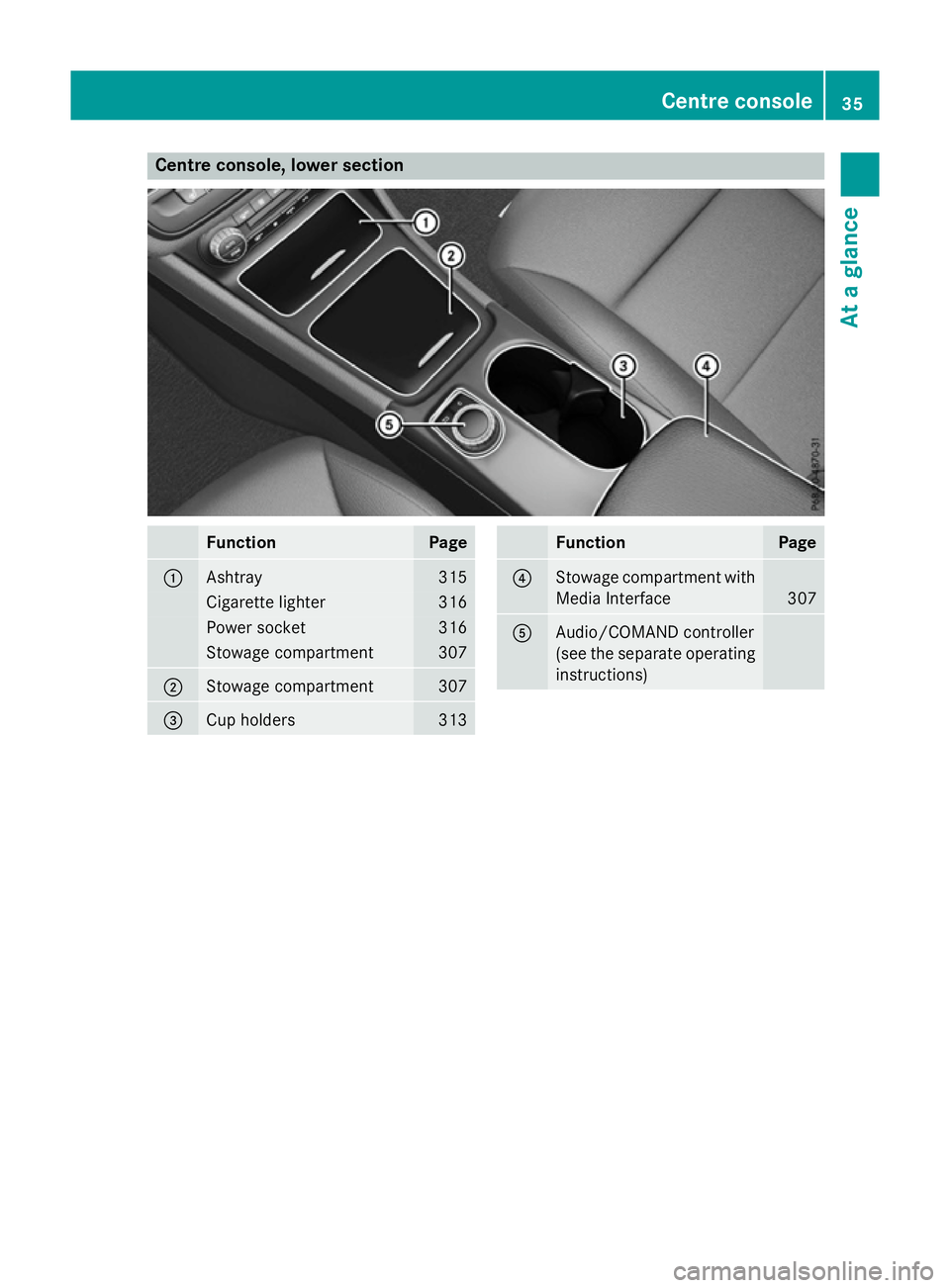
Centre console, lower section
Function Page
:
Ashtray 315
Cigarette lighter 316
Power socket 316
Stowage compartment 307
;
Stowage compartment 307
=
Cup holders 313 Function Page
?
Stowage compartment with
Media Interface 307
A
Audio/COMAND controller
(see the separate operating
instructions) Centre console
35At a glance
Page 39 of 417
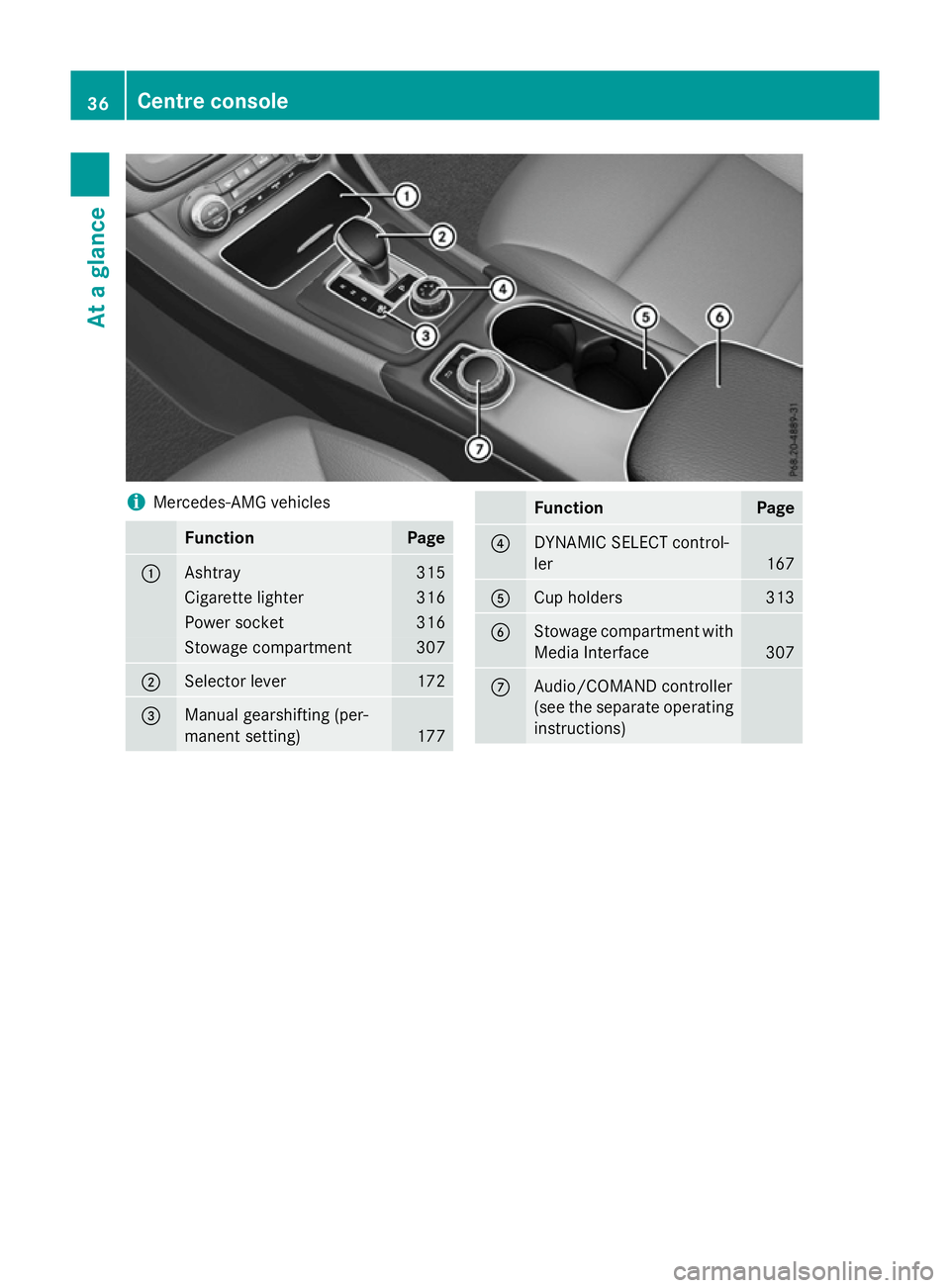
i
Mercedes-AMG vehicles Function Page
:
Ashtray 315
Cigarette lighter 316
Power socket 316
Stowage compartment 307
;
Selector lever 172
=
Manual gearshifting (per-
manent setting)
177 Function Page
?
DYNAMIC SELECT control-
ler 167
A
Cup holders 313
B
Stowage compartment with
Media Interface 307
C
Audio/COMAND controller
(see the separate operating
instructions) 36
Centre consoleAt a glance
Page 41 of 417
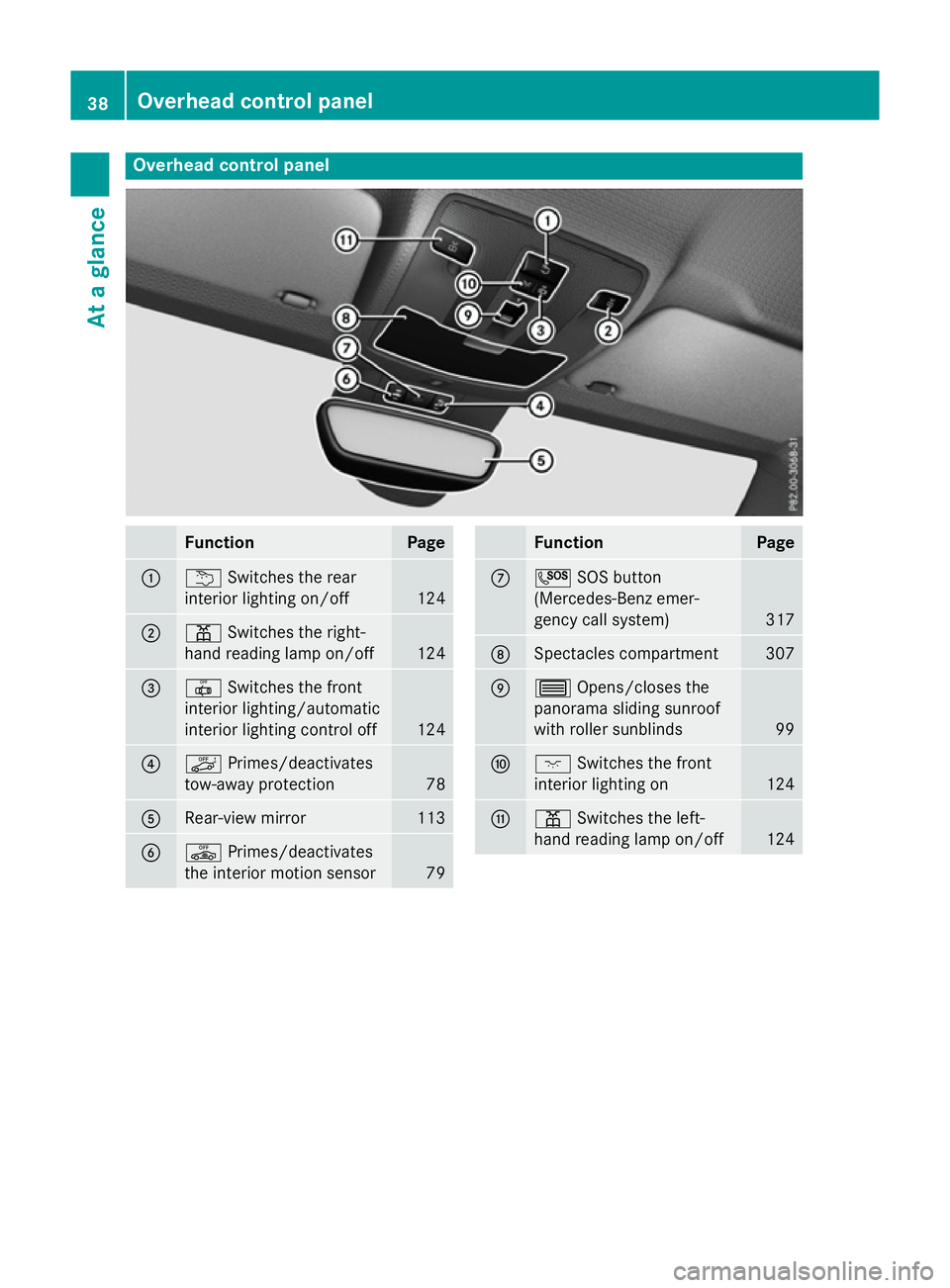
Overhead control panel
Function Page
:
u
Switches the rear
interior lighting on/off 124
;
p
Switches the right-
hand reading lamp on/off 124
=
|
Switches the front
interior lighting/automatic
interior lighting control off 124
?
ë
Primes/deactivates
tow-away protection 78
A
Rear-view mirror 113
B
ê
Primes/deactivates
the interior motion sensor 79 Function Page
C
G
SOS button
(Mercedes-Benz emer-
gency call system) 317
D
Spectacles compartment 307
E
3
Opens/closes the
panorama sliding sunroof
with roller sunblinds 99
F
c
Switches the front
interior lighting on 124
G
p
Switches the left-
hand reading lamp on/off 12438
Overhead control panelAt a glance
Page 48 of 417
automatically; see "Belt adjustment"
(Y
page 45).
X If necessary, pull upwards on the shoulder
section of the seat belt to tighten the belt
across your body. The shoulder section of the seat belt must
always be routed across the centre of the
shoulder. Adjust the belt outlet if necessary.
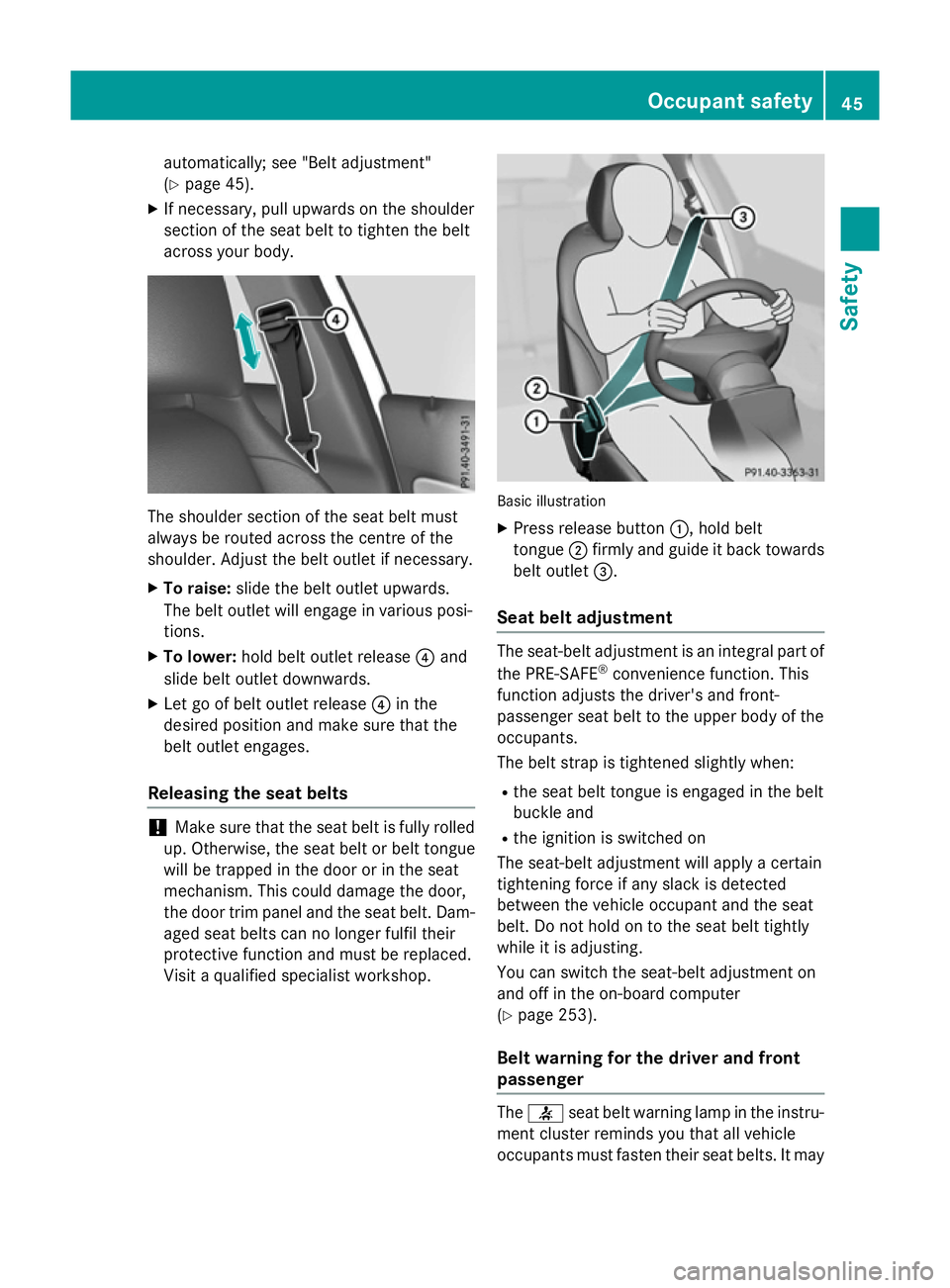
X To raise: slide the belt outlet upwards.
The belt outlet will engage in various posi-
tions.
X To lower: hold belt outlet release ?and
slide belt outlet downwards.
X Let go of belt outlet release ?in the
desired position and make sure that the
belt outlet engages.
Releasing the seat belts !
Make sure that the seat belt is fully rolled
up. Otherwise, the seat belt or belt tongue
will be trapped in the door or in the seat
mechanism. This could damage the door,
the door trim panel and the seat belt. Dam- aged seat belts can no longer fulfil their
protective function and must be replaced.
Visit a qualified specialist workshop. Basic illustration
X Press release button :, hold belt
tongue ;firmly and guide it back towards
belt outlet =.
Seat belt adjustment The seat-belt adjustment is an integral part of
the PRE-SAFE ®
convenience function. This
function adjusts the driver's and front-
passenger seat belt to the upper body of the
occupants.
The belt strap is tightened slightly when:
R the seat belt tongue is engaged in the belt
buckle and
R the ignition is switched on
The seat-belt adjustment will apply a certain
tightening force if any slack is detected
between the vehicle occupant and the seat
belt. Do not hold on to the seat belt tightly
while it is adjusting.
You can switch the seat-belt adjustment on
and off in the on-board computer
(Y page 253).
Belt warning for the driver and front
passenger The
7 seat belt warning lamp in the instru-
ment cluster reminds you that all vehicle
occupants must fasten their seat belts. It may Occupant safety
45Safety Z
Page 58 of 417
Deployment of belt tensioners and air-
bags
Important safety notes G
WARNING
After the airbag deploys, the airbag parts are
hot. There is a risk of injury.
Do not touch the airbag parts. Have a
deployed airbag replaced at a qualified spe-
cialist workshop as soon as possible. G
WARNING
Pyrotechnic seat belt tensioners that have
been deployed are no longer operational and
are unable to perform their intended protec-
tive function. This poses an increased risk of
injury or even fatal injury.
Therefore, have pyrotechnic belt tensioners
which have been triggered immediately
replaced at a qualified specialist workshop.
Mercedes-Benz recommends that you have
the vehicle towed to a qualified specialist
workshop after an accident. Take this into
account, particularly if a seat belt tensioner
was triggered or an airbag was deployed.
An electric motor is used by PRE-SAFE ®
to
trigger the tightening of the seat belt in haz-
ardous situations. This procedure is reversi-
ble.
If the belt tensioners are triggered or an air-
bag is deployed, you will hear a bang, and a
small amount of powder may also be
released. The 6restraint system warning
lamp lights up.
Only in rare cases will the bang affect your
hearing. In general, the powder released is
not hazardous to health but may cause short- term breathing difficulties to persons suffer-
ing from asthma or other pulmonary condi-
tions. Provided it is safe to do so, you should
leave the vehicle immediately or open the
window in order to prevent breathing difficul- ties. Operation During the first stage of a collision, the
restraint system control unit evaluates impor-
tant physical data relating to vehicle deceler-
ation or acceleration, such as:
R duration
R direction
R intensity
Based on the evaluation of this data, the
restraint system control unit triggers the seat
belt tensioners in the event of a head-on or
rear collision.
A seat belt tensioner can only be triggered if:
R the ignition is switched on
R the components of the restraint system are
operational. You can find further informa-
tion under: "Restraint system warning
lamp" (Y page 41)
R the belt tongue has engaged in the belt
buckle of the respective front seat
The seat belt tensioners in the rear compart-
ment are triggered independently of the lock
status of the seat belts.
If the restraint system control unit detects a
high severity accident, in certain head-on col- lisions, additional components of the
restraint system are deployed independently
of each other:
R front airbags and driver's kneebag
R windowbag, if the system determines that
deployment can offer additional protection
to that provided by the seat belt
On vehicles with the automatic front-
passenger front airbag deactivation system:
depending on the person in the front-
passenger seat, the front-passenger front air- bag is either disabled or enabled. The front-
passenger front airbag can only be deployed
in an accident if the PASSENGER AIR BAG ON
indicator lamp is lit. Observe the information
on the PASSENGER AIR BAG indicator lamps
(Y page 41).
Your vehicle has two-stage front airbags. In
the first deployment stage, the front airbag is Occupant safety
55Safety Z
Page 61 of 417
G
WARNING
If you leave children unattended in the vehi-
cle, they may be able to set the vehicle in
motion if, for example, they:
R release the parking brake
R shift the automatic transmission out of park
position Por shift manual transmission into
neutral
R start the engine
In addition, they may operate vehicle equip-
ment and become trapped. There is a risk of
an accident and injury.
When leaving the vehicle, always take the key with you and lock the vehicle. Never leave
children unattended in the vehicle. G
WARNING
If persons (particularly children) are exposed
to heat or cold for a prolonged period, there is a risk of serious or even fatal injuries. Never
leave persons (particularly children) unatten-
ded in the vehicle. G
WARNING
If the child restraint system is placed in direct sunlight, the parts could become very hot.
Children could be suffer burns by touching
these parts, in particular on the metallic parts
of the child restraint system. There is a risk of injury.
If you and your child leave the vehicle, always
make sure that the child restraint system is
not in direct sunlight. Cover it with a blanket, for example. If the child restraint system has
been exposed to direct sunlight, leave it to
cool down before securing the child in it.
Never leave children unattended in the vehi-
cle.
Always ensure that all vehicle occupants have their seat belts fastened correctly and are sit-
ting properly. Particular attention must be
paid to children.
Observe the safety notes on the seat belt
(Y page 42) and the information on the cor-
rect use of the seat belt (Y page 44). Child restraint system
If you fit a rearward-facing child restraint sys- tem to the centre rear seat, the rear arm restmust be folded back as far as possible.
Observe the instructions for correct use of
the child restraint system (Y page 62).
For safety reasons, Mercedes-Benz recom-
mends that you only use a child restraint sys- tem recommended by Mercedes-Benz
(Y page 66). G
WARNING
If the child restraint system is incorrectly fit-
ted on the seat position suitable for this pur-
pose, it cannot perform its intended protec-
tive function. In the event of an accident,
sharp braking or a sudden change in direction, the child may not be held securely. There is an
increased risk of serious or even fatal injuries.
Observe the manufacturer's installation
instructions and the correct use for the child
restraint system. Make sure that the entire
surface of the child restraint system is resting
on the seat surface. Never place objects
under or behind the child restraint system,
e.g. cushions. Only use child restraint sys-
tems with the original cover designed for
them. Only replace damaged covers with gen- uine covers. G
WARNING
If the child restraint system is fitted incor-
rectly or is not secured, it can come loose in
the event of an accident, heavy braking or a
sudden change in direction. The child
restraint system could be thrown about, strik- ing vehicle occupants. There is an increased
risk of injury, possibly even fatal.
Always fit child restraint systems properly,
even if they are not being used. Make sure
that you observe the child restraint system
manufacturer's installation instructions.
You will find further information on stowing
objects, luggage and loads securely under
"Loading guidelines" (Y page 306).58
Children in the vehicleSafety
Page 77 of 417
G
WARNING
If ESP ®
is malfunctioning, ESP ®
is unable to
stabilise the vehicle. In addition, other driving
safety systems are switched off. This increa-
ses the risk of skidding and an accident.
Drive on carefully. Have ESP ®
checked at a
qualified specialist workshop.
Vehicles without 4MATIC: when towing
away your vehicle with the front axle raised,
please observe the notes on ESP ®
(Y page 352).
If the å ESP®
OFF warning lamp lights up
continuously, ESP ®
is deactivated.
If the ÷ ESP®
warning lamp and the å
warning lamp are lit continuously, ESP ®
is not
available due to a malfunction.
Observe the information on warning lamps
(Y page 297) and display messages which
may be shown in the instrument cluster
(Y page 258).
Only use wheels with the recommended tyre
sizes. Only then will ESP ®
function properly.
Characteristics of ESP ®General notes
If the
÷ ESP warning lamp goes out before
beginning the journey, ESP ®
is automatically
active.
If ESP ®
intervenes, the ÷ESP®
warning
lamp flashes in the instrument cluster.
If ESP ®
intervenes:
X Do not deactivate ESP ®
under any circum-
stances.
X When pulling away, only depress the accel-
erator pedal as far as is necessary.
X Adapt your driving style to suit the prevail-
ing road and weather conditions.
ECO start/stop function
The ECO start/stop function switches the
engine off automatically if the vehicle stops
moving. When pulling away again, the engine starts automatically. ESP
®
remains in its pre-
viously selected status. Example:if ESP®
was deactivated before the engine was
switched off, ESP ®
remains deactivated when
the engine is switched on again.
Deactivating/activating ESP ®
(except
Mercedes‑AMG vehicles) Important safety notes
You can select between the following sta-
tuses of ESP ®
:
R ESP ®
is activated
R ESP ®
is deactivated G
WARNING
If you deactivate ESP ®
, ESP ®
no longer sta-
bilises the vehicle. There is an increased risk
of skidding and an accident.
Only deactivate ESP ®
in the situations descri-
bed in the following.
It may be best to deactivate ESP ®
in the fol-
lowing situations:
R when using snow chains
R in deep snow
R on sand or gravel
i Activate ESP ®
as soon as the situations
described above no longer apply. ESP ®
will
otherwise not be able to stabilise the vehi-
cle if the vehicle starts to skid or a wheel
starts to spin.
Deactivating/activating ESP ®
You can deactivate or activate ESP ®
via the
on-board computer (Y page 248).
ESP ®
deactivated:
The å ESP®
OFF warning lamp in the
instrument cluster lights up.
ESP ®
activated:
The å ESP®
OFF warning lamp in the
instrument cluster goes out. 74
Driving safety systemsSafety