automatic transmission MERCEDES-BENZ A-CLASS HATCHBACK 2015 Manual PDF
[x] Cancel search | Manufacturer: MERCEDES-BENZ, Model Year: 2015, Model line: A-CLASS HATCHBACK, Model: MERCEDES-BENZ A-CLASS HATCHBACK 2015Pages: 417, PDF Size: 11.91 MB
Page 371 of 417
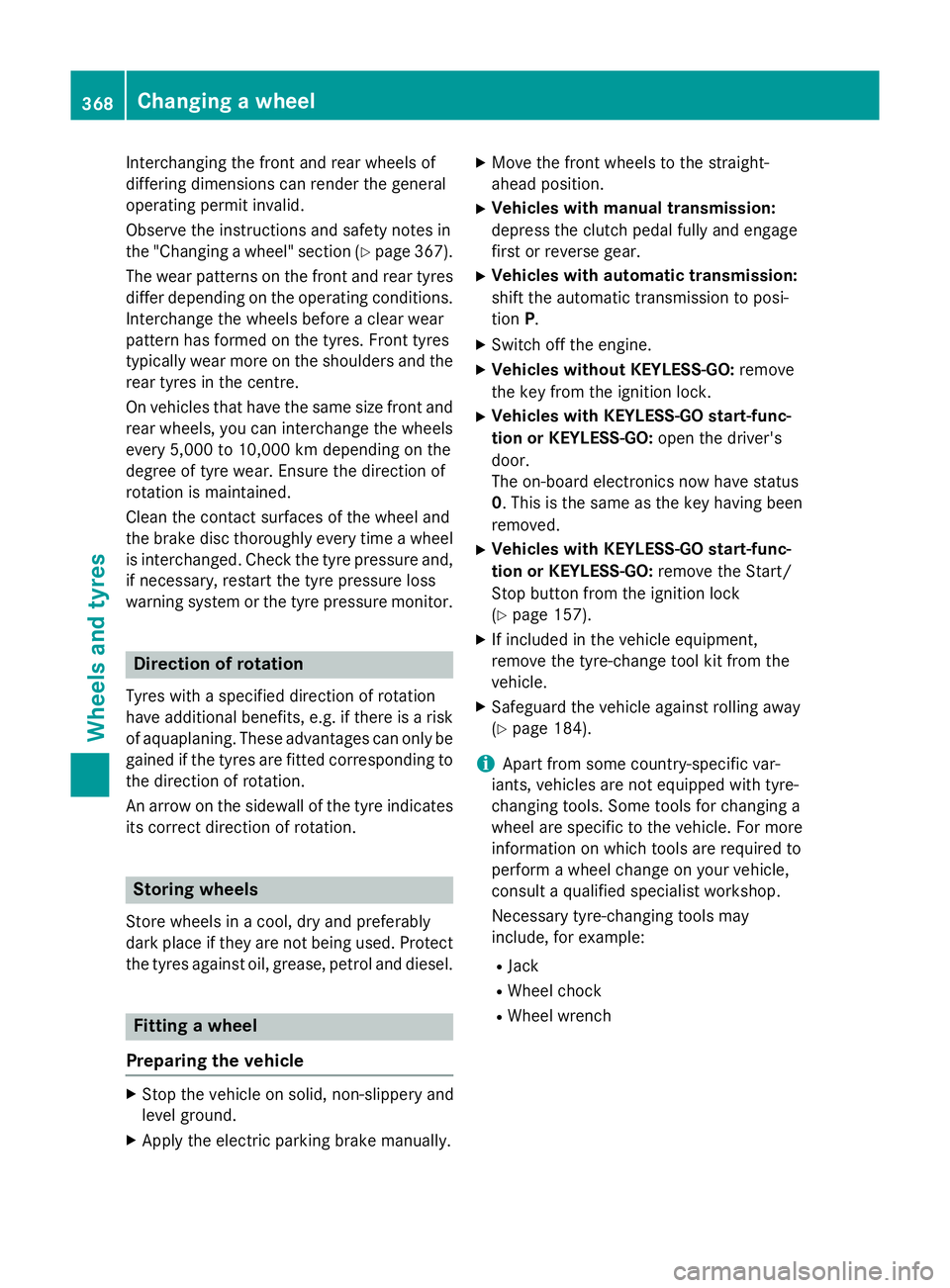
Interchanging the front and rear wheels of
differing dimensions can render the general
operating permit invalid.
Observe the instructions and safety notes in
the "Changing a wheel" section (Y page 367).
The wear patterns on the front and rear tyres differ depending on the operating conditions.
Interchange the wheels before a clear wear
pattern has formed on the tyres. Front tyres
typically wear more on the shoulders and the
rear tyres in the centre.
On vehicles that have the same size front and rear wheels, you can interchange the wheels
every 5,000 to 10,000 km depending on the
degree of tyre wear. Ensure the direction of
rotation is maintained.
Clean the contact surfaces of the wheel and
the brake disc thoroughly every time a wheel
is interchanged. Check the tyre pressure and, if necessary, restart the tyre pressure loss
warning system or the tyre pressure monitor. Direction of rotation
Tyres with a specified direction of rotation
have additional benefits, e.g. if there is a risk
of aquaplaning. These advantages can only be gained if the tyres are fitted corresponding to the direction of rotation.
An arrow on the sidewall of the tyre indicates
its correct direction of rotation. Storing wheels
Store wheels in a cool, dry and preferably
dark place if they are not being used. Protect
the tyres against oil, grease, petrol and diesel. Fitting a wheel
Preparing the vehicle X
Stop the vehicle on solid, non-slippery and
level ground.
X Apply the electric parking brake manually. X
Move the front wheels to the straight-
ahead position.
X Vehicles with manual transmission:
depress the clutch pedal fully and engage
first or reverse gear.
X Vehicles with automatic transmission:
shift the automatic transmission to posi-
tion P.
X Switch off the engine.
X Vehicles without KEYLESS-GO: remove
the key from the ignition lock.
X Vehicles with KEYLESS-GO start-func-
tion or KEYLESS-GO: open the driver's
door.
The on-board electronics now have status
0. This is the same as the key having been removed.
X Vehicles with KEYLESS-GO start-func-
tion or KEYLESS-GO: remove the Start/
Stop button from the ignition lock
(Y page 157).
X If included in the vehicle equipment,
remove the tyre-change tool kit from the
vehicle.
X Safeguard the vehicle against rolling away
(Y page 184).
i Apart from some country-specific var-
iants, vehicles are not equipped with tyre-
changing tools. Some tools for changing a
wheel are specific to the vehicle. For more information on which tools are required to
perform a wheel change on your vehicle,
consult a qualified specialist workshop.
Necessary tyre-changing tools may
include, for example:
R Jack
R Wheel chock
R Wheel wrench 368
Changing a wheelWheels and tyres
Page 409 of 417
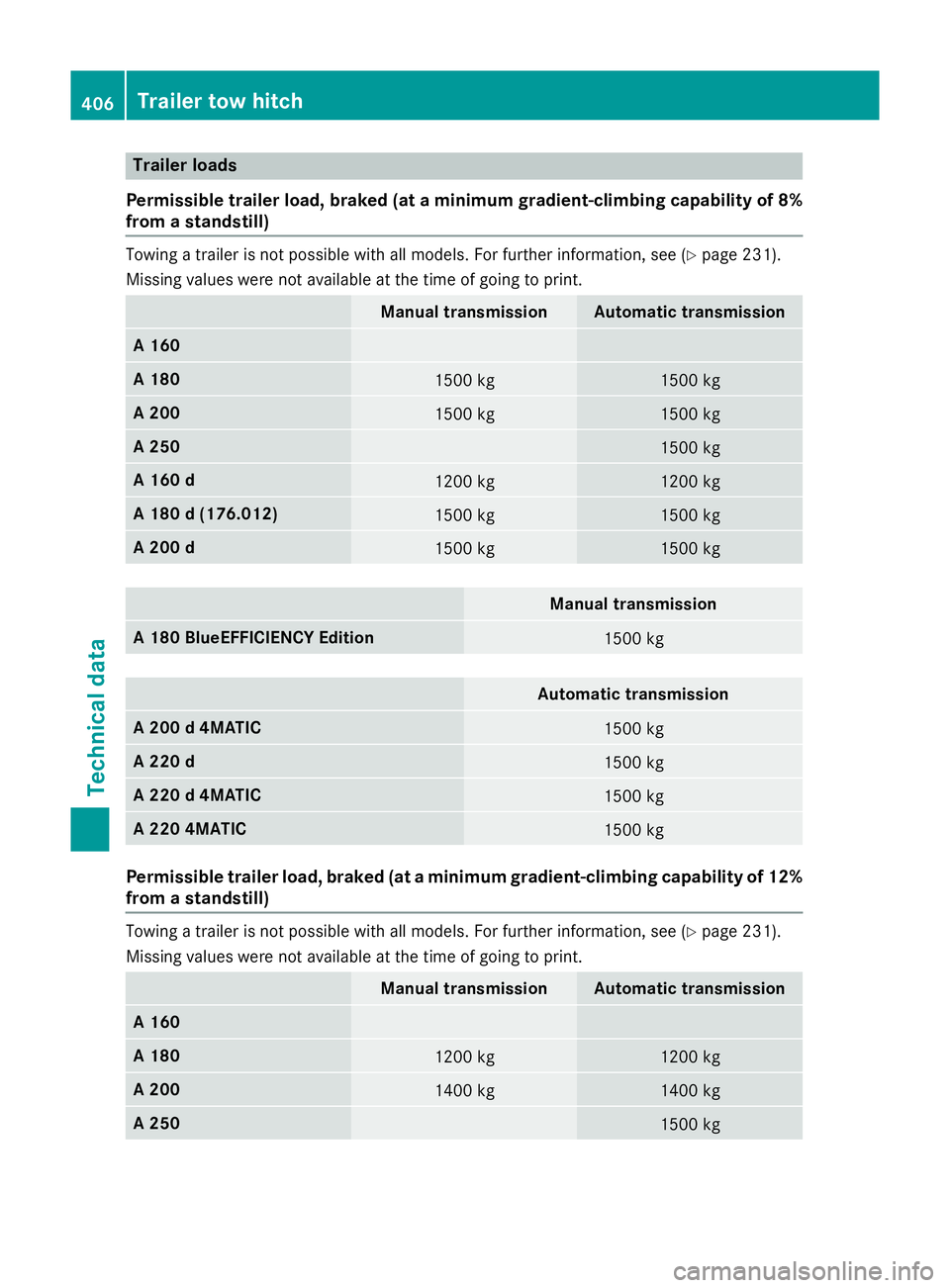
Trailer loads
Permissible trailer load, braked (at a minimum gradient-climbing capability of 8%
from a standstill) Towing a trailer is not possible with all models. For further information, see (Y
page 231).
Missing values were not available at the time of going to print. Manual transmission Automatic transmission
A 160
A 180
1500 kg 1500 kg
A 200
1500 kg 1500 kg
A 250
1500 kg
A 160 d
1200 kg 1200 kg
A 180 d (176.012)
1500 kg 1500 kg
A 200 d
1500 kg 1500 kg
Manual transmission
A 180 BlueEFFICIENCY Edition
1500 kg
Automatic transmission
A 200 d 4MATIC
1500 kg
A 220 d
1500 kg
A 220 d 4MATIC
1500 kg
A 220 4MATIC
1500 kg
Permissible trailer load, braked (at a minimum gradient-climbing capability of 12%
from a standstill) Towing a trailer is not possible with all models. For further information, see (Y
page 231).
Missing values were not available at the time of going to print. Manual transmission Automatic transmission
A 160
A 180
1200 kg 1200 kg
A 200
1400 kg 1400 kg
A 250
1500 kg406
Trailer tow hitchTechnical data
Page 410 of 417
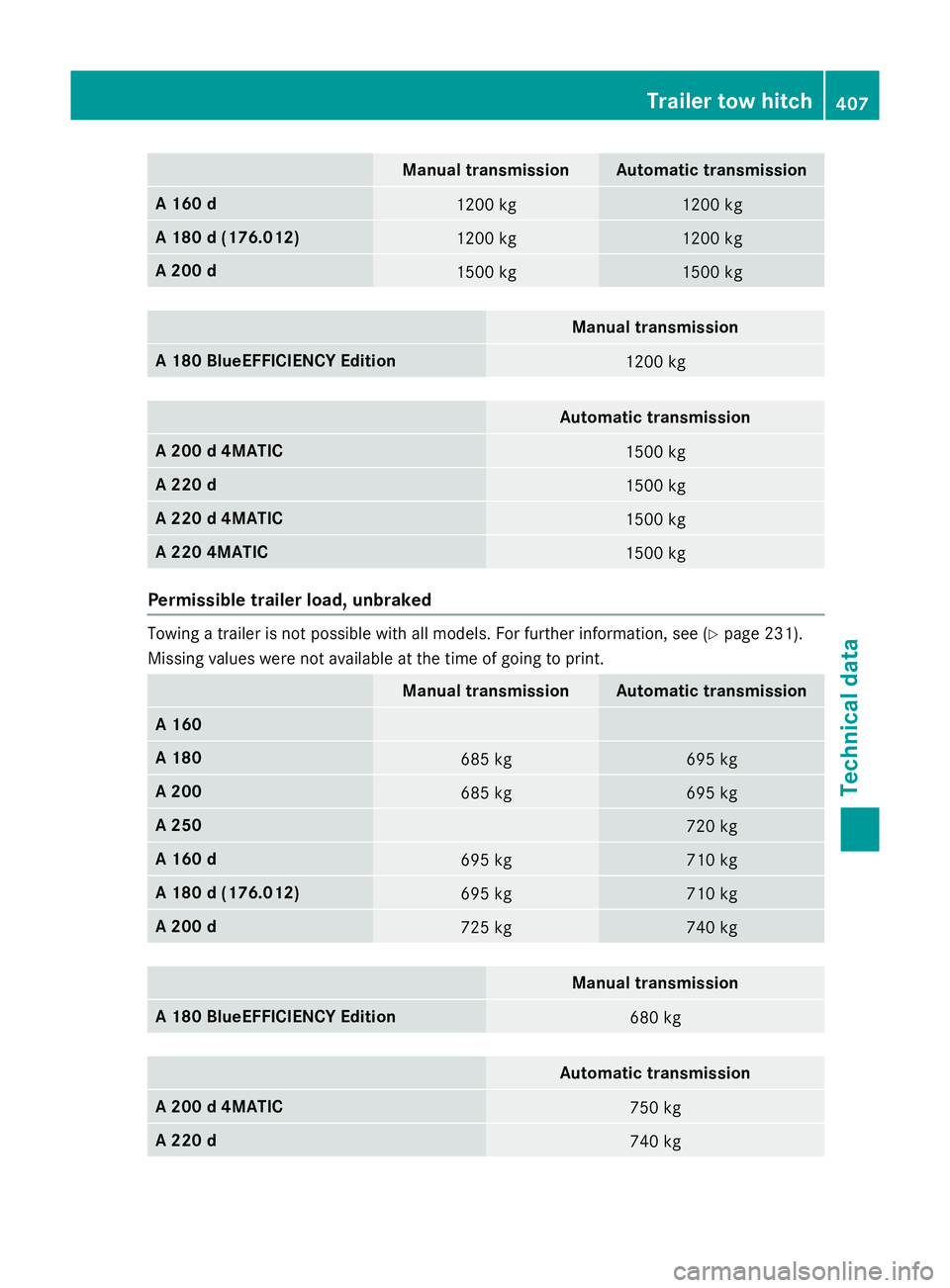
Manual transmission Automatic transmission
A 160 d
1200 kg 1200 kg
A 180 d (176.012)
1200 kg 1200 kg
A 200 d
1500 kg 1500 kg
Manual transmission
A 180 BlueEFFICIENCY Edition
1200 kg
Automatic transmission
A 200 d 4MATIC
1500 kg
A 220 d
1500 kg
A 220 d 4MATIC
1500 kg
A 220 4MATIC
1500 kg
Permissible trailer load, unbraked
Towing a trailer is not possible with all models. For further information, see (Y
page 231).
Missing values were not available at the time of going to print. Manual transmission Automatic transmission
A 160
A 180
685 kg 695 kg
A 200
685 kg 695 kg
A 250
720 kg
A 160 d
695 kg 710 kg
A 180 d (176.012)
695 kg 710 kg
A 200 d
725 kg 740 kg
Manual transmission
A 180 BlueEFFICIENCY Edition
680 kg
Automatic transmission
A 200 d 4MATIC
750 kg
A 220 d
740 kg Trailer tow hitch
407Technical data Z
Page 411 of 417
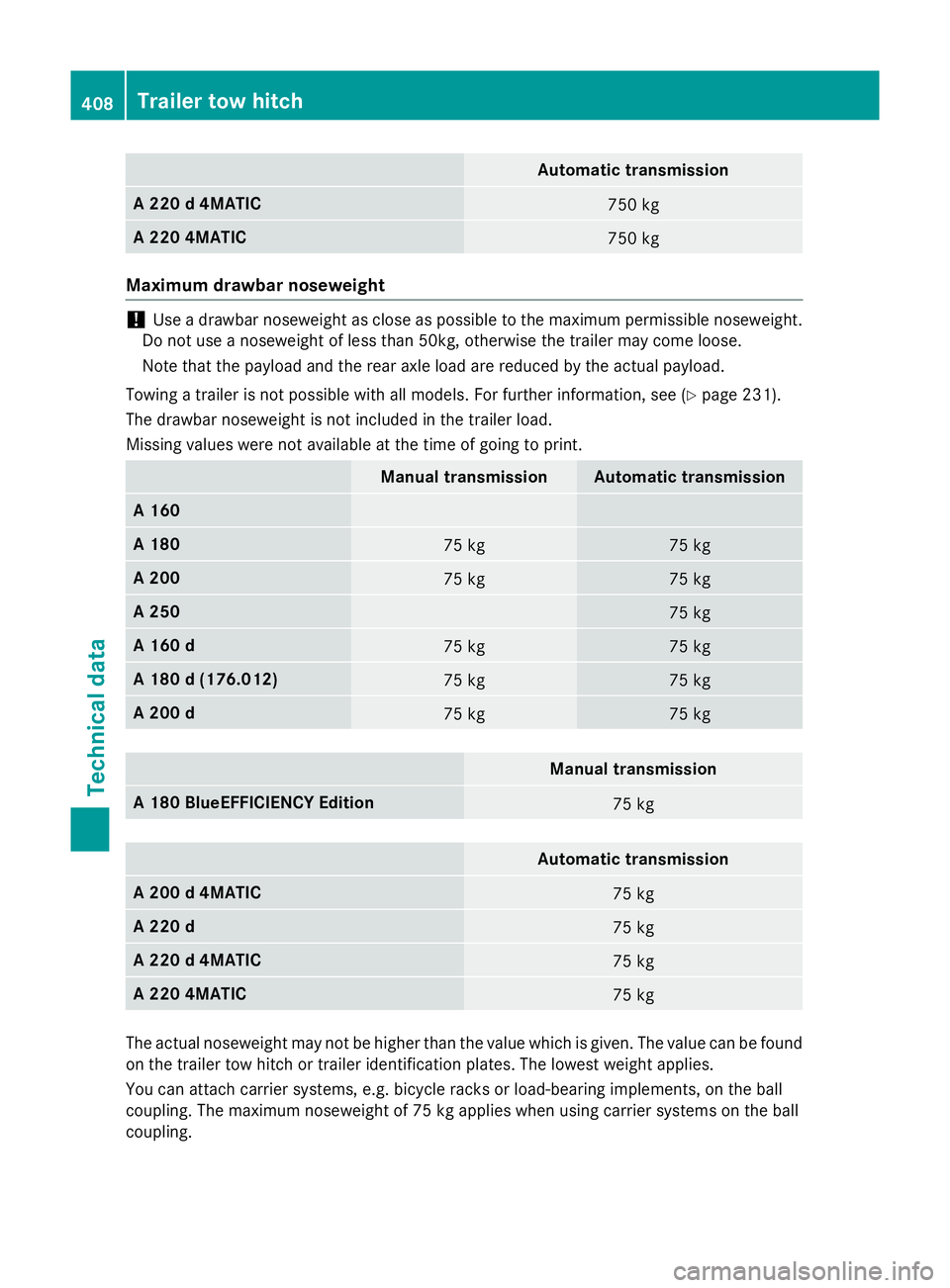
Automatic transmission
A 220 d 4MATIC
750 kg
A 220 4MATIC
750 kg
Maximum drawbar noseweight
!
Use a drawbar noseweight as close as possible to the maximum permissible noseweight.
Do not use a noseweight of less than 50kg, otherwise the trailer may come loose.
Note that the payload and the rear axle load are reduced by the actual payload.
Towing a trailer is not possible with all models. For further information, see (Y page 231).
The drawbar noseweight is not included in the trailer load.
Missing values were not available at the time of going to print. Manual transmission Automatic transmission
A 160
A 180
75 kg 75 kg
A 200
75 kg 75 kg
A 250
75 kg
A 160 d
75 kg 75 kg
A 180 d (176.012)
75 kg 75 kg
A 200 d
75 kg 75 kg
Manual transmission
A 180 BlueEFFICIENCY Edition
75 kg
Automatic transmission
A 200 d 4MATIC
75 kg
A 220 d
75 kg
A 220 d 4MATIC
75 kg
A 220 4MATIC
75 kg
The actual noseweight may not be higher than the value which is given. The value can be found
on the trailer tow hitch or trailer identification plates. The lowest weight applies.
You can attach carrier systems, e.g. bicycle racks or load-bearing implements, on the ball
coupling. The maximum noseweight of 75 kg applies when using carrier systems on the ball
coupling. 408
Trailer tow hitchTechnical data
Page 412 of 417
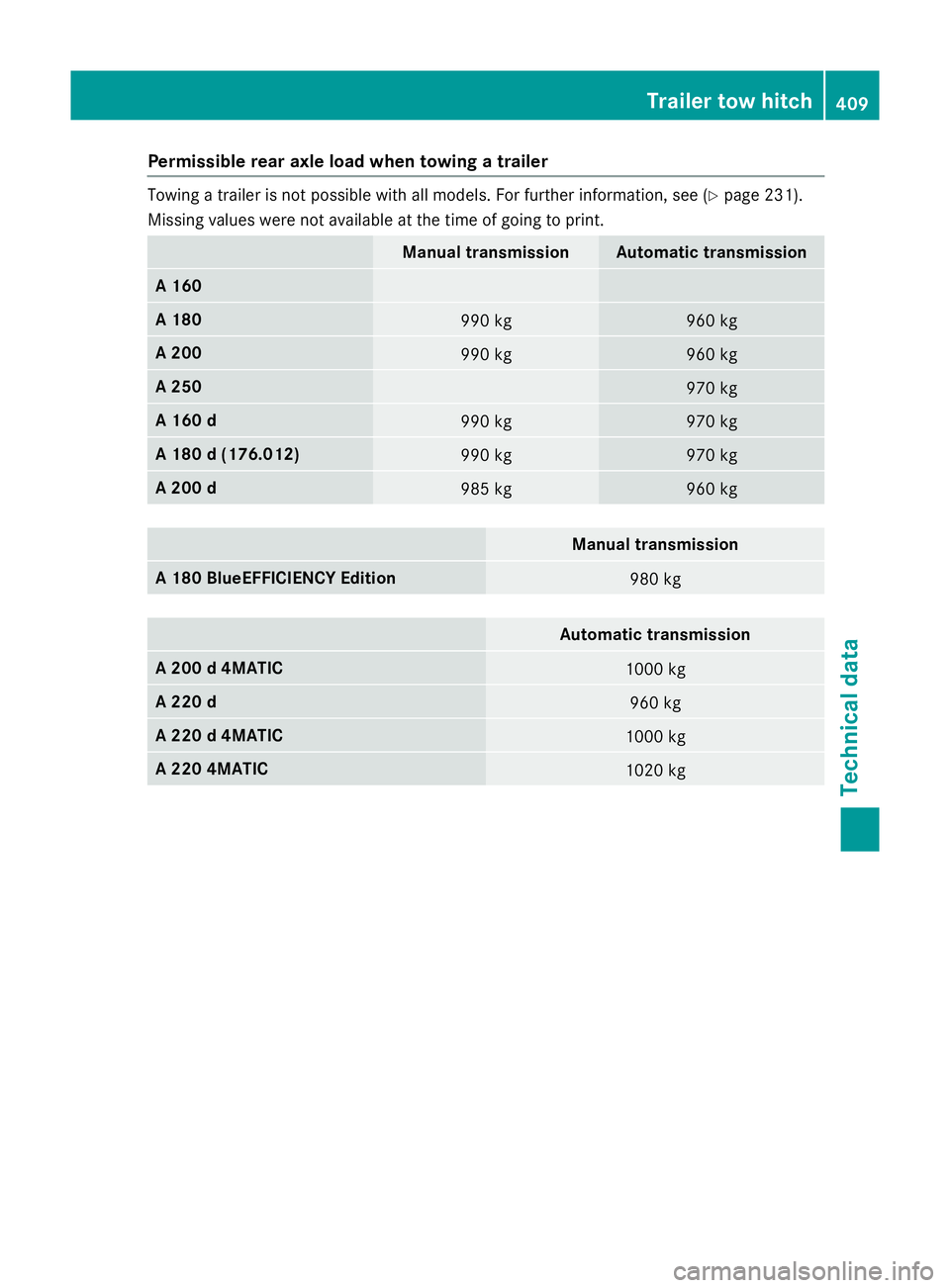
Permissible rear axle load when towing a trailer
Towing a trailer is not possible with all models. For further information, see (Y
page 231).
Missing values were not available at the time of going to print. Manual transmission Automatic transmission
A 160
A 180
990 kg 960 kg
A 200
990 kg 960 kg
A 250
970 kg
A 160 d
990 kg 970 kg
A 180 d (176.012)
990 kg 970 kg
A 200 d
985 kg 960 kg
Manual transmission
A 180 BlueEFFICIENCY Edition
980 kg
Automatic transmission
A 200 d 4MATIC
1000 kg
A 220 d
960 kg
A 220 d 4MATIC
1000 kg
A 220 4MATIC
1020 kg Trailer tow hitch
409Technical data Z