Anti collision MERCEDES-BENZ A-CLASS HATCHBACK 2015 Owners Manual
[x] Cancel search | Manufacturer: MERCEDES-BENZ, Model Year: 2015, Model line: A-CLASS HATCHBACK, Model: MERCEDES-BENZ A-CLASS HATCHBACK 2015Pages: 417, PDF Size: 11.91 MB
Page 12 of 417
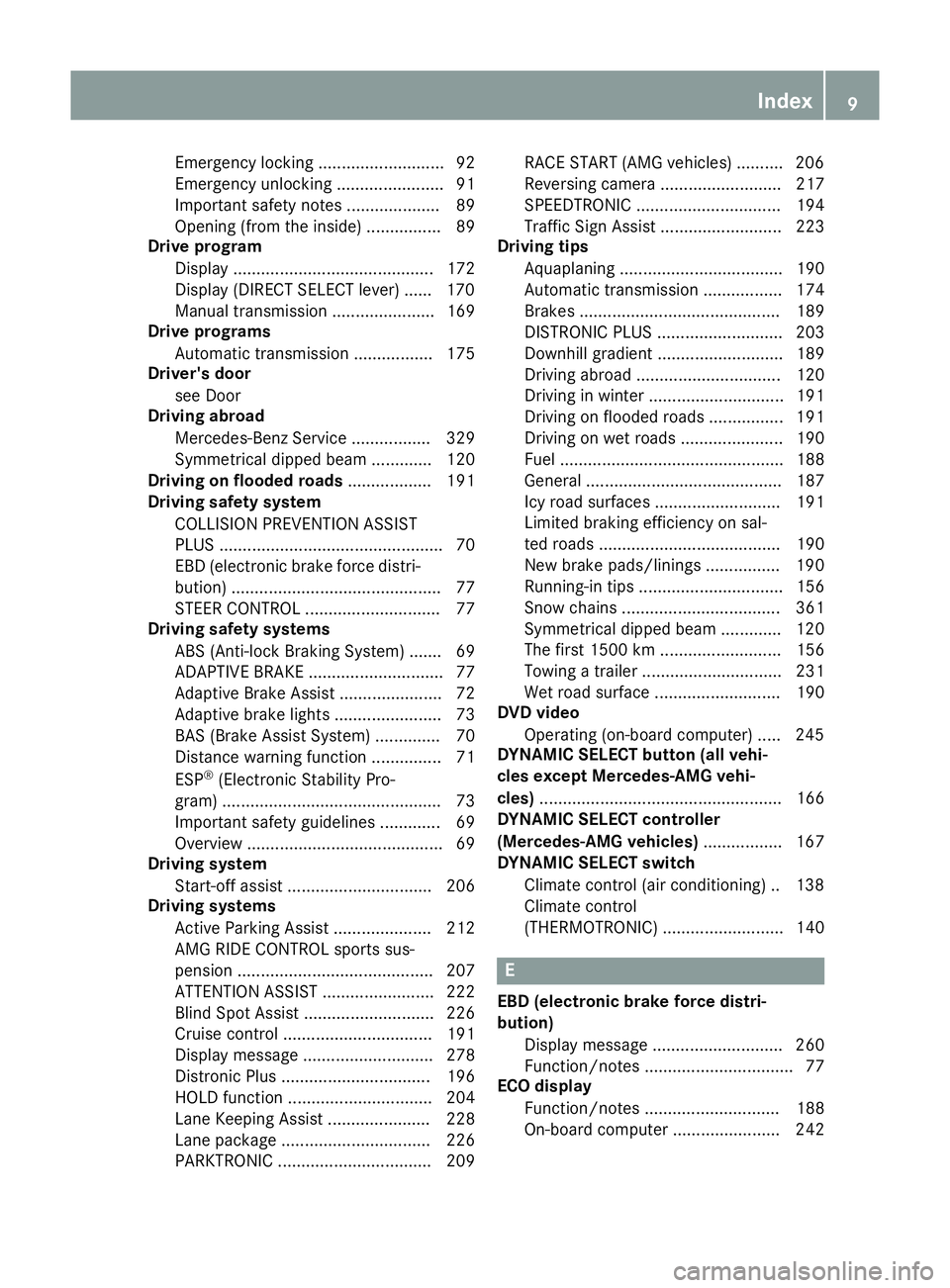
Emergency locking ........................... 92
Emergency unlocking ....................... 91
Important safety note s.................... 89
Opening (from the inside) ................ 89
Drive program
Display ........................................... 172
Display (DIRECT SELECT lever) ...... 170
Manual transmission ...................... 169
Drive programs
Automatic transmission ................. 175
Driver's door
see Door
Driving abroad
Mercedes-Benz Service ................. 329
Symmetrical dipped beam ............. 120
Driving on flooded roads .................. 191
Driving safety system
COLLISION PREVENTION ASSIST
PLUS ................................................ 70
EBD (electronic brake force distri-bution) ............................................. 77
STEER CONTROL ............................. 77
Driving safety systems
ABS (Anti-lock Braking System) ....... 69
ADAPTIVE BRAK E............................. 77
Adaptive Brake Assist ...................... 72
Adaptive brake lights ....................... 73
BAS (Brake Assist System) .............. 70
Distance warning function ............... 71
ESP ®
(Electronic Stability Pro-
gram) ............................................... 73
Important safety guidelines ............. 69
Overview .......................................... 69
Driving system
Start-off assis t............................... 206
Driving systems
Active Parking Assist ..................... 212
AMG RIDE CONTROL sports sus-
pension .......................................... 207
ATTENTION ASSIST ........................ 222
Blind Spot Assist ............................ 226
Cruise control ................................ 191
Display message ............................ 278
Distronic Plus ................................ 196
HOLD function ............................... 204
Lane Keeping Assist ...................... 228
Lane package ................................ 226
PARKTRONIC ................................. 209 RACE START (AMG vehicles) .......... 206
Reversing camera .......................... 217
SPEEDTRONIC ............................... 194
Traffic Sign Assist .......................... 223
Driving tips
Aquaplaning ................................... 190
Automatic transmission ................. 174
Brakes ........................................... 189
DISTRONIC PLUS ........................... 203
Downhill gradient ........................... 189
Driving abroad ............................... 120
Driving in winter ............................. 191
Driving on flooded roads ................ 191
Driving on wet roads ...................... 190
Fuel ................................................ 188
General .......................................... 187
Icy road surfaces ........................... 191
Limited braking efficiency on sal-
ted roads ....................................... 190
New brake pads/linings ................ 190
Running-in tip s............................... 156
Snow chains .................................. 361
Symmetrical dipped beam ............. 120
The first 1500 km .......................... 156
Towing a trailer .............................. 231
Wet road surface ........................... 190
DVD video
Operating (on-board computer) ..... 245
DYNAMIC SELECT button (all vehi-
cles except Mercedes-AMG vehi-
cles) .................................................... 166
DYNAMIC SELECT controller
(Mercedes-AMG vehicles) ................. 167
DYNAMIC SELECT switch
Climate control (air conditioning) .. 138
Climate control
(THERMOTRONIC) .......................... 140 E
EBD (electronic brake force distri-
bution) Display message ............................ 260
Function/note s................................ 77
ECO display
Function/note s............................. 188
On-board computer ....................... 242 Index
9
Page 59 of 417
filled with propellant gas to reduce the risk of
injuries. The front airbag is fully deployed if
the second deployment stage is activated
within a few milliseconds.
The activation threshold for the seat belt ten-
sioners and airbags is determined based on
the evaluation of the vehicle's rate of decel-
eration or acceleration at various points in the vehicle. This process is pre-emptive in nature.The triggering/deployment process should
take place in good time at the start of the
collision.
The rate of vehicle deceleration or accelera-
tion and the direction of the force are essen- tially determined by:
R the distribution of forces during the colli-
sion
R the collision angle
R the deformation characteristics of the vehi-
cle
R the characteristics of the object with which
the vehicle has collided
Factors which can only be seen and measured
after a collision has occurred do not play a
decisive role in the deployment of an airbag,
nor do they provide an indication of airbag
deployment.
The vehicle may be deformed significantly
without an airbag being deployed. This is the
case if only parts which are relatively easily
deformed are affected and the rate of decel-
eration is not high. Conversely, an airbag may
be deployed even though the vehicle suffers
only minor deformation. This is the case if, for example, very rigid vehicle parts such as lon-
gitudinal body members are hit, and sufficient deceleration occurs as a result.
If the restraint system control unit detects a
side impact, the applicable components of
the restraint system are activated independ-
ently of each other.
R Sidebags on the side on which an impact
occurs, independent from the seat belt ten-
sioner and seat belt usage
Vehicles with the automatic front-
passenger airbag deactivation system: the sidebag on the front-passenger side
deploys under the following conditions:
- an occupant is detected on the front-
passenger seat or
- the belt tongue is engaged in the belt
buckle of the front-passenger seat
R Windowbag on the side on which an impact
occurs, independent of seat belt usage and
regardless of whether the front-passenger
seat is occupied
R Seat belt tensioners, if the system deter-
mines that deployment can offer additional
protection for the vehicle occupants in this situation
i Not all airbags are deployed in an acci-
dent. The different airbag systems work
independently of each other.
How the airbag system works is deter-
mined by the severity of the accident detec- ted, especially the vehicle deceleration or
acceleration, and the apparent type of acci-
dent:
R frontal collision
R side impact PRE-SAFE
®
(anticipatory occupant
protection)
Introduction In certain hazardous situations, PRE-SAFE
®
takes pre-emptive measures to protect the
vehicle occupants.
Important safety notes !
Make sure that there are no objects in the
footwell or behind the seats. There is a risk that the seats and/or the objects could be
damaged when PRE-SAFE ®
is activated.
Although your vehicle is equipped with PRE-
SAFE ®
, the possibility of injury in the event of
an accident cannot be ruled out. Always
adapt your driving style to suit the prevailing
road and weather conditions and maintain a 56
Occupant safetySafety
Page 72 of 417
Pets in the vehicle
G
WARNING
If you leave animals unsupervised or unse-
cured in the vehicle, they may push a button
or a switch, for example.
They could:
R activate vehicle equipment and become
trapped, for example
R switch vehicle systems on or off, thus
endangering other road users
In the event of an accident, sudden braking or
abrupt changes of direction, unsecured ani-
mals could be flung around the vehicle, injur-
ing the vehicle occupants. There is a risk of an accident and injury.
Never leave animals unattended in the vehi-
cle. Always secure animals correctly during a
journey, e.g. in an animal transport box. Driving safety systems
Driving safety systems overview
In this section, you will find information about the following driving safety systems:
R ABS ( Anti-lock BrakingSystem)
(Y page 69)
R BAS ( Brake Assist System) (Y page 70)
R COLLISION PREVENTION ASSIST PLUS
(Y page 70)
R Adaptive brake lights (Y page 73)
R ESP ®
(Electronic StabilityProgram)
(Y page 73)
R EBD ( electronic brake force distribution)
(Y page 77)
R ADAPTIVE BRAKE (Y page 77)
R STEER CONTROL (Y page 77) Important safety notes
If you fail to adapt your driving style or if you
are inattentive, the driving safety systems can neither reduce the risk of an accident nor
override the laws of physics. Driving safety
systems are merely aids designed to assist
driving. You are responsible for maintaining
the distance to the vehicle in front, for vehicle speed, for braking in good time, and for stay-ing in lane. Always adapt your driving style to
suit the prevailing road and weather condi-
tions and maintain a safe distance from the
vehicle in front. Drive carefully.
The driving safety systems described only
work as effectively as possible when there is
adequate contact between the tyres and the
road surface. Please pay special attention to
the notes on tyres, recommended minimum
tyre tread depths etc. (Y page 358).
In wintry driving conditions, always use winter
tyres (M+S tyres) and, if necessary, snow
chains. Only in this way will the driving safety systems described in this section work as
effectively as possible. ABS (Anti-lock Braking System)
General notes ABS regulates brake pressure in such a way
that the wheels do not lock when you brake.
This allows you to continue steering the vehi-
cle when braking.
The ! ABS warning lamp in the instrument
cluster lights up when the ignition is switched on. It goes out when the engine is running.
ABS works from a speed of about 8 km/h,
regardless of road-surface conditions. ABS
works on slippery surfaces, even when you
only brake gently.
Important safety notes i
Observe the "Important safety notes" sec-
tion (Y page 69). G
WARNING
If ABS is faulty, the wheels could lock when
braking. The steerability and braking charac-
teristics may be severely impaired. Addition- Driving safety systems
69Safety
Z
Page 261 of 417
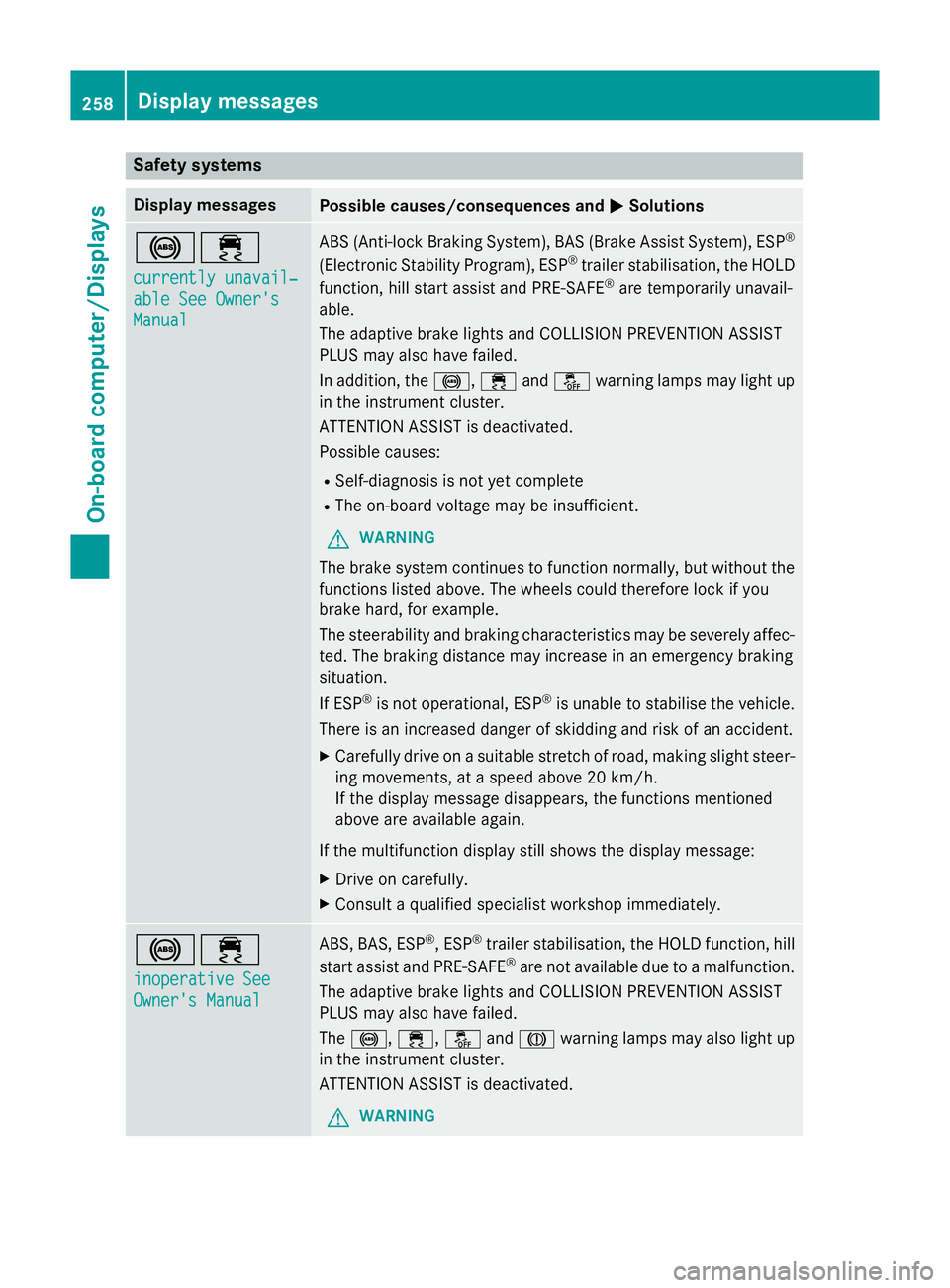
Safety systems
Display messages
Possible causes/consequences and
M
MSolutions !÷
currently unavail‐ currently unavail‐
able See Owner's able See Owner's
Manual Manual ABS (Anti-lock Braking System), BAS (Brake Assist System), ESP
®
(Electronic Stability Program), ESP ®
trailer stabilisation, the HOLD
function, hill start assist and PRE-SAFE ®
are temporarily unavail-
able.
The adaptive brake lights and COLLISION PREVENTION ASSIST
PLUS may also have failed.
In addition, the !,÷andå warning lamps may light up
in the instrument cluster.
ATTENTION ASSIST is deactivated.
Possible causes:
R Self-diagnosis is not yet complete
R The on-board voltage may be insufficient.
G WARNING
The brake system continues to function normally, but without the functions listed above. The wheels could therefore lock if you
brake hard, for example.
The steerability and braking characteristics may be severely affec-ted. The braking distance may increase in an emergency braking
situation.
If ESP ®
is not operational, ESP ®
is unable to stabilise the vehicle.
There is an increased danger of skidding and risk of an accident.
X Carefully drive on a suitable stretch of road, making slight steer-
ing movements, at a speed above 20 km/h.
If the display message disappears, the functions mentioned
above are available again.
If the multifunction display still shows the display message:
X Drive on carefully.
X Consult a qualified specialist workshop immediately. !÷
inoperative See inoperative See
Owner's Manual Owner's Manual ABS, BAS, ESP
®
, ESP ®
trailer stabilisation, the HOLD function, hill
start assist and PRE-SAFE ®
are not available due to a malfunction.
The adaptive brake lights and COLLISION PREVENTION ASSIST
PLUS may also have failed.
The !, ÷, åandJ warning lamps may also light up
in the instrument cluster.
ATTENTION ASSIST is deactivated.
G WARNING 258
Display messagesOn-board computer/Displays
Page 298 of 417
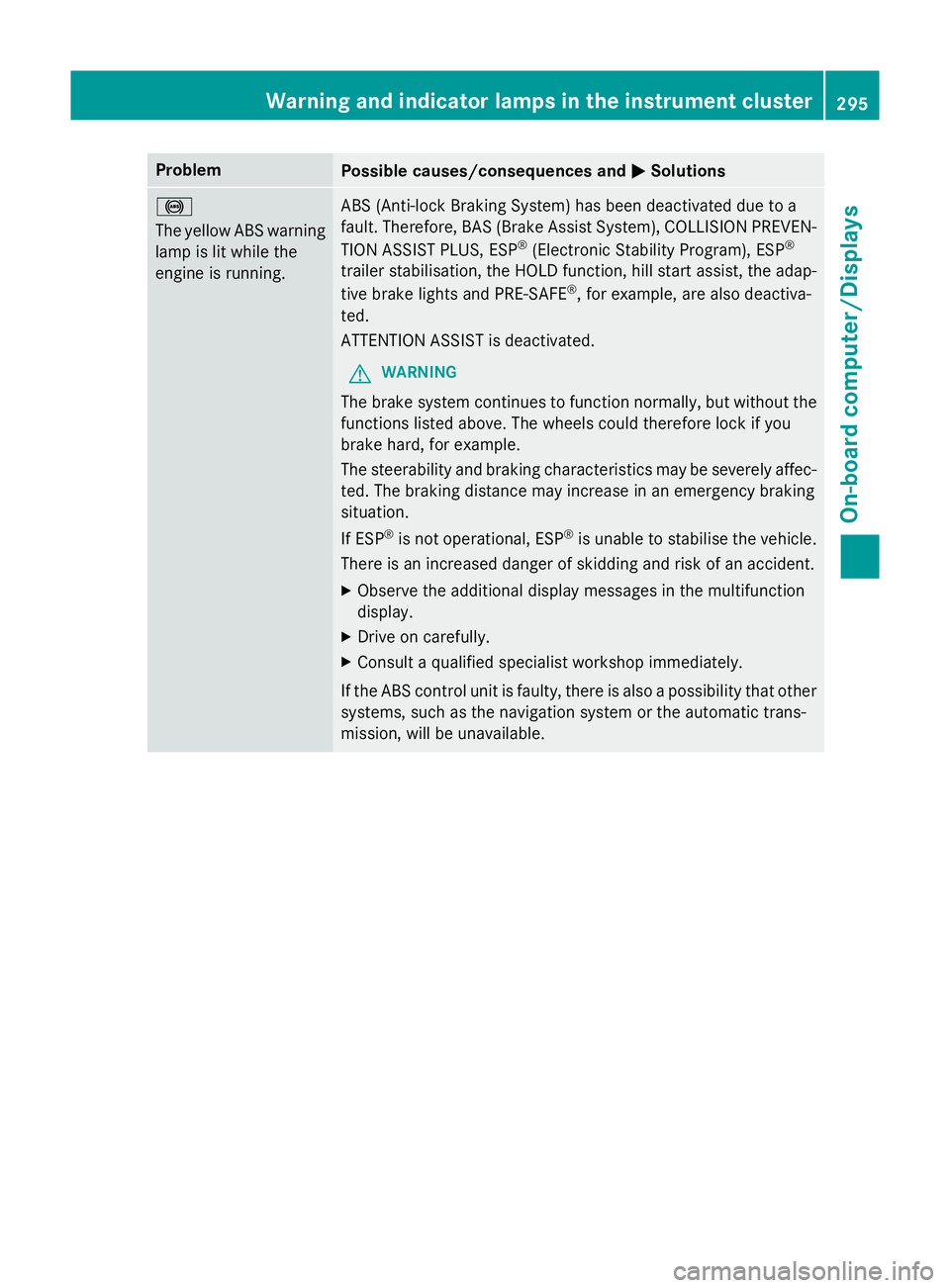
Problem
Possible causes/consequences and
M
MSolutions !
The yellow ABS warning
lamp is lit while the
engine is running. ABS (Anti-lock Braking System) has been deactivated due to a
fault. Therefore, BAS (Brake Assist System), COLLISION PREVEN-
TION ASSIST PLUS, ESP ®
(Electronic Stability Program), ESP ®
trailer stabilisation, the HOLD function, hill start assist, the adap-
tive brake lights and PRE‑SAFE ®
, for example, are also deactiva-
ted.
ATTENTION ASSIST is deactivated.
G WARNING
The brake system continues to function normally, but without the functions listed above. The wheels could therefore lock if you
brake hard, for example.
The steerability and braking characteristics may be severely affec-ted. The braking distance may increase in an emergency braking
situation.
If ESP ®
is not operational, ESP ®
is unable to stabilise the vehicle.
There is an increased danger of skidding and risk of an accident.
X Observe the additional display messages in the multifunction
display.
X Drive on carefully.
X Consult a qualified specialist workshop immediately.
If the ABS control unit is faulty, there is also a possibility that other systems, such as the navigation system or the automatic trans-
mission, will be unavailable. Warning and indicator lamps in the instrument cluster
295On-board computer/Displays Z