brake MERCEDES-BENZ A-CLASS HATCHBACK 2018 Manual PDF
[x] Cancel search | Manufacturer: MERCEDES-BENZ, Model Year: 2018, Model line: A-CLASS HATCHBACK, Model: MERCEDES-BENZ A-CLASS HATCHBACK 2018Pages: 609, PDF Size: 10.73 MB
Page 474 of 609
R
When replacing with tyres that do not
fe ature run-flat characteristics: vehicles
with MOExtended tyres are not equipped
with a TIREFIT kit at thefa ctor y.Equip the
ve hicle with a TIREFIT kit af terre placing with
tyres that do not feature run-flat characteris‐
tics, e.g. winter tyres.
Fo r more information on wheels and tyres, con‐
ta ct a qualified specialist workshop.
Be sure toalso obse rveth efo llowing fur ther
re lated subjects:
R Notes on tyre pressure (→ page 459)
R Tyre pressure table (→ page 460)
R Notes on the emer gency spa rewheel
(→ page 477) Note
s on inter changing wheels &
WARNING Risk of inju rythro ugh dif fer‐
ent wheel sizes
Inter changing the front and rear wheels if the
wheels or tyres ha vediffere nt dimensions may se
verely impair the driving characteris‐
tics.
The disk brakes or wheel suspension compo‐
nents may also be damaged. #
Rotate front and rear wheels on lyifthe
wheels and tyres are of the same
dimensions. Inter
changing the front and rear wheels if the
wheels or tyres ha vediffere nt dimensions can
re nder thege neral operating pe rmit in valid.
The wear pat tern s on the front and rear wheels
dif fer:
R Front wheels wear more on the shoulder of
th e tyre
R Rear wheels wear more in the cent reofthe
tyre
On vehicles with the same front and rear wheel
size, you can inter change the wheels every
5,000 to10,000 km, depending on thewe ar.
Ensure the direction of rotation is maintained for
th e wheels. It is imperative
toobser vethe instructions and
saf ety no tes on "Wheel change" when doing so. Note
s onstoring wheels R
Afterre moving wheels, store them in a cool,
dry and preferably dark place.
R Protect the tyres from conta ct withoil,
grease or fuel. Overview of
the ty re-change tool kit Apart from some countr
y-specific variants, vehi‐
cles are not equipped with a tyre-change tool kit.
Fo r more information on which tyre-changing
to ol kits are requ ired and appr ovedfo r per form‐
ing a wheel change on your vehicle, consult a
qu alified specialist workshop.
Yo urequ irethefo llowing tools, for ins tance, to
ch ange a wheel:
R Jack
R Chock
R Wheel wrench
R Cent ring pin Wheels and tyres
471
Page 475 of 609
%
The jack weighs appr oximately 3.4 kg.
The maximum load capacity of the jack can
be found on thest icke r af fixe dto the jac k.
The jack is maintenance-free. If there is a
malfunction, please conta ct aqualified spe‐
cialist workshop.
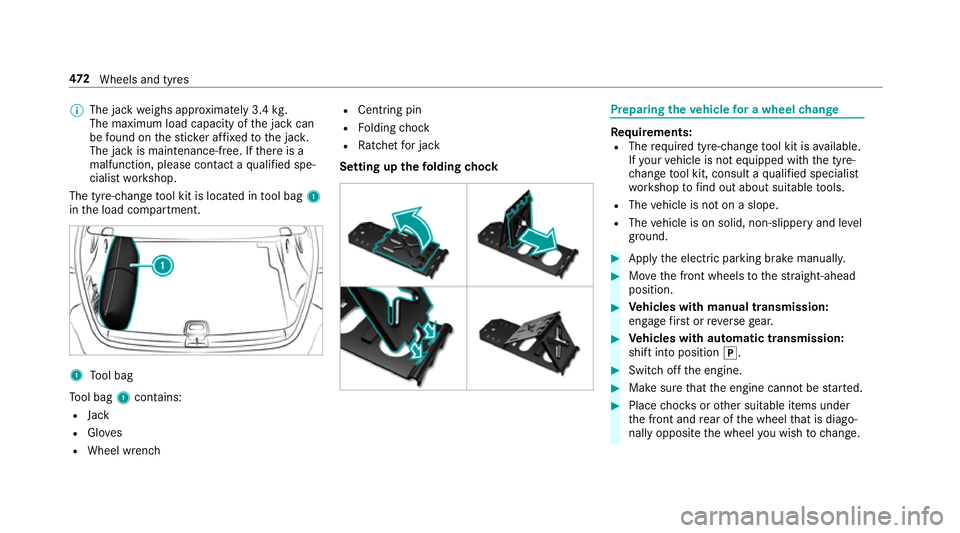
The tyre-change tool kit is located in tool bag 1
in the load compartment. 1
Tool bag
To ol bag 1contains:
R Jack
R Gloves
R Wheel wrench R
Centring pin
R Folding chock
R Ratchet for jack
Setting up thefo lding chock Prepa
ring theve hicle for a wheel change Re
quirements:
R The requ ired tyre-change tool kit is available.
If yo ur vehicle is not equipped with the tyre-
ch ange tool kit, consult a qualified specialist
wo rkshop tofind out about suitable tools.
R The vehicle is not on a slope.
R The vehicle is on solid, non-slippery and le vel
ground. #
Apply the electric parking brake manually. #
Movethe front wheels tothest ra ight-ahead
position. #
Vehicles with manual transmission:
engage firs t or reve rsege ar. #
Vehicles with automatic transmission:
shift into position j. #
Switch off the engine. #
Make sure that the engine cann otbe star ted. #
Place choc ks orother suitable items under
th e front and rear of the wheel that is diago‐
nally opposite the wheel you wish tochange. 472
Wheels and tyres
Page 477 of 609
Ru
les of conduct when theve hicle is raised:
R Never place your hands or feet under the
ve hicle.
R Do not lie under theve hicle.
R Do not start the engine and do not release
th e electric parking brake.
R Do not open or close any doors or theta il‐
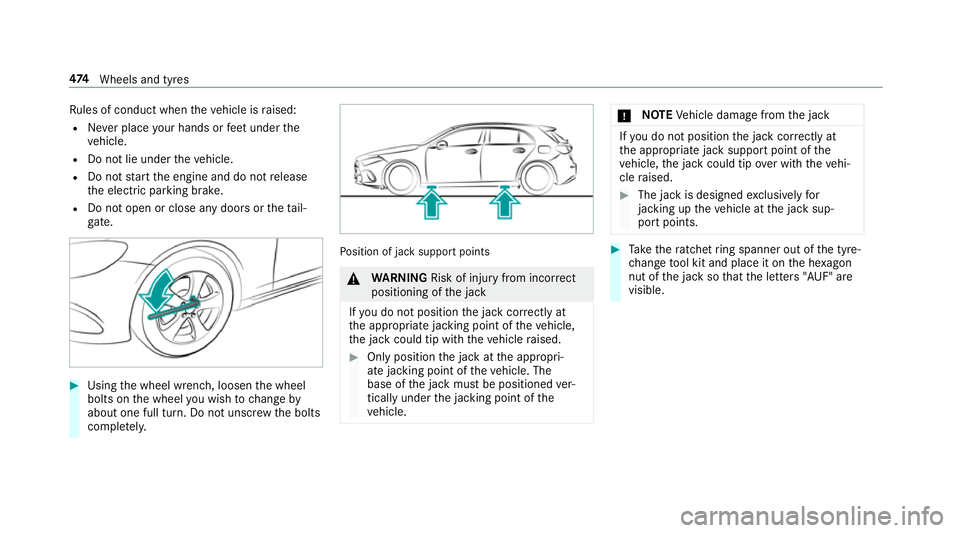
ga te. #
Using the wheel wrench, loosen the wheel
bolts on the wheel you wish tochange by
about one full turn. Do not unscr ewthe bolts
comple tely. Po
sition of jack support points &
WARNING Risk of inju ryfrom incor rect
positioning of the jack
If yo u do not position the jack cor rectly at
th e appropriate jacking point of theve hicle,
th e jack could tip with theve hicle raised. #
Only position the jack at the appropri‐
ate jacking point of theve hicle. The
base of the jack must be positioned ver‐
tically under the jacking point of the
ve hicle. *
NO
TEVehicle damage from the jack If
yo u do not position the jack cor rectly at
th e appropriate jack support point of the
ve hicle, the jack could tip over with theve hi‐
cle raised. #
The jack is designed exclusively for
jacking up theve hicle at the jack sup‐
port points. #
Take thera tchet ring spanner out of the tyre-
ch ange tool kit and place it on the he xagon
nut of the jack so that the letters "AUF" are
visible. 474
Wheels and tyres
Page 478 of 609
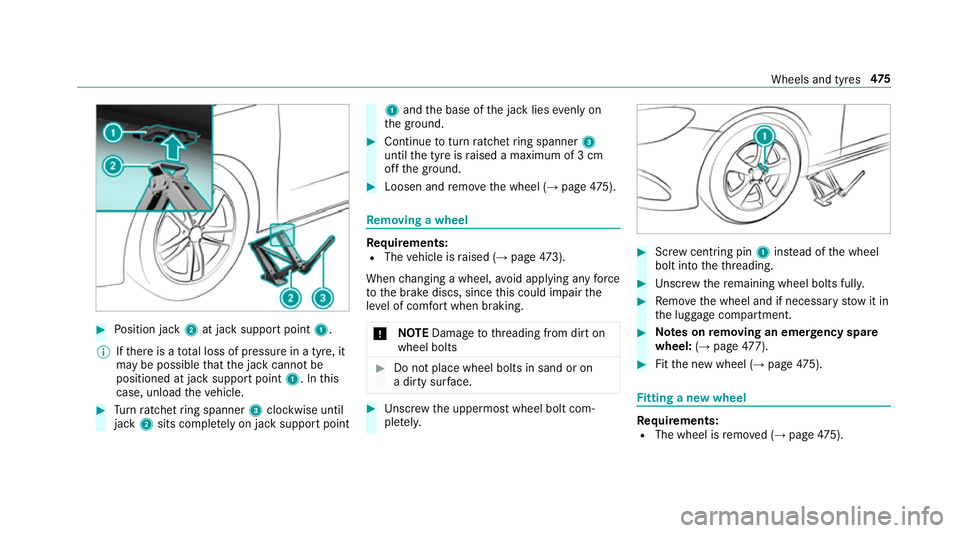
#
Position jack 2at jack support point 1.
% Ifth ere is a total loss of pressure in a tyre, it
may be possible that the jack cann otbe
positioned at jack support point 1. Inthis
case, unload theve hicle. #
Turn ratchet ring spanner 3clockwise until
jack 2sits comple tely on ja cksupport point 1
and the base of the jack lies evenly on
th e ground. #
Continue toturn ratchet ring spanner 3
until the tyre is raised a maximum of 3 cm
off the ground. #
Loosen and remo vethe wheel (→ page475). Re
moving a wheel Re
quirements:
R The vehicle is raised (→ page473).
When changing a wheel, avoid applying any force
to the brake discs, since this could impair the
le ve l of com fort when braking.
* NO
TEDama getothre ading from dirt on
wheel bolts #
Do not place wheel bolts in sand or on
a dirty sur face. #
Unscr ew the uppermost wheel bolt com‐
ple tely. #
Screw centring pin 1instead of the wheel
bolt into theth re ading. #
Unscr ew there maining wheel bolts fully. #
Remo vethe wheel and if necessary stowit in
th e luggage compartment. #
Note s onremoving an eme rgency spa re
wheel: (→page 477). #
Fitth e new wheel (→ page475). Fi
tting a new wheel Re
quirements:
R The wheel is remo ved (→ page 475). Wheels and
tyres475
Page 488 of 609
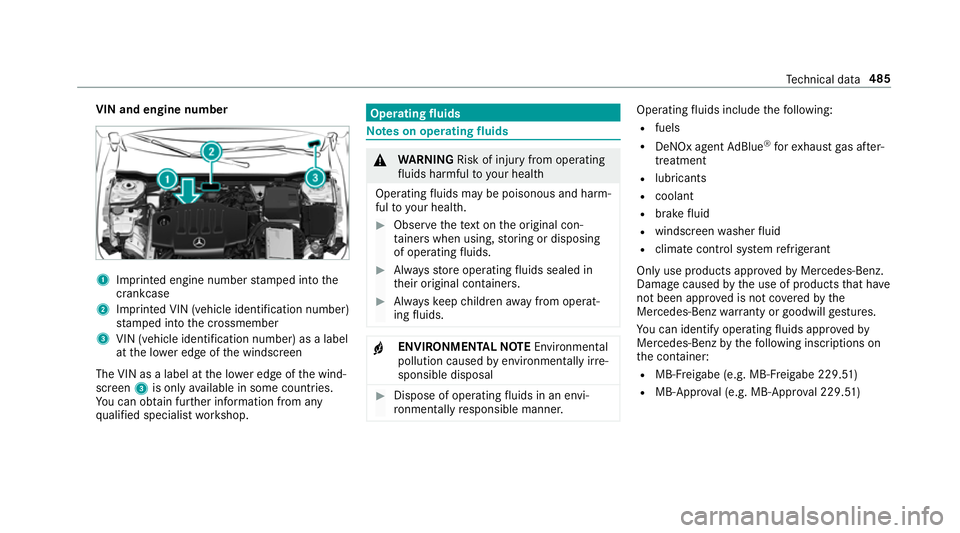
VIN and engine number
1
Imprinted engine number stamped into the
crankcase
2 Imprinted VIN (vehicle identification number)
stamped into the crossmember
3 VIN (vehicle identification number) as a label
at the lo wer edge of the windscreen
The VIN as a label at the lo wer edge of the wind‐
screen 3is only available in some countries.
Yo u can obtain fur ther information from any
qu alified specialist workshop. Operating
fluids Note
s on operating fluids &
WARNING Risk of inju ryfrom operating
fl uids harmful to your health
Operating fluids may be poisonous and harm‐
ful to yo ur health. #
Obser vethete xt on the original con‐
ta iners when using, storing or disposing
of operating fluids. #
Alw aysst ore operating fluids sealed in
th eir original conta iners. #
Alw ayske ep children away from operat‐
ing fluids. +
ENVIRONMEN
TALNO TEEnvironmental
pollution caused byenvironmen tally ir re‐
sponsible disposal #
Dispose of operating fluids in an envi‐
ro nmentally responsible manner. Operating
fluids include thefo llowing:
R fuels
R DeNOx agent AdBlue ®
forex haust gas af ter‐
treatment
R lubri cants
R coolant
R brake fluid
R windsc reen washer fluid
R climate cont rol sy stem refrigerant
Only use products app rove dby Mercedes-Benz.
Damage caused bythe use of products that ha ve
not been appr oved is not co veredby the
Mercedes-Benz warranty or goodwill gestures.
Yo u can identify operating fluids appr ovedby
Mercedes-Benz bythefo llowing insc ript ions on
th e conta iner:
R MB- Freigabe (e.g. MB-Fr eigabe 229.51 )
R MB-Appr oval (e.g. MB-App rova l 229.51) Te
ch nical da ta485
Page 495 of 609
Re
placement amount Mode
lR eplacement
amount
A 16 0
A 180
A 200 5.1 litres
A 18 0 d
A 250 5.5 litres
All other models 6.5 litresNote
s on brake fluid Obser
vethe no tes on operating fluids
(→ page 485). &
WARNING Risk of an accident due to
va pour poc kets form ing in the brake sys‐
tem
The brake fluid cons tantly absorbs moi sture
from the air. This lo wersthe boiling point of
th e brake fluid. If the boiling point is too lo w, va
pour poc kets may form inthe brake sys‐
te m when the brakes are applied hard.
This impairs the braking ef fect. #
Have the brake fluid rene we d at the
specified inter vals. Ha
ve the brake fluid regularly replaced at a
qu alified specialist workshop.
Only use brake fluid appr ovedby Mercedes-Benz
according toMB-F reigabe or MB-Appr oval 33 1.0.
Yo u can obtain fur ther information on brake fluid
in thefo llowing places:
R inthe Mercedes-Benz Specifications for
Operating Fluids
- at http://be vo.mercedes-benz.com
- inthe Mercedes-Benz BeVo App
R at a qualified specialist workshop Coolant
Note
s on coolant
Obser vethe no tes on operating fluids
(→ page 485). &
WARNING Risk offire ‑ and inju ryfrom
antifreeze
If antifreeze comes into contact with hot
component parts in the engine compart‐
ment, it may ignite. #
Allow the engine tocool down before
yo uto p up the antif reeze. #
Make sure that no antifreeze spills out
next tothefiller opening. #
Thoroughly clean the antif reeze from
component parts before starting the
ve hicle. *
NO
TEDama gecaused byincor rect cool‐
ant #
Only add coolant that has been pre‐
mixed with therequ ired antifreeze pro‐
te ction. 492
Tech nical da ta
Page 499 of 609
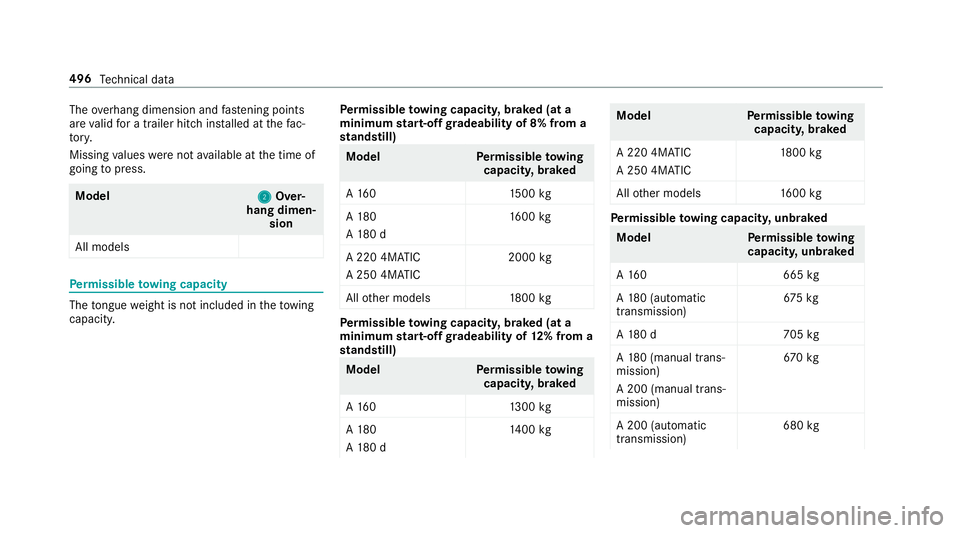
The
overhang dimension and fastening points
are valid for a trailer hitch ins talled at thefa c‐
to ry.
Missing values werenot available at the time of
going topress. Model
2
2Over‐
hang dimen‐ sion
All models Pe
rm issible towing capacity The
tongue weight is not included in theto wing
capacity. Pe
rm issible towing capacit y,braked (at a
minimum start-off gradeability of 8% from a
st andstill) Model
Perm issible towing
capacit y,braked
A 16 01 500kg
A 180
A 18 0 d 16
00 kg
A 220 4MATIC
A 250 4MATIC 2000
kg
All other models 1800 kg Pe
rm issible towing capacit y,braked (at a
minimum start-off gradeability of 12% from a
st andstill) Model
Perm issible towing
capacit y,braked
A 16 01 300kg
A 180
A 18 0 d 14
00 kg Model
Perm issible towing
capacit y,braked
A 220 4MATIC
A 250 4MATIC 18
00 kg
All other models 1600 kg Pe
rm issible towing capacit y,unbraked Model
Perm issible towing
capacit y,unbraked
A 16 06 65kg
A 18 0 (au tomatic
transmission) 67
5kg
A 18 0d7 05kg
A 18 0 (manual trans‐
mission)
A 200 (manual trans‐
mission) 67
0kg
A 200 (automatic
transmission) 680
kg 496
Tech nical da ta
Page 500 of 609
Model
Perm issible towing
capacit y,unbraked
A 200 d7 25kg
A 220 d7 40kg
A 220 4MATIC 745kg
A 250 720kg
A 250 4MATIC 750kg Maximum
tongue weight *
NO
TEDama gecaused bythe trailer
coming loose If
th eto ngue weight used is too lo w,the
trailer may come loose. #
The tongue weight must not be below
50 kg. #
Use a tongue weight that is as close as
possible tothe maximum permissible
to ngue weight. Maximum
tongue weight Model
All models
80kg Pe
rm issible rear axle load during trailer
operation Axle load
Model
Axle load
A 16 09 77kg
A 18 0 (au tomatic
transmission)
A 200 (auto matic
transmission) 97
6kg
A 18 0 (manual trans‐
mission)
A 200 (manual trans‐
mission) 978
kg
A 18 0 d
A 200 d 97
0kg Model
Axle load
A 220 d9 83kg
A 220 4MATIC 974kg
A 250 986kg
A 250 4MATIC 1027 kg Te
ch nical da ta497
Page 502 of 609
Saf
ety sy stems Display messages
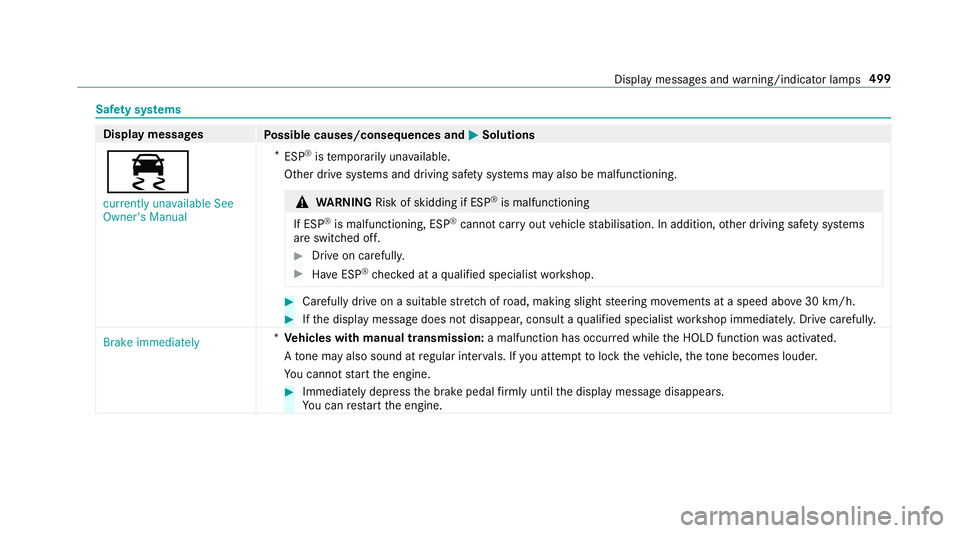
Possible causes/consequences and M
MSolutions
÷ currently unavailable See
Owner's Manual *
ESP ®
is temp orarily una vailable.
Other drive sy stems and driving saf ety sy stems may also be malfunctioning. &
WARNING Risk of skidding if ESP ®
is malfunctioning
If ESP ®
is malfunctioning, ESP ®
cannot car ryout vehicle stabilisation. In addition, other driving saf ety sy stems
are switched off. #
Drive on carefull y. #
Have ESP ®
ch ecked at a qualified specialist workshop. #
Carefully drive on a suitable stre tch of road, making slight steering mo vements at a speed abo ve30 km/h. #
Ifth e display message does not disappear, consult a qualified specialist workshop immediately. Drive carefully.
Brake immediately *
Ve hicles with manual transmission: a malfunction has occurred while the HOLD function was activated.
A tone may also sound at regular inter vals. If you attem pttolock theve hicle, theto ne becomes louder.
Yo u cannot start the engine. #
Immediately depress the brake pedal firm lyuntil the display message disappears.
Yo u can restart the engine. Display messages and
warning/indicator lamps 499
Page 503 of 609
Display messages
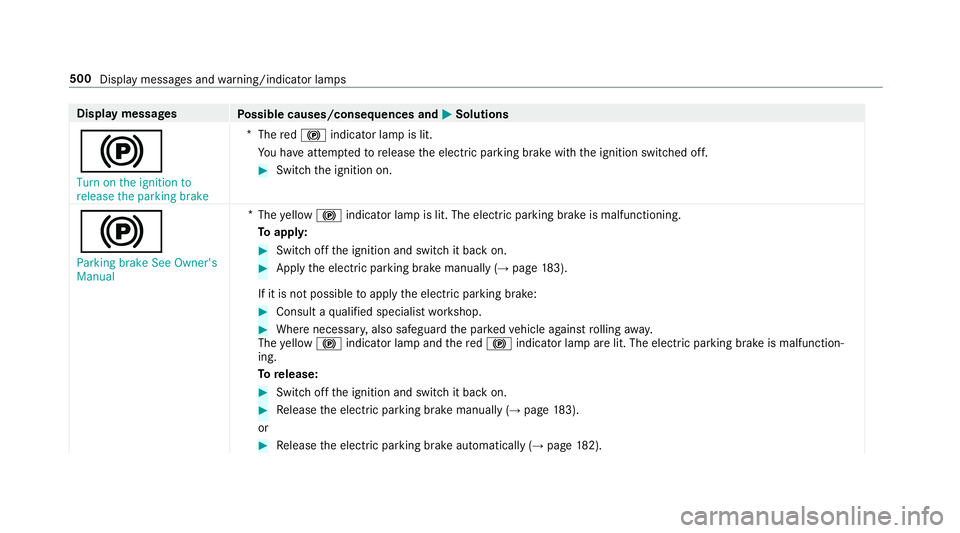
Possible causes/consequences and M
MSolutions
! Turn on the ignition to
release the parking brake *
The red! indicator lamp is lit.
Yo u ha veattem ptedto release the electric parking brake with the ignition switched off. #
Switch the ignition on.
! Parking brake See Owner's
Manual *
The yellow ! indicator lamp is lit. The elect ric pa rking brake is malfunctioning.
To appl y: #
Switch off the ignition and switch it back on. #
Apply the electric parking brake manually (→ page183).
If it is not possible toapply the electric parking brake: #
Consult a qualified specialist workshop. #
Where necessar y,also safeguard the par kedve hicle against rolling away.
The yellow ! indicator lamp and there d! indicator lamp are lit. The elect ric pa rking brake is malfunction‐
ing.
To release: #
Swit choff the ignition and switch it back on. #
Release the electric parking brake manually (→ page183).
or #
Release the electric parking brake automatically (→ page182). 500
Displaymessa ges and warning/indicator lamps