light switch MERCEDES-BENZ B-CLASS HATCHBACK 2008 User Guide
[x] Cancel search | Manufacturer: MERCEDES-BENZ, Model Year: 2008, Model line: B-CLASS HATCHBACK, Model: MERCEDES-BENZ B-CLASS HATCHBACK 2008Pages: 305, PDF Size: 5.1 MB
Page 26 of 305
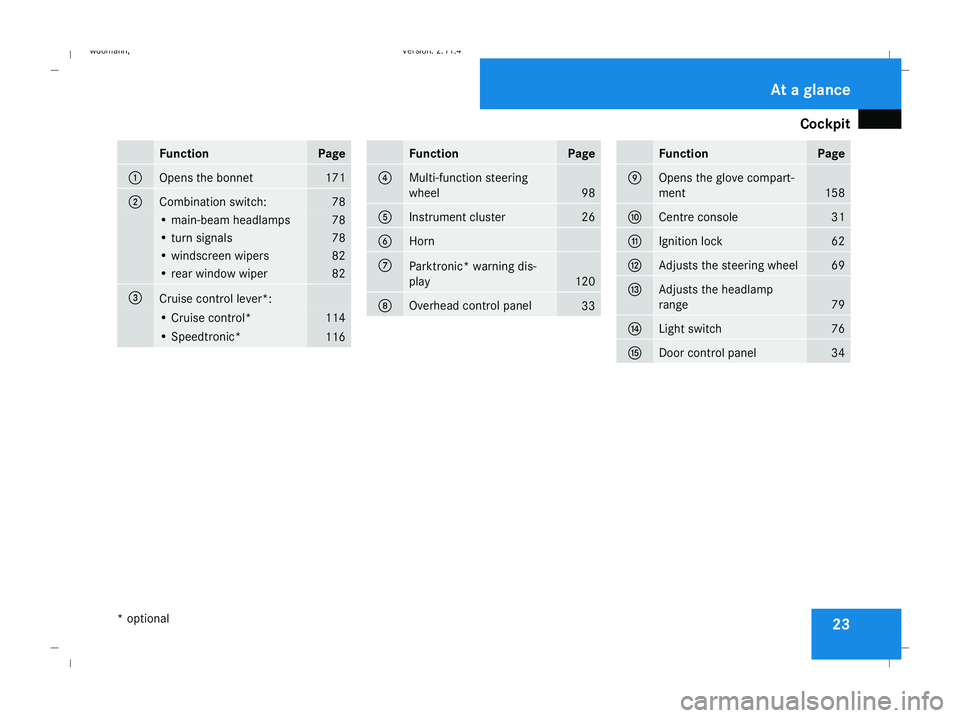
Cockpit
23Function Page
1
Opens the bonnet 171
2
Combination switch: 78
• main-beam headlamps 78
• turn signals 78
• windscreen wipers 82
• rear window wiper 82
3
Cruise control lever*:
• Cruise control* 114
• Speedtronic*
116 Function Page
4
Multi-function steering
wheel
98
5
Instrument cluster 26
6
Horn
7
Parktronic* warning dis-
play
120
8
Overhead control panel
33 Function Page
9
Opens the glove compart-
ment
158
a
Centre console 31
b
Ignition lock 62
c
Adjusts the steering wheel 69
d
Adjusts the headlamp
range
79
e
Light switch 76
f
Door control panel 34At a glance
* optional
245_AKB; 2; 7, en-GB
wdomann
,V ersion: 2.11.4
2008-10-17T11:22:31+02:00 - Seite 23 Dateiname: 6515_1640_02_buchblock.pdf; preflight
Page 28 of 305
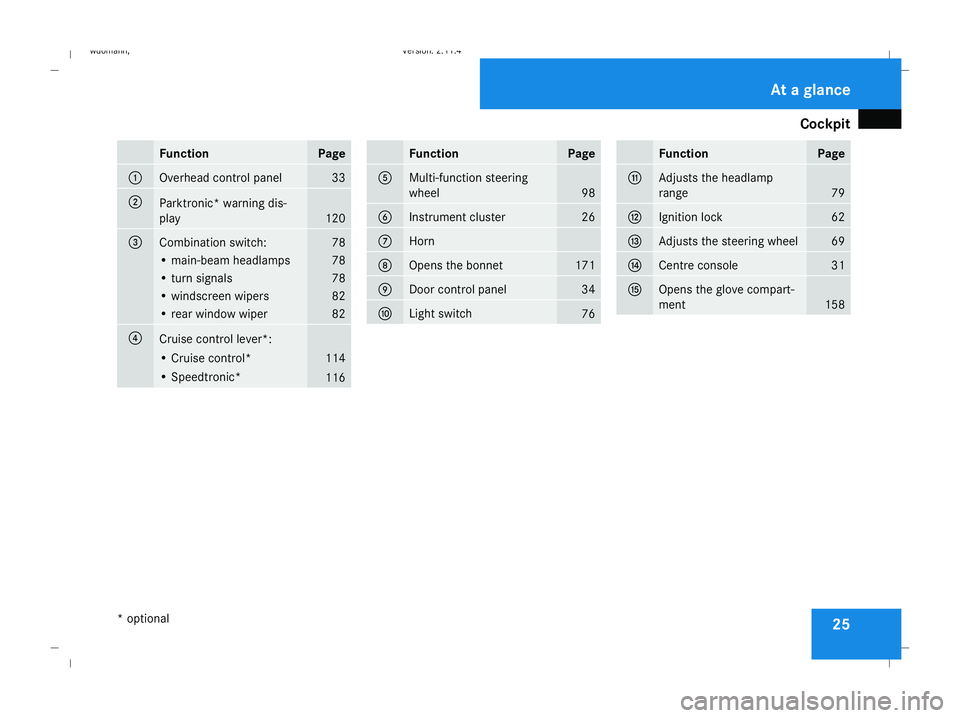
Cockpit
25Function Page
1
Overhead control panel 33
2
Parktronic* warning dis-
play
120
3
Combination switch: 78
• main-beam headlamps 78
• turn signals 78
• windscreen wipers 82
• rear window wiper 82
4
Cruise control lever*:
• Cruise control* 114
• Speedtronic*
116 Function Page
5
Multi-function steering
wheel
98
6
Instrument cluster 26
7
Horn
8
Opens the bonnet 171
9
Door control panel 34
a
Light switch
76 Function Page
b
Adjusts the headlamp
range
79
c
Ignition lock 62
d
Adjusts the steering wheel 69
e
Centre console 31
f
Opens the glove compart-
ment
158At a glance
* optional
245_AKB; 2; 7, en-GB
wdomann
,V ersion: 2.11.4
2008-10-17T11:22:31+02:00 - Seite 25 Dateiname: 6515_1640_02_buchblock.pdf; preflight
Page 30 of 305
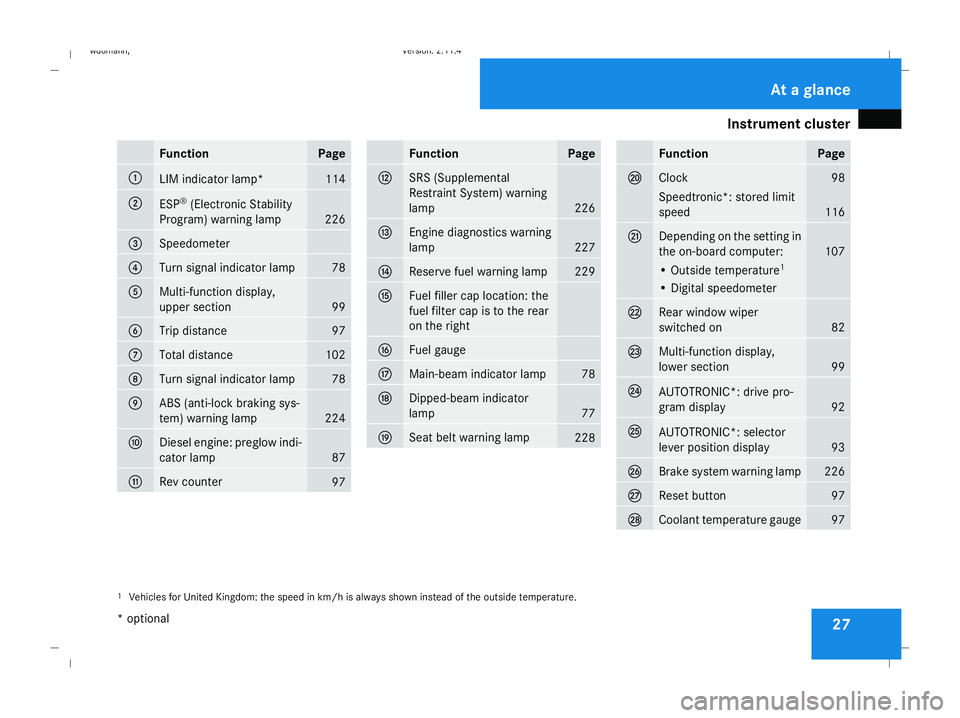
Instrument cluster
27Function Page
1
LIM indicator lamp* 114
2
ESP
®
(Electronic Stability
Program) warning lamp 226
3
Speedometer
4
Turn signal indicator lamp 78
5
Multi-function display,
upper section
99
6
Trip distance 97
7
Total distance 102
8
Turn signal indicator lamp 78
9
ABS (anti-lock braking sys-
tem) warning lamp
224
a
Diesel engine: preglow indi-
cator lamp
87
b
Rev counter
97 Function Page
c
SRS (Supplemental
Restraint System) warning
lamp
226
d
Engine diagnostics warning
lamp
227
e
Reserve fuel warning lamp 229
f
Fuel filler cap location: the
fuel filter cap is to the rear
on the right
g
Fuel gauge
h
Main-beam indicator lamp 78
j
Dipped-beam indicator
lamp
77
k
Seat belt warning lamp
228 Function Page
l
Clock 98
Speedtronic*: stored limit
speed
116
m
Depending on the setting in
the on-board computer:
107
• Outside temperature
1 • Digital speedometer
n
Rear window wiper
switched on
82
o
Multi-function display,
lower section
99
p
AUTOTRONIC*: drive pro-
gram display
92
q
AUTOTRONIC*: selector
lever position display
93
r
Brake system warning lamp 226
s
Reset button 97
t
Coolant temperature gauge 97
1
Vehicles for United Kingdom: the speed in km/h is always shown instead of the outside temperature. At a glance
* optional
245_AKB; 2; 7, en-GB
wdomann
,V ersion: 2.11.4
2008-10-17T11:22:31+02:00 - Seite 27 Dateiname: 6515_1640_02_buchblock.pdf; preflight
Page 32 of 305
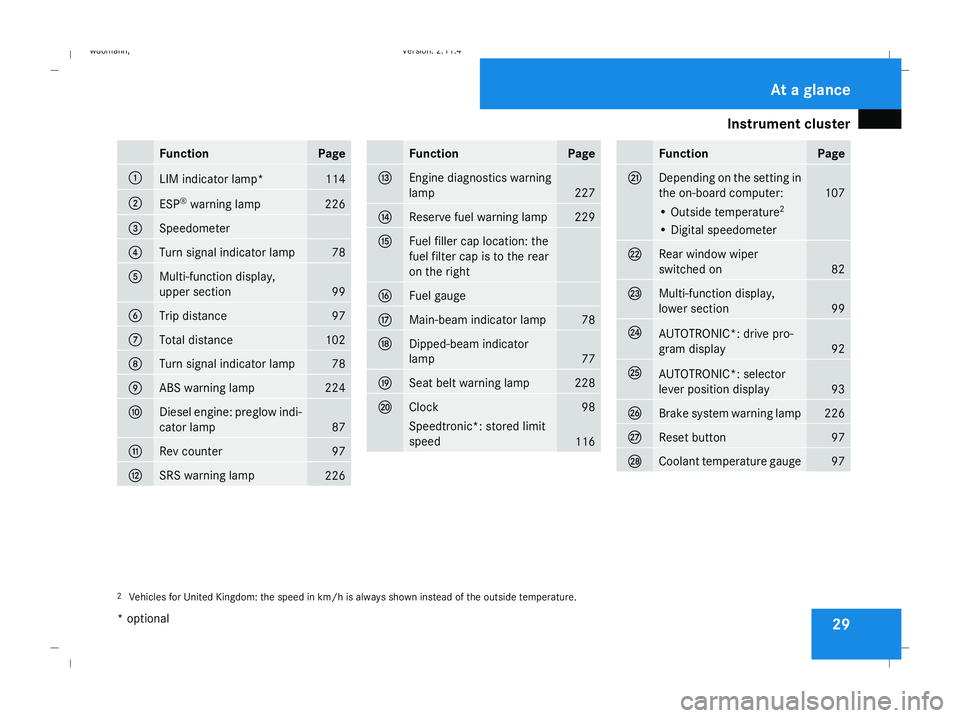
Instrument cluster
29Function Page
1
LIM indicator lamp* 114
2
ESP
®
warning lamp 226
3
Speedometer
4
Turn signal indicator lamp 78
5
Multi-function display,
upper section
99
6
Trip distance 97
7
Total distance 102
8
Turn signal indicator lamp 78
9
ABS warning lamp 224
a
Diesel engine: preglow indi-
cator lamp
87
b
Rev counter 97
c
SRS warning lamp
226 Function Page
d
Engine diagnostics warning
lamp
227
e
Reserve fuel warning lamp 229
f
Fuel filler cap location: the
fuel filter cap is to the rear
on the right
g
Fuel gauge
h
Main-beam indicator lamp 78
j
Dipped-beam indicator
lamp
77
k
Seat belt warning lamp 228
l
Clock 98
Speedtronic*: stored limit
speed
116 Function Page
m
Depending on the setting in
the on-board computer:
107
• Outside temperature
2 • Digital speedometer
n
Rear window wiper
switched on
82
o
Multi-function display,
lower section
99
p
AUTOTRONIC*: drive pro-
gram display
92
q
AUTOTRONIC*: selector
lever position display
93
r
Brake system warning lamp 226
s
Reset button 97
t
Coolant temperature gauge 97
2
Vehicles for United Kingdom: the speed in km/h is always shown instead of the outside temperature. At a glance
* optional
245_AKB; 2; 7, en-GB
wdomann
,V ersion: 2.11.4
2008-10-17T11:22:31+02:00 - Seite 29 Dateiname: 6515_1640_02_buchblock.pdf; preflight
Page 33 of 305
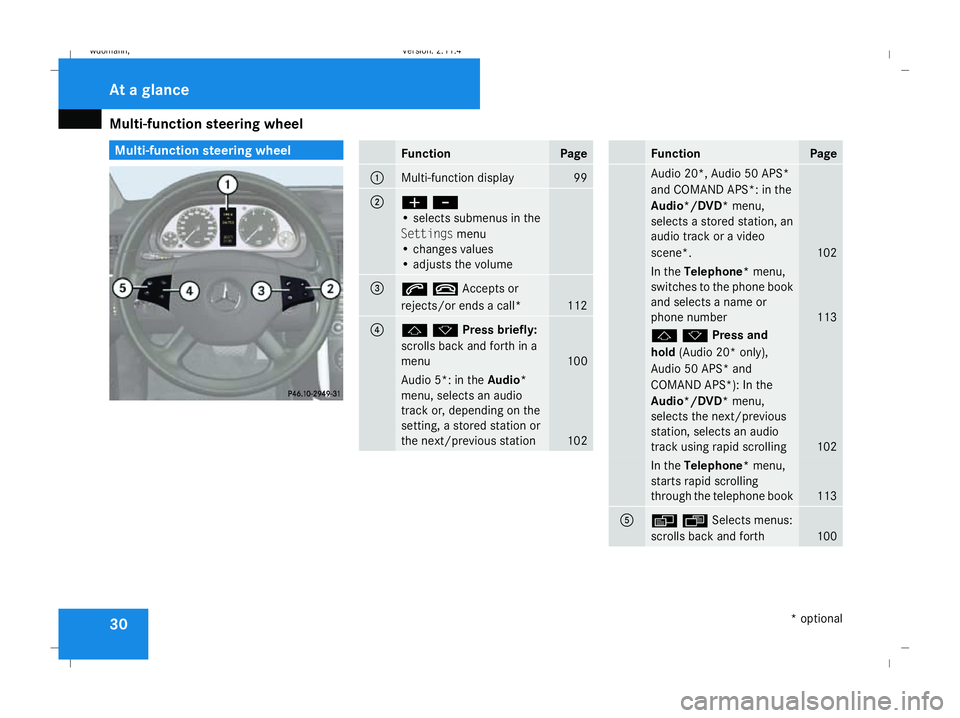
Multi-function steering wheel
30 Multi-function steering wheel
Function Page
1
Multi-function display 99
2
æ
-
• selects submenus in the
Settings menu
• changes values
• adjusts the volume 3
stAccepts or
rejects/or ends a call*
112
4
jkPress briefly:
scrolls back and forth in a
menu
100
Audio 5*: in the
Audio*
menu, selects an audio
track or, depending on the
setting, a stored station or
the next/previous station 102 Function Page
Audio 20*, Audio 50 APS*
and COMAND APS*: in the
Audio*/DVD*
menu,
selects a stored station, an
audio track or a video
scene*. 102
In the
Telephone* menu,
switches to the phone book
and selects a name or
phone number 113
jkPress and
hold
(Audio 20* only),
Audio 50 APS* and
COMAND APS*): In the
Audio*/DVD* menu,
selects the next/previous
station, selects an audio
track using rapid scrolling 102
In the
Telephone* menu,
starts rapid scrolling
through the telephone book 113
5
èÿSelects menus:
scrolls back and forth
100At a glance
* optional
245_AKB; 2; 7, en-GB
wdomann,
Version: 2.11.4 2008-10-17T11:22:31+02:00 - Seite 30Dateiname: 6515_1640_02_buchblock.pdf; preflight
Page 34 of 305

Centre console
31Centre console
Upper section Function Page
1
Switches the hazard warn-
ing lamps on/off
79
2
5
PASSENGER AIRBAG
OFF warning lamp* 45
3
Controls COMAND APS*
and the audio system* –
see the respective operat-
ing instructions
4
Controls Heatmatic, the air-
conditioning system* or
Thermotronic*
128
Switches the rear window
heating on/off
139
5
Activates/deactivates the
seat heating* for the right-
hand seat
68
6
Activates/deactivates the
ECO start/stop function*
126
7
Primes/deactivates the
interior motion sensor*/
tow-away protection*
58 Function Page
8
Deactivates/activates
Parktronic*
121
9
Activates/deactivates the
seat heating* for the left-
hand seat
68At a glance
* optional
245_AKB; 2; 7, en-GB
wdomann,
Version: 2.11.4 2008-10-17T11:22:31+02:00 - Seite 31Dateiname: 6515_1640_02_buchblock.pdf; preflight
Page 36 of 305
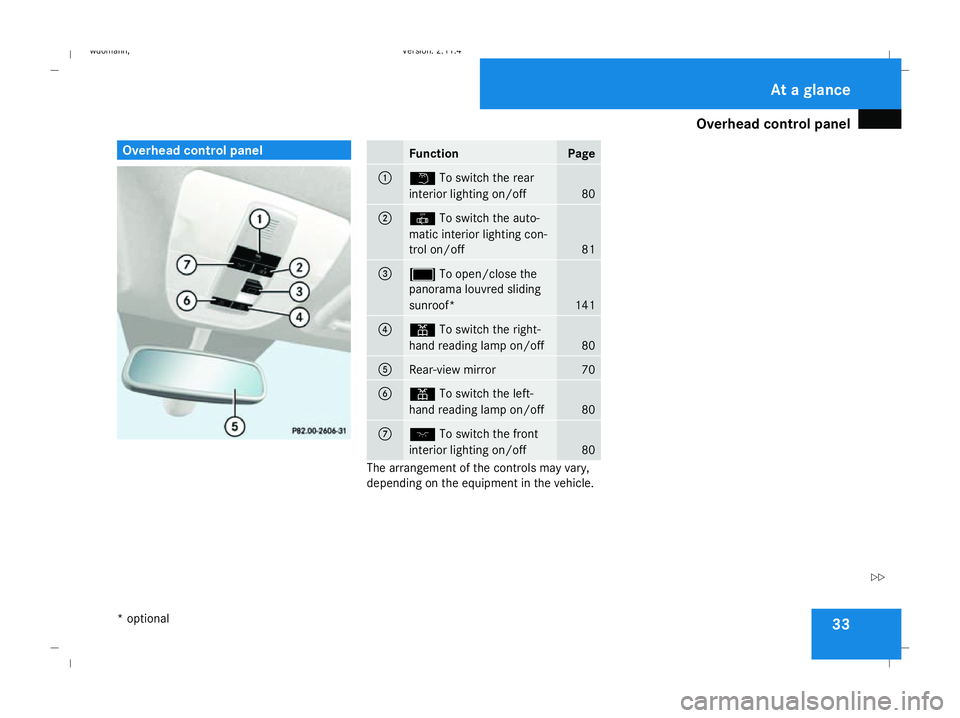
Overhead control panel
33Overhead control panel
Function Page
1
£
To switch the rear
interior lighting on/off 80
2
¥
To switch the auto-
matic interior lighting con-
trol on/off 81
3
a
To open/close the
panorama louvred sliding
sunroof* 141
4
X
To switch the right-
hand reading lamp on/off 80
5
Rear-view mirror 70
6
X
To switch the left-
hand reading lamp on/off 80
7
ð
To switch the front
interior lighting on/off 80
The arrangement of the controls may vary,
depending on the equipment in the vehicle. At a glance
* optional
245_AKB; 2; 7, en-GB
wdomann ,V ersion: 2.11.4
2008-10-17T11:22:31+02:00 - Seite 33 ZDateiname: 6515_1640_02_buchblock.pdf; preflight
Page 40 of 305
Occupant safety
37carry out any modifications on the restraint
systems.
Never tamper with electronic components
and their software.
SRS (Supplemental Restraint System)
The SRS reduces the risk of occupants com-
ing into contact with the vehicle's interior in
the event of an accident. It can also reduce
the forces to which occupants are subjected
during an accident.
The SRS consists of:
R The 1 warning lamp
R belt tensioners
R belt force limiters
R airbags
The 1 1 warning lamp The SRS functions are checked regularly
when you turn on the ignition and when the
engine is running. Malfunctions can therefore
be detected in good time.
The
1 warning lamp in the instrument
cluster lights up when the ignition is switched
on. It goes out no later than a few seconds
after the engine is started. G
Risk of injury
If SRS is malfunctioning, individual systems
may be activated unintentionally or not be
deployed in the event of an accident with
heavy braking.
A malfunction has occurred if the +
warning lamp:
R does not light up when you switch on the
ignition
R does not go out after the engine has been
running for a few seconds
R lights up again once the engine is running
In this case, have SRS checked immedi-
ately at a qualified specialist workshop.
Triggering of belt tensioners, belt force
limiters and airbags In the event of a collision, the sensor in the
airbag control unit evaluates important phys-
ical data such as duration, direction and force
of the vehicle deceleration or acceleration.
Based on the evaluation of this data and
depending on the vehicle's rate of longitudi-
nal deceleration in a collision, in the first
stage the airbag control unit pre-emptively
triggers the belt tensioners. The front airbags are only deployed if there is
an even higher rate of vehicle deceleration in
a longitudinal direction.
Your vehicle has adaptive, dual stage front
airbags. When the first activation threshold is
reached, the front airbag is filled with enough
propellant gas to reduce the risk of injuries.
The front airbag is only fully inflated if a sec-
ond threshold is reached within a few milli-
seconds, due to the control unit having detec-
ted further deceleration.
Criteria for triggering belt tensioners and
airbags
In the first stage of a collision, the airbag con-
trol unit evaluates the duration and direction
of vehicle acceleration or deceleration in
order to determine whether it is necessary to
trigger the belt tensioner and/or airbag.
The belt tensioner and airbag triggering
thresholds are variable and are adapted to the
rate of deceleration of the vehicle. This proc-
ess is pre-emptive in nature as the airbag
must be deployed during – and not at the end
of – the collision.
i Airbags are not deployed in all types of
accidents. They are controlled by complex
sensor technology and evaluation logic.
This process is pre-emptive in nature as Safety
245_AKB; 2; 7, en-GB
wdomann
,V ersion: 2.11.4
2008-10-17T11:22:31+02:00 - Seite 37 ZDateiname: 6515_1640_02_buchblock.pdf; preflight
Page 41 of 305
Occupant safety
38airbag deployment must take place during
the impact and must be adapted to provide
calculated, additional protection for the
vehicle occupants. Not all airbags are
deployed in an accident.
The different airbag systems work inde-
pendently of each other. However, the
deployment of each individual system will
depend on the type of accident determined
by the control system in the first stages of
the collision (head-on collision, side impact
and overturn) and the extent of the acci-
dent (in particular, the vehicle's rate of
deceleration or acceleration).
The rate of vehicle deceleration or accelera-
tion and the direction of the force are basi-
cally determined by:
R the distribution of forces during the colli-
sion
R the collision angle
R the deformation characteristics of the vehi-
cle
R the characteristics of the object with which
the vehicle has collided, e.g. the other vehi-
cle
Factors which can only be seen and measured
after a collision has occurred do not play a decisive role in the deployment of an airbag,
nor do they provide an indication of it.
The vehicle may be deformed significantly,
e. g. on the bonnet or the wing, without an
airbag being deployed. This is the case if only
parts which are relatively easily deformed are
affected and the necessary deceleration does
not occur. Conversely, airbags may be
deployed even though the vehicle suffers only
minor deformations. This is the case if, for
example, very rigid vehicle parts such as lon-
gitudinal body members are affected and suf-
ficient deceleration occurs as a result.
Belt tensioners, belt force limiters The front seat belts and the outer seat belts
in the rear are equipped with belt tensioners.
If the seat belt is also equipped with a belt
force limiter, the force exerted by the seat
belt on the seat occupant is reduced.
Belt tensioners tighten the seat belts in an
accident, pulling them close against the body.
i Belt tensioners do not correct incorrect
seat positions or incorrectly fastened seat
belts.
Belt tensioners do not pull occupants back
towards the backrest. The front belt force limiters are synchronised
with the front airbags, which distribute the
forces exerted by the belt force limiters on
the occupant over a greater area.
When the ignition is switched on, the belt ten-
sioner is triggered:
R
only if the restraint systems are operational
(the 1 warning lamp lights up after the
ignition is switched on and goes out once
the engine is running) (Y page 37)
R in the event of a head-on or rear-end colli-
sion if the vehicle decelerates or acceler-
ates rapidly in a longitudinal direction dur-
ing the initial stages of impact
If the airbags are deployed, you will hear a
bang and a small amount of powder may also
be released. Only in rare cases will the bang
affect your hearing. The powder that escapes
does not generally constitute a health hazard.
The 1 warning lamp lights up. G
Risk of injury
If the seat belt tensioners have been trig-
gered, they provide no additional protec-
tion in the event of another accident. There-
fore, have belt tensioners which have been
triggered replaced at a qualified specialist
workshop. Safety
245_AKB; 2; 7, en-GB
wdomann
,V ersion: 2.11.4
2008-10-17T11:22:31+02:00 - Seite 38 Dateiname: 6515_1640_02_buchblock.pdf; preflight
Page 48 of 305
Occupant safety
45
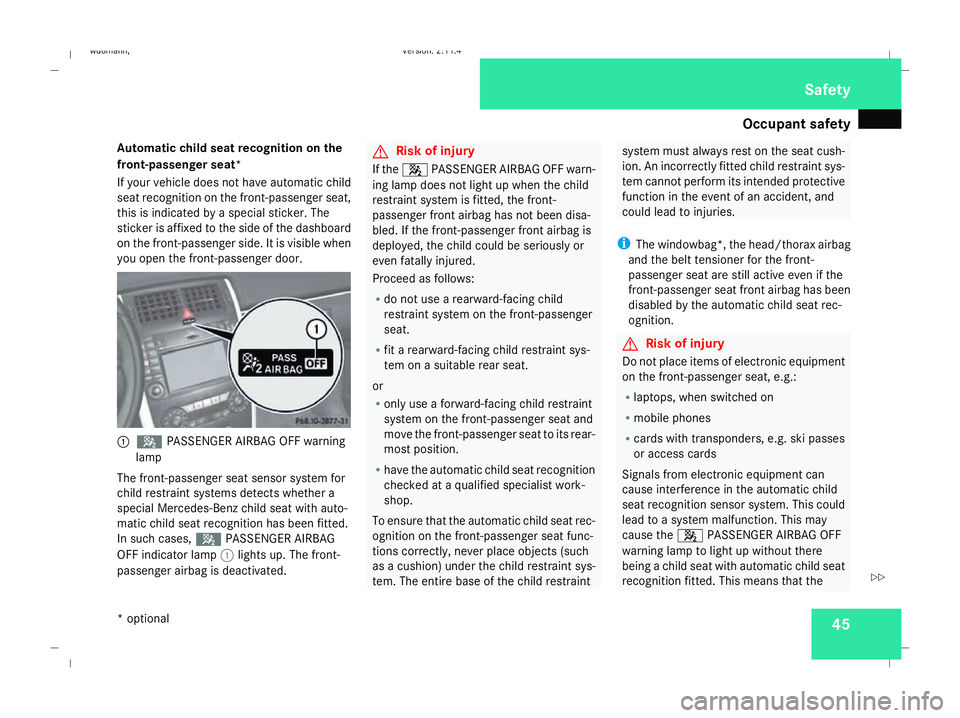
Automatic child seat recognition on the
front-passenger seat*
If your vehicle does not have automatic child
seat recognition on the front-passenger seat,
this is indicated by a special sticker. The
sticker is affixed to the side of the dashboard
on the front-passenger side. It is visible when
you open the front-passenger door. 1
5 PASSENGER AIRBAG OFF warning
lamp
The front-passenger seat sensor system for
child restraint systems detects whether a
special Mercedes-Benz child seat with auto-
matic child seat recognition has been fitted.
In such cases, 5PASSENGER AIRBAG
OFF indicator lamp 1lights up. The front-
passenger airbag is deactivated. G
Risk of injury
If the 4 PASSENGER AIRBAG OFF warn-
ing lamp does not light up when the child
restraint system is fitted, the front-
passenger front airbag has not been disa-
bled. If the front-passenger front airbag is
deployed, the child could be seriously or
even fatally injured.
Proceed as follows:
R do not use a rearward-facing child
restraint system on the front-passenger
seat.
R fit a rearward-facing child restraint sys-
tem on a suitable rear seat.
or
R only use a forward-facing child restraint
system on the front-passenger seat and
move the front-passenger seat to its rear-
most position.
R have the automatic child seat recognition
checked at a qualified specialist work-
shop.
To ensure that the automatic child seat rec-
ognition on the front-passenger seat func-
tions correctly, never place objects (such
as a cushion) under the child restraint sys-
tem. The entire base of the child restraint system must always rest on the seat cush-
ion. An incorrectly fitted child restraint sys-
tem cannot perform its intended protective
function in the event of an accident, and
could lead to injuries.
i The windowbag*, the head/thorax airbag
and the belt tensioner for the front-
passenger seat are still active even if the
front-passenger seat front airbag has been
disabled by the automatic child seat rec-
ognition. G
Risk of injury
Do not place items of electronic equipment
on the front-passenger seat, e.g.:
R laptops, when switched on
R mobile phones
R cards with transponders, e.g. ski passes
or access cards
Signals from electronic equipment can
cause interference in the automatic child
seat recognition sensor system. This could
lead to a system malfunction. This may
cause the 4PASSENGER AIRBAG OFF
warning lamp to light up without there
being a child seat with automatic child seat
recognition fitted. This means that the Safety
* optional
245_AKB; 2; 7, en-GB
wdomann,
Version: 2.11.4 2008-10-17T11:22:31+02:00 - Seite 45 ZDateiname: 6515_1640_02_buchblock.pdf; preflight