steering MERCEDES-BENZ B-CLASS HATCHBACK 2008 Service Manual
[x] Cancel search | Manufacturer: MERCEDES-BENZ, Model Year: 2008, Model line: B-CLASS HATCHBACK, Model: MERCEDES-BENZ B-CLASS HATCHBACK 2008Pages: 305, PDF Size: 5.1 MB
Page 212 of 305
Display
messages 209Display messages Possible cause/consequence Possible solution
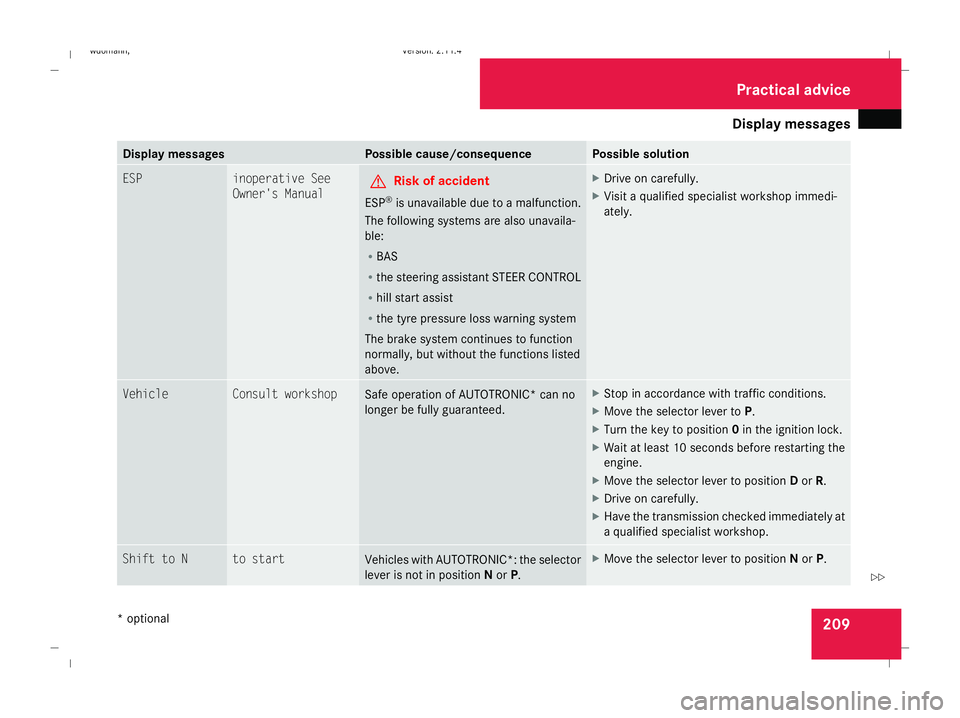
ESP inoperative See
Owner's Manual G
Risk of accident
ESP ®
is unavailable due to a malfunction.
The following systems are also unavaila-
ble:
R BAS
R the steering assistant STEER CONTROL
R hill start assist
R the tyre pressure loss warning system
The brake system continues to function
normally, but without the functions listed
above. X
Drive on carefully.
X Visit a qualified specialist workshop immedi-
ately. Vehicle Consult workshop
Safe operation of AUTOTRONIC* can no
longer be fully guaranteed. X
Stop in accordance with traffic conditions.
X Move the selector lever to P.
X Turn the key to position 0in the ignition lock.
X Wait at least 10 seconds before restarting the
engine.
X Move the selector lever to position Dor R.
X Drive on carefully.
X Have the transmission checked immediately at
a qualified specialist workshop. Shift to N to start
Vehicles with AUTOTRONIC*: the selector
lever is not in position
Nor P. X
Move the selector lever to position Nor P. Practical advi
ce
* optional
245_AKB; 2; 7, en-GB
wdomann,
Version: 2.11.4 2008-10-17T11:22:31+02:00 - Seite 209 ZDateiname: 6515_1640_02_buchblock.pdf; preflight
Page 213 of 305
Display
messages 210 Display messages Possible cause/consequence Possible solution
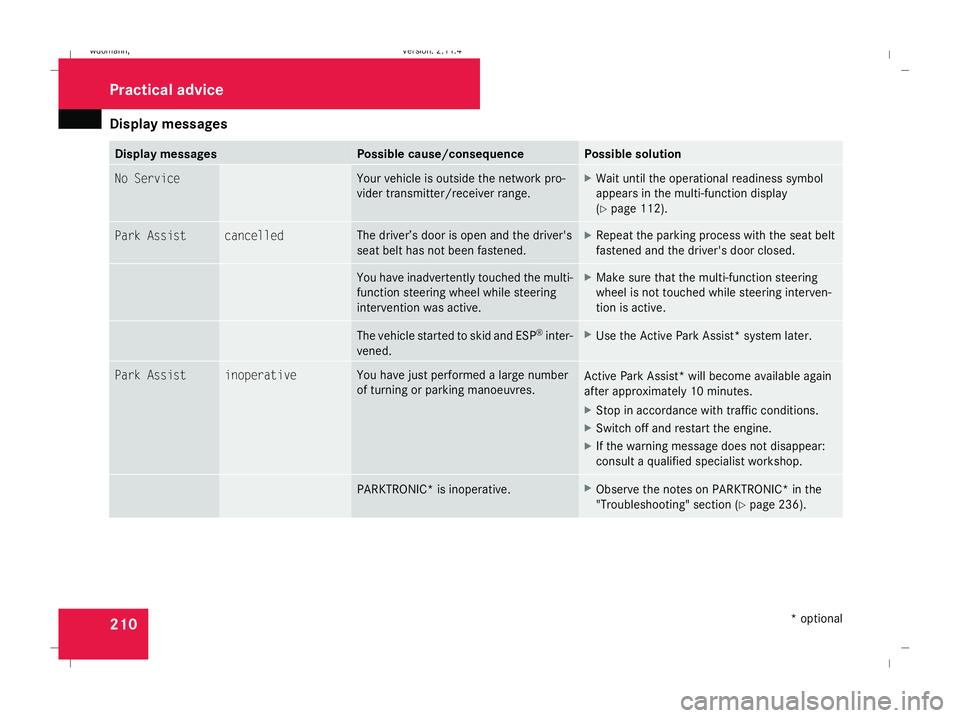
No Service Your vehicle is outside the network pro-
vider transmitter/receiver range. X
Wait until the operational readiness symbol
appears in the multi-function display
(Y page 112). Park Assist cancelled The driver’s door is open and the driver's
seat belt has not been fastened. X
Repeat the parking process with the seat belt
fastened and the driver's door closed. You have inadvertently touched the multi-
function steering wheel while steering
intervention was active. X
Make sure that the multi-function steering
wheel is not touched while steering interven-
tion is active. The vehicle started to skid and ESP
®
inter-
vened. X
Use the Active Park Assist* system later. Park Assist inoperative You have just performed a large number
of turning or parking manoeuvres.
Active Park Assist* will become available again
after approximately 10 minutes.
X
Stop in accordance with traffic conditions.
X Switch off and restart the engine.
X If the warning message does not disappear:
consult a qualified specialist workshop. PARKTRONIC* is inoperative. X
Observe the notes on PARKTRONIC* in the
"Troubleshooting" section (Y page 236).Practical advi
ce
* optional
245_AKB; 2; 7, en-GB
wdomann,
Version: 2.11.4 2008-10-17T11:22:31+02:00 - Seite 210Dateiname: 6515_1640_02_buchblock.pdf; preflight
Page 214 of 305
Display
messages 211Display messages Possible cause/consequence Possible solution
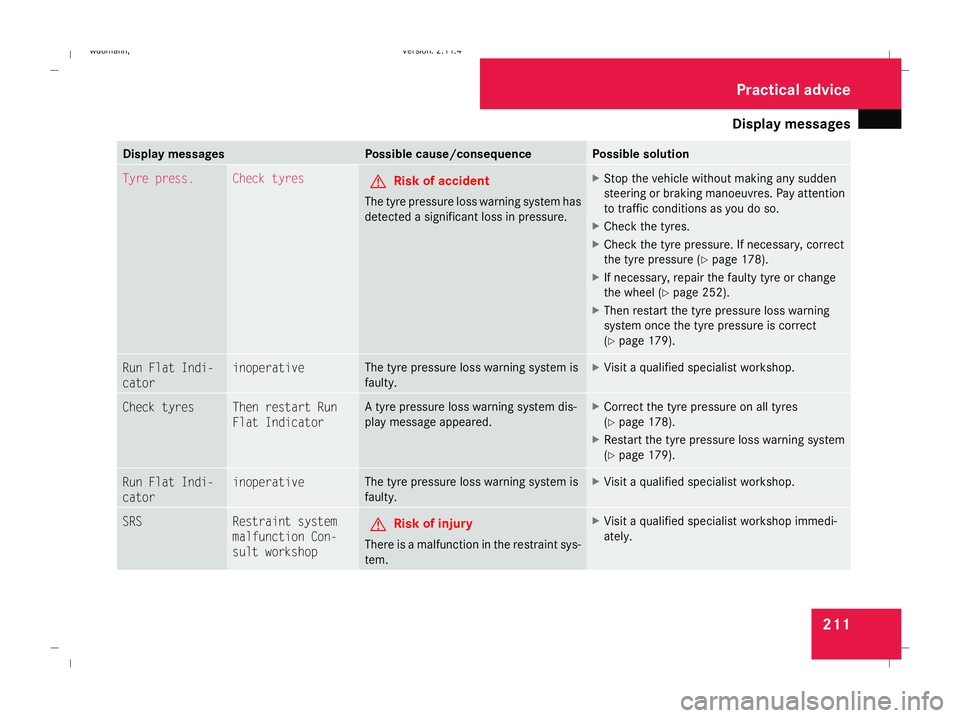
Tyre press. Check tyres
G
Risk of accident
The tyre pressure loss warning system has
detected a significant loss in pressure. X
Stop the vehicle without making any sudden
steering or braking manoeuvres. Pay attention
to traffic conditions as you do so.
X Check the tyres.
X Check the tyre pressure. If necessary, correct
the tyre pressure (Y page 178).
X If necessary, repair the faulty tyre or change
the wheel (Y page 252).
X Then restart the tyre pressure loss warning
system once the tyre pressure is correct
(Y page 179). Run Flat Indi-
cator inoperative The tyre pressure loss warning system is
faulty. X
Visit a qualified specialist workshop. Check tyres Then restart Run
Flat Indicator A tyre pressure loss warning system dis-
play message appeared. X
Correct the tyre pressure on all tyres
(Y page 178).
X Restart the tyre pressure loss warning system
(Y page 179). Run Flat Indi-
cator inoperative The tyre pressure loss warning system is
faulty. X
Visit a qualified specialist workshop. SRS Restraint system
malfunction Con-
sult workshop G
Risk of injury
There is a malfunction in the restraint sys-
tem. X
Visit a qualified specialist workshop immedi-
ately. Practical advi
ce
245_AKB; 2; 7, en-GB
wdomann,
Version: 2.11.4 2008-10-17T11:22:31+02:00 - Seite 211 ZDateiname: 6515_1640_02_buchblock.pdf; preflight
Page 218 of 305
Display
messages 215Display messages Possible cause/consequence Possible solution
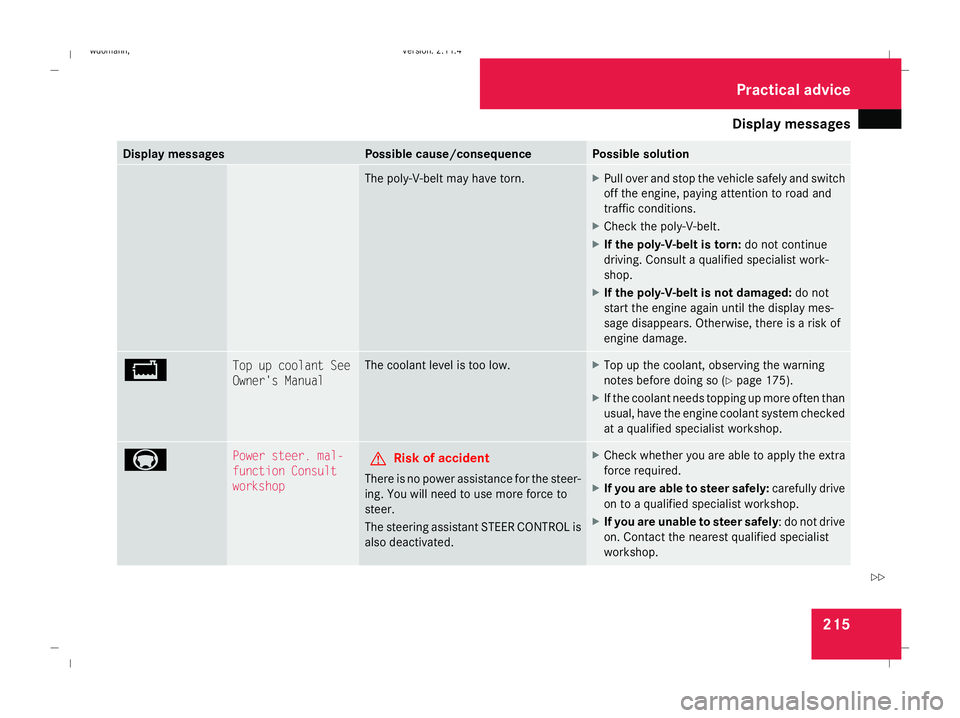
The poly-V-belt may have torn. X
Pull over and stop the vehicle safely and switch
off the engine, paying attention to road and
traffic conditions.
X Check the poly-V-belt.
X If the poly-V-belt is torn: do not continue
driving. Consult a qualified specialist work-
shop.
X If the poly-V-belt is not damaged: do not
start the engine again until the display mes-
sage disappears. Otherwise, there is a risk of
engine damage. B Top up coolant See
Owner's Manual The coolant level is too low. X
Top up the coolant, observing the warning
notes before doing so (Y page 175).
X If the coolant needs topping up more often than
usual, have the engine coolant system checked
at a qualified specialist workshop. 3 Power steer. mal-
function Consult
workshop G
Risk of accident
There is no power assistance for the steer-
ing. You will need to use more force to
steer.
The steering assistant STEER CONTROL is
also deactivated. X
Check whether you are able to apply the extra
force required.
X If you are able to steer safely: carefully drive
on to a qualified specialist workshop.
X If you are unable to steer safely : do not drive
on. Contact the nearest qualified specialist
workshop. Practical advi
ce
245_AKB; 2; 7, en-GB
wdomann,
Version: 2.11.4 2008-10-17T11:22:31+02:00 - Seite 215 ZDateiname: 6515_1640_02_buchblock.pdf; preflight
Page 227 of 305
Troubleshooting
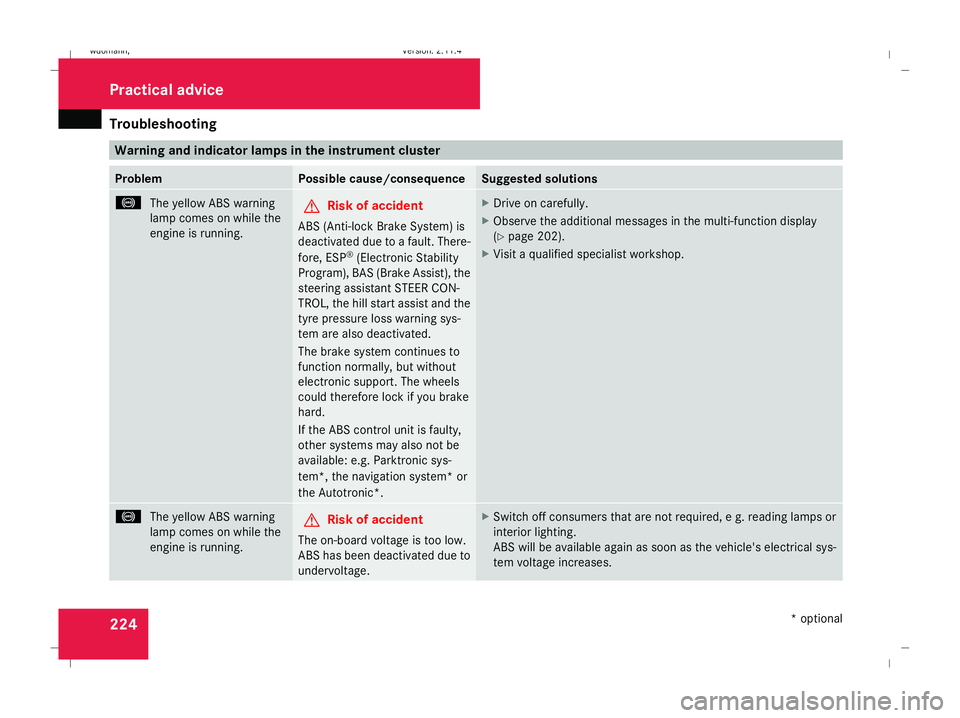
224 Warning and indicator lamps in the instrument cluster
Problem Possible cause/consequence Suggested solutions
-
The yellow ABS warning
lamp comes on while the
engine is running. G
Risk of accident
ABS (Anti-lock Brake System) is
deactivated due to a fault. There-
fore, ESP ®
(Electronic Stability
Program), BAS (Brake Assist), the
steering assistant STEER CON-
TROL, the hill start assist and the
tyre pressure loss warning sys-
tem are also deactivated.
The brake system continues to
function normally, but without
electronic support. The wheels
could therefore lock if you brake
hard.
If the ABS control unit is faulty,
other systems may also not be
available: e.g. Parktronic sys-
tem*, the navigation system* or
the Autotronic*. X
Drive on carefully.
X Observe the additional messages in the multi-function display
(Y page 202).
X Visit a qualified specialist workshop. -
The yellow ABS warning
lamp comes on while the
engine is running. G
Risk of accident
The on-board voltage is too low.
ABS has been deactivated due to
undervoltage. X
Switch off consumers that are not required, e g. reading lamps or
interior lighting.
ABS will be available again as soon as the vehicle's electrical sys-
tem voltage increases. Practical advice
* optional
245_AKB; 2; 7, en-GB
wdomann,
Version: 2.11.4 2008-10-17T11:22:31+02:00 - Seite 224Dateiname: 6515_1640_02_buchblock.pdf; preflight
Page 228 of 305
Troubleshooting
225Problem Possible cause/consequence Suggested solutions
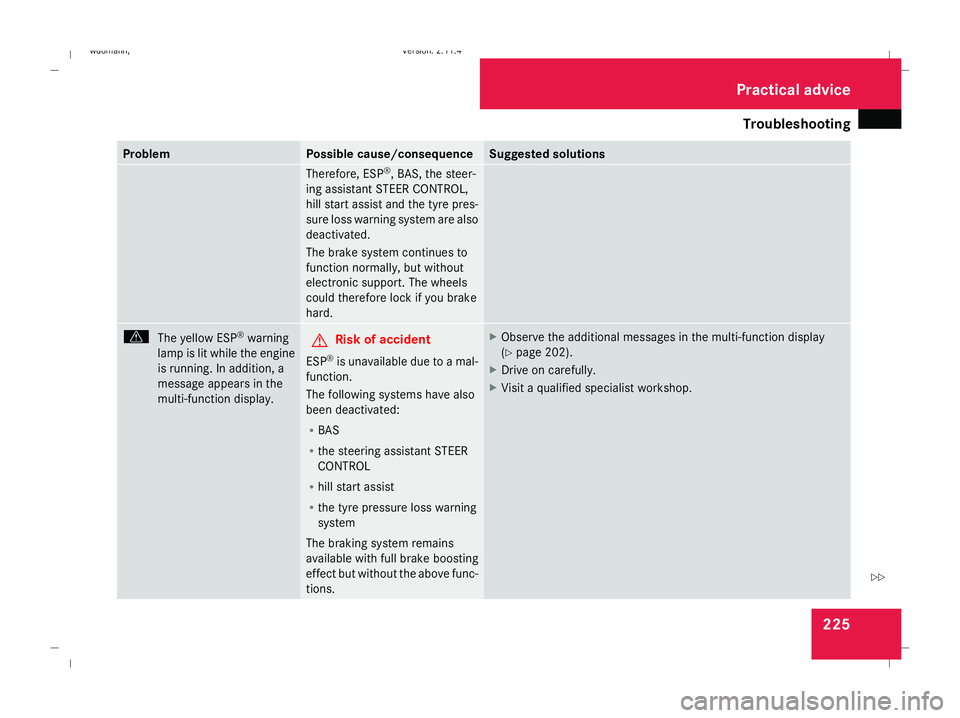
Therefore, ESP
®
, BAS, the steer-
ing assistant STEER CONTROL,
hill start assist and the tyre pres-
sure loss warning system are also
deactivated.
The brake system continues to
function normally, but without
electronic support. The wheels
could therefore lock if you brake
hard. v
The yellow ESP ®
warning
lamp is lit while the engine
is running. In addition, a
message appears in the
multi-function display. G
Risk of accident
ESP ®
is unavailable due to a mal-
function.
The following systems have also
been deactivated:
R BAS
R the steering assistant STEER
CONTROL
R hill start assist
R the tyre pressure loss warning
system
The braking system remains
available with full brake boosting
effect but without the above func-
tions. X
Observe the additional messages in the multi-function display
(Y page 202).
X Drive on carefully.
X Visit a qualified specialist workshop. Practical advice
245_AKB; 2; 7, en-GB
wdomann,
Version: 2.11.4
2008-10-17T11:22:31+02:00 - Seite 225 ZDateiname: 6515_1640_02_buchblock.pdf; preflight
Page 242 of 305
Troubleshooting
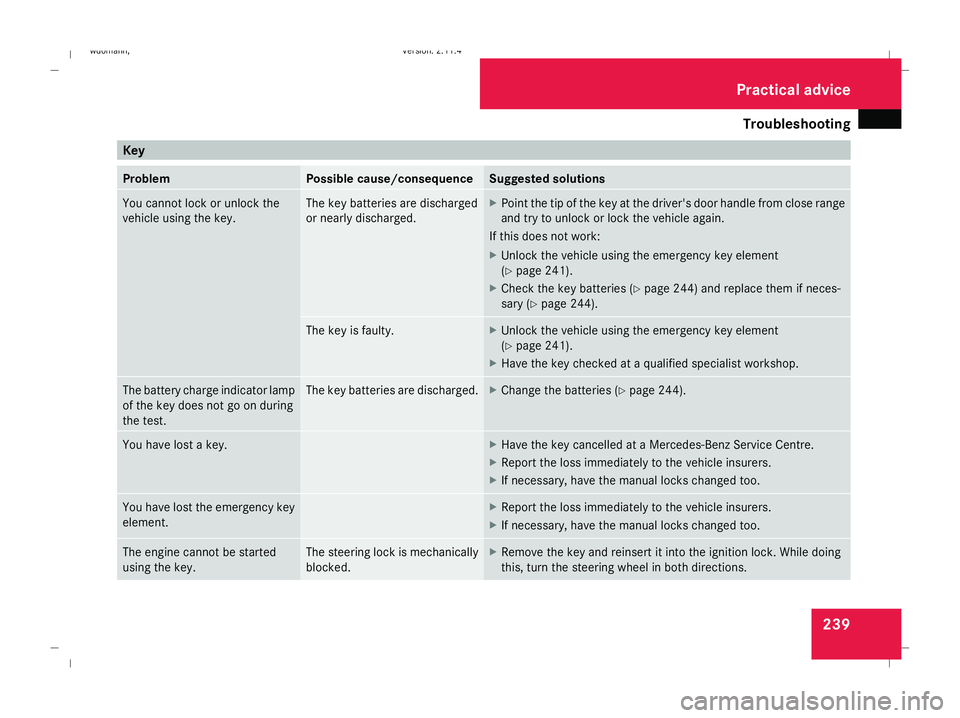
239Key
Problem Possible cause/consequence Suggested solutions
You cannot lock or unlock the
vehicle using the key. The key batteries are discharged
or nearly discharged. X
Point the tip of the key at the driver's door handle from close range
and try to unlock or lock the vehicle again.
If this does not work:
X Unlock the vehicle using the emergency key element
(Y page 241).
X Check the key batteries (Y page 244) and replace them if neces-
sary (Y page 244). The key is faulty. X
Unlock the vehicle using the emergency key element
(Y page 241).
X Have the key checked at a qualified specialist workshop. The battery charge indicator lamp
of the key does not go on during
the test. The key batteries are discharged. X
Change the batteries (Y page 244).You have lost a key. X
Have the key cancelled at a Mercedes-Benz Service Centre.
X Report the loss immediately to the vehicle insurers.
X If necessary, have the manual locks changed too. You have lost the emergency key
element. X
Report the loss immediately to the vehicle insurers.
X If necessary, have the manual locks changed too. The engine cannot be started
using the key. The steering lock is mechanically
blocked. X
Remove the key and reinsert it into the ignition lock. While doing
this, turn the steering wheel in both directions. Practical advice
245_AKB; 2; 7, en-GB
wdomann,
Version: 2.11.4
2008-10-17T11:22:31+02:00 - Seite 239 ZDateiname: 6515_1640_02_buchblock.pdf; preflight
Page 270 of 305
Towing and tow-starting
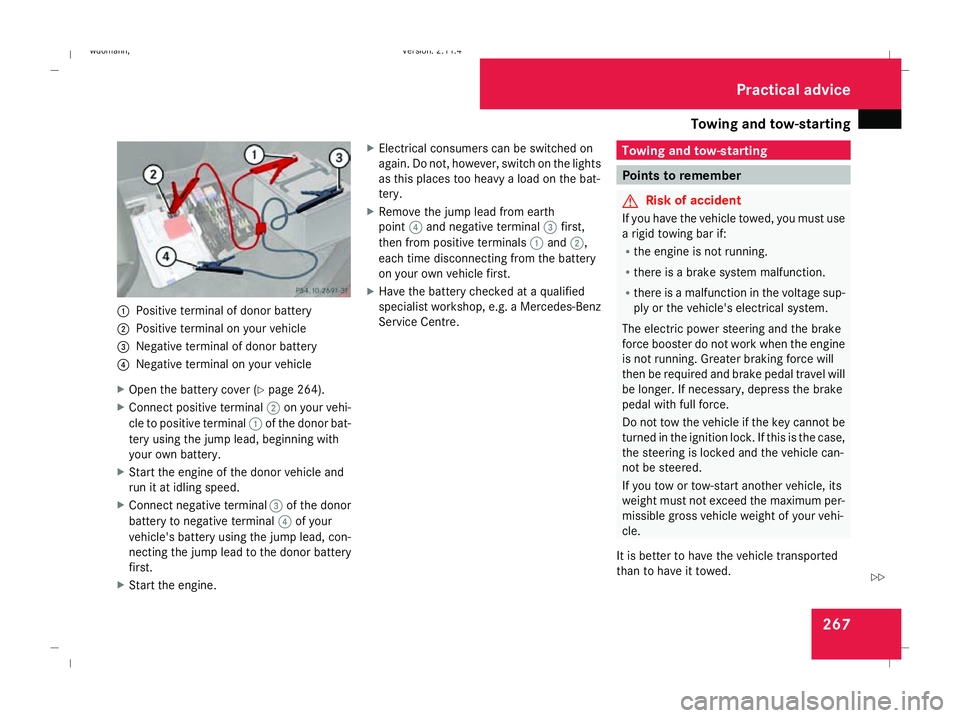
2671
Positive terminal of donor battery
2 Positive terminal on your vehicle
3 Negative terminal of donor battery
4 Negative terminal on your vehicle
X Open the battery cover ( Ypage 264).
X Connect positive terminal 2on your vehi-
cle to positive terminal 1of the donor bat-
tery using the jump lead, beginning with
your own battery.
X Start the engine of the donor vehicle and
run it at idling speed.
X Connect negative terminal 3of the donor
battery to negative terminal 4of your
vehicle's battery using the jump lead, con-
necting the jump lead to the donor battery
first.
X Start the engine. X
Electrical consumers can be switched on
again. Do not, however, switch on the lights
as this places too heavy a load on the bat-
tery.
X Remove the jump lead from earth
point 4and negative terminal 3first,
then from positive terminals 1and 2,
each time disconnecting from the battery
on your own vehicle first.
X Have the battery checked at a qualified
specialist workshop, e.g. a Mercedes-Benz
Service Centre. Towing and tow-starting
Points to remember
G
Risk of accident
If you have the vehicle towed, you must use
a rigid towing bar if:
R the engine is not running.
R there is a brake system malfunction.
R there is a malfunction in the voltage sup-
ply or the vehicle's electrical system.
The electric power steering and the brake
force booster do not work when the engine
is not running. Greater braking force will
then be required and brake pedal travel will
be longer. If necessary, depress the brake
pedal with full force.
Do not tow the vehicle if the key cannot be
turned in the ignition lock. If this is the case,
the steering is locked and the vehicle can-
not be steered.
If you tow or tow-start another vehicle, its
weight must not exceed the maximum per-
missible gross vehicle weight of your vehi-
cle.
It is better to have the vehicle transported
than to have it towed. Practical advice
245_AKB; 2; 7, en-GB
wdomann,
Version: 2.11.4 2008-10-17T11:22:31+02:00 - Seite 267 ZDateiname: 6515_1640_02_buchblock.pdf; preflight
Page 273 of 305
Fuses
270
X
Tow the vehicle or let it roll.
X Shift to a suitable gear and bring the clutch
pedal up slowly. Do not depress the accel-
erator pedal.
The engine is started. Removing the towing eye
X Take the wheel wrench from the vehicle
tool kit (Y page 200).
X Insert the wheel wrench handle into the
towing eye and turn it anti-clockwise.
X Unscrew the towing eye.
X Replace the cover and press it until it
engages.
X Return the towing eye and the wheel
wrench to the vehicle tool kit. Transporting the vehicle
The towing eyes or trailer coupling* can be
used to pull the vehicle onto a trailer or trans-
porter if you wish to transport it.
! Only secure the vehicle by the wheels or
wheel rims, not by parts of the vehicle such
as axle or steering components. Otherwise,
the vehicle could be damaged.
Vehicles with manual transmission X
Shift to neutral.
Vehicles with AUTOTRONIC* X
Turn the key to position 2(Y page 62) in
the ignition lock.
X Move the selector lever to N. Fuses
Notes on changing fuses
The fuses in your vehicle serve to close down
faulty circuits. If a fuse blows, all the compo-
nents on the circuit and their functions will
fail.
Blown fuses must be replaced with fuses of
the same rating, which you can recognise by
the colour and value. The fuse ratings are lis-
ted in the fuse allocation chart. A Mercedes-
Benz Service Centre will be happy to advise
you. G
Risk of fire
Only use fuses that have been approved for
Mercedes-Benz vehicles and which have
the correct fuse rating for the systems con-
cerned. Do not attempt to repair or bridge
faulty fuses. Otherwise, a circuit overload
could cause a fire. Have the cause traced
and rectified at a qualified specialist work-
shop, e.g. a Mercedes-Benz Service Centre.
If the newly inserted fuse also blows, have the
cause traced and rectified at a qualified spe-
cialist workshop, e.g. a Mercedes-Benz
Service Centre.
! Only use fuses that have been approved
for Mercedes-Benz vehicles and which Practical advice
* optional
245_AKB; 2; 7, en-GB
wdomann
,V ersion: 2.11.4
2008-10-17T11:22:31+02:00 - Seite 270 Dateiname: 6515_1640_02_buchblock.pdf; preflight