ESP MERCEDES-BENZ B-CLASS HATCHBACK 2008 Workshop Manual
[x] Cancel search | Manufacturer: MERCEDES-BENZ, Model Year: 2008, Model line: B-CLASS HATCHBACK, Model: MERCEDES-BENZ B-CLASS HATCHBACK 2008Pages: 305, PDF Size: 5.1 MB
Page 211 of 305
Display
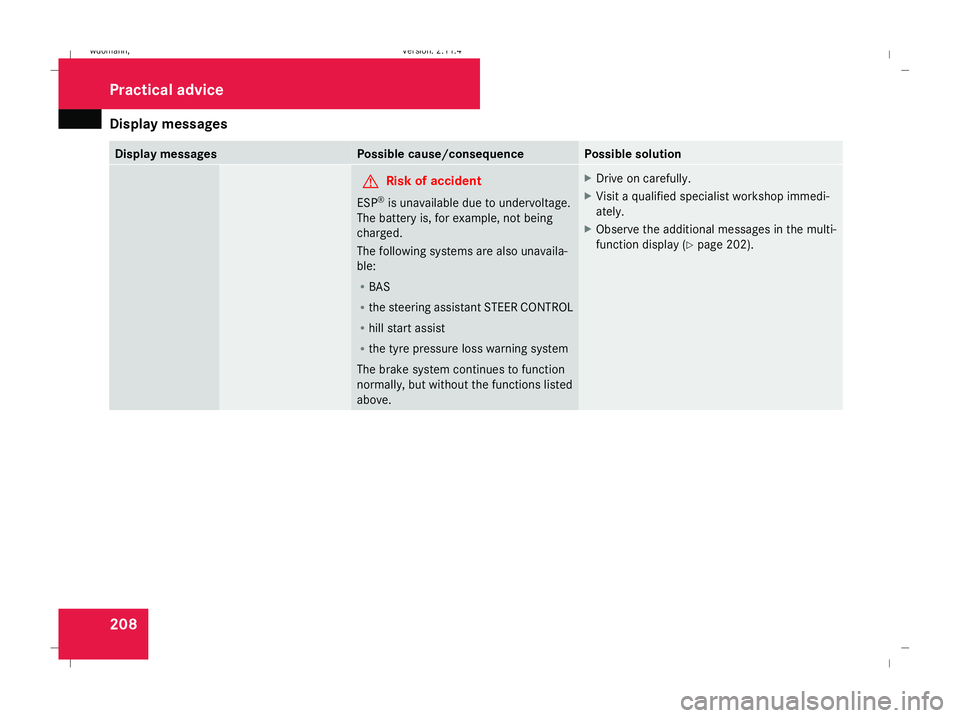
messages 208 Display messages Possible cause/consequence Possible solution
G
Risk of accident
ESP ®
is unavailable due to undervoltage.
The battery is, for example, not being
charged.
The following systems are also unavaila-
ble:
R BAS
R the steering assistant STEER CONTROL
R hill start assist
R the tyre pressure loss warning system
The brake system continues to function
normally, but without the functions listed
above. X
Drive on carefully.
X Visit a qualified specialist workshop immedi-
ately.
X Observe the additional messages in the multi-
function display (Y page 202). Practical advi
ce
245_AKB; 2; 7, en-GB
wdomann,
Version: 2.11.4 2008-10-17T11:22:31+02:00 - Seite 208Dateiname: 6515_1640_02_buchblock.pdf; preflight
Page 212 of 305
Display
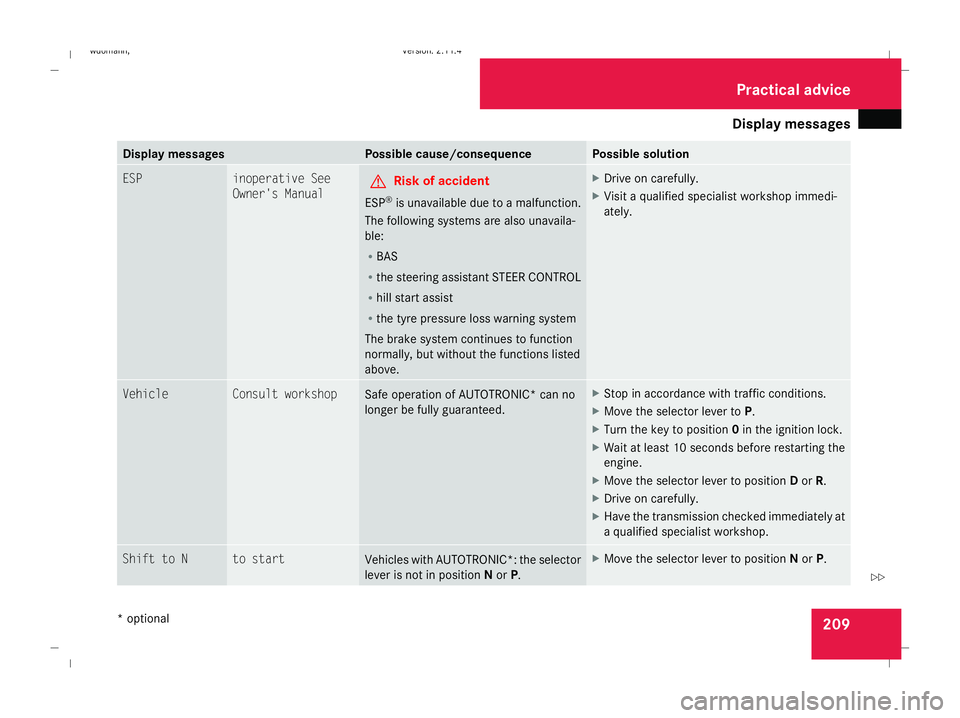
messages 209Display messages Possible cause/consequence Possible solution
ESP inoperative See
Owner's Manual G
Risk of accident
ESP ®
is unavailable due to a malfunction.
The following systems are also unavaila-
ble:
R BAS
R the steering assistant STEER CONTROL
R hill start assist
R the tyre pressure loss warning system
The brake system continues to function
normally, but without the functions listed
above. X
Drive on carefully.
X Visit a qualified specialist workshop immedi-
ately. Vehicle Consult workshop
Safe operation of AUTOTRONIC* can no
longer be fully guaranteed. X
Stop in accordance with traffic conditions.
X Move the selector lever to P.
X Turn the key to position 0in the ignition lock.
X Wait at least 10 seconds before restarting the
engine.
X Move the selector lever to position Dor R.
X Drive on carefully.
X Have the transmission checked immediately at
a qualified specialist workshop. Shift to N to start
Vehicles with AUTOTRONIC*: the selector
lever is not in position
Nor P. X
Move the selector lever to position Nor P. Practical advi
ce
* optional
245_AKB; 2; 7, en-GB
wdomann,
Version: 2.11.4 2008-10-17T11:22:31+02:00 - Seite 209 ZDateiname: 6515_1640_02_buchblock.pdf; preflight
Page 213 of 305
Display
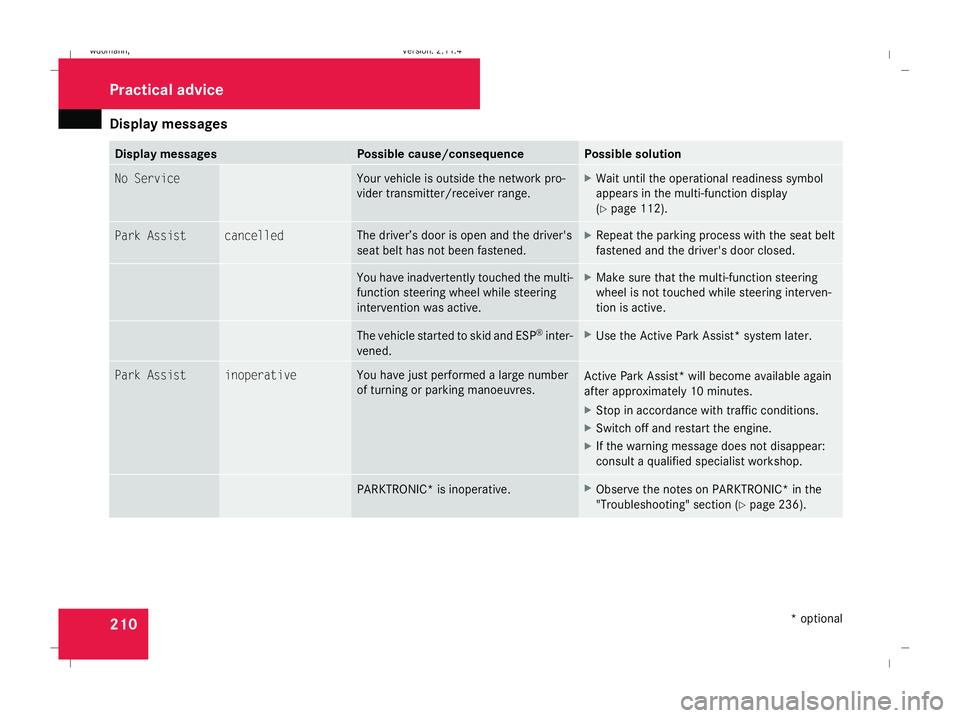
messages 210 Display messages Possible cause/consequence Possible solution
No Service Your vehicle is outside the network pro-
vider transmitter/receiver range. X
Wait until the operational readiness symbol
appears in the multi-function display
(Y page 112). Park Assist cancelled The driver’s door is open and the driver's
seat belt has not been fastened. X
Repeat the parking process with the seat belt
fastened and the driver's door closed. You have inadvertently touched the multi-
function steering wheel while steering
intervention was active. X
Make sure that the multi-function steering
wheel is not touched while steering interven-
tion is active. The vehicle started to skid and ESP
®
inter-
vened. X
Use the Active Park Assist* system later. Park Assist inoperative You have just performed a large number
of turning or parking manoeuvres.
Active Park Assist* will become available again
after approximately 10 minutes.
X
Stop in accordance with traffic conditions.
X Switch off and restart the engine.
X If the warning message does not disappear:
consult a qualified specialist workshop. PARKTRONIC* is inoperative. X
Observe the notes on PARKTRONIC* in the
"Troubleshooting" section (Y page 236).Practical advi
ce
* optional
245_AKB; 2; 7, en-GB
wdomann,
Version: 2.11.4 2008-10-17T11:22:31+02:00 - Seite 210Dateiname: 6515_1640_02_buchblock.pdf; preflight
Page 227 of 305
Troubleshooting
224 Warning and indicator lamps in the instrument cluster
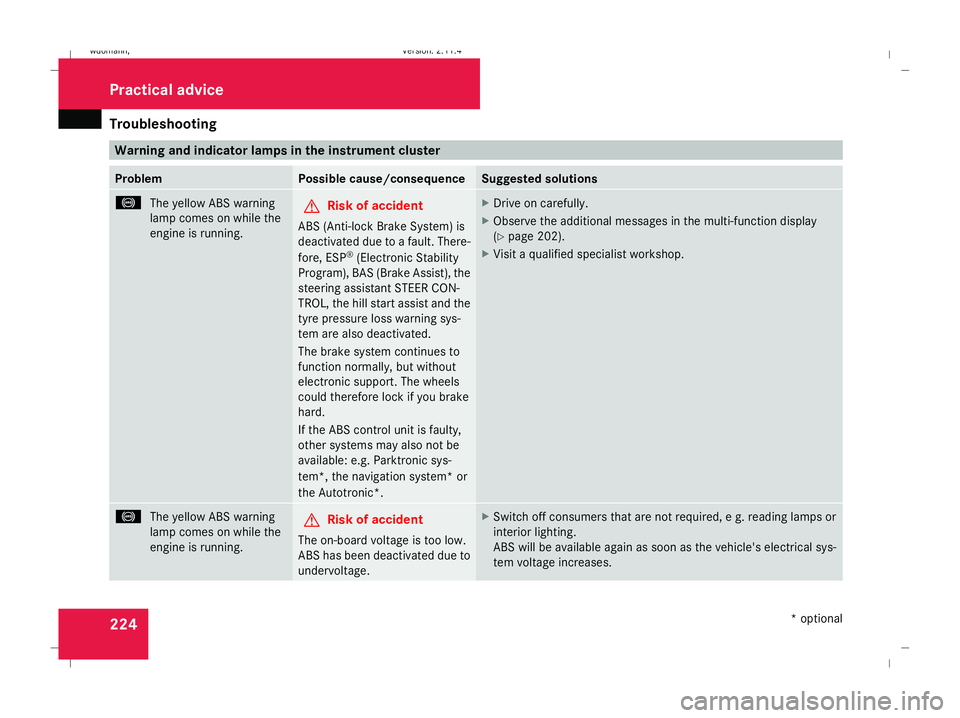
Problem Possible cause/consequence Suggested solutions
-
The yellow ABS warning
lamp comes on while the
engine is running. G
Risk of accident
ABS (Anti-lock Brake System) is
deactivated due to a fault. There-
fore, ESP ®
(Electronic Stability
Program), BAS (Brake Assist), the
steering assistant STEER CON-
TROL, the hill start assist and the
tyre pressure loss warning sys-
tem are also deactivated.
The brake system continues to
function normally, but without
electronic support. The wheels
could therefore lock if you brake
hard.
If the ABS control unit is faulty,
other systems may also not be
available: e.g. Parktronic sys-
tem*, the navigation system* or
the Autotronic*. X
Drive on carefully.
X Observe the additional messages in the multi-function display
(Y page 202).
X Visit a qualified specialist workshop. -
The yellow ABS warning
lamp comes on while the
engine is running. G
Risk of accident
The on-board voltage is too low.
ABS has been deactivated due to
undervoltage. X
Switch off consumers that are not required, e g. reading lamps or
interior lighting.
ABS will be available again as soon as the vehicle's electrical sys-
tem voltage increases. Practical advice
* optional
245_AKB; 2; 7, en-GB
wdomann,
Version: 2.11.4 2008-10-17T11:22:31+02:00 - Seite 224Dateiname: 6515_1640_02_buchblock.pdf; preflight
Page 228 of 305
Troubleshooting
225Problem Possible cause/consequence Suggested solutions
Therefore, ESP
®
, BAS, the steer-
ing assistant STEER CONTROL,
hill start assist and the tyre pres-
sure loss warning system are also
deactivated.
The brake system continues to
function normally, but without
electronic support. The wheels
could therefore lock if you brake
hard. v
The yellow ESP ®
warning
lamp is lit while the engine
is running. In addition, a
message appears in the
multi-function display. G
Risk of accident
ESP ®
is unavailable due to a mal-
function.
The following systems have also
been deactivated:
R BAS
R the steering assistant STEER
CONTROL
R hill start assist
R the tyre pressure loss warning
system
The braking system remains
available with full brake boosting
effect but without the above func-
tions. X
Observe the additional messages in the multi-function display
(Y page 202).
X Drive on carefully.
X Visit a qualified specialist workshop. Practical advice
245_AKB; 2; 7, en-GB
wdomann,
Version: 2.11.4
2008-10-17T11:22:31+02:00 - Seite 225 ZDateiname: 6515_1640_02_buchblock.pdf; preflight
Page 229 of 305
Troubleshooting
226 Problem Possible cause/consequence Suggested solutions
v
The yellow ESP ®
warning
lamp flashes while the
vehicle is in motion. G
Risk of accident
ESP ®
or traction control has
intervened because there is a risk
of skidding or at least one wheel
has started to spin. X
Only depress the accelerator pedal as far as necessary when pull-
ing away.
X Release the accelerator pedal while you are driving.
X Adapt your driving style to suit the road and weather conditions.
X Do not deactivate ESP ®
. 1
The red SRS warning lamp
is lit while the engine is
running. G
Risk of injury
There is a malfunction in the
restraint system. The airbags or
belt tensioners may either be trig-
gered unintentionally or, in the
event of an accident, not be trig-
gered at all. X
Visit a qualified specialist workshop immediately. 1
The red SRS warning lamp
is lit while the engine is
running. In addition, the
indicator lamp 5
PASSENGER AIRBAG OFF
flashes in the centre con-
sole and a warning tone
sounds. The connector on the removable
front-passenger seat* is
detached. X
Attach the connector to the coupling on the seat ( Ypage 155). H
The red brake system
warning lamp comes on
while you are driving. A
warning tone also sounds. You are driving with the parking
brake applied. X
Release the parking brake.
The warning lamp goes out and the warning tone ceases. Practical advice
* optional
245_AKB; 2; 7, en-GB
wdomann,
Version: 2.11.4 2008-10-17T11:22:31+02:00 - Seite 226Dateiname: 6515_1640_02_buchblock.pdf; preflight
Page 236 of 305
Troubleshooting
233Engine
Problem Possible cause/consequence Suggested solutions
The engine will not start. You can
hear the starter motor operating. R
The engine electronics system
is malfunctioning.
R There is a malfunction in the
fuel supply.
R The on-board voltage is too low
because the starter battery is
too weak or discharged. X
Turn the key back to position 0(Y page 62) in the ignition lock
before the next starting attempt.
X Try to start the engine again (Y page 86). When doing so, remember
that excessively long and frequent attempts to start the engine will
drain the battery.
If the engine does not start after several attempts:
X Consult a qualified specialist workshop. The engine will not start. You can
hear the starter motor operating.
The reserve fuel warning lamp is
on and the fuel gauge shows
0. The fuel tank has been run dry. X
Refuel the vehicle.
X Bleed the fuel system (Y page 232).The engine will not start. You can-
not hear the starter motor oper-
ating. The on-board voltage is too low
because the starter battery is too
weak or discharged. X
Jump-start the vehicle (Y page 266).
If the engine does not start despite attempting to jump-start it:
X Consult a qualified specialist workshop. The starter motor was exposed to
a thermal load that was too high. X
Allow the starter motor to cool down for approximately two
minutes.
X Try to start the engine again.
If the engine still does not start:
X Consult a qualified specialist workshop. Practical advice
245_AKB; 2; 7, en-GB
wdomann,
Version: 2.11.4
2008-10-17T11:22:31+02:00 - Seite 233 ZDateiname: 6515_1640_02_buchblock.pdf; preflight
Page 252 of 305
Changing bulbs
249
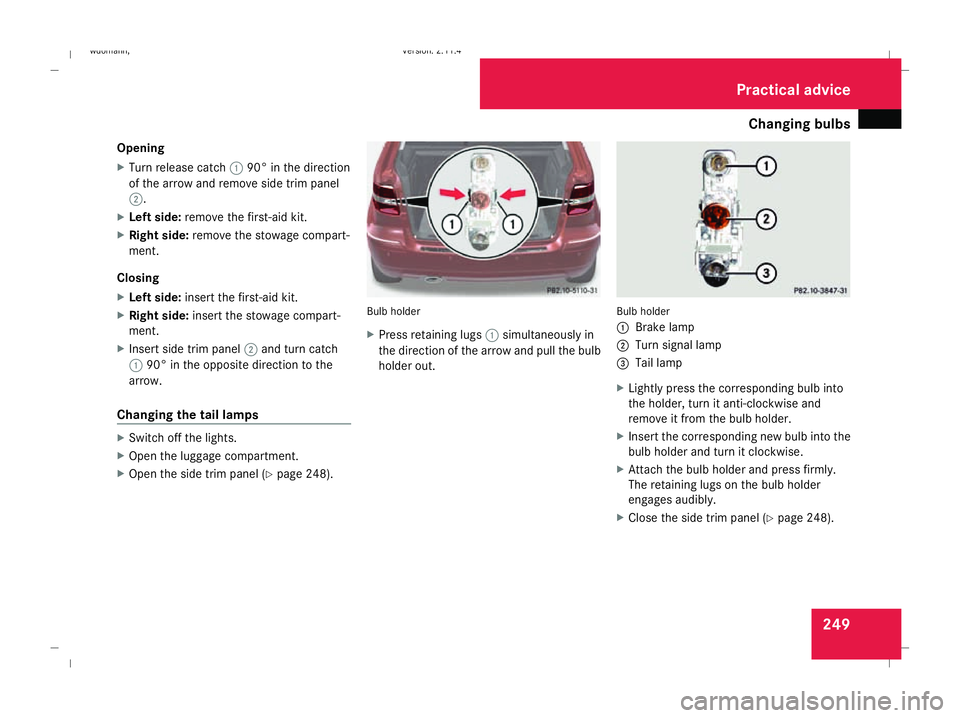
Opening
X
Turn release catch 190° in the direction
of the arrow and remove side trim panel
2.
X Left side: remove the first-aid kit.
X Right side: remove the stowage compart-
ment.
Closing
X Left side: insert the first-aid kit.
X Right side: insert the stowage compart-
ment.
X Insert side trim panel 2and turn catch
1 90° in the opposite direction to the
arrow.
Changing the tail lamps X
Switch off the lights.
X Open the luggage compartment.
X Open the side trim panel (Y page 248). Bulb holder
X
Press retaining lugs 1simultaneously in
the direction of the arrow and pull the bulb
holder out. Bulb holder
1
Brake lamp
2 Turn signal lamp
3 Tail lamp
X Lightly press the corresponding bulb into
the holder, turn it anti-clockwise and
remove it from the bulb holder.
X Insert the corresponding new bulb into the
bulb holder and turn it clockwise.
X Attach the bulb holder and press firmly.
The retaining lugs on the bulb holder
engages audibly.
X Close the side trim panel (Y page 248). Practical advice
245_AKB; 2; 7, en-GB
wdomann
,V ersion: 2.11.4
2008-10-17T11:22:31+02:00 - Seite 249 ZDateiname: 6515_1640_02_buchblock.pdf; preflight
Page 261 of 305
Flat tyre
258 G
Risk of accident
Do not exceed the maximum speed of
80 km/h.
The "max. 80 km/h" sticker must be affixed
within the driver's field of vision.
The vehicle's handling characteristics may
be affected. H
Environmental note
Have the used TIREFIT kit disposed of pro-
fessionally, e.g. at a Mercedes-Benz
Service Centre.
X Have the TIREFIT kit replaced every four
years at a qualified specialist workshop,
e.g. a Mercedes-Benz Service Centre. Changing a wheel/fitting the spare
wheel*
G
Risk of accident
The wheel dimensions and tyre size of the
"Minispare" emergency spare wheel* may
differ from those of the standard wheels.
Your vehicle's handling characteristics will
change when a "Minispare" emergency
spare wheel* is fitted. Adapt your style of
driving accordingly.
The "Minispare" emergency spare wheel*
may only be used for a short time. Do not
exceed the maximum speed of 80 km/h
and do not deactivate ESP ®
.
Never drive the vehicle with more than one
"Minispare" emergency spare wheel* fit-
ted. G
Risk of accident
Have the "Minispare" emergency spare
wheel* or the spare wheel* replaced with
a new wheel as soon as possible at a quali-
fied specialist workshop which has the nec-
essary specialist knowledge and tools to
carry out the work required. Mercedes-
Benz recommends that you use a
Mercedes-Benz Service Centre for this pur- pose. In particular, work relevant to safety
or on safety-related systems must be car-
ried out at a qualified specialist workshop.
Preparing the vehicle X
Prepare the vehicle as described
(Y page 252).
X If a trailer is coupled, uncouple it.
X Place the wheels in the straight-ahead posi-
tion.
X Take the "Minispare" emergency spare
wheel* or the spare wheel* out of the stow-
age well under the luggage compartment
floor.
X Take the following out of the stowage com-
partment behind the rear seat backrest:
R
the vehicle tool kit
R the wheel chock
R the jack
X Secure the vehicle to prevent it from rolling
away.
On level ground: place chocks or similar
items under the front and rear of the wheel
that is diagonally opposite the wheel you
wish to change. Practical advice
* optional
245_AKB; 2; 7, en-GB
wdomann
,V ersion: 2.11.4
2008-10-17T11:22:31+02:00 - Seite 258 Dateiname: 6515_1640_02_buchblock.pdf; preflight
Page 263 of 305
Flat tyre
260 Otherwise, the jack will not be able to ach-
ieve its load-bearing capacity due to the
restricted height.
Do not start the engine at any time while
the wheel is being changed.
Do not lie under the vehicle when it is being
supported by the jack. If you do not raise
the vehicle as described, it could slip off the
jack (e.g. if the engine is started or a door
or the tailgate is opened or closed) and you
could be seriously injured. G
Risk of accident
If you fail to position the jack correctly, the
vehicle may:
R slip off the jack
R injure you or others
R be damaged
Thus, it is important to make sure that the
jack is positioned correctly in the respec-
tive jacking points. Before positioning the
jack, remove any dirt that may have collec-
ted in the jacking points.
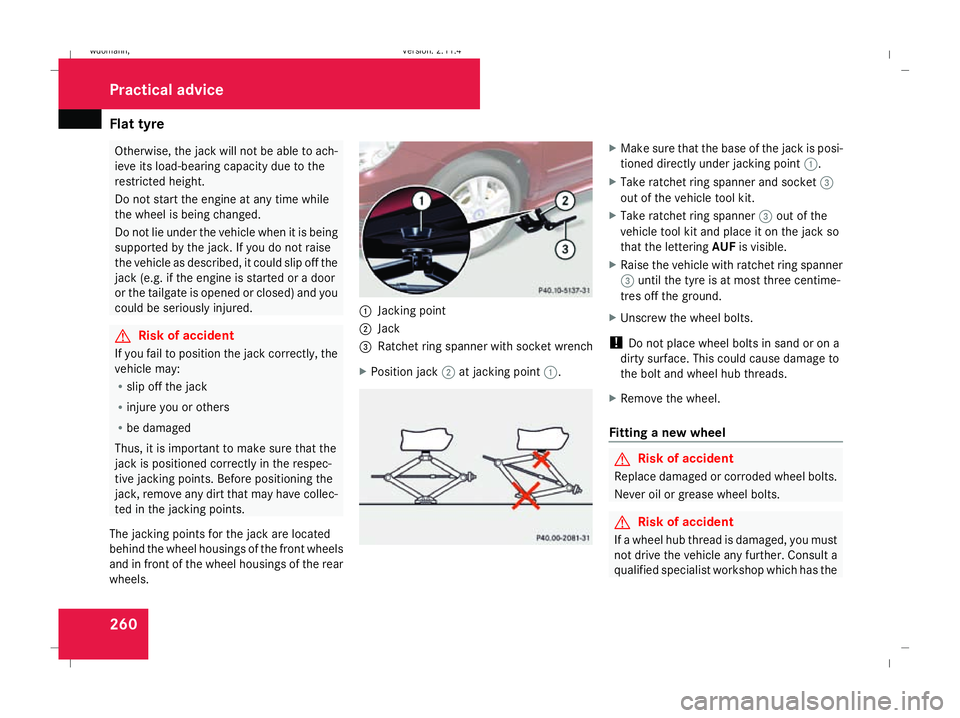
The jacking points for the jack are located
behind the wheel housings of the front wheels
and in front of the wheel housings of the rear
wheels. 1
Jacking point
2 Jack
3 Ratchet ring spanner with socket wrench
X Position jack 2at jacking point 1. X
Make sure that the base of the jack is posi-
tioned directly under jacking point 1.
X Take ratchet ring spanner and socket 3
out of the vehicle tool kit.
X Take ratchet ring spanner 3out of the
vehicle tool kit and place it on the jack so
that the lettering AUFis visible.
X Raise the vehicle with ratchet ring spanner
3 until the tyre is at most three centime-
tres off the ground.
X Unscrew the wheel bolts.
! Do not place wheel bolts in sand or on a
dirty surface. This could cause damage to
the bolt and wheel hub threads.
X Remove the wheel.
Fitting a new wheel G
Risk of accident
Replace damaged or corroded wheel bolts.
Never oil or grease wheel bolts. G
Risk of accident
If a wheel hub thread is damaged, you must
not drive the vehicle any further. Consult a
qualified specialist workshop which has the Practical advice
245_AKB; 2; 7, en-GB
wdomann , Version: 2.11.4 2008-10-17T11:22:31+02:00 - Seite 260Dateiname: 6515_1640_02_buchblock.pdf; preflight