tow MERCEDES-BENZ B-CLASS HATCHBACK 2008 Repair Manual
[x] Cancel search | Manufacturer: MERCEDES-BENZ, Model Year: 2008, Model line: B-CLASS HATCHBACK, Model: MERCEDES-BENZ B-CLASS HATCHBACK 2008Pages: 305, PDF Size: 5.1 MB
Page 192 of 305
Trailer towing*
189
not use a noseweight of less than 50 kg,
otherwise the trailer may come loose.
Bear in mind that the payload and the rear
axle load are reduced by the actual nose-
weight.
i The height of the ball coupling changes
with the load of the vehicle. If necessary,
use a trailer with a height-adjustable draw-
bar.
Coupling up a trailer G
Risk of injury
Do not disconnect a trailer with an engaged
overrun brake. Otherwise, your hand could
become trapped between the bumper and
drawbar.
! Do not disconnect a trailer with an
engaged overrun brake. Otherwise, your
vehicle could be damaged by the rebound-
ing of the overrun brake.
X Position the trailer level behind the vehicle.
X Couple up the trailer.
X Establish the electrical connection
between the vehicle and the trailer. Driving tips In Germany, the maximum permitted speed
for vehicle/trailer combinations is 80 km/h.
G
Risk of accident
A maximum speed of 80 km/h should not
be exceeded, even in countries where
higher speeds are permitted for vehicle/
trailer combinations. This lowers the risk of
an accident.
When towing a trailer, your vehicle's handling
characteristics will be different in comparison
to when driving without a trailer.
The vehicle/trailer combination:
R is heavier
R is restricted in its acceleration and gradi-
ent-climbing capability
R has an increased braking distance
R is affected more by strong crosswinds
R demands more sensitive steering
R consumes more fuel
On long and steep downhill gradients, you
must select a lower gear in good time, or in
vehicles with AUTOTRONIC*, select shift
range 1,2or 3. i
This also applies if you have activated
cruise control* or Speedtronic*.
This will use the braking effect of the engine,
so less braking will be required to maintain
the speed. This relieves the load on the brake
system and prevents the brakes from over-
heating and wearing too quickly. If you need
additional braking, depress the brake pedal
repeatedly rather than continuously. G
Risk of accident
Never depress the brake pedal continu-
ously while the vehicle is in motion, e.g.
never cause the brakes to rub by applying
constant slight pedal pressure. This causes
the brake system to overheat, increases
the braking distance and can lead to the
brakes failing completely.
Driving tips
R Maintain a greater distance from the vehi-
cle in front than when driving without a
trailer.
R Avoid braking abruptly. If possible, brake
gently at first to allow the trailer to run on.
Then increase the braking force rapidly.
R The values given for gradient-climbing
capabilities from a standstill refer to sea
level. When driving in mountainous areas, Operation
* optional
245_AKB; 2; 7, en-GB
wdomann,
Version: 2.11.4
2008-10-17T11:22:31+02:00 - Seite 189 ZDateiname: 6515_1640_02_buchblock.pdf; preflight
Page 193 of 305
Trailer towing*
190note that the power output of the engine,
and consequently the vehicle's gradient-
climbing capability, decrease with increas-
ing altitude.
If the trailer swings from side to side:
X Do not accelerate.
X Do not counter-steer.
X Brake if necessary. G
Risk of accident
On no account should you attempt to draw
the vehicle/trailer combination out by
increasing speed. Removing the ball coupling
X Pull the protective cap off the lock in the
handwheel.
X Insert the key into the lock in the hand-
wheel.
X Turn the key clockwise.
The lock is unlocked.
X Hold the ball coupling. Pull the handwheel
away from the ball coupling and turn it
clockwise until it engages.
The green area on the ball coupling is
aligned with the red mark on the hand-
wheel. X
Pull out the ball coupling downwards.
X Clean the ball coupling if it is dirty.
X Vehicles without ECO start/stop func-
tion*: open the stowage compartment on
the right of the luggage compartment.
X Fold the trim downwards.
X Vehicles with start/stop function*:
open the luggage compartment floor.
X Remove the protective cap from the ball
coupling recess.
X Press the protective cap into the ball cou-
pling recess until it engages.
Storing the ball coupling X
Store the ball coupling with the key inser-
ted in the ball coupling recess.
X Vehicle without ECO start/stop func-
tion: Secure the ball coupling in place using
the retainer strap. G
Risk of accident
Do not carry the ball coupling in the vehicle
interior if it is not secured.
Otherwise, you and others could be injured
by the ball coupling being thrown around if
you: R
brake sharply
R change direction suddenly
R are involved in an accident Trailer power supply
When it leaves the factory, your vehicle's
trailer socket outlet is equipped with a per-
manent power supply and a power supply that
is switched on via the ignition lock.
The permanent power supply is supplied via
trailer socket pin 9.
The power supply that is switched on via the
ignition lock is supplied via trailer socket pin
10.
! You can connect consumers with a power
rating of up to 240 W to the permanent
power supply and up to 180 W to the power
supply that is switched on via the ignition
lock.
You must not charge a trailer battery using
the power supply.
The trailer's turn signal lamps are only guar-
anteed to function when bulbs are used.
You can obtain further information about
installing the trailer electrics from a qualified Operation
* optional
245_AKB; 2; 7, en-GB
wdomann,
Version: 2.11.4 2008-10-17T11:22:31+02:00 - Seite 190Dateiname: 6515_1640_02_buchblock.pdf; preflight
Page 202 of 305
199
Where will I find...?
...........................200
Display messages ............................. 202
Troubleshooting ................................ 222
Locking/unlocking in an emer-
gency ................................................. 241
Changing the batteries .....................243
Changing bulbs ................................. 244
Replacing the wiper blades ..............250
Flat tyre ............................................. 252
Battery ............................................... 263
Jump-starting .................................... 266
Towing and tow-starting ..................267
Fuses .................................................. 270 Practical advice
245_AKB; 2; 7, en-GB
wdomann
, Version: 2.11.4 2008-10-17T11:22:31+02:00 - Seite 199Dateiname: 6515_1640_02_buchblock.pdf; preflight
Page 203 of 305
Where will I find...?
200 Where will I find...?
Vehicle tool kit, jack and folding
wheel chock
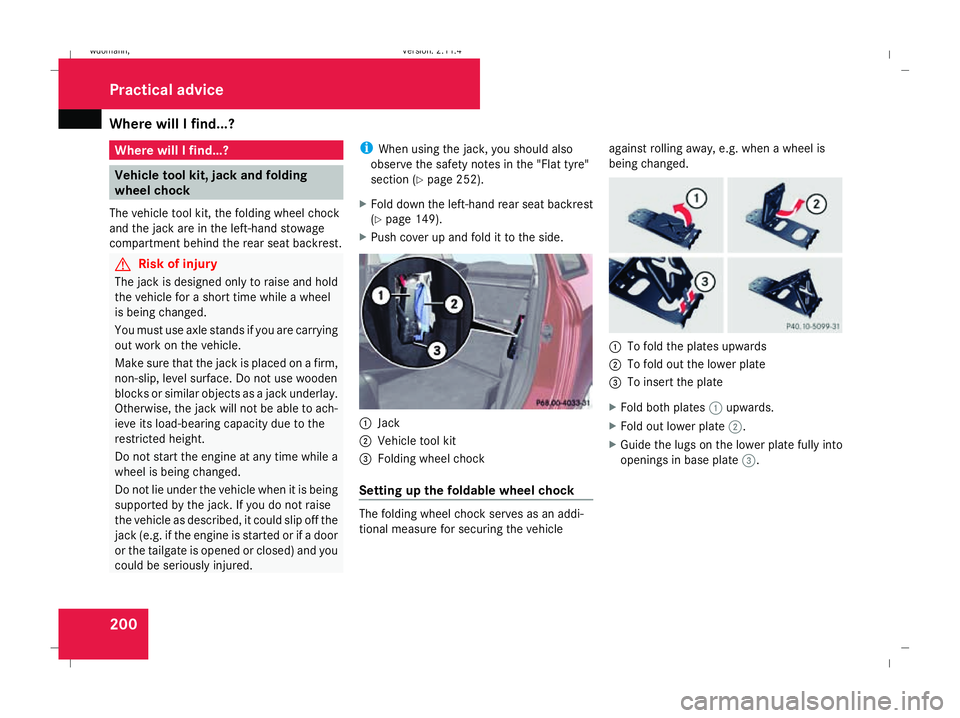
The vehicle tool kit, the folding wheel chock
and the jack are in the left-hand stowage
compartment behind the rear seat backrest. G
Risk of injury
The jack is designed only to raise and hold
the vehicle for a short time while a wheel
is being changed.
You must use axle stands if you are carrying
out work on the vehicle.
Make sure that the jack is placed on a firm,
non-slip, level surface. Do not use wooden
blocks or similar objects as a jack underlay.
Otherwise, the jack will not be able to ach-
ieve its load-bearing capacity due to the
restricted height.
Do not start the engine at any time while a
wheel is being changed.
Do not lie under the vehicle when it is being
supported by the jack. If you do not raise
the vehicle as described, it could slip off the
jack (e.g. if the engine is started or if a door
or the tailgate is opened or closed) and you
could be seriously injured. i
When using the jack, you should also
observe the safety notes in the "Flat tyre"
section (Y page 252).
X Fold down the left-hand rear seat backrest
(Y page 149).
X Push cover up and fold it to the side. 1
Jack
2 Vehicle tool kit
3 Folding wheel chock
Setting up the foldable wheel chock The folding wheel chock serves as an addi-
tional measure for securing the vehicleagainst rolling away, e.g. when a wheel is
being changed.
1
To fold the plates upwards
2 To fold out the lower plate
3 To insert the plate
X Fold both plates 1upwards.
X Fold out lower plate 2.
X Guide the lugs on the lower plate fully into
openings in base plate 3.Practical advice
245_AKB; 2; 7, en-GB
wdomann,
Version: 2.11.4
2008-10-17T11:22:31+02:00 - Seite 200 Dateiname: 6515_1640_02_buchblock.pdf; preflight
Page 204 of 305
Where will I find...?
201First-aid kit, TIREFIT kit and warning
triangle
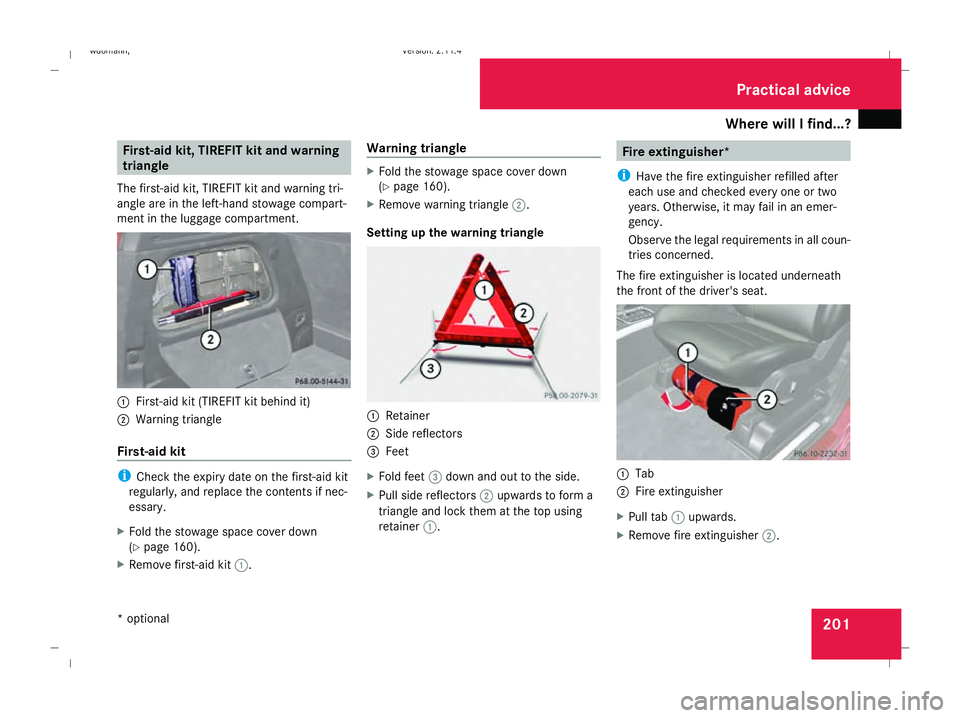
The first-aid kit, TIREFIT kit and warning tri-
angle are in the left-hand stowage compart-
ment in the luggage compartment. 1
First-aid kit (TIREFIT kit behind it)
2 Warning triangle
First-aid kit i
Check the expiry date on the first-aid kit
regularly, and replace the contents if nec-
essary.
X Fold the stowage space cover down
(Y page 160).
X Remove first-aid kit 1. Warning triangle X
Fold the stowage space cover down
(Y page 160).
X Remove warning triangle 2.
Setting up the warning triangle 1
Retainer
2 Side reflectors
3 Feet
X Fold feet 3down and out to the side.
X Pull side reflectors 2upwards to form a
triangle and lock them at the top using
retainer 1. Fire extinguisher*
i Have the fire extinguisher refilled after
each use and checked every one or two
years. Otherwise, it may fail in an emer-
gency.
Observe the legal requirements in all coun-
tries concerned.
The fire extinguisher is located underneath
the front of the driver's seat. 1
Tab
2 Fire extinguisher
X Pull tab 1upwards.
X Remove fire extinguisher 2. Practical advice
* optional
245_AKB; 2; 7, en-GB
wdomann,
Version: 2.11.4 2008-10-17T11:22:31+02:00 - Seite 201 ZDateiname: 6515_1640_02_buchblock.pdf; preflight
Page 205 of 305
Display
messages 202 Spare
wheel*/"Minispare" emer-
gency spare wheel*
X Open the luggage compartment floor
(Y page 153).
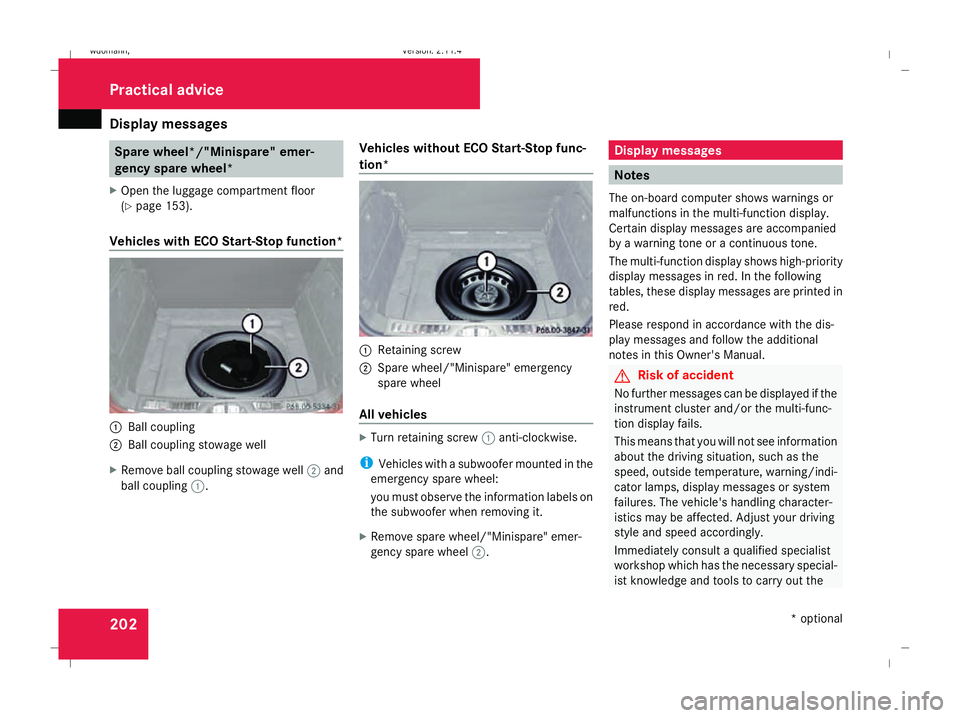
Vehicles with ECO Start-Stop function* 1
Ball coupling
2 Ball coupling stowage well
X Remove ball coupling stowage well 2and
ball coupling 1. Vehicles without ECO Start-Stop func-
tion* 1
Retaining screw
2 Spare wheel/"Minispare" emergency
spare wheel
All vehicles X
Turn retaining screw 1anti-clockwise.
i Vehicles with a subwoofer mounted in the
emergency spare wheel:
you must observe the information labels on
the subwoofer when removing it.
X Remove spare wheel/"Minispare" emer-
gency spare wheel 2. Display messages
Notes
The on-board computer shows warnings or
malfunctions in the multi-function display.
Certain display messages are accompanied
by a warning tone or a continuous tone.
The multi-function display shows high-priority
display messages in red. In the following
tables, these display messages are printed in
red.
Please respond in accordance with the dis-
play messages and follow the additional
notes in this Owner's Manual. G
Risk of accident
No further messages can be displayed if the
instrument cluster and/or the multi-func-
tion display fails.
This means that you will not see information
about the driving situation, such as the
speed, outside temperature, warning/indi-
cator lamps, display messages or system
failures. The vehicle's handling character-
istics may be affected. Adjust your driving
style and speed accordingly.
Immediately consult a qualified specialist
workshop which has the necessary special-
ist knowledge and tools to carry out the Practical advice
* optional
245_AKB; 2; 7, en-GB
wdomann,
Version: 2.11.4 2008-10-17T11:22:31+02:00 - Seite 202Dateiname: 6515_1640_02_buchblock.pdf; preflight
Page 231 of 305
Troubleshooting
228 Problem Possible cause/consequence Suggested solutions
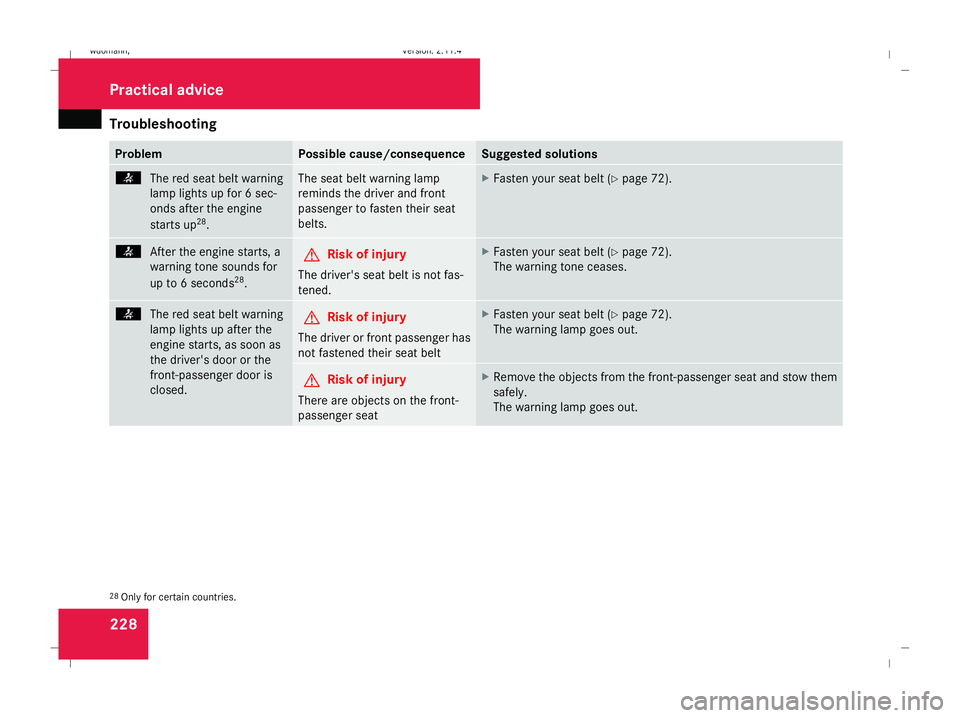
<
The red seat belt warning
lamp lights up for 6 sec-
onds after the engine
starts up 28
. The seat belt warning lamp
reminds the driver and front
passenger to fasten their seat
belts. X
Fasten your seat belt (Y page 72).<
After the engine starts, a
warning tone sounds for
up to 6 seconds 28
. G
Risk of injury
The driver's seat belt is not fas-
tened. X
Fasten your seat belt (Y page 72).
The warning tone ceases. <
The red seat belt warning
lamp lights up after the
engine starts, as soon as
the driver's door or the
front-passenger door is
closed. G
Risk of injury
The driver or front passenger has
not fastened their seat belt X
Fasten your seat belt (Y page 72).
The warning lamp goes out. G
Risk of injury
There are objects on the front-
passenger seat X
Remove the objects from the front-passenger seat and stow them
safely.
The warning lamp goes out. 28
Only for certain countries. Practical advice
245_AKB; 2; 7, en-GB
wdomann,
Version: 2.11.4 2008-10-17T11:22:31+02:00 - Seite 228Dateiname: 6515_1640_02_buchblock.pdf; preflight
Page 232 of 305
Troubleshooting
229Problem Possible cause/consequence Suggested solutions
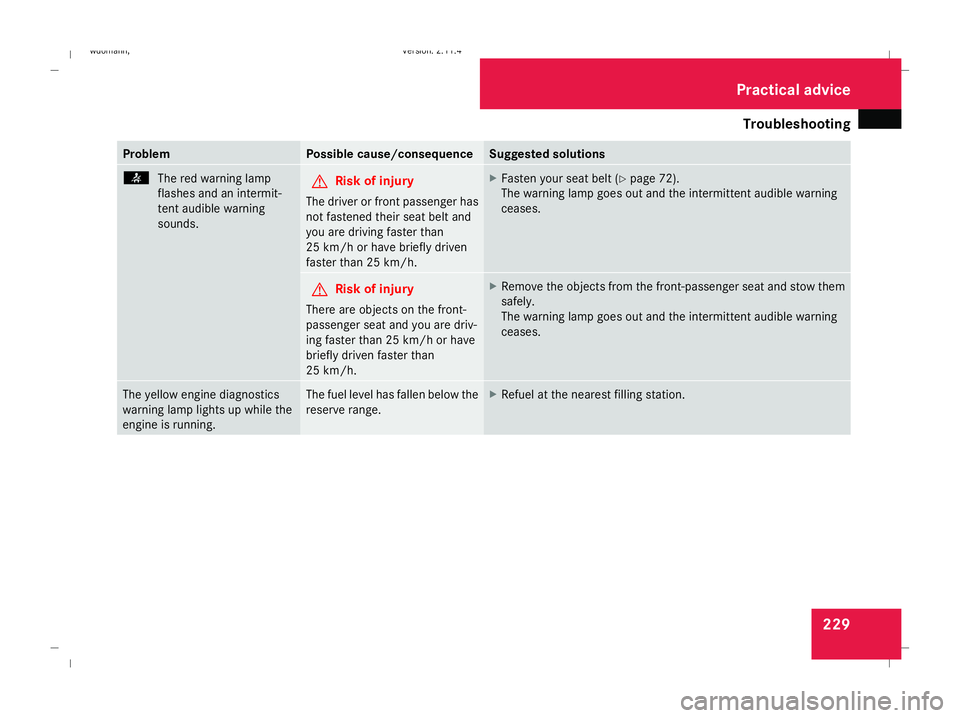
<
The red warning lamp
flashes and an intermit-
tent audible warning
sounds. G
Risk of injury
The driver or front passenger has
not fastened their seat belt and
you are driving faster than
25 km/h or have briefly driven
faster than 25 km/h. X
Fasten your seat belt (Y page 72).
The warning lamp goes out and the intermittent audible warning
ceases. G
Risk of injury
There are objects on the front-
passenger seat and you are driv-
ing faster than 25 km/h or have
briefly driven faster than
25 km/h. X
Remove the objects from the front-passenger seat and stow them
safely.
The warning lamp goes out and the intermittent audible warning
ceases. The yellow engine diagnostics
warning lamp lights up while the
engine is running. The fuel level has fallen below the
reserve range. X
Refuel at the nearest filling station. Practical advice
245_AKB; 2; 7, en-GB
wdomann,
Version: 2.11.4
2008-10-17T11:22:31+02:00 - Seite 229 ZDateiname: 6515_1640_02_buchblock.pdf; preflight
Page 243 of 305
Troubleshooting
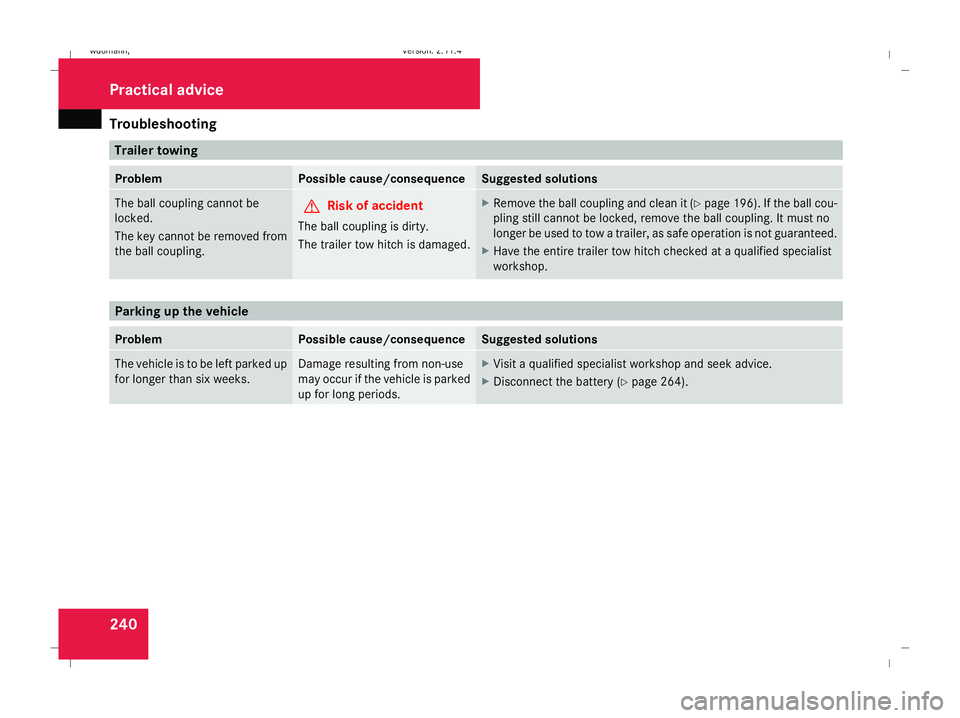
240 Trailer towing
Problem Possible cause/consequence Suggested solutions
The ball coupling cannot be
locked.
The key cannot be removed from
the ball coupling.
G
Risk of accident
The ball coupling is dirty.
The trailer tow hitch is damaged. X
Remove the ball coupling and clean it (Y page 196). If the ball cou-
pling still cannot be locked, remove the ball coupling. It must no
longer be used to tow a trailer, as safe operation is not guaranteed.
X Have the entire trailer tow hitch checked at a qualified specialist
workshop. Parking up the vehicle
Problem Possible cause/consequence Suggested solutions
The vehicle is to be left parked up
for longer than six weeks. Damage resulting from non-use
may occur if the vehicle is parked
up for long periods. X
Visit a qualified specialist workshop and seek advice.
X Disconnect the battery ( Ypage 264). Practical advice
245_AKB; 2; 7, en-GB
wdomann,
Version: 2.11.4 2008-10-17T11:22:31+02:00 - Seite 240Dateiname: 6515_1640_02_buchblock.pdf; preflight
Page 246 of 305
Changing the batteries
243Releasing the parking lock manually
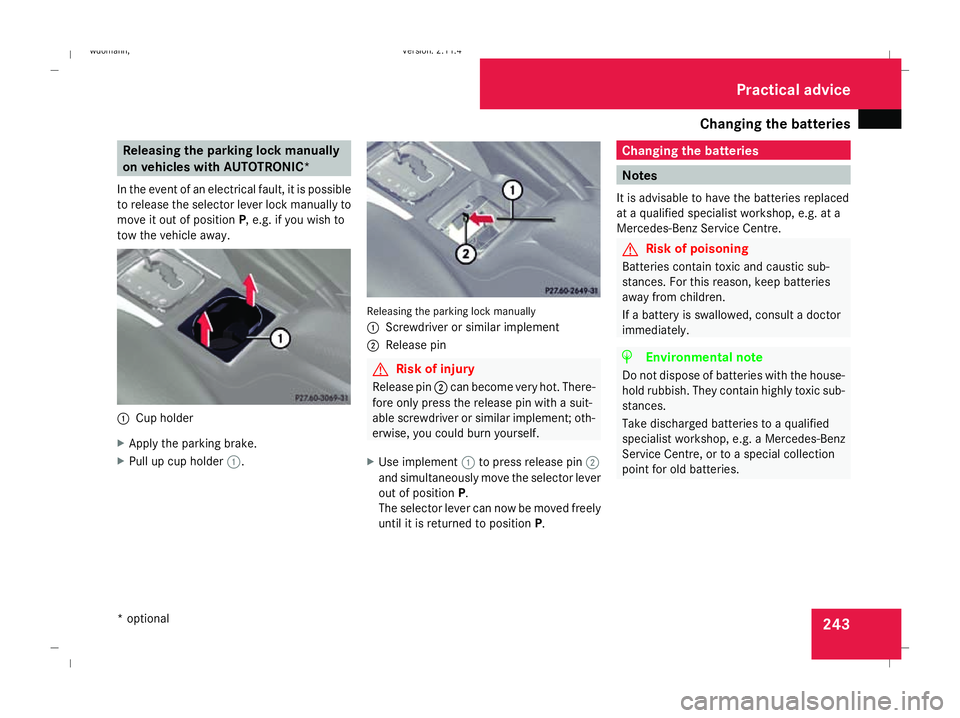
on vehicles with AUTOTRONIC*
In the event of an electrical fault, it is possible
to release the selector lever lock manually to
move it out of position P, e.g. if you wish to
tow the vehicle away. 1
Cup holder
X Apply the parking brake.
X Pull up cup holder 1. Releasing the parking lock manually
1
Screwdriver or similar implement
2 Release pin G
Risk of injury
Release pin 2can become very hot. There-
fore only press the release pin with a suit-
able screwdriver or similar implement; oth-
erwise, you could burn yourself.
X Use implement 1to press release pin 2
and simultaneously move the selector lever
out of position P.
The selector lever can now be moved freely
until it is returned to position P. Changing the batteries
Notes
It is advisable to have the batteries replaced
at a qualified specialist workshop, e.g. at a
Mercedes-Benz Service Centre. G
Risk of poisoning
Batteries contain toxic and caustic sub-
stances. For this reason, keep batteries
away from children.
If a battery is swallowed, consult a doctor
immediately. H
Environmental note
Do not dispose of batteries with the house-
hold rubbish. They contain highly toxic sub-
stances.
Take discharged batteries to a qualified
specialist workshop, e.g. a Mercedes-Benz
Service Centre, or to a special collection
point for old batteries. Practical advice
* optional
245_AKB; 2; 7, en-GB
wdomann,
Version: 2.11.4 2008-10-17T11:22:31+02:00 - Seite 243 ZDateiname: 6515_1640_02_buchblock.pdf; preflight