wheel MERCEDES-BENZ B-CLASS HATCHBACK 2008 Manual Online
[x] Cancel search | Manufacturer: MERCEDES-BENZ, Model Year: 2008, Model line: B-CLASS HATCHBACK, Model: MERCEDES-BENZ B-CLASS HATCHBACK 2008Pages: 305, PDF Size: 5.1 MB
Page 262 of 305
Flat tyre
259
X
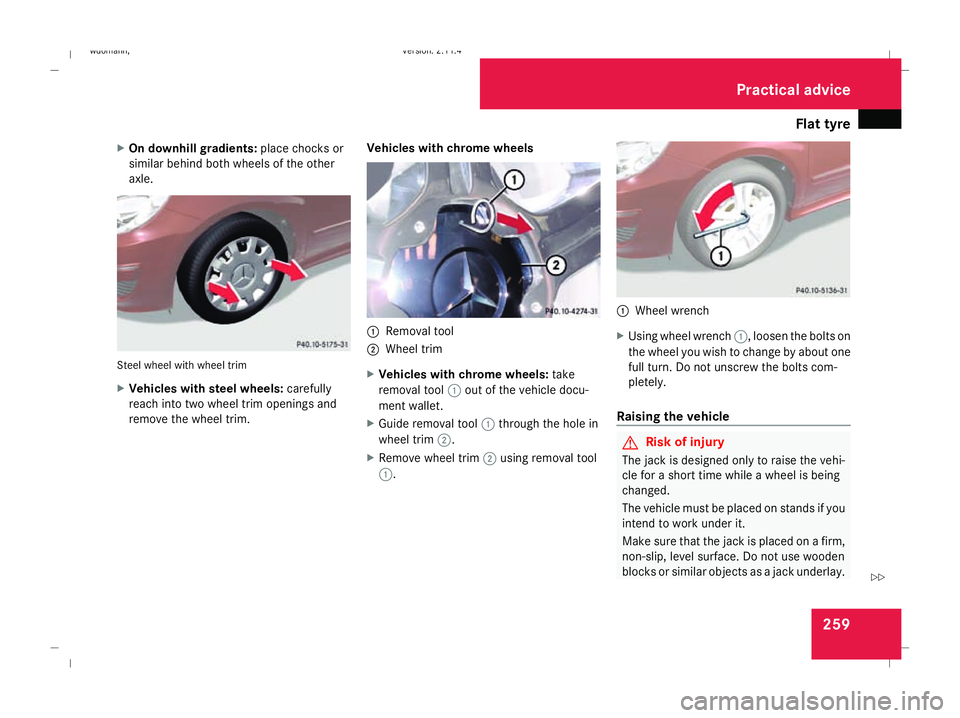
On downhill gradients: place chocks or
similar behind both wheels of the other
axle. Steel wheel with wheel trim
X Vehicles with steel wheels: carefully
reach into two wheel trim openings and
remove the wheel trim. Vehicles with chrome wheels 1
Removal tool
2 Wheel trim
X Vehicles with chrome wheels: take
removal tool 1out of the vehicle docu-
ment wallet.
X Guide removal tool 1through the hole in
wheel trim 2.
X Remove wheel trim 2using removal tool
1. 1
Wheel wrench
X Using wheel wrench 1, loosen the bolts on
the wheel you wish to change by about one
full turn. Do not unscrew the bolts com-
pletely.
Raising the vehicle G
Risk of injury
The jack is designed only to raise the vehi-
cle for a short time while a wheel is being
changed.
The vehicle must be placed on stands if you
intend to work under it.
Make sure that the jack is placed on a firm,
non-slip, level surface. Do not use wooden
blocks or similar objects as a jack underlay. Practical advice
245_AKB; 2; 7, en-GB
wdomann
, Version: 2.11.4
2008-10-17T11:22:31+02:00 - Seite 259 ZDateiname: 6515_1640_02_buchblock.pdf; preflight
Page 263 of 305
Flat tyre
260 Otherwise, the jack will not be able to ach-
ieve its load-bearing capacity due to the
restricted height.
Do not start the engine at any time while
the wheel is being changed.
Do not lie under the vehicle when it is being
supported by the jack. If you do not raise
the vehicle as described, it could slip off the
jack (e.g. if the engine is started or a door
or the tailgate is opened or closed) and you
could be seriously injured. G
Risk of accident
If you fail to position the jack correctly, the
vehicle may:
R slip off the jack
R injure you or others
R be damaged
Thus, it is important to make sure that the
jack is positioned correctly in the respec-
tive jacking points. Before positioning the
jack, remove any dirt that may have collec-
ted in the jacking points.
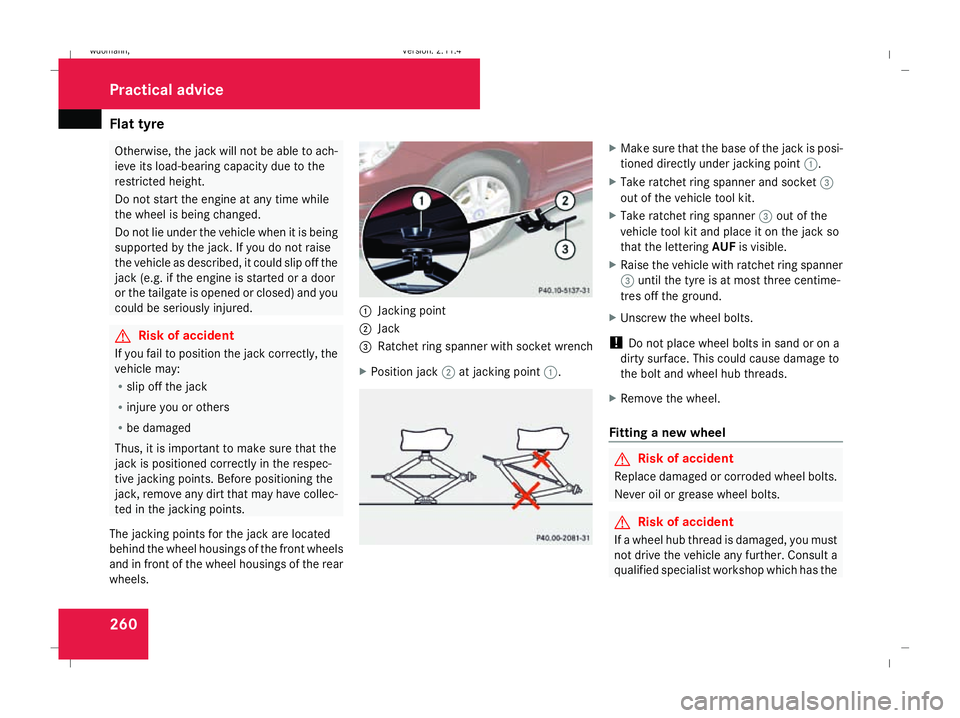
The jacking points for the jack are located
behind the wheel housings of the front wheels
and in front of the wheel housings of the rear
wheels. 1
Jacking point
2 Jack
3 Ratchet ring spanner with socket wrench
X Position jack 2at jacking point 1. X
Make sure that the base of the jack is posi-
tioned directly under jacking point 1.
X Take ratchet ring spanner and socket 3
out of the vehicle tool kit.
X Take ratchet ring spanner 3out of the
vehicle tool kit and place it on the jack so
that the lettering AUFis visible.
X Raise the vehicle with ratchet ring spanner
3 until the tyre is at most three centime-
tres off the ground.
X Unscrew the wheel bolts.
! Do not place wheel bolts in sand or on a
dirty surface. This could cause damage to
the bolt and wheel hub threads.
X Remove the wheel.
Fitting a new wheel G
Risk of accident
Replace damaged or corroded wheel bolts.
Never oil or grease wheel bolts. G
Risk of accident
If a wheel hub thread is damaged, you must
not drive the vehicle any further. Consult a
qualified specialist workshop which has the Practical advice
245_AKB; 2; 7, en-GB
wdomann , Version: 2.11.4 2008-10-17T11:22:31+02:00 - Seite 260Dateiname: 6515_1640_02_buchblock.pdf; preflight
Page 264 of 305
Flat tyre
261necessary specialist knowledge and tools
to carry out the work required. Mercedes-
Benz recommends that you use a
Mercedes-Benz Service Centre or Service
24h for this purpose. In particular, work rel-
evant to safety or on safety-related systems
must be carried out at a qualified specialist
workshop. G
Risk of accident
Only use wheel bolts that have been
designed for the wheel and the vehicle. For
safety reasons, Mercedes-Benz recom-
mends that you only use wheel bolts which
have been approved for Mercedes-Benz
vehicles. Other bolts could work loose.
Do not tighten the wheel bolts completely
while the vehicle is still jacked up. The vehi-
cle could topple off the jack.
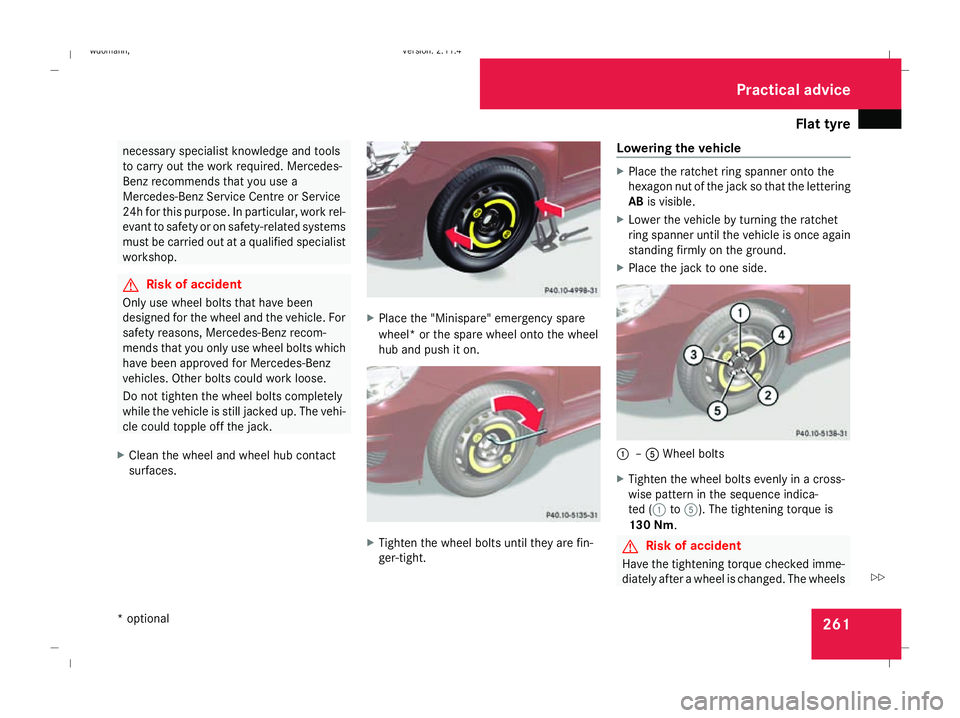
X Clean the wheel and wheel hub contact
surfaces. X
Place the "Minispare" emergency spare
wheel* or the spare wheel onto the wheel
hub and push it on. X
Tighten the wheel bolts until they are fin-
ger-tight. Lowering the vehicle X
Place the ratchet ring spanner onto the
hexagon nut of the jack so that the lettering
AB is visible.
X Lower the vehicle by turning the ratchet
ring spanner until the vehicle is once again
standing firmly on the ground.
X Place the jack to one side. 1
–5 Wheel bolts
X Tighten the wheel bolts evenly in a cross-
wise pattern in the sequence indica-
ted (1 to5). The tightening torque is
130 Nm. G
Risk of accident
Have the tightening torque checked imme-
diately after a wheel is changed. The wheels Practical advice
* optional
245_AKB; 2; 7, en-GB
wdomann
, Version: 2.11.4 2008-10-17T11:22:31+02:00 - Seite 261 ZDateiname: 6515_1640_02_buchblock.pdf; preflight
Page 265 of 305
Flat tyre
262 could work loose if they are not tightened
to a torque of 130 Nm.
X Turn the jack back to its initial position and
store it and the rest of the vehicle tool kit
in the stowage compartment behind the
rear seat backrest.
i When you are driving with the "Minispare"
emergency spare wheel* fitted, the tyre
pressure loss warning system* cannot
function reliably. MOExtended run-flat system*
The MOExtended run-flat system may only be
used in conjunction with the tyre pressure
loss warning system.
! The maximum permissible distance which
can be driven in run-flat mode depends on
the load in the vehicle. It is 50 km if the
vehicle is partially laden and 30 km if fully
laden.
The maximum range that can be driven in
emergency operation is measured from the
point at which the pressure loss warning
message appears in the multi-function dis-
play. You must not exceed a maximum speed of
80 km/h. G
Risk of accident
The handling characteristics of your vehicle
deteriorate in run-flat mode, for example:
R when cornering
R when braking
R when accelerating rapidly
Adapt your driving style accordingly and
avoid sudden changes in direction and sud-
den acceleration, as well as driving over
obstacles (i.e. kerbs, potholes), and driving
off-road. This is particularly the case when
the vehicle is heavily laden.
The maximum permissible distance that
can be driven in run-flat mode depends to
a large extent on the loads placed on the
vehicle. It can be shorter due to high
speeds, a heavy load, sudden acceleration
and/or manoeuvring, the road surface con-
dition, outside temperature, etc., or further,
if you drive carefully and conservatively.
Do not continue to drive in run-flat mode if:
R you hear banging noises.
R the vehicle starts to shake.
R you see smoke and smell rubber. R
ESP ®
is intervening constantly.
R there are tears in the sidewalls of the
tyre.
After driving in run-flat mode, you must
have the wheel(s) checked for damage at a
qualified specialist workshop which has the
necessary specialist knowledge and tools
to carry out the work required. The faulty
tyre must be replaced in every case.
Mercedes-Benz recommends that you use
a Mercedes-Benz Service Centre for this
purpose. In particular, work relevant to
safety or on safety-related systems must be
carried out at a qualified specialist work-
shop.
i On a vehicle with MOExtended tyres, only
use MOExtended spare tyres. These must
be of the size specified for the vehicle. Practical advice
* optional
245_AKB; 2; 7, en-GB
wdomann
,V ersion: 2.11.4
2008-10-17T11:22:31+02:00 - Seite 262 Dateiname: 6515_1640_02_buchblock.pdf; preflight
Page 272 of 305
Towing and tow-starting
269
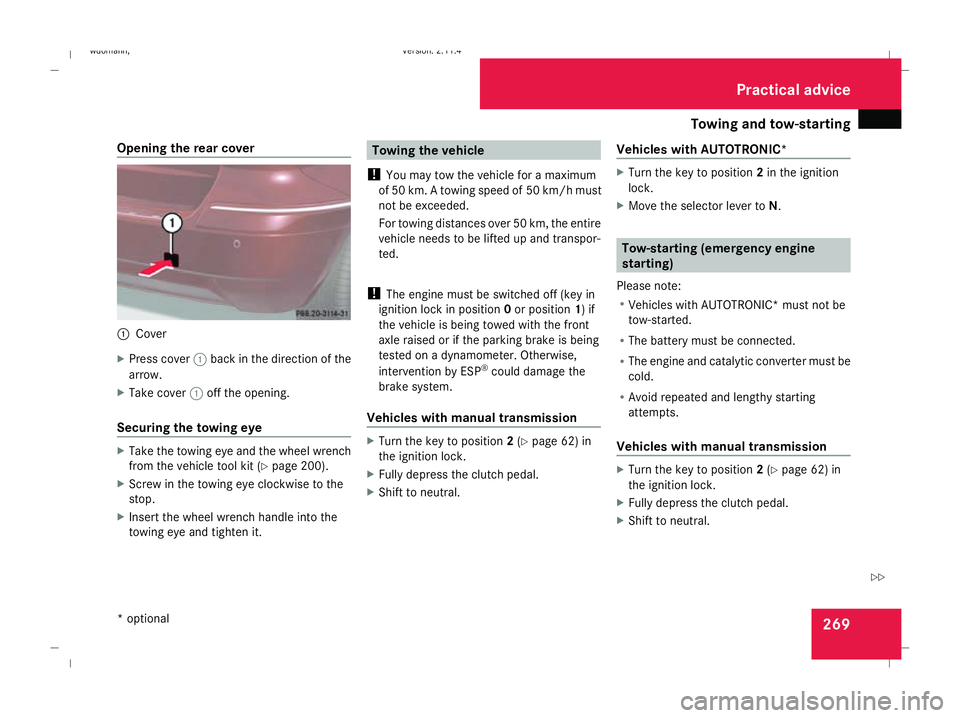
Opening the rear cover
1
Cover
X Press cover 1back in the direction of the
arrow.
X Take cover 1off the opening.
Securing the towing eye X
Take the towing eye and the wheel wrench
from the vehicle tool kit ( Ypage 200).
X Screw in the towing eye clockwise to the
stop.
X Insert the wheel wrench handle into the
towing eye and tighten it. Towing the vehicle
! You may tow the vehicle for a maximum
of 50 km. A towing speed of 50 km/h must
not be exceeded.
For towing distances over 50 km, the entire
vehicle needs to be lifted up and transpor-
ted.
! The engine must be switched off (key in
ignition lock in position 0or position 1) if
the vehicle is being towed with the front
axle raised or if the parking brake is being
tested on a dynamometer. Otherwise,
intervention by ESP ®
could damage the
brake system.
Vehicles with manual transmission X
Turn the key to position 2(Y page 62) in
the ignition lock.
X Fully depress the clutch pedal.
X Shift to neutral. Vehicles with AUTOTRONIC* X
Turn the key to position 2in the ignition
lock.
X Move the selector lever to N. Tow-starting (emergency engine
starting)
Please note:
R Vehicles with AUTOTRONIC* must not be
tow-started.
R The battery must be connected.
R The engine and catalytic converter must be
cold.
R Avoid repeated and lengthy starting
attempts.
Vehicles with manual transmission X
Turn the key to position 2(Y page 62) in
the ignition lock.
X Fully depress the clutch pedal.
X Shift to neutral. Practical advice
* optional
245_AKB; 2; 7, en-GB
wdomann, Version: 2.11.4 2008-10-17T11:22:31+02:00 - Seite 269 ZDateiname: 6515_1640_02_buchblock.pdf; preflight
Page 273 of 305
Fuses
270
X
Tow the vehicle or let it roll.
X Shift to a suitable gear and bring the clutch
pedal up slowly. Do not depress the accel-
erator pedal.
The engine is started. Removing the towing eye
X Take the wheel wrench from the vehicle
tool kit (Y page 200).
X Insert the wheel wrench handle into the
towing eye and turn it anti-clockwise.
X Unscrew the towing eye.
X Replace the cover and press it until it
engages.
X Return the towing eye and the wheel
wrench to the vehicle tool kit. Transporting the vehicle
The towing eyes or trailer coupling* can be
used to pull the vehicle onto a trailer or trans-
porter if you wish to transport it.
! Only secure the vehicle by the wheels or
wheel rims, not by parts of the vehicle such
as axle or steering components. Otherwise,
the vehicle could be damaged.
Vehicles with manual transmission X
Shift to neutral.
Vehicles with AUTOTRONIC* X
Turn the key to position 2(Y page 62) in
the ignition lock.
X Move the selector lever to N. Fuses
Notes on changing fuses
The fuses in your vehicle serve to close down
faulty circuits. If a fuse blows, all the compo-
nents on the circuit and their functions will
fail.
Blown fuses must be replaced with fuses of
the same rating, which you can recognise by
the colour and value. The fuse ratings are lis-
ted in the fuse allocation chart. A Mercedes-
Benz Service Centre will be happy to advise
you. G
Risk of fire
Only use fuses that have been approved for
Mercedes-Benz vehicles and which have
the correct fuse rating for the systems con-
cerned. Do not attempt to repair or bridge
faulty fuses. Otherwise, a circuit overload
could cause a fire. Have the cause traced
and rectified at a qualified specialist work-
shop, e.g. a Mercedes-Benz Service Centre.
If the newly inserted fuse also blows, have the
cause traced and rectified at a qualified spe-
cialist workshop, e.g. a Mercedes-Benz
Service Centre.
! Only use fuses that have been approved
for Mercedes-Benz vehicles and which Practical advice
* optional
245_AKB; 2; 7, en-GB
wdomann
,V ersion: 2.11.4
2008-10-17T11:22:31+02:00 - Seite 270 Dateiname: 6515_1640_02_buchblock.pdf; preflight
Page 276 of 305

273
Introduction to technical data
.........274
Genuine Mercedes-Benz parts .........274
Vehicle electronics ...........................275
Vehicle identification plates ............276
Engine ................................................ 278
Performance ...................................... 280
Tyres and wheels .............................. 282
Vehicle dimensions ..........................286
Vehicle weights ................................. 286
Trailer coupling* ............................... 289
Service products and capacities .....291 Technical data
245_AKB; 2; 7, en-GB
wdomann
, Version: 2.11.4 2008-10-17T11:22:31+02:00 - Seite 273Dateiname: 6515_1640_02_buchblock.pdf; preflight
Page 285 of 305

Tyres and wheels
282 Tyres and wheels
Points to remember
! For safety reasons, Mercedes-Benz rec-
ommends that you only use tyres which
have been approved specifically for your
vehicle by Mercedes-Benz. These tyres are
specially adapted for use with the control
systems, such as ABS or ESP ®
, and are
marked as follows:
R MO = Mercedes-Benz Original
R MOE = Mercedes-Benz Original Exten-
ded* (with run-flat characteristics)
If you use other tyres, Mercedes-Benz can-
not accept any responsibility for damage
which may occur. Information about tyres
can be obtained from any Mercedes-Benz
Service Centre.
i Vehicles with MOExtended run-flat sys-
tem are not equipped with the TIREFIT
kit* 34
.
Therefore, it is recommended that you
additionally equip your vehicle with the
TIREFIT kit* when fitting tyres that do not
feature run-flat properties, e.g. winter
tyres. i
A TIREFIT kit* is available from any quali-
fied specialist workshop, e.g. a Mercedes-
Benz Service Centre.
! If you fit tyres other than those tested and
recommended by Mercedes-Benz, charac-
teristics such as handling, noise levels and
fuel consumption, etc. may be adversely
affected. In addition, when driving with a
load, tyre dimensional variations could
cause the tyres to come into contact with
the bodywork and axle components. This
could result in damage to the tyres or the
vehicle.
i Further information about tyres and
wheels can be obtained from any
Mercedes-Benz Service Centre.
You will find a table of tyre pressures on the
inside of your vehicle's fuel filler flap. You
will find further information about tyre pres-
sures in the "Operation" section
(Y page 178).
34 Only for certain countries. Technical data
* optional
245_AKB; 2; 7, en-GB
wdomann,
Version: 2.11.4 2008-10-17T11:22:31+02:00 - Seite 282Dateiname: 6515_1640_02_buchblock.pdf; preflight
Page 286 of 305
Tyres and wheels
283Tyres
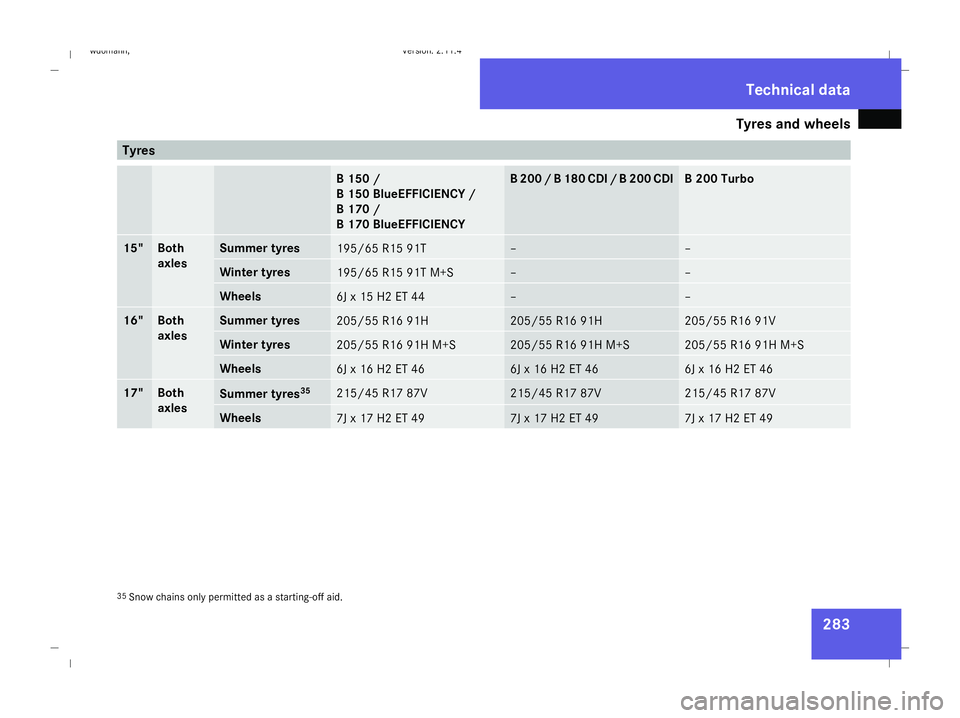
B 150 /
B 150 BlueEFFICIENCY /
B 170 /
B 170 BlueEFFICIENCY B 200 / B 180 CDI / B 200 CDI B 200 Turbo
15" Both
axles Summer tyres
195/6
5 R15 91T – –
Winter
tyres 195/65 R15 91T M+S – –
Wheels
6J x 15 H2 ET 44 – –
16" Both
axles Summer tyres
205/55 R16 91H 205/55 R16 91H 205/55 R16 91V
Winter tyres
205/55 R16 91H M+S 205/55 R16 91H M+S 205/55 R16 91H M+S
Wheels
6J x 16 H2 ET 46 6J x 16 H2 ET 46 6J x 16 H2 ET 46
17" Both
axles
Summer tyres
35 215/45 R17 87V 215/45 R17 87V 215/45 R17 87V
Wheels
7J x 17 H2 ET 49 7J x 17 H2 ET 49 7J x 17 H2 ET 49
35
Snow chains only permitted as a starting-off aid. Technical data
245_AKB; 2; 7, en-GB
wdomann,
Version: 2.11.4 2008-10-17T11:22:31+02:00 - Seite 283 ZDateiname: 6515_1640_02_buchblock.pdf; preflight
Page 287 of 305

Tyres and wheels
284 AMG equipment*
All models
18" Both axles
Summer tyres
36 215/4
0 R 18 89W XL Light-alloy wheels
7J
x 18 H2 ET 49 MOExtended tyres*
i Tyres with run-flat characteristics, only in conjunction with light-alloy wheels and tyre pressure loss warning system. B 150 / B 150 BlueEFFICIENCY / B 170 /
B 170 BlueEFFICIENCY B 200 / B 200 Turbo
B 180 CDI / B 200 CDI 16" Both axles
Winter tyres
37, 38 195/55 R16 87T M+S MOExtended
39 195/55 R16 87T M+S MOExtended
40 Light-alloy wheels
41 6J x 16 H2 ET 46 6J x 16 H2 ET 46
17" Both axles
Summer tyres
37,42 215/45 R17 87V MOExtended 215/45 R17 87V MOExtended
Light-alloy wheels
41 7J x 17 H2 ET 49 7J x 17 H2 ET 49
36
Snow chains only permitted as a starting-off aid.
37 Tyres with run-flat characteristics and only in combination with the tyre pressure loss warning or tyre pressure monitor* activated.
38 Not available directly from the factory. You can obtain further information from the approval sheet no. 1810081462 or from a specialist workshop, e.g. a Mercedes-
Benz Service Centre.
39 Tyre pressures as per standard tyres.
40 Tyre pressures as per 215/45 R17 size.
41 Not on steel wheels.
42 Use of snow chains only permitted as a pull-away aid. Technical data
* optional
245_AKB; 2; 7, en-GB
wdomann,
Version: 2.11.4 2008-10-17T11:22:31+02:00 - Seite 284Dateiname: 6515_1640_02_buchblock.pdf; preflight