brake MERCEDES-BENZ B-CLASS HATCHBACK 2011 Owners Manual
[x] Cancel search | Manufacturer: MERCEDES-BENZ, Model Year: 2011, Model line: B-CLASS HATCHBACK, Model: MERCEDES-BENZ B-CLASS HATCHBACK 2011Pages: 329, PDF Size: 7.91 MB
Page 303 of 329
The following must be observed when raising
the vehicle:
R
to raise the vehicle, only use the vehicle-
specific jack that has been tested and
approved by Mercedes-Benz.Ifu sed incor-
rectly, the jack could tip over with the vehi-
cle raised.
R the jack is designed only to raise and hold
the vehicle for a short time while a wheel
is being changed. It is not suited for per-
forming maintenance work under the vehi-
cle.
R avoid changing the wheel on uphill and
downhill slopes.
R before raising the vehicle, secure it from
rolling away by applying the parking brake
and inserting wheel chocks. Never disen-
gage the parking brake while the vehicle is
raised.
R the jack must be placed on a firm, flat and
non-slip surface. On a loose surface, a
large, load-bearing underlay must be used.
On a slippery surface, a non-slip underlay
must be used, e.g. rubber mats.
R do not use wooden blocks or similar
objects as a jack underlay.O therwise, the
jack will not be able to achieve its load-
bearing capacity due to the restricted
height.
R make sure tha tthe distance between the
underside of the tyres and the ground does
not exceed 3 cm.
R never place your hands and feet under the
raised vehicle.
R never lie under the raised vehicle.
R never start the engine when the vehicle is
raised.
R never open or close a door or the tailgate
when the vehicle is raised.
R make sure that no persons are present in
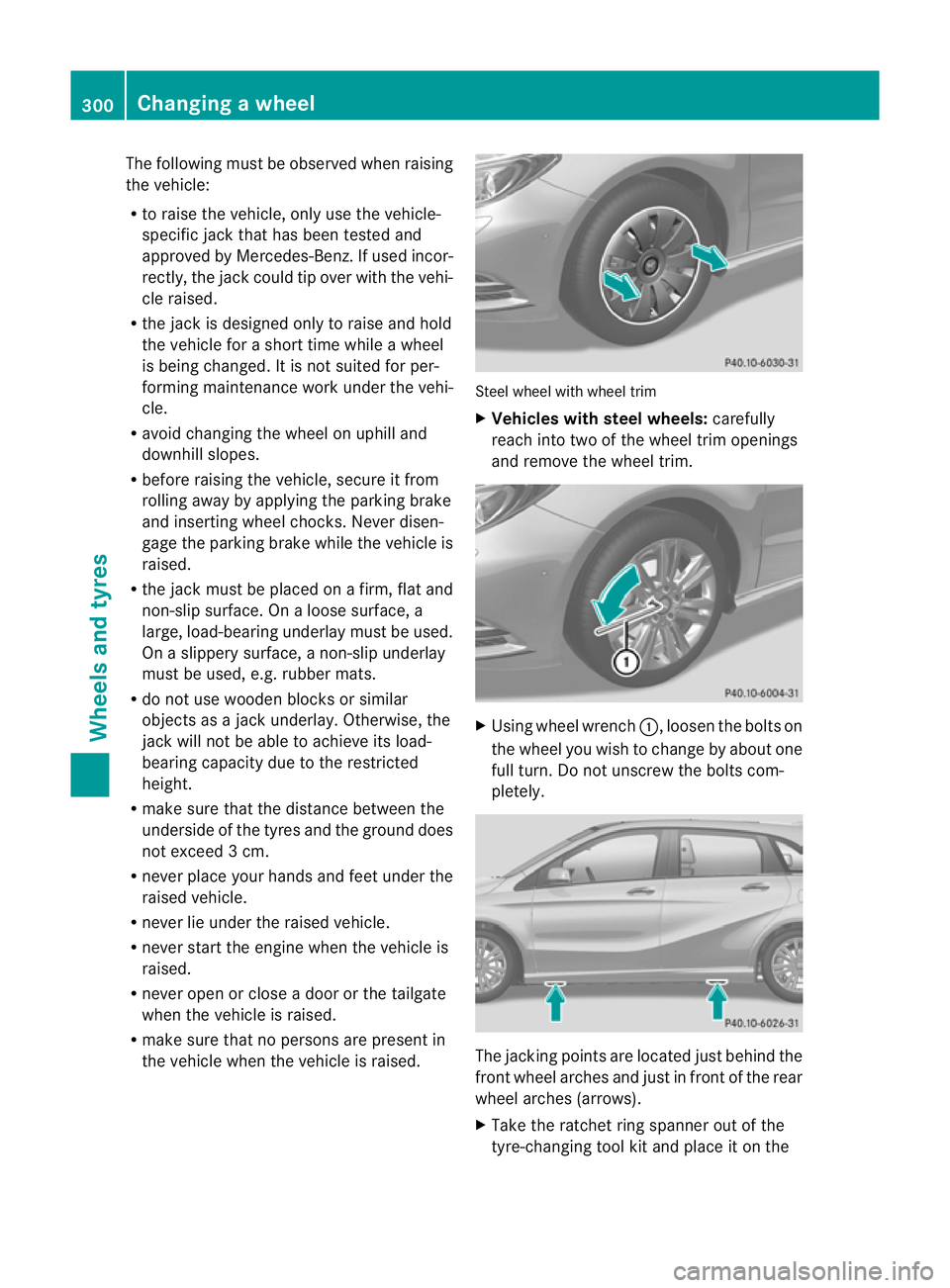
the vehicle when the vehicle is raised. Steel wheel with wheel trim
X Vehicles with steel wheels: carefully
reach into two of the wheel trim openings
and remove the wheel trim. X
Using wheel wrench :, loosen the bolts on
the wheel you wish to change by about one
full turn. Do not unscrew the bolts com-
pletely. The jacking points are located just behind the
front wheel arches and just in front of the rear
wheel arches (arrows).
X Take the ratchet ring spanner out of the
tyre-changing tool kit and place it on the 300
Changing
awheelWheels and tyres
Page 311 of 329
Useful information
i This Owner's Manual describes all models
and all standard and optional equipment
available to your vehicle at the time of pub-
lication of the Owner's Manual. Country-
specific deviations are possible. Please
note that your vehicle may not be equipped
with all features described. This also
applies to safety-relevan tsystems and
functions.
i Please read the information on qualified
specialist workshops (Y page 22).Notes on the technical data
You can find technical data on the Internet at:
http://www.mercedes-benz.com
i The technical data was determined in
accordance with EC Directives. All data
applies to the vehicle's standard equip-
ment. It may therefore differ for vehicles
with optional equipment. You can obtain
further information from a Mercedes-Benz
Service Centre. Genuine Mercedes-Benz parts
G
WARNING
Driving safety may be impaired if non-
approved parts, tyres and wheels or safety-
relevant accessories are used.
This could lead to malfunctions in safety-rel-
evant systems, e.g. the brake system. This
could cause you to lose control of your vehicle
and cause an accident.
Fo rthis reason, Mercedes-Ben zrecommends
that you use genuine Mercedes-Benz parts or
parts of equal quality. Only use tyres, wheels
and accessories that have been specifically
approved for your vehicle. H
Environmental note
Daimler AG also supplies reconditioned
assemblies and parts which are of the same
quality as new parts. For these, the same war-
ranty applies as for new parts.
! Airbags and seat belt tensioners, as well
as control units and sensors for these
restraint systems, may be installed in the
following areas of your vehicle:
R doors
R door pillars
R door sills
R seats
R dashboard
R instrument cluster
R centre console
Do not install accessories such as audio
systems in these areas. Do not carry out
repairs or welding. You could impair the
operating efficiency of the restraint sys-
tems.
Have accessories retrofitted at a qualified
specialist workshop. Mercedes-Benz rec-
ommends that you use a Mercedes-Benz
Service Centre for this purpose.
Mercedes-Benz tests genuine parts and con-
version parts and accessories that have been
specifically approved for your vehicle for their
reliability, safety and suitability. Despite
ongoing market research, Mercedes-Benz is
unable to evaluate other parts. Mercedes-
Benz accepts no responsibility for the use of
parts that have been independently or offi-
cially approved.
In Germany, certain parts are only officially
approved for installation or modification if
they comply with legal requirements. This
also applies to some other countries. All gen-
uine Mercedes-Benz parts meet the approval
requirements. The use of non-approved parts
may invalidate the vehicle's general operating
permit. 308
Genuine Mercedes-Benz partsTechnical data
Page 314 of 329
D
Maximum permissible rear axle load (kg)
E Paint code
i The data shown on the vehicle identifica-
tion plate is example data. This data is dif-
ferent for every vehicle, and can deviate
from the data shown here. You can find the
data applicable to your vehicle on the vehi-
cle's identification plate. Vehicle identification number (VIN)
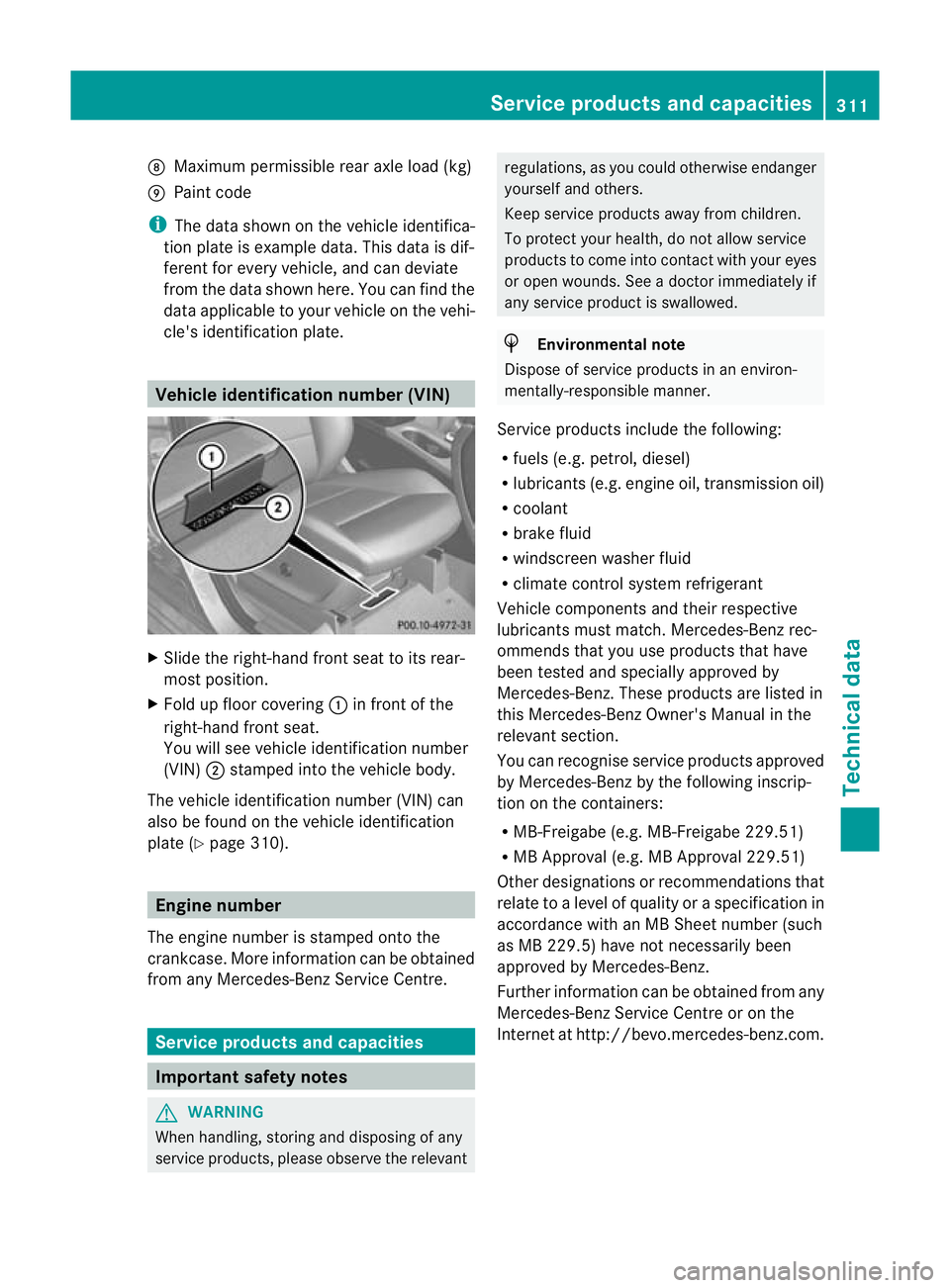
X
Slide the right-hand front seat to its rear-
most position.
X Fold up floor covering :in front of the
right-hand front seat.
You will see vehicle identification number
(VIN) ;stamped into the vehicle body.
The vehicle identification number (VIN) can
also be found on the vehicle identification
plate (Y page 310). Engine number
The engine number is stamped onto the
crankcase. More information can be obtained
from any Mercedes-Benz Service Centre. Service products and capacities
Important safety notes
G
WARNING
When handling, storing and disposing of any
service products, please observe the relevant regulations, as you could otherwise endanger
yourself and others.
Keep service products away from children.
To protect your health, do not allow service
products to come into contact with your eyes
or open wounds. See a doctor immediately if
any service product is swallowed.
H
Environmental note
Dispose of service products in an environ-
mentally-responsible manner.
Service products include the following:
R fuels (e.g. petrol, diesel)
R lubricants (e.g. engine oil, transmission oil)
R coolant
R brake fluid
R windscreen washer fluid
R climate control system refrigerant
Vehicle components and their respective
lubricants must match. Mercedes-Benz rec-
ommends that you use products that have
been tested and specially approved by
Mercedes-Benz. These products are listed in
this Mercedes-Ben zOwner's Manual in the
relevant section.
You can recognise service products approved
by Mercedes-Ben zby the following inscrip-
tion on the containers:
R MB-Freigabe (e.g. MB-Freigabe 229.51)
R MB Approval (e.g. MB Approval 229.51)
Other designations or recommendations that
relate to a level of quality or a specification in
accordance with an MB Sheet number (such
as MB 229.5) hav enot necessarily been
approved by Mercedes-Benz.
Further information can be obtained from any
Mercedes-Benz Service Centre or on the
Internet at http://bevo.mercedes-benz.com. Service products and capacities
311Technical data Z
Page 318 of 329
You can call up an overview of approved
engine oils on the Internet at
http://bevo.mercedes-benz.com by enter-
ing the designation, e.g. 229.5.
The table shows which engine oils have been
approved for your vehicle. Petrol engines MB Approval
B1
8021
B2 0021 229.3, 229.5,
229.51
Diesel engines MB Approval
B1
80 CDI 21
B2 00 CDI 21 228.51,
229.31, 229.51
i
If the engine oils listed in the table are not
available, you may add the following engine
oils until the nex toil change:
R vehicles with a petrol engine: MB
Approval 229.1 or ACEA A3
R vehicles with a diesel engine: MB
Approval 229.1 or ACEA C3
This must only be added once and the
amount must not be greater than 1.0 l.
Capacities The following values refer to an oil change
including the oil filter. Model Replacement
amount B1
8021
B2 0021 5.8 l
B1
80 CDI 21
B2 00 CDI 21 7.0 l
Additives
!
Do not use additives in engine oil. This
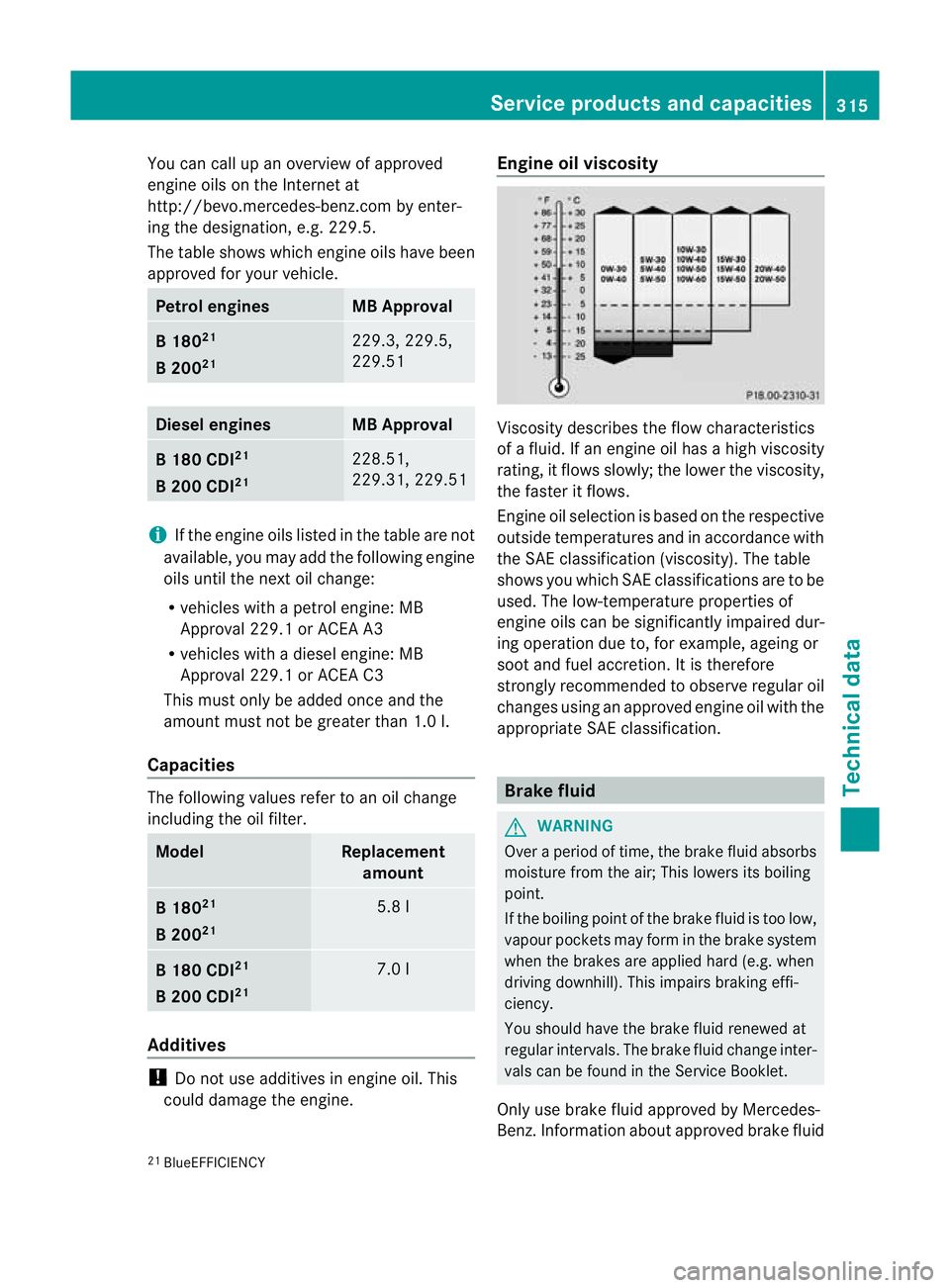
could damage the engine. Engine oil viscosity
Viscosity describes the flow characteristics
of a fluid. If an engine oil has a high viscosity
rating, it flows slowly; the lower the viscosity,
the faster it flows.
Engine oil selection is based on the respective
outside temperatures and in accordance with
the SAEc
lassification (viscosity). The table
shows you which SA Eclassifications are to be
used. The low-temperature properties of
engine oils can be significantly impaired dur-
ing operation due to, for example, ageing or
soot and fuel accretion. It is therefore
strongly recommended to observe regular oil
changes using an approved engine oil with the
appropriate SA Eclassification. Brake fluid
G
WARNING
Over a period of time, the brake fluid absorbs
moisture fro mthe air; This lowers its boiling
point.
If the boiling point of the brake fluid is too low,
vapour pockets may form in the brake system
when the brakes are applied hard (e.g. when
driving downhill). This impairs braking effi-
ciency.
You should have the brake fluid renewed at
regular intervals. The brake fluid change inter-
vals can be found in the Service Booklet.
Only use brake fluid approved by Mercedes-
Benz.I nformation abou tapproved brake fluid
21 BlueEFFICIENCY Service products and capacities
315Technical data Z
Page 319 of 329
can be obtained at any qualified specialist
workshop or on the Internet at
http://bevo.mercedes-benz.co
m.
i Have the brake fluid regularly checked at
a qualified specialist workshop.
There is usually a notice in the engine com-
partment to remind you when the next
brake fluid change is due. Coolant
Important safety notes G
WARNING
Antifreeze is highly flammable. Fire, naked
flames and smoking are prohibited whe nhan-
dling antifreeze.
If antifreeze comes into contact with hot
engine parts, it may ignite and you could burn
yourself. Do no tspill any antifreeze on hot
engine parts.
! Only add coolant that has been premixed
with the desired antifreeze protection. You
could otherwise damage the engine.
Further information on coolants can be
found in the Mercedes-Benz Specifications
for Service Products, MB Specifications for
Service Products 310.1, e.g. on the Inter-
net at http://bevo.mercedes-benz.com.
Or contact a qualified specialist workshop.
! Always use a suitable coolant mixture,
even in countries where high temperatures
prevail.
Otherwise, the engine cooling system is not
sufficiently protected from corrosion and
overheating.
! The engine cooling system is filled with
coolant, which must be renewed after
15 years or after 250,000 kilometres at the
latest. The coolant is a mixture of water and anti-
freeze/corrosion inhibitor. It performs the
following tasks:
R
anti-corrosion protection
R antifreeze protection
R raising the boiling point
If antifreeze/corrosion inhibito ris present in
the correct concentration, the boiling point of
the coolant during operation will be around
130 †.
The antifreeze/corrosion inhibitor concentra-
tion in the engine cooling system should:
R be at least 50%. This will protect the engine
cooling system against freezing down to
around -37 †.
R not exceed 55% (antifreeze protection
down to -45 †). Otherwise, heat will not be
dissipated as effectively.
If the vehicle has lost coolant, top it up with
equal amounts of water and antifreeze/cor-
rosion inhibitor. Mercedes-Benz recom-
mends an antifreeze/corrosion inhibitor con-
centrate in accordance with MB Specifica-
tions for Service Products 310.1.
i When the vehicle is first delivered, it is fil-
led with a coolant mixture that ensures
adequate antifreeze and corrosion protec-
tion. Washer fluid
G
WARNING
Windscreen washer fluid/antifreeze is highly
flammable.A void spilling windscreen washer
fluid/antifreeze on hot engine components as
it can ignite and burn. Severe burns could be
the result.
! Only use washer fluid that is suitable for
plastic lamp lenses, e.g. MB SummerFit or
MB WinterFit. Unsuitable washer fluid
could damage the plastic lenses of the
headlamps. 316
Service products and capacitiesTechnical data
Page 323 of 329
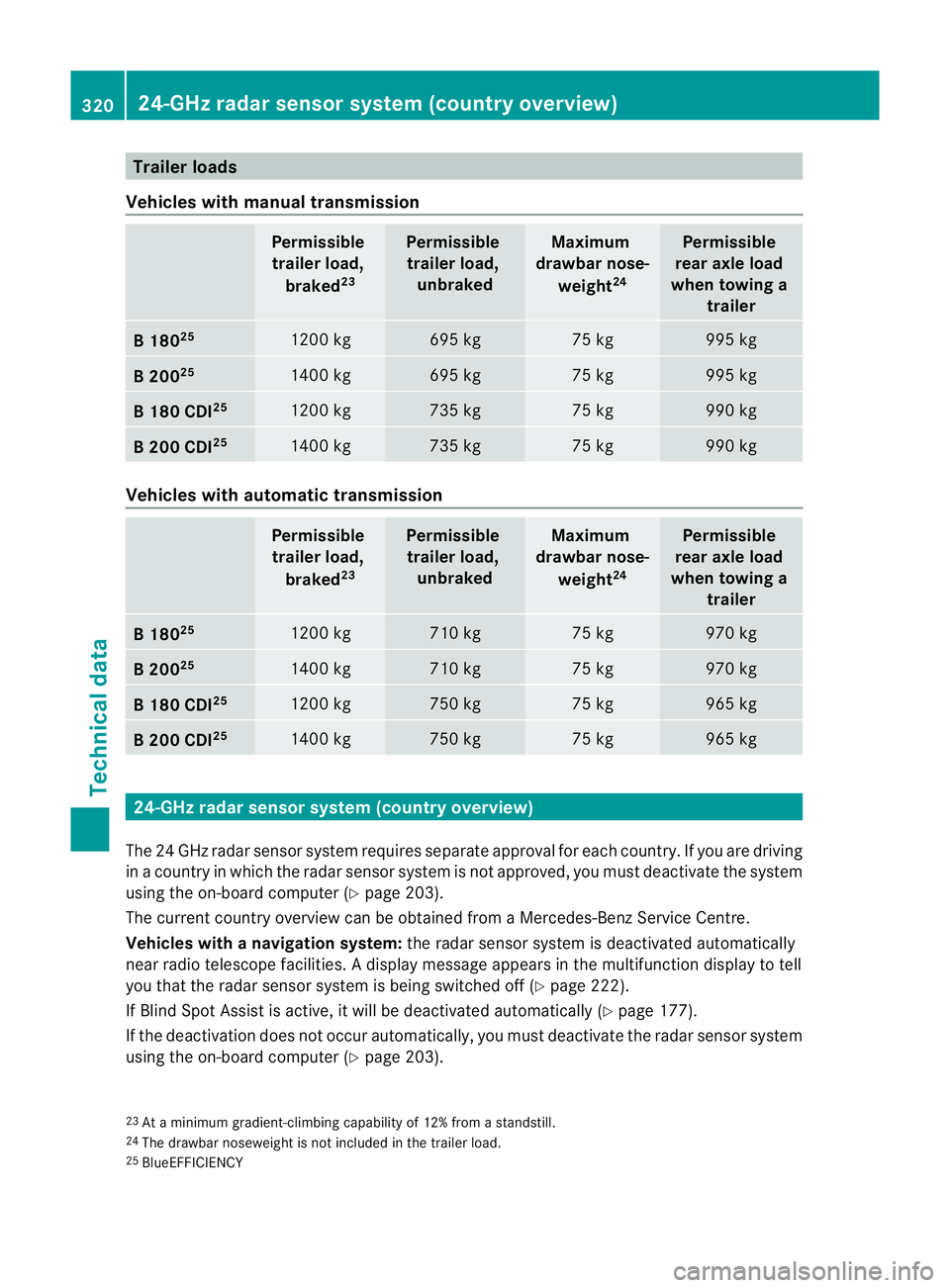
Trailer loads
Vehicles with manual transmission Permissible
trailer load,
braked 23 Permissible
trailer load, unbraked Maximum
drawbar nose-
weight 24 Permissible
rear axle load
when towing a trailer B1
8025 1200 kg 695 kg 75 kg 995 kg
B2
0025 1400 kg 695 kg 75 kg 995 kg
B1
80 CDI 25 1200 kg 735 kg 75 kg 990 kg
B2
00 CDI 25 1400 kg 735 kg 75 kg 990 kg
Vehicles with automatic transmission
Permissible
trailer load,
braked 23 Permissible
trailer load, unbraked Maximum
drawbar nose-
weight 24 Permissible
rear axle load
when towing a trailer B1
8025 1200 kg 710 kg 75 kg 970 kg
B2
0025 1400 kg 710 kg 75 kg 970 kg
B1
80 CDI 25 1200 kg 750 kg 75 kg 965 kg
B2
00 CDI 25 1400 kg 750 kg 75 kg 965 kg
24-GHz radar sensor system (country overview)
The 24 GHz radar sensor system requires separate approval for each country. If you are driving
in a country in which the radar sensor system is not approved, you must deactivate the system
using the on-board computer (Y page 203).
The current country overview can be obtained from a Mercedes-Benz Service Centre.
Vehicles with anavigation system: the radar sensor system is deactivated automatically
near radio telescope facilities. Adisplay message appears in the multifunction display to tell
you that the radar sensor system is being switched off (Y page 222).
If Blind Spot Assist is active, it will be deactivated automatically (Y page 177).
If the deactivation does not occur automatically, you must deactivate the radar sensor system
using the on-board computer (Y page 203).
23 At a minimum gradient-climbing capability of 12% fro mastandstill.
24 The drawbarn oseweight is not included in the trailer load.
25 BlueEFFICIENCY 320
24-GHz radar sensor system (country overview)Technical data