tow MERCEDES-BENZ B-CLASS HATCHBACK 2014 User Guide
[x] Cancel search | Manufacturer: MERCEDES-BENZ, Model Year: 2014, Model line: B-CLASS HATCHBACK, Model: MERCEDES-BENZ B-CLASS HATCHBACK 2014Pages: 405, PDF Size: 12.24 MB
Page 37 of 405
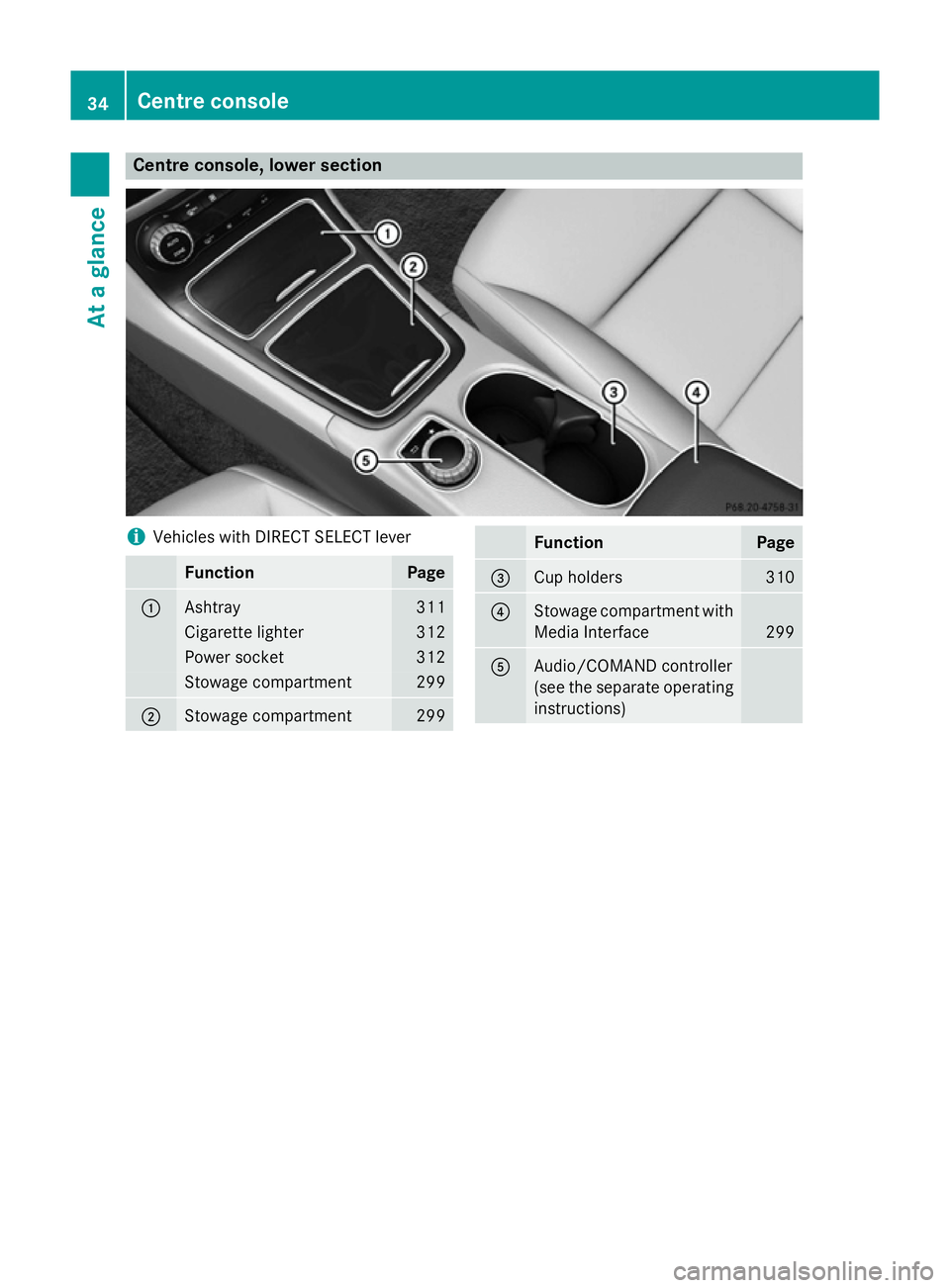
Centre console, lower section
i
Vehicles with DIRECT SELECT lever Function Page
:
Ashtray 311
Cigarette lighter 312
Power socket 312
Stowage compartment 299
;
Stowage compartment 299 Function Page
=
Cup holders 310
?
Stowage compartment with
Media Interface 299
A
Audio/COMAND controller
(see the separate operating
instructions) 34
Centre consoleAt a glance
Page 39 of 405
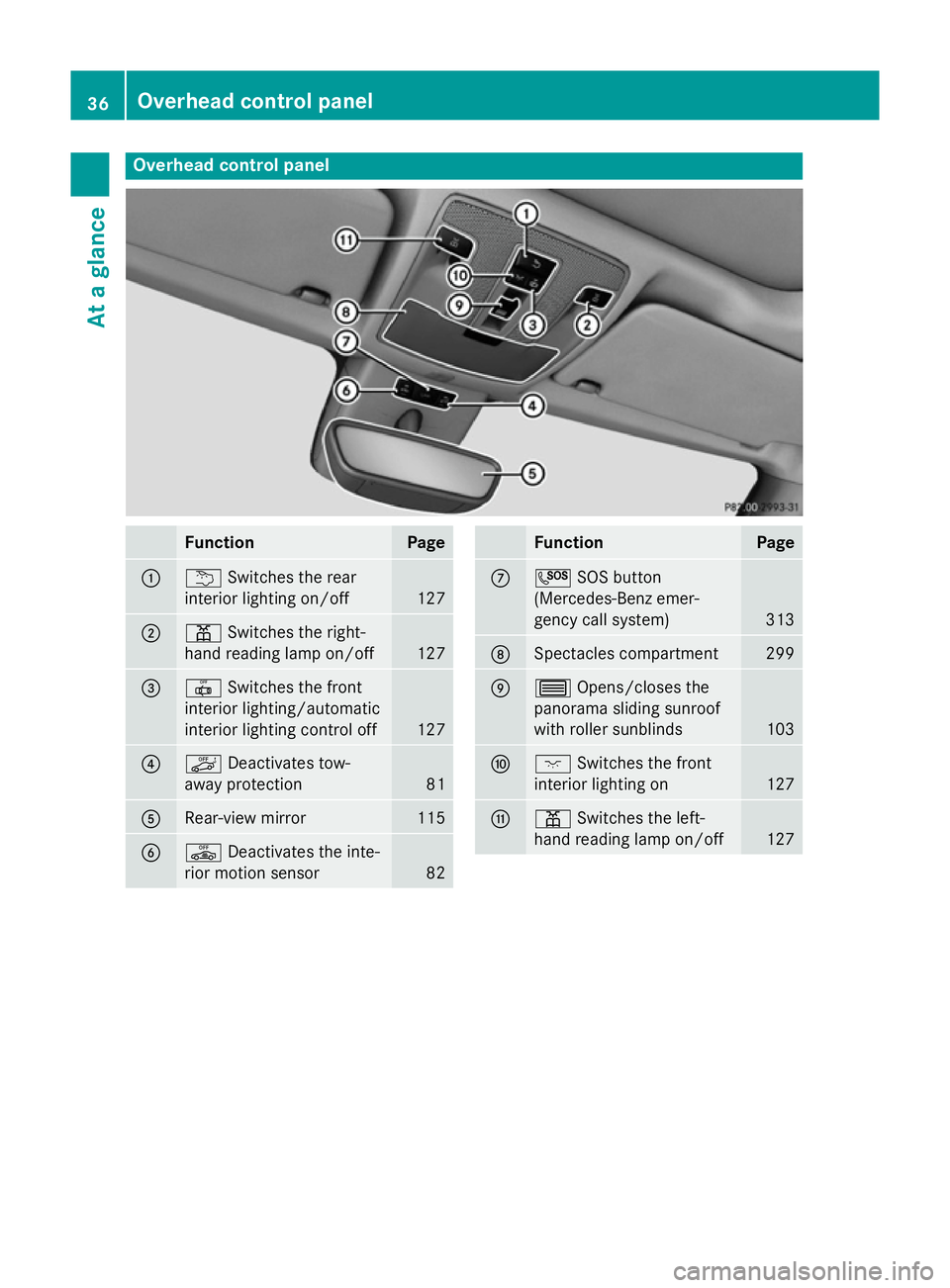
Overhead control panel
Function Page
:
u
Switches the rear
interior lighting on/off 127
;
p
Switches the right-
hand reading lamp on/off 127
=
|
Switches the front
interior lighting/automatic
interior lighting control off 127
?
ë
Deactivates tow-
away protection 81
A
Rear-view mirror 115
B
ê
Deactivates the inte-
rior motion sensor 82 Function Page
C
G
SOS button
(Mercedes-Benz emer-
gency call system) 313
D
Spectacles compartment 299
E
3
Opens/closes the
panorama sliding sunroof
with roller sunblinds 103
F
c
Switches the front
interior lighting on 127
G
p
Switches the left-
hand reading lamp on/off 12736
Overhead control panelAt a glance
Page 40 of 405
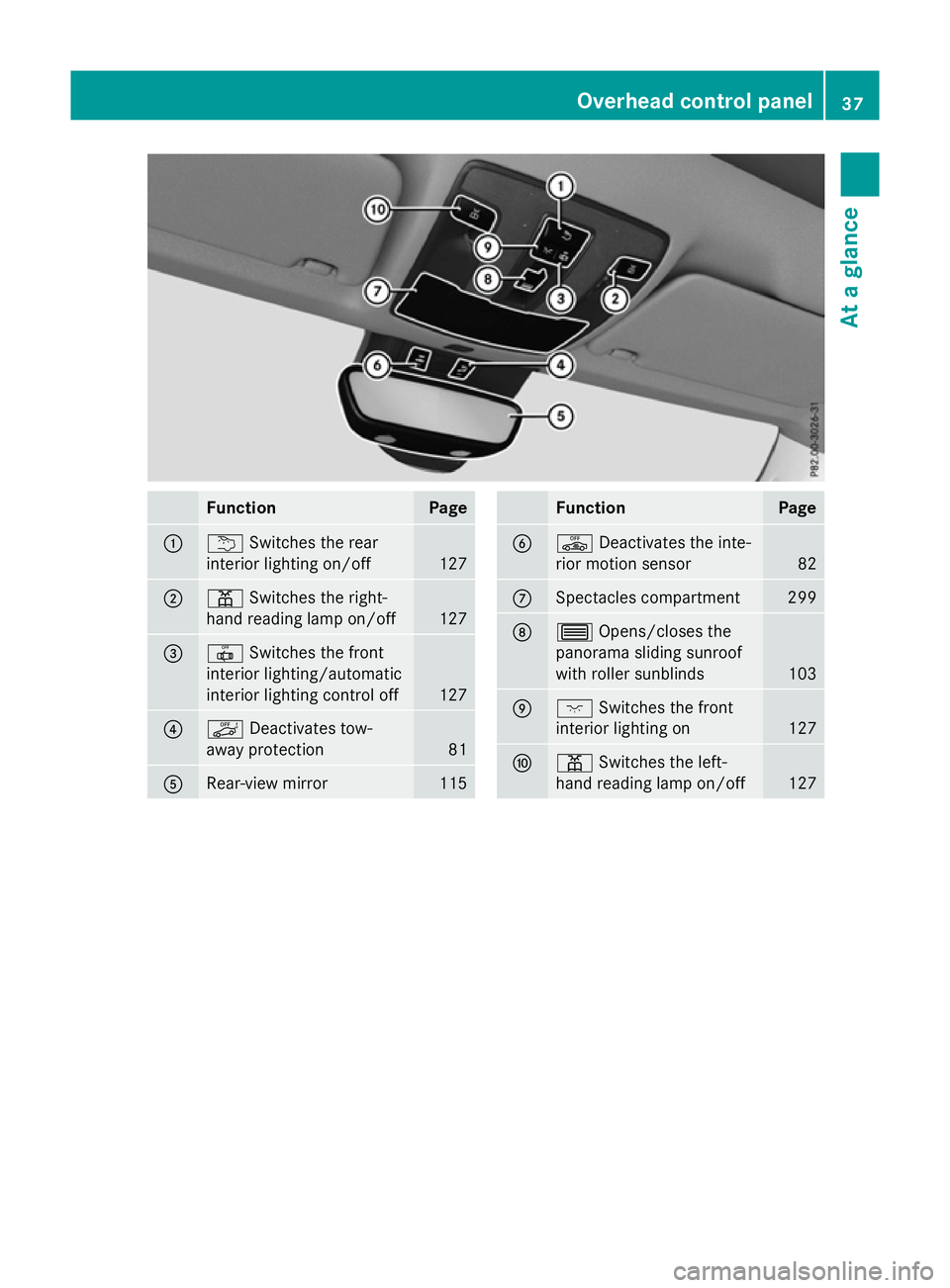
Function Page
:
u
Switches the rear
interior lighting on/off 127
;
p
Switches the right-
hand reading lamp on/off 127
=
|
Switches the front
interior lighting/automatic
interior lighting control off 127
?
ë
Deactivates tow-
away protection 81
A
Rear-view mirror 115 Function Page
B
ê
Deactivates the inte-
rior motion sensor 82
C
Spectacles compartment 299
D
3
Opens/closes the
panorama sliding sunroof
with roller sunblinds 103
E
c
Switches the front
interior lighting on 127
F
p
Switches the left-
hand reading lamp on/off 127Overhead control panel
37At a glance
Page 48 of 405
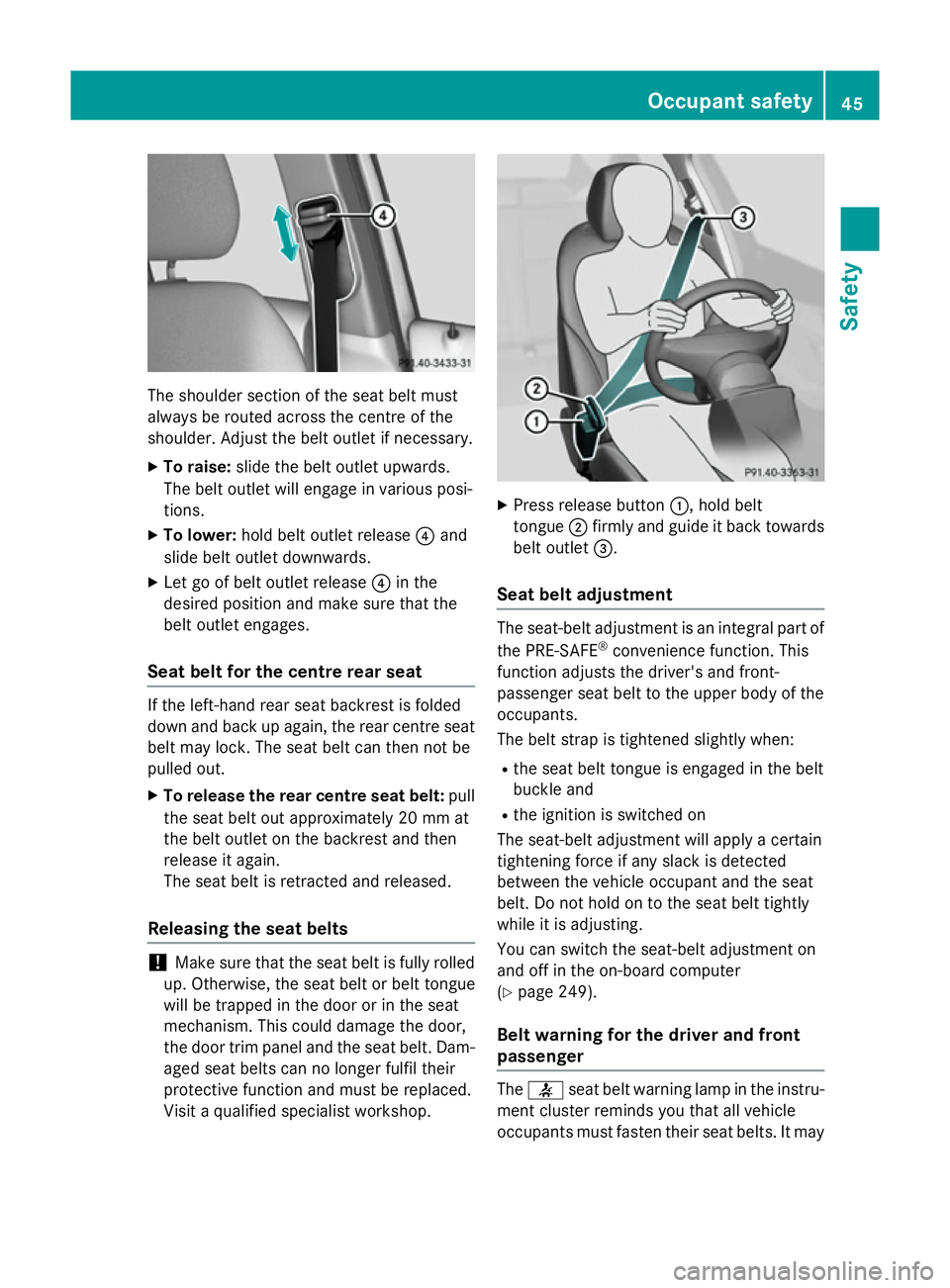
The shoulder section of the seat belt must
always be routed across the centre of the
shoulder. Adjust the belt outlet if necessary.
X To raise: slide the belt outlet upwards.
The belt outlet will engage in various posi-
tions.
X To lower: hold belt outlet release ?and
slide belt outlet downwards.
X Let go of belt outlet release ?in the
desired position and make sure that the
belt outlet engages.
Seat belt for the centre rear seat If the left-hand rear seat backrest is folded
down and back up again, the rear centre seat
belt may lock. The seat belt can then not be
pulled out.
X To release the rear centre seat belt: pull
the seat belt out approximately 20 mm at
the belt outlet on the backrest and then
release it again.
The seat belt is retracted and released.
Releasing the seat belts !
Make sure that the seat belt is fully rolled
up. Otherwise, the seat belt or belt tongue
will be trapped in the door or in the seat
mechanism. This could damage the door,
the door trim panel and the seat belt. Dam- aged seat belts can no longer fulfil their
protective function and must be replaced.
Visit a qualified specialist workshop. X
Press release button :, hold belt
tongue ;firmly and guide it back towards
belt outlet =.
Seat belt adjustment The seat-belt adjustment is an integral part of
the PRE-SAFE ®
convenience function. This
function adjusts the driver's and front-
passenger seat belt to the upper body of the
occupants.
The belt strap is tightened slightly when:
R the seat belt tongue is engaged in the belt
buckle and
R the ignition is switched on
The seat-belt adjustment will apply a certain
tightening force if any slack is detected
between the vehicle occupant and the seat
belt. Do not hold on to the seat belt tightly
while it is adjusting.
You can switch the seat-belt adjustment on
and off in the on-board computer
(Y page 249).
Belt warning for the driver and front
passenger The
7 seat belt warning lamp in the instru-
ment cluster reminds you that all vehicle
occupants must fasten their seat belts. It may Occupant safety
45Safety Z
Page 58 of 405
are unable to perform their intended protec-
tive function. This poses an increased risk of
injury or even fatal injury.
Therefore, have pyrotechnic belt tensioners
which have been triggered immediately
replaced at a qualified specialist workshop.
Mercedes-Benz recommends that you have
the vehicle towed to a qualified specialist
workshop after an accident. Take this into
account, particularly if a seat belt tensioner
was triggered or an airbag was deployed.
An electric motor is used by PRE-SAFE ®
to
trigger the tightening of the seat belt in haz-
ardous situations. This procedure is reversi-
ble.
If the belt tensioners are triggered or an air-
bag is deployed, you will hear a bang, and a
small amount of powder may also be
released. The 6restraint system warning
lamp lights up.
Only in rare cases will the bang affect your
hearing. In general, the powder released is
not hazardous to health but may cause short- term breathing difficulties to persons suffer-
ing from asthma or other pulmonary condi-
tions. Provided it is safe to do so, you should
leave the vehicle immediately or open the
window in order to prevent breathing difficul- ties.
Operation During the first stage of a collision, the
restraint system control unit evaluates impor-
tant physical data relating to vehicle deceler- ation or acceleration, such as:
R duration
R direction
R intensity
Based on the evaluation of this data, the
restraint system control unit triggers the seat belt tensioners in the event of a head-on or
rear collision. A seat belt tensioner can only be triggered if:
R the ignition is switched on
R the components of the restraint system are
operational; see "Restraint system warning lamp" (Y page 41)
R the belt tongue has engaged in the belt
buckle of the respective front seat
The seat belt tensioners in the rear compart-
ment are triggered independently of the lock
status of the seat belts.
If the restraint system control unit detects a
high severity of an accident, in certain head-
on collisions, additional components of the
restraint system are deployed independently
of each another:
R Front airbags and driver's kneebag
R Windowbag, if the system determines that
deployment can offer additional protection
to that provided by the seat belt
On vehicles with the automatic front-
passenger front airbag deactivation system:
depending on the person in the front-
passenger seat, the front-passenger front air-
bag is either disabled or enabled. The front-
passenger front airbag can only be deployed
in an accident if the PASSENGER AIR BAG ON indicator lamp is lit. Observe the information
on the PASSENGER AIR BAG indicator lamps
(Y page 41).
Your vehicle has two-stage front airbags. In
the first deployment stage, the front airbag is
filled with propellant gas to reduce the risk of
injuries. The front airbag is fully deployed if
the second deployment stage is activated
within a few milliseconds.
The activation threshold for the seat belt ten- sioners and airbags is determined based on
the evaluation of the vehicle's rate of decel-
eration or acceleration at various points in the
vehicle. This process is pre-emptive in nature. The triggering/deployment process should
take place in good time at the start of the
collision. Occupant safety
55Safety Z
Page 61 of 405
In addition, they may operate vehicle equip-
ment and become trapped. There is a risk of
an accident and injury.
When leaving the vehicle, always take the key with you and lock the vehicle. Never leave
children unattended in the vehicle. G
WARNING
If persons (particularly children) are exposed
to heat or cold for a prolonged period, there is a risk of serious or even fatal injuries. Never
leave persons (particularly children) unatten-
ded in the vehicle. G
WARNING
If the child restraint system is placed in direct sunlight, the parts could become very hot.
Children could be suffer burns by touching
these parts, in particular on the metallic parts
of the child restraint system. There is a risk of injury.
If you and your child leave the vehicle, always
make sure that the child restraint system is
not in direct sunlight. Cover it with a blanket, for example. If the child restraint system has
been exposed to direct sunlight, leave it to
cool down before securing the child in it.
Never leave children unattended in the vehi-
cle.
Always ensure that all vehicle occupants have their seat belts fastened correctly and are sit-
ting properly. Particular attention must be
paid to children.
Observe the safety notes on the seat belt
(Y page 42) and the information on the cor-
rect use of the seat belt (Y page 43).Child restraint system
If you fit a rearward-facing child restraint sys- tem to the centre rear seat, the rear arm restmust be folded back as far as possible.
Observe the instructions for correct use of
the child restraint system (Y page 66).For safety reasons, Mercedes-Benz recom-
mends that you only use a child restraint sys-
tem recommended by Mercedes-Benz
(Y page 70). G
WARNING
If the child restraint system is incorrectly fit-
ted on the seat position suitable for this pur-
pose, it cannot perform its intended protec-
tive function. In the event of an accident,
sharp braking or a sudden change in direction, the child may not be held securely. There is an
increased risk of serious or even fatal injuries.
Observe the manufacturer's installation
instructions and the correct use for the child
restraint system. Make sure that the entire
surface of the child restraint system is resting
on the seat surface. Never place objects
under or behind the child restraint system,
e.g. cushions. Only use child restraint sys-
tems with the original cover designed for
them. Only replace damaged covers with gen- uine covers. G
WARNING
If the child restraint system is fitted incor-
rectly or is not secured, it can come loose in
the event of an accident, heavy braking or a
sudden change in direction. The child
restraint system could be thrown about, strik- ing vehicle occupants. There is an increased
risk of injury, possibly even fatal.
Always fit child restraint systems properly,
even if they are not being used. Make sure
that you observe the child restraint system
manufacturer's installation instructions.
You will find further information on stowing
objects, luggage and loads securely under
"Loading guidelines" (Y page 298). G
WARNING
Child restraint systems or their securing sys-
tems that have been damaged or subjected to a load in an accident cannot perform their
intended protective function. In the event of
an accident, sharp braking or a sudden
change in direction, the child may not be held 58
Children in the vehicleSafety
Page 66 of 405
and be thrown around, endangering vehicle
occupants. This poses an increased risk of
injury or even fatal injury.
Fit the ICS padded play table as described.
After fitting the ICS padded play table, make
sure that it is secured correctly. For safety
reasons, only use the ICS padded play table
that has been tested and approved for your
vehicle.
The ICS padded play table is only suitable for
use with the folded-out integrated child seat.
On the rear seats with an integrated child
seat, only use the ICS padded play table that
is recommended for Mercedes-Benz vehicles. Only use the ICS padded play table with its
original cover. Without the original cover, the
official approval is invalidated.
Use the ICS padded play table in accordance
with the instructions in the table in the "Inte-
grated child seat (ICS)" section (Y page 61).
Note that children under two years old and
children who weigh less than 12.5 kg require a different and suitable child restraint system.
Information about other child restraint sys-
tems is available at any Mercedes-Benz Ser-
vice Centre.
You must not use the integrated child seat
with ICS padded play table as a direct attach- ment to a baby car seat for which a body
weight of up to 10 kg is permissible. Note that
children younger than 24 month sold require
a different child restraint system
(Y page 70).
If you are not using the ICS padded play table, stow it in an appropriate place, e.g. in the lug-
gage compartment. You will find further infor-
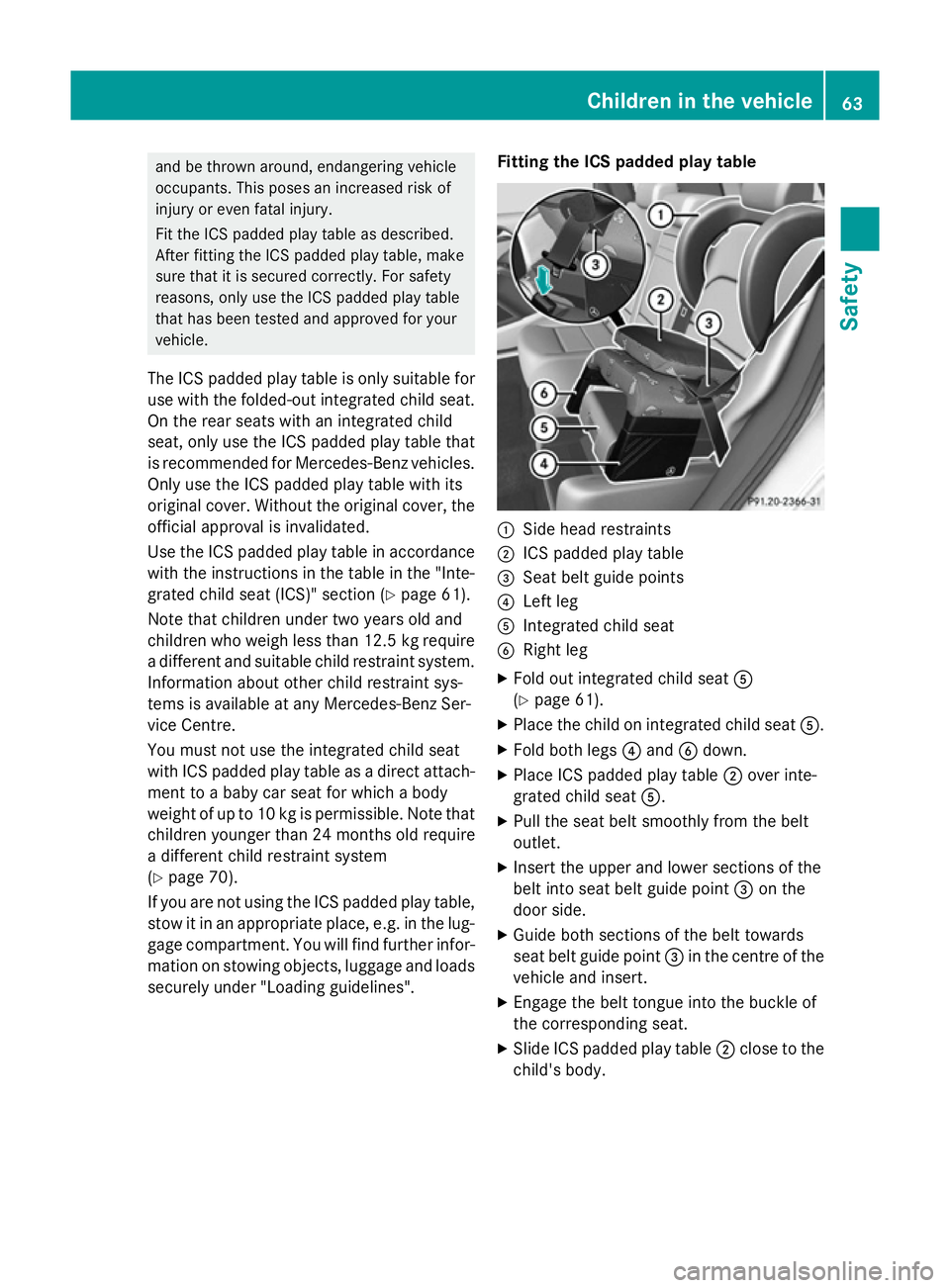
mation on stowing objects, luggage and loads securely under "Loading guidelines". Fitting the ICS padded play table
:
Side head restraints
; ICS padded play table
= Seat belt guide points
? Left leg
A Integrated child seat
B Right leg
X Fold out integrated child seat A
(Y page 61).
X Place the child on integrated child seat A.
X Fold both legs ?and Bdown.
X Place ICS padded play table ;over inte-
grated child seat A.
X Pull the seat belt smoothly from the belt
outlet.
X Insert the upper and lower sections of the
belt into seat belt guide point =on the
door side.
X Guide both sections of the belt towards
seat belt guide point =in the centre of the
vehicle and insert.
X Engage the belt tongue into the buckle of
the corresponding seat.
X Slide ICS padded play table ;close to the
child's body. Children in the vehicle
63Safety Z
Page 67 of 405
X
Pull both parts of the belt tight. Make sure
that the seat belt is not twisted.
X Adjust the head restraint if necessary; see
(Y page 111).
Side head restraints G
WARNING
If the side head restraint has been fitted incor-
rectly, it cannot perform its intended protec-
tive function. A child's head therefore cannot be supported in the event of an accident,
heavy braking or a sudden change of direc-
tion. In addition, the side head restraint could become loose and be thrown around, endan-
gering vehicle occupants. This poses an
increased risk of injury or even fatal injury.
Only fasten the side head restraint to the spe-
cially designed securing points on the rear
head restraint. For safety reasons, only use
side head restraints that have been tested
and approved for your vehicle. Use the side head restraints in accordance
with the instructions in table (Y
page 61).
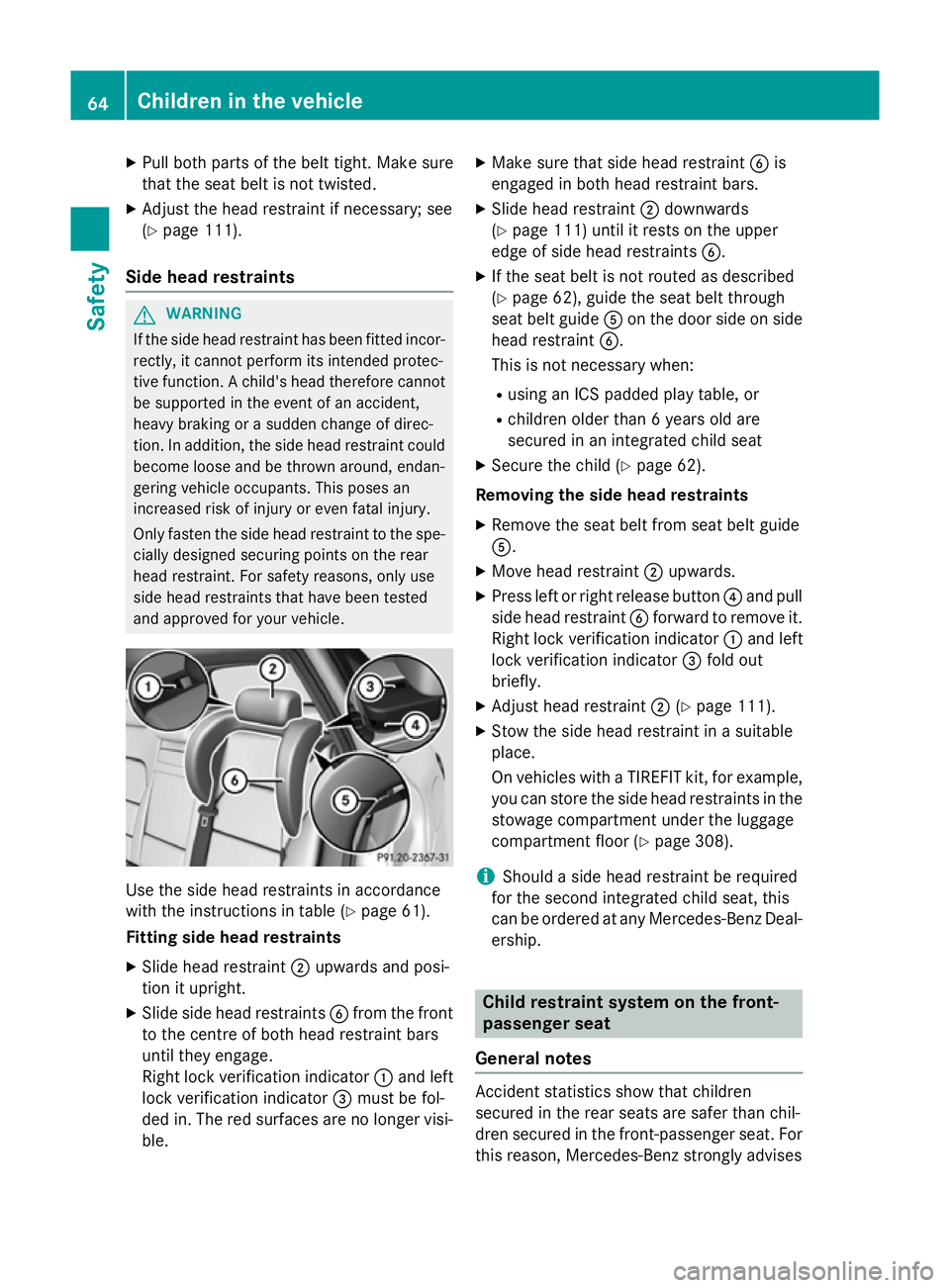
Fitting side head restraints
X Slide head restraint ;upwards and posi-
tion it upright.
X Slide side head restraints Bfrom the front
to the centre of both head restraint bars
until they engage.
Right lock verification indicator :and left
lock verification indicator =must be fol-
ded in. The red surfaces are no longer visi-
ble. X
Make sure that side head restraint Bis
engaged in both head restraint bars.
X Slide head restraint ;downwards
(Y page 111) until it rests on the upper
edge of side head restraints B.
X If the seat belt is not routed as described
(Y page 62), guide the seat belt through
seat belt guide Aon the door side on side
head restraint B.
This is not necessary when:
R using an ICS padded play table, or
R children older than 6 years old are
secured in an integrated child seat
X Secure the child (Y page 62).
Removing the side head restraints X Remove the seat belt from seat belt guide
A.
X Move head restraint ;upwards.
X Press left or right release button ?and pull
side head restraint Bforward to remove it.
Right lock verification indicator :and left
lock verification indicator =fold out
briefly.
X Adjust head restraint ;(Ypage 111).
X Stow the side head restraint in a suitable
place.
On vehicles with a TIREFIT kit, for example,
you can store the side head restraints in thestowage compartment under the luggage
compartment floor (Y page 308).
i Should a side head restraint be required
for the second integrated child seat, this
can be ordered at any Mercedes-Benz Deal- ership. Child restraint system on the front-
passenger seat
General notes Accident statistics show that children
secured in the rear seats are safer than chil-
dren secured in the front-passenger seat. For
this reason, Mercedes-Benz strongly advises 64
Children in the vehicleSafety
Page 84 of 405
X
To switch the alarm off using KEYLESS-
GO: grasp the outside door handle. The key
must be outside the vehicle.
The alarm is switched off.
or
X Press the Start/Stop button on the dash-
board. The key must be inside the vehicle.
The alarm is switched off.
The alarm is not switched off, even if you
close the open door that has triggered it, for
example.
i If the alarm stays on for more than
30 second s,the Mercedes‑Benz emer-
gency call system automatically sends a
message to the Customer Assistance
Centre. This is done by means of a text
message or a data connection.
The emergency call system sends a mes-
sage or establishes a data connection pro-
vided that:
R you have subscribed to the
Mercedes‑Benz emergency call system
R the Mercedes‑ Benz emergency call sys-
tem has been activated properly
R the necessary mobile phone network is
available Tow-away protection
Function An audible and visual alarm is triggered if your
vehicle's angle of inclination is altered while
tow-away protection is primed. This can occur if the vehicle is jacked up on one side, for
example.
Priming X
Make sure that: R
the doors are closed
R the tailgate is closed
Only then is the tow-away protection
primed.
X Lock the vehicle with the key or KEYLESS-
GO.
Tow-away protection is primed after
approximately 60 second s.
Switching off X
Unlo ck the vehicle with the key or KEY-
LESS-GO.
or X Insert the key into the ignition lock.
Tow-away protection is switched off auto-
matically.
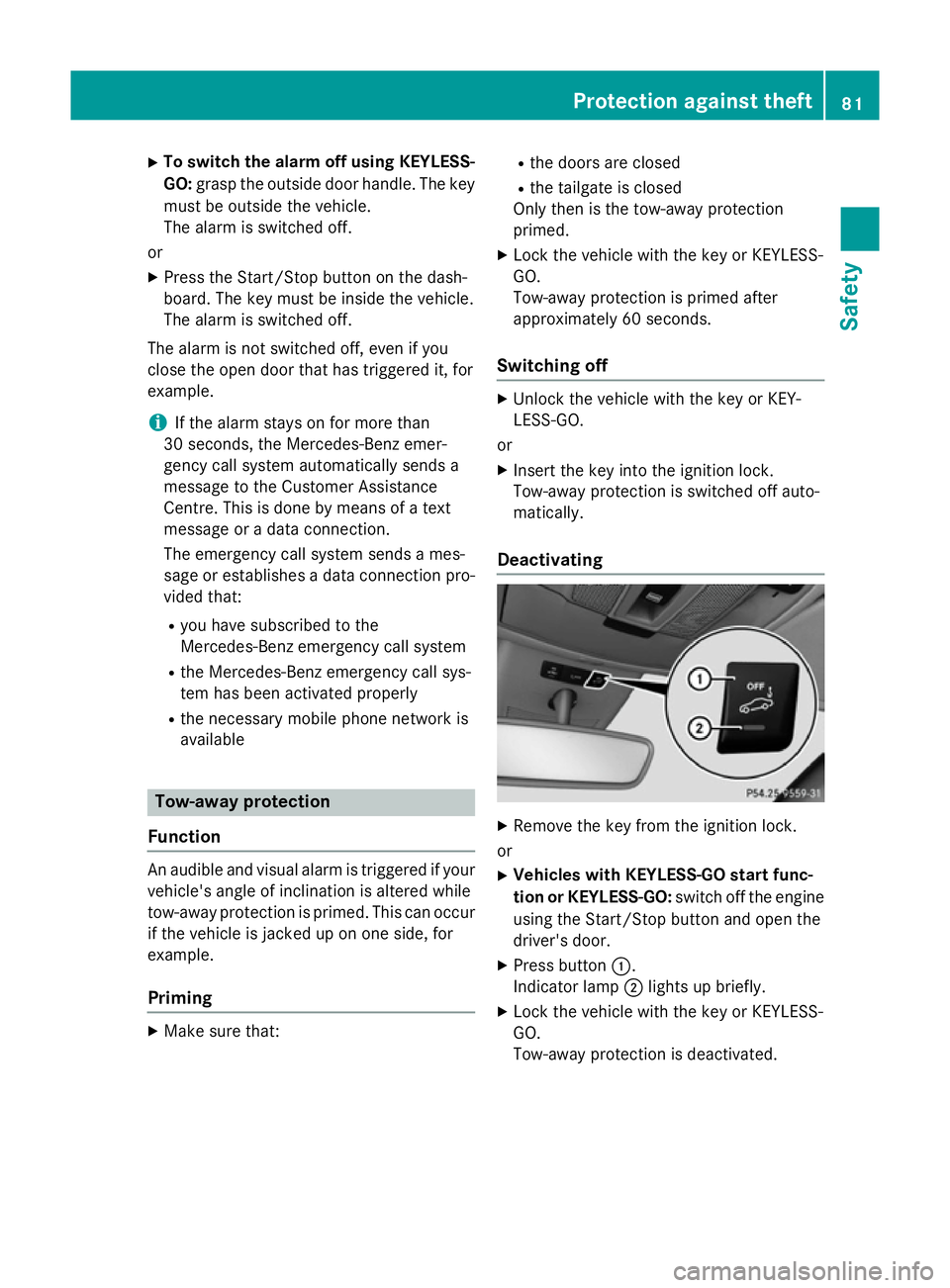
Deactivating X
Remove the key from the ignition lock.
or X Vehicles with KEYLESS-GO start func-
tion or KEYLESS-GO: switch off the engine
using the Start/Stop button and open the
driver's door.
X Press button :.
Indicator lamp ;lights up briefly.
X Lock the vehicle with the key or KEYLESS-
GO.
Tow-away protection is deactivated. Protection against theft
81Safety Z
Page 85 of 405
Tow-away protection remains deactivated
until:
R the vehicle is unlocked again
R a door is opened and closed again and
R the vehicle is locked again
To prevent a false alarm, deactivate tow-away protection if you lock your vehicle and it:
R is being transported
R is being loaded onto a ferry or car trans-
porter, for example
R is parked on a movable surface, e.g. in a
split-level garage Interior motion sensor
Function When the interior motion sensor is primed, a
visual and audible alarm is triggered if move- ment is detected in the vehicle interior. This
can occur if someone reaches into the vehicle
interior, for example.
Priming X
Make sure that:
R the side windows are closed
R the panorama sliding sunroof is closed
R there are no objects, e.g. mascots, hang-
ing on the rear-view mirror or on the grab handles on the roof trim
This will prevent false alarms.
X Make sure that:
R the doors are closed
R the panorama sliding sunroof is closed
R the tailgate is closed
Only then is the interior motion sensor
primed.
X Lock the vehicle with the key or KEYLESS-
GO.
The interior motion sensor is primed after
approximately 30 seconds. Switching off X
Unlock the vehicle with the key or KEY-
LESS-GO.
or X Insert the key into the ignition lock.
or X Press the Start/Stop button.
The key must be in the vehicle.
The interior motion sensor is automatically switched off.
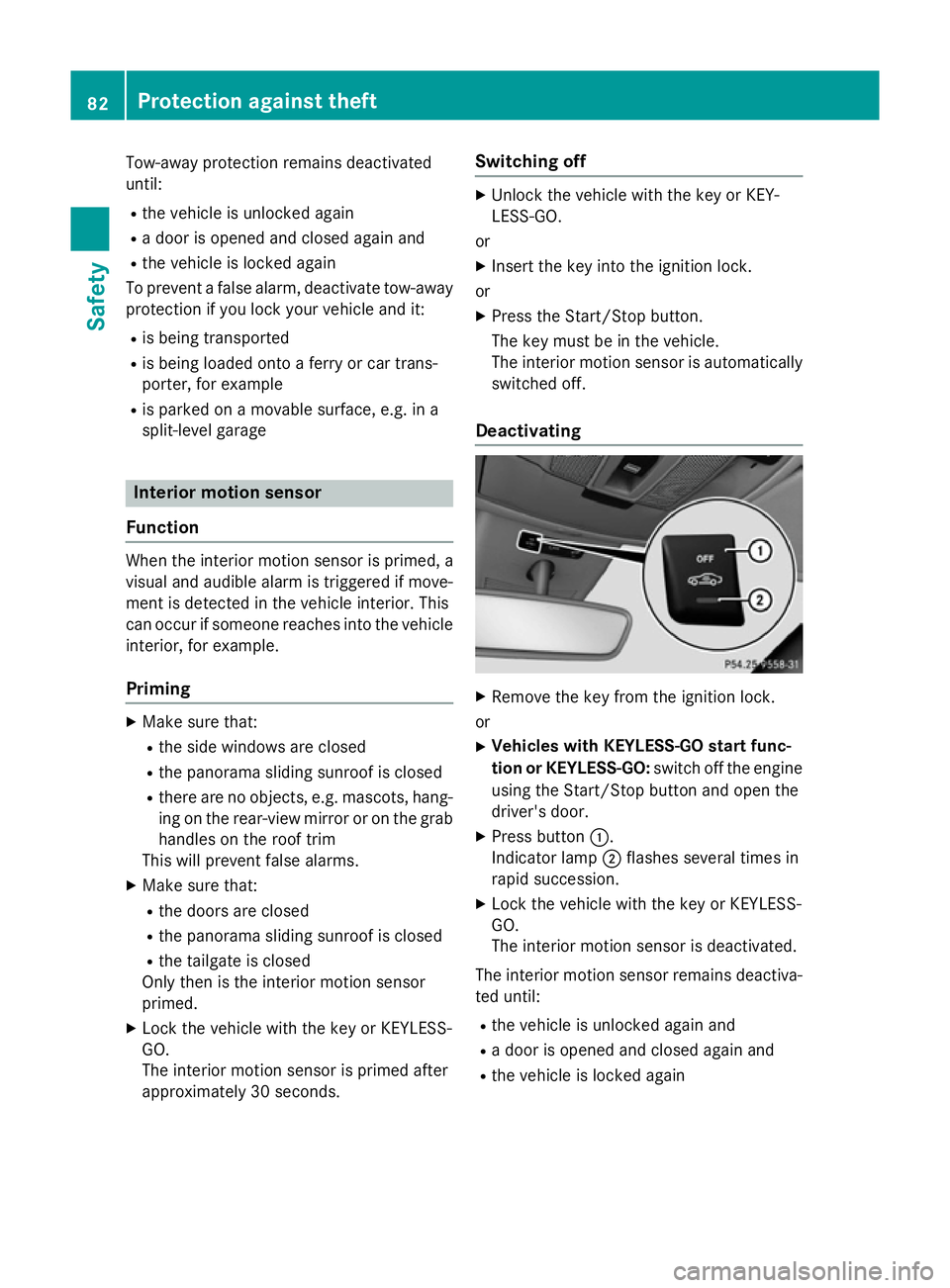
Deactivating X
Remove the key from the ignition lock.
or X Vehicles with KEYLESS-GO start func-
tion or KEYLESS-GO: switch off the engine
using the Start/Stop button and open the
driver's door.
X Press button :.
Indicator lamp ;flashes several times in
rapid succession.
X Lock the vehicle with the key or KEYLESS-
GO.
The interior motion sensor is deactivated.
The interior motion sensor remains deactiva- ted until:
R the vehicle is unlocked again and
R a door is opened and closed again and
R the vehicle is locked again 82
Protection against theftSafety