light MERCEDES-BENZ B-CLASS HATCHBACK 2015 User Guide
[x] Cancel search | Manufacturer: MERCEDES-BENZ, Model Year: 2015, Model line: B-CLASS HATCHBACK, Model: MERCEDES-BENZ B-CLASS HATCHBACK 2015Pages: 293, PDF Size: 10.83 MB
Page 16 of 293
Warning display ............................. 157
PASSENGER AIR BAG
Display message ............................1 99
Indicator lamps ................................ 35
Problems (malfunctions) ................ 199
Pets in the vehicle ............................... 61
Plastic trim (cleaning instruc-
tions) ................................................. .246
Power display ................................... .173
Power windows
see Side windows
Pre-Crash Safety System
see PRE-SAFE ®
(anticipatory
occupant protection)
PRE-SAFE ®
(anticipatory occupant
protection)
Operation ......................................... 48
PRE-SAFE ®
(preventive occupant
safety system)
Display message ............................ 196
Program selector button .................. 131
Protection against theft
ATA (Anti-Theft Alarm system) ......... 68
Immobiliser ...................................... 67
Interior motion sensor ..................... 69
Tow-away protection ........................ 68
Protection of the environment
General notes .................................. 19
Pulling away
Hill start assist ............................... 128 Q
QR code Mercedes-Benz Guide App ................. 1
Rescue card ..................................... 23
Qualified specialist workshop ........... 23R
Radio Selecting a station ......................... 180
see separate operating instructions
Radio-based vehicle components
Declaration of conformity ................ 22
Range
RANGE PLUS ................................. 137 RANGE PLUS
charge .......................................... .184
Range ............................................ 137
Reading lamp ..................................... 102
READY indicator ................................ 172
Rear bench seat
Folding the backrest forwards/
back ............................................... 228
Rear compartment
Setting the air vents ..................... .124
Rear foglamp
Changing bulbs .............................. 107
Display message ............................ 202
Switching on/off .............................. 98
Rear lamps
see Lights
Rear window heating
Problem (fault) ............................... 120
Switching on/off ........................... 119
Rear window wiper
Replacing the wiper blade .............. 111
Switching on/off ........................... 109
Rear-compartment seat belt sta-
tus indicator ........................................ 39
Rear-view mirror
Anti-dazzle mode (automatic) .......... 94
Dipping (manual ).............................. 93
Recuperative Brake System
Driving safety systems ..................... 67
Replacing bulbs
Important safety notes .................. 103
Overview of bulb types .................. 104
Removing/replacing the cover
(front wheel arch) .......................... 105
Rescue card ......................................... 23
Reserve
High-voltage battery ...................... 222
Residual heat (climate control) ........ 122
Restraint system
Display message ............................ 198
Introduction ..................................... 34
Warning lamp ................................. 222
Warning lamp (function) ................... 34
Reverse gear
Engaging ........................................ 130
Reversing camera
Cleaning instructions ..................... 246 Index
13
Page 18 of 293
Snow chains
...................................... 269
Socket
Luggage compartment ...................2 36
Sockets
Centre console .............................. 235
General notes ................................ 235
Rear compartment ......................... 236
Specialist workshop ............................ 23
Spectacles compartment ................. 225
Speed, controlling
see Cruise control
Speedometer
Activating/deactivating the addi-
tional speedometer ........................ 186
Digital ............................................ 178
In the Instrument cluster ................. 27
Selecting a display unit .................. 186
SPEEDTRONIC
Deactivating variable ..................... 154
Function/notes ............................ .152
Important safety notes .................. 152
LIM indicator lamp ......................... 153
Selecting ........................................ 153
Storing the current spee d.............. 153
Variabl e......................................... 153
SPEEDTRONIC (variable)
Storing the current speed and
calling up the last stored speed ..... 153
Start/Stop button
Removing ....................................... 127
Starting the drive system ............... 127
Starting
the Vehicle ..................................... 127
Starting the vehicle. .......................... 127
STEER CONTROL .................................. 67
Steering
Display message ............................ 212
Steering assistant STEER CON-
TROL
see STEER CONTROL
Steering wheel
Adjusting (manually) ........................ 92
Button overview ............................... 29
Buttons (on-board computer) ......... 174
Cleaning ......................................... 247
Gearshift paddle s........................... 132
Important safety notes .................... 92 Steering wheel gearshift paddles
.... 132
Stowage compartment
Map pockets .................................. 227
Stowage compartments
Armrest (front) ............................... 225
Armrest (under) ............................. 226
Centre console .............................. 225
Centre console (rear) ..................... 226
Cup holde r..................................... 233
Glove compartment ....................... 225
Important safety information ......... 224
Spectacles compartment ............... 225
Under driver's seat/front-
passenger sea t.............................. 226
Stowage net ....................................... 227
Stowage space
Stowage net ................................... 227
Summer tyres .................................... 268
Sun visor ............................................ 234 T
Tail lamps see Lights
Tailgate
Display message ............................ 211
Emergency unlocking ....................... 81
Important safety notes .................... 81
Opening dimensions ...................... 284
Opening/closing (from outside) ....... 81
Technical data
Capacities ...................................... 282
Information .................................... 280
Tyres/wheels ................................. 277
Vehicle data ................................... 284
Telephone
Accepting a call (multifunction
steering wheel) .............................. 181
Display message ............................ 212
Introduction ................................... 181
Menu (on-board computer) ............ 181
Number from the phone book ........ 181
Redialling ....................................... 182
Rejecting/ending a call ................. 181
Telephone compartment ................ 226
Temperature
Outside temperature ...................... 172
Setting (climate control )................ 117 Index
15
Page 27 of 293
In general, this technical information docu-
ments the state of a component, a module, a
system or the surroundings.
These include, for example:
R operating conditions of system components,
e.g. fluid levels
R the vehicle's status messages and those of its
individual components, e.g. number of wheelrevolutions/speed, deceleration in move-
ment, lateral acceleration, accelerator pedal
position
R malfunctions and defects in important system
components, e.g. lights, brakes
R vehicle reactions and operating conditions in
special driving situations, e.g. airbag deploy-
ment, intervention of stability control sys-
tems
R ambient conditions, e.g. outside temperature
This data is of an exclusively technical nature
and can be used to:
R assist in detecting and rectifying faults and
defects
R analyse vehicle functions, e.g. after an acci-
dent
R optimise vehicle functions
The data cannot be used to trace the vehicle's
movements.
When your vehicle is serviced, technical infor-
mation can be read from the event data memory
and fault data memory.
Services include, for example:
R repair services
R service processes
R warranty events
R quality assurance
The vehicle is read out by employees of the ser-
vice network (including the manufacturer) using
special diagnostic testers. You can obtain more information there, if required.
After a fault has been rectified, the information
is deleted from the fault memory or is continu-
ally overwritten.
When operating the vehicle, situations are con-
ceivable in which this technical data, in connec-
tion with other information (if necessary, after
consultation with an authorised expert), could
be traced to a person. Examples include:
R accident reports
R damage to the vehicle
R witness statements
Further additional functions that have been con- tractually agreed upon with the customer allow
certain vehicle data to be conveyed by the vehi-
cle as well. The additional functions include, for example, vehicle location in case of an emer-
gency. Copyright information
General notes
Information on licences for free and open-
source software used in your vehicle and its
electronic components is available on the fol-
lowing website:
http://www.mercedes-benz.com/opensource 24
Introduction
Page 28 of 293
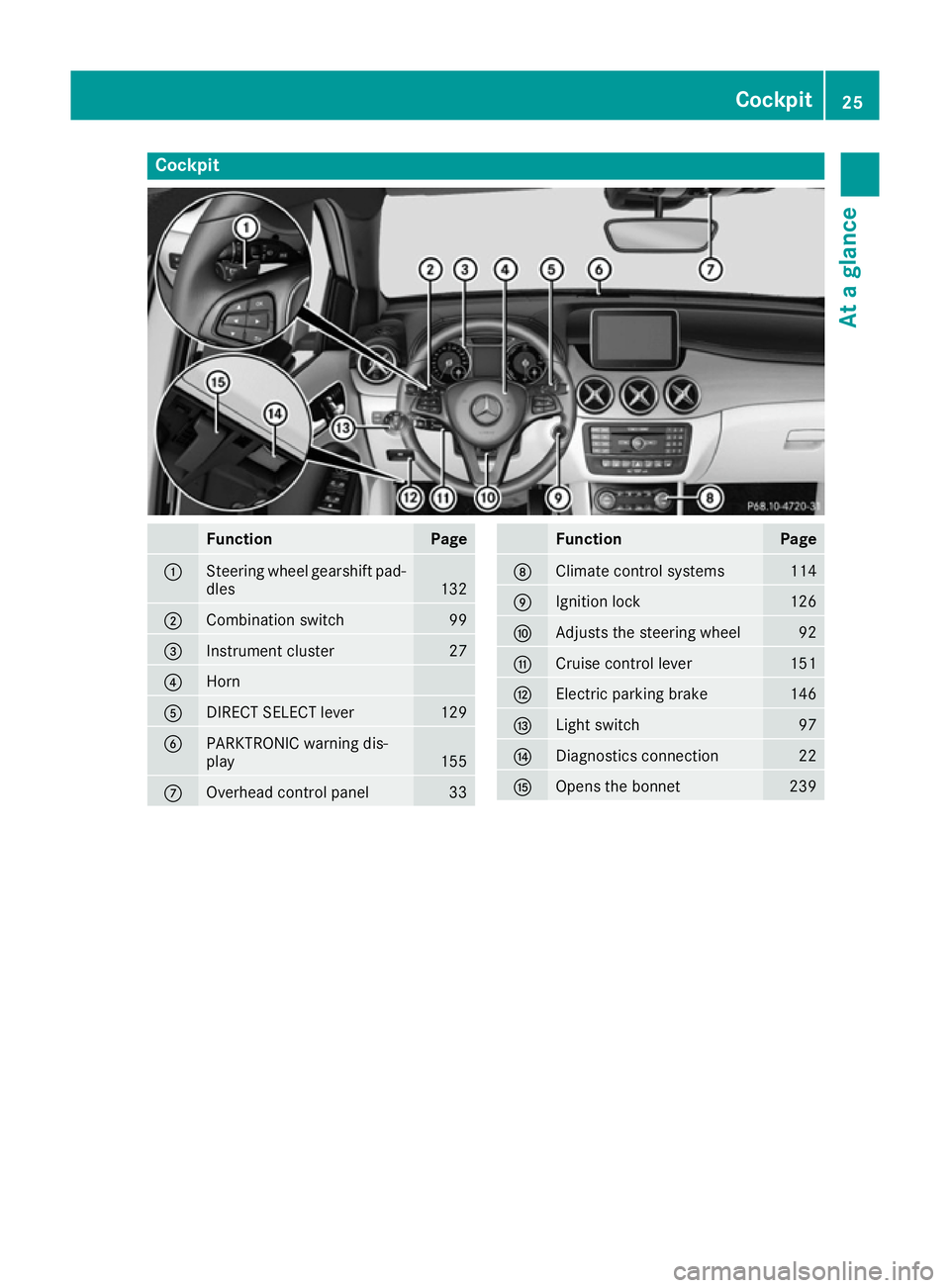
Cockpit
Function Page
:
Steering wheel gearshift pad-
dles 132
;
Combination switch 99
=
Instrument cluster 27
?
Horn
A
DIRECT SELECT lever 129
B
PARKTRONIC warning dis-
play
155
C
Overhead control panel 33 Function Page
D
Climate control systems 114
E
Ignition lock 126
F
Adjusts the steering wheel 92
G
Cruise control lever 151
H
Electric parking brake 146
I
Light switch 97
J
Diagnostics connection 22
K
Opens the bonnet 239Cockpit
25At a glance
Page 29 of 293
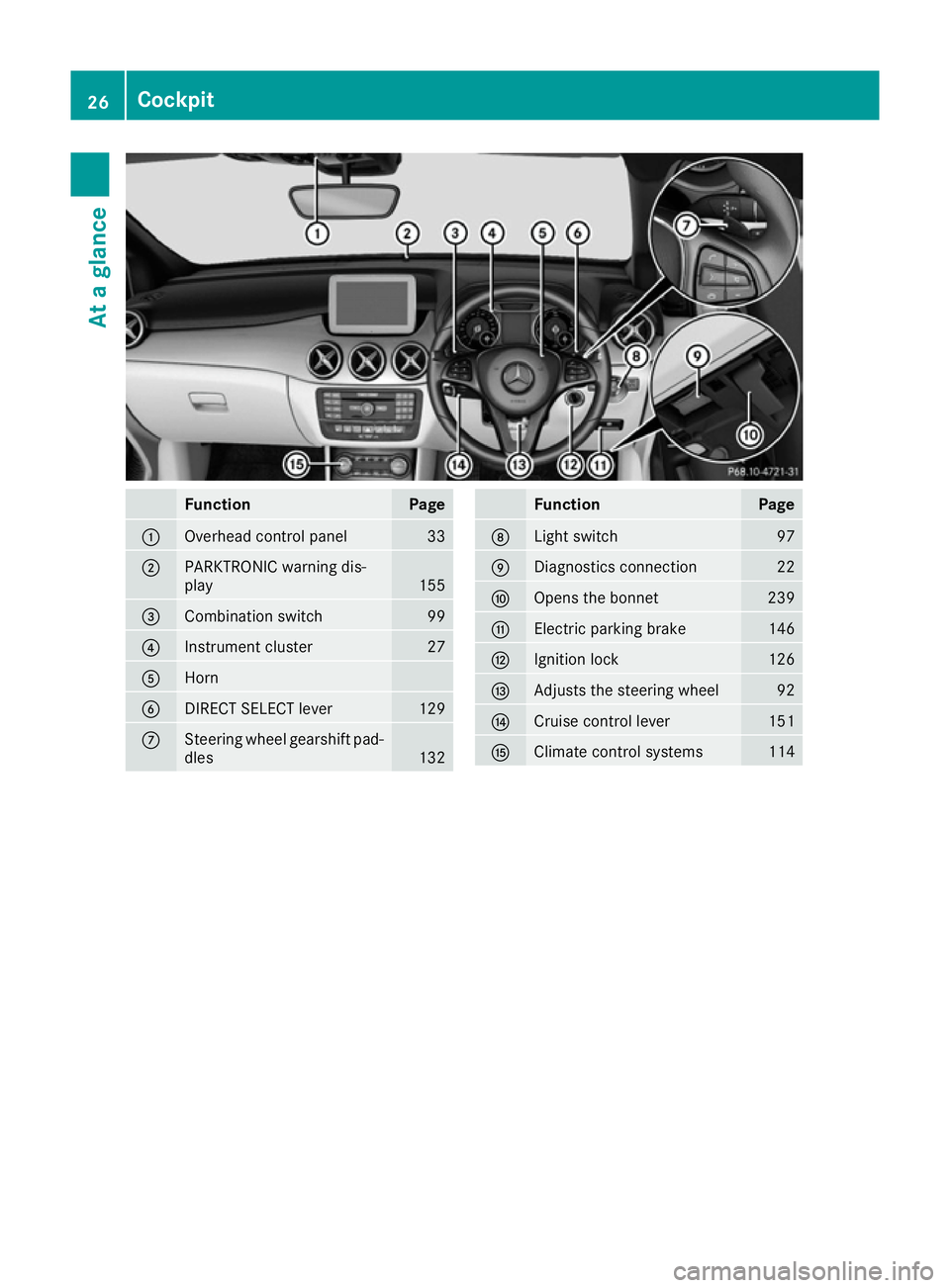
Function Page
:
Overhead control panel 33
;
PARKTRONIC warning dis-
play
155
=
Combination switch 99
?
Instrument cluster 27
A
Horn
B
DIRECT SELECT lever 129
C
Steering wheel gearshift pad-
dles 132 Function Page
D
Light switch 97
E
Diagnostics connection 22
F
Opens the bonnet 239
G
Electric parking brake 146
H
Ignition lock 126
I
Adjusts the steering wheel 92
J
Cruise control lever 151
K
Climate control systems 11426
CockpitAt a glance
Page 30 of 293
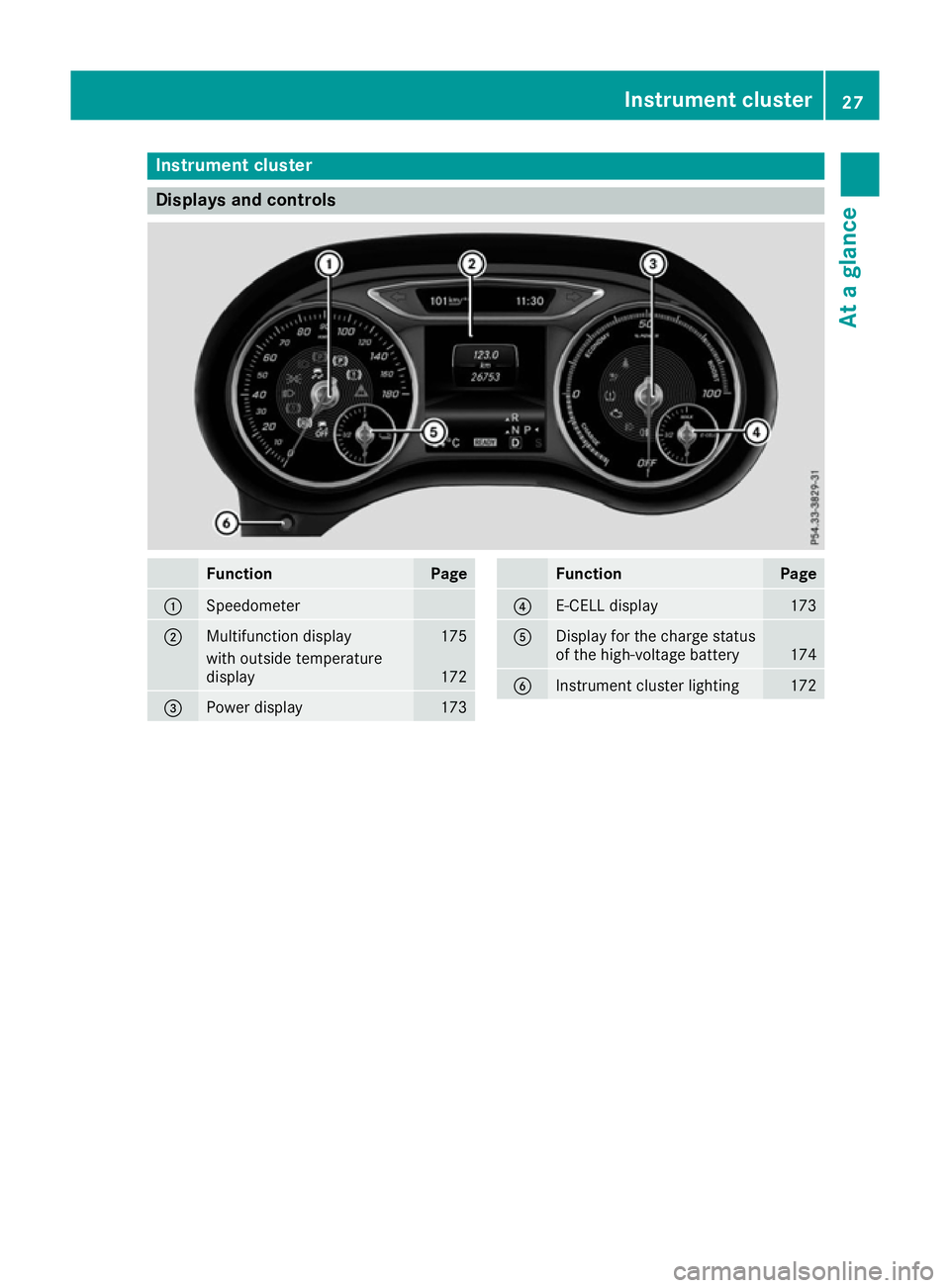
Instrument cluster
Displays and controls
Function Page
:
Speedometer
;
Multifunction display 175
with outside temperature
display
172
=
Power display 173 Function Page
?
E-CELL display 173
A
Display for the charge status
of the high-voltage battery 174
B
Instrument cluster lighting 172Instrument cluster
27At a glance
Page 34 of 293
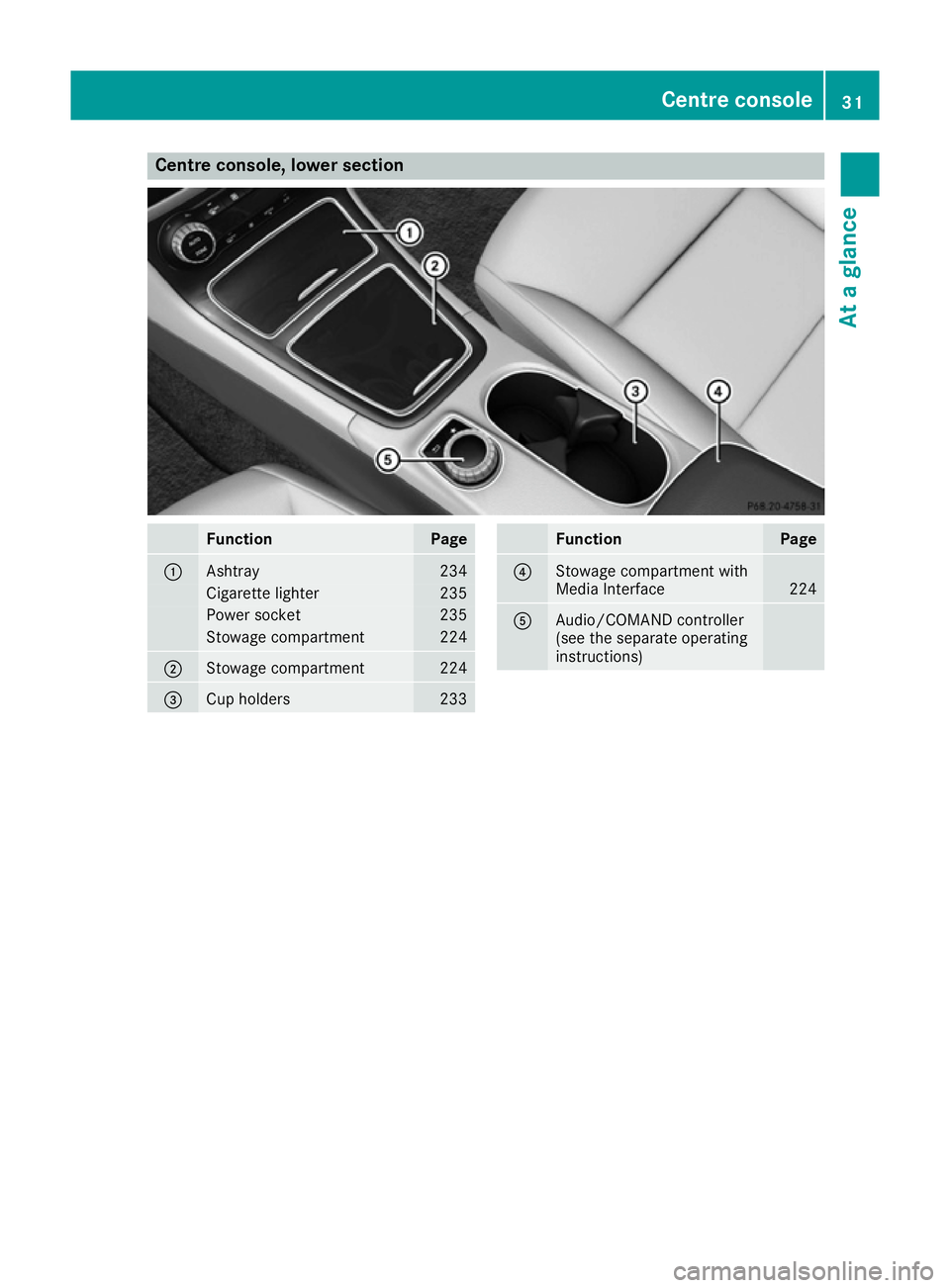
Centre console, lower section
Function Page
:
Ashtray 234
Cigarette lighter 235
Power socket 235
Stowage compartment 224
;
Stowage compartment 224
=
Cup holders 233 Function Page
?
Stowage compartment with
Media Interface
224
A
Audio/COMAND controller
(see the separate operating
instructions) Centre console
31At a glance
Page 36 of 293
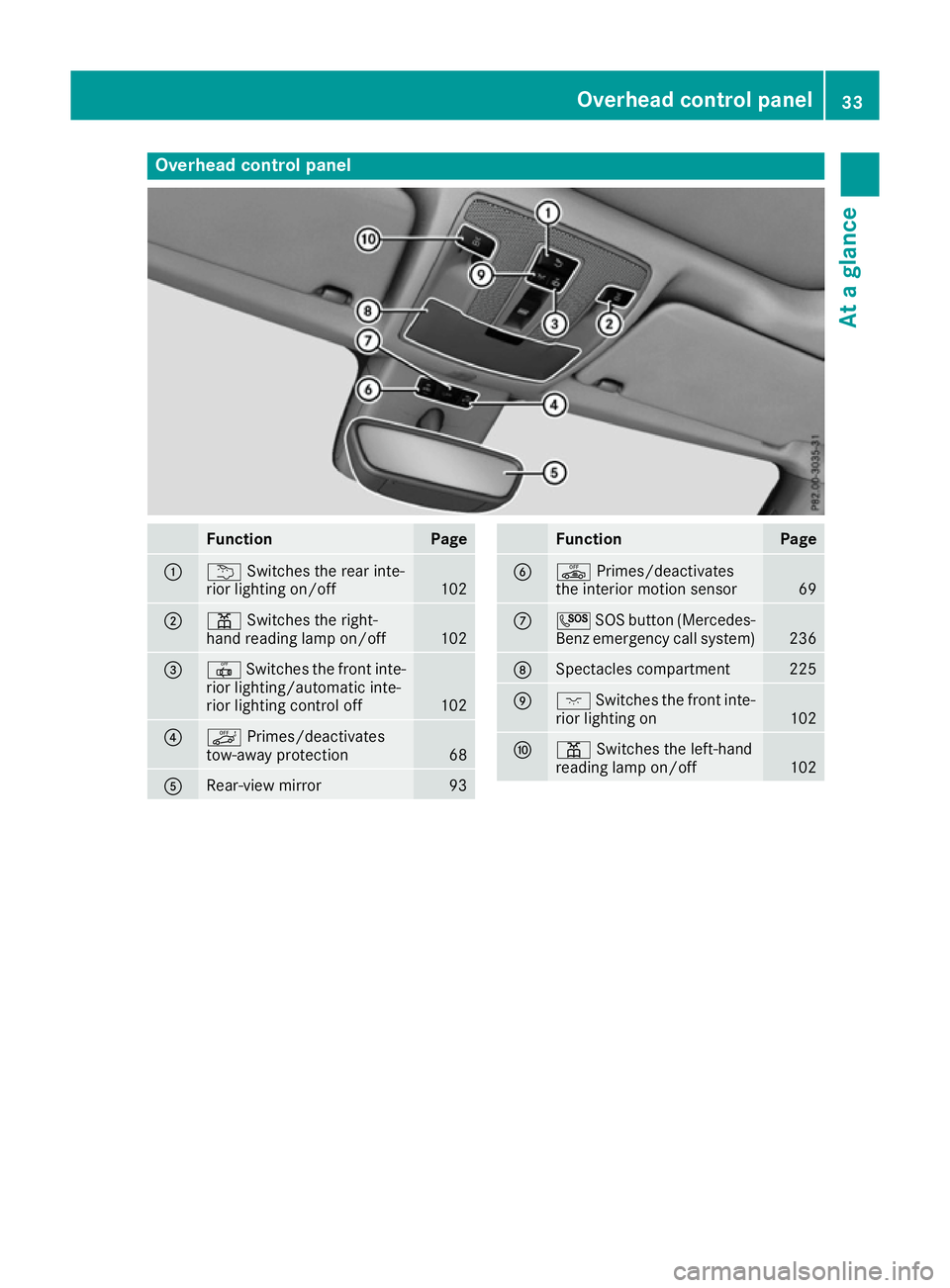
Overhead control panel
Function Page
:
u
Switches the rear inte-
rior lighting on/off 102
;
p
Switches the right-
hand reading lamp on/off 102
=
|
Switches the front inte-
rior lighting/automatic inte-
rior lighting control off 102
?
ë
Primes/deactivates
tow-away protection 68
A
Rear-view mirror 93 Function Page
B
ê
Primes/deactivates
the interior motion sensor 69
C
G
SOS button (Mercedes-
Benz emergency call system) 236
D
Spectacles compartment 225
E
c
Switches the front inte-
rior lighting on 102
F
p
Switches the left-hand
reading lamp on/off 102Overhead control panel
33At a glance
Page 37 of 293
Useful information
i This Owner's Manual describes all models,
series and optional equipment for your vehi-
cle that were available at the time of going to
press. National variations are possible. Note
that your vehicle may not be equipped with all
of the functions described. This is also the
case for systems and functions relevant to
safety.
i Read the information on qualified specialist
workshops: (Y page 23). Occupant safety
Introduction to the restraint system
The restraint system can reduce the risk of vehi-
cle occupants coming into contact with parts of
the vehicle's interior in the event of an accident. The restraint system can also reduce the forces
to which vehicle occupants are subjected during an accident.
The restraint system comprises:
R Seat belt system
R Airbags
R Child restraint system
R Child seat securing systems
The components of the restraint system work in
conjunction with each other. They can only
deploy their protective function if all vehicle
occupants always:
R fasten their seat belts correctly
(Y page 37)
R adjust their seat and head restraint properly
(Y page 87).
As the driver, you also have to make sure that
the steering wheel is adjusted correctly.
Observe the information relating to the correct
driver's seat position (Y page 86).
You also have to make sure that an airbag can
inflate properly if deployed (Y page 39).
An airbag supplements a correctly fastened seat belt. As an additional safety device, the airbag
increases the level of protection for vehicle
occupants in the event of an accident. For exam-
ple, if the protection of the seat belt is sufficient in an accident, the airbags are not deployed. In
the event of an accident, only the airbags that
increase protection in the relevant accident sit- uation are deployed. However, seat belts and
airbags generally do not protect against objects
penetrating the vehicle from the outside.
Information on the restraint system operation
can be found under "Triggering of belt tension-
ers and airbags" (Y page 46).
For more information about children travelling
with you in the vehicle, see "Children in the vehi-
cle" (Y page 49). Important safety notes
G
WARNING
If the restraint system is modified, it may no
longer work as intended. The restraint system
may then not perform its intended protective function by failing in an accident or triggering
unexpectedly, for example. There is an
increased risk of injury, possibly even fatal.
Never modify parts of the restraint system. Do not attempt to modify the wiring as well as
electronic components or their software.
If it is necessary to modify an airbag system to
accommodate a person with disabilities, con-
tact a Mercedes-Benz Service Centre for details. Restraint system warning lamp
The functions of the restraint system are
checked after the ignition is switched on and at
regular intervals while the drive system is run-
ning. Therefore, malfunctions can be detected in good time.
The 6 restraint system warning lamp in the
instrument cluster lights up when the ignition is switched on. It goes out no later than a few sec-
onds after the vehicle is started. The compo-
nents of the restraint system are in operational
readiness.
A malfunction has occurred if the 6restraint
system warning lamp:
R does not light up after the ignition is switched
on
R does not go out after a few seconds with the
drive system running
R lights up again while the drive system is run-
ning 34
Occupant safetySafety
Page 38 of 293
G
DANGER
If the restraint system is malfunctioning,
restraint system components may be trig-
gered unintentionally or might not be trig-
gered at all in the event of an accident with a high rate of vehicle deceleration. This can
effect belt tensioners or airbags, for example. In addition, the vehicle's high-voltage electri-
cal system may not be deactivated as inten-
ded in the event of an accident. Touching
damaged components of the vehicle's high-
voltage electrical system could result in an
electric shock. There is an increased risk of
injury, possibly even fatal.
Have the restraint system checked and
repaired immediately at a qualified specialist
workshop. After an accident, immediately
switch the ignition off and remove the key
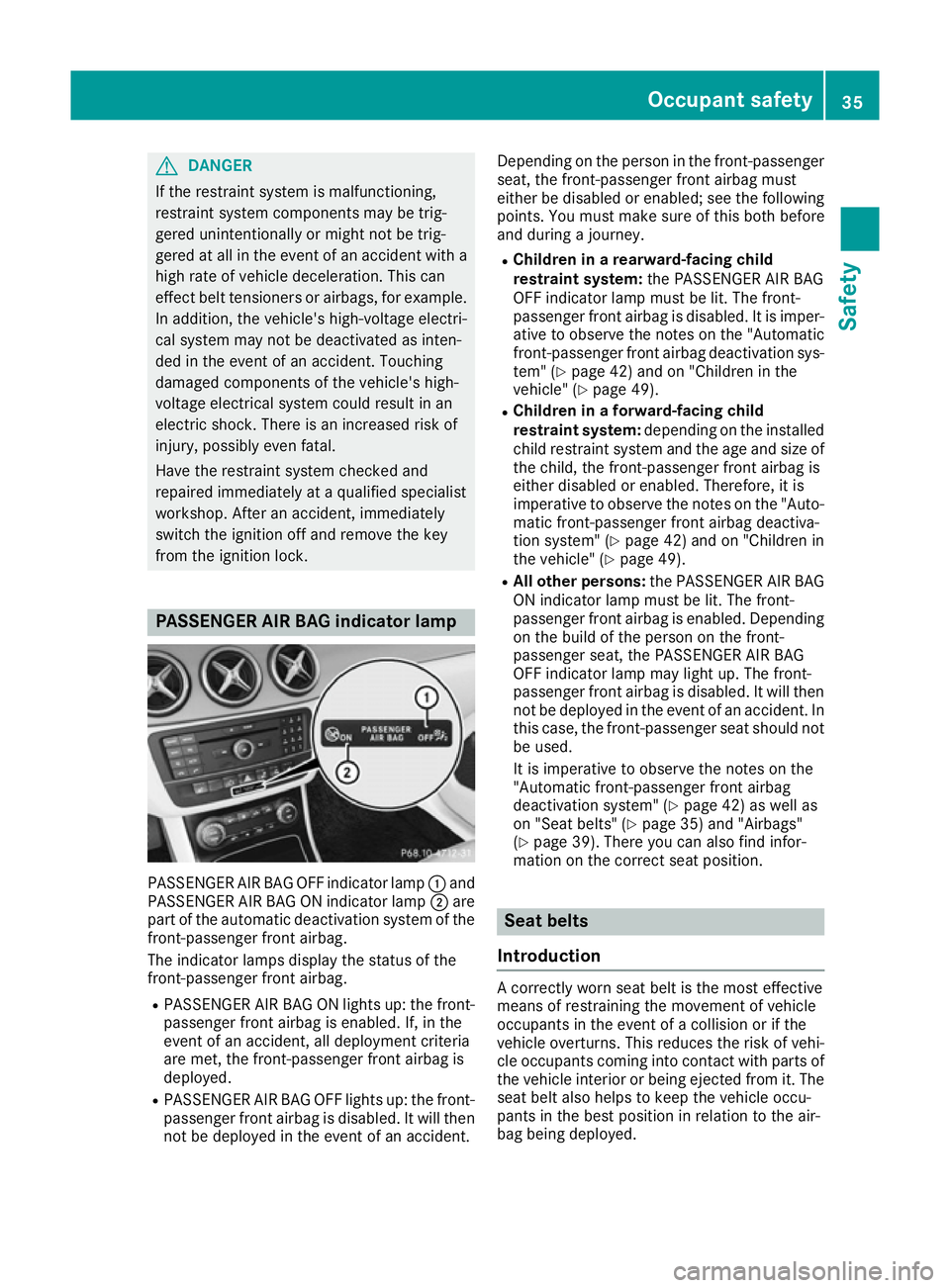
from the ignition lock. PASSENGER AIR BAG indicator lamp
PASSENGER AIR BAG OFF indicator lamp
:and
PASSENGER AIR BAG ON indicator lamp ;are
part of the automatic deactivation system of the front-passenger front airbag.
The indicator lamps display the status of the
front-passenger front airbag.
R PASSENGER AIR BAG ON lights up: the front-
passenger front airbag is enabled. If, in the
event of an accident, all deployment criteria
are met, the front-passenger front airbag is
deployed.
R PASSENGER AIR BAG OFF lights up: the front-
passenger front airbag is disabled. It will then
not be deployed in the event of an accident. Depending on the person in the front-passenger
seat, the front-passenger front airbag must
either be disabled or enabled; see the following
points. You must make sure of this both before
and during a journey.
R Children in a rearward-facing child
restraint system: the PASSENGER AIR BAG
OFF indicator lamp must be lit. The front-
passenger front airbag is disabled. It is imper- ative to observe the notes on the "Automatic
front-passenger front airbag deactivation sys- tem" (Y page 42) and on "Children in the
vehicle" (Y page 49).
R Children in a forward-facing child
restraint system: depending on the installed
child restraint system and the age and size of
the child, the front-passenger front airbag is
either disabled or enabled. Therefore, it is
imperative to observe the notes on the "Auto- matic front-passenger front airbag deactiva-
tion system" (Y page 42) and on "Children in
the vehicle" (Y page 49).
R All other persons: the PASSENGER AIR BAG
ON indicator lamp must be lit. The front-
passenger front airbag is enabled. Depending on the build of the person on the front-
passenger seat, the PASSENGER AIR BAG
OFF indicator lamp may light up. The front-
passenger front airbag is disabled. It will then
not be deployed in the event of an accident. In this case, the front-passenger seat should notbe used.
It is imperative to observe the notes on the
"Automatic front-passenger front airbag
deactivation system" (Y page 42) as well as
on "Seat belts" (Y page 35) and "Airbags"
(Y page 39). There you can also find infor-
mation on the correct seat position. Seat belts
Introduction A correctly worn seat belt is the most effective
means of restraining the movement of vehicle
occupants in the event of a collision or if the
vehicle overturns. This reduces the risk of vehi-
cle occupants coming into contact with parts of
the vehicle interior or being ejected from it. The seat belt also helps to keep the vehicle occu-
pants in the best position in relation to the air-
bag being deployed. Occupant safety
35Safety Z