check engine MERCEDES-BENZ B-CLASS SPORTS 2014 Owner's Manual
[x] Cancel search | Manufacturer: MERCEDES-BENZ, Model Year: 2014, Model line: B-CLASS SPORTS, Model: MERCEDES-BENZ B-CLASS SPORTS 2014Pages: 360, PDF Size: 39.45 MB
Page 226 of 360
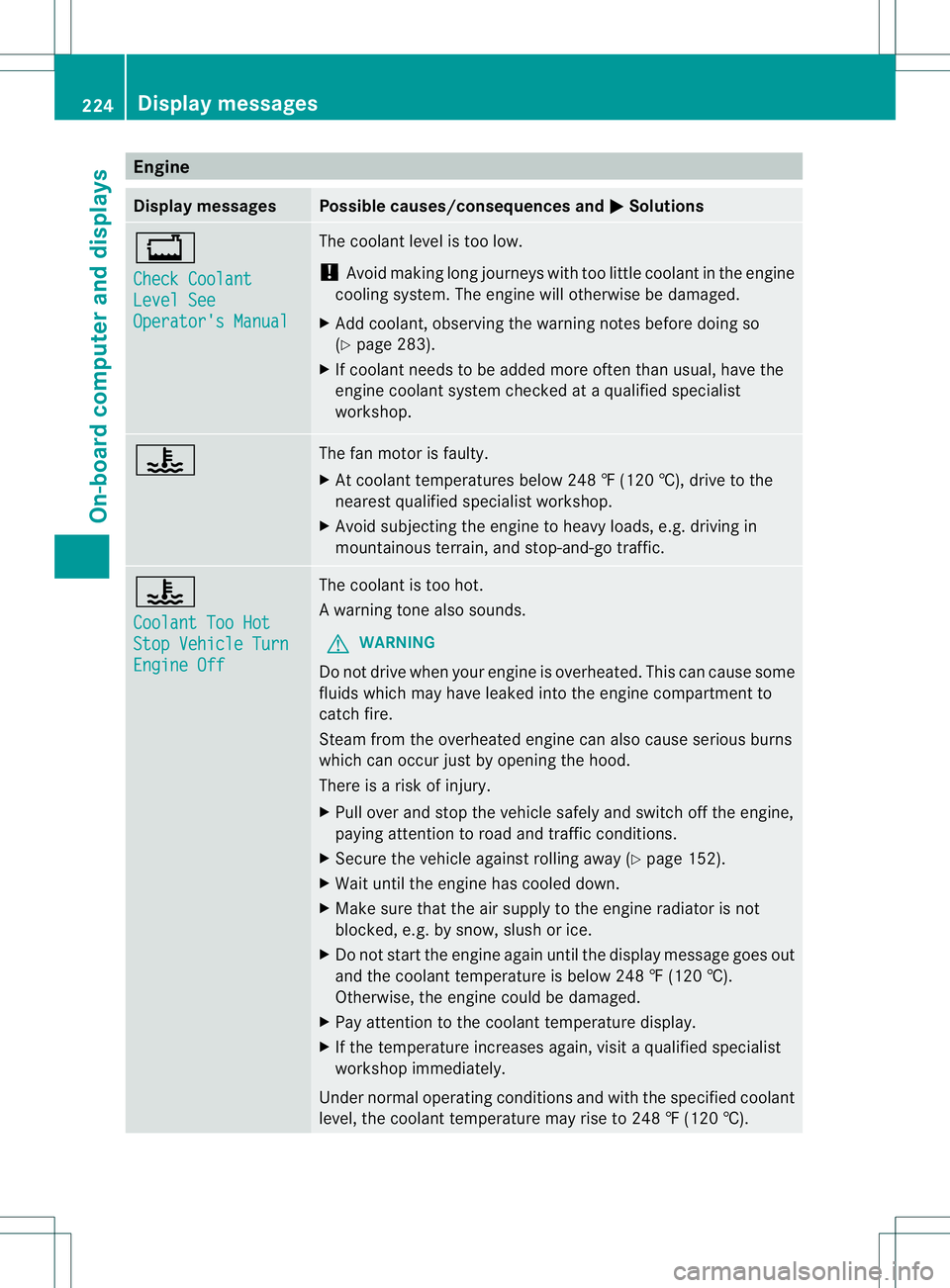
Engine
Display messages Possible causes/consequences and
000B Solutions
0014
Check Coolant
Level See
Operator'
sManual The coolant leve
listoolow.
! Avoid making lon gjou rneys with to olittle coolant in th eengine
cooling system. The engin ewill otherwise be damaged.
X Add coolant ,observing th ewarning note sbefore doin gso
( Ypage 283).
X If coolant needs to be added mor eoften than usual, have the
engin ecoolant system checked at aqualifie dspecialist
workshop. 0010 The fan motor is faulty.
X
At coolant temperatures below 24 8‡(120† ), driv etothe
neares tqualified specialist workshop.
X Avoid subjecting th eenginetoh eavy loads, e.g. driving in
mountainous terrain, and stop-and-go traffic. 0010
Coolant Too Hot
Stop Vehicle Turn
Engine Off The coolant is too hot.
Aw
arning tone also sounds.
G WARNING
Do no tdrive when youre ngine is overheated. Thi scan caus esome
fluids whic hmay have leaked int othe engin ecom partmen tto
catch fire.
Stea mfrom the overheated engine can alsoc auseserious burns
which can occur just by opening the hood.
There is arisk of injury.
X Pullo ver and stop the vehicl esafel yand switch off the engine,
paying attention to road and traffic conditions.
X Secure the vehicl eagainst rolling away (Y page152).
X Waitu ntil the engine ha scoole ddown.
X Make sure tha tthe air supply to the engine radiator is not
blocked, e.g. by snow, slush or ice.
X Do not start the engine again until the displaym essage goes out
and the coolant temperature is below 248 ‡(120 †).
Otherwise, the engine could be damaged.
X Pay attention to the coolant temperature display.
X If the temperature increases again, visit aqualified specialist
workshop immediately.
Under normal operating conditionsa nd with the specified coolant
level, the coolant temperature may rise to 248 ‡(120 †). 224
Display messagesOn-board computer and displays
Page 227 of 360
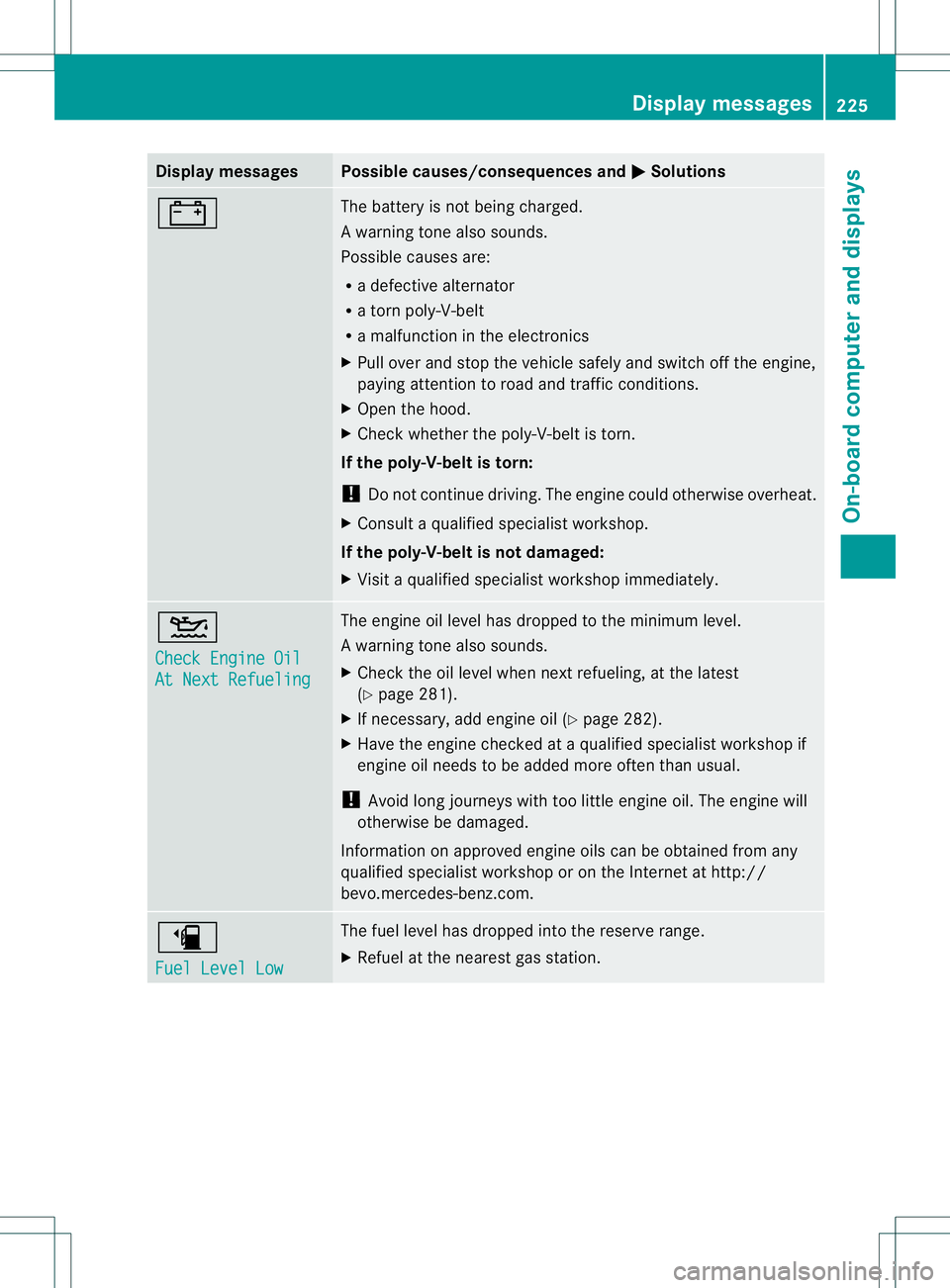
Display messages Possible causes/consequences and
000B Solutions
0012 The battery is no
tbeing charged.
Aw arning tone also sounds.
Possible causes are:
R ad efective alternator
R at ornp oly-V-belt
R am alfunctio nintheelectronics
X Pull ove rand stop the vehicl esafelya nd switch off the engine,
paying attentio ntoroada nd traffic conditions.
X Ope nthe hood.
X Check whether the poly-V-belt is torn.
If the poly-V-belt is torn:
! Do not continue driving. The engine could otherwise overheat.
X Consult aqualified specialist workshop.
If the poly-V-belt is not damaged:
X Visit aqualified specialist workshop immediately. 0008
Check Engine Oil
At Next Refueling The engine oil level has dropped to the minimum level.
Aw
arning tone also sounds.
X Chec kthe oil level when next refueling, at the latest
(Y page 281).
X If necessary, add engine oil (Y page 282).
X Have the engine checked at aqualified specialist workshop if
engine oil needs to be added more often than usual.
! Avoid long journeys with too little engine oil. The engine will
otherwise be damaged.
Information on approved engine oils can be obtained from any
qualified specialist workshop or on the Internet at http://
bevo.mercedes-benz.com. 0007
Fuel Level Low The fuel level has dropped into the reserve range.
X
Refuel at the nearest gas station. Display messages
225On-board computer and displays Z
Page 231 of 360
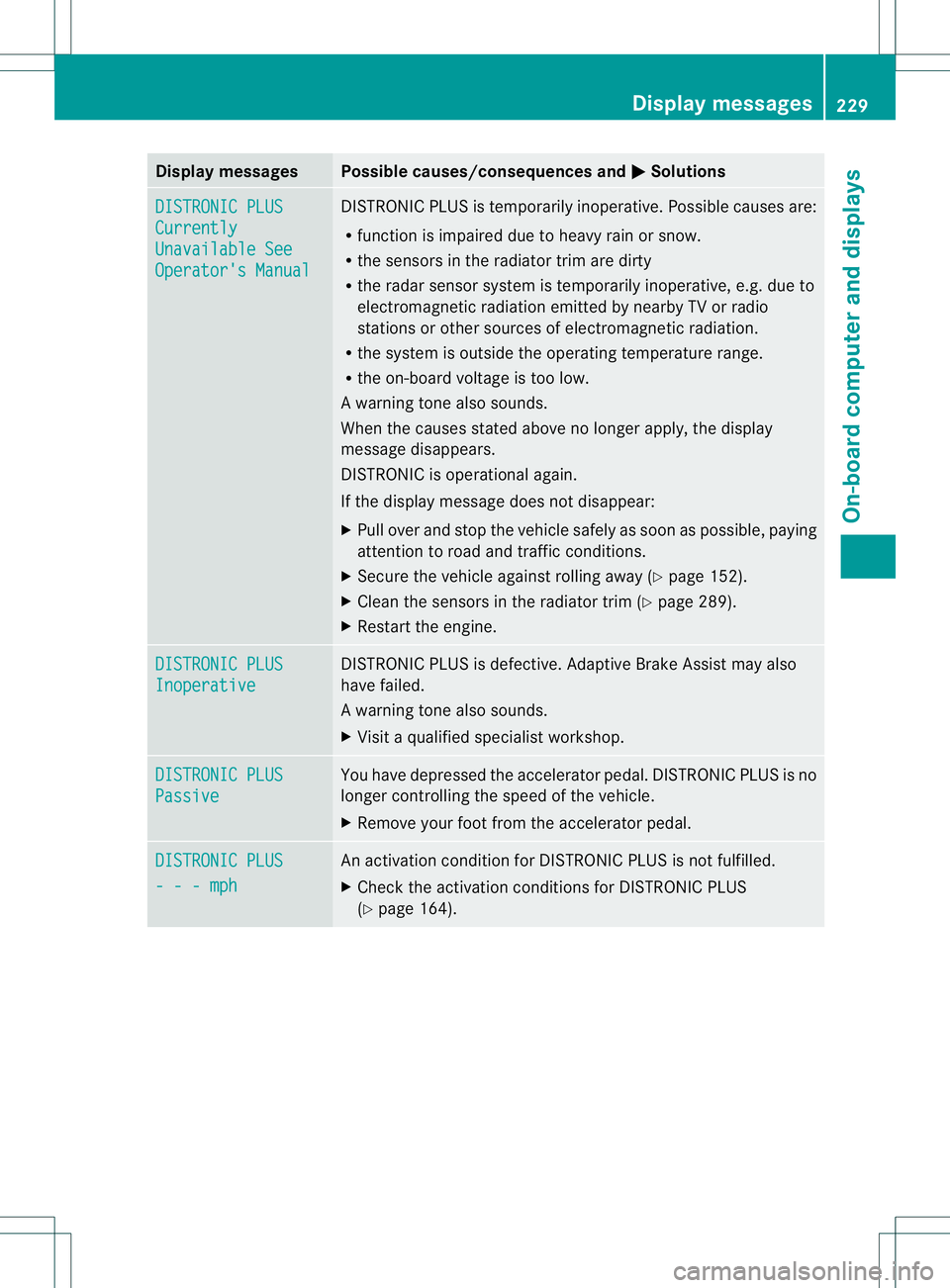
Display messages Possible causes/consequences and
000B Solutions
DISTRONIC PLUS
Currently
Unavailable See
Operator'
sManual DISTRONIC PLU
Sistemporarily inoperative. Possible causes are:
R function is impaired due to heavy rain or snow.
R the sensors in the radiator trim are dirty
R the radar sensor system is temporarily inoperative, e.g. due to
electromagnetic radiation emitted by nearby TV or radio
stations or other sources of electromagnetic radiation.
R the system is outside the operating temperature range.
R the on-board voltage is too low.
Aw arning tone also sounds.
When th ecauses state dabov enol onger apply, th edisplay
message disappears.
DISTRONI Cisoperational again.
If th edisplay message does no tdisappear:
X Pull over and stop the vehicle safely as soon as possible ,paying
attention to road and traffic conditions.
X Secure the vehicle against rollin gaway (Y page 152).
X Clean the sensors in the radiator trim (Y page 289).
X Restar tthe engine. DISTRONIC PLUS
Inoperative DISTRONIC PLUS is defective. Adaptive Brake Assist may also
have failed.
Aw
arning tone also sounds.
X Visi taq ualified specialist workshop. DISTRONIC PLUS
Passive You have depressed the accelerator pedal. DISTRONIC PLUS is no
longer controlling the speed of the vehicle.
X
Remove your foot from the accelerator pedal. DISTRONIC PLUS
---m
ph An activation condition for DISTRONIC PLUS is not fulfilled.
X
Check the activation condition sfor DISTRONIC PLUS
(Y page 164). Display messages
229On-boardcomputer and displays Z
Page 244 of 360
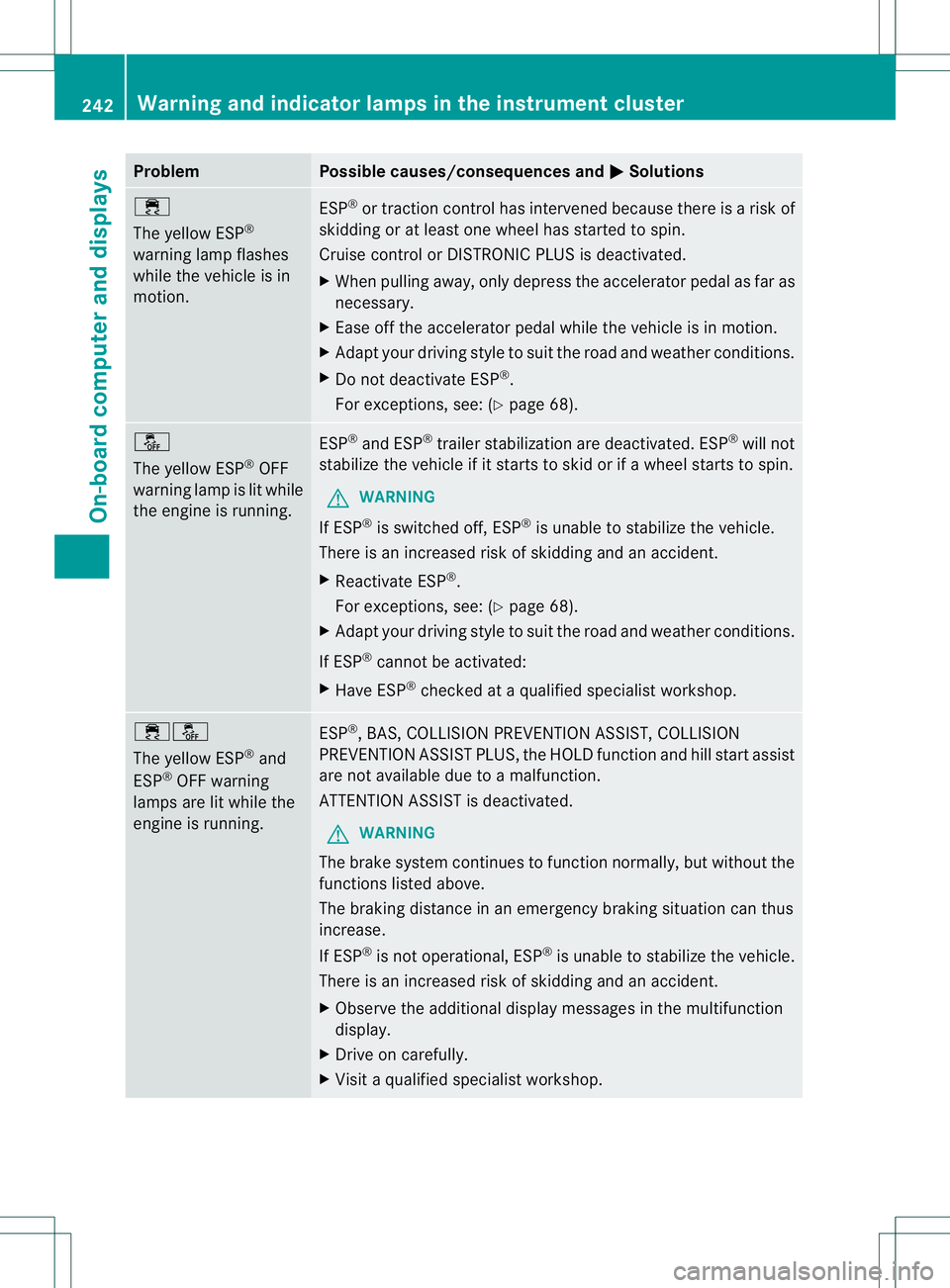
Problem Possible causes/consequences and
000B Solutions
000A
The yellowE
SP®
warning lamp flashes
while the vehicle is in
motion. ESP
®
or traction control has intervened because there is arisk of
skidding or at least one wheel has started to spin.
Cruise control or DISTRONIC PLUS is deactivated.
X When pulling away,o nly depress the accelerator pedal as far as
necessary.
X Ease off the accelerator pedal while the vehicle is in motion.
X Adapt your driving style to suit the road and weather conditions.
X Do not deactivate ESP ®
.
For exceptions, see: (Y page 68).0004
The yellowE
SP®
OFF
warning lamp is lit while
the engine is running. ESP
®
and ESP ®
trailer stabilization are deactivated. ESP ®
will not
stabilize the vehicle if it starts to skid or if awheel starts to spin.
G WARNING
If ESP ®
is switched off, ESP ®
is unable to stabilize the vehicle.
There is an increased risk of skidding and an accident.
X Reactivate ESP ®
.
For exceptions, see: (Y page 68).
X Adapt your driving style to suit the road and weather conditions.
If ESP ®
cannot be activated:
X Have ESP ®
checked at aqualified specialist workshop. 000A0004
The yellow ESP
®
and
ESP ®
OFF warning
lamps are lit while the
engine is running. ESP
®
,B AS,C OLLISION PREVENTION ASSIST, COLLISION
PREVENTION ASSIST PLUS, the HOLD function and hill start assist
are not available due to amalfunction.
ATTENTION ASSIST is deactivated.
G WARNING
The brake system continues to function normally, but without the
functions listed above.
The braking distance in an emergency braking situation can thus
increase.
If ESP ®
is not operational, ESP ®
is unable to stabilize the vehicle.
There is an increased risk of skidding and an accident.
X Observe the additional display messages in the multifunction
display.
X Drive on carefully.
X Visit aqualified specialist workshop. 242
Warning and indicator lampsint
he instrument clusterOn-board computer and displays
Page 246 of 360
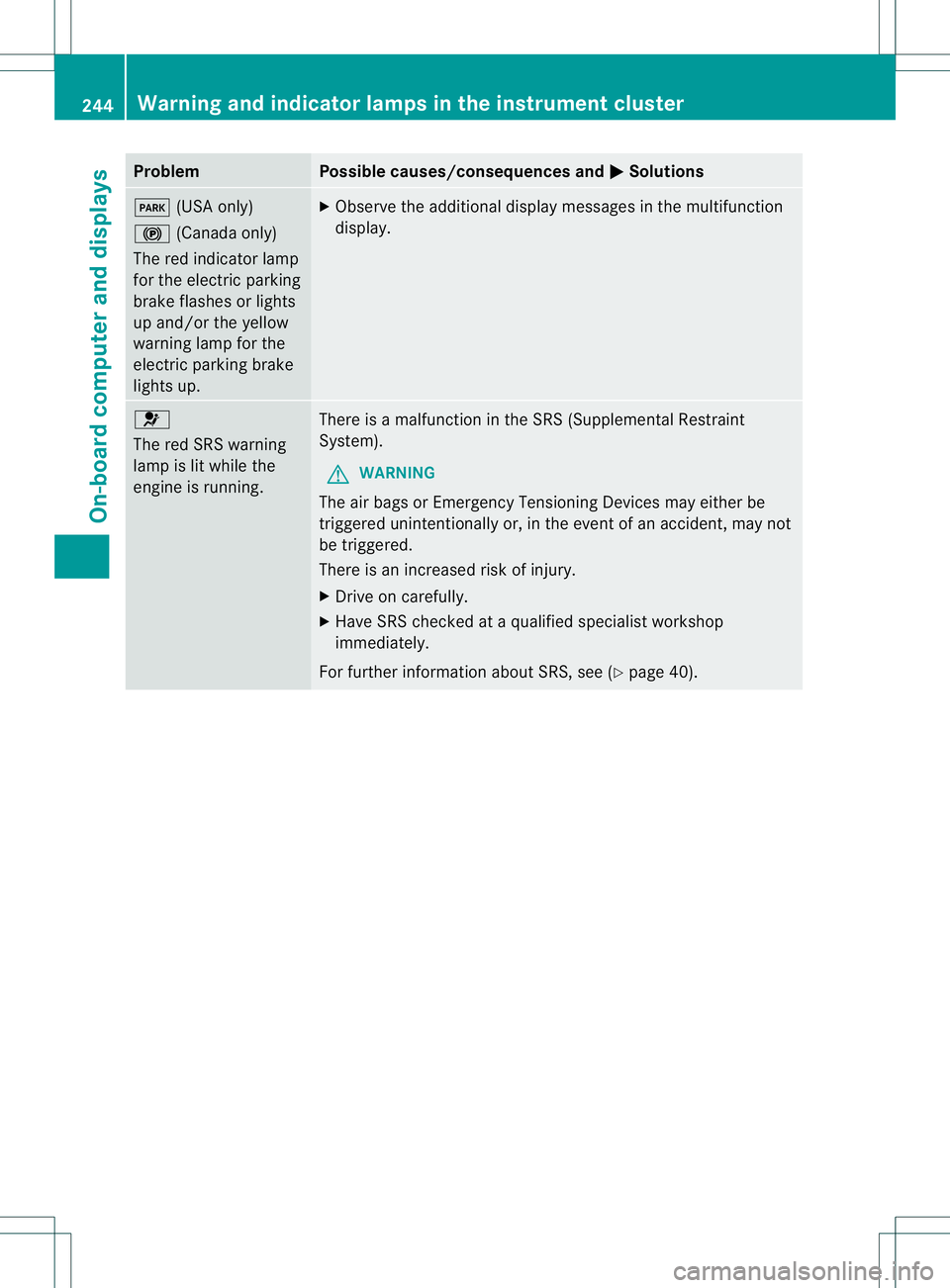
Problem Possible causes/consequences and
000B Solutions
0005
(USA only)
000A (Canada only)
The red indicator lamp
for the electric parking
brake flashes or lights
up and/or the yellow
warning lamp for the
electric parking brake
lights up. X
Observe the additional display messages in the multifunction
display. 0021
The red SRS warning
lamp is lit while the
engine is running.
There is
amalfunction in the SRS (Supplemental Restraint
System).
G WARNING
The air bags or Emergency Tensioning Devices may either be
triggered unintentionally or, in the event of an accident, may not
be triggered.
There is an increased risk of injury.
X Drive on carefully.
X Have SRS checked at aqualified specialist workshop
immediately.
For further information about SRS, see (Y page 40).244
Warning and indicator lampsint
he instrument clusterOn-board computer and displays
Page 247 of 360
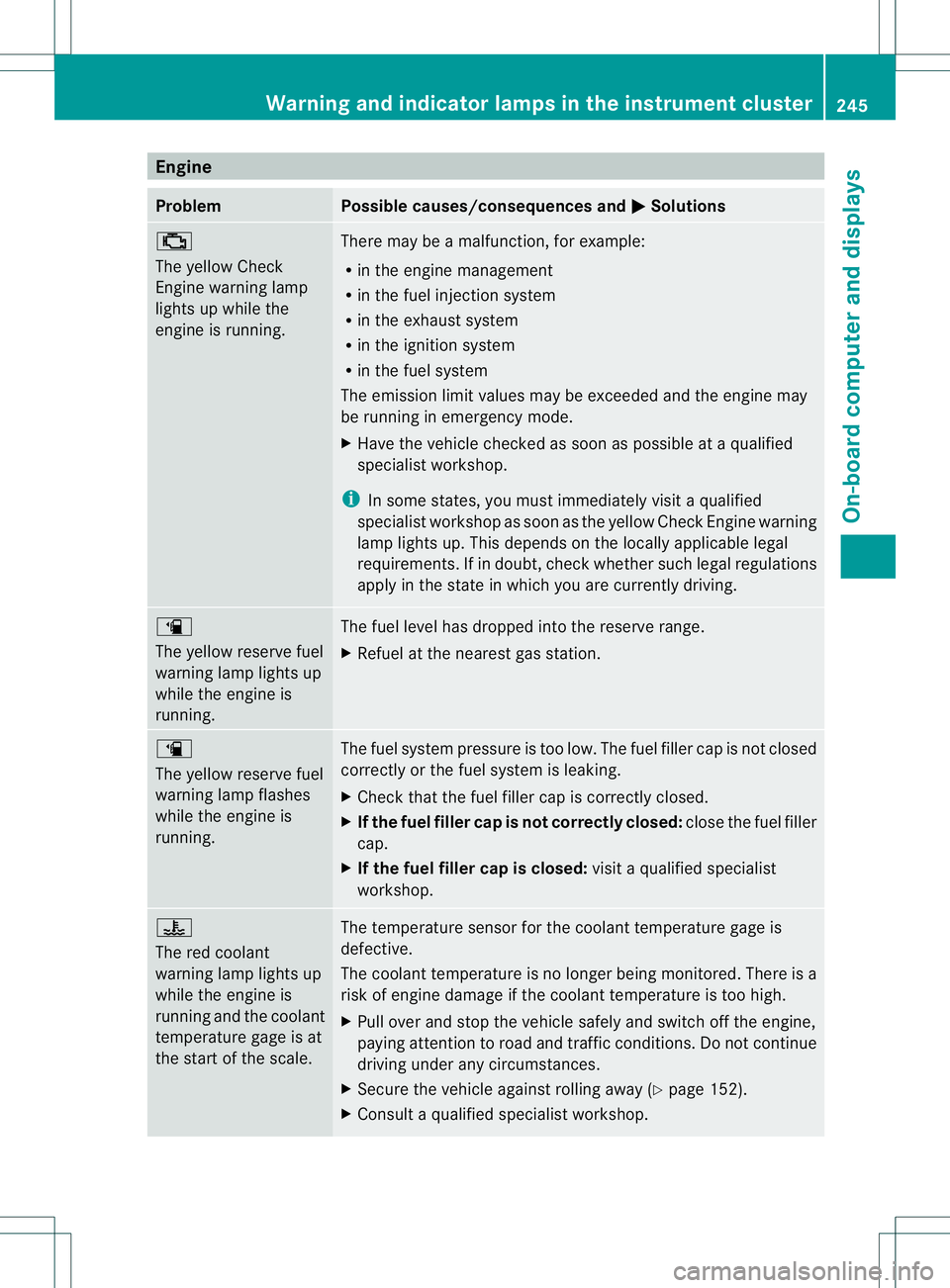
Engine
Problem Possible causes/consequences and
000B Solutions
000A
The yellow Check
Engin
ewarning lamp
light supw hile the
engin eisrunning. Ther
emay be amalfunction, for example:
R in th eenginem anagement
R in th efuel injection system
R in th eexhaust system
R in th eignition system
R in th efuel system
The emission limit values may be exceeded and th eenginem ay
be runnin ginemergenc ymode.
X Hav ethe vehicle checked as soon as possible at aqualified
specialist workshop.
i In som estates, you must immediately visit aqualified
specialist worksho passoon as th eyellow Chec kEngine warning
lamp lights up .This depends on the locally applicable legal
requirements. If in doubt, check whether such legal regulations
apply in the state in which you are currently driving. 0007
The yellow reserve fuel
warning lamp lights up
while the engine is
running.
The fuel level has dropped into the reserve range.
X
Refuel at the nearest gas station. 0007
The yellow reserve fuel
warning lamp flashes
while the engine is
running.
The fuel system pressure is too low. The fuel filler cap is not closed
correctly or the fuel system is leaking.
X
Check that the fuel filler cap is correctly closed.
X If the fuel filler cap is not correctly closed: close the fuel filler
cap.
X If the fuel filler cap is closed: visitaqualified specialist
workshop. 0010
The red coolant
warning lamp lights up
while the engine is
running and the coolant
temperature gage is at
the start of the scale.
The temperature sensor for the coolant temperature gage is
defective.
The coolant temperature is no longer being monitored. There is a
risk of engine damage if the coolant temperature is too high.
X Pull over and stop the vehicle safely and switch off the engine,
paying attention to road and traffic conditions. Do not continue
driving under any circumstances.
X Secure the vehicle against rolling away (Y page 152).
X Consult aqualified specialist workshop. Warning and indicator lampsint
he instrument cluster
245On-board computer and displays Z
Page 248 of 360
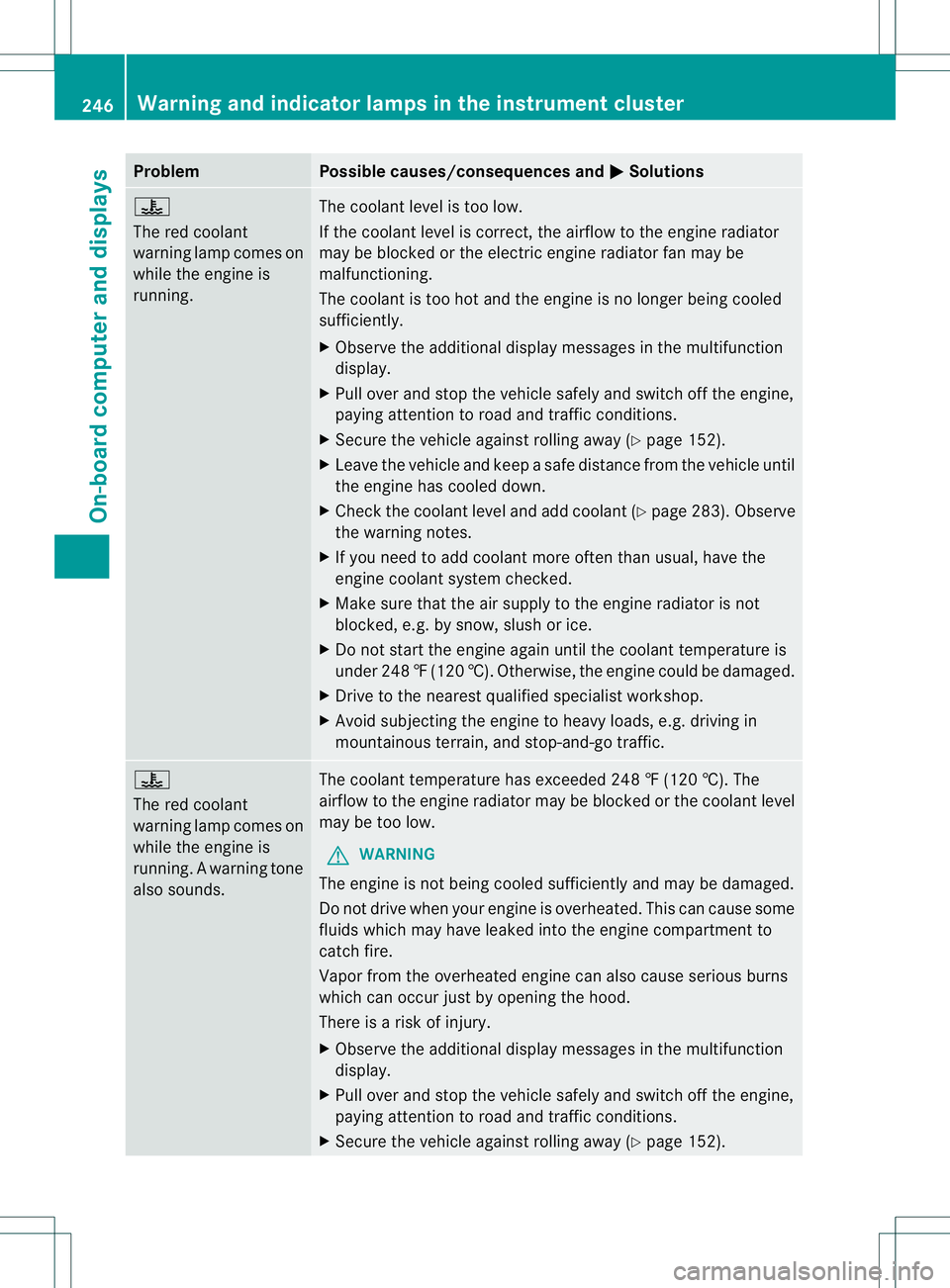
Problem Possible causes/consequences and
000B Solutions
0010
The red coolant
warning lamp comes on
while the engine is
running.
The coolant level is too low.
If the coolant level is correct, the airflow to the engine radiator
may be blocked or the electric engine radiator fan may be
malfunctioning.
The coolant is too hot and the engine is no longer being cooled
sufficiently.
X
Observe the additional display messages in the multifunction
display.
X Pull over and stop the vehicle safely and switch off the engine,
paying attention to road and traffic conditions.
X Secure the vehicle against rolling away (Y page 152).
X Leave the vehicle and keep asafe distance from the vehicle until
the engine has cooled down.
X Check the coolant level and add coolant (Y page 283). Observe
the warning notes.
X If you need to add coolant more often than usual, have the
engine coolant system checked.
X Make sure that the air supply to the engine radiator is not
blocked, e.g. by snow, slush or ice.
X Do not start the engine again until the coolant temperature is
under 248 ‡(120 †). Otherwise ,the engine coul dbedamaged.
X Drive to the nearest qualified specialist workshop.
X Avoid subjecting the engine to heavy loads, e.g. driving in
mountainou sterrain, and stop-and-go traffic. 0010
The red coolant
warning lamp comes on
while the engine is
running.
Awarning tone
also sounds. The coolant temperature has exceeded 248
‡(120 †). The
airflow to the engine radiator may be blocked or the coolant level
may be too low.
G WARNING
The engine is not being coole dsufficiently and may be damaged.
Do not drive whe nyour engine is overheated. This can cause some
fluids which may have leaked into the engine compartment to
catchf ire.
Vapor from the overheated engine can also cause serious burns
which can occur just by opening the hood.
There is arisk of injury.
X Observe the additional display messages in the multifunction
display.
X Pull over and stop the vehicle safely and switch off the engine,
paying attention to road and traffic conditions.
X Secure the vehicle against rolling away (Y page 152).246
Warning and indicator lampsint
he instrument clusterOn-board computer and displays
Page 249 of 360
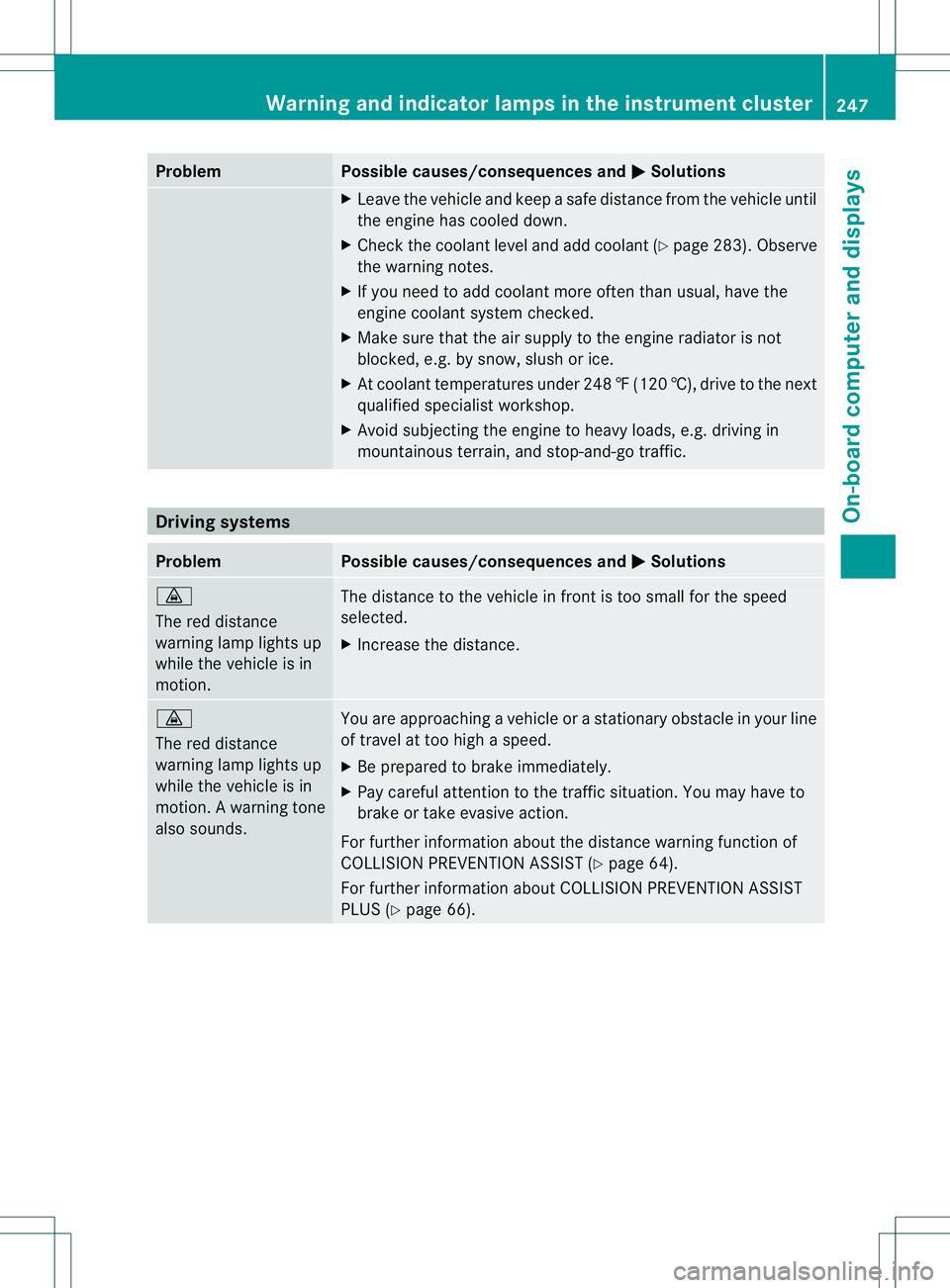
Problem Possible causes/consequences and
000B Solutions
X
Leave the vehicle and keep asafe distance from the vehicle until
the engine has cooled down.
X Check the coolant level and add coolant (Y page 283). Observe
the warning notes.
X If you need to add coolant more often than usual, have the
engine coolant system checked.
X Make sure that the air supply to the engine radiator is not
blocked, e.g. by snow, slush or ice.
X At coolant temperatures under 248 ‡(120 †), drive to the next
qualified specialist workshop.
X Avoid subjecting the engine to heavy loads, e.g. driving in
mountainou sterrain, and stop-and-go traffic. Driving systems
Problem Possible causes/consequencesa
nd000B Solutions
0008
The red distance
warning lamp lights up
while the vehicle is in
motion.
The distance to the vehicle in front is too smal
lfor the speed
selected.
X Increase the distance. 0008
The red distance
warning lamp lights up
while the vehicle is in
motion
.Awarning tone
also sounds. You are approaching
avehicle or astationary obstacle in your line
of travel at too high aspeed.
X Be prepared to brake immediately.
X Pay careful attention to the traffic situation. You may have to
brake or take evasive action.
For further information about the distance warning function of
COLLISION PREVENTION ASSIST (Y page 64).
For further information about COLLISION PREVENTION ASSIST
PLUS (Y page 66). Warning and indicator lampsint
he instrument cluster
247On-board computer and displays Z
Page 283 of 360
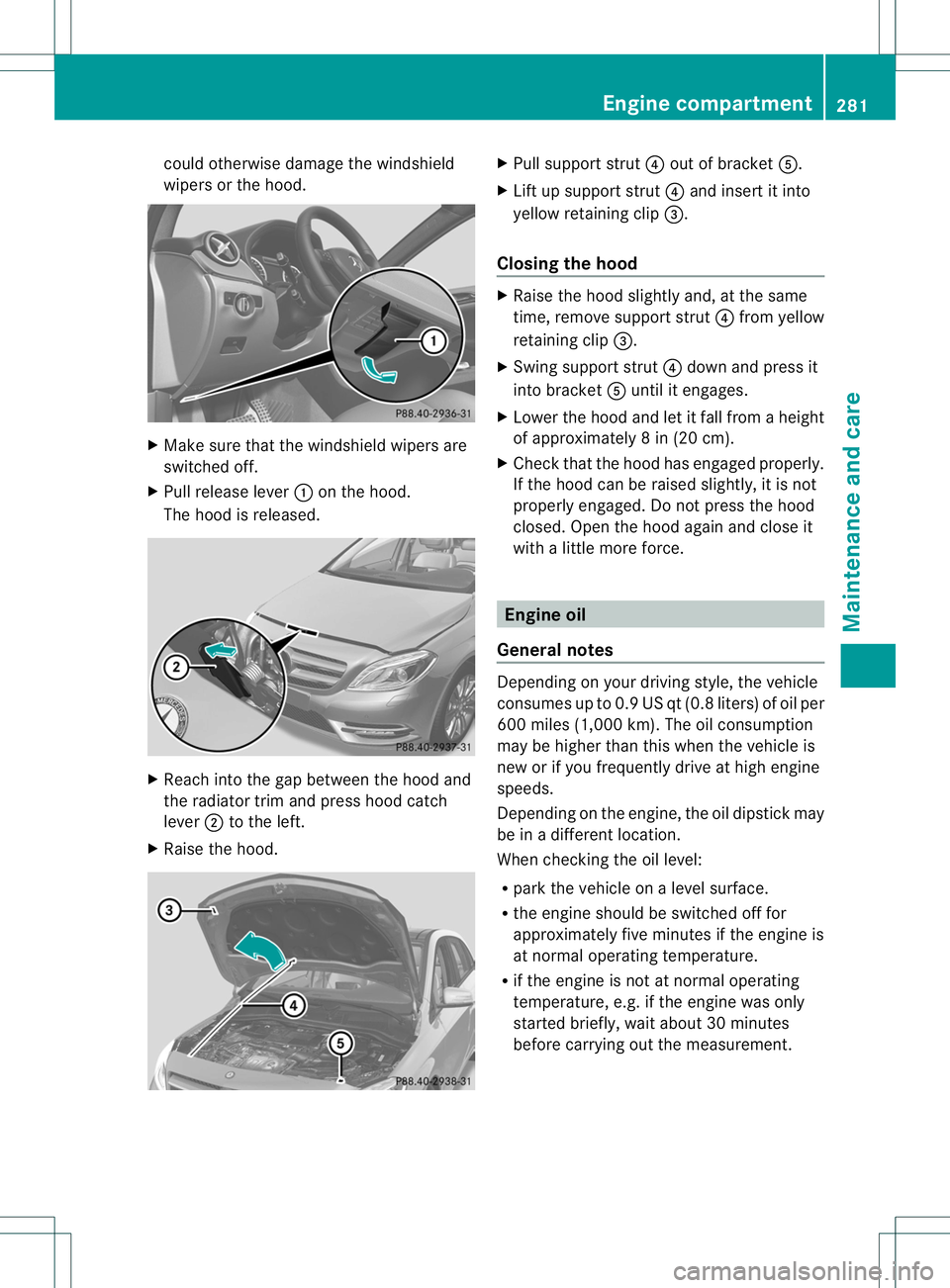
could otherwise damag
ethe windshield
wiper sorthe hood. X
Make sure that the windshield wiper sare
switched off.
X Pull release lever 001Aon the hood.
The hoo disreleased. X
Reach into the ga pbetween the hoo dand
the radiator trim and press hoo dcatch
lever 0010to the left.
X Raise the hood. X
Pull support strut 0021outofb racket 001E.
X Lift up support strut 0021and insert it into
yellow retaining clip 0023.
Closin gthe hood X
Raise the hoo dslightl yand,att he same
time ,remove support strut 0021from yellow
retaining clip 0023.
X Swing support strut 0021dow nand press it
into bracket 001Eunti lite ngages.
X Lower the hoo dand le titfall from aheight
of approximately 8in(20 cm).
X Chec kthat the hood has engaged properly.
If the hood can be raised slightly, it is not
properly engaged. Do not press the hood
closed. Open the hood again and close it
with alittle more force. Engine oil
General notes Depending on your driving style, the vehicle
consumes up to 0.9 US qt (0.8 liters) of oil per
600 miles (1,000 km). The oil consumption
may be higher than this when the vehicle is
new or if you frequently drive at high engine
speeds.
Depending on the engine, the oil dipstick may
be in
adifferent location.
When checking the oil level:
R park the vehicle on alevel surface.
R the engine should be switched off for
approximately five minutes if the engine is
at normal operating temperature.
R if the engine is not at normal operating
temperature, e.g. if the engine was only
started briefly, wait about 30 minutes
before carrying out the measurement. Engine compartment
281Maintenance and care Z
Page 284 of 360
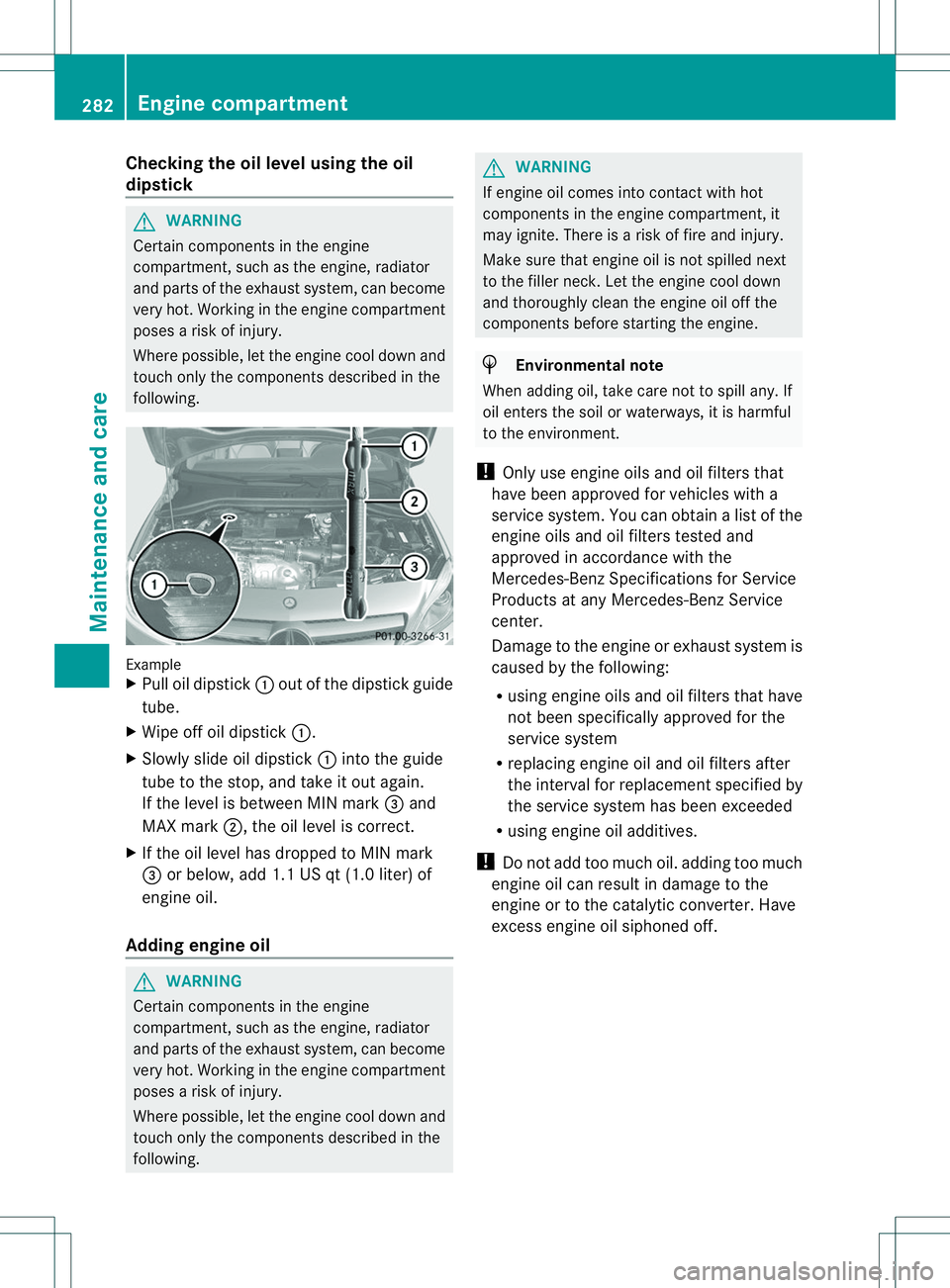
Checking th
eoil level usin gthe oil
dipstick G
WARNING
Certain components in th eengine
compartment, suc hasthe engine, radiator
and parts of the exh austsystem, can become
very hot. Working in the engine compartment
poses arisk of injury.
Where possible, let the engine cool down and
touch only the components described in the
following. Example
X
Pull oil dipstick 001Aout of the dipstick guide
tube.
X Wipe off oil dipstick 001A.
X Slowly slide oil dipstick 001Ainto the guide
tube to the stop, and take it out again.
If the level is between MIN mark 0023and
MAX mark 0010,the oil level is correct.
X If the oil level has dropped to MIN mark
0023 or below, add 1.1 US qt (1.0 liter) of
engine oil.
Adding engine oil G
WARNING
Certain components in the engine
compartment, such as the engine, radiator
and parts of the exhaust system, can become
very hot. Working in the engine compartment
poses arisk of injury.
Where possible, let the engine cool down and
touch only the components described in the
following. G
WARNING
If engine oil comes into contact with hot
components in the engine compartment, it
may ignite. There is arisk of fire and injury.
Make sure that engine oil is not spilled next
to the filler neck.L et the engine cool down
and thoroughly clean the engine oil off the
components before starting the engine. H
Environmental note
When adding oil, take care not to spill any. If
oil enterst he soil or waterways, it is harmful
to the environment.
! Only use engine oils and oil filters that
have been approved for vehicles with a
service system. You can obtain alist of the
engine oils and oil filters tested and
approved in accordanc ewith the
Mercedes-Benz Specifications for Service
Products at any Mercedes-Benz Service
center.
Damage to the engine or exhaust system is
caused by the following:
R using engine oils and oil filters that have
not been specifically approved for the
service system
R replacing engine oil and oil filters after
the interval for replacement specified by
the service system has been exceeded
R using engine oil additives.
! Do not add too much oil. adding too much
engine oil can result in damage to the
engine or to the catalytic converter. Have
excess engine oil siphoned off. 282
Engine compartmentMaintenance and care