check engine MERCEDES-BENZ B-CLASS SPORTS 2014 User Guide
[x] Cancel search | Manufacturer: MERCEDES-BENZ, Model Year: 2014, Model line: B-CLASS SPORTS, Model: MERCEDES-BENZ B-CLASS SPORTS 2014Pages: 360, PDF Size: 39.45 MB
Page 94 of 360
Useful information
i This Operator's Manual describes all
models and all standard and optional
equipment of your vehicle available at the
time of publication of the Operator's
Manual. Country-specific differences are
possible. Please not ethat your vehicle may
not be equipped with all features
described. This also applies to safety-
related system sand functions.
i Read the information on qualified
specialist workshops: (Y page 25).Correct driver's seat position
G
WARNING
You could lose contro lofyour vehicle if you
do the following while driving:
R adjust the driver' sseat, head restraint,
steering wheel or mirrors
R faste nthe seat belt
There is arisk of an accident.
Adjust the driver's seat, head restraint,
steering wheel and mirror and fasten your
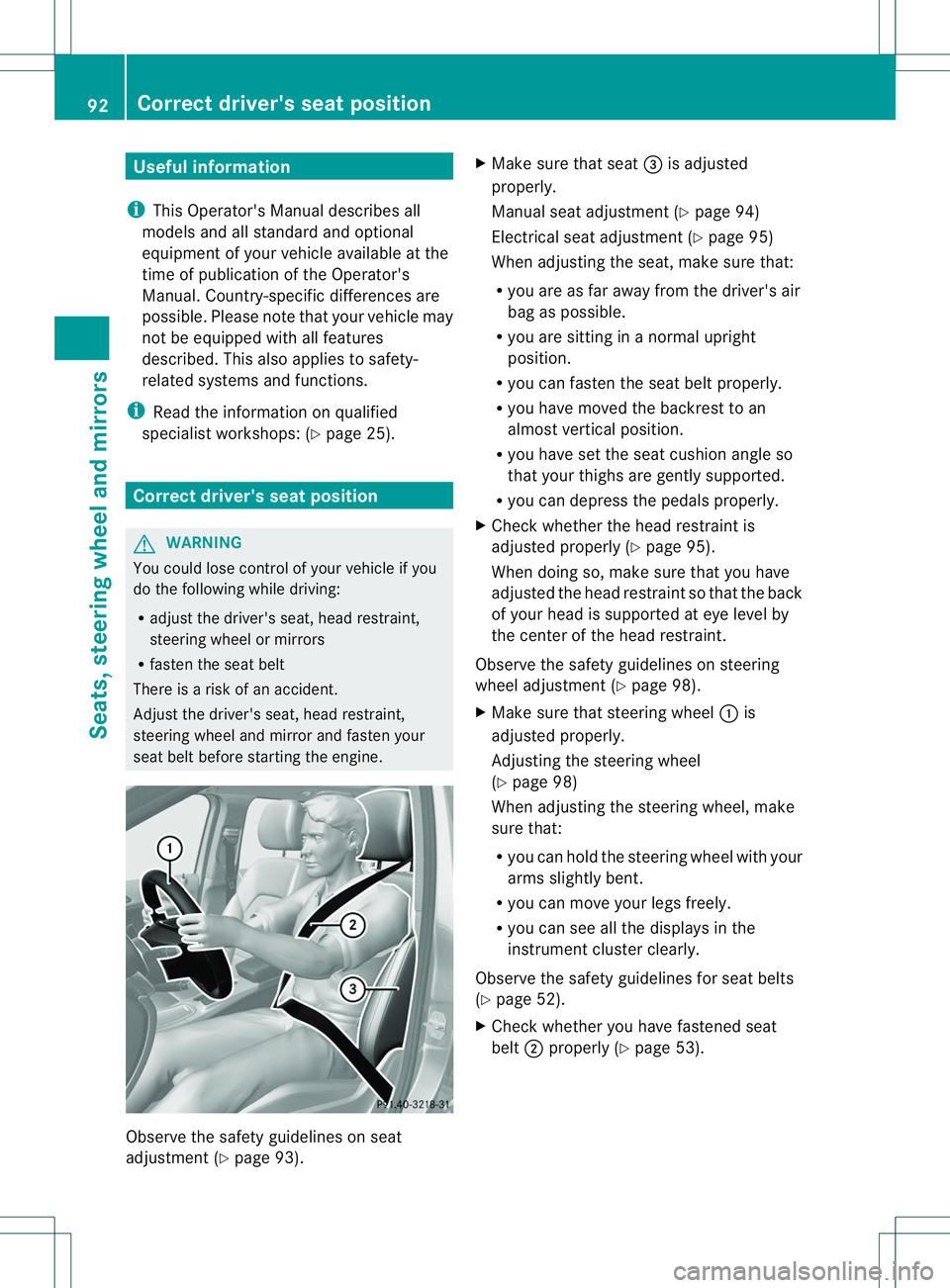
seat belt before startingt he engine.Observe the safety guidelines on seat
adjustment (Y
page 93). X
Make sure that seat 0023is adjusted
properly.
Manual seat adjustment (Y page 94)
Electrical seat adjustment (Y page 95)
When adjusting the seat, make sure that:
R you are as far away from the driver's air
bag as possible.
R you are sitting in anormal upright
position.
R you can fasten the seat belt properly.
R you have moved the backrest to an
almost vertical position.
R you have set the seat cushion angle so
that your thighs are gently supported.
R you can depress the pedals properly.
X Check whether the head restraint is
adjusted properly (Y page 95).
When doing so, make sure that you have
adjusted the head restraint so that the back
of your head is supported at eye level by
the center of the head restraint.
Observe the safety guidelines on steering
wheel adjustment (Y page 98).
X Make sure that steering wheel 001Ais
adjusted properly.
Adjustingt he steering wheel
(Y page 98)
When adjusting the steering wheel, make
sure that:
R you can hold the steering wheel with your
arms slightly bent.
R you can move your legs freely.
R you can see all the displays in the
instrumentc lusterclearly.
Observe the safet yguideline sfor seat belts
(Y page 52).
X Check whether you have fastened seat
belt 0010properly (Y page 53). 92
Correct driver'
sseat positionSeats, steering wheel and mirrors
Page 100 of 360
Problems with the seat heating
Problem Possible causes/consequences and
000B Solutions
The seat heating has
switched off
prematurely or cannot
be switched on. The on-board voltage is too low because too many electrical
consumers are switched on.
X
Switch off electrical consumers that you do not need, such as
the rear window defroster or interior lighting.
Once the battery is sufficiently charged, the seat heating will
switch back on automatically. Steering wheel
Important safety notes
G
WARNING
You could lose control of your vehicle if you
do the following while driving:
R adjust the driver's seat, head restraint,
steering wheel or mirrors
R fasten the seat belt
There is arisk of an accident.
Adjust the driver's seat, head restraint,
steering wheel and mirror and fasten your
seat belt before startingt he engine.G
WARNING
Children could injure themselves if they
adjust the steering wheel. There is arisk of
injury.
When leaving the vehicle, always take the
SmartKey with you and lock the vehicle. Never
leave children unsupervised in the vehicle. Adjusting the steering wheel
G
WARNING
If the steering wheel is unlocked while the
vehicle is in motion, it could change position
unexpectedly. This could cause you to lose
control of the vehicle. There is arisk of an
accident. Before startingo
ff, make sure the steering
wheel is locked. Never unlock the steering
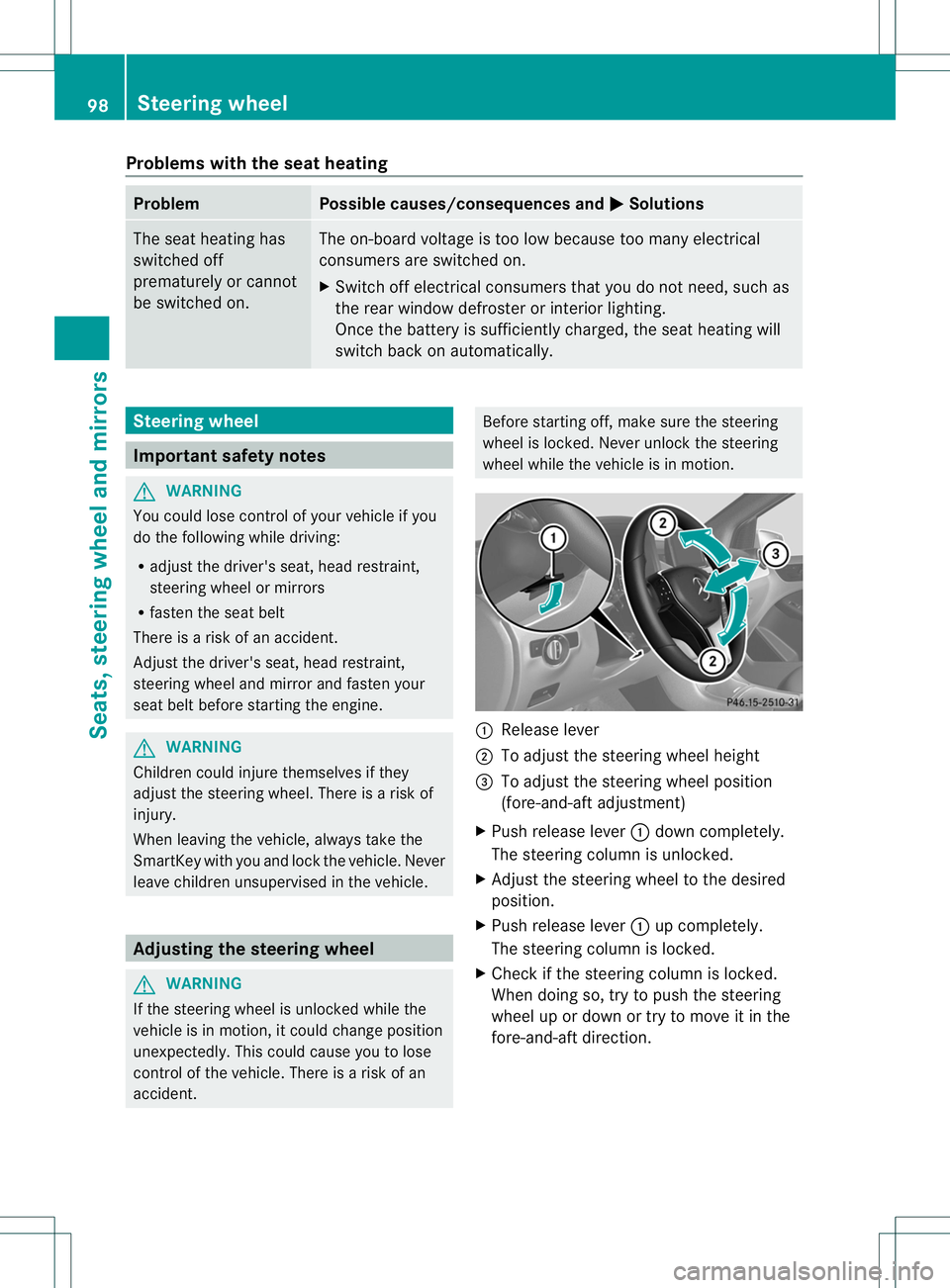
wheel while the vehicle is in motion. 001A
Release lever
0010 To adjust the steering wheel height
0023 To adjust the steering wheel position
(fore-and-aft adjustment)
X Push release lever 001Adown completely.
The steering column is unlocked.
X Adjust the steering wheel to the desired
position.
X Push release lever 001Aup completely.
The steering column is locked.
X Check if the steering column is locked.
When doing so, try to push the steering
wheel up or down or try to move it in the
fore-and-aft direction. 98
Steering wheelSeats, steering wheela
nd mirrors
Page 139 of 360
more effort to steer and brake. There is
arisk
of an accident.
Do not switch off the ignitio nwhile driving. G
WARNING
If the parking brake has not been fully
released when driving, the parking brake can:
R overheat and cause afire
R lose its hold function.
There is arisk of fire and an accident. Release
the parking brake fully before driving off.
! Warm up the engine quickly. Do not use
the engine's full performance until it has
reached operating temperature.
Only shift the automatic transmission to
the desired drive position when the vehicle
is stationary.
Where possible, avoid spinning the drive
wheels when pulling away on slippery
roads. You could otherwise damage the
drive train. Key positions
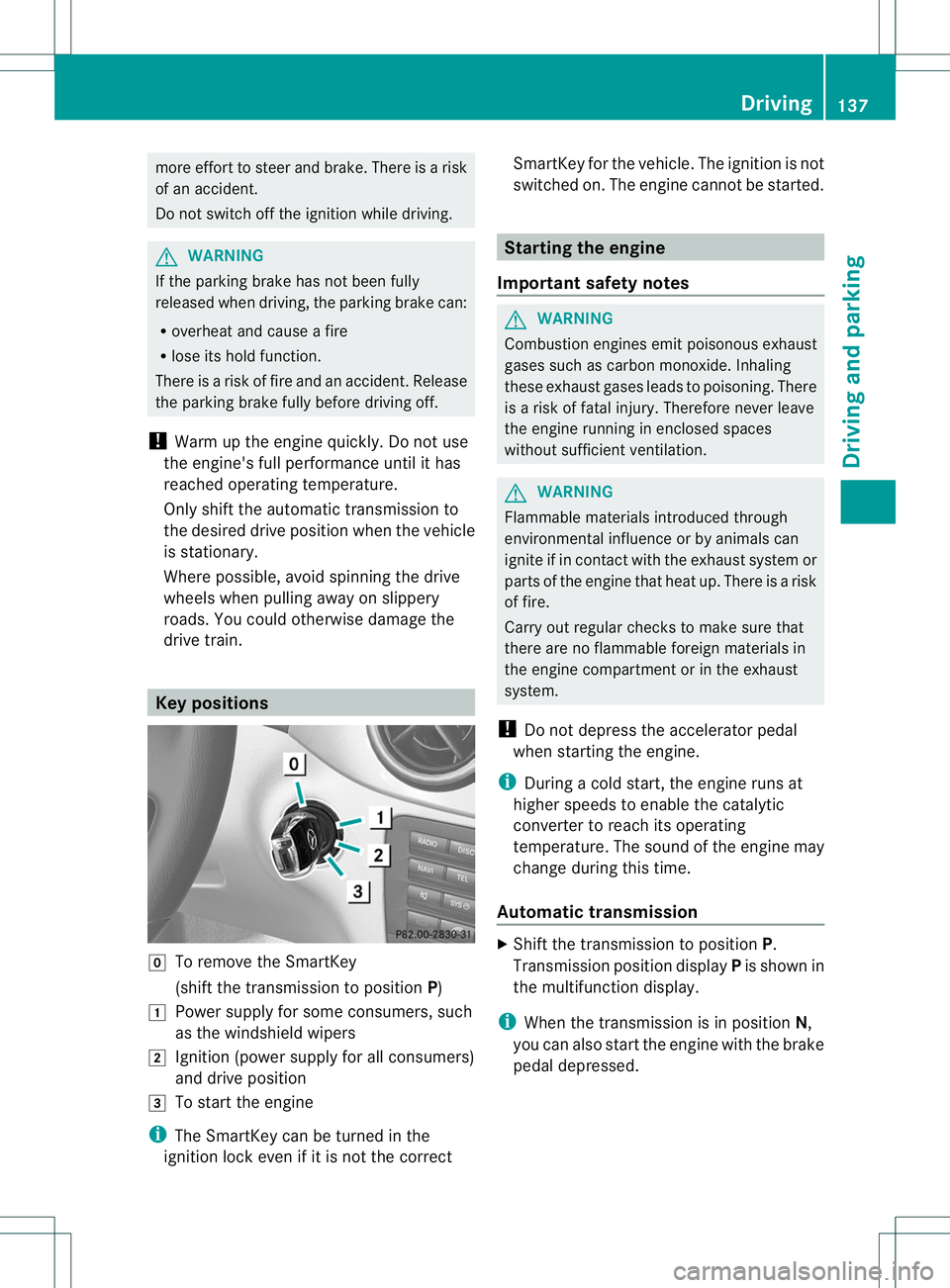
0005
To remove the SmartKey
(shift the transmission to position P)
000C Power supply for some consumers, such
as the windshield wipers
0001 Ignition (power supply for all consumers)
and drive position
0002 To start the engine
i The SmartKey can be turned in the
ignition lock even if it is not the correct SmartKey for the vehicle. The ignition is not
switched on. The engine cannot be started. Starting the engine
Important safety notes G
WARNING
Combustion engines emit poisonous exhaust
gases such as carbon monoxide. Inhaling
these exhaust gases leads to poisoning. There
is ar isk of fatal injury. Therefore never leave
the engine running in enclosed spaces
without sufficient ventilation. G
WARNING
Flammable materials introduced through
environmental influence or by animals can
ignite if in contact with the exhaust system or
parts of the engine that heat up. There is arisk
of fire.
Carry out regular checkstom ake sure that
there are no flammable foreign materials in
the engine compartmentorint he exhaust
system.
! Do not depress the accelerator pedal
when startingt he engine.
i During acold start, the engine runs at
higher speeds to enable the catalytic
converter to reach its operating
temperature. The sound of the engine may
change during this time.
Automatic transmission X
Shift the transmission to position P.
Transmission position display Pis shown in
the multifunction display.
i When the transmission is in position N,
you can also start the engine with the brake
pedal depressed. Driving
137Driving and parking Z
Page 145 of 360
Problem Possible causes/consequences and
000B Solutions
The engine is not
running smoothly and
is misfiring. There is
amalfunction in the engine electronics or in amechanical
componentoft he engine management system.
X Only depress the accelerator pedal slightly.
X Have the cause rectified immediately at aqualified specialist
workshop.
Otherwise, non-combusted fuel may get into the catalytic
converter and damage it. The coolant
temperature display is
showing more than
248
‡(120 †). The
coolant warning lamp
may also be lit and a
warning tone may
sound. The coolant level is too low. The coolant is too hot and the engine
is no longer being cooled sufficiently.
X
Stop as soon as possible and allow the engine and the coolant
to cool down.
X Check the coolant level (Y page 283). Observe the warning
notes as you do so and add coolant if necessary. Automatic transmission
Important safety notes
G
WARNING
If the engine speed is above the idling speed
and you engage transmission position Dor
R,t he vehicle could pull away suddenly. There
is ar isk of an accident.
When engaging transmission position Dor R,
always firmly depress the brake pedal and do
not simultaneously accelerate. G
WARNING
The automatic transmission switches to
neutral position Nwhen you switch off the
engine. The vehicle may roll away.T here is a
risk of an accident.
After switching off the engine, always switch
to parking position P.Prevent the parked
vehicle from rolling away by applying the
parking brake. DIRECTS
ELECT lever
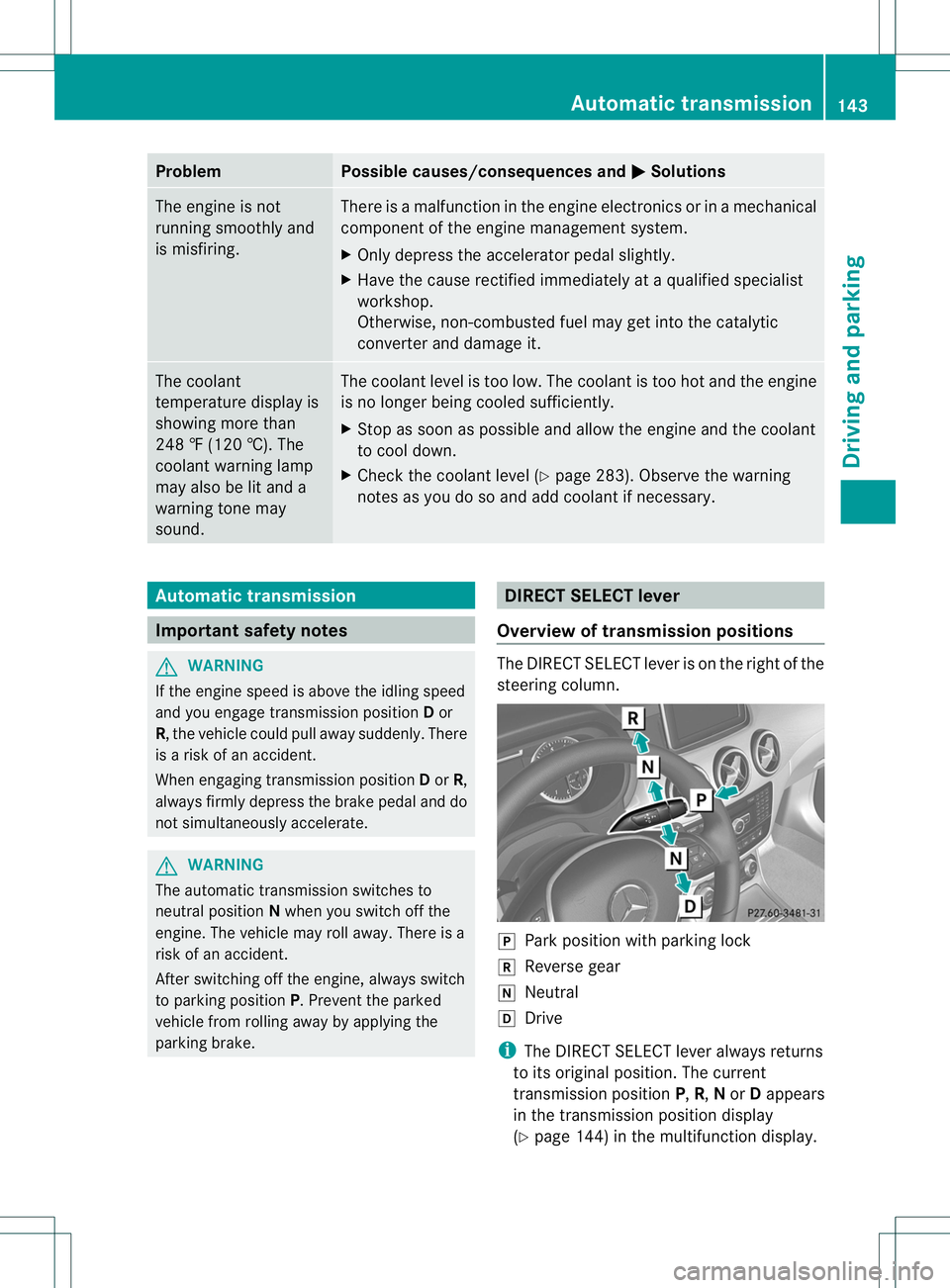
Overview of transmission positions The DIRECT SELECT leve
risonthe right of the
steering column. 0006
Park position with parking lock
0019 Reverse gear
0018 Neutral
000A Drive
i The DIRECT SELECT lever always returns
to its original position. The current
transmission position P,R, Nor Dappears
in the transmission position display
(Y page 144) in the multifunction display. Automatic transmission
143Driving and parking Z
Page 147 of 360
Remaining in neutral N
If the automatic transmissio
nistor emain in
neutral N,e.g. for washing the vehicle in car
washe swithat owing device ,please observe
the followin ginstructions: G
WARNING
If children are left unsupervised in the vehicle,
the ycould:
R open the doors ,thus endangerin gother
people or road users.
R get out and disrupt traffic.
R operat ethe vehicle's equipment.
Additionally, children could set the vehicle in
motion if, for example, they:
R release the parking brake.
R shifting the automatic transmission out of
park position P
R Start the engine.
There is arisk of an accident and injury.
When leavin gthe vehicle, always tak ethe
SmartKey with you and lock the vehicle. Never
leave children or animals unattended in the
vehicle. Always keep the SmartKey out of
reac hofc hildren.
R Make sure that the ignition is switched on.
R When the vehicle is stationary, depres sthe
brak epedal and keep it depressed.
R Shif tton eutral N.
R Release the brak epedal.
R If the electric parking brak eisengaged,
release it.
R Switch off the ignition and leave the
SmartKey in the ignition lock.
Engaging drive position D X
When the vehicle is stationary, depres sthe
brak epedal.
X Push the DIRECT SELECT lever down past
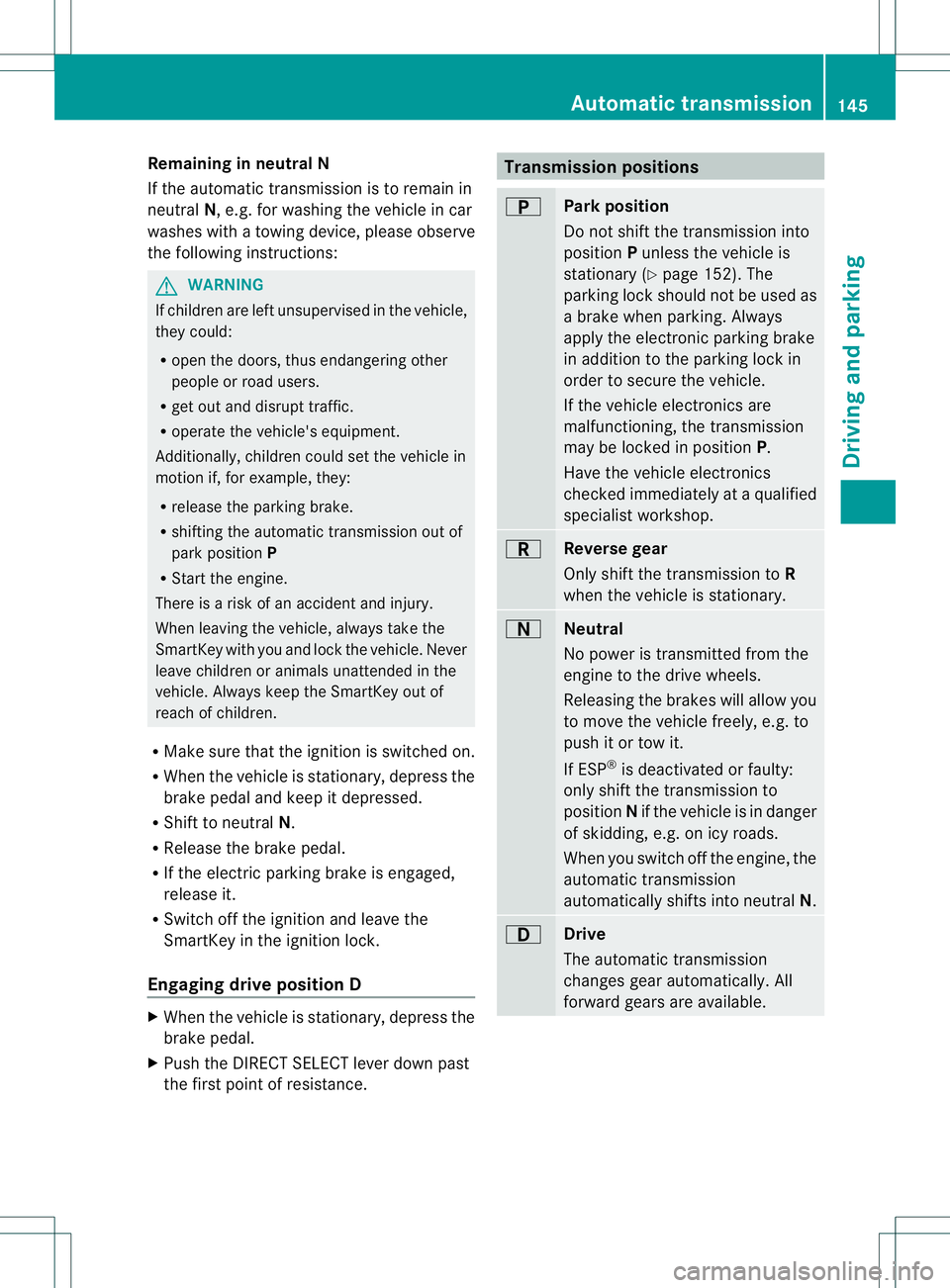
the firs tpoint of resistance. Transmission positions
0007
Par
kposition
Do not shif tthe transmission into
position Punles sthe vehicle is
stationar y(Ypage 152). The
parking lock should not be used as
ab rak ew hen parking .Always
apply the electronic parking brake
in additio ntothe parking lock in
order to secure the vehicle.
If the vehicle electronics are
malfunctioning, the transmission
may be locked in position P.
Have the vehicle electronics
checked immediately at aqualified
specialist workshop. 0006
Reverse gear
Only shift the transmission to
R
when the vehicle is stationary. 000D
Neutral
No power is transmitted from the
engine to the drive wheels.
Releasing the brakes will allow you
to move the vehicle freely, e.g. to
push it or tow it.
If ESP
®
is deactivated or faulty:
only shift the transmission to
position Nif the vehicle is in danger
of skidding, e.g. on icy roads.
When you switch off the engine, the
automatic transmission
automatically shifts into neutral N. 0009
Drive
The automatic transmission
changes gear automatically. All
forward gears are available. Automatic transmission
145Driving and parking Z
Page 152 of 360
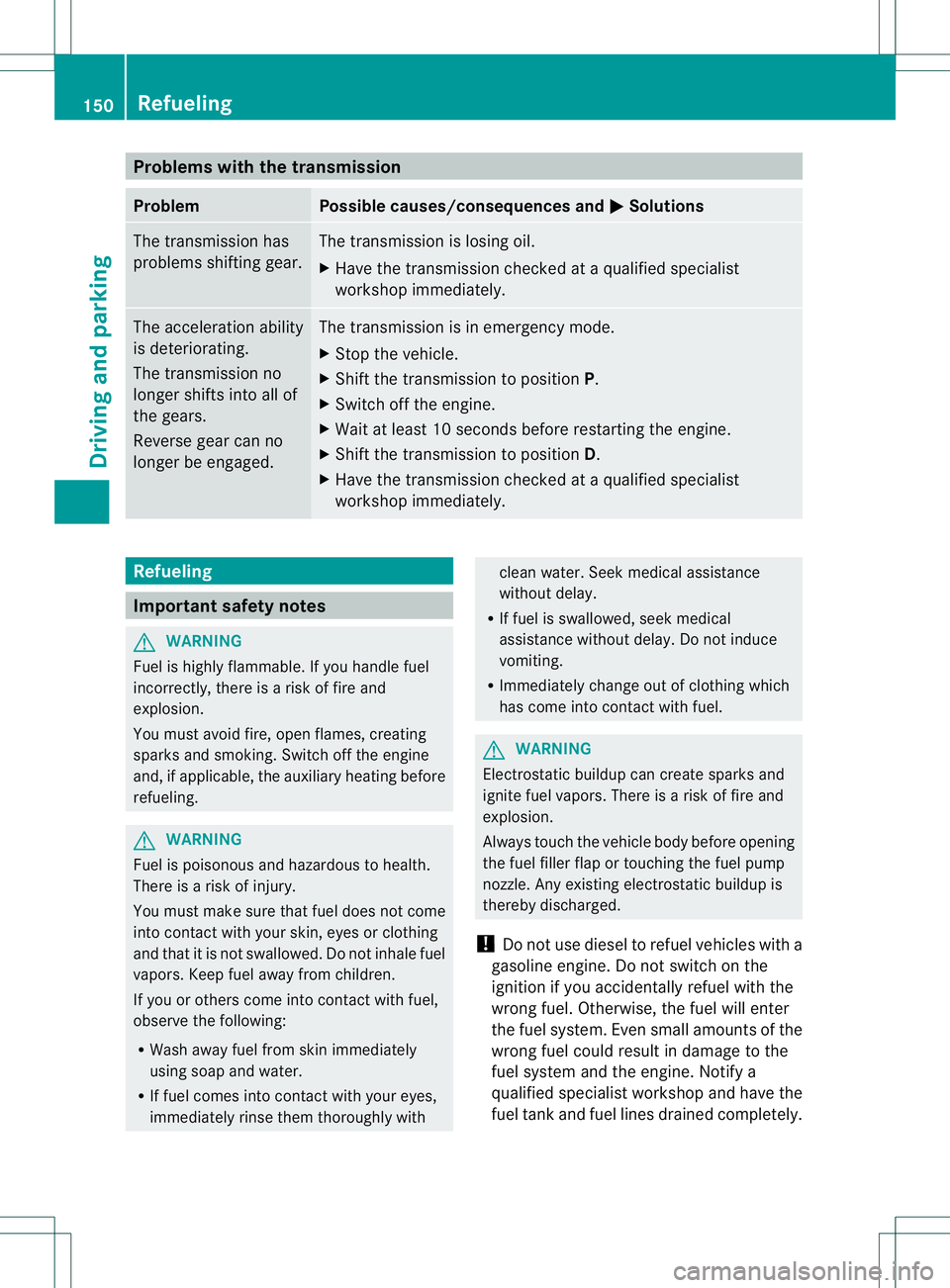
Problems with the transmission
Problem Possible causes/consequences and
000B Solutions
The transmission has
problems shifting gear. The transmission is losing oil.
X
Have the transmission checked at aqualified specialist
workshop immediately. The acceleration ability
is deteriorating.
The transmission no
longer shifts into all of
the gears.
Reverse gear can no
longer be engaged. The transmission is in emergency mode.
X
Stop the vehicle.
X Shift the transmission to position P.
X Switch off the engine.
X Wait at least 10 seconds before restarting the engine.
X Shift the transmission to position D.
X Have the transmission checked at aqualified specialist
workshop immediately. Refueling
Important safety notes
G
WARNING
Fuel is highly flammable. If you handle fuel
incorrectly, there is arisk of fire and
explosion.
You must avoid fire, open flames, creating
sparks and smoking. Switch off the engine
and, if applicable, the auxiliary heating before
refueling. G
WARNING
Fuel is poisonous and hazardous to health.
There is arisk of injury.
You must make sure that fuel does not come
into contact with your skin, eyes or clothing
and that it is not swallowed. Do not inhale fuel
vapors. Keep fuel away from children.
If you or others come into contact with fuel,
observe the following:
R Wash away fuel from skin immediately
using soap and water.
R If fuel comes into contact with your eyes,
immediately rinse them thoroughly with clean water. Seek medical assistance
without delay.
R If fuel is swallowed, seek medical
assistance without delay.Don ot induce
vomiting.
R Immediately change out of clothin gwhich
has come into contact with fuel. G
WARNING
Electrostatic buildu pcan create sparks and
ignite fuel vapors. There is arisk of fire and
explosion.
Always touch the vehicle body before opening
the fuel filler flap or touching the fuel pump
nozzle. Any existin gelectrostatic buildu pis
thereby discharged.
! Do not use diesel to refuel vehicles with a
gasoline engine. Do not switch on the
ignition if you accidentally refuel with the
wrong fuel. Otherwise, the fuel will enter
the fuel system. Even small amounts of the
wrong fuel could result in damage to the
fuel system and the engine. Notify a
qualified specialist workshop and have the
fuel tank and fuel lines drained completely. 150
RefuelingDriving and parking
Page 153 of 360
!
Overfilling the fuel tank could damage the
fuel system.
! Take care not to spill any fuel on painted
surfaces. You could otherwise damage the
paintwork.
! Use afilter when refueling from afuel can.
Otherwise, the fuel lines and/or injection
system could be blocked by particles from
the fuel can.
Do not get into the vehicle againd uringthe
refuelin gprocess. Otherwise, electrostatic
charge could build up again.
If you overfill th efuel tank, fuel could spray
out when th efuel pump nozzle is removed.
Fo rfurther information on fuel and fuel quality
(Y page 348). Refueling
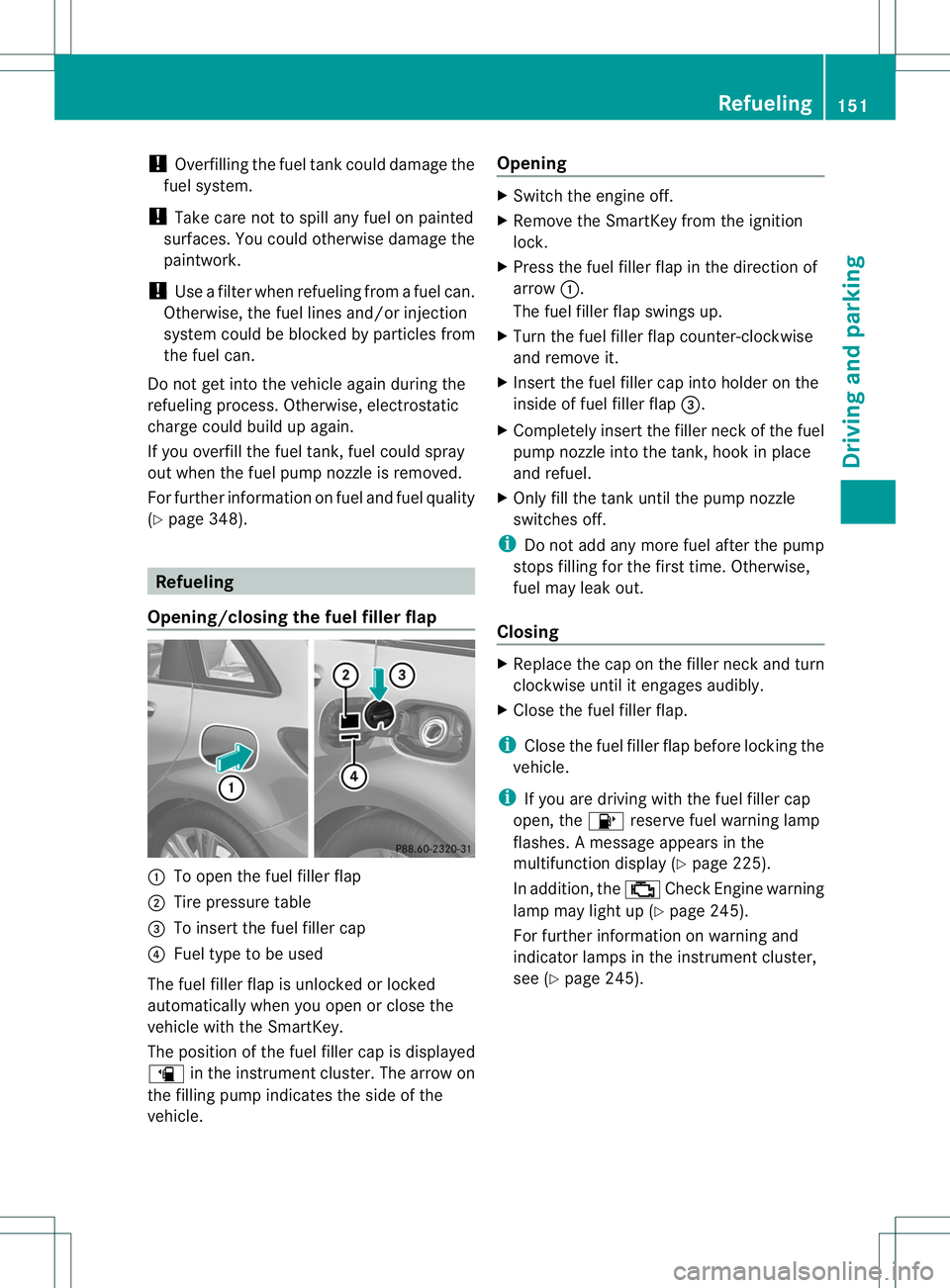
Opening/closing th efuelfiller flap 001A
To open th efuel filler flap
0010 Tirep ressur etable
0023 To insert th efuel filler cap
0021 Fuel typ etobeu sed
The fuel filler flap is unlocked or locked
automatically when you open or close the
vehicl ewitht he SmartKey.
The position of th efuel filler cap is displayed
0007 in theinstrumen tcluster .The arrow on
the filling pump indicates the side of the
vehicle. Opening X
Switch the engine off.
X Remove the SmartKey from the ignition
lock.
X Press the fuel filler flap in the direction of
arrow 001A.
The fuel filler flap swings up.
X Turn the fuel filler flap counter-clockwise
and remove it.
X Insert the fuel filler cap into holder on the
inside of fuel filler flap 0023.
X Completely insert the filler neck of the fuel
pump nozzle into the tank,h ook in place
and refuel.
X Only fill the tank until the pump nozzle
switches off.
i Do not add any more fuel after the pump
stops filling for the first time. Otherwise,
fuel may leak out.
Closing X
Replace the cap on the filler neck and turn
clockwise until it engages audibly.
X Close the fuel filler flap.
i Close the fuel filler flap before locking the
vehicle.
i If you are driving with the fuel filler cap
open, the 0007reserve fuel warning lamp
flashes. Amessage appears in the
multifunction display (Y page 225).
In addition, the 000ACheck Engine warning
lamp may light up (Y page 245).
For further information on warning and
indicator lamps in the instrument cluster,
see (Y page 245). Refueling
151Driving and parking Z
Page 160 of 360
brake pads. This can result in
asignificantly
longer brakin gdistance.
R Brak eoccasionally to remov eany possible
salt residue. Make sure that you do not
endanger other road users when doing so.
R Carefully depress the brake pedal and the
beginning and end of ajourney.
R Maintain agreater distance to the vehicle
ahead.
Servicing the brakes !
If the red brake warning lamp lights up in
the instrument cluster and you hear a
warning ton ewhile the engin eisrunning,
the brake fluid level may be too low.
Observ eadditional warning messages in
the multifunction display.
The brake fluid level may be too low due to
brake pad wear or leaking brake lines.
Have the brake system checked
immediately. This work should be carried
out at aqualified specialist workshop.
! Afunction or performanc etest should
only be carried out on a2-axle
dynamometer. If yo uareplanning to have
the vehicl eteste dons uchad ynamometer,
contact an authorize dMercedes-Benz
Center to obtai nfurthe rinformatio nfirst.
Otherwise, yo ucould damage the drive
trai nort he brake system.
! As the ESP ®
system operates
automatically, the engine and the ignition
must be switched off (the SmartKe ymust
be in position 0or 1in the ignition lock) if:
R the electri cparking brak eistested on a
brake dynamometer (for amaximum of
ten seconds)
R the vehicle is towed with the front axle
raised.
Braking triggered automaticallybyE SP®
may seriouslyd amage the brake system.
All checks and maintenance work on the
brake system must be carried out at a qualified specialist workshop. Consult a
qualified specialist workshop to arrange this.
Have brake pads installed and brake fluid
replaced at
aqualified specialist workshop.
If the brake system has only been subject to
moderate loads, you should test the
functionality of your brakes at regular
intervals.
You can find adescription of Brake Assist
(BAS) on (Y page 64).
Mercedes-Benz recommends that you only
have brake pads/linings installed on your
vehicle which have been approved for
Mercedes-Benz vehicles or which correspond
to an equivalent quality standard. Brake
pads/linings which have not been approved
for Mercedes-Benz vehicles or which are not
of an equivalent quality could affect your
vehicle's operating safety.
Mercedes-Benz recommends that you only
use brake fluid that has been specially
approved for your vehicle by Mercedes-Benz,
or which corresponds to an equivalent quality
standard. Brake fluid which has not been
approved for Mercedes-Benz vehicles or
which is not of an equivalent quality could
affect your vehicle's operating safety.
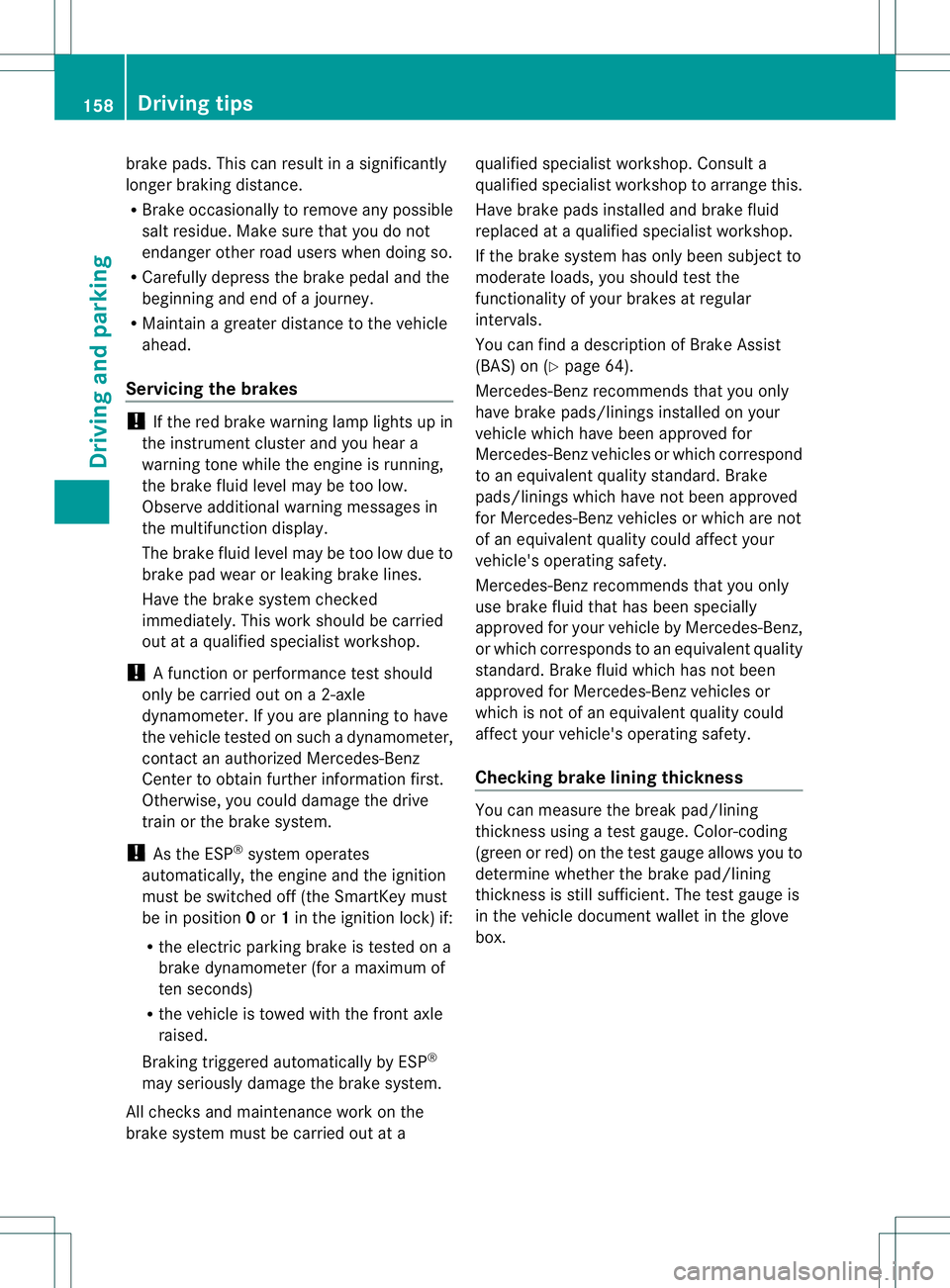
Checking brake liningt hickness You can measure the break pad/lining
thickness using
atest gauge.C olor-coding
(green or red) on the test gauge allows you to
determin ewhether the brake pad/lining
thickness is still sufficient .The test gauge is
in the vehicle document wallet in the glove
box. 158
Driving tipsDriving and parking
Page 161 of 360
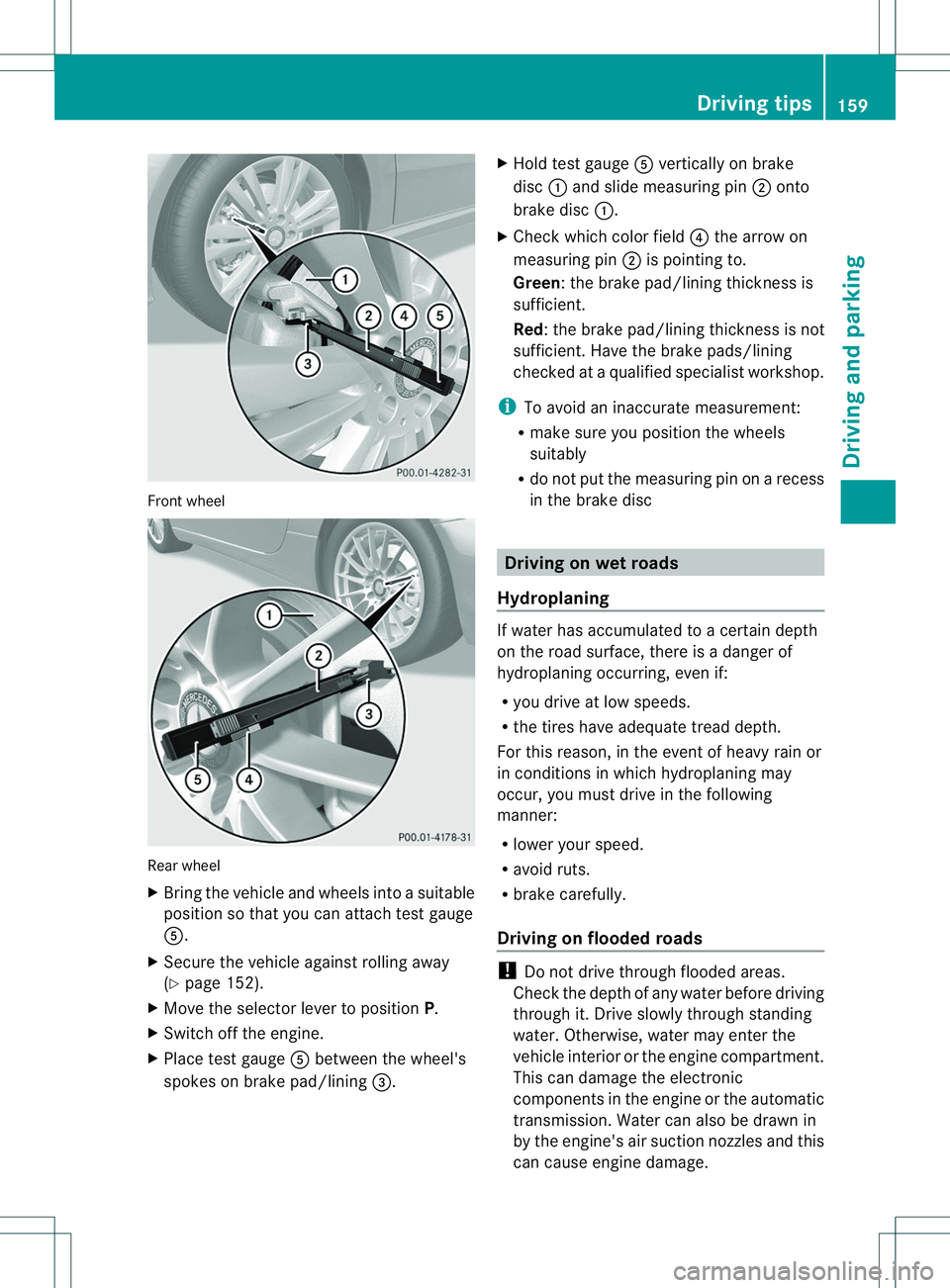
Front wheel
Rear wheel
X
Bring the vehicle and wheels into asuitable
positio nsothat you can attach test gauge
001E.
X Secure the vehicle against rolling away
(Y page 152).
X Move the selector lever to position P.
X Switch off the engine.
X Place test gauge 001Ebetween the wheel's
spokes on brake pad/lining 0023.X
Hold test gauge 001Evertically on brake
disc 001Aand slide measuring pin 0010onto
brake disc 001A.
X Check which color field 0021the arrow on
measuring pin 0010is pointin gto.
Green:t he brake pad/lining thickness is
sufficient.
Red:t he brake pad/lining thickness is not
sufficient. Have the brake pads/lining
checked at aqualified specialist workshop.
i To avoid an inaccurate measurement:
R make sure you position the wheels
suitably
R do not put the measuring pin on arecess
in the brake disc Driving on wet roads
Hydroplaning If water has accumulated to
acertain depth
on the road surface, there is adanger of
hydroplaning occurring, even if:
R you drive at low speeds.
R the tires have adequate tread depth.
For this reason, in the event of heavy rain or
in conditionsinw hich hydroplaning may
occur, you must drive in the following
manner:
R lower your speed.
R avoid ruts.
R brake carefully.
Driving on flooded roads !
Do not drive through flooded areas.
Check the depth of any water before driving
through it. Drive slowly through standing
water. Otherwise, water may enter the
vehicle interior or the engine compartment.
This can damage the electronic
components in the engine or the automatic
transmission. Water can also be drawn in
by the engine's air suction nozzles and this
can cause engine damage. Driving tips
159Driving and parking Z
Page 192 of 360
Useful information
i This Operator's Manual describes all
models and all standard and optional
equipment of your vehicle available at the
time of publication of the Operator's
Manual. Country-specific differences are
possible. Please not ethat your vehicle may
not be equipped with all features
described. This also applies to safety-
related system sand functions.
i Read the information on qualified
specialist workshops: (Y page 25).Important safet
ynotes G
WARNING
If you operate information system sand
communication equipment integrated in the
vehicle while driving, you will be distracted
from traffic conditions. You could also lose
contro lofthe vehicle. There is arisk of an
accident.
Only operate the equipment when the traffic
situatio npermits .Ifyou are not sure that this
is possible, park the vehicle paying attention
to traffic conditions and operate the
equipment when the vehicle is stationary. G
WARNING
If the instrument cluster has failed or
malfunctioned, you may not recognize
function restrictions in systems relevant to
safety. The operating safety of your vehicle
may be impaired. There is arisk of an
accident.
Drive on carefully. Have the vehicle checked
at aq ualified specialist workshop
immediately.
You must observe the legal requirements for
the country in which you are currently driving
when operating the on-board computer.
The on-board computer only shows messages
or warnings from certain systems in the multifunction display
.You should therefore
make sure your vehicle is operating safely at
all times. Otherwise, avehicle that is not
operating safely may cause an accident.
For an overview, see the instrument panel
illustration (Y page 31). Displays and operation
Instrument cluster lighting
The lighting in the instrument cluster, in the
display sand the controls in the vehicle
interior can be adjusted using the brightness
control knob.
The brightness control knob is located on the
bottom left of the instrument cluster
(Y page 31).
X Turn the brightness control knob clockwise
or counter-clockwise.
If the light switch is set to 000C,000For
0005,t he brightness is dependent upon
the brightness of the ambient light.
i The light sensor in the instrument cluster
automatically controls the brightness of
the multifunction display.
In daylight, the display sinthe instrument
cluster are not illuminated. Coolant temperature display
G
WARNING
Opening the hood when the engine is
overheated or when there is afire in the
engine compartment could expose you to hot
gases or other service products. There is a
risk of injury.
Let an overheated engine cool down before
opening the hood. If there is afire in the
engine compartment, keep the hood closed
and contact the fire department.
! Adisplay message is shown if the coolant
temperature is too high. 190
Display
sand operationOn-board computer and displays