emergency towing MERCEDES-BENZ B-CLASS SPORTS 2015 Owners Manual
[x] Cancel search | Manufacturer: MERCEDES-BENZ, Model Year: 2015, Model line: B-CLASS SPORTS, Model: MERCEDES-BENZ B-CLASS SPORTS 2015Pages: 346, PDF Size: 45.04 MB
Page 19 of 346
Checking ........................................ 303
Curb weight (definition)................. 321
Definition of terms ......................... 319
Direction of rotation ...................... 322
Display message ............................ 229
Distribution of the vehicle occu-
pants (definition) ............................ 322
DOT (Department of Transporta-
tion) (definition) ............................. 320
DOT, Tire Identification Number
(TIN) ............................................... 319
GAWR (Gross Axle Weight Rating)
(definition) ..................................... 320
General notes ................................ 326
GVW (Gross Vehicle Weight) (def-
inition) ........................................... 320
GVWR (Gross Vehicle Weight Rat-
ing) (definition) .............................. 320
Important safety notes .................. 302
Increased vehicle weight due to
optional equipment (definition) ...... 320
Information on driving .................... 302
Kilopascal (kPa) (definition) ........... 320
Labeling (overview) ........................ 316
Load bearing index (definition) ...... 321
Load index ..................................... 318
Load index (definition) ................... 320
M+S tire s....................................... 304
Maximum load on a tire (defini-
tion) ............................................... 321
Maximum loaded vehicle weight
(definition) ..................................... 320
Maximum permissible tire pres-
sure (definition) ............................. 321
Maximum tire load ......................... 318
Maximum tire load (definition) ....... 321
MOExtended tire s.......................... 304
Optional equipment weight (defi-
nition) ............................................ 321
PSI (pounds per square inch) (def-
inition) ........................................... 321
Replacing ....................................... 322
Service life ..................................... 304
Sidewall (definition) ....................... 321
Speed rating (definition) ................ 320
Storing ........................................... 322
Structure and characteristics
(definition) ..................................... 319 Summer tire
s................................. 304
Temperature .................................. 315
TIN (Tire Identification Number)
(definition) ..................................... 321
Tire bead (definition) ...................... 321
Tire pressure (definition) ................ 321
Tire pressures (recommended) ...... 320
Tire size (data) ............................... 326
Tire size designation, load-bearing capacity, speed rating .................... 316
Tire tread ....................................... 303
Tire tread (definition) ..................... 321
Total load limit (definition) ............. 322
Traction ......................................... 315
Traction (definition) ....................... 321
Tread wear ..................................... 315
Uniform Tire Quality Grading
Standards ...................................... 314
Uniform Tire Quality Grading
Standards (definition) .................... 320
Wear indicator (definition) ............. 321
Wheel and tire combination ........... 328
Wheel rim (definition) .................... 320
see Flat tire
Top Tether ............................................ 57
Tow-starting
Emergency engine starting ............ 298
Important safety notes .................. 295
Installing the towing eye ................ 296
Removing the towing eye ............... 297
Towing a trailer
ESP ®
(Electronic Stability Pro-
gram) ............................................... 66
Towing away
Important safety guidelines ........... 295
Installing the towing eye ................ 296
Notes for 4MATIC vehicles ............ 298
Removing the towing eye ............... 297
Transporting the vehicl e................ 298
With both axles on the ground ....... 297
With front axle raised ..................... 297
Towing eye ......................................... 284
Transmission
see Automatic transmission
Transmission position display
(DIRECT SELECT lever) ...................... 143
Transporting the vehicle .................. 298
Index17
Page 286 of 346
Useful information
iThis Operator's Manual describes all
models and all standard and optional equip- ment of your vehicle available at the time of
publication of the Operator's Manual.
Country-specific differences are possible.
Please note that your vehicle may not be
equipped with all features described. This
also applies to safety-related systems and
functions.
iRead the information on qualified special-
ist workshops ( Ypage 24).
Where will I find...?
Vehicle tool kit
General notes
Vehicles with a TIREFIT kit: the TIREFIT kit is
located in the stowage well under the cargo
compartment floor.
Vehicles with a tire-change tool kit: the tire-
change tool kit is in the stowage well under
the cargo compartment floor.
For vehicles with an emergency spare wheel, see "Removing the emergency spare wheel" ( Y page 330).
iApart from certain country-specific varia-
tions, the vehicles are not equipped with a
tire-change tool kit. Some tools for chang-
ing a wheel are specific to the vehicle. For
more information on which tire changing
tools are required and approved to perform
a wheel change on your vehicle, consult a
qualified specialist workshop.
Tools required for changing a wheel may
include, for example:
R Jack
R Wheel chock
R Lug wrench
R Alignment bolt
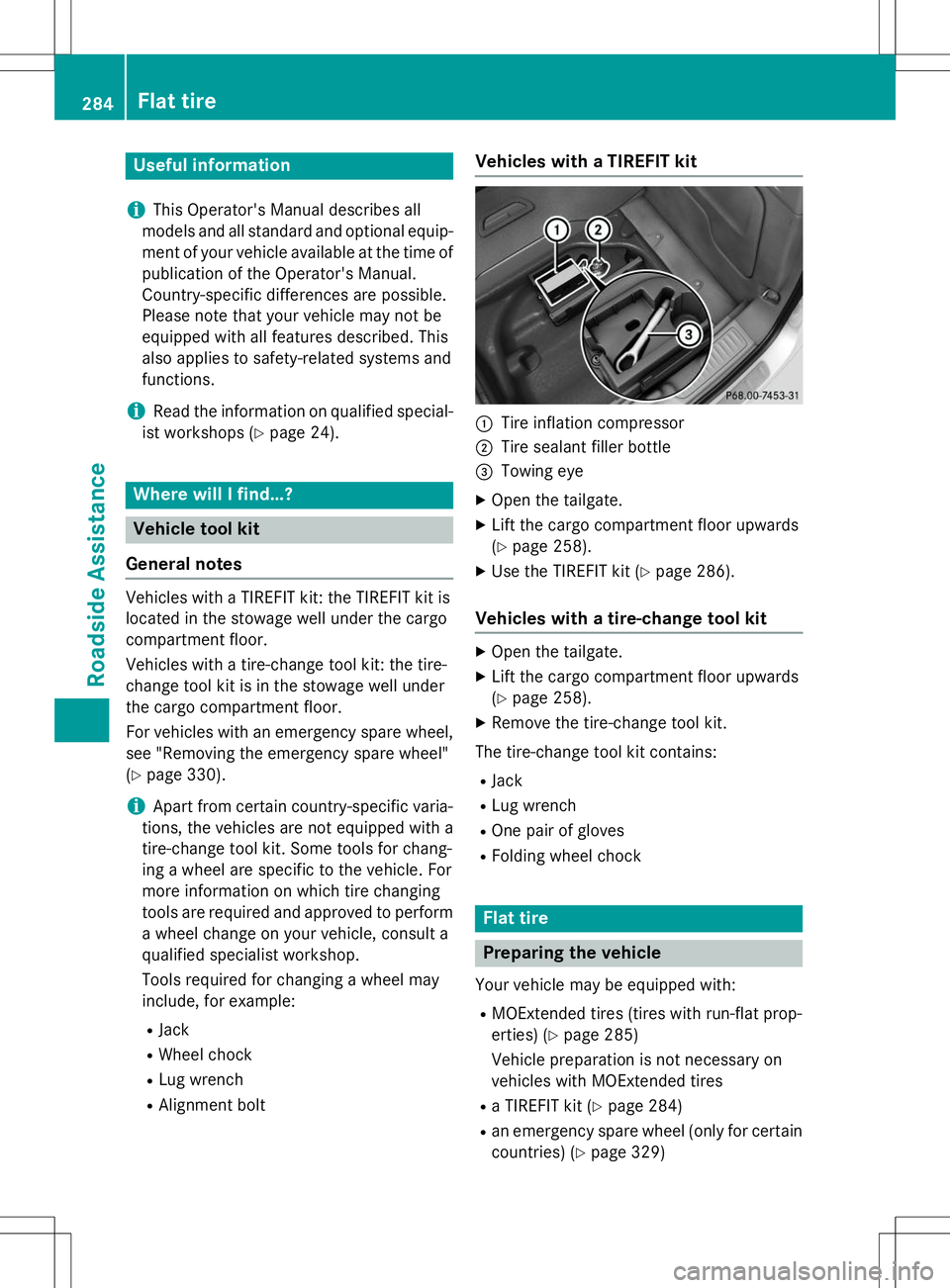
Vehicles with a TIREFIT kit
:Tire inflation compressor
;Tire sealant filler bottle
=Towing eye
X Open the tailgate.
X Lift the cargo compartment floor upwards (Y page 258).
X Use the TIREFIT kit ( Ypage 286).
Vehicles with a tire-change tool kit
X
Open the tailgate.
X Lift the cargo compartment floor upwards (Y page 258).
X Remove the tire-change tool kit.
The tire-change tool kit contains: R Jack
R Lug wrench
R One pair of gloves
R Folding wheel chock
Flat tire
Preparing the vehicle
Your vehicle may be equipped with:
R MOExtended tires (tires with run-flat prop-
erties) ( Ypage 285)
Vehicle preparation is not necessary on
vehicles with MOExtended tires
R a TIREFIT kit ( Ypage 284)
R an emergency spare wheel (only for certain
countries) ( Ypage 329)
284Flat tire
Roadside Assistance
Page 300 of 346
XDepress and hold the brake pedal.
X Shift the automatic transmission to posi-
tion N.
X Leave the SmartKey in position 2in the
ignition lock.
X Release the brake pedal.
X Release the electric parking brake.
X Switch on the hazard warning lamps(Y page 107).
iIn order to signal a change of direction
when towing the vehicle with the hazard
warning lamps switched on, use the com-
bination switch as usual. In this case, only
the indicator lamps for the direction of
travel flash. After resetting the combina-
tion switch, the hazard warning lamp starts
flashing again.
Transporting the vehicle
!
You may only secure the vehicle by the
wheels, not by parts of the vehicle such as
axle or steering components. Otherwise,
the vehicle could be damaged.
X Turn the SmartKey to position 2in the igni-
tion lock ( Ypage 135).
X Shift the transmission to position N.
As soon as the vehicle has been loaded: X Prevent the vehicle from rolling away by
applying the electric parking brake.
X Shift the transmission to position P.
X Turn the SmartKey to position 0in the igni-
tion lock and remove it.
X Secure the vehicle.
The towing eye can be used to pull the vehicle
onto a trailer or transporter for transporting
purposes.
Notes on 4MATIC vehicles
!
Vehicles with 4MATIC must not be towed
with either the front or the rear axle raised,
as doing so will damage the transmission.
Vehicles with 4MATIC may only either be
towed away with both axles on the ground or be loaded up and transported.
If the vehicle's transmission, front, or rear
axle is damaged, have the vehicle transported on a truck or trailer.
In the event of damage to the electrical
system:
If the battery is defective, the automatic
transmission will be locked in position P. To
shift the automatic transmission to positionN , you must provide power to the vehicle's
electrical system in the same way as when
jump-starting ( Ypage 293).
Have the vehicle transported on a transporter
or trailer.
Tow-starting (emergency engine
starting)
!
Vehicles with automatic transmission
must not be tow-started. You could other-
wise damage the automatic transmission.
iYou can find information on "Jump-start-
ing" under ( Ypage 293).
Fuses
Important safety notes
GWARNING
If you manipulate or bridge a faulty fuse or if
you replace it with a fuse with a higher amper-
age, the electric cables could be overloaded.
This could result in a fire. There is a risk of an
accident and injury.
Always replace faulty fuses with the specified
new fuses having the correct amperage.
298Fuses
Roadside Assistance