light MERCEDES-BENZ C-CLASS 1999 User Guide
[x] Cancel search | Manufacturer: MERCEDES-BENZ, Model Year: 1999, Model line: C-CLASS, Model: MERCEDES-BENZ C-CLASS 1999Pages: 122, PDF Size: 1.66 MB
Page 51 of 122
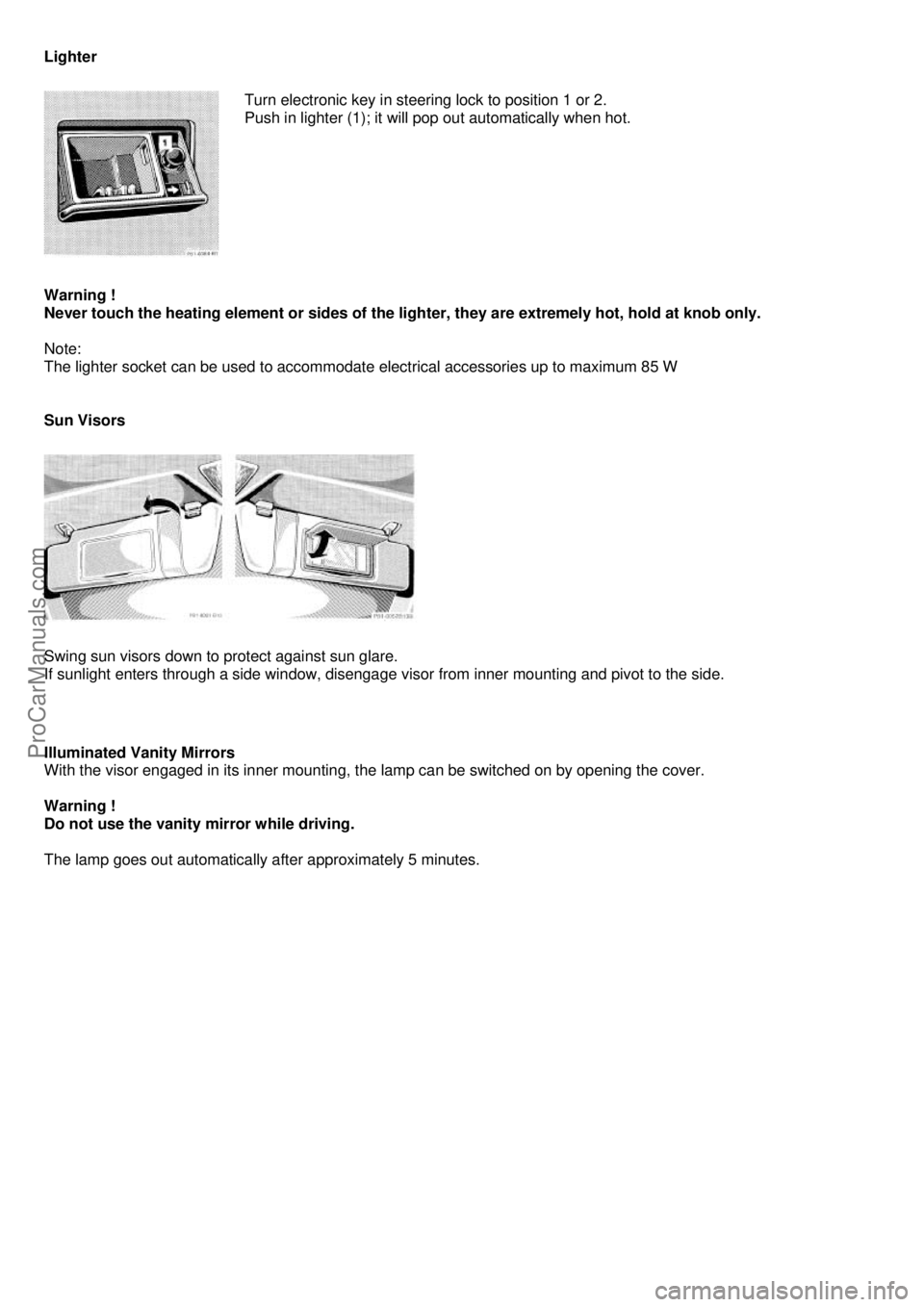
Lighter
Turn electronic key in steering lock to position 1 or 2.
Push in lighter (1); it will pop out automatically when hot.
Warning !
Never touch the heating element or sides of the lighter, they are extremely hot, hold at knob only.
Note:
The lighter socket can be used to accommodate electrical accessories up to maximum 85 W
Sun Visors
Swing sun visors down to protect against sun glare.
If sunlight enters through a side window, disengage visor from inner mounting and pivot to the side.
Illuminated Vanity Mirrors
With the visor engaged in its inner mounting, the lamp can be switched on by opening the cover.
Warning !
Do not use the vanity mirror while driving.
The lamp goes out automatically after approximately 5 minutes.
ProCarManuals.com
Page 52 of 122

Interior Lighting
1. Door contact switch:
Press once and interior lamps are switched on when opening a door. Interior lamps are switched on,
and off (soft fade) delayed, when unlocking or locking the vehicle, or when opening or closing a door.
However, there will be no (soft fade) delay when the electronic key is in steering lock position 2
Press again and interior lamps remain switc hed off, even when centrally unlocking or opening a door.
2. Press to switch interior and reading lamps on or off.
3. Press to switch rear passenger compartment lamp on or off.
4. Press to switch reading lamp on or off.
ProCarManuals.com
Page 53 of 122
Storage Compartments and Cupholder
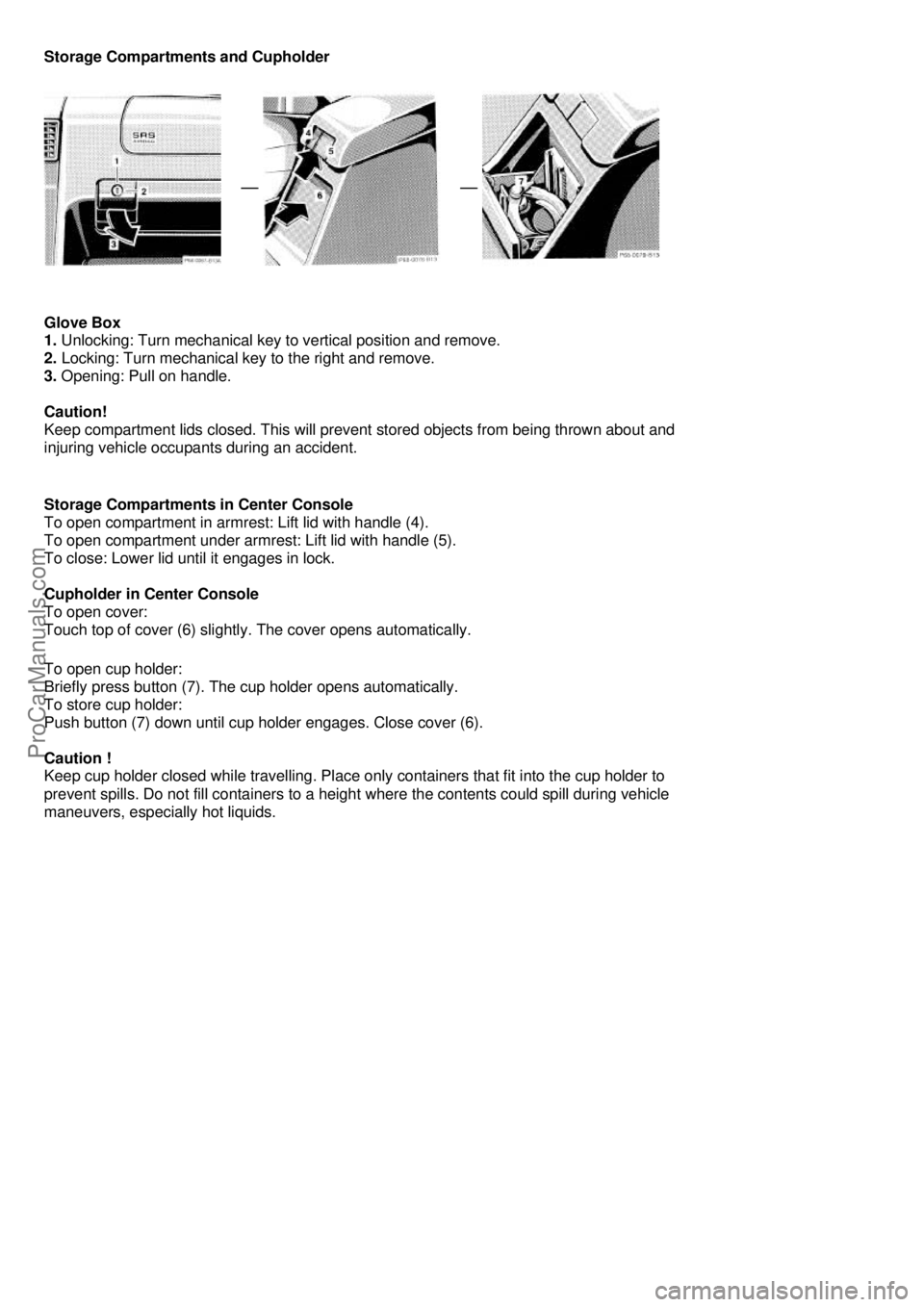
Glove Box
1. Unlocking: Turn mechanical key to vertical position and remove.
2. Locking: Turn mechanical key to the right and remove.
3. Opening: Pull on handle.
Caution!
Keep compartment lids closed. This will prevent stored objects from being thrown about and
injuring vehicle occupants during an accident.
Storage Compartments in Center Console
To open compartment in armrest: Lift lid with handle (4).
To open compartment under armrest: Lift lid with handle (5).
To close: Lower lid until it engages in lock.
Cupholder in Center Console
To open cover:
Touch top of cover (6) slightly. The cover opens automatically.
To open cup holder:
Briefly press button (7). The cup holder opens automatically.
To store cup holder:
Push button (7) down until cup holder engages. Close cover (6).
Caution !
Keep cup holder closed while travelling. Place only containers that fit into the cup holder to
prevent spills. Do not fill contai ners to a height where the conten ts could spill during vehicle
maneuvers, especially hot liquids.
ProCarManuals.com
Page 55 of 122
Power Windows
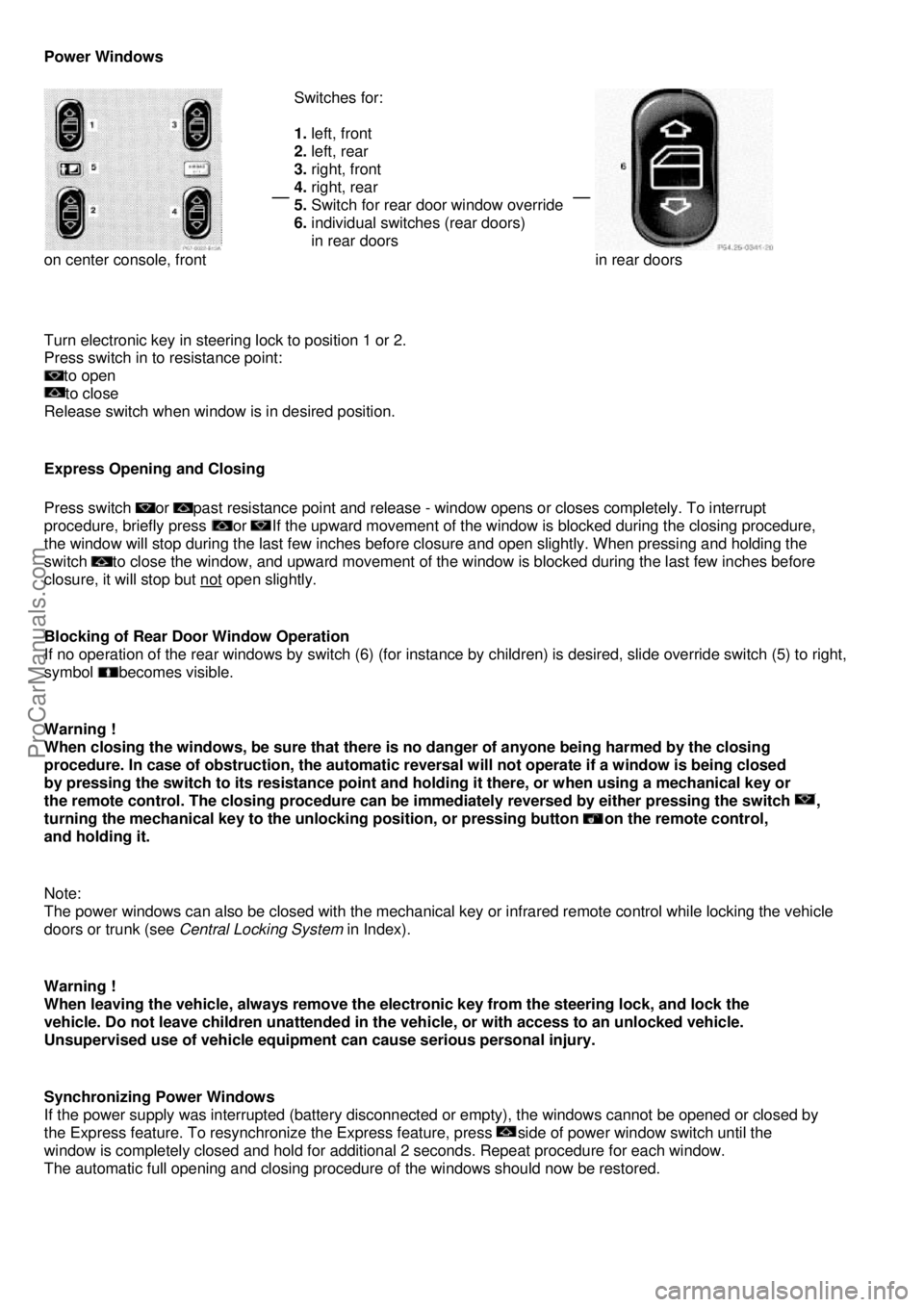
on center console, front
Switches for:
1.
left, front
2. left, rear
3. right, front
4. right, rear
5. Switch for rear door window override
6. individual switches (rear doors)
in rear doors
in rear doors
Turn electronic key in steering lock to position 1 or 2.
Press switch in to resistance point:
to open
to close
Release switch when window is in desired position.
Express Opening and Closing
Press switch or past resistance point and release - window opens or closes completely. To interrupt
procedure, briefly press
or If the upward movement of the window is blocked during the closing procedure,
the window will stop during the last few inches before closure and open slightly. When pressing and holding the
switch
to close the window, and upward movement of the wi ndow is blocked during the last few inches before
closure, it will stop but not
open slightly.
Blocking of Rear Door Window Operation
If no operation of the rear windows by switch (6) (for instance by children) is desired, slide override switch (5) to right,
symbol
becomes visible.
Warning !
When closing the windows, be sure that there is no danger of anyone being harmed by the closing
procedure. In case of obstruction, the automatic rever sal will not operate if a window is being closed
by pressing the switch to its resistance point and holdi ng it there, or when using a mechanical key or
the remote control. The closing procedure can be immediately reversed by either pressing the switch
,
turning the mechanical key to the unlocking position, or pressing button
on the remote control,
and holding it.
Note:
The power windows can also be closed with the mechanical ke y or infrared remote control while locking the vehicle
doors or trunk (see Central Locking System in Index).
Warning !
When leaving the vehicle, always remove the el ectronic key from the steering lock, and lock the
vehicle. Do not leave children unattended in the vehicle, or with access to an unlocked vehicle.
Unsupervised use of vehicle equipment can cause serious personal injury.
Synchronizing Power Windows
If the power supply was interrupted (battery disconnected or empty), the wi ndows cannot be opened or closed by
the Express feature. To resynchronize the Ex press feature, press
side of power window switch until the
window is completely closed and hold for additional 2 seconds. Repeat procedure for each window.
The automatic full opening and closing procedure of the windows should now be restored.
ProCarManuals.com
Page 56 of 122

Instrument Lamps
Press + or - button to vary intensity of instrument lamps.
Display illumination
The display for temperature, odometer, oil level indicator, FSS indicator and clock is illuminated briefly when
opening the driver door. The display illumination brightness responds automatically according to changes in the
surrounding light sensitivity. To briefly illuminate the display (with electronic key
removed or in steering lock position 0 or 1), press button O, +,- , h or m.
Trip Odometer
• To reset:
• Press button O once and hold (with display illuminated).
• Press button O twice and hold (with display not illuminated).
Clock
Adjusting clock (display illuminated): Press button m or h briefly. The disp lay flashes to indicate that the clock
can be adjusted.
Minute: Press button m briefly.
Minutes: Press and hold button m.
Hour: Press button h briefly.
Hours: Press and hold button h .
ProCarManuals.com
Page 58 of 122

Garage Door Opener
1. Remote control transmitter located on driver side sun visor
2. Portable remote control transmitter
Warning !
When programming a garage door opener, the door moves up or down. When programming or operating
the remote control make sure there is no possib ility of anyone being harmed by the moving door.
The visor remote control is capable of operati ng up to three separately controlled objects.
Notes:
Certain types of garage door openers are incompatible wi th the integrated opener. If you should experience
difficulties
with programming the transmitter, contact your authoriz ed Mercedes-Benz dealer or call Mercedes-Benz Customer
Assistance Center (in the U.S.A. only) at 1-800-FOR- MERCedes. For operation in the USA only: This devise
complies
with Part 15 of the FCC Rules. Operation is subject to the following two conditions:
(1) This device may not cause harmful interference, and (2) this device must accept any interference received,
including interference that may cause undesired operation. Any unauthorized modification to this device could void
the user's
authority to operate the equipment.
Programming or reprogramming the remote control:
1. Turn electronic key in steering lock to position 1 or 2.
2. Press and hold one button of the remote control located on the sun visor until its control light begins to flash at a
rate of about once a second. Continue holding down the button.
Note:
The light blinks immediately if the remote control is being programmed for the first time, or if its memory was
previously erased. If you are re programming a previously used button, the light will flash afte r about 20 seconds.
3. Hold end opposite to battery of portable remote contro l against the sun visor transmitter to be programmed. While
still holding down the button on the transmitter on the sun visor, press down the button on your portable remote
control, until the sun visor remote control light starts to flash rapidly. This means that the integrated remote control
has accepted the frequency and code of the portable transmitter.
4. If you wish, repeat the procedure for each remaining button.
Operation of remote control:
1. Turn electronic key in steering lock to position 1 or 2.
2. Select and press the appropriate button (1, 2 or 3) to ac tivate the remote controlled device. The remote control
transmitter continues to send the signal as long as the button is pressed - up to 20 seconds.
Erasing the remote control memory:
1. Turn electronic key in steering lock to position 1 or 2.
2. Simultaneously holding down buttons 1 and 3 for approximatel y 20 seconds, or until the control light blinks rapidly,
will erase the code s of all three channels.
ProCarManuals.com
Page 64 of 122

Important !
Coasting the vehicle, or driving for any other reason with selector lever in "N" can result in transmission damage
that is not covered by the Mercedes-Benz Limited Warranty.
D - The transmission automatically upshifts through 5th gear . Position "D" provides optimum driving characteristics
under all normal operating conditions.
4 - Upshift through 4th gear only.
Suitable for performance driving. To shift from position "D" to "4", push selector lever to the left.
3 - Upshift through 3rd gear only.
Suitable for moderately steep hill s. Since the transmission does not shift hi gher than 3rd gear, this gear selection
will allow use of the engine's braking power downhill.
2 - Upshift through 2nd gear only.
For driving in mountainous regions or under extreme operating conditions. This gear selection will allow use of the
engine's braking power when descending steep grades.
1 - In this position, the engine's
braking effect is utilized by shifting into 1 st gea r. Use this position while descending very steep or lengthy
downgrades and only at speeds below 40 mph (60 km/h).
Important !
With selector lever in position "D", "4" or "3", upshifting from 1st to 2nd to 3rd gear is delayed depending on vehicle
speed and engine temperature. This allows the catalytic converter to heat up more quickly to operating temperatures.
During the brief warm-up period this delayed upshift and increased engine noise might be perceived as a malfunction.
However, neither the engine nor transmission are negatively affected by this mode of operation.
The delayed upshift is effective with vehicle speeds below 31 mph (50 km/h) at partial throttle and engine
temperatures below 95°F (35°C). To avoid overrevving the engi ne when the selector lever is moved to a lower driving
range, the transmission will not shift to a lower gear as l ong as the vehicle speed exceeds the speed limit of that gear.
To prevent the engine from laboring at low RPMs, do not allow the engine speed to drop too low on uphill gradients.
Depending on the degree of the incline, shift selector feve r to a lower gear range early enough to maintain engine
RPM within the best torque range.
Warning!
On slippery road surfaces, never downshift in order to obtain braking action. This could result in rear wheel
slip and reduced vehicle control. Your vehicle's AB S will not prevent this type of loss of control.
Maneuvering
To maneuver in tight areas, e.g. when pulling into a parki ng space, control the car speed by gradually releasing the
brakes. Accelerate gently and never abr uptly step on the accelerator. To rock a car out of soft ground (mud or snow),
alternately shift from forward to reverse, while applying slight partial throttle. Rocking a car free in this manner may
cause the ABS malfunction indicator lamp to come on. Turn off and restart the engine to clear the malfunction
indication.
Stopping
For brief stops, e.g. at traffic lights, leave the transmission in gear and hold vehicle with the service brake. For longer
stops with the engine idling, shift into "N" or "P" and hold t he vehicle with the service brake. When stopping the car on
an uphill incline, do not hold it with the accelerator, use the brake. This avoids unnecessary transmission heat build
up.
Warning !
Getting out of your car with the selector lever not fully engaged in position "P" is dangerous. Also, when
parked on an incline, position "P" alone may not pr event your vehicle from moving, possibly hitting people
or objects. Always set the parking brake in addition to sh ifting to position "P". When parked on an incline,
also turn front wheel against curb.
ProCarManuals.com
Page 66 of 122

Cruise Control
Cruise Control
Any given speed above approximately 22 mph (35 km/h) can be maintained with the cruise control by operating the
lever.
1. Accelerate and set:
Lift lever briefly to set speed. Hold lever up to accelerate.
2. Decelerate and set:
Depress lever briefly to set sp eed. Hold lever down to decelerate.
Normally the vehicle is accelerated to the desired speed with the accelerator. Speed is set by briefly pushing
the lever to position 1 or 2. The accelerator can be released. The speed can be increased (e.g. for passing)
by using the accelerator. As soon as the accelerator is released, the previously set speed will be resumed
automatically. If a set speed is to be increased or decreased slightly, e.g. to adapt to the traffic flow, hold lever in
position 1 or 2 until the desired speed is reached, or br iefly tip the control lever in the appropriate direction for
increases or decreases in 0.6 mph (1 km/h) increment s. When the lever is released, the newly set speed remains.
3. Canceling
To cancel the cruise control, briefly push lever to position 3.
When you step on the brake or the vehicle speed drops below approx. 22 rnph (35 km/h), for example when driving
upgrade, the cruise control will be canceled. If the cruise control cancels by itself and remains inoperative until the
engine is restarted, have the syst em checked at your authorized Mercedes-Benz dealer as soon as possible.
4. Resume
If the lever is briefly pushed to position 4 when drivi ng at a speed exceeding approx. 22 mph (35 km/h), the vehicle
resumes the speed which was set prior to the cancella tion of the cruise control. The last memorized speed is
canceled when the key in the steering lock is turned to position 1 or 0.
Note:
If the engine does not brake the vehicle sufficiently while dr iving on a downgrade, the speed you set on the cruise
control may be exceeded and you may have to step on the brake pedal to slow down.
As soon as the grade eases, the cruise controlled speed w ill again be maintained as long as the brakes were not
previously applied, or the lever may be used to resume the previously set speed if the brakes were applied.
Caution !
Moving gear selector lever to position "N" switches the cruise control off.
Warning !
Only use the cruise control if the traffic and weather conditions make it advisable to travel at a steady speed.
• The use of cruise control can be dangerous on winding roads or in heavy traffic because conditions do not
allow safe driving at a steady speed.
• The use of cruise control can be dangerous on slippery roads. Rapid changes in tire adhesion can result
in wheel spin and loss of control.
The "Resume" function should only be operated if the driv er is fully aware of the previously set speed and
wishes to resume this particular preset speed.
ProCarManuals.com
Page 67 of 122

Charge Indicator Lamp
Should the charge indicator lamp fail to come on prior to starting when the electronic key is in steering lock position 2
or should it fail to go out after starting or during operati on, this indicates a fault which must be repaired at an
authorized Mercedes-Benz dealer immediately.
If the charge indicator lamp comes on while the engine is ru nning, this may indicate that the poly-V-belt has broken.
Should this condition occur, the poly-V-bel t must be replaced before continuing to operate the vehicle. Otherwise, the
engine will overheat due to an inoperative water pump which may result in damage to the engine.
Do not continue to drive the vehicle with the charge indicator lamp illuminated. Doing so could result in serious engine
damage that is not covered by the Mercedes-Benz Limited Warranty.
Low Engine Oil Level Warning Lamp
With the electronic key in steering lock position 2, the o il level warning lamp comes on. It should go out immediately
when the engine is running.
If the warning lamp does not go out after starting the engi ne, or comes on with the engine running and at operating
temperature, the engine oil level has dropped to approximately the minimum mark on the dipstick.
When this occurs, the warning lamp will first come on intermittently and then stay on if the oil level drops further.
If no oil leaks are noted, continue to drive to the nearest service station where the engine oil should be topped to the
"full" mark on the dipstick with an approved oil.
The low engine oil level warning light should not be ignored. Extended driving with the light illuminated could result in
serious engine damage that is not covered by the Mercedes -Benz Limited Warranty. In addition to the warning lamp,
the engine oil level should be periodically checked with the di pstick (or via the odometer display - Model 280 only), for
example during a fuel stop, or before a long trip (see Index)
ProCarManuals.com
Page 70 of 122

Low Engine Coolant Level Warning Lamp
With the electronic key in steering lock position 2, the warning lamp comes on.
It should go out when the engine is running. If the warning lamp does not go out after starting the
engine, or if it comes on while driving, then the coolant level has dropped below the required level. If
no leaks are noticeable and the engine temperature does not increase, continue to drive to the
nearest service station and have coolant added to the coolant system (see Index).
The low engine coolant level warning light should not be ignored. Extended driving with the light
illuminated may cause serious engine damage not co vered by the Mercedes-Benz Limited Warranty.
In cases of major or frequent minor coolant lo ss, have the cooling system checked at your
authorized Mercedes-Benz dealer as soon as possible.
Note:
Do not drive without coolant in the cooling sy stem. The engine will overheat causing major engine
damage. Monitor the coolant temperature gauge while driving.
Warning !
Do not spill antifreeze on hot engine parts. Antifreeze contains ethylene glycol which may
burn if it comes into contact with hot engine parts. You can be seriously burned.
Low Windshield and Headlamp Washer System Fluid Level Warning Lamp
With the electronic key in steering lock position 2, the warning lamp comes on. It should go out when
the engine is running. If the warning lamp does not go out after starting the engine, or if it comes on
while driving, the level of the reservoir has droppe d to approx.1/4 of the total volume. The reservoir
should be refilled with MB Windshield Washer Concentrate "S" and water (or commercially available
premixed windshield washer solvent/antifreeze, depending on ambient temperature - see Index) at
the next opportunity. The reservoir for the windshie ld and headlamp washer systems is located in
the engine compartment.
ProCarManuals.com