service MERCEDES-BENZ C-CLASS 1999 User Guide
[x] Cancel search | Manufacturer: MERCEDES-BENZ, Model Year: 1999, Model line: C-CLASS, Model: MERCEDES-BENZ C-CLASS 1999Pages: 122, PDF Size: 1.66 MB
Page 77 of 122

Emission Control
Certain systems of the engine serve to keep the toxic components of the exhaust gases within
permissible limits required by law. These syst ems, of course, will function properly only when
maintained strictly according to factory spec ifications. Any adjustments on the engine should,
therefore, be carried out only by qualified Merc edes-Benz authorized dealer technicians. Engine
adjustments should not be altered in any way. Moreover, the specified service jobs must be carried
out regularly according to Mercedes-Benz servicing requirements. For details refer to the Service
Booklet.
Warning !
Inhalation of exhaust gas is hazardous to your health. All exhaust gas contains carbon
monoxide, and inhaling it can cause unconsciousness and lead to death.
Do not run the engine in confined areas (such as a garage) which are not properly ventilated.
If you think that exhaust gas fumes are entering the vehicle while driving, have the cause
determined and corrected immediately. If you must drive under these conditions, drive only
with at least one window fully open.
On-Board Diagnostic System
The Sequential Multiport Fuel Injection (SFI) c ontrol module monitors emission control components
that either provide input signals to or receive output signals from the control module. Malfunctions
resulting from interruptions or failure of any of these components are indicated by the "CHECK
ENGINE" malfunction indicator lamp in the instrument cluster and are simultaneously stored in the
diagnostic module. If the "CHECK ENGINE" malfunc tion indicator lamp comes on, have the system
checked at your authorized Mercedes-Benz deal er as soon as possible. The control module
switches off the "CHECK ENGINE" indicator lamp if the condition, causing the lamp to come on, no
longer exists. An on-board diagnostic connector is located in the passenger compartment near to the
parking brake pedal, allowing the accurate identificat ion of system malfunctions through the readout
of diagnostic trouble codes.
ProCarManuals.com
Page 78 of 122

Winter Driving
Have your car winterized at your authorized Mercedes-Benz dealer before the onset of winter.
• Change the engine oil if the engine contains an oil which is not approved for winter operation.
For viscosity (SAE/CCMC class) and filling quantity, see Capacities: Fuels, Coolants,
Lubricants etc. in Index.
• Check engine coolant anticorr osion/antifreeze concentration.
• Additive for the windshield washer and headlamp cleani ng system: Add MB Concentrate "S" to a premixed
windshield washer solvent/antifreeze which is form ulated for below freezing temperatures (see Index).
• Test battery: Battery capacity drops with dec reasing ambient temperature. A well charged
battery helps to ensure that the engine can be started, even at low ambient temperatures.
• Tires: We recommend M+S rated radial-ply tires on all four wheels for the winter season. Observe
permissible maximum speed for M+S rated radial-ply tires and the legal speed limit.
Note:
In winter operation, the maximum effect iveness of the acceleration slip regulation or of the electronic traction system
can only be achieved with M+S rated radial-ply tires and/or snow chains recommended by Mercedes-Benz. Snow
chains maximize performance.
Snow Chains
Use only snow chains that are tested and recommended by Mercedes-Benz. Your authorized Mercedes-Benz dealer
will be glad to advise you on this subject. Chains should only be used on the rear wheels. Follow the manufacturer's
mounting instructions. Snow chains should only be driven on snow covered roads at speeds not to exceed 30 mph
(50 km/h). Remove chains as soon as possible when driving on roads without snow. For tips on driving on slippery
winter roads, refer to Index. Vehicles with Acceleration Slip Regulation (ASR) or Electronic Stability Program (ESP):
When driving with snow chai ns, press the ASR or ESP control switch, refer to Index.
Model C 43 AMG
Important!
Use of snow chains is permissible only on winter tire size 215/45 R 17 H M+S. Refer to "Rims - Tires" in section
"Technical Data" (see Index).
Travelling Abroad
Abroad, there is a widely-spread Mercedes-Benz service network at your disposal. If you plan to travel into areas
which are not listed in the index of your dealer directory, you should request pertinent information from your
authorized Mercedes-Benz dealer.
ProCarManuals.com
Page 86 of 122

Wheels
Replace rims or tires with the same designation, manufacturer and type as shown on the original part. See your
authorized Mercedes-Benz dealer for further information. See your authorized Mercedes- Benz dealer for information
on tested and recommended rims and tires for summer and wi nter operation. They can also offer advice concerning
tire service and purchase.
Tire Replacement
Front tires should be replaced in sets. Furthermore - in the event of tire replacement - the spare wheel (except model
C 43 AMG), if possible, should be used on the rear axle. Ri ms and tires must be of the correct size and type. For
dimensions, see "Technical Data". We recommend that y ou break in new tires for approx. 60 miles (100 km) at
moderate speed. It is imperative that the wheel mounting bolts be fastened to a tightening torque of 80 ft.lb. (110 Nm)
whenever wheels are mounted. For rim and tire specifications, refer to "Technical Data".
Warning !
Worn, old tires can cause accidents. If the tire tread is badly worn, or if the tires have sustained damage,
replace them. When replacing rims, use only genuine Mercedes-Benz wheel bolts specified for the particular
rim type. Failure to do so can result in the bolts loosening and possibly an accident.
Rotating Wheels
Rotation of wheels with summer tires does not apply to m odel C 43 AMG. The wheels can be rotated according to the
degree of tire wear while retaining the same direction of travel. Rotating, however, should be carried out at the
scheduled service intervals, before the characteristic tire wear pattern (shoulder wear on front wheels and tread
center wear on rear wheels) becomes visible, as otherwise the driving properties
Important !
Unidirectional tires must always be mounted with arrow on tire sidewall pointing in direction of vehicle forward
movement. Notes: Thoroughly clean the inner side of the w heels any time you rotate the wheels or wash the vehicle
underside. The use of retread tires is not recommended. Retread tires may adversely affect the handling
characteristics and safety of the vehicle. Dented or bent rims can cause tire pressure loss and damage to the tire
beads. For this reason, check rims for damage at regular in tervals. The rim flanges must be checked for wear before
a tire is mounted. Remove burrs, if any. Check and correct ti re inflation pressure after rotating the wheels. For Tire
Inflation Pressure refer to Index.
ProCarManuals.com
Page 95 of 122

Battery
Warning !
Failure to follow these instructions can result in severe injury or death. Never lean over batteries while
connecting, you might get injured. Battery fluid contains sulfuric acid. Do not allow this fluid to come in
contact with eyes, skin or clothing. In case it does, immediately flush affected area with water and seek
medical help if necessary. A battery will also produ ce hydrogen gas, which is flammable and explosive.
Keep flames or sparks away from battery, avoid im proper connection of jumper cables, smoking etc..
Important !
Battery maintenance information:
The battery is located in the trunk under the trunk floor. The fluid level must be checked at every A and B service.
Always insure that the fluid level is at the specified maximum level and that only distilled water is used. Failure to
maintain proper fluid level may result in cell deterioration and possible battery rupture. The service life of the battery is
dependent on its condition of charge. The battery should alwa ys be kept sufficiently charged, in order to last an
optimum length of time.
Therefore, we strongly recommend that you have the battery charge checked frequently, and corrected if
necessary, especially if you use the vehicle less than approximately 200 miles (300 km) per month, mostly for
short distance trips, or if it is not used for long periods of time.
Only charge a battery with a battery charger after the battery has been disconnected from the vehicle electrical circuit.
Always disconnect the battery negative lead first and connect last. When removing and connecting the battery,
always make sure that all electrical consumers are off and the electronic key is in steering lock position 0. The battery
and its vent tube must always be securely installed when the car is in operation. While the engine is running the
battery terminal clamps must not be loosened or detached, otherwise the generator and other electronic components
would be damaged.
Note:
After reconnecting the battery al so resynchronize the Express feature of the power windows
(see Power Windows in Index).
Battery Recycling
Batteries contain materials that can harm the environment with improper disposal. Large 12 Volt storage batteries
contain lead. Recycling of batteries is the preferred method of disposal. Many states require sellers of batteries to
accept old batteries for recycling.
ProCarManuals.com
Page 107 of 122

C230
C 280, C 43 AMG
Layout of Poly-V-belt Drive
1. Automatic belt tensioner
2. Crankshaft
3. Air conditioning compressor
4. Generator (alternator)
5. Idler pulley
6. Power steering pump
7. Coolant pump, fan
For dimensions of the poly-V-belt, see Technical Data in Index.
Spare Parts Service
All authorized Mercedes-Benz dealers maintain a stock of original spare parts required for maintenance and repair
work.
In addition, strategically located parts distributi on centers provide quick and reliable parts service.
More than 300,000 different spare parts, for other Mercedes-Benz models, are available.
Mercedes-Benz original spare parts are subjecte d to the most stringent quality inspections.
Each part has been specifically developed, manufactured or selected for and adapted to Mercedes-Benz vehicles.
Therefore, Mercedes-Benz original spare parts should be installed.
Important !
The use of non-genuine parts and accessories not authorized by Mercedes-Benz could damage the vehicle or
compromise its durability or safety.
ProCarManuals.com
Page 109 of 122

Warranty Coverage
Your car is covered under the terms of the "warranties" printed in the Owner's Service and
Warranty Information booklet and your authoriz ed Mercedes-Benz dealer will exchange or
repair any defective parts in accordance wi th the terms of the following warranties:
1 . New vehicle limited warranty
2 . Emission systems warranty
3 . Emission performance warranty
4 . California emission control systems warranty.
Loss of Owner's Service and Warranty Information Booklet
Should you lose your Owner's Service and Warr anty Information booklet, have your authorized
Mercedes-Benz dealer arrange for a replacement. It will be mailed to you.
ProCarManuals.com
Page 114 of 122
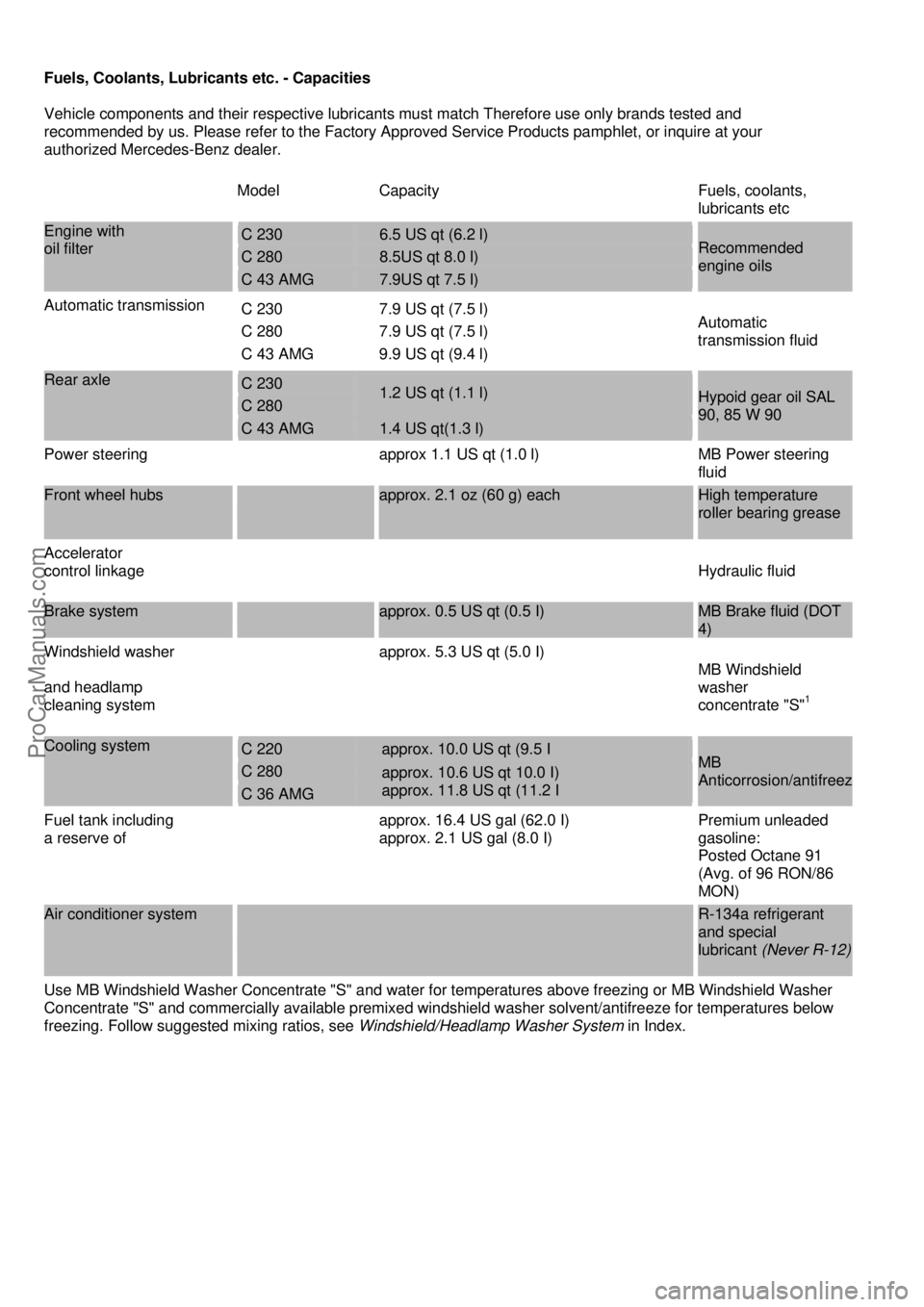
Fuels, Coolants, Lubricants etc. - Capacities
Vehicle components and their respective lubricants must match Therefore use only brands tested and
recommended by us. Please refer to the Factory Approv ed Service Products pamphlet, or inquire at your
authorized Mercedes-Benz dealer.
Model Capacity Fuels, coolan ts,
lubricants etc
Engine with
oil filter C 230 6.5 US qt (6.2 l)
C 280 8.5US qt 8.0 l)
C 43 AMG 7.9US qt 7.5 l)
Recommended
engine oils
Automatic transmission C 230 7.9 US qt (7.5 l)
C 280 7.9 US qt (7.5 l)
C 43 AMG 9.9 US qt (9.4 l)
Automatic
transmissio
n fluid
Rear axle C 230
C 280 1.2 US qt (1.1 l)
C 43 AMG 1.4 US qt(1.3 l)
Hypoid gear oil SAL
90, 85 W 90
Power steering approx 1.1 US qt (1.0 l)
MB Power steering
fluid
Front wheel hubs
approx. 2.1 oz (60 g) each High temperature
roller bearing grease
Accelerator
control linkage
Hydraulic fluid
Brake system approx. 0.5 US qt (0.5 I) MB Brake fluid (DOT
4)
Windshield washer
and headlamp
cleaning system
approx. 5.3 US qt (5.0 I)
MB Windshield
washe
r
concentrate "S"
1
Cooling system C 220 approx. 10.0 US qt (9.5 I
C 280
C 36 AMG
approx. 10.6 US qt 10.0 I)
approx. 11.8 US qt (11.2 I
MB
Anticorrosion/antifreez
Fuel tank including
a reserve of
approx. 16.4 US gal (62.0 I)
approx. 2.1 US gal (8.0 I)
Premium unleaded
gasoline:
Posted O
c
tane 91
(Avg. of 96 RON/86
MON)
Air conditioner system
R-134a refrigerant
and special
lubricant (Never R-12)
Use MB Windshield Washer Concentrate "S" and water for temperatures above freezing or MB Windshield Washer
Con c
entrate "S" and commercially available premixed windsh ield washer solvent/antifreeze for temperatures below
freezing. Follow suggested mixing ratios, see Windshield/Headlamp Washer System in Index.
ProCarManuals.com
Page 115 of 122

Engine Oils
Engine oils are specifically tested for their suitability in our engines. Therefore, use only engine oils recommended by
Mercedes-Benz. Information on recommended brands is av ailable at your authorized Mercedes-Benz dealer. Please
follow service Booklet recommendations for scheduled oil ch anges. Failure to do so could result in engine damage
not covered by the Mercedes-Benz Limited Warranty.
Engine Oil Additives
Do not blend oil additives with engine oil. They may be harmful to the engine operation. Damage or malfunctions
resulting from blending oil additives are not covered by the Mercedes-Benz Limited Warranty.
Air Conditioner Refrigerant
R-134a (HFC) refrigerant and special PAG lubricating oil is used in the air conditioner system. Never use R-12 (CFC)
or mineral based lubricating oil, otherwise damage to the system will occur.
Brake Fluid
During vehicle operation, the boiling poin t of the brake fluid is continuously reduced through the absorption of
moisture from the atmosphere. Under extremely hard operati ng conditions, this moisture content can lead to the
formation of bubbles in the system thus reducing the syste m's efficiency. The brake fluid must therefore be replaced
every two years, preferably in the spring. It is recomm ended to use only brake fluid approved by Mercedes- Benz.
Your authorized Mercedes Benz dealer will provide you with additional information.
ProCarManuals.com
Page 117 of 122

Coolants
The engine coolant is a mixture of water and anticorrosion/antifreeze, which provides:
• corrosion protection,
• freeze protection,
• boiling protection (by increasing the boiling point).
The cooling system was filled at the factory with a coolant providing freeze protection to approx. -22°F
(-30°C) and corrosion protection. The coolant solution mu st be used year round to provide the necessary corrosion
protection and increase in the boil-over protection. You should have it replaced every 3 years. To provide the
important corrosion protection, the solution must be at leas t 45% anticorrosion/antifreeze (equals a freeze protection
to approx. -22°F [-30°C]). If you use a solution that is mo re than 55% anticorrosion/antifreeze (freeze protection to
approx. -49°F
[-45°C]), the engine temperature will increase due to the lo wer heat transfer capability of the solution. Therefore, do
not use more than this amount of anticorrosion/ant ifreeze. If the coolant level is low, water and MB
anticorrosion/antifreeze should be used to bring it up to the proper level (have cooling system checked for signs of
leakage). The water in the cooling system must meet mi nimum requirements, which are usually satisfied by normal
drinking water. If you are not sure about the water qua lity, consult your authorized Mercedes-Benz dealer.
Anticorrosion/antifreeze
Your vehicle contains a number of aluminum parts. T he use of aluminum components in motor vehicle engines
necessitates that anticorrosion/antifreeze coolant used in such engines be specifically formulated to protect the
aluminum parts. (Failure to use such anticorrosion/antifr eeze coolant will result in a significantly shortened service
life.)
Therefore the following product is strongly recommended for use in your car: Mercedes-Benz Anticorrosion/Antifreeze
Agent. Before the start of the winter season (or once a year in the hot southern regions), you should have the
anticorrosion/antifreeze concentration c hecked. The coolant is also regularly checked each time you bring your
vehicle to your authorized Merc edes-Benz dealer for service.
Model
Approx.freeze Protection
-35°F
(~37°C)
-49°F
(-45°C)
C 230 5.0 US qt
(4.75 I)
5.5 US qt
(5.25 I)
C 280 5.3 US qt
(5.0 I)
5.8 US qt
(5.5 I)
C 43 AMG 5.9US qt
(5.6 I)
6.6 US qt
(6.2 I)
ProCarManuals.com
Page 118 of 122

Consumer Information
This has been prepared as required of all manufacturers of passenger cars under Title 49,
Code of U.S. Federal Regulations, Part 5 75 pursuant to the "National Traffic and
Motor Vehicle Safety Act of 1966".
Uniform Tire Quality Grading
Refer to the tire sidewall for the specific tire grades for the tires with which this vehicle is equipped.
All passenger car tires must conf orm to federal safety requirements in addition to these grades.
Tread w
ear
The treadwear grade is a comparative rating based on t he wear rate
of the tire when tested under controlled
conditions on a specified government test course. For ex ample, a tire graded 150 would wear one and one-half (11/2)
times as well on the government course as a tire grad ed 100. The relative performance of tires depends upon the
actual conditions of their use, however, and may depart signi ficantly from the norm due to variations in driving habits,
service practices and differences in road characteristics and climate.
Traction "A", "B", "C"
The traction grades, from highest to lowest, are "A", "B", and "C", and they represent the tire's ability to stop on wet
pavement as measured under controlled c onditions on specified government test surfaces of asphalt and concrete. A
tire marked "C" may have poor traction performance.
Warning !
The traction grade assigned to this tire is based on braking (straight ahead) traction
tests and does not include cornering (turning) traction.
Temperature "A", "B", "C".
The temperature grades are "A" (the highest), "B", and "C", r epresenting the tire's resistance to the generation of heat
and its ability to dissipate heat when tested under controlled conditions
on a specified indoor laboratory test wheel. Sustained hi gh temperature can cause the material of the tire to
degenerate and reduce tire life, and excessive temperature can lead to sudden tire failure. The grade "C"
corresponds to a level of performance which all passenger car tires must meet under the Federal Motor Vehicle
Safety Standard No. 109. Grades "B" and "A" represent hi gher levels of performance on the laboratory test wheel
than the minimum required by law.
Warning !
The temperature grade for this tire is established for a tire that is properly inflated and not overloaded.
Excessive speed, underinflation, or excessive loading, either separately or in combination, can cause
excessive heat build up and possible tire failure.
ProCarManuals.com