lock MERCEDES-BENZ C-CLASS 1999 Owner's Manual
[x] Cancel search | Manufacturer: MERCEDES-BENZ, Model Year: 1999, Model line: C-CLASS, Model: MERCEDES-BENZ C-CLASS 1999Pages: 122, PDF Size: 1.66 MB
Page 29 of 122

Heated Seats (optional)
The front seat heater switches are located in the center console. The front seat heaters
can be switched on with the electronic key in steering lock positions 1 or 2.
Press switch to turn on heater:
1. Normal heating mode. One indicator lamp in the switch lights up.
2. Rapid heating mode. Bo indicator lamps in the switch light up. After approximately
5 minutes in the rapid heating mode, the heater automatically witches to normal
operation and only one indicator lamp will stay on.
Turning off heater:
If one indicator lamp is on, press upper half of switch.
If both indicator lamps are on, press lower half of switch.
If left on, the heater automatically turns off after approximately 30 minutes of operation.
Note:
When in operation, the seat heater consumes a large amount of electrical power. It is not advisable to use the seat
heater longer than necessary. The seat heaters may automatically switch off if too many power consumers are
switched on at the same time, or if the battery charge is lo w. When this occurs, the indicator lamp in the switch will
blink (both indicator lamps blink during rapid seat heating) . The seat heaters will switch on again automatically as
soon as sufficient voltage is available. If the blinking of the indicator lamps is distracting to you, the seat heaters can
be switched off.
ProCarManuals.com
Page 30 of 122
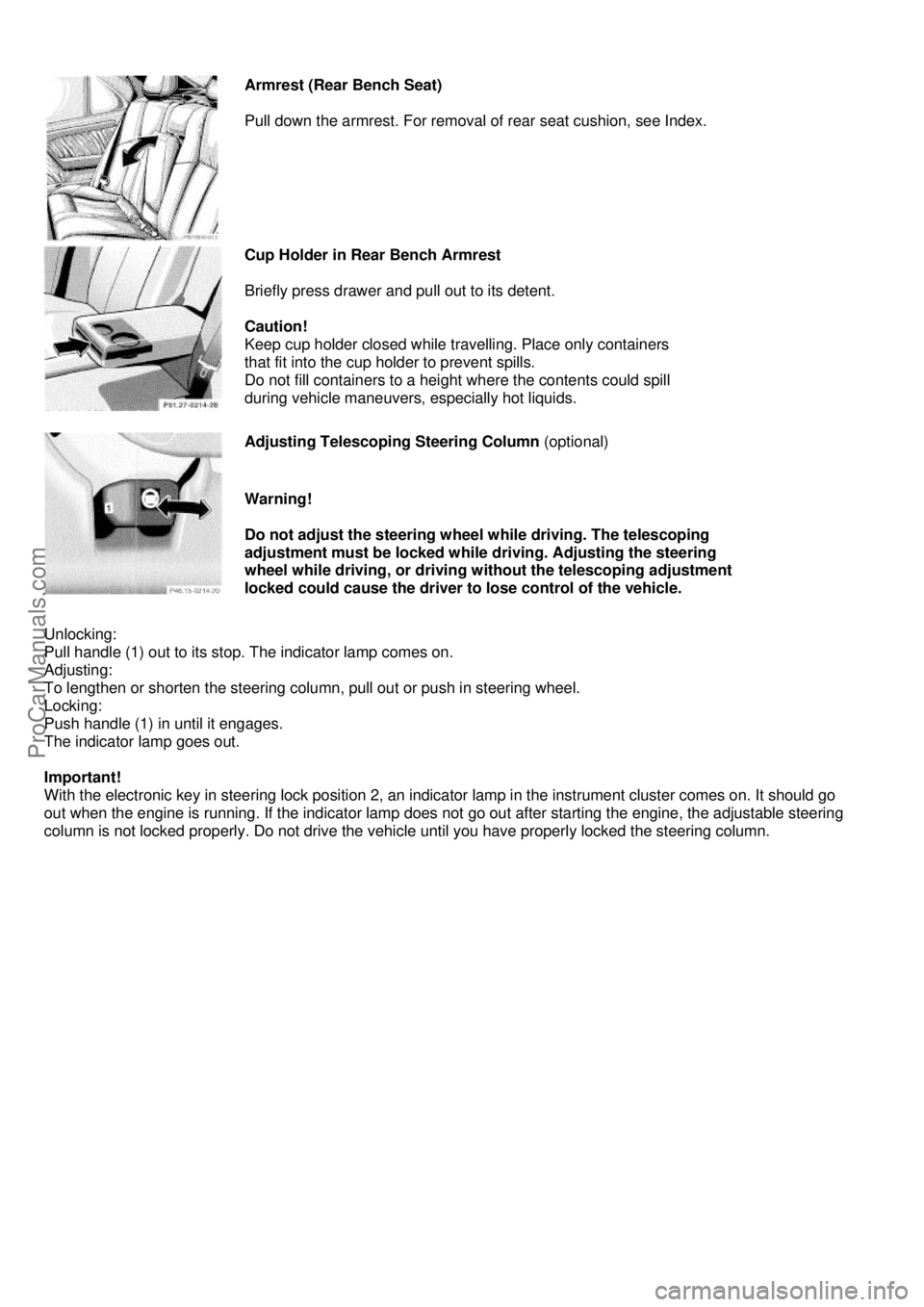
Armrest (Rear Bench Seat)
Pull down the armrest. For removal of rear seat cushion, see Index.
Cup Holder in Rear Bench Armrest
Briefly press drawer and pull out to its detent.
Caution!
Keep cup holder closed while travelling. Place only containers
that fit into the cup holder to prevent spills.
Do not fill containers to a height where the contents could spill
during vehicle maneuvers, especially hot liquids.
Adjusting Telescoping Steering Column (optional)
Warning!
Do not adjust the steering wheel while driving. The telescoping
adjustment must be locked while driving. Adjusting the steering
wheel while driving, or driving without the telescoping adjustment
locked could cause the driver to lose control of the vehicle.
Unlocking:
Pull handle (1) out to its stop. The indicator lamp comes on.
Adjusting:
To lengthen or shorten the steering column, pull out or push in steering wheel.
Locking:
Push handle (1) in until it engages.
The indicator lamp goes out.
Important!
With the electronic key in steering lock position 2, an indicator lamp in the instrument cluster comes on. It should go
out when the engine is running. If the indicator lamp does not go out after starting the engine, the adjustable steering
column is not locked properly. Do not drive the vehi cle until you have properly locked the steering column.
ProCarManuals.com
Page 31 of 122
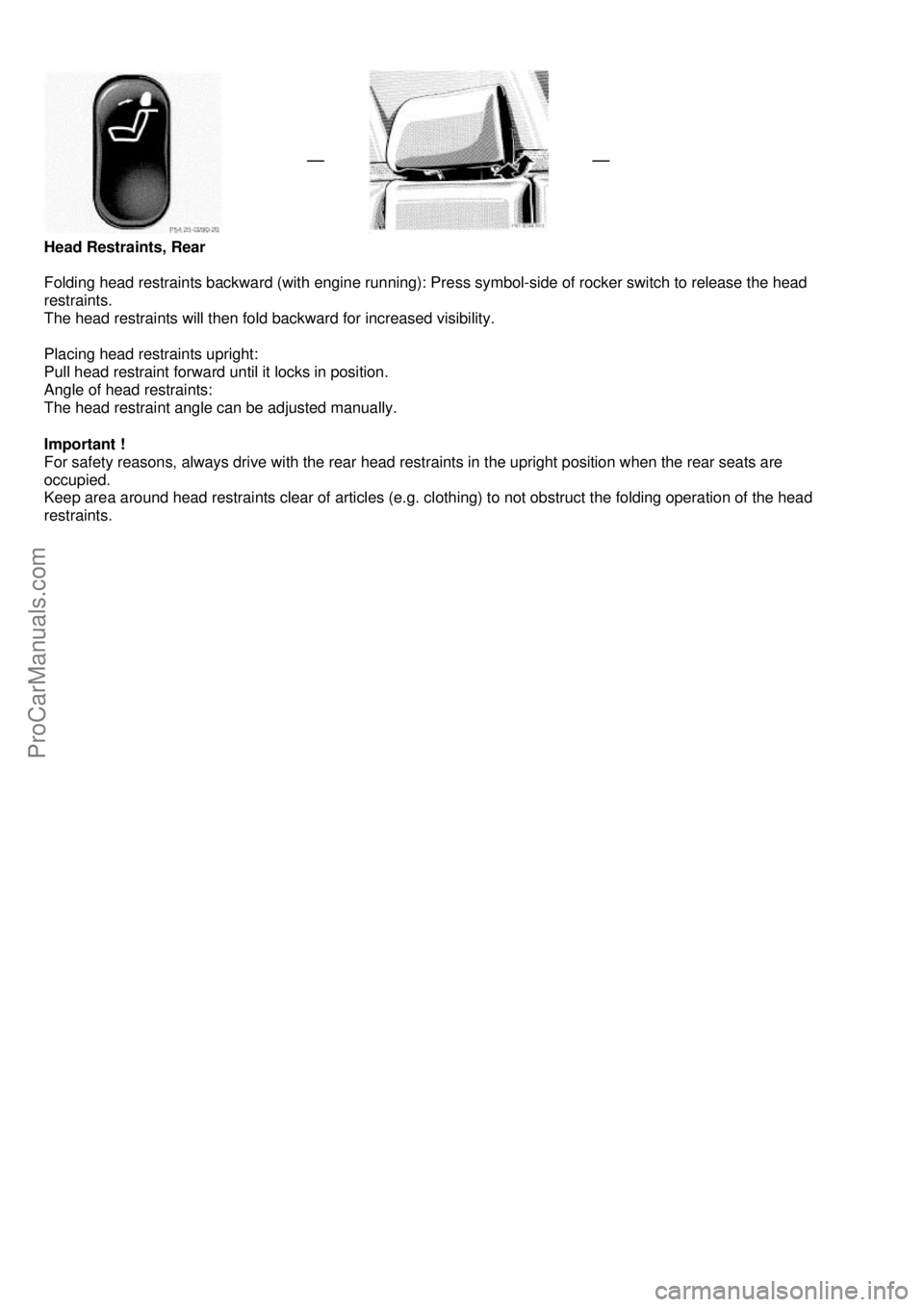
Head Restraints, Rear
Folding head restraints backward (with engine running): Press symbol-side of rocker switch to release the head
restraints.
The head restraints will then fold backward for increased visibility.
Placing head restraints upright:
Pull head restraint forward until it locks in position.
Angle of head restraints:
The head restraint angle can be adjusted manually.
Important !
For safety reasons, always drive with the rear head rest raints in the upright position when the rear seats are
occupied.
Keep area around head restraints clear of articles (e.g. cl othing) to not obstruct the folding operation of the head
restraints.
ProCarManuals.com
Page 32 of 122

Seat Belts
Your vehicle is equipped with seat belts for all seats, emergency tensioning retractors for the front
seats, as well as front and side impact airbags and knee bolsters for driver and front passenger.
Important !
Laws in most states and all Canadian provinces require seat belt use. All states and provinces
require use of child restraints that comply with U.S. Federal Motor Vehicle Safety Standard 213 and
Canadian Motor Vehicle Safety Standard 213.1.
For your safety and that of your pass engers we strongly recommend their use.
Warning !
Children 12 years old and under must never ride in the front seat, except in a Mercedes-Benz
authorized BabySmart? compatible child seat, which operates with the BabySmart? system
installed in the vehicle to deactivate the passenger side front airbag when it is properly
installed. Otherwise they will be struck by the airbag when it inflates in a crash. If this
happens, serious or fatal injury will result. The back seat is the safest place for children.
Infants and small children must ride in back seats and be seated in an appropriate infant or
child restraint system, which is properly secured with the vehicle's seat belt, fully in
accordance with the seat manufacturer's instructions. A child's risk of serious or fatal
injuries is significantly increased if the child restraints are not properly secured in the vehicle
and the child is not properly secured in the child restraint.
Warning !
Never ride in a moving vehicle with the seat back reclined. Sitting in an excessively reclined
position can be dangerous. You could slide under the seat belt in a collision. If you slide
under it, the belt would apply force at the abdomen or neck. That could cause serious or even
fatal injuries. The seat back and seat belts provide the best restraint when the wearer is in an
upright position and belts are properly positioned on the body.
Seat Belt Warning System
With the electronic key in steering lock position 2, a warning sounds for a short time if the driver's
seat belt is not fastened.
Warning !
Failure to wear and properly fasten and position your seat belt greatly increases your risk of
injuries and their likely severity in an accident. You and your passengers should always wear
seat belts.
If you are ever in an accident, your injuries can be considerably more severe without your
seat belt properly buckled. Without your seat belt buckled, you are much more likely
to hit the interior of the vehicle or be ejected from it. You can be seriously injured or killed.
In the same crash, the possibility for injury or death is lessened with your seat belt
buckled.
ProCarManuals.com
Page 33 of 122
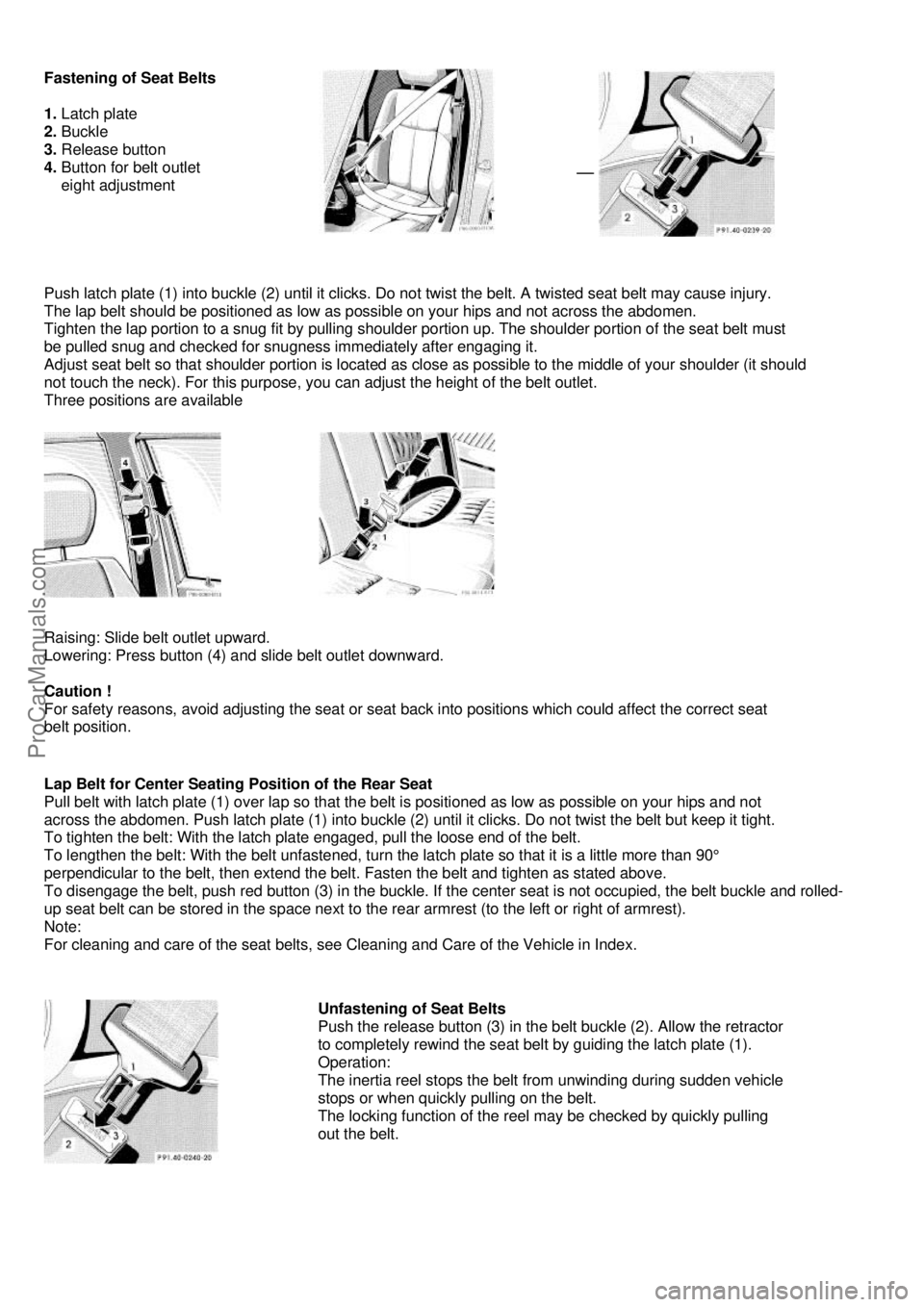
Fastening of Seat Belts
1. Latch plate
2. Buckle
3. Release button
4. Button for belt outlet
eight adjustment
Push latch plate (1) into buckle (2) until it clicks. Do not twist the belt. A twisted seat belt may cause injury.
The lap belt should be positioned as low as possib le on your hips and not across the abdomen.
Tighten the lap portion to a snug fit by pulling shoulder portion up. The shoulder portion of the seat belt must
be pulled snug and checked for snugness immediately after engaging it.
Adjust seat belt so that shoulder portion is located as cl ose as possible to the middle of your shoulder (it should
not touch the neck). For this purpose, you can adjust the height of the belt outlet.
Three positions are available
Raising: Slide belt outlet upward.
Lowering: Press button (4) and slide belt outlet downward.
Caution !
For safety reasons, avoid adjusting the seat or seat ba ck into positions which could affect the correct seat
belt position.
Lap Belt for Center Seating Position of the Rear Seat
Pull belt with latch plate (1) over lap so that the belt is positioned as low as possible on your hips and not
across the abdomen. Push latch plate (1) into buckle (2) until it clicks. Do not twist the belt but keep it tight.
To tighten the belt: With the latch plate engaged, pull the loose end of the belt.
To lengthen the belt: With the belt unfastened, turn the latch plate so that it is a little more than 90°
perpendicular to the belt, then extend the bel t. Fasten the belt and tighten as stated above.
To disengage the belt, push red button (3) in the buckle. If t he center seat is not occupied, the belt buckle and rolled-
up seat belt can be stored in the space next to the rear armrest (to the left or right of armrest).
Note:
For cleaning and care of the seat belts, see Cleaning and Care of the Vehicle in Index.
Unfastening of Seat Belts
Push the release button (3) in the belt buckle (2). Allow the retractor
to completely rewind the seat bel t by guiding the latch plate (1).
Operation:
The inertia reel stops the belt from unwinding during sudden vehicle
stops or when quickly pulling on the belt.
The locking function of the reel may be checked by quickly pulling
out the belt.
ProCarManuals.com
Page 35 of 122
BabySmart™ Airbag Deactivation System
Special child seats, designed for use with the Mercedes-Benz system and available at any
authorized Mercedes-Benz dealer are required for use with the BabySmart™ airbag deactivation
system. With the special child seat properly insta lled, the passenger front airbag will not deploy. The
indicator lamp located on the center console will be illuminated, except with electronic key
removed or in steering lock position 0. The system does not deactivate the door mounted side
impact airbag.
Warning !
The BabySmart™ Airbag Deactivation System will ONLY work with a special seat designed to
operate with it. It will not work with seats which are not BabySmart™ compatible. Never place
anything between seat cushion and child seat (e .g. pillow), since it reduces the effectiveness
of the deactivation system. Follow the manufacture r's instructions for installation of special
child seats. The passenger side front airbag will not deploy only if the
indicator lamp
remains illuminated. Please be sure to check the indicator every time you use the special
system child seat. Should the light go out while the restraint is installed, please check
installation. If the light remains out, do not use the BabySmart™ restraint to transport
children, or otherwise do not transport child restraints on the front passenger seat until the
system has been repaired.
Self-Test BabySmart™ Without Special Child Seat Installed
After turning electronic key in steering lock to position 1 or 2, the
indicator lamp located on
center console comes on for approx. 6 seconds.
If the lamp should not come on or is continuously li t, the system is not functioning. You must see an
authorized Mercedes-Benz dealer before using any child seat.
BabySmart is a trademark of Siemens Automotive Corp.
ProCarManuals.com
Page 37 of 122

Emergency Tensioning Retractor (ETR)
The seat belts for the front seats are equipped with emergency tensioning retractors. These tensioning retractors are
located in each belt's inertia reel and become operationally ready with the electronic key in steering lock position 1 or
2. The emergency tensioning retractors are designed to acti vate only when the seat belts are fastened during frontal
impacts exceeding the first threshold of the SRS and in rear impacts exceeding a preset security level. They remove
slack from the belts in such a way that the seat belts fit more snugly against the body restricting its forward movement
as much as possible.
In cases of other frontal impacts, angled impacts, roll-overs, certain side impacts, or other accidents without sufficient
frontal or rear impact forces, the emergency tensioning re tractors will not be activated. The driver and passengers will
then be protected by the fastened seat belts and inertia reel in the usual manner. For seat belt and emergency
tensioning retractor safety guidelines see Safety Guidelines in Index.
ProCarManuals.com
Page 38 of 122
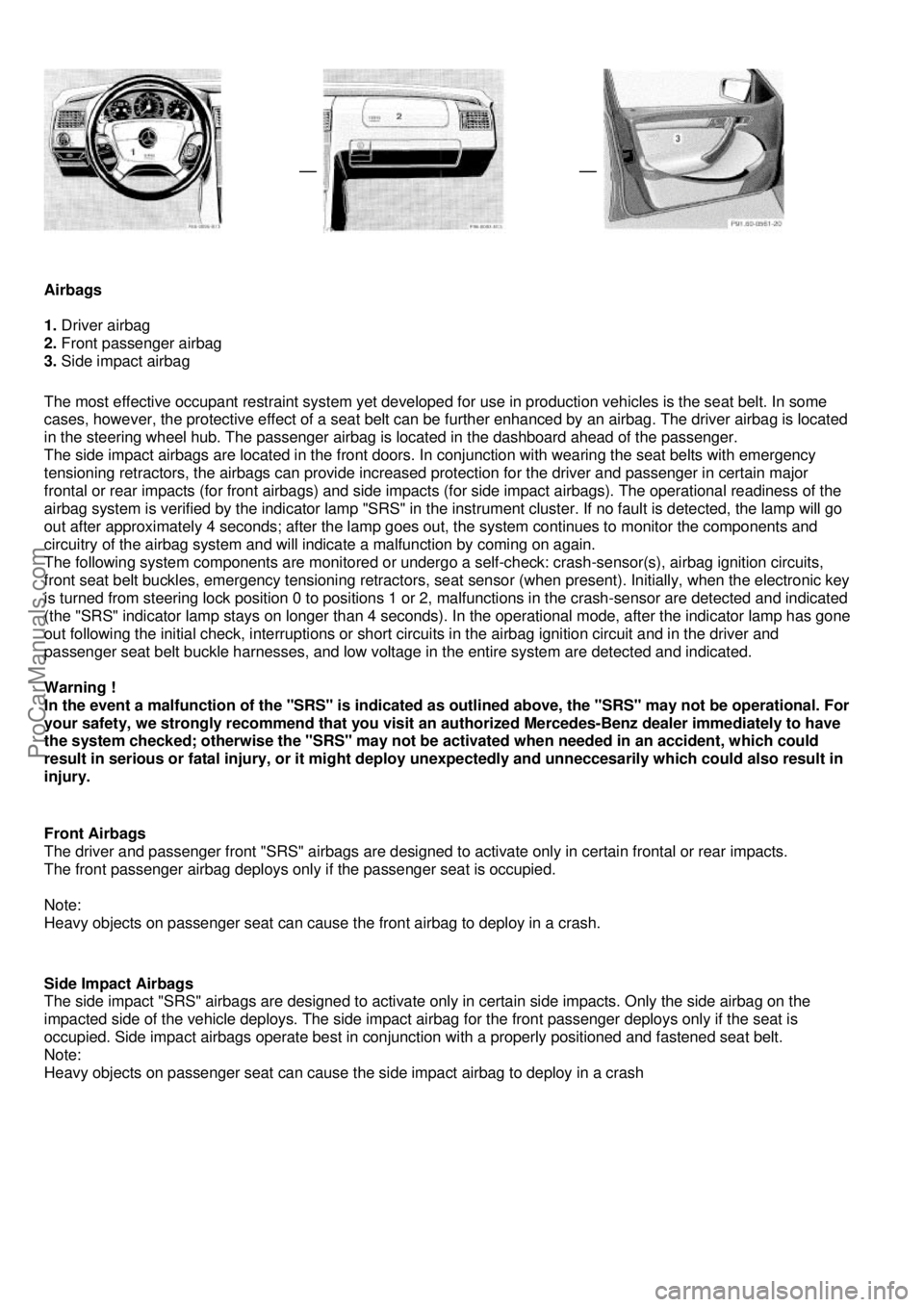
Airbags
1. Driver airbag
2. Front passenger airbag
3. Side impact airbag
The most effective occupant restraint system yet developed fo
r use in production vehicles is the seat belt. In some
cases, however, the protective effect of a seat belt can be further enhanced by an airbag. The driver airbag is located
in the steering wheel hub. The passenger airbag is located in the dashboard ahead of the passenger.
The side impact airbags are located in the front doors. In conjunction with wearing the seat belts with emergency
tensioning retractors, the airbags can provide increased protection for the driver and passenger in certain major
frontal or rear impacts (for front airbags) and side impacts (for side impact airbags). The operational readiness of the
airbag system is verified by the indicator lamp "SRS" in the instrument cluster. If no fault is detected, the lamp will go
out after approximately 4 seconds; after the lamp goes out, the system continues to monitor the components and
circuitry of the airbag system and will indicate a malfunction by coming on again.
The following system components are monitored or undergo a self-check: crash-sensor(s), airbag ignition circuits,
front seat belt buckles, emergency tensioning retractors, seat sensor (when present). Initially, when the electronic key
is turned from steering lock position 0 to positions 1 or 2, malfunctions in the crash-sensor are detected and indicated
(the "SRS" indicator lamp stays on longer than 4 seconds). In the operational mode, after the indicator lamp has gone
out following the initial check, interruptions or short circ uits in the airbag ignition circuit and in the driver and
passenger seat belt buckle harnesses, and low voltage in the entire system are detected and indicated.
Warning !
In the event a malfunction of the "SRS" is indicated as outlined above, the "SRS" may not be operational. For
your safety, we strongly recommend that you visit an authorized Mercedes-Benz dealer immediately to have
the system checked; otherwise the "SRS" may not be activated when needed in an accident, which could
result in serious or fatal injury, or it might deploy unexpectedly and unneccesarily which could also result in
injury.
Front Airbags
The driver and passenger front "SRS" airbags are designed to activate only in certain frontal or rear impacts.
The front passenger airbag deploys only if the passenger seat is occupied.
Note:
Heavy objects on passenger seat can cause the front airbag to deploy in a crash.
Side Impact Airbags
The side impact "SRS" airbags are designed to activate onl y in certain side impacts. Only the side airbag on the
impacted side of the vehicle deploys. The side impact ai rbag for the front passenger deploys only if the seat is
occupied. Side impact airbags operate best in conjunct ion with a properly positioned and fastened seat belt.
Note:
Heavy objects on passenger seat can cause the side impact airbag to deploy in a crash
ProCarManuals.com
Page 40 of 122

Infant and Child Restraint Systems
We recommend that all infants and children be properly restra ined at all times while the vehicle is in motion. All lap-
shoulder belts except driver seat have special seat belt re tractors for secure fastening of child restraints. To fasten a
child restraint, use this seat belt: Follow child restraint in structions for routing. Then pull shoulder belt out completely
and let it retract. The belt is now locked. Push down on child restraint to take up any slack.
Important !
The use of infant or child restraints is required by law in all 50 states and all Canadian provinces. Infants and small
children should be seated in an appropriate infant or child restraint system properly secured by a lap-shoulder belt,
and that complies with U.S. Federal Motor Vehicle Safety Standard 213 and Canadian Motor Vehicle Safety Standard
213.1. A statement by the child rest raint manufacturer of compliance with this standard can be found on the
instruction label on the restraint and in the instruction manual provided with the restraint. When using any infant or
child restraint system, be sure to carefully read and follow all manufacturer's instructions for installation and use.
Please read and observe warning labels affixed to inside of vehicle.
Warning !
Children 12 years old and under must never ride in the front seat, except in a Mercedes-Benz authorized
BabySmart™ compatible child seat, which operates with the BabySmart™ system installed in the vehicle to
deactivate the passenger side front airbag when it is properly installed. Otherwise they will be struck by the
airbag when it inflates in a crash. If this happens, serious or fatal injury will result.
The back seat is the safest place for children, infants and small children must ride in back seats and be
seated in an infant or child restraint system, which is properly secured with the vehicle's seat belt, fully in
accordance with the seat manufacturer's instructions.
Infants and small children should never share a seat belt with another occupant. During an accident, they
could be crushed between the occupant and seat belt. Children too big for child restraint systems must ride
in back seats using regular seat belts. Position shoulder belt across chest and shoulder, not face or neck. A
booster seat is necessary to achieve proper belt positioning for children from 41 Ibs. to the point where a
lap/shoulder belt fits properly without one.
When the child restraint is not in use, remove it from the car or secure it with the seat belt to prevent the
child restraint from becoming a projectile in the event of an accident.
U.S.A. Models only:
Since 1986 all U.S. child restraints comply with U.S. regulations without the use of a tether strap. Canada Models
only: This vehicle is provided with tether anchorages for a top tether strap. Consult your authorized Mercedes-Benz
dealer for installation of these anchorages. In compliance with Canadian Motor Vehicle Safety Standard 210.1, child
restraint tether anchorage hardware is attached to the tool kit located in the trunk.
ProCarManuals.com
Page 41 of 122
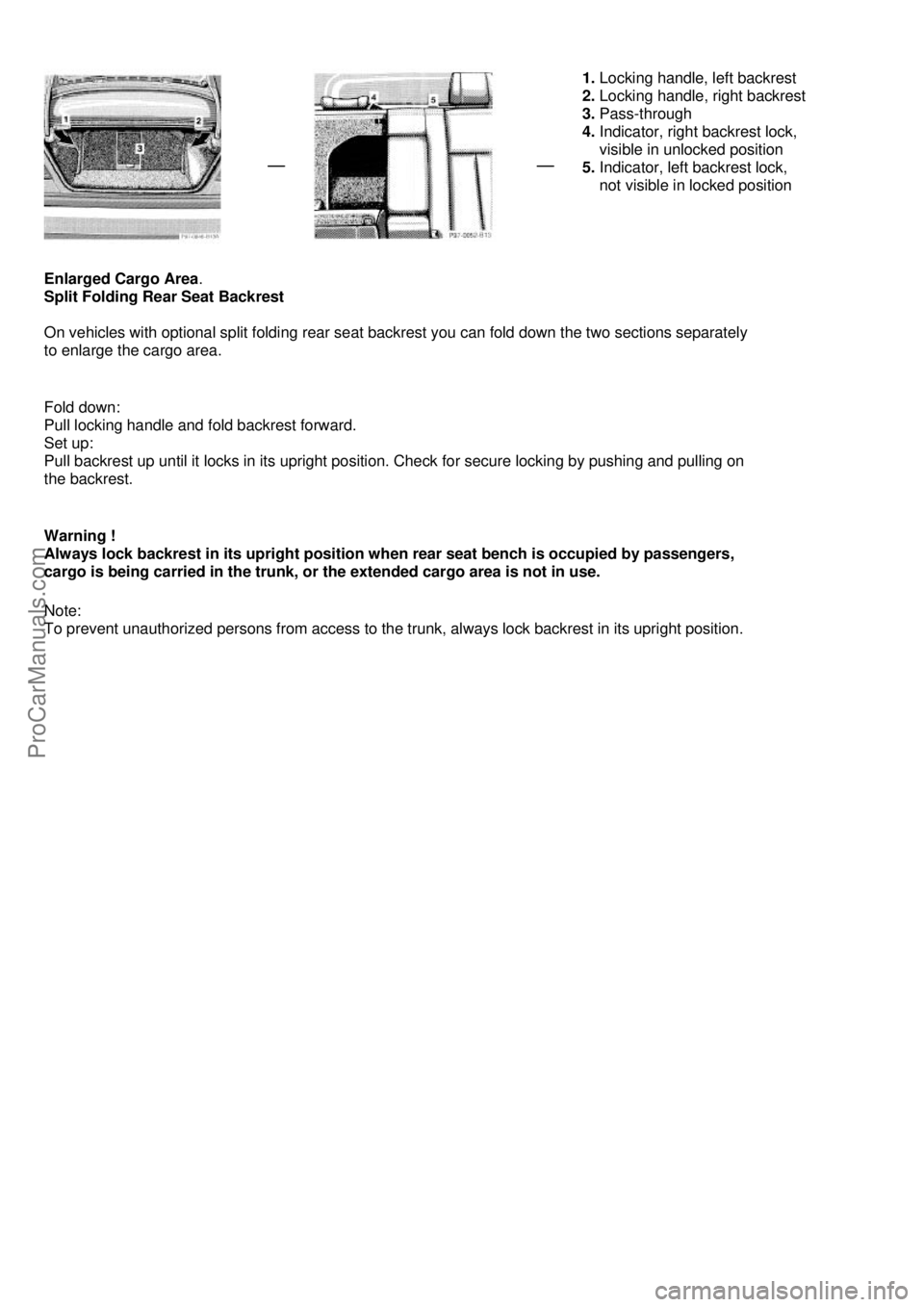
1. Locking handle, left backrest
2. Locking handle, right backrest
3. Pass-through
4. Indicator, right backrest lock,
visible in unlocked position
5. Indicator, left backrest lock,
not visible in locked position
Enlarged Cargo Area .
Split Folding Rear Seat Backrest
On vehicles with optional split folding rear seat back rest you can fold down the two sections separately
to enlarge the cargo area.
Fold down:
Pull locking handle and fold backrest forward.
Set up:
Pull backrest up until it locks in its upright position. Check for secure locking by pushing and pulling on
the backrest.
Warning !
Always lock backrest in its upright position when rear seat bench is occupied by passengers,
cargo is being carried in the trunk, or the extended cargo area is not in use.
Note:
To prevent unauthorized persons from access to the trunk, always lock backrest in its upright position.
ProCarManuals.com