lock MERCEDES-BENZ C-CLASS 1999 Repair Manual
[x] Cancel search | Manufacturer: MERCEDES-BENZ, Model Year: 1999, Model line: C-CLASS, Model: MERCEDES-BENZ C-CLASS 1999Pages: 122, PDF Size: 1.66 MB
Page 87 of 122

Spare Wheel for Model C 43 AMG
The spare wheel rim size is 71/2Jx17H2 In the case of a flat tire or break- down, you may temporarily use a 71/2Jx17
H 2 instead of the 81/2J x 17 H 2 wheel rim on the rear axle, when observing the following restrictions:
• Do not exceed vehicle speed of 50 mph (80 km/h).
• Drive to the nearest repair facility to have the fl at tire repaired or replaced as appropriate.
For additional information, refer to "Technical Data".
1. Wheel bolt for model C 43 AMG
2. Wheel bolt for model 230 und C 28
Replace rims or tires with the same designation, manufa cturer and type as shown on the original part. See your
authorized Mercedes-Benz dealer for further information.
Warning !
The jack is designed exclusively for jacking up the vehicle at the jack tubes built into either side of the
vehicle. To help avoid personal injury, use the jack only to lift the vehicle during a wheel change. Never get
beneath the vehicle while it is supported by the jack. Keep hands and feet away from the area under the lifted
vehicle. Always firmly set parking brake and block whee ls before raising vehicle with jack. Do not disengage
parking brake while the vehicle is raised. Be certain that the jack is always vertical when in use, especially on
hills. Always try to use the jack on level surface. Be sure that the jack arm is fully inserted in the jack tube.
Always lower the vehicle onto sufficient capacity jackstands before working under the vehicle.
ProCarManuals.com
Page 88 of 122
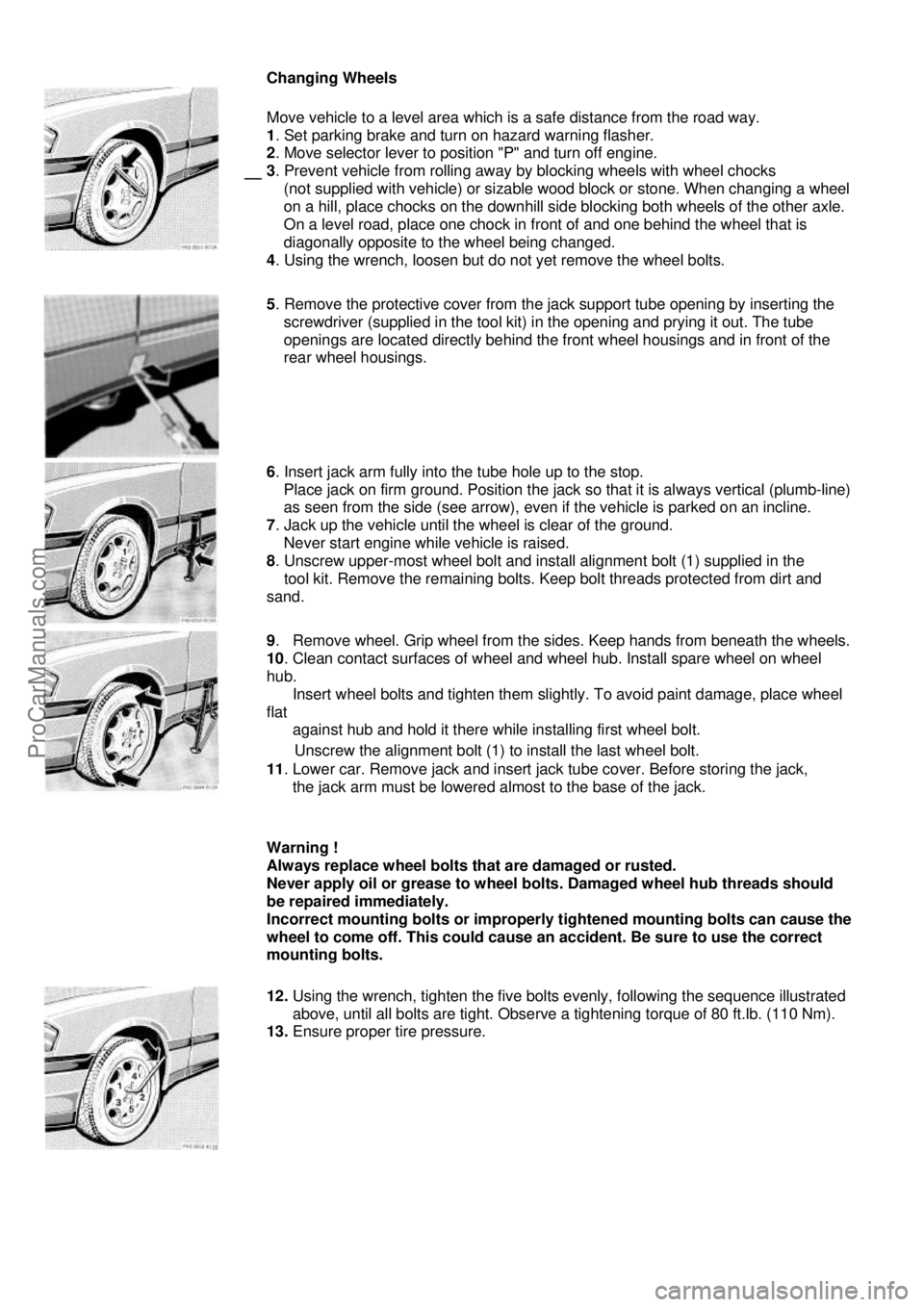
Changing Wheels
Move vehicle to a level area which is a safe distance from the road way.
1 . Set parking brake and turn on hazard warning flasher.
2 . Move selector lever to position "P" and turn off engine.
3 . Prevent vehicle from rolling away by blocking wheels with wheel chocks
(not supplied with vehicle) or sizable wood block or stone. When changing a wheel
on a hill, place chocks on the downhill side blocking both wheels of the other axle.
On a level road, place one chock in front of and one behind the wheel that is
diagonally opposite to the wheel being changed.
4 . Using the wrench, loosen but do not yet remove the wheel bolts.
5
. Remove the protective cover from the jack support tube opening by inserting the
screwdriver (supplied in the tool kit) in the opening and prying it out. The tube
openings are located directly behind the front wheel housings and in front of the
rear wheel housings.
6
. Insert jack arm fully into the tube hole up to the stop.
Place jack on firm ground. Position the jack so that it is always vertical (plumb-line)
as seen from the side (see arrow), even if the vehicle is parked on an incline.
7. Jack up the vehicle until the wheel is clear of the ground.
Never start engine while vehicle is raised.
8 . Unscrew upper-most wheel bolt and install alignment bolt (1) supplied in the
tool kit. Remove the remaining bolts. Keep bolt threads protected from dirt and
sand.
9. Remove wheel. Grip wheel from the sides. Keep hands from beneath the wheels.
10. Clean contact surfaces of wheel and wheel hub. Install spare wheel on wheel
hub.
Insert wheel bolts and tighten them slightly. To avoid paint damage, place wheel
flat
against hub and hold it there while installing first wheel bolt.
Unscrew the alignment bolt (1) to install the last wheel bolt.
11. Lower car. Remove jack and insert jack tube cover. Before storing the jack,
the jack arm must be lowered almost to the base of the jack.
Warning !
Always replace wheel bolts that are damaged or rusted.
Never apply oil or grease to wheel bolts. Damaged wheel hub threads should
be repaired immediately.
Incorrect mounting bolts or improperly tightened mounting bolts can cause the
wheel to come off. This could cause an accident. Be sure to use the correct
mounting bolts.
12.
Using the wrench, tighten the five bolts evenly, following the sequence illustrated
above, until all bolts are tight. Obse rve a tightening torque of 80 ft.lb. (110 Nm).
13. Ensure proper tire pressure.
ProCarManuals.com
Page 91 of 122

Bulb for High Beam H1 (55 W)
Open hood.
Move retaining clamps (4) aside and remove cover (3). Pull off electrical connector (10). Unhook clamping ring
and pull out bulb together with clamping ring. Remove bulb. Insert new bulb (seating properly in cutouts of bulb
socket), mount clamping ring. Reinstall and push electr ical connector on securely. Reinstall cover and fasten
with retaining clamp (4).
Turn Signal, Parking, Side Marker and Standing Lamp
(2357 NA [28.5/8.3 W/30/2.2 cp bulb])
Open hood.
Squeeze latch (1) together and lift complete lamp assemb ly out to front of vehicle. Twist bulb socket (2)
counterclockwise and pull out. Push bulb into socket, turn counterclockwise and remove. Insert new bulb in socket
push in and twist clockwise. Reinstall bulb socket. Reinsta ll lamp assembly by sliding tabs (3) into guides (4) until
properly seated.
1. Latch for turn signal, parking, side marker, and standing lamp assembly
2. Bulb socket for turn signal, parking, side marker, and standing lamp
3. Tab
4. Guide
ProCarManuals.com
Page 92 of 122

Adjusting Headlamp Aim
(Halogen)
Correct headlamp adjustment is extremely important. To check and readjust a headlamp do the following:
• Horizontal aim will change and must be corrected as descri bed below, whenever a vertical adjustment is made.
• Low beam adjustments simultaneously aim the high beam and fog lamp.
• Vehicle should have a normal trunk load.
1 . Park vehicle on level surface approximately 6 inches (152 mm ) from a vertical test screen or wall. The centerline
of
the vehicle must be at a 90° angle to the test screen.
2 . Using a "T" square and a carpenter's level, align and ma rk avertical centerline (8) on the test screen using the
outer
reference point (low centerlines should be 47 1/4 inches (1198 mm).
3 . Move vehicle on the level surface 25 feet (7.6 m) straight back from the wall.
4 . Open hood, depress latch (1), and remove access cover (2) from the headlamp.
5 . Vertical headlamp aim (low beams on): Turn adjusting screw (3) (counterclockwise to adjust headlamp downward,
clockwise upward) until bubble in the level (4) is centered on the "0" mark. Graduations: 0.18° pitch.
6 . Horizontal headlamp aim (low beams on):
Turn adjusting screw (5) (Right fr ont headlamp: counterclockwise to adjust to the left, clockwise to the right; left
front headlamp: counterclockwise to adjust to the right, clockwise to the left.) until the headlamps (low beam)
illuminate the test screen as shown. The vertex of the angle formed in each beam image should align with the
vertical centerline (8) of each lamp. The left and right headlamps must be adjusted individually.
7 . The indicator (6) in the sight glass should align with the "0" mark after any horizontal adjustment. If it does not,
slide the "0" mark on the scale (7) until it a ligns with the indicator (6). Graduations: 0.38° pitch.
8 . Reinstall access cover(2).
ProCarManuals.com
Page 93 of 122

Adjusting Headlamp Aim
(Xenon)
Correct headlamp adjustment is extremely important. To ch eck and readjust a headlamp, follow steps 1 through 5.
Please note:
• Low beam adjustments simultaneously aim the high beam.
• Vehicle should have a normal trunk load.
• Vertical aim adjustments change horizontal aim.
1 . Park vehicle on level surface approximately 25 feet (7.6 m) from a vertical test screen or wall. The centerline of the
vehicle must be at a 90° angle to the test screen.
2 . (low beams on) Using a "T" square and a carpenter's leve l, align and mark a vertical centerline (8) on the test
screen using the vertex of the angle formed in each beam image. As a check, the distance between centerlines
should be 47
1/4inches(1198mm).
3 . Mark a horizontal centerline (9) at a height of 221/2 inches (570 mm) on the test screen. It must be at a 90° angle
to the vertical centerline.
4 . Open hood.
5 . Vertical headlamp aim (low beams on):
Turn adjusting screws (1 and 2) equally in direct ion and turns (counterclockwise to adjust headlamp downward,
clockwise upward) until the headlamps (low beam) illuminate the test screen as shown. The left and right
headlamps
must be adjusted individually.
Note:
If it is not possible to obtain a proper headlamp ad justment, have the system checked at your authorized
Mercedes-Benz dealer.
ProCarManuals.com
Page 94 of 122

Taillamp Assemblies
1. Stop lamp (21 W/32 cp bulb)
2. Turn signal lamp (21 W/32 cp bulb)
3. Backup lamp (21 W/32 cp bulb)
4. Tail, parking, side marker and standing lamp (5 W/4 cp bulb)
5. Passenger side: Tail and parking lamp (21/4W bulb) Driver 's side: Tail, parking and rear fog lamp (21/4 bulb)
To replace bulbs:
From inside trunk, open locks and swing open lamp cover. Turn locking lever on lamp to horizontal
position and remove bulb carrier. Push down on bulb to be changed, twist counterclockwise and remove.
ProCarManuals.com
Page 95 of 122

Battery
Warning !
Failure to follow these instructions can result in severe injury or death. Never lean over batteries while
connecting, you might get injured. Battery fluid contains sulfuric acid. Do not allow this fluid to come in
contact with eyes, skin or clothing. In case it does, immediately flush affected area with water and seek
medical help if necessary. A battery will also produ ce hydrogen gas, which is flammable and explosive.
Keep flames or sparks away from battery, avoid im proper connection of jumper cables, smoking etc..
Important !
Battery maintenance information:
The battery is located in the trunk under the trunk floor. The fluid level must be checked at every A and B service.
Always insure that the fluid level is at the specified maximum level and that only distilled water is used. Failure to
maintain proper fluid level may result in cell deterioration and possible battery rupture. The service life of the battery is
dependent on its condition of charge. The battery should alwa ys be kept sufficiently charged, in order to last an
optimum length of time.
Therefore, we strongly recommend that you have the battery charge checked frequently, and corrected if
necessary, especially if you use the vehicle less than approximately 200 miles (300 km) per month, mostly for
short distance trips, or if it is not used for long periods of time.
Only charge a battery with a battery charger after the battery has been disconnected from the vehicle electrical circuit.
Always disconnect the battery negative lead first and connect last. When removing and connecting the battery,
always make sure that all electrical consumers are off and the electronic key is in steering lock position 0. The battery
and its vent tube must always be securely installed when the car is in operation. While the engine is running the
battery terminal clamps must not be loosened or detached, otherwise the generator and other electronic components
would be damaged.
Note:
After reconnecting the battery al so resynchronize the Express feature of the power windows
(see Power Windows in Index).
Battery Recycling
Batteries contain materials that can harm the environment with improper disposal. Large 12 Volt storage batteries
contain lead. Recycling of batteries is the preferred method of disposal. Many states require sellers of batteries to
accept old batteries for recycling.
ProCarManuals.com
Page 98 of 122
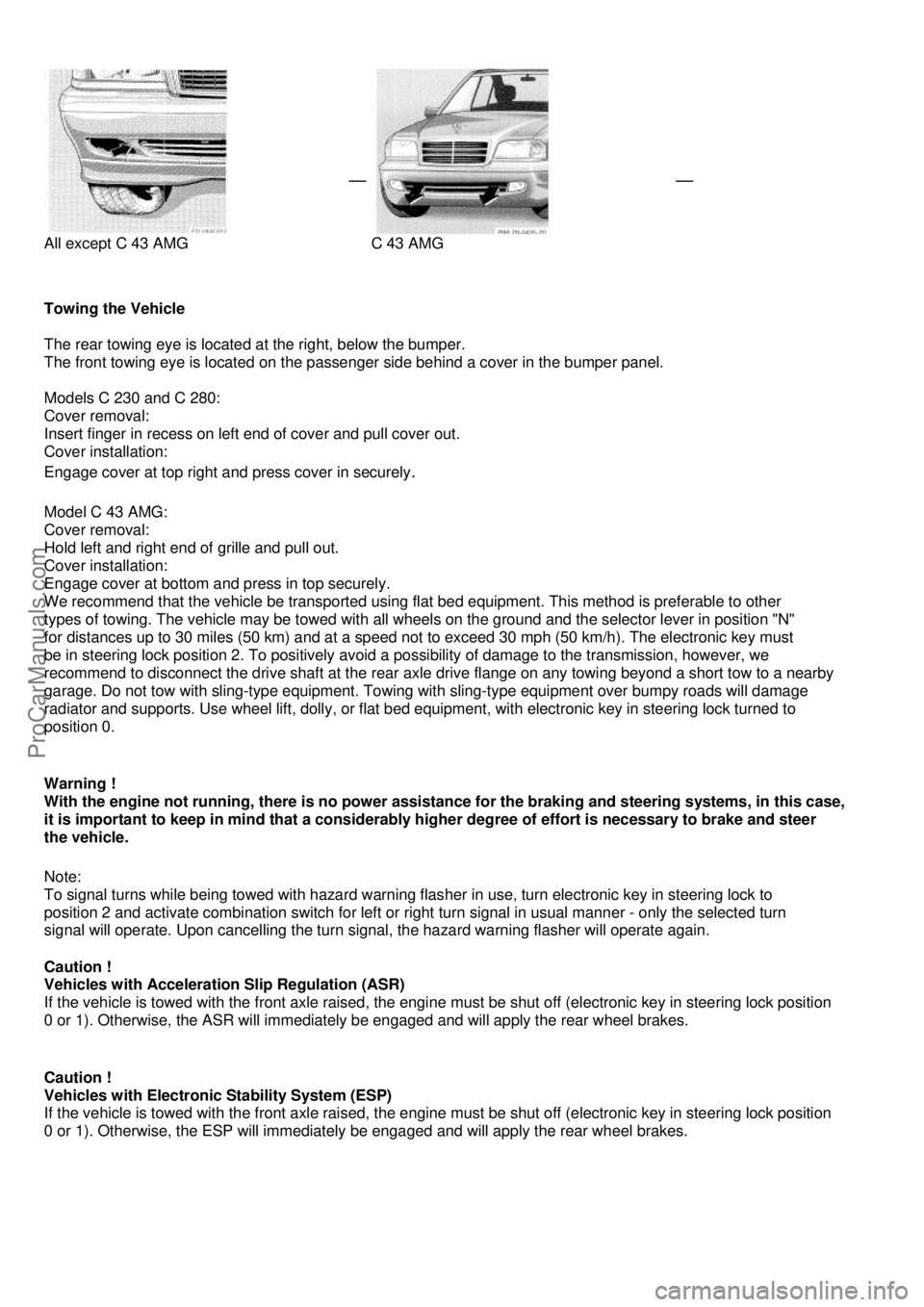
All except C 43 AMG
C 43 AMG
Towing the Vehicle
The rear towing eye is located at the right, below the bumper.
The front towing eye is located on the passenger side behind a cover in the bumper panel.
Models C 230 and C 280:
Cover removal:
Insert finger in recess on left end of cover and pull cover out.
Cover installation:
Engage cover at top right and press cover in securely
.
Model C 43 AMG:
Cover removal:
Hold left and right end of grille and pull out.
Cover installation:
Engage cover at bottom and press in top securely.
We recommend that the vehicle be transported using flat bed equipment. This method is preferable to other
types of towing. The vehicle may be towed with all wheel s on the ground and the selector lever in position "N"
for distances up to 30 miles (50 km) and at a speed not to exceed 30 mph (50 km/h). The electronic key must
be in steering lock position 2. To positively avoid a possibility of damage to the transmission, however, we
recommend to disconnect the drive shaft at the rear axle drive flange on any towing beyond a short tow to a nearby
garage. Do not tow with sling-type equipment. Towing with sling-type equipment over bumpy roads will damage
radiator and supports. Use wheel lift, dolly, or flat bed equipment, with electronic key in steering lock turned to
position 0.
Warning !
With the engine not running, there is no power assistance for the braking and steering systems, in this case,
it is important to keep in mind that a considerably higher degree of effort is necessary to brake and steer
the vehicle.
Note:
To signal turns while being towed with hazard warning flas her in use, turn electronic key in steering lock to
position 2 and activate combination switch for left or right turn signal in usual manner - only the selected turn
signal will operate. Upon cancelling the turn signal, the hazard warning flasher will operate again.
Caution !
Vehicles with Acceleration Slip Regulation (ASR)
If the vehicle is towed with the front axle raised, the engi ne must be shut off (electronic key in steering lock position
0 or 1). Otherwise, the ASR will immediately be engaged and will apply the rear wheel brakes.
Caution !
Vehicles with Electronic Stability System (ESP)
If the vehicle is towed with the front axle raised, the engine must be shut off (electronic key in steering lock position
0 or 1). Otherwise, the ESP will immediately be engaged and will apply the rear wheel brakes.
ProCarManuals.com
Page 102 of 122
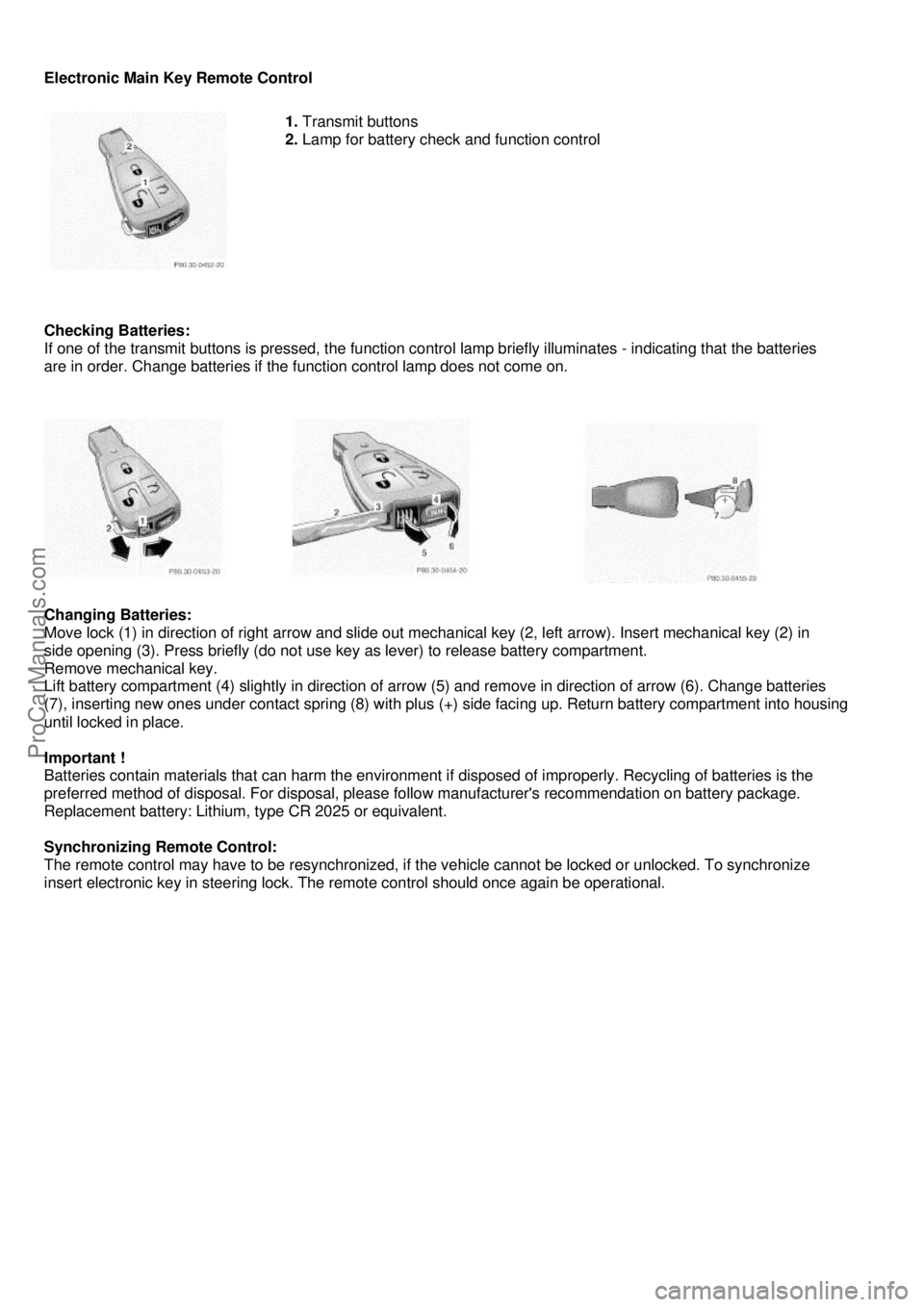
Electronic Main Key Remote Control
1. Transmit buttons
2. Lamp for battery check and function control
Checking Batteries:
If one of the transmit buttons is pressed, the function contro l lamp briefly illuminates - indicating that the batteries
are in order. Change batteries if the function control lamp does not come on.
Changing Batteries:
Move lock (1) in direction of right arrow and slide out mechanical key (2, left arrow). Insert mechanical key (2) in
side opening (3). Press briefly (do not use ke y as lever) to release battery compartment.
Remove mechanical key.
Lift battery compartment (4) slightly in direction of arrow (5) and remove in direction of arrow (6). Change batteries
(7), inserting new ones under contact spring (8) with plus (+) side facing up. Return battery compartment into housing
until locked in place.
Important !
Batteries contain materials that can harm the environment if disposed of improperly. Recycling of batteries is the
preferred method of disposal. For disposal, please fo llow manufacturer's recommendation on battery package.
Replacement battery: Lithium, type CR 2025 or equivalent.
Synchronizing Remote Control:
The remote control may have to be resynchronized, if t he vehicle cannot be locked or unlocked. To synchronize
insert electronic key in steering lock. The remote control should once again be operational.
ProCarManuals.com
Page 104 of 122

Rear Seat Cushion
Removal:
Push in locking tabs (on left and right side of seat) and pull up seat at the front. Installation: Slide rear edge of
cushion under the backrest. Push front of cushion down until it locks in place.
Caution!
Watch out for sharp edges when removing or installing the rear seat cushion, and make sure that it is securely
locked in place again, to prevent personal injury.
Emergency Operation of Sliding/Pop-Up Roof
The sliding/pop-up roof can be opened or closed manually should an electrical malfunction occur.
The sliding/pop-up roof drive is located behind the le ns of the left interior lamp between the sun visors.
1. Pry off lens (1) by using a screw driver.
2. Obtain crank (2) (supplied with vehicle) and insert it through hole.
To slide the roof closed or to raise the roof at the rear: turn crank clockwise.
To slide the roof open or to lower the roof at the rear: turn crank counterclockwise.
ProCarManuals.com