Heat MERCEDES-BENZ C-Class 2000 W202 User Guide
[x] Cancel search | Manufacturer: MERCEDES-BENZ, Model Year: 2000, Model line: C-Class, Model: MERCEDES-BENZ C-Class 2000 W202Pages: 130, PDF Size: 2.43 MB
Page 17 of 130
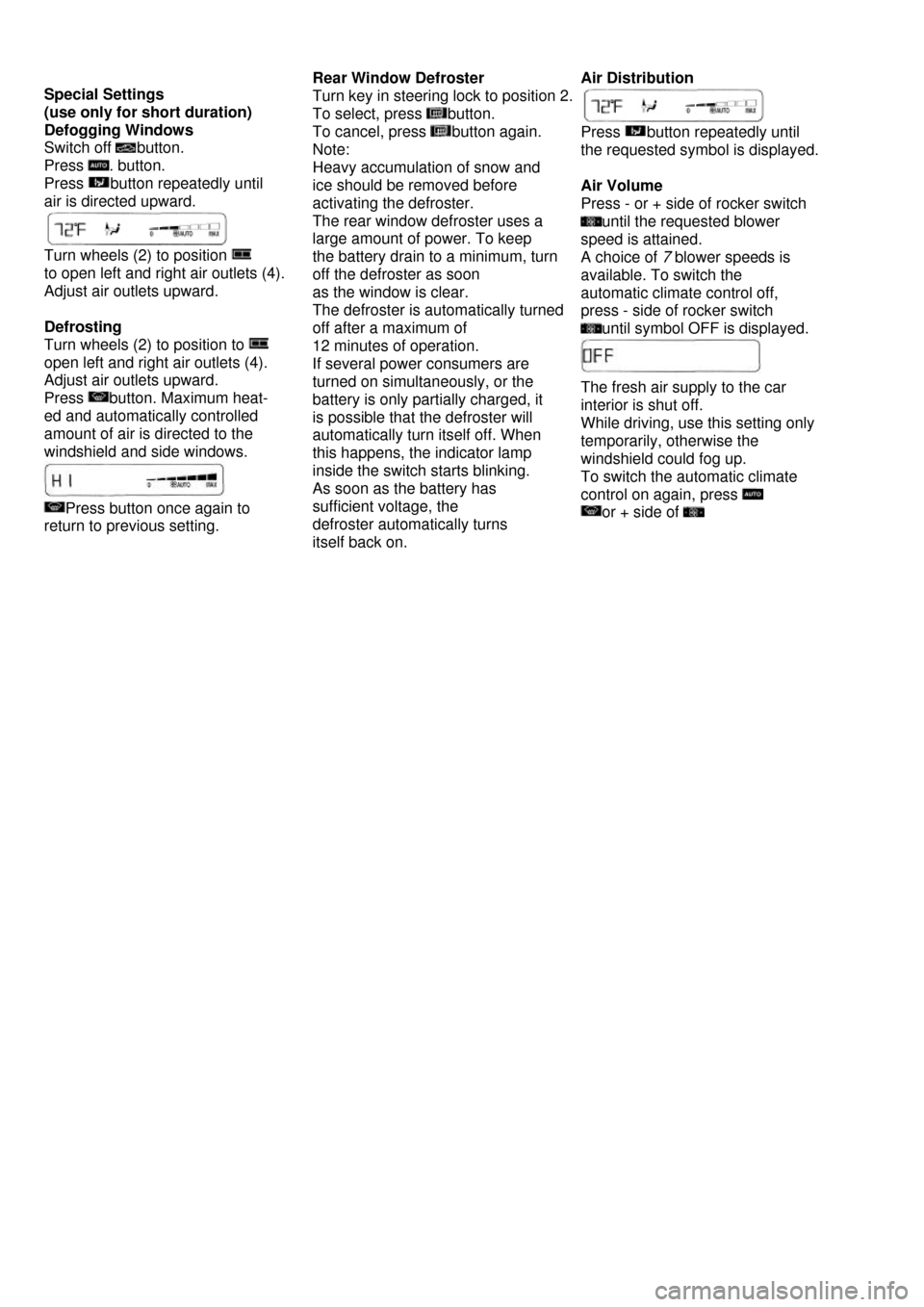
Special Settings
(use only for short duration)
Defogging Windows
Switch off button.
Press . button.
Press button repeatedly until
air is directed upward.
Turn wheels (2) to position
to open left and right air outlets (4).
Adjust air outlets upward.
Defrosting
Turn wheels (2) to position to
open left and right air outlets (4).
Adjust air outlets upward.
Press button. Maximum heat-
ed and automatically controlled
amount of air is directed to the
windshield and side windows.
Press button once again to
return to previous setting.
Rear Window Defroster
Turn key in steering lock to position 2.
To select, press button.
To cancel, press button again.
Note:
Heavy accumulation of snow and
ice should be removed before
activating the defroster.
The rear window defroster uses a
large amount of power. To keep
the battery drain to a minimum, turn
off the defroster as soon
as the window is clear.
The defroster is automatically turned
off after a maximum of
12 minutes of operation.
If several power consumers are
turned on simultaneously, or the
battery is only partially charged, it
is possible that the defroster will
automatically turn itself off. When
this happens, the indicator lamp
inside the switch starts blinking.
As soon as the battery has
sufficient voltage, the
defroster automatically turns
itself back on.
Air Distribution
Press button repeatedly until
the requested symbol is displayed.
Air Volume
Press - or + side of rocker switch
until the requested blower
speed is attained.
A choice of 7 blower speeds is
available. To switch the
automatic climate control off,
press - side of rocker switch
until symbol OFF is displayed.
The fresh air supply to the car
interior is shut off.
While driving, use this setting only
temporarily, otherwise the
windshield could fog up.
To switch the automatic climate
control on again, press
or + side of
Page 18 of 130

Air Recirculation
This mode can be selected to prevent annoying odours or dust from entering the car's interior.
Outside air is not supplied to the car's interior.
To select, press button.
To cancel, press button again.
The system will automatically switch from recirculated air to fresh air
• after approx. 5 minutes at outside temperatures below approx. 40°F (5°C),
• after approx. 30 minutes, at outside temperatures above approx. 40°F (5°C),
• after approx. 5 minutes, if button is pressed.
Notes:
If the windows should fog up from the inside, switch from recirculated air back to fresh air.
At high outside temperatures, the system automatically engages the recirculated air mode thereby
increasing the cooling capacity performance, switching to partially fresh air within 20 minutes.
Dust Filter
Nearly all dust particles and pollen are filtered out before outside air enters the
passenger compartment through the air distribution system.
Notes:
Do not obstruct the air flow by placing objects on the air flowthrough exhaust slots below the rear
window.
Also keep the air intake grille in front of windshield free of snow and debris.
Residual Engine Heat Utilization
With the engine switched off, it is possible to continue heating the interior for a short while.
Air volume and distribution are controlled automatically
To select:
Turn electronic key in steering lock to position 1 or 0 or remove electronic key.
Press button.
This function selection will not activate if the battery charge level is insufficient.
To cancel:
Press button.
The system will automatically shut off
• if you turn electronic key in steering lock to position 2,
• after approx. 30 minutes,
• if the battery voltage drops.
Page 34 of 130

Heated Seats (optional)
Heated Seats (optional)
The front seat heater can be switched on with the electronic key in steering lock
positions 1 or 2.
Press switch to turn on seat heater:
1. Normal seat heating mode. One indicator lamp in the switch lights up.
2. Rapid seat heating mode. Both indicator lamps in the switch light up. After
approximately 5 minutes in the rapid seat heating mode, the seat heater automatically
switches to normal operation and only one indicator lamp will stay on.
Turning off seat heater:
If one indicator lamp is on, press upper half of switch.
If both indicator lamps are on, press lower half of switch.
If left on, the seatheater automatically turns off after approximately 30 minutes of operation.
Note:
When in operation, the seat heater consumes a large amount of electrical power. It is not advisable to use the seat
heater longer than necessary. The seat heaters may automatically switch off if too many power consumers are
switched on at the same time, or if the battery charge is low. When this occurs, the indicator lamp in the switch will
blink (both indicator lamps blink during rapid seat heating mode). The seat heaters will switch on again automatically
as soon as sufficient voltage is available. If the blinking of the indicator lamps is distracting to you, the seat heaters
can be switched off.
Page 50 of 130

Steering Lock
0 - The electronic key can be withdrawn in this position only. The steering is locked with the electronic key removed
from the steering lock. The electronic key an be removed only with the selector lever in position "P" and the foot off
the brake pedal. After removing the electronic key or with the electronic key in steering lock position 0, the
selector lever is locked in position "P".
1 - Steering is unlocked. (If necessary, move steering wheel slightly to allow the electronic key to be turned clockwise
to position 1.) Most electrical consumers can be operated. For detailed information see respective subjects.
2 - Driving position.
3 - Starting position.
Refer to Index for Starting and turning off the engine.
Warning !
When leaving the vehicle always remove the electronic key from the steering lock, and lock the vehicle.
Do not leave children unattended in the vehicle, or with access to an unlocked vehicle.
Unsupervised use of vehicle equipment may cause serious personal injury.
Important !
If the electronic key is left in the steering lock position 0 for an extended period of time, it can no longer be turned
in the lock. In this case, remove electronic key from steering lock and reinsert.
Notes:
A warning sounds when the driver's door is opened with the electronic key in steering lock position 1 or 0. With the
engine at idle speed, the charging rate of the alternator (output) is limited. It is therefore recommended to turn off
unnecessary electrical consumers while driving in stop-and-go traffic. This precaution helps to avoid draining of the
battery. Unnecessary strain on the battery and charging system may be minimized by turning off the following power
consumers, for example: Heated seats, rear window defroster. In addition, the automatic climate air volume control
should be set to the lowest position. The steering lock can only be unlocked with the vehicle battery properly
connected.
Caution !
To prevent accelerated battery discharge and a possible dead battery, always remove the electronic key from the
steering lock. Do not leave the electronic key in steering lock position 0.
Page 51 of 130
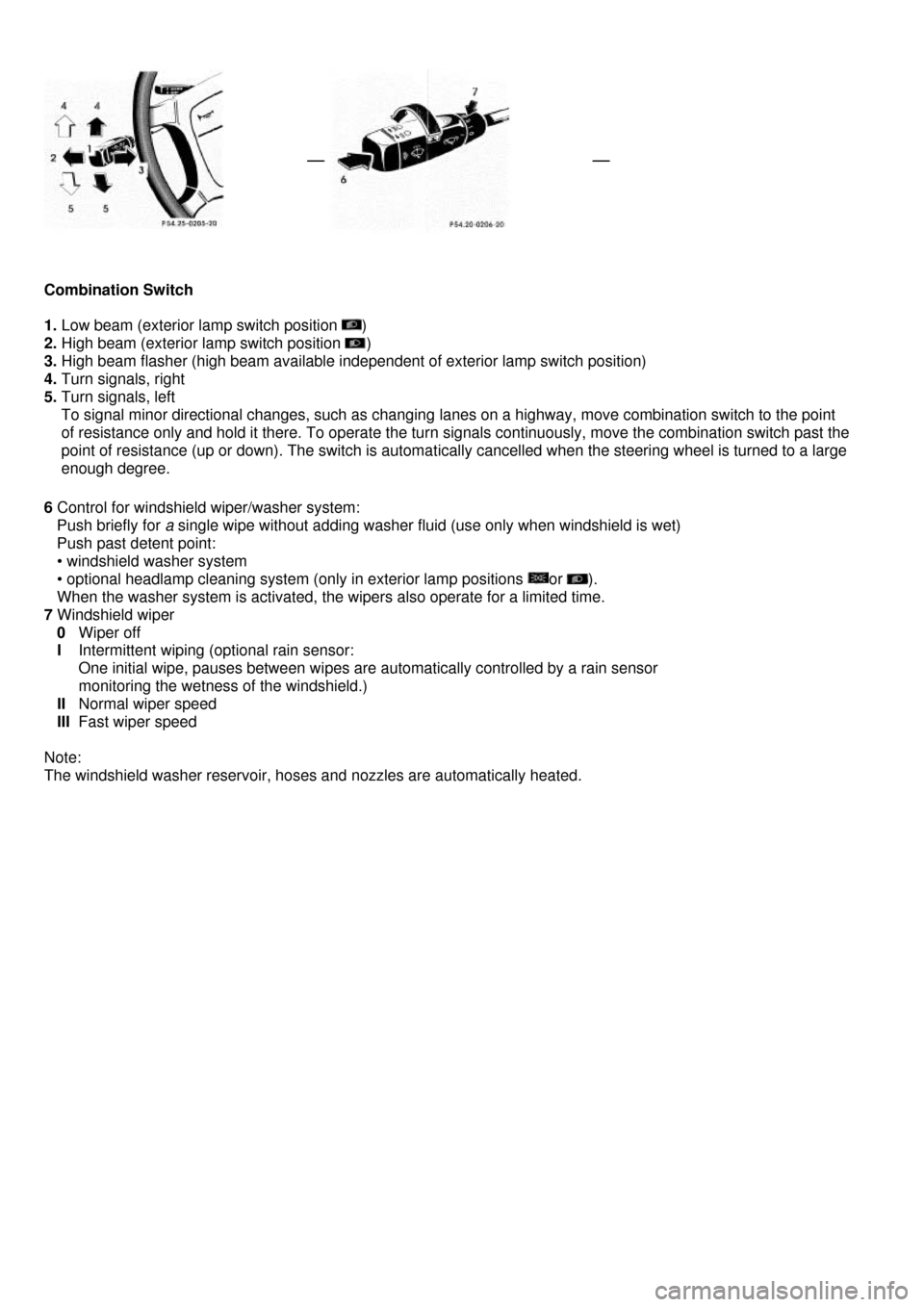
Combination Switch
1. Low beam (exterior lamp switch position )
2. High beam (exterior lamp switch position )
3. High beam flasher (high beam available independent of exterior lamp switch position)
4. Turn signals, right
5. Turn signals, left
To signal minor directional changes, such as changing lanes on a highway, move combination switch to the point
of resistance only and hold it there. To operate the turn signals continuously, move the combination switch past the
point of resistance (up or down). The switch is automatically cancelled when the steering wheel is turned to a large
enough degree.
6 Control for windshield wiper/washer system:
Push briefly for a single wipe without adding washer fluid (use only when windshield is wet)
Push past detent point:
• windshield washer system
• optional headlamp cleaning system (only in exterior lamp positions or ).
When the washer system is activated, the wipers also operate for a limited time.
7 Windshield wiper
0 Wiper off
I Intermittent wiping (optional rain sensor:
One initial wipe, pauses between wipes are automatically controlled by a rain sensor
monitoring the wetness of the windshield.)
II Normal wiper speed
III Fast wiper speed
Note:
The windshield washer reservoir, hoses and nozzles are automatically heated.
Page 55 of 130

Exterior Rear View Mirrors
The switch is located on the center console.
Turn electronic key in steering lock to position 2.
First select the mirror to be adjusted - press button:
Left mirror
Right mirror
To adjust, toggle the switch forward, backward or to either side. With the electronic key in steering lock position 2, the
driver's side mirror reflection brightness responds to changes in light sensitivity. With gear selector lever in position
"R",
or with the interior lamp switched on, the driver's side mirror brightness does not respond to changes in light
sensitivity.
Warning !
Exercise care when using the passenger-side mirror. The passenger-side exterior mirror is convex
(outwardly curved surface for a wider field of view). Objects in mirror are closer than they appear.
Check your inside rear view mirror or glance over your shoulder before changing lanes.
Notes:
The exterior mirrors have electrically heated glass. The heater switches on automatically, depending on outside
temperature. If an exterior mirror housing is forcibly pivoted from its normal position, it must be repositioned by
applying firm pressure until it snaps into place.
Page 57 of 130
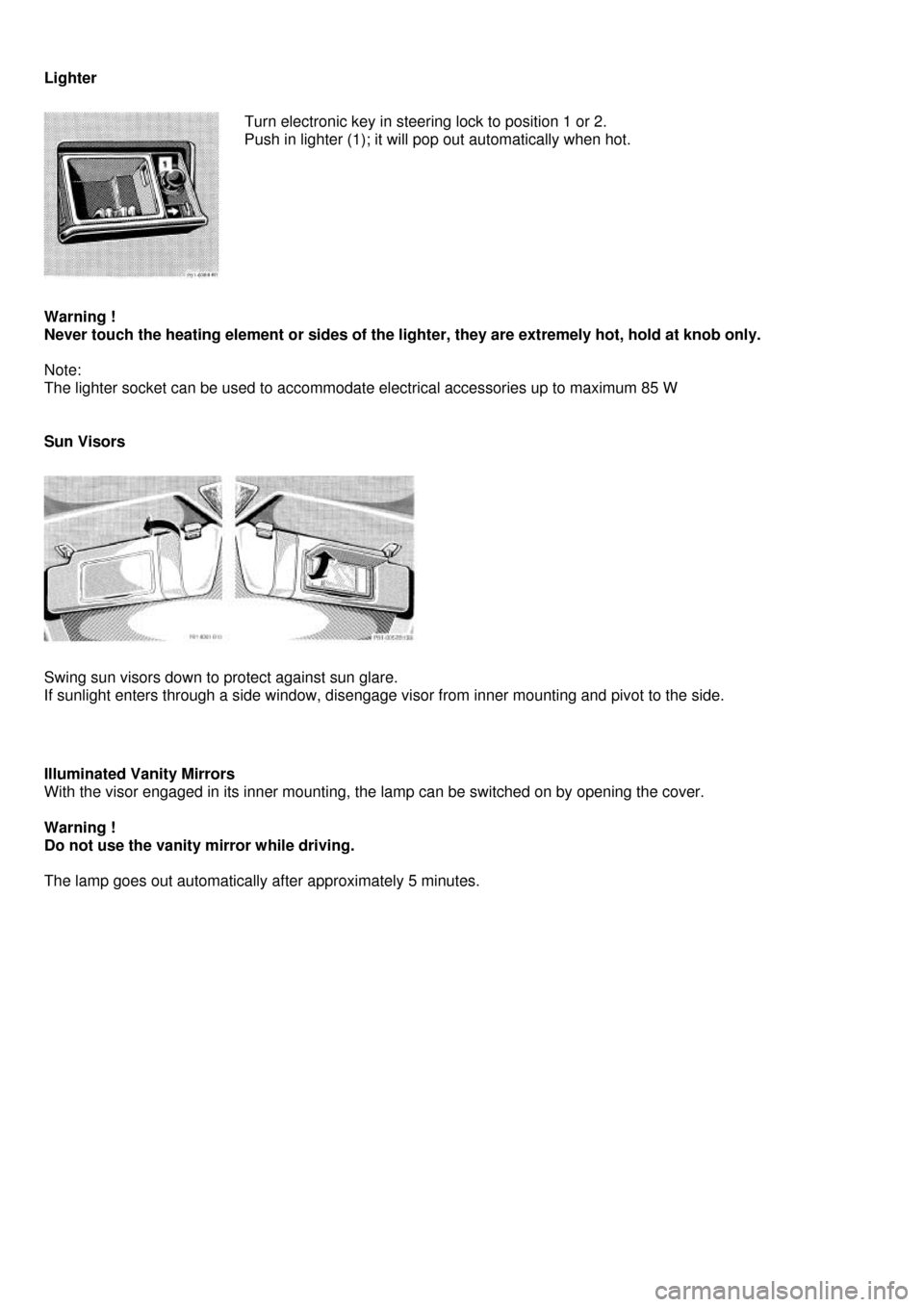
Lighter
Turn electronic key in steering lock to position 1 or 2.
Push in lighter (1); it will pop out automatically when hot.
Warning !
Never touch the heating element or sides of the lighter, they are extremely hot, hold at knob only.
Note:
The lighter socket can be used to accommodate electrical accessories up to maximum 85 W
Sun Visors
Swing sun visors down to protect against sun glare.
If sunlight enters through a side window, disengage visor from inner mounting and pivot to the side.
Illuminated Vanity Mirrors
With the visor engaged in its inner mounting, the lamp can be switched on by opening the cover.
Warning !
Do not use the vanity mirror while driving.
The lamp goes out automatically after approximately 5 minutes.
Page 69 of 130

Important !
Coasting the vehicle, or driving for any other reason with selector lever in "N" can result in transmission damage
that is not covered by the Mercedes-Benz Limited Warranty.
D - The transmission automatically upshifts through 5th gear. Position "D" provides optimum driving characteristics
under all normal operating conditions.
4 - Upshift through 4th gear only.
Suitable for performance driving. To shift from position "D" to "4", push selector lever to the left.
3 - Upshift through 3rd gear only.
Suitable for moderately steep hill s. Since the transmission does not shift hi gher than 3rd gear, this gear selection
will allow use of the engine's braking power downhill.
2 - Upshift through 2nd gear only.
For driving in mountainous regions or under extreme operating conditions. This gear selection will allow use of the
engine's braking power when descending steep grades.
1 - In this position, the engine's braking effect is utilized by shifting into 1st gear.
Use this position while descending very steep or l engthy downgrades and only at speeds below 40 mph (60
km/h).
Important !
With selector lever in position "D", "4" or "3", upshifting from 1st to 2nd to 3rd gear is delayed depending on vehicle
speed and engine temperature. This allows the catalytic converter to heat up more quickly to operating temperatures.
During the brief warm-up period this delayed upshift and increased engine noise might be perceived as a malfunction.
However, neither the engine nor transmission are negatively affected by this mode of operation.
The delayed upshift is effective with vehicle speeds below 31 mph (50 km/h) at partial throttle and engine
temperatures below 95°F (35°C). To avoid overrevving the engi ne when the selector lever is moved to a lower driving
range, the transmission will not shift to a lower gear, if the engine's speed limit would be exceeded. In this case there
will be no downshift, even when the vehicle speed reaches t he engine's speed limit of that gear, e.g. by applying the
service brakes. Continue driving in the usual manner. The transmission will then shift down automatically.
To prevent the engine from laboring at low RPM when driv ing uphill gradients or with your vehicle heavily loaded, the
automatic transmission will downshift when necessary to maintain engine RPM within the best torque range.
Warning!
On slippery road surfaces, never downshift in order to obtain braking action. This could result in drive wheel
slip and reduced vehicle control. Your vehicle's AB S will not prevent this type of loss of control.
Warning !
On slippery road surfaces, never downshift in order to obtain braking action. This could result in rear
wheel slip and reduced vehicle control. Your vehicle' s ABS will not prevent this type of loss of control.
Maneuvering
To maneuver in tight areas, e.g. when pulling into a parki ng space, control the vehicle speed by gradually releasing
the
brakes. Accelerate gently and never abruptly step on the ac celerator. To rock a vehicle out of soft ground (mud or
snow),
alternately shift from forward to revers e, while applying slight partial throttle. Rocking a vehicle free in this manner
may
cause the ABS malfunction indicator lamp to come on. Turn off and restart the engine to clear the malfunction
indication.
Stopping
For brief stops, e.g. at traffic lights, leave the transmission in gear and hold vehicle with the service brake. For longer
stops with the engine idling, shift into "N" or "P" and hold the vehicle with the service brake. When stopping the
vehicle
on an uphill gradient, do not hold it with the accelerator, use the brake. This avoids unnecessary transmission heat
build up.
Warning !
Getting out of your vehicle with the selector lever not fully engaged in position "P" is dangerous. Also,
when parked on an incline, position "P" alone may not prevent your vehicle from moving, possibly hitting
people or objects. Always set the parking brake in a ddition to shifting to position "P". When parked on
an incline, also turn front wheel against curb.
Page 72 of 130

Charge Indicator Lamp
Should the charge indicator lamp fail to come on prior to starting when the electronic key is in steering lock position 2
or should it fail to go out after starting or during operati on, this indicates a fault which must be repaired at an
authorized Mercedes-Benz dealer immediately.
If the charge indicator lamp comes on while the engine is ru nning, this may indicate that the poly-V-belt has broken.
Should this condition occur, the poly-V-bel t must be replaced before continuing to operate the vehicle. Otherwise, the
engine will overheat due to an inoperative water pump which may result in damage to the engine.
Do not continue to drive the vehicle with the charge indicator lamp illuminated. Doing so could result in serious engine
damage that is not covered by the Mercedes-Benz Limited Warranty.
Low Engine Oil Level Warning Lamp
With the electronic key in steering lock position 2, the o il level warning lamp comes on. It should go out immediately
when the engine is running.
If the warning lamp does not go out after starting the engi ne, or comes on with the engine running and at operating
temperature, the engine oil level has dropped to approximately the minimum mark on the dipstick.
When this occurs, the warning lamp will first come on intermittently and then stay on if the oil level drops further.
If no oil leaks are noted, continue to drive to the nearest service station where the engine oil should be topped to the
"full" mark on the dipstick with an approved oil.
The low engine oil level warning light should not be ignored. Extended driving with the light illuminated could result in
serious engine damage that is not covered by the Mercedes -Benz Limited Warranty. In addition to the warning lamp,
the engine oil level should be periodically checked with t he dipstick (or via the odometer display - Model C280 and
C43 AMG only), for example during a fuel stop, or before a long trip (see Engine Oil Level, Checking in Index)
Page 74 of 130

Outside Temperature Indicator
The temperature sensor is located in the front bumper area. Due to its location, the sensor can be affected by road or
engine heat during idling or slow driving. This means that the accuracy of the displayed temperature can only be
verified by comparison to a thermometer placed next, to the sensor, not by comparison to external displays (e.g. bank
signs etc.).
Adaptation to ambient temperature takes place in steps and depends on the prevailing driving conditions (stop-and-
go or moderate, constant driving) and amount of temperature change.
Warning !
The outside temperature indicator is not designed to serve as an Ice-Warning Device and is therefore
unsuitable for that purpose. Indicated temperatures just above the freezing point do not guarantee that the
road surface is free of ice.
Coolant Temperature Gauge
If the antifreeze mixture is effective to -22°F (-30°C), the boiling point of the c oolant in the pressurized cooling system
of your vehicle is approx. 266°F (130°C). During severe operating conditions and stop-and-go city traffic, the coolant
temperature may rise close to the red marking. The engine should not be operated with the coolant temperature in
the red zone. Doing so may cause serious engine damage wh ich is not covered by the Mercedes-Benz Limited
Warranty.
Warning !
• Driving when your engine is badly overheated can cause some fluids which may
have leaked into the engine compartment to catch fire. You could be seriously burned.
• Steam from an overheated engine can cause serious burns and can occur just by opening
the engine hood. Stay away from the engine if you see or hear steam coming from it.
Turn off the engine, get out of the vehicle and do not stand near the car until it cools down.