lock MERCEDES-BENZ C-Class 2000 W202 Owner's Guide
[x] Cancel search | Manufacturer: MERCEDES-BENZ, Model Year: 2000, Model line: C-Class, Model: MERCEDES-BENZ C-Class 2000 W202Pages: 130, PDF Size: 2.43 MB
Page 43 of 130
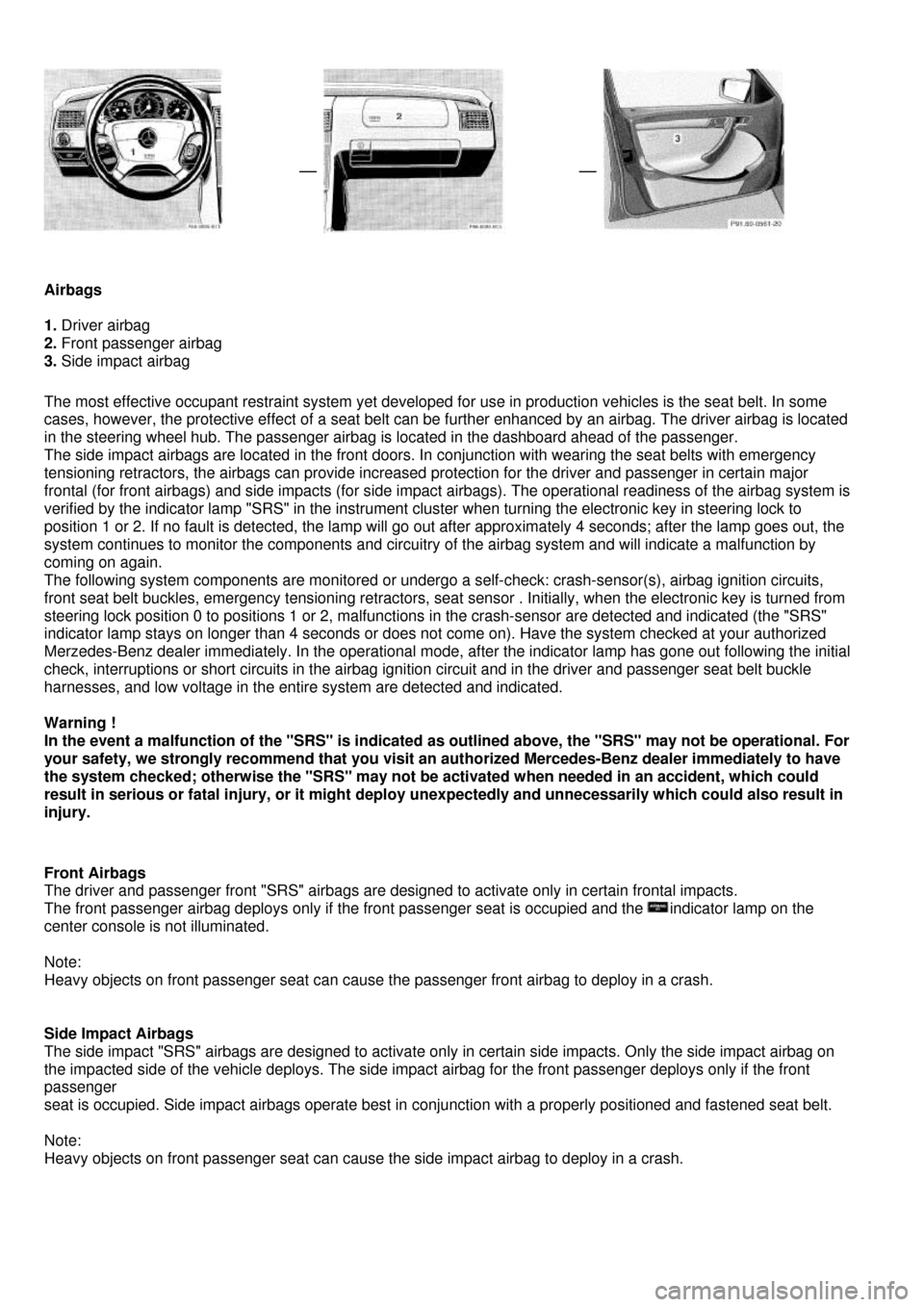
Airbags
1. Driver airbag
2. Front passenger airbag
3. Side impact airbag
The most effective occupant restraint system yet developed for use in production vehicles is the seat belt. In some
cases, however, the protective effect of a seat belt can be further enhanced by an airbag. The driver airbag is located
in the steering wheel hub. The passenger airbag is located in the dashboard ahead of the passenger.
The side impact airbags are located in the front doors. In conjunction with wearing the seat belts with emergency
tensioning retractors, the airbags can provide increased protection for the driver and passenger in certain major
frontal (for front airbags) and side impacts (for side impact airbags). The operational readiness of the airbag system is
verified by the indicator lamp "SRS" in the instrument cluster when turning the electronic key in steering lock to
position 1 or 2. If no fault is detected, the lamp will go out after approximately 4 seconds; after the lamp goes out, the
system continues to monitor the components and circuitry of the airbag system and will indicate a malfunction by
coming on again.
The following system components are monitored or undergo a self-check: crash-sensor(s), airbag ignition circuits,
front seat belt buckles, emergency tensioning retractors, seat sensor . Initially, when the electronic key is turned from
steering lock position 0 to positions 1 or 2, malfunctions in the crash-sensor are detected and indicated (the "SRS"
indicator lamp stays on longer than 4 seconds or does not come on). Have the system checked at your authorized
Merzedes-Benz dealer immediately. In the operational mode, after the indicator lamp has gone out following the initial
check, interruptions or short circuits in the airbag ignition circuit and in the driver and passenger seat belt buckle
harnesses, and low voltage in the entire system are detected and indicated.
Warning !
In the event a malfunction of the "SRS" is indicated as outlined above, the "SRS" may not be operational. For
your safety, we strongly recommend that you visit an authorized Mercedes-Benz dealer immediately to have
the system checked; otherwise the "SRS" may not be activated when needed in an accident, which could
result in serious or fatal injury, or it might deploy unexpectedly and unnecessarily which could also result in
injury.
Front Airbags
The driver and passenger front "SRS" airbags are designed to activate only in certain frontal impacts.
The front passenger airbag deploys only if the front passenger seat is occupied and the indicator lamp on the
center console is not illuminated.
Note:
Heavy objects on front passenger seat can cause the passenger front airbag to deploy in a crash.
Side Impact Airbags
The side impact "SRS" airbags are designed to activate only in certain side impacts. Only the side impact airbag on
the impacted side of the vehicle deploys. The side impact airbag for the front passenger deploys only if the front
passenger
seat is occupied. Side impact airbags operate best in conjunction with a properly positioned and fastened seat belt.
Note:
Heavy objects on front passenger seat can cause the side impact airbag to deploy in a crash.
Page 46 of 130

Infant and Child Restraint Systems
We recommend that all infants and children be properly restrained at all times while the vehicle is in
motion. All lap-shoulder belts except driver seat have special seat belt retractors for secure fastening
of child restraints. To fasten a child restraint, use th is seat belt: Follow child restraint instructions for
routing. Then pull shoulder belt out completely and let it retract. During the seat belt retraction a
ratcheting sound can be heard to indicate that the spec ial seat belt retractor is activated. The belt is
now locked. Push down on child restraint to take up any slack. To deactivate, release seat belt
buckle and let seat belt retract completely. The seat belt can again be used in the usual manner.
Warning !
Never release the seat belt buckle while vehicle is in motion, since the special seat belt
retractor will be deactivated.
Important !
The use of infant or child restraints is required by law in all 50 states and all Canadian provinces.
Infants and small children should be seated in an approp riate infant or child restraint system properly
secured by a lap-shoulder belt, and that complies with U.S. Federal Motor Vehicle Safety Standard
213 and Canadian Motor Vehicle Safety Standard 213. A statement by the child restraint
manufacturer of compliance with this standard ca n be found on the instruction label on the restraint
and in the instruction manual provided with the re straint. When using any infant or child restraint
system, be sure to carefully read and follow all manu facturer's instructions for installation and use.
Please read and observe warning labels affixed to inside of vehicle.
Children 12 years old and under must never ride in the front seat, except in a Mercedes-Benz
authorized BabySmart™ compatible child seat, which operates with the BabySmart™ system
installed in the vehicle to deactivate the passenger side front airbag when it is properly
installed. Otherwise they will be struck by the airbag when it inflates in a crash. If this
happens, serious or fatal injury will result.
According to accident statistics, children are safer when properly restrained in the rear
seating positions than in the front seating positions. Infants and small children must ride in
back seats and be seated in an infant or child restraint system, which is properly secured
with the vehicle's seat belt, fully in accordan ce with the seat manufacturer's instructions.
Infants and small children should never share a seat belt with another occupant. During an
accident, they could be crushed between the occupant and seat belt. Children too big for
child restraint systems must ride in back seats using regular seat belts. Position shoulder
belt across chest and shoulder, not face or neck. A booster seat is necessary to achieve
proper belt positioning for children from 41 Ibs. to the point where a lap/shoulder belt fits
properly without one.
When the child restraint is not in use, remove it from the car or secure it with the seat belt to
prevent the child restraint from becoming a projectile in the event of an accident.
U.S.A. Models only:
Since 1986 all U.S. child restraints comply with U. S. regulations without the use of a tether strap.
Canada Models only: This vehicle is provided with tether anchorages for a top tether strap. Consult
your authorized Mercedes-Benz dealer for installa tion of these anchorages. In compliance with
Canadian Motor Vehicle Safety Standard 210.1, ch ild restraint tether anchorage hardware is
attached to the tool kit located in the trunk.
Page 47 of 130
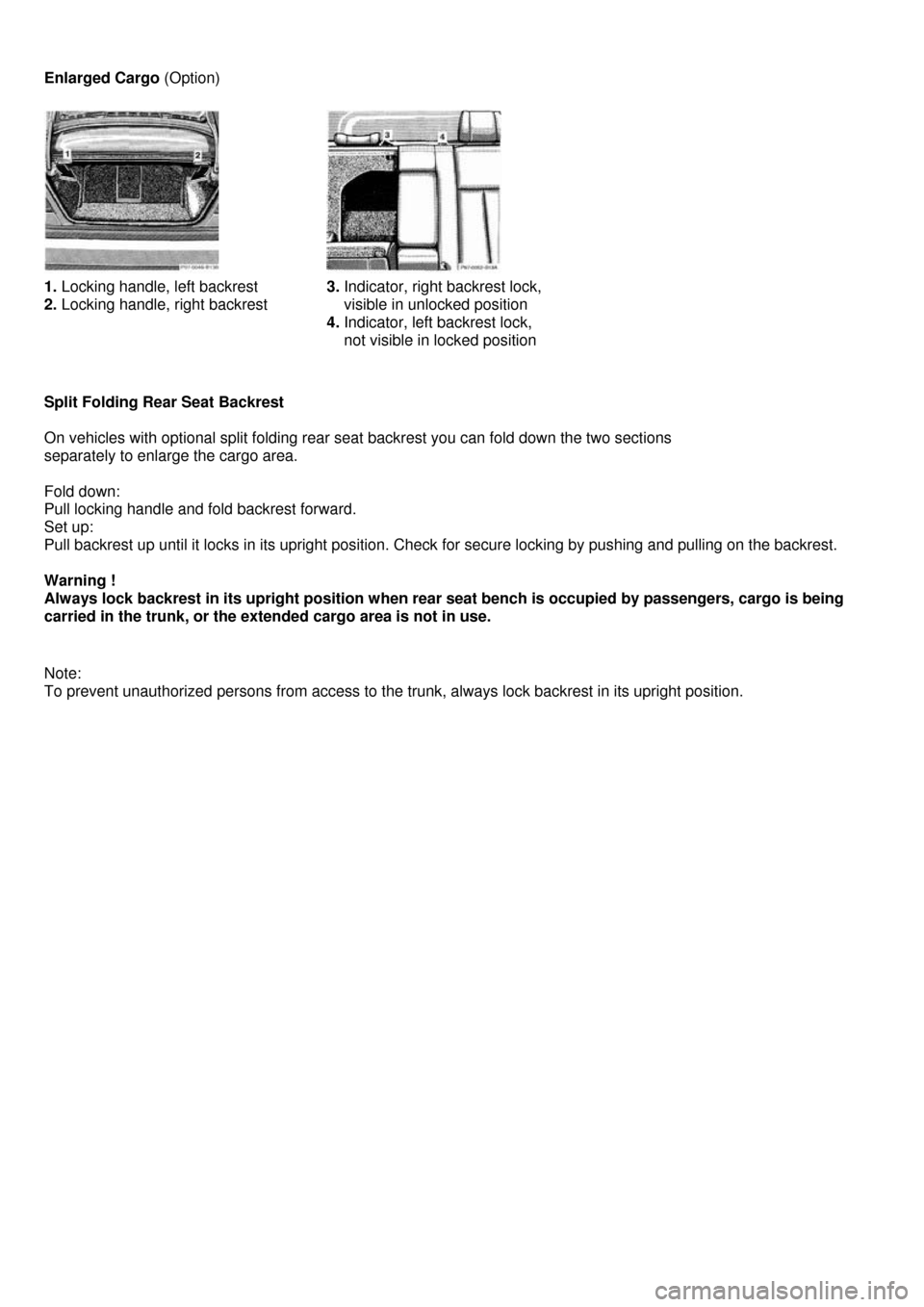
Enlarged Cargo (Option)
1. Locking handle, left backrest
2. Locking handle, right backrest
3. Indicator, right backrest lock,
visible in unlocked position
4. Indicator, left backrest lock,
not visible in locked position
Split Folding Rear Seat Backrest
On vehicles with optional split folding rear seat backrest you can fold down the two sections
separately to enlarge the cargo area.
Fold down:
Pull locking handle and fold backrest forward.
Set up:
Pull backrest up until it locks in its upright position. Check for secure locking by pushing and pulling on the backrest.
Warning !
Always lock backrest in its upright position when rear seat bench is occupied by passengers, cargo is being
carried in the trunk, or the extended cargo area is not in use.
Note:
To prevent unauthorized persons from access to the trunk, always lock backrest in its upright position.
Page 48 of 130
Loading instructions
(Vehicles with enlarged cargo area)
The total load weight including vehicle occupants and luggage/ cargo should not exceed the vehicle capacity
weight indicated on the certification tag which can be found on the left door pillar. The handling characteristics
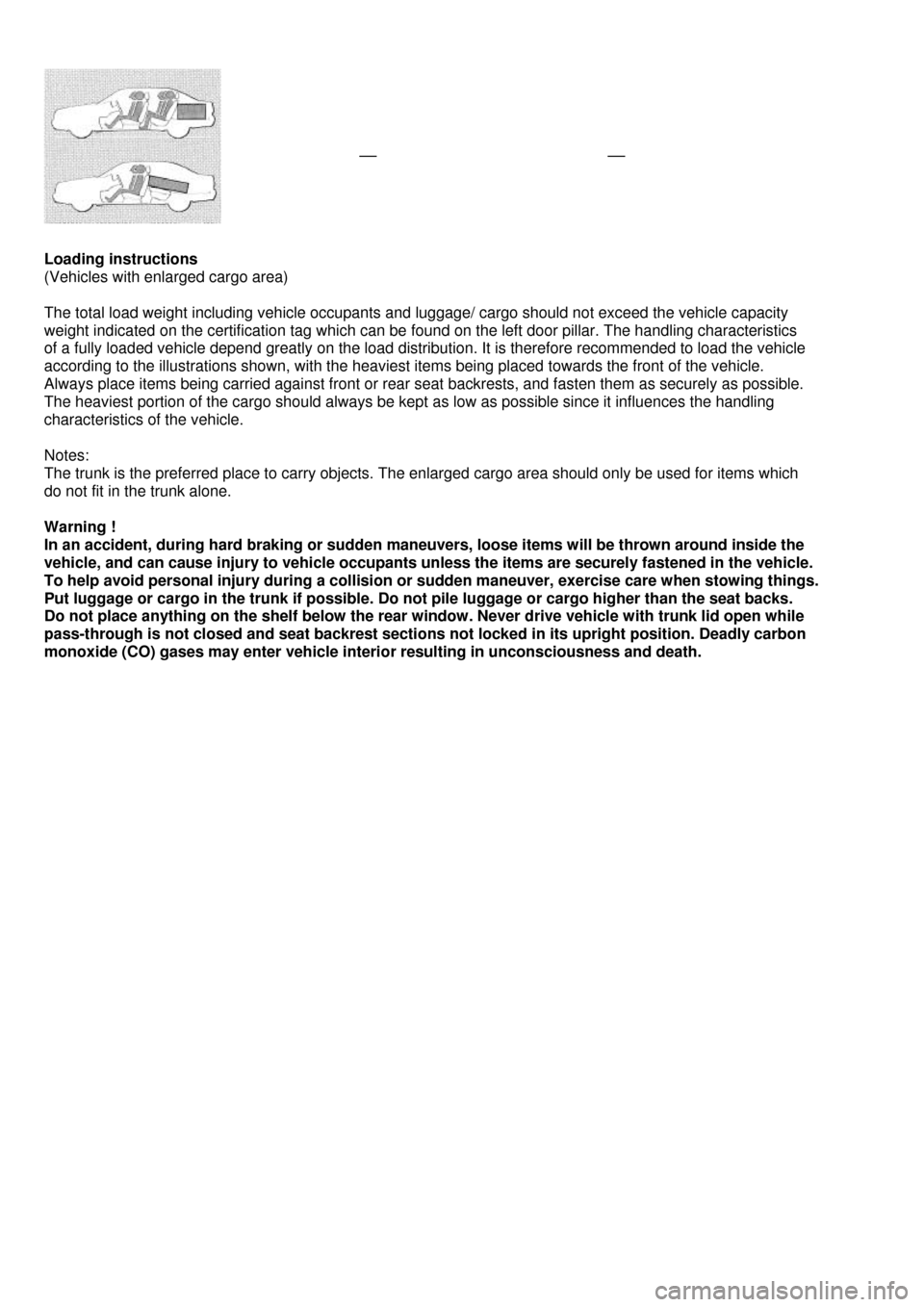
of a fully loaded vehicle depend greatly on the load distribution. It is therefore recommended to load the vehicle
according to the illustrations shown, with the heaviest items being placed towards the front of the vehicle.
Always place items being carried against front or rear seat backrests, and fasten them as securely as possible.
The heaviest portion of the cargo should always be kept as low as possible since it influences the handling
characteristics of the vehicle.
Notes:
The trunk is the preferred place to carry objects. The enlarged cargo area should only be used for items which
do not fit in the trunk alone.
Warning !
In an accident, during hard braking or sudden maneuvers, loose items will be thrown around inside the
vehicle, and can cause injury to vehicle occupants unless the items are securely fastened in the vehicle.
To help avoid personal injury during a collision or sudden maneuver, exercise care when stowing things.
Put luggage or cargo in the trunk if possible. Do not pile luggage or cargo higher than the seat backs.
Do not place anything on the shelf below the rear window. Never drive vehicle with trunk lid open while
pass-through is not closed and seat backrest sections not locked in its upright position. Deadly carbon
monoxide (CO) gases may enter vehicle interior resulting in unconsciousness and death.
Page 50 of 130
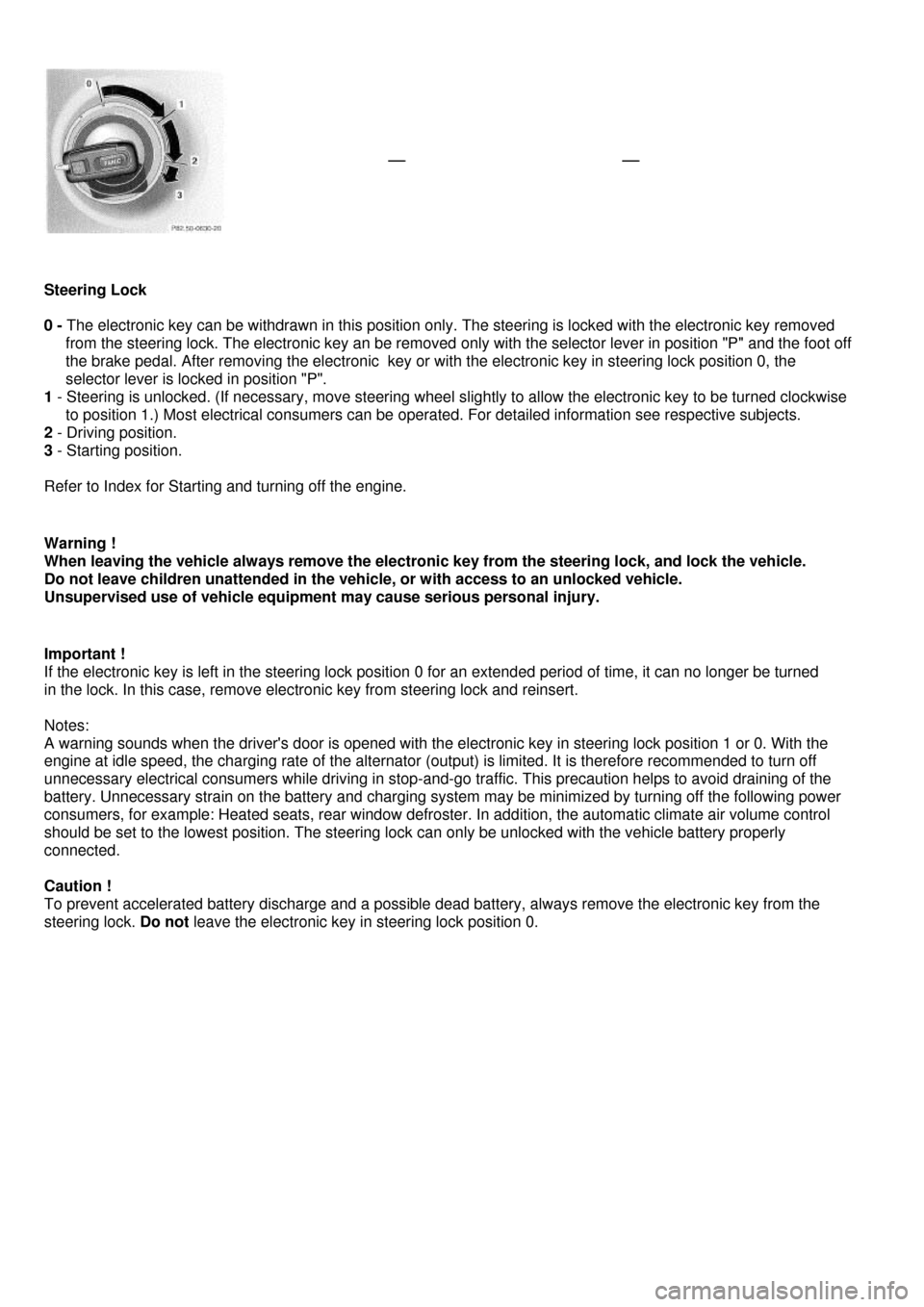
Steering Lock
0 - The electronic key can be withdrawn in this position only. The steering is locked with the electronic key removed
from the steering lock. The electronic key an be removed only with the selector lever in position "P" and the foot off
the brake pedal. After removing the electronic key or with the electronic key in steering lock position 0, the
selector lever is locked in position "P".
1 - Steering is unlocked. (If necessary, move steering wheel slightly to allow the electronic key to be turned clockwise
to position 1.) Most electrical consumers can be operated. For detailed information see respective subjects.
2 - Driving position.
3 - Starting position.
Refer to Index for Starting and turning off the engine.
Warning !
When leaving the vehicle always remove the electronic key from the steering lock, and lock the vehicle.
Do not leave children unattended in the vehicle, or with access to an unlocked vehicle.
Unsupervised use of vehicle equipment may cause serious personal injury.
Important !
If the electronic key is left in the steering lock position 0 for an extended period of time, it can no longer be turned
in the lock. In this case, remove electronic key from steering lock and reinsert.
Notes:
A warning sounds when the driver's door is opened with the electronic key in steering lock position 1 or 0. With the
engine at idle speed, the charging rate of the alternator (output) is limited. It is therefore recommended to turn off
unnecessary electrical consumers while driving in stop-and-go traffic. This precaution helps to avoid draining of the
battery. Unnecessary strain on the battery and charging system may be minimized by turning off the following power
consumers, for example: Heated seats, rear window defroster. In addition, the automatic climate air volume control
should be set to the lowest position. The steering lock can only be unlocked with the vehicle battery properly
connected.
Caution !
To prevent accelerated battery discharge and a possible dead battery, always remove the electronic key from the
steering lock. Do not leave the electronic key in steering lock position 0.
Page 52 of 130

Windshield Washer Fluid Mixing Ratio
For temperatures above freezing: MB Windshield Washer Concentrate "S" and water 1 part "S" to
100 parts water (40 ml "S" to 1 gallon water). For temperature below freezing: MB Windshield
Washer Concentrate "S" and commercially available premixed windshield washer solvent/antifreeze
1 part "S" to 100 parts solvent (40 ml "S" to 1 gallon solvent).
Windshield Wiper Smears
If the windshield wiper smears the windshield, even dur ing rain, activate the washer system as often
as necessary. The fluid in the washer reservoir should be mixed in the correct ratio.
Blocked Windshield Wiper
If the windshield wiper becomes blocked (for example, due to snow), switch off the wiper. For safety
reasons before removing ice or snow, remove electronic key from steering lock. Remove blockage.
Activate combination switch again (electronic key in steering lock position 1).
Turn Signal Failure
If one of the turn signals fails, the turn signal indicator system flashes and sounds at a faster than
normal rate.
Page 53 of 130
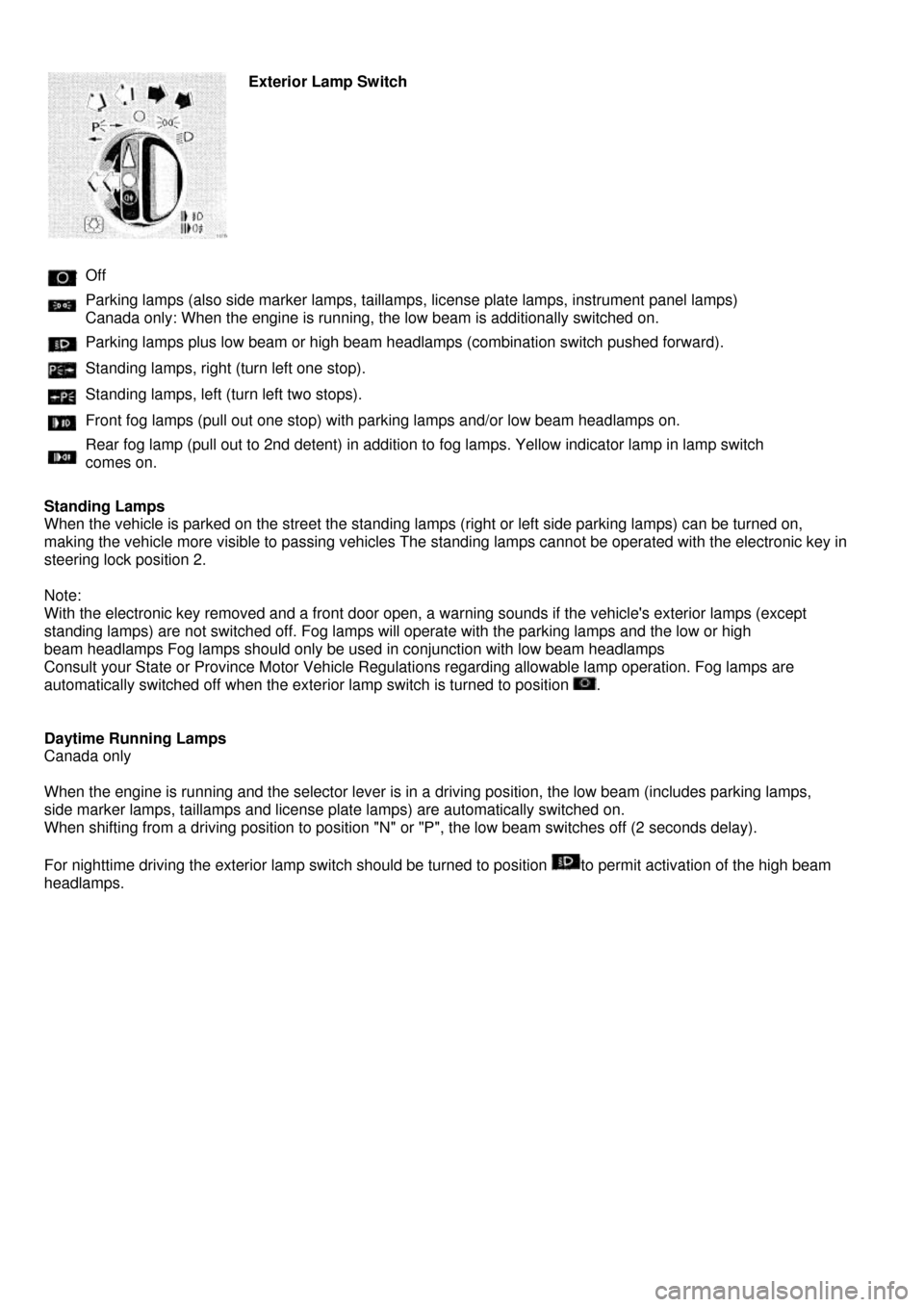
Exterior Lamp Switch
Off
Parking lamps (also side marker lamps, taillamps, license plate lamps, instrument panel lamps)
Canada only: When the engine is running, the low beam is additionally switched on.
Parking lamps plus low beam or high beam headlamps (combination switch pushed forward).
Standing lamps, right (turn left one stop).
Standing lamps, left (turn left two stops).
Front fog lamps (pull out one stop) with parking lamps and/or low beam headlamps on.
Rear fog lamp (pull out to 2nd detent) in addition to fog lamps. Yellow indicator lamp in lamp switch
comes on.
Standing Lamps
When the vehicle is parked on the street the standing lamps (right or left side parking lamps) can be turned on,
making the vehicle more visible to passing vehicles The standing lamps cannot be operated with the electronic key in
steering lock position 2.
Note:
With the electronic key removed and a front door open, a warning sounds if the vehicle's exterior lamps (except
standing lamps) are not switched off. Fog lamps will operate with the parking lamps and the low or high
beam headlamps Fog lamps should only be used in conjunction with low beam headlamps
Consult your State or Province Motor Vehicle Regulations regarding allowable lamp operation. Fog lamps are
automatically switched off when the exterior lamp switch is turned to position .
Daytime Running Lamps
Canada only
When the engine is running and the selector lever is in a driving position, the low beam (includes parking lamps,
side marker lamps, taillamps and license plate lamps) are automatically switched on.
When shifting from a driving position to position "N" or "P", the low beam switches off (2 seconds delay).
For nighttime driving the exterior lamp switch should be turned to position to permit activation of the high beam
headlamps.
Page 54 of 130

Night Security Illumination
When exiting the vehicle after driving with the exterior lamps on, they switch on again for added illumination for
approximately 30 seconds after closing the last door. The lamp-on time period can be changed at your
Mercedes-Benz dealer.
Inside Rear View Mirror
Manually adjust the mirror.
Use your inside mirror to determine the size and distan ce of objects seen in the passenger side convex mirror.
Antiglare Night Position
With the electronic key in steering lock position 2, the mirror reflection brightness responds to changes in light
sensitivity. With gear selector lever in position "R", or with the interior lamp switched on, the mirror brightness
does not respond to changes in light sensitivity.
Note:
The automatic antiglare function is restricted, if incoming light is not aimed directly at sensors in the mirror.
Page 55 of 130
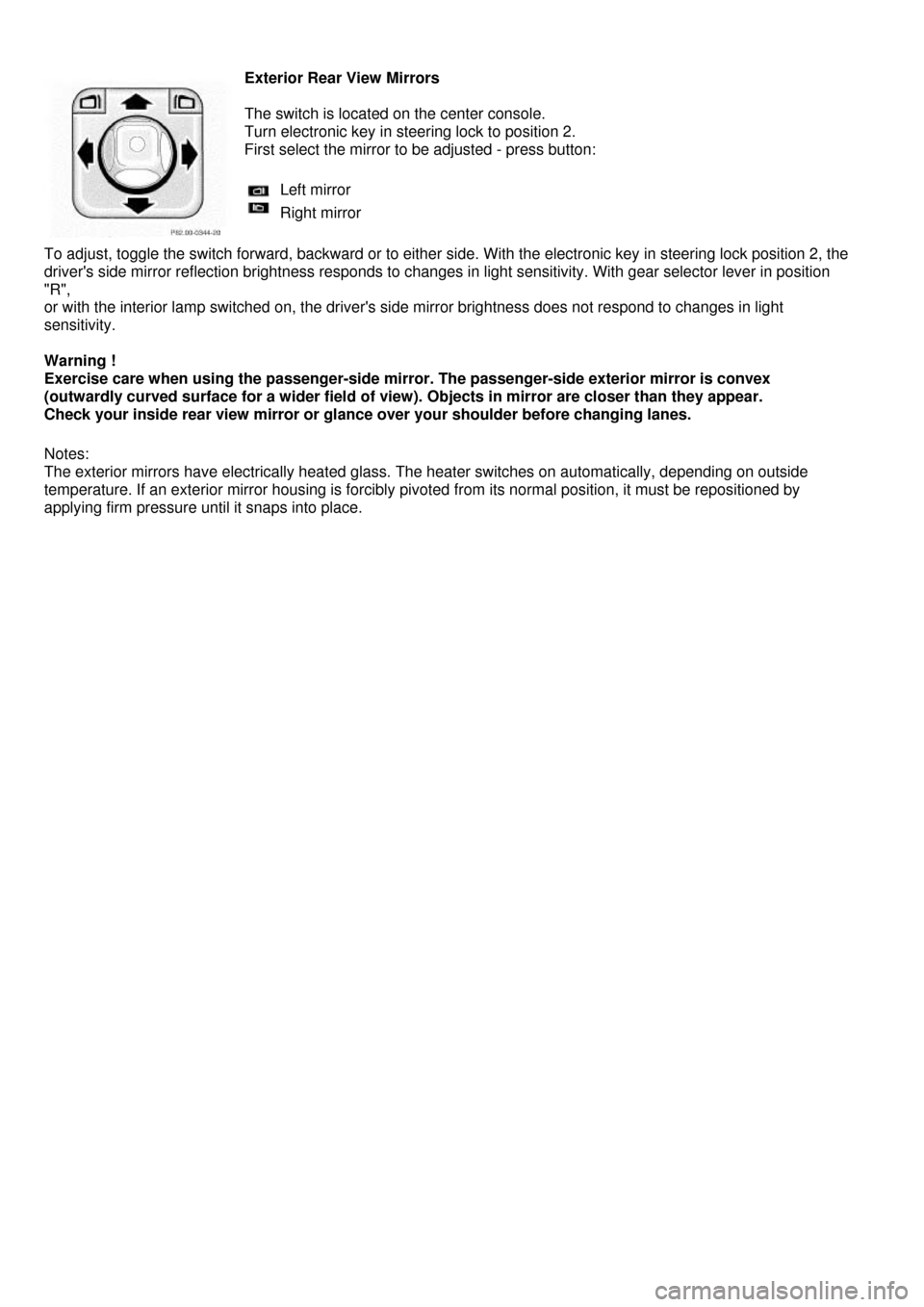
Exterior Rear View Mirrors
The switch is located on the center console.
Turn electronic key in steering lock to position 2.
First select the mirror to be adjusted - press button:
Left mirror
Right mirror
To adjust, toggle the switch forward, backward or to either side. With the electronic key in steering lock position 2, the
driver's side mirror reflection brightness responds to changes in light sensitivity. With gear selector lever in position
"R",
or with the interior lamp switched on, the driver's side mirror brightness does not respond to changes in light
sensitivity.
Warning !
Exercise care when using the passenger-side mirror. The passenger-side exterior mirror is convex
(outwardly curved surface for a wider field of view). Objects in mirror are closer than they appear.
Check your inside rear view mirror or glance over your shoulder before changing lanes.
Notes:
The exterior mirrors have electrically heated glass. The heater switches on automatically, depending on outside
temperature. If an exterior mirror housing is forcibly pivoted from its normal position, it must be repositioned by
applying firm pressure until it snaps into place.
Page 57 of 130
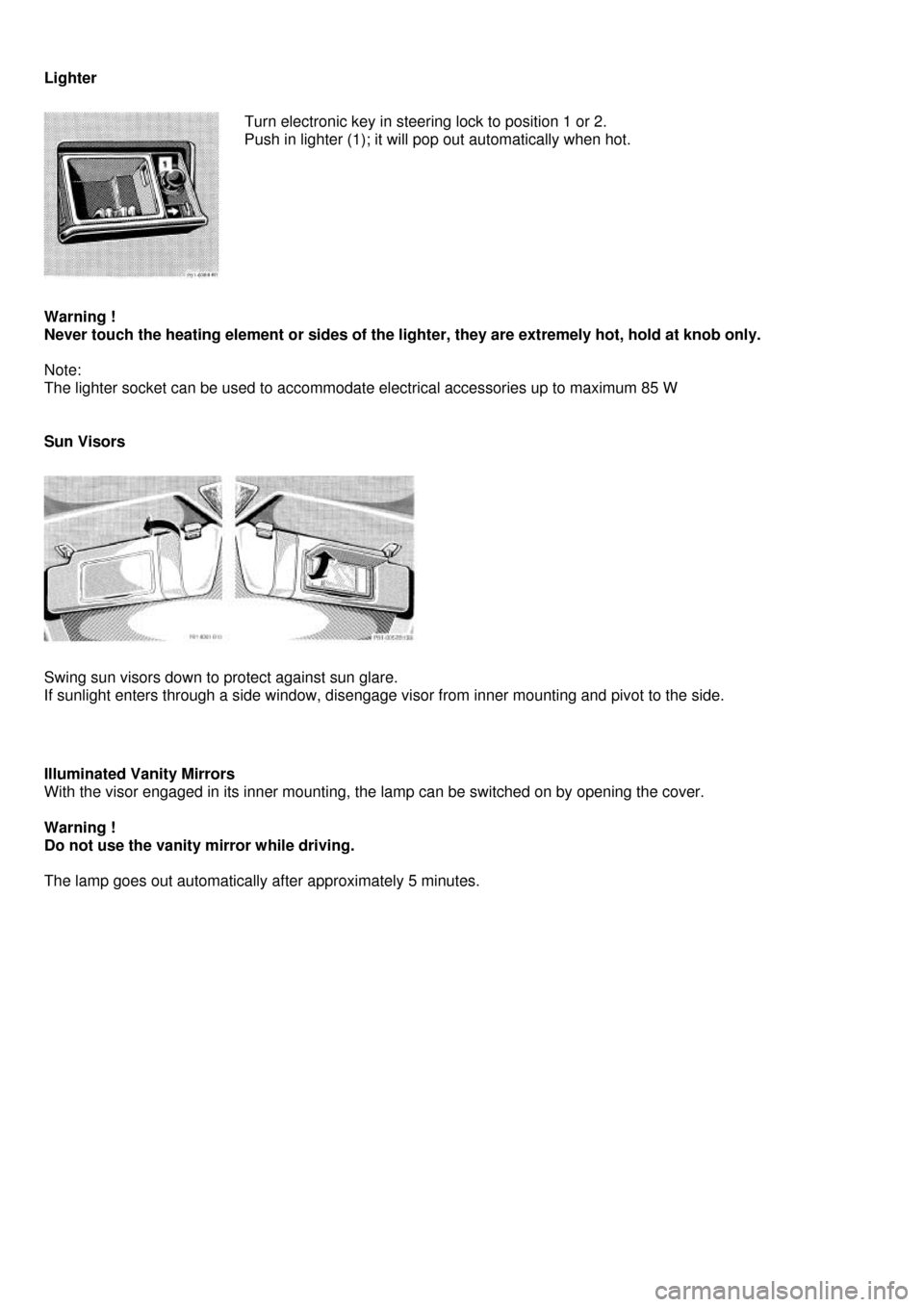
Lighter
Turn electronic key in steering lock to position 1 or 2.
Push in lighter (1); it will pop out automatically when hot.
Warning !
Never touch the heating element or sides of the lighter, they are extremely hot, hold at knob only.
Note:
The lighter socket can be used to accommodate electrical accessories up to maximum 85 W
Sun Visors
Swing sun visors down to protect against sun glare.
If sunlight enters through a side window, disengage visor from inner mounting and pivot to the side.
Illuminated Vanity Mirrors
With the visor engaged in its inner mounting, the lamp can be switched on by opening the cover.
Warning !
Do not use the vanity mirror while driving.
The lamp goes out automatically after approximately 5 minutes.