coolant MERCEDES-BENZ C-CLASS 2002 User Guide
[x] Cancel search | Manufacturer: MERCEDES-BENZ, Model Year: 2002, Model line: C-CLASS, Model: MERCEDES-BENZ C-CLASS 2002Pages: 399, PDF Size: 16.95 MB
Page 282 of 399

279
What you should know at the gas station
Te ch n i c a l
data
Instruments
and controls Operation
DrivingInstrument
cluster display Practical hints Car care Index
Fuel tank capacity approximately 16.4 US gal (62.0 l).
This includes approximately 2.1 US gal (8.0 l) reserve.
Use premium unleaded gasoline:
Posted Octane Index 91 (Average of 96 RON / 86 MON).
Engine oil
Checking oil level, see instructions on page 141 and 318.
Recommended engine oils, see Approved Service
Products sheet.
Coolant
For normal replenishing, use water (potable water
quality). For further information refer to page 319.
Tire pressure
For tire pressure, refer to tire pressure label inside the
fuel filler flap. See page 335 for further details.
Spark plugs
Approved spark plugs, refer to “Technical Data”.
Air conditioner
R-134a refrigerant and special PAG lubricant, refer to
“Technical Data”.
Bulbs
High and low beams: H7 (55 W),
fog lamps: H B4 (55 W),
turn signal lamps,
front 1156 NA (26.9 / 5 W/32/4 cp),
parking and standing lamps, front: W 5W (5 W)
side marker lamps, front: 5 W / 4 cp,
turn signal lamps, rear: PY 21 W bulb (yellow),
stop lamps: P 21 W/32 cp bulb,
rear fog lamp, driver’s side: P 21 W/32 cp bulb,
tail, parking, standing and
side marker lamp: R 5 W / 4 cp,
backup lamps: 21 W / 32 cp,
license plate lamps: 5 W / 4 cp
ProCarManuals.com
Page 283 of 399

280
Check regularly and before a long trip
Te ch n i c a l
data
Instruments
and controls Operation
DrivingInstrument
cluster display Practical hints Car care Index
Check regularly and before a long trip 1 Windshield washer and
headlamp cleaning system
For refilling reservoir see page 320.
2 Coolant level,
see “Coolant level” on page 319
3 Brake fluid, (fuse box cover removed),
see “Brake fluid” on page 379
Opening hood, see page 315.
Removing fuse box cover, see page 312.
Ve h i c l e l i g h t i n g : Check function and cleanliness. For
replacement of light bulbs, see “Exterior lamps” on
page 345.
Exterior lamp switch, see page 143.
P01.00-2213-26
ProCarManuals.com
Page 284 of 399
281
Contents - Instrument cluster display
Te ch n i c a l
data
Instruments
and controls Operation Driving
Instrument
cluster display Practical hints Car care Index
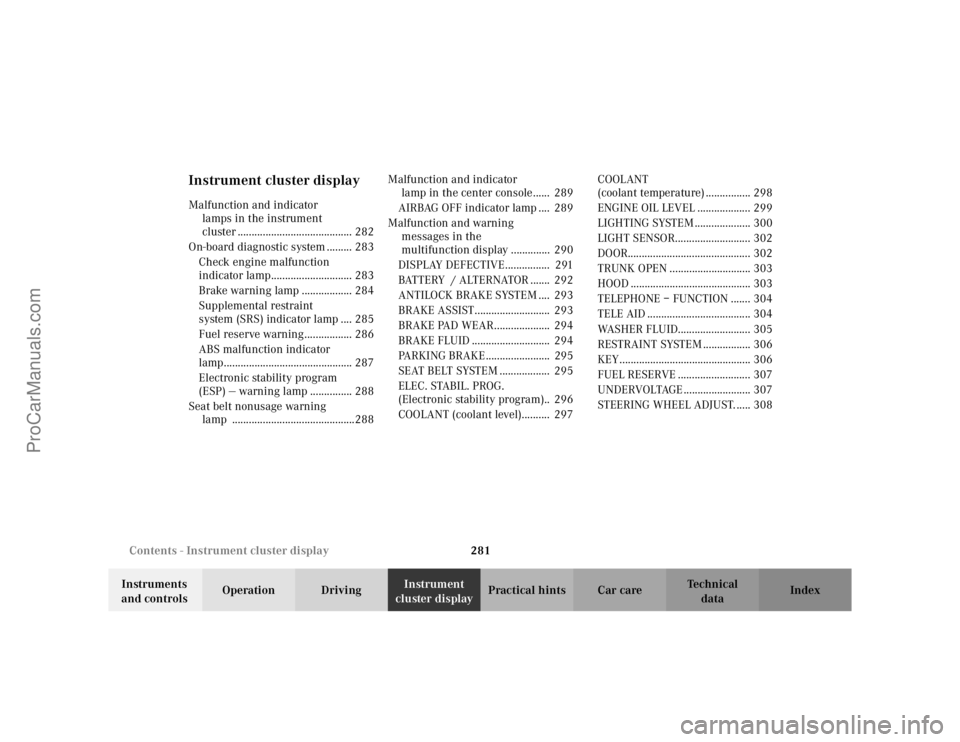
Instrument cluster displayMalfunction and indicator
lamps in the instrument
cluster ......................................... 282
On-board diagnostic system ......... 283 Check engine malfunction
indicator lamp............................. 283
Brake warning lamp .................. 284
Supplemental restraint
system (SRS) indicator lamp .... 285
Fuel reserve warning................. 286
ABS malfunction indicator
lamp.............................................. 287
Electronic stability program
(ESP) — warning lamp ............... 288
Seat belt nonusage warning lamp ............................................288 Malfunction and indicator
lamp in the center console...... 289
AIRBAG OFF indicator lamp .... 289
Malfunction and warning messages in the
multifunction display .............. 290
DISPLAY DEFECTIVE................ 291
BATTERY / ALTERNATOR ....... 292
ANTILOCK BRAKE SYSTEM .... 293
BRAKE ASSIST........................... 293
BRAKE PAD WEAR.................... 294
BRAKE FLUID ............................ 294
PARKING BRAKE ....................... 295
SEAT BELT SYSTEM .................. 295
ELEC. STABIL. PROG.
(Electronic stability program).. 296
COOLANT (coolant level).......... 297 COOLANT
(coolant temperature) ................ 298
ENGINE OIL LEVEL ................... 299
LIGHTING SYSTEM .................... 300
LIGHT SENSOR........................... 302
DOOR............................................ 302
TRUNK OPEN ............................. 303
HOOD ........................................... 303
TELEPHONE – FUNCTION ....... 304
TELE AID ..................................... 304
WASHER FLUID.......................... 305
RESTRAINT SYSTEM ................. 306
KEY............................................... 306
FUEL RESERVE .......................... 307
UNDERVOLTAGE ........................ 307
STEERING WHEEL ADJUST. ..... 308
ProCarManuals.com
Page 294 of 399
291
Malfunction and warning messages
Te ch n i c a l
data
Instruments
and controls Operation Driving
Instrument
cluster display Practical hints Car care Index
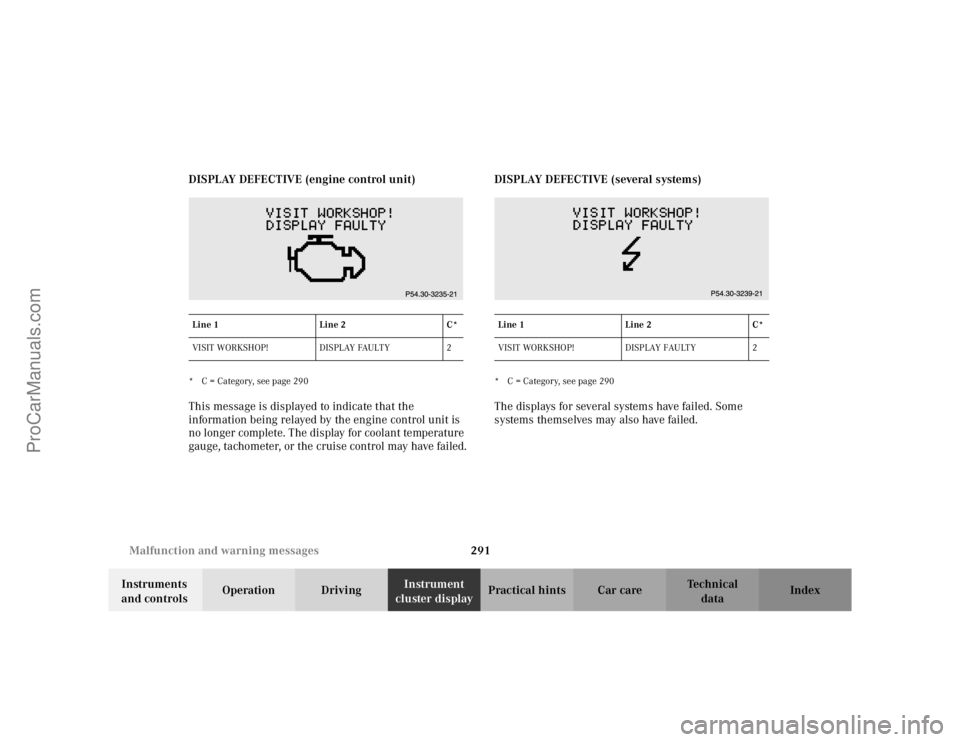
DISPLAY DEFECTIVE (engine control unit)
* C = Category, see page 290This message is displayed to indicate that the
information being relayed by the engine control unit is
no longer complete. The display for coolant temperature
gauge, tachometer, or the cruise control may have failed.
DISPLAY DEFECTIVE (several systems)
* C = Category, see page 290The displays for several systems have failed. Some
systems themselves may also have failed.
Line 1
Line 2C*
VISIT WORKSHOP! DISPLAY FAULTY2
Line 1Line 2C*
VISIT WORKSHOP! DISPLAY FAULTY2
ProCarManuals.com
Page 300 of 399
297
Malfunction and warning messages
Te ch n i c a l
data
Instruments
and controls Operation Driving
Instrument
cluster display Practical hints Car care Index
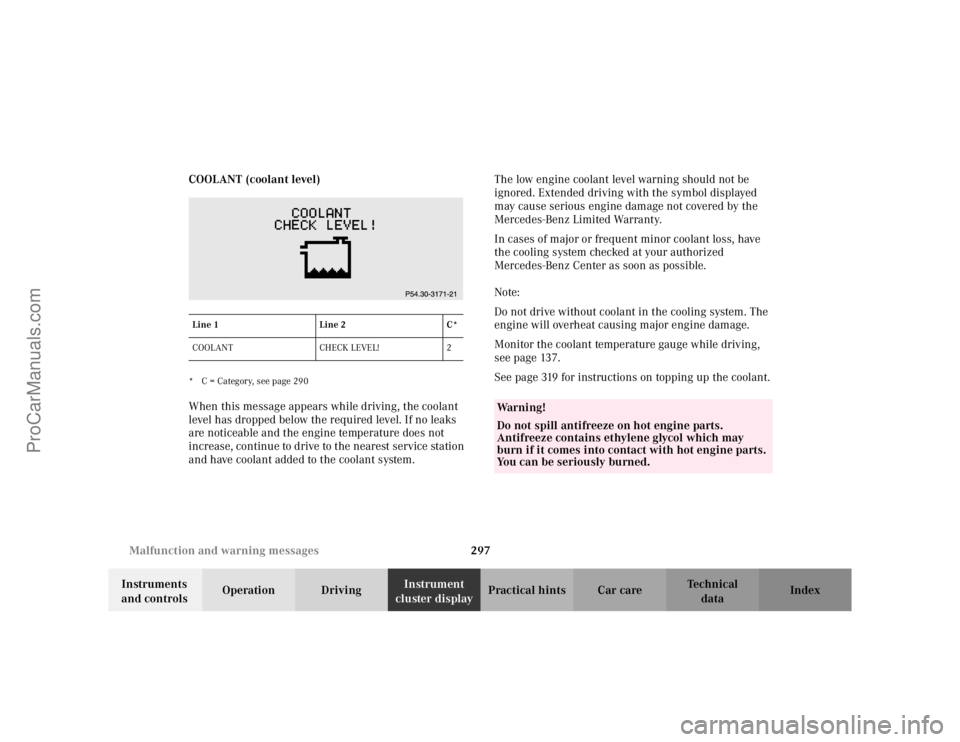
COOLANT (coolant level)
* C = Category, see page 290When this message appears while driving, the coolant
level has dropped below the required level. If no leaks
are noticeable and the engine temperature does not
increase, continue to drive to the nearest service station
and have coolant added to the coolant system.
The low engine coolant level warning should not be
ignored. Extended driving with the symbol displayed
may cause serious engine damage not covered by the
Mercedes-Benz Limited Warranty.
In cases of major or frequent minor coolant loss, have
the cooling system checked at your authorized
Mercedes-Benz Center as soon as possible.
Note:
Do not drive without coolant in the cooling system. The
engine will overheat causing major engine damage.
Monitor the coolant temperature gauge while driving,
see page 137.
See page 319 for instructions on topping up the coolant.Line 1
Line 2C*
COOLANT CHECK LEVEL! 2
Wa r n i n g !
Do not spill antifreeze on hot engine parts.
Antifreeze contains ethylene glycol which may
burn if it comes into contact with hot engine parts.
You can be seriously burned.
ProCarManuals.com
Page 301 of 399

298
Malfunction and warning messages
Te ch n i c a l
data
Instruments
and controls Operation Driving
Instrument
cluster display Practical hints Car care Index
COOLANT (coolant temperature)
* C = Category, see page 290
1 This may indicate that the poly-V-belt has broken. Should this condition occur, the poly-V-belt must be replaced before continuing
to operate the vehicle. Otherwise, the engine will overheat due to
an inoperative water pump which may result in damage to the
engine. Do not continue to drive the vehicle with this message
displayed. Doing so could result in serious engine damage that is
not covered by the Mercedes-Benz Limited Warranty.
2 The cooling fan for the coolant is faulty. Observe the coolant temperature gauge. See page 137
During severe operating conditions and stop-and-go city
traffic, the coolant temperature may rise close to 120
°C.
The engine should not be operated with the coolant
temperature above 120
°C. Doing so may cause serious
engine damage which is not covered by the
Mercedes-Benz Limited Warranty.
Line 1 Line 2C*
COOLANT STOP, ENGINE OFF!
1
1
COOLANT VISIT WORKSHOP!
2
2
Wa r n i n g !
Driving when your engine is badly overheated can
cause some fluids which may have leaked into the
engine compartment to catch fire. You could be
seriously burned.Steam from an overheated engine can cause serious
burns and can occur just by opening the engine
hood. Stay away from the engine if you see or hear
steam coming from it.Turn off the engine, get out of the vehicle and do
not stand near the vehicle until it cools down.
ProCarManuals.com
Page 312 of 399

309
Contents - Practical hints
Te ch n i c a l
data
Instruments
and controls Operation Driving
Instrument
cluster display Practical hints
Car care Index
Practical hintsFirst aid kit...................................... 310
Stowing things in the vehicle ...... 311
Fuses ................................................ 311
Hood ................................................. 315
Automatic transmission
fluid level ................................... 317
Adding engine oil........................... 318
Coolant level ................................... 319 Adding coolant............................ 319
Windshield and headlamp washer system ........................... 320
Spare wheel, storage compartment.............................. 321 Vehicle tools and air pump .......... 322
Vehicle jack .................................... 323
Wheels ............................................ 324
Tire replacement........................ 324
Rotating wheels ......................... 325
Spare wheel .................................... 326
Changing wheels ........................... 327
Inflating the collapsible
spare tire ..................................... 333
Storing spare wheel in
wheel well ................................... 334
Tire inflation pressure ................. 335
Battery............................................. 336
Jump starting.................................. 338 Towing the vehicle......................... 341
Transmission selector lever,
manually unlocking ................... 344
Exterior lamps ................................ 345
Replacing bulbs .......................... 345
Changing batteries in the electronic main key .................. 351
Synchronizing remote
control .......................................... 353
Emergency engine shut-down ..... 353
Fuel filler flap, manual release ... 354
Replacing wiper blade insert ....... 356
Roof rack ......................................... 357
ProCarManuals.com
Page 318 of 399

315
Engine compartment
Te ch n i c a l
data
Instruments
and controls Operation Driving
Instrument
cluster display Practical hints
Car care Index
Hood
Wa r n i n g !
To help prevent personal injury, stay clear of
moving parts when the hood is open and the engine
is running. Be sure the hood is properly closed
before driving. When closing hood, use extreme
caution not to catch hands or fingers.The radiator fan may continue to run for
approximately 30 seconds or even restart after the
engine has been turned off. Stay clear from fan
blades.If you see flames or smoke coming from the engine
compartment, or if the coolant temperature gauge
indicates that the engine is overheated, do not open
the hood. Move away from vehicle and do not open
the hood until the engine has cooled. If necessary,
call a fire department.
The engine is equipped with a transistorized
ignition system. Because of the high voltage it is
dangerous to touch any components (ignition coils,
spark plug sockets, diagnostic socket) of the
ignition system
• with the engine running,
• while starting the engine,
• if ignition is “on” and the engine is turned manually.
ProCarManuals.com
Page 322 of 399

319
Engine compartment
Te ch n i c a l
data
Instruments
and controls Operation Driving
Instrument
cluster display Practical hints
Car care Index
Coolant level
1 Coolant expansion tank
To check the coolant level, the vehicle must be parked
on level ground an d the engine stopped.
Check coolant level only when coolant is cold.
The coolant level should reach the black top part of the
reservoir.
See page 381 for antifreeze / anticorrosion mixture. Adding coolant
If coolant has to be added, a 50/50 mixture of water and
MB anticorrosion / antifreeze should be added.
Wa r n i n g !
• In order to avoid possibly serious burns: Use extreme caution when opening the hood if
there are any signs of steam or coolant leaking
from the cooling system, or if the coolant
temperature gauge indicates that the coolant is
overheated.• Do not remove pressure cap on coolant
reservoir if engine temperature is above 194
°F
(90
°C). Allow engine to cool down before
removing cap. The coolant reservoir contains
hot fluid and is under pressure.
• Using a rag, slowly open cap approximately
1/2 turn to relieve excess pressure. If opened
immediately, scalding hot fluid and steam will
be blown out under pressure.• Do not spill antifreeze on hot engine parts. Antifreeze contains ethylene glycol which may
burn if it comes into contact with hot engine
parts.
ProCarManuals.com
Page 363 of 399
360
Cleaning and care of the vehicle
Te ch n i c a l
data
Instruments
and controls Operation Driving
Instrument
cluster display Practical hints
Car care Index
Cleaning and care of the vehicle
In operation, your vehicle is subjected to varying
external influences which, if gone unchecked, can
attack the paintwork as well as the underbody and
cause lasting damage.
Such damage is caused not only by extreme and varying
climatic conditions, but also by air polution, road salt,
tar, gravel and stone chipping. Grease and oil, fuel,
coolant, brake fluid, bird droppings, insects, tree resins
etc. should be removed immediately to avoid paint
damage. Frequent washing reduces and/or eliminates
the aggressiveness and potency of the above adverse
influences. More frequent washings are necessary to deal with
unfavorable conditions; for example, near the ocean, in
industrial areas (smoke, exhaust emissions), or during
winter operation.
You should check your vehicle from time to time for
stone chipping or other damage. Any damage should be
repaired as soon as possible to prevent the start of
corrosion.
In doing so, do not neglect the underside of the vehicle.
A prerequisite for a thorough check is a washing of the
underbody followed by a thorough inspection. Damaged
areas need to be reundercoated.
Your vehicle has been treated at the factory with a wax-
base rustproofing in the body cavities which will last for
the lifetime of the vehicle. Post-production treatment is
neither necessary nor recommended by Mercedes-Benz
because of the possibility of
incompatibility between
materials used in the production process and others
applied later.
We have selected car-care products and compiled
recommendations which are specially matched to our
vehicles and which always reflect the latest technology.
You can obtain Mercedes-Benz approved car-care
products at your authorized Mercedes-Benz Center.
Wa r n i n g !
Many cleaning products can be hazardous. Some
are poisonous, others are flammable. Always follow
the instructions on the particular container.
Always open your vehicle’s doors or windows when
cleaning the inside.Never use fluids or solvents that are not designed
for cleaning your vehicle.
ProCarManuals.com