Message MERCEDES-BENZ C-Class 2011 W204 User Guide
[x] Cancel search | Manufacturer: MERCEDES-BENZ, Model Year: 2011, Model line: C-Class, Model: MERCEDES-BENZ C-Class 2011 W204Pages: 320, PDF Size: 13.17 MB
Page 16 of 320
SPORT handling modeActivating/deactivating (AMG
vehicles) .......................................... 64
Warning lamp ................................. 208
SRS (Supplemental Restraint
System) Display message ............................ 185
Introduction ..................................... 34
Warning lamp ................................. 209
Warning lamp (function) ................... 34
Standard display (on-board
computer) .......................................... 170
Starting the engine Important safety notes ..................133
Station
see Radio
Steering (display message) .............. 201
Steering wheel Adjusting (electrically) .....................98
Adjusting (manually) ........................98
Buttons (on-board computer) ......... 167
Cleaning ......................................... 248
Important safety notes ....................98
Memory function (storing
settings) ........................................... 98
Storing settings (memory
function) ........................................ 102
Steering wheel paddle shifters ........ 141
Stowage compartments Armrest (under) ............................. 217
Glove box ....................................... 216
Stowage space
Cup holders ................................... 220
Important safety information .........216
Stowage well
Trunk floor (under) .........................219
Submenu (on-board computer)
Convenience .................................. 181
Factory setting ............................... 182
Instrument cluster .........................178
Lights ............................................. 180
Standard display ............................ 170
Time/Date ..................................... 179
Vehicle ........................................... 181
Summer opening
see Convenience opening feature
Sun visor ............................................ 221Supplemental Restraint System
see SRS
Surround lighting (on-board
computer) .......................................... 180
Switching off the alarm (ATA) ............ 67
T
Tachometer ........................................ 167
Tailgate Display message (12-button
multifunction steering wheel) ........200
Tail lamps (Display message) ........... 192
Tank content Fuel gauge ....................................... 26
Technical data ................................... 302
C 250 ............................................. 311
C 250 4MATIC ............................... 311
C 300 ............................................. 311
C 300 4MATIC ............................... 312
C 350 .................................... 312, 313
C 350 4MATIC ............................... 312
Tires/wheels ................................. 293
TELEAID
Call priority .................................... 230
Display message ............................ 185
Downloading destinations
(COMAND) ..................................... 230
Emergency call .............................. 227
Important safety notes ..................226
Locating a stolen vehicle ...............231
MB info call button ........................229
Remote vehicle locking ..................231
Roadside Assistance button ..........229
Self-test ......................................... 227
System .......................................... 227
Vehicle remote unlocking ..............231
Telephone
Accepting a call ............................. 176
Display message ............................ 201
Menu (on-board computer) ............176
Number from the phone book ........ 177
Redialing ........................................ 177
Rejecting/ending a call .................177
Telephone compartment .................. 217
Temperature Coolant .......................................... 166
Coolant (on-board computer) ......... 171
14IndexBA 204 USA, CA Edition A 2011; 1; 5, en-UShereepeVersion: 3.0.3.62010-05-20T09:17:30+02:00 - Seite 14
Page 17 of 320
Engine oil (on-board computer) ...... 171
Outside temperature ...................... 167
Setting ........................................... 123
Theft deterrent locking system
Immobilizer ...................................... 66
Through-loading feature ................... 218
Tilt/sliding sunroof Opening/closing .............................. 88
Resetting ......................................... 88
Time (on-board computer) ................ 179
Timer (on-board computer) .............. 172
Tire pressure Calling up (on-board computer) .....277
Checking manually ........................275
Display message ............................ 197
Maximum ....................................... 280
Notes ............................................. 273
Pressure loss warning ....................275
Recommended ............................... 272
Tire pressure monitoring system
Function/notes ............................. 277
Restarting ...................................... 279
Warning lamp ................................. 212
Tires
Aspect ratio (definition) .................292
Average weight of the vehicle
occupants (definition) ....................290
Bar (definition) ............................... 290
Characteristics .............................. 290
Checking ........................................ 271
Cleaning ......................................... 272
Definition of terms .........................290
Direction of rotation ......................284
Distribution of the vehicle
occupants (definition) ....................293
DOT, Tire Identification Number
(TIN) ............................................... 289
DOT (Department of
Transportation) (definition) ............290
Flat tire .......................................... 254
GAWR (Gross Axle Weight Rating)
(definition) ..................................... 291
Guidelines to be observed .............271
GVW (Gross Vehicle Weight)
(definition) ..................................... 291
GVWR (Gross Vehicle Weight
Rating) (definition) .........................291Increased vehicle weight due to
optional equipment (definition) ......291
Kilopascal (kPa) (definition) ...........291
Labeling (overview) ........................286
Load bearing index (definition) ......292
Load index ..................................... 289
Load index (definition) ...................291
Maximum loaded vehicle weight
(definition) ..................................... 291
Maximum load on a tire
(definition) ..................................... 292
Maximum permissible tire
pressure (definition) ....................... 292
Maximum tire load .........................284
Maximum tire load (definition) .......291
Optional equipment weight
(definition) ..................................... 292
PSI (pounds per square inch)
(definition) ..................................... 292
Replacing ....................................... 286
Service life ..................................... 271
Sidewall (definition) .......................292
Speed index (definition) .................291
Storing ........................................... 272
Structure and characteristics
(definition) ..................................... 290
Temperature .................................. 285
TIN (Tire Identification Number)
(definition) ..................................... 292
Tire bead (definition) ......................292
Tire pressure (definition) ................292
Tire pressures (recommended) ......290
Tire size (data) ............................... 293
Tire size designation, load-bearing
capacity, speed index ....................287
Tire tread ....................................... 271
Tire tread (definition) .....................292
Total load limit (definition) .............293
Traction ......................................... 285
Traction (definition) .......................292
Tread wear ..................................... 285
Uniform Tire Quality Grading
Standards ...................................... 284
Uniform Tire Quality Grading
Standards (definition) ....................290
Unladen weight (definition) ............291
Wear indicator (definition) .............292
Wheel rim (definition) ....................291Index15BA 204 USA, CA Edition A 2011; 1; 5, en-UShereepeVersion: 3.0.3.62010-05-20T09:17:30+02:00 - Seite 15
Page 18 of 320
Tires and wheels (important safety
information) ....................................... 270
Top Tether ............................................ 59
Towing Important safety guidelines ...........264
Installing the towing eye ................264
Removing the towing eye ...............265
Tow-starting
Emergency engine starting ............266
Installing the towing eye ................266
Removing the towing eye ...............266
Transfer case ..................................... 144
Transmission position display ......... 138
Transmission positions .................... 139
Trip computer (on-board
computer) .......................................... 170
Trip odometer Calling up ....................................... 170
Resetting (on-board computer) ......171
Trunk
Automatic opening ........................... 81
Emergency release ..........................82
Important safety guidelines .............80
Locking separately ...........................82
Trunk lid
Display message ............................ 200
Turn signal (display message) ......... 191
Turn signals ....................................... 108
Type plate see Vehicle identification plate
U
Unlocking Emergency unlocking .......................79
From inside the vehicle (central
unlocking button) ............................. 78
V
Vanity mirror Sun visor ........................................ 222
Vehicle
Data acquisition ............................... 22
Emergency unlocking .......................79
Equipment ....................................... 18
Exterior view .................................... 24
Individual settings (on-board
computer) ...................................... 178
Loading .......................................... 280
Lowering ........................................ 258
Maintenance .................................... 19
Parking up ..................................... 150
Raising ........................................... 256
Reporting problems .........................21
Towing away .................................. 264
Tow-starting ................................... 264
Transporting .................................. 266
Vehicle data
see Technical data
Vehicle identification number
see VIN
Vehicle identification plate .............. 303
Vehicle tool kit .................................. 253
Video (DVD) ........................................ 176
Video DVD (on-board computer) ...... 176
VIN ...................................................... 303
W
Warning and indicator lamps ABS ................................................ 206
Brakes ........................................... 203
Check Engine ................................. 210
Coolant .......................................... 210
ESP ®
.............................................. 207
ESP ®
OFF ....................................... 208
Fuel tank ........................................ 210
Overview .......................................... 27
PASSENGER AIRBAG OFF
indicator lamp (only Canada) ...........46
PASSENGER AIRBAG OFF
indicator lamp (only USA) ................41
Reserve fuel ................................... 210
Seat belt ........................................ 204
SPORT handling mode ...................208
SRS ................................................ 209
Tire pressure monitor ....................212
Warranty ............................................ 302
Wheel bolt tightening torque ........... 258
Wheel chock ...................................... 255
Wheels Changing/replacing .......................286
Changing a wheel .......................... 255
Checking ........................................ 271
16IndexBA 204 USA, CA Edition A 2011; 1; 5, en-UShereepeVersion: 3.0.3.62010-05-20T09:17:30+02:00 - Seite 16
Page 19 of 320
Cleaning ......................................... 245
Guidelines to be observed .............271
Mounting a wheel .......................... 258
Removing a wheel ..........................257
Tightening torque ........................... 258
Wheel size/tire size .......................293
Window curtain air bag
Display message ............................ 186
Operation ......................................... 40
Windows
see Side windows
Windows (cleaning instructions) ..... 246
Windshield Defrosting ...................................... 124
Windshield washer fluid (display
message) ............................................ 201
Windshield washer system Adding washer fluid .......................241
Notes ............................................. 310
Windshield wipers
Important safety notes ..................115
Replacing the wiper blades ....116, 117
Switching on/off ........................... 116
Troubleshooting ............................. 117
Winter operation ............................... 155
Winter tires M+S tires ....................................... 154
Wiper blades
Cleaning ......................................... 246Index17BA 204 USA, CA Edition A 2011; 1; 5, en-UShereepeVersion: 3.0.3.62010-05-20T09:17:30+02:00 - Seite 17
Page 30 of 320
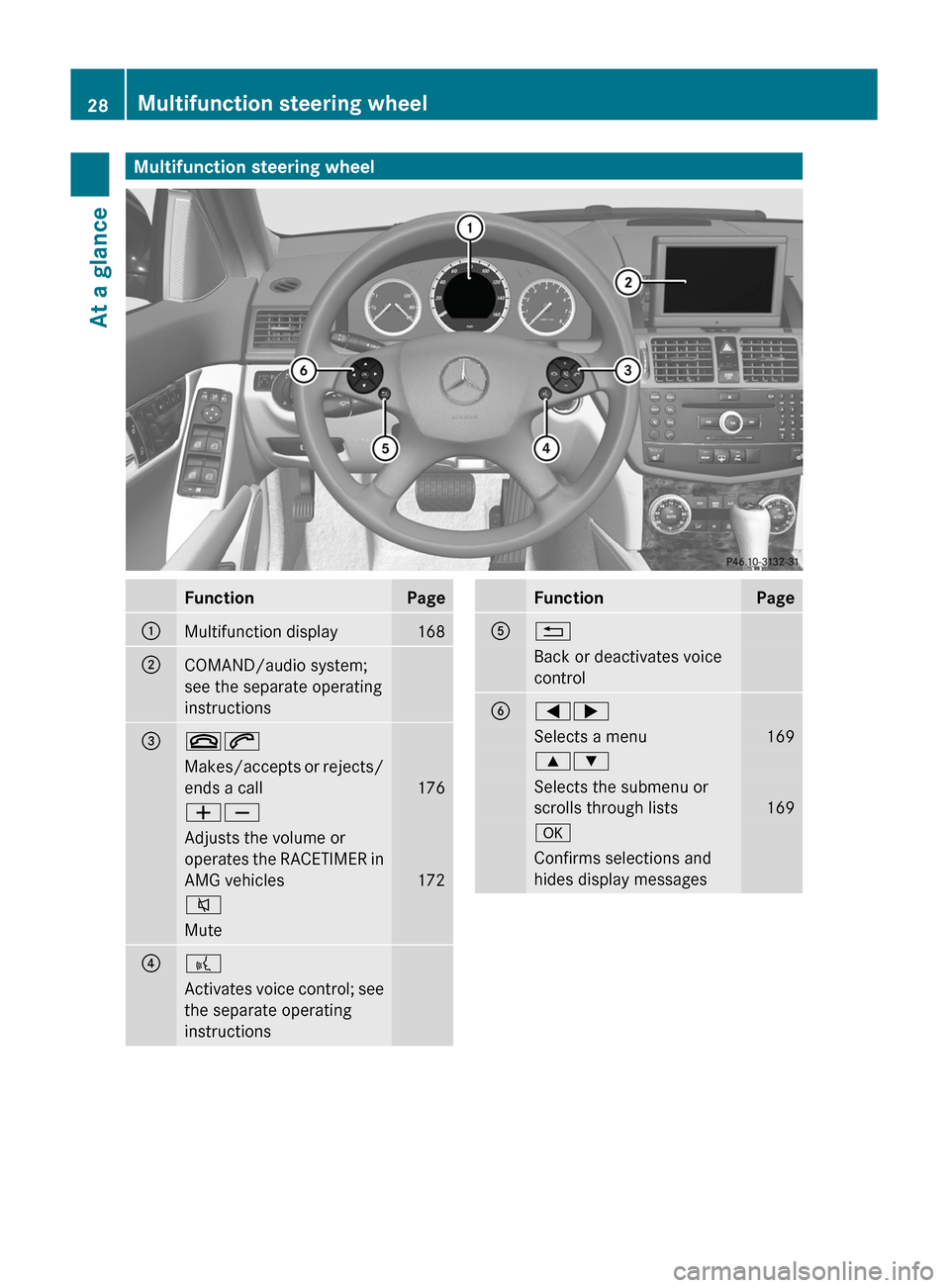
Multifunction steering wheelFunctionPage:Multifunction display168;COMAND/audio system;
see the separate operating
instructions=~6Makes/accepts or rejects/
ends a call
176
WXAdjusts the volume or
operates the RACETIMER in
AMG vehicles
172
8Mute??Activates voice control; see
the separate operating
instructionsFunctionPageA%Back or deactivates voice
controlB=;Selects a menu1699:Selects the submenu or
scrolls through lists
169
aConfirms selections and
hides display messages28Multifunction steering wheelAt a glance
BA 204 USA, CA Edition A 2011; 1; 5, en-UShereepeVersion: 3.0.3.62010-05-20T09:17:30+02:00 - Seite 28
Page 44 of 320
12-month-old child in a standard child
restraint, the 45 indicator lamp will
illuminate when the engine is started and
remain illuminated. This indicates that the
front passenger front air bag is deactivated.
When the OCS senses that the front
passenger seat is classified as being empty,
the 45 indicator lamp will illuminate
when the engine is started and remain
illuminated. This indicates that the front
passenger front air bag is deactivated.
When the OCS senses that the front
passenger seat occupant is classified as
being heavier than the weight of a typical 12-
month-old child seated in a standard child
restraint or as being a small individual (such
as a young teenager or a small adult), the
45 indicator lamp will illuminate for
approximately 6 seconds when the engine is
started. Depending on occupant weight
sensor readings from the seat, it will then
remain illuminated or go out. With the
45 indicator lamp illuminated, the
front passenger front air bag is deactivated.
With the 45 indicator lamp out, the
front passenger front air bag is activated.
When the OCS senses that the front
passenger seat occupant is classified as an
adult or someone larger than a small
individual, the 45 indicator lamp will
illuminate for approximately six seconds
when the engine is started and then go out.
This indicates that the front passenger front
air bag is activated.
If the 45 indicator lamp is illuminated,
the front passenger front air bag is
deactivated and will not be deployed.
If the 45 indicator lamp is not
illuminated, the front passenger front air bag
is activated and will be deployed
R in the event of certain frontal impacts
R if the impact exceeds a predetermined
triggering threshold
R independent of the side impact air bag or
pelvis air bagIf the front passenger front air bag is
deployed, the rate of inflation will be
influenced by
R the rate of vehicle deceleration as assessed
by the air bag control unit
R the front passenger's weight category as
identified by the OCS
For further information, see the section
regarding air bag display messages
( Y page 187).GWarning
According to accident statistics, children are
safer when properly restrained on the rear
seats than on the front-passenger seat. Thus,
we strongly recommend that children be
placed in the rear seats whenever possible.
Regardless of seating position, children 12
years old and under must be seated and
properly secured in an appropriate infant
restraint, toddler restraint, or booster seat
recommended for the size and weight of the
child.
The infant or child restraint must be properly
secured with the vehicle's seat belt, the seat
belt and Top Tether strap, or lower anchors
and Top Tether strap, fully in accordance with
the child seat manufacturer's instructions.
Occupants, especially children, should always
sit as upright as possible, wear the seat belt
properly and use an appropriately sized infant
restraint, toddler restraint, or booster seat
recommended for the size and weight of the
child.
Children can be killed or seriously injured by
an inflating air bag. Note the following
important information when circumstances
require you to place a child in the front-
passenger seat:
R Your vehicle is equipped with air bag
technology designed to deactivate the
front-passenger front air bag in your vehicle
when the system senses the weight of a
typical 12-month-old child or less along
42Occupant safetySafety
BA 204 USA, CA Edition A 2011; 1; 5, en-UShereepeVersion: 3.0.3.62010-05-20T09:17:30+02:00 - Seite 42
Page 47 of 320
Problems with the occupant classification systemProblemPossible causes/consequences and M SolutionsThe 45
indicator lamp
illuminates and
remains illuminated.
The person sitting on
the front-passenger
seat:
R weighs as much as a
typical adult
R weighs more than a
childOCS is malfunctioning.XHave OCS checked as soon as possible at an authorized
Mercedes-Benz Center.XObserve the additional display messages in the multifunction
display ( Y page 187).GWarning
If the 45 indicator lamp illuminates and remains illuminated when the weight of a typical
adult or someone larger than a small individual has been detected on the passenger seat, do not
allow any occupant to use the passenger seat until the system has been repaired.
ProblemPossible causes/consequences and M SolutionsThe 45
indicator lamp does not
illuminate and/or does
not remain illuminated.
The front-passenger
seat is:
R unoccupied
R occupied with the
weight of a typical
12-month-old child in
a standard child
restraint or lessOCS is malfunctioning.XMake sure there is nothing between the seat cushion and the
child seat.XCheck the installation of the child restraint system.XMake sure there are no objects applying additional weight onto
the seat.XIf the 45 indicator lamp remains out, have OCS checked
as soon as possible at an authorized Mercedes-Benz Center. Do
not transport a child on the front-passenger seat until OCS has
been repaired.XObserve the additional display messages in the multifunction
display ( Y page 187).GWarning
If the 45 indicator lamp does not illuminate or remains out with the weight of a typical
12-month-old child in a standard child restraint or less, or is unoccupied, on the front-passenger
seat, do not transport a child on the front-passenger seat until the system has been repaired.
Occupant safety45SafetyBA 204 USA, CA Edition A 2011; 1; 5, en-UShereepeVersion: 3.0.3.62010-05-20T09:17:30+02:00 - Seite 45Z
Page 64 of 320
section must never be exploited in a reckless
or dangerous manner which could jeopardize
the user's safety or the safety of others.
Always adjust your driving style to the
prevailing road and weather conditions and
keep a safe distance to other road users and
objects on the street.
If a driving system malfunctions, other driving
safety systems may also switch off. Observe
indicator and warning lamps that may come
on as well as messages in the multifunction
display that may appear.
i In wintry driving conditions, always use
winter tires (M+S tires) and if necessary,
snow chains. Only in this way will the
driving safety systems described in this
section work as effectively as possible.
ABS (Anti-lock Braking System)
Important safety notes
GWarning
Observe "Important safety notes"
( Y page 61).
GWarning
Do not pump the brake pedal. Use firm, steady
brake pedal pressure instead. Pumping the
brake pedal defeats the purpose of the ABS
and significantly reduces braking
effectiveness.
ABS regulates brake pressure in such a way
that the wheels do not lock when you brake.
This allows you to continue steering the
vehicle when braking.
ABS works from a speed of about
5 mph (8 km/h) upwards, regardless of road-
surface conditions. ABS works on slippery
surfaces, even when you only brake gently.
The ! warning lamp in the instrument
cluster lights up when the ignition is switched
on. It goes out when the engine is running.
Braking
If ABS intervenes when braking, you will feel
a pulsing in the brake pedal.
XIf ABS intervenes: continue to depress the
brake pedal with force until the braking
situation is over.XTo make a full brake application:
depress the brake pedal with full force.GWarning
If the ABS malfunctions, other driving systems
such as the BAS or the ESP ®
are also switched
off. Observe indicator and warning lamps that
may come on as well as messages in the
multifunction display that may appear.
If the ABS malfunctions, the wheels may lock
during hard braking, reducing the steering
capability and extending the braking distance.
The pulsating brake pedal can be an
indication of hazardous road conditions and
functions as a reminder to take extra care
while driving.
BAS (Brake Assist)
GWarning
Observe "Important safety notes"
( Y page 61).
BAS operates in emergency braking
situations. If you depress the brake pedal
quickly, BAS automatically boosts the braking
force, thus shortening the stopping distance.
XKeep the brake pedal firmly depressed until
the emergency braking situation is over.
ABS prevents the wheels from locking.
The brakes will function as usual once you
release the brake pedal. BAS is deactivated.
GWarning
If the BAS malfunctions, the brake system still
functions, but without the additional brake
boost available that the BAS would normally
provide in an emergency braking maneuver.
Therefore, the braking distance may increase.
62Driving safety systemsSafety
BA 204 USA, CA Edition A 2011; 1; 5, en-UShereepeVersion: 3.0.3.62010-05-20T09:17:30+02:00 - Seite 62
Page 67 of 320
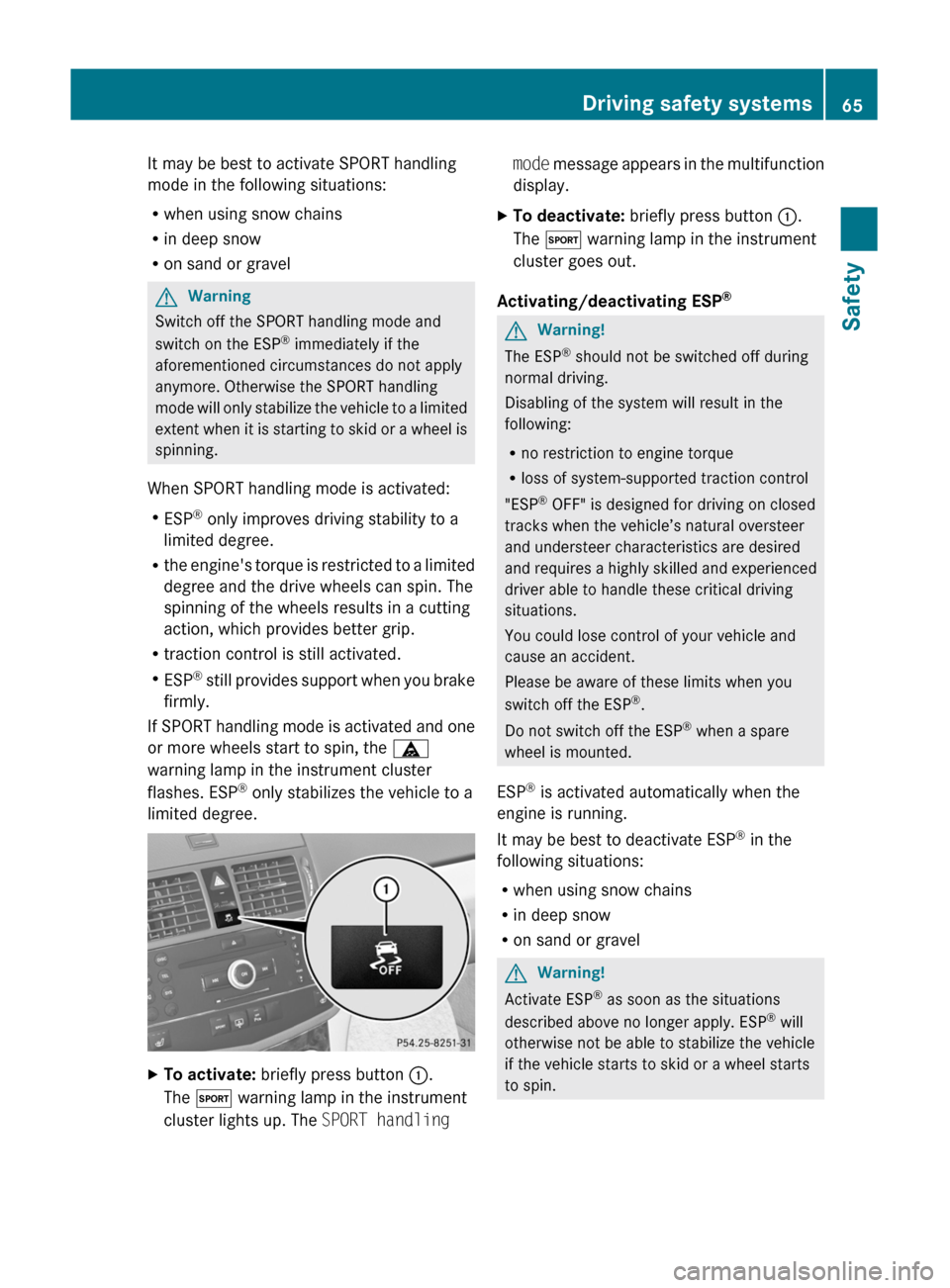
It may be best to activate SPORT handling
mode in the following situations:
R when using snow chains
R in deep snow
R on sand or gravelGWarning
Switch off the SPORT handling mode and
switch on the ESP ®
immediately if the
aforementioned circumstances do not apply
anymore. Otherwise the SPORT handling
mode will only stabilize the vehicle to a limited
extent when it is starting to skid or a wheel is
spinning.
When SPORT handling mode is activated:
R ESP ®
only improves driving stability to a
limited degree.
R the engine's torque is restricted to a limited
degree and the drive wheels can spin. The
spinning of the wheels results in a cutting
action, which provides better grip.
R traction control is still activated.
R ESP ®
still provides support when you brake
firmly.
If SPORT handling mode is activated and one
or more wheels start to spin, the ä
warning lamp in the instrument cluster
flashes. ESP ®
only stabilizes the vehicle to a
limited degree.
XTo activate: briefly press button :.
The M warning lamp in the instrument
cluster lights up. The SPORT handling mode message appears in the multifunction
display.XTo deactivate: briefly press button :.
The M warning lamp in the instrument
cluster goes out.
Activating/deactivating ESP ®
GWarning!
The ESP
®
should not be switched off during
normal driving.
Disabling of the system will result in the
following:
R no restriction to engine torque
R loss of system-supported traction control
"ESP ®
OFF" is designed for driving on closed
tracks when the vehicle’s natural oversteer
and understeer characteristics are desired
and requires a highly skilled and experienced
driver able to handle these critical driving
situations.
You could lose control of your vehicle and
cause an accident.
Please be aware of these limits when you
switch off the ESP ®
.
Do not switch off the ESP ®
when a spare
wheel is mounted.
ESP ®
is activated automatically when the
engine is running.
It may be best to deactivate ESP ®
in the
following situations:
R when using snow chains
R in deep snow
R on sand or gravel
GWarning!
Activate ESP ®
as soon as the situations
described above no longer apply. ESP ®
will
otherwise not be able to stabilize the vehicle
if the vehicle starts to skid or a wheel starts
to spin.
Driving safety systems65SafetyBA 204 USA, CA Edition A 2011; 1; 5, en-UShereepeVersion: 3.0.3.62010-05-20T09:17:30+02:00 - Seite 65Z
Page 68 of 320
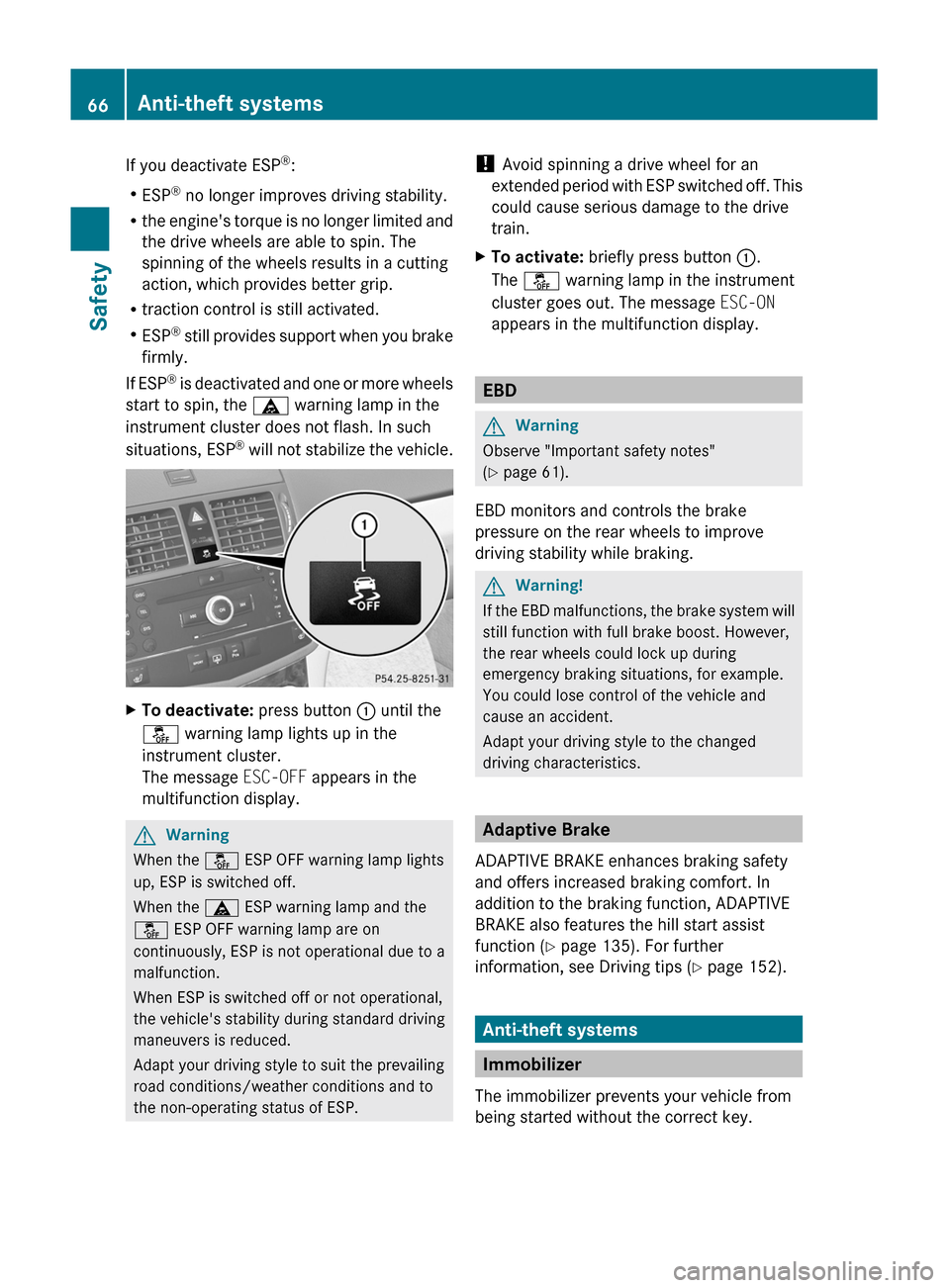
If you deactivate ESP®
:
R ESP ®
no longer improves driving stability.
R the engine's torque is no longer limited and
the drive wheels are able to spin. The
spinning of the wheels results in a cutting
action, which provides better grip.
R traction control is still activated.
R ESP ®
still provides support when you brake
firmly.
If ESP ®
is deactivated and one or more wheels
start to spin, the ä warning lamp in the
instrument cluster does not flash. In such
situations, ESP ®
will not stabilize the vehicle.XTo deactivate: press button : until the
å warning lamp lights up in the
instrument cluster.
The message ESC-OFF appears in the
multifunction display.GWarning
When the å ESP OFF warning lamp lights
up, ESP is switched off.
When the ä ESP warning lamp and the
å ESP OFF warning lamp are on
continuously, ESP is not operational due to a
malfunction.
When ESP is switched off or not operational,
the vehicle's stability during standard driving
maneuvers is reduced.
Adapt your driving style to suit the prevailing
road conditions/weather conditions and to
the non-operating status of ESP.
! Avoid spinning a drive wheel for an
extended period with ESP switched off. This
could cause serious damage to the drive
train.XTo activate: briefly press button :.
The å warning lamp in the instrument
cluster goes out. The message ESC-ON
appears in the multifunction display.
EBD
GWarning
Observe "Important safety notes"
( Y page 61).
EBD monitors and controls the brake
pressure on the rear wheels to improve
driving stability while braking.
GWarning!
If the EBD malfunctions, the brake system will
still function with full brake boost. However,
the rear wheels could lock up during
emergency braking situations, for example.
You could lose control of the vehicle and
cause an accident.
Adapt your driving style to the changed
driving characteristics.
Adaptive Brake
ADAPTIVE BRAKE enhances braking safety
and offers increased braking comfort. In
addition to the braking function, ADAPTIVE
BRAKE also features the hill start assist
function ( Y page 135). For further
information, see Driving tips ( Y page 152).
Anti-theft systems
Immobilizer
The immobilizer prevents your vehicle from
being started without the correct key.
66Anti-theft systemsSafety
BA 204 USA, CA Edition A 2011; 1; 5, en-UShereepeVersion: 3.0.3.62010-05-20T09:17:30+02:00 - Seite 66