ABS MERCEDES-BENZ C-CLASS CABRIOLET 2018 Owner's Manual
[x] Cancel search | Manufacturer: MERCEDES-BENZ, Model Year: 2018, Model line: C-CLASS CABRIOLET, Model: MERCEDES-BENZ C-CLASS CABRIOLET 2018Pages: 350, PDF Size: 5.73 MB
Page 6 of 350
1, 2, 3 ...
4ETS (Electronic Traction System)see ETS/4ETS (Electronic Trac-
tion System)
4MATIC (permanent four-wheel
drive) .................................................. 166
12 V socket
see Socket (12 V)
360° camera
Cleaning .........................................2 92
Display in the multimedia system .. 178
Function/notes .............................1 76
A
ABS (Anti-lock Braking System)
Display message ............................ 213
Function/notes ................................ 64
Warning lamp ................................. 244
Acceleration
see Kickdown
Accident
Automatic measures after an acci-
dent ................................................. 59
Accident warning
see Driving safety system
Activating media mode
General notes ................................ 261
Activating/deactivating cooling
with air dehumidification ................. 117
Active Blind Spot Assist
Activating/deactivating (on-
board computer) ............................ 205
Display message ............................ 230
Function/notes .............................1 86
Active Brake Assist
Activating or deactivating .............. 204
Display message ............................ 218
Function/notes ................................ 65
Active Brake Assist with cross-
traffic function
Activating or deactivating .............. 205
Display message ............................ 219
Function/notes ................................ 71
Important safety notes .................... 72
Warning lamp ................................. 250 Active Lane Keeping Assist
Activating/deactivating (on-
board computer) ............................ 205
Display message ............................ 229
Function/information .................... 189
Active light function
Display message ............................ 224
Active Service System PLUS
see ASSYST PLUS
ADAPTIVE BRAKE ................................. 71
Adaptive Brake Assist
Function/notes ................................ 67
Adaptive Damping System
Function/notes ............................. 165
Adaptive Damping System with
continuous damping adjustment
(ADS PLUS) ........................................ 164
Adaptive Highbeam Assist
Display message ............................ 224
Function/notes ............................. 109
Switching on/off ........................... 110
Additional speedometer ................... 207
Additives (engine oil) ........................ 343
Address book
see also Digital Operator's Man-
ual .................................................. 253
A
djusting the volume
Multimedia system ........................ 254
After-sales service center
see ASSYST PLUS
Air bags
Deployment ..................................... 56
Display message ............................ 222
Front air bag (driver, front
passenger) ....................................... 50
Head bag ......................................... 51
Important safety notes .................... 49
Introduction ..................................... 48
Knee bag .......................................... 50
Occupant Classification System
(OCS) ............................................... 51
PASSENGER AIR BAG indicator
lamps ............................................... 44
Side impact air bag .......................... 50
Air vents
Important safety notes .................. 120
Rear ............................................... 120
Setting ........................................... 120
4Index
Page 7 of 350
Setting the blower output of the
AIRSCARF vents ............................. 121
Setting the center air vents ........... 120
Setting the side air vents ............... 120
Switching AIRSCARF on/off .......... 100
Air-conditioning system
see Climate control
Airbag
Warning lamp ................................. 247
AIRCAP
Cleaning instructions ..................... 289
Extending/retracting ....................... 91
Important safety notes .................... 91
AIRMATIC
Display message ............................ 228
Function/notes ............................. 163
Setting the normal vehicle level ..... 164
Setting the raised vehicle level ...... 164
AIRSCARF
Switching on/off ........................... 100
AIRSCARF vents
Setting the blower output .............. 121
Alarm
ATA (Anti-Theft Alarm system) ......... 74
Switching off (ATA) .......................... 74
Switching the function on/off
(ATA) ................................................ 74
Alarm system
see ATA (Anti-Theft Alarm system)
All-wheel drive
see 4MATIC (permanent four-
wheel drive)
AMG
Adaptive sport suspension sys-
tem ................................................ 165
Performance Seat ............................ 98
Switchable performance exhaust
system ........................................... 129
AMG menu (on-board computer) ..... 208
Animals
see Pets in the vehicle
Anti-lock braking system
see ABS (Anti-lock Braking System)
Anti-skid chains
see Snow chains
Anti-Theft Alarm system
see ATA (Anti-Theft Alarm system) AppCode
see QR code
Armrest
Stowage compartment .................. 264
Ashtray ............................................... 269
Assistance display (on-board com-
puter) .................................................. 203
Assistance menu (on-board com-
puter) .................................................. 204
Assistance system
see Driving systems
ASSYST PLUS
Displaying a service message ........ 285
Driving abroad ............................... 286
Hiding a service message .............. 285
Rese
tting the service interval dis-
play ................................................ 286
Service message ............................ 285
Special service requirements ......... 286
ATA (Anti-Theft Alarm system)
Activating/deactivating ................... 74
Function ........................................... 74
Switching off the alarm .................... 74
ATTENTION ASSIST
Activating/deactivating ................. 205
Display message ............................ 228
Displaying level .............................. 181
Function/notes ............................. 180
Authorized Mercedes-Benz Center
see Qualified specialist workshop
Authorized workshop
see Qualified specialist workshop
AUTO lights
Display message ............................ 224
see Lights
Automatic car wash (care) ............... 286
Automatic engine start (ECO start/
stop function) .................................... 128
Automatic engine switch-off (ECO
start/stop function) .......................... 127
Automatic headlamp mode .............. 107
Automatic transmission
Accelerator pedal position ............. 135
Changing gear ............................... 135
DIRECT SELECT lever ..................... 133
Display message ............................ 236
Double-clutch function .................. 135
Index5
Page 8 of 350
Drive program ................................ 136
Drive program display .................... 134
Driving tips .................................... 135
DYNAMIC SELECT switch .............. 130
Emergency running mode .............. 141
Engaging drive position .................. 134
Engaging neutral ............................ 133
Engaging park position automati-
cally ............................................... 133
Engaging reverse gear ................... 133
Engaging the park position ............ 133
Gearshift recommendation ............ 140
Gliding mode ................................. 136
Kickdown ....................................... 136
Manual shifting .............................. 138
Oil temperature (on-board com-
puter, Mercedes-AMG vehicles) ..... 208
Overview ........................................ 132
Permanent setting ......................... 139
Problem (malfunction) ................... 141
Pulling away ................................... 126
Starting the engine ........................ 125
Steering wheel paddle shifters ...... 138
Transmission position display
(DIRECT SELECT lever) ................... 134
Transmission positions .................. 135
Automatic transmission emer-
gency mode ....................................... 141
B
Back button ....................................... 254
Backup lamp
Display message ............................ 224
BAS (Brake Assist System) ................. 65
Basic settings
see Settings
Battery (SmartKey)
Checking .......................................... 79
Important safety notes .................... 78
Replacing ......................................... 79
Battery (vehicle)
Charging ........................................ 303
Display message ............................ 226
Important safety notes .................. 301
Jump starting ................................. 304
Belt
see Seat belts Belt warning
......................................... 48
Blind Spot Assist
Activating/deactivating (on-
board computer) ............................ 205
Display message ............................ 230
Notes/function .............................. 182
see Active Blind Spot Assist
Blower
see Climate control
Bluetooth
®
Connecting a different mobile
phone ............................................ 261
Searching for a mobile phone ........ 260
see also Digital Operator's Man-
ual .................................................. 253
Telephony ...................................... 260
Brake
Active Brake Assist with cross-
traffic function ................................. 71
Brake Assist
see BAS (Brake Assist System)
Brake assistance
see BAS (Brake Assist System)
Brake fluid
Display message ............................ 218
Notes ............................................. 343
Brake force distribution
see EBD (electronic brake force
distribution)
Brake linings
Display message ............................ 218
Brakes
ABS .................................................. 64
Adaptive Brake Assist ...................... 67
BAS .................................................. 65
Brake fluid (notes) ......................... 343
Display message ............................ 213
EBD .................................................. 71
High-performance brake system .... 150
Hill start assist ............................... 127
HOLD function ............................... 161
Important safety notes .................. 148
Maintenance .................................. 149
Parking brake ................................ 145
Riding tips ...................................... 148
Warning lamp ................................. 243
Breakdown
Where will I find...? ........................ 295
6Index
Page 11 of 350
Data
see Technica ldat a
Dat acarrier
Selecting ........................................ 20 1
Daytime runnin glam pmode
see Daytime running lamp s
Daytime runnin glamps
Displa ymessage ............................ 22 4
Function/notes ............................ .107
Switching on/off (on-board com-
puter) ............................................. 207
Diagnostics connection ......................31
Digital Operator's Manua l
Help ................................................ .26
Introduction .....................................2 6
Digital speedometer .........................197
DIRECT SELECT lever
Automatic transmission ................. 133
Display
see Display messages
see Warning and indicator lamps
Display messages
ASSYST PLUS ................................ 285
Calling up (on-board computer) ..... 212
Driving systems .............................2 28
Engine ............................................ 225
General notes ................................ 211
Hiding (on-board computer) ........... 211
Introduction ................................... 211
Lights ............................................. 224
Safety systems .............................. 213
SmartKey ....................................... 240
Tires ............................................... 234
Vehicle ...........................................2 36
Distance control
see Driving system
Distance Pilot DISTRONIC
Activating ....................................... 155
Activation conditions ..................... 155
Cruise control lever ....................... 155
Display Message .............. .............. 231
Di
splays in the instrument cluster .. 157
Driving tips ....................................1 59
Driving with Distance Pilot
DISTRONIC ....................................1 56
Function/notes .............................1 53
Important safety notes .................. 154
Setting a speed .............................. 157 Setting the specified minimum
distance ......................................... 157
Stopping ........................................ 156
Switching off .................................. 158
with Steering Pilot ......................... 159
Distance recorder .............................1 96
Distance warning (warning lamp) .... 250
Distance warning function
Function/notes ................................ 66
Distance warning system
see Active Brake Assist
Doors
Automatic locking (switch) ...............8 2
Central locking/unlocking
(SmartKey) ...................................... .76
Control panel .................................. .42
Display message ............................ 238
Emergency locking ........................... 83
Emergency unlocking ....................... 83
Important safety notes .................... 81
Opening (from inside) ...................... 81
Drinking and driving ......................... 147
Drive program
Automatic transmission ................. 136
SETUP (on-board computer,
Mercedes-AMG vehicles) ............... 209
Drive programs
Display (DIRECT SELECT lever) ...... 134
DYNAMIC SELECT switch .............. 130
Driver's door
see Doors
Driver's seat
see Seat
Driving abroad
Mercedes-Benz Service ................. 286
Driving Assistance PLUS package ... 186
Driving on flooded roads .................. 150
Driving safety system
Active Brake Assist .......................... 65
Crosswind Assist ............................. 71
Drivin g safety systems
ABS (Anti-lock Braking System) ....... 64
Active Brake Assist with cross-
traffic function ................................. 71
ADAPTIVE BRAKE ............................. 71
Adaptive Brake Assist ...................... 67
BAS (Brake Assist System) .............. 65
Index9
Page 26 of 350
Vehicle batterysee Battery (vehicle)
Vehicle dimensions ........................... 345
Vehicle emergency locking ................ 83
Vehicle identification number
see VIN
Vehicle identification plate .............. 339
Vehicle level
AIRMATIC ...................................... 164
Display message ............................ 228
Video
Operating the DVD ......................... 201
see also Digital Operator's Man-
ual .................................................. 253
VIN
Seat ............................................... 340
Type plate ...................................... 339
W
Warning and indicator lampsABS ................................................ 244
Active Brake Assist ........................ 250
Airbag ............................................ 247
Brakes ........................................... 243
Coolant .......................................... 248
Distance warning ........................... 250
Engine diagnostics ......................... 247
ESP
®.............................................. 244
ESP®OFF ....................................... 246
Fuel tank ........................................ 247
General notes ................................ 241
Overview .......................................... 36
Parking brake ................................ 247
PASSENGER AIR BAG ...................... 44
Reserve fuel ................................... 247
Restraint system ............................ 247
Seat belt ........................................ 241
SPORT handling mode ................... 246
Steering ......................................... 252
Tire pressure monitor .................... 251
Warranty .............................................. 28
Washer fluid
Display message ............................ 239
Weather display (COMAND)
see also Digital Operator's Man-
ual .................................................. 253 Wheel and tire combinations
Tires ............................................... 336
Wheel bolt tightening torque ........... 336
Wheel chock ...................................... 332
Wheels
Changing a wheel .......................... 331
Checking ........................................ 313
Cleaning ......................................... 291
Important safety notes .................. 312
Information on driving .................... 312
Interchanging/changing ................ 331
Mounting a new wheel ................... 335
Mounting a wheel .......................... 332
Removing a wheel .......................... 335
Snow chains .................................. 315
Storing ........................................... 332
Tightening torque ........................... 336
Wheel size/tire size ....................... 336
Wind deflector (cleaning instruc-
tions) .................................................. 289
Wind screen ......................................... 91
Wind screen (cleaning instruc-
tions) .................................................. 290
Windows
see Side windows
Windshield
Defrosting ...................................... 118
Windshield washer fluid
see Windshield washer system
Windshield washer system
Adding washer fluid ....................... 285
Important safety notes .................. 344
Windshield wipers
Problem (malfunction) ................... 114
Repl acing the w
iper blades ............ 112
Switching on/off ........................... 111
Winter driving
Important safety notes .................. 314
Slippery road surfaces ................... 151
Snow chains .................................. 315
Winter operation
Radiator cover ............................... 282
Summer tires ................................. 314
Winter tires
M+S tires ....................................... 314
Wiper arm
Moving to a vertical position .......... 112
24Index
Page 38 of 350
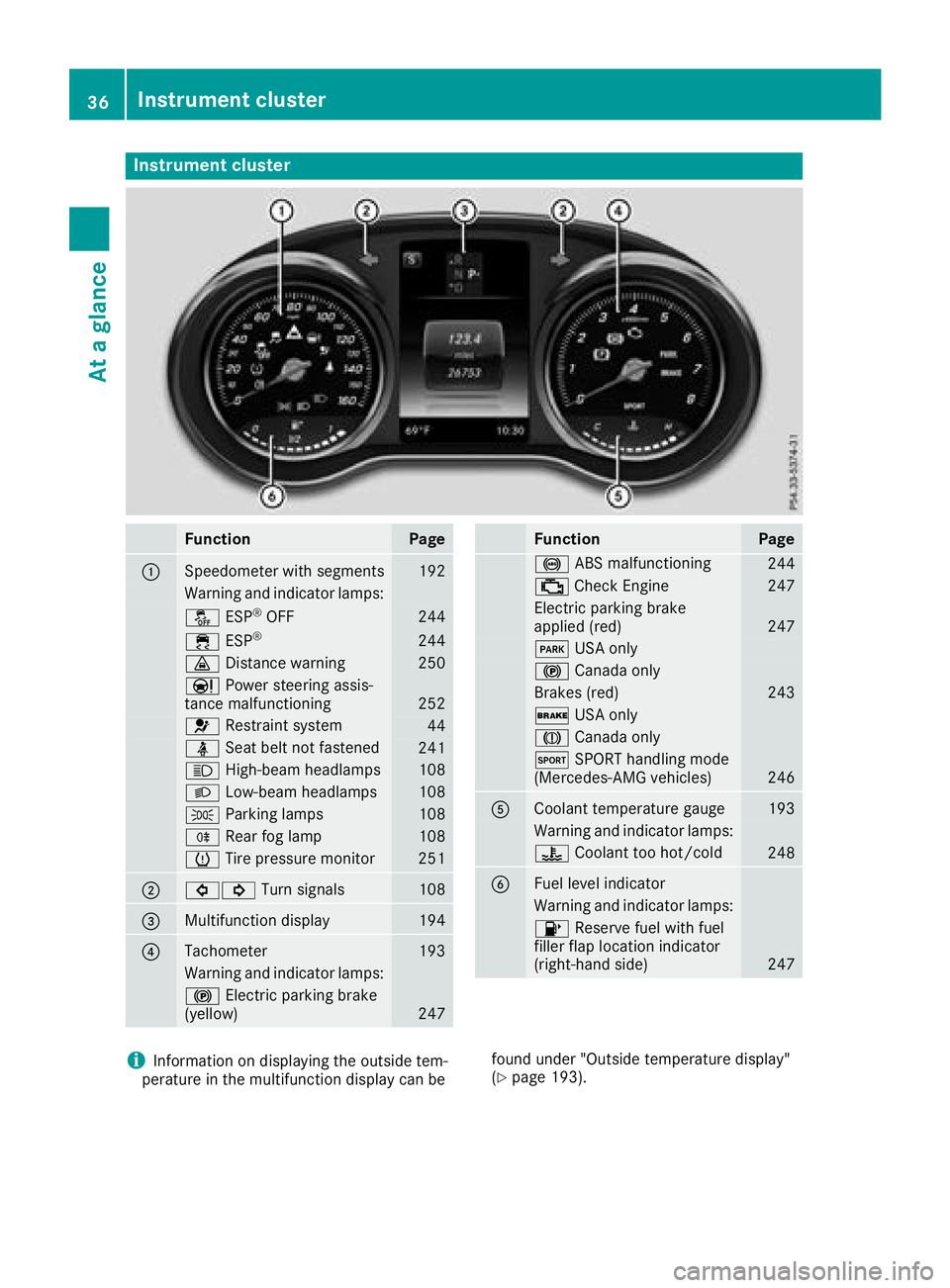
Instrument cluster
FunctionPage
:Speedometer wit hsegments19 2
Warning and indicator lamps:
å ESP®OF F244
÷ ESP®24 4
· Distanc ewarning25 0
Ð Powersteering assis-
tance malfunctioning25 2
6 Restrain tsystem44
ü Seat belt no tfastene d241
K High-beam headlamps108
L Low-beam headlamps108
T Parking lamp s108
R Rear fog lamp108
h Tirepressur emonitor25 1
;#! Turn signals108
=Multifunction display194
?Tachometer193
Warning and indicator lamps:
! Electric parking brak e
(yellow)24 7
FunctionPag e
! ABSmalfunctioning24 4
; CheckEngin e247
Electric parking brak e
applie d(red)24 7
F USAonly
! Canad aonly
Brake s(red)24 3
$ USAonly
J Canad aonly
M SPORT handlin gmod e
(Mercedes-AM Gvehicles)24 6
ACoolan ttemperature gauge19 3
Warning and indicator lamps:
? Coolan tto ohot/cold24 8
BFue llevel indicator
Warning and indicator lamps:
8 Reserve fuel wit hfuel
filler flap location indicator
(right-hand side )
247
iInformation on displayin gth eoutside tem-
peratur ein th emultifunction display can be foun
dunder "Outside temperature display"
(Ypage 193).
36Instrument cluster
At a glance
Page 47 of 350

occupant in the best position in relation to the
air bag.
The seat belt system comprises:
RSeat belts
REmergency Tensioning Devices and seat belt
force limiters
If the seat belt is pulled out of the belt outlet
quickly or with a jerky movement, the belt
retractor locks. The belt strap cannot be extrac-
ted any further.
The Emergency Tensioning Device tightens the
seat belt in an accident, pulling the belt close
against the body. However it does not pull the
vehicle occupant back in the direction of the
backrest.
The Emergency Tensioning Device does not cor-
rect an incorrect seat position or the routing of
an incorrectly fastened seat belt.
When triggered, a seat belt force limiter helps to
reduce the force exerted by the seat belt on the
vehicle occupant.
The seat belt force limiters for the front seats are
synchronized with the front air bags, which
absorb part of the deceleration force. This can
reduce the force exerted on the vehicle occu-
pants during an accident.
!If the front-passenger seat is not occupied,
do not engage the seat belt tongue in the
buckle on the front-passenger seat. Other-
wise, the Emergency Tensioning Device and
side impact air bag could be triggered in the
event of an accident and would need to be
replaced.
Important safety notes
The use of seat belts and child restraint systems is required by law in:
Rall 50 states
Rthe U.S. territories
Rthe District of Columbia
Rall Canadian provinces
Even where this is not required by law, all vehicle
occupants should correctly fasten their seat
belts before starting the journey.
GWARNING
If the seat belt is not worn correctly, it cannot
perform its intended protective function. An
incorrectly fastened seat belt can also cause
injuries, for example, in the event of an acci-
dent or when braking or changing direction
abruptly. This poses an increased risk of injury or even fatal injury.
Always ensure that all vehicle occupants have
their seat belts fastened correctly and are sit-
ting properly.
The components of the restraint system work in
conjunction with each other. They can only
deploy their protective function if, at all times, all vehicle occupants:
Rhave fastened their seat belts correctly
(Ypage 46)
Rhave the seat and head restraint adjusted
properly (Ypage 94)
GWARNING
The seat belt does not offer the intended level of protection if you have not moved the back-
rest to an almost vertical position. When brak-
ing or in the event of an accident, you could
slide underneath the seat belt and sustain
abdomen or neck injuries, for example. This
poses an increased risk of injury or even fatal injury.
Adjust the seat properly before beginning
your journey. Always ensure that the backrest
is in an almost vertical position and that the
shoulder section of your seat belt is routed
across the center of your shoulder.
GWARNING
Persons less than 5 ft (1.50 m) tall cannot
wear the seat belt correctly without an addi-
tional and suitable restraint system. If the
seat belt is not worn correctly, it cannot per-
form its intended protective function. An
incorrectly fastened seat belt can also cause
injuries, for example, in the event of an acci-
dent or when braking or changing direction
abruptly. This poses an increased risk of injury or even fatal injury.
For this reason, always secure persons under
5 ft (1.50 m) tall in suitable additional restraint
systems.
Occupant safety45
Safety
Z
Page 53 of 350
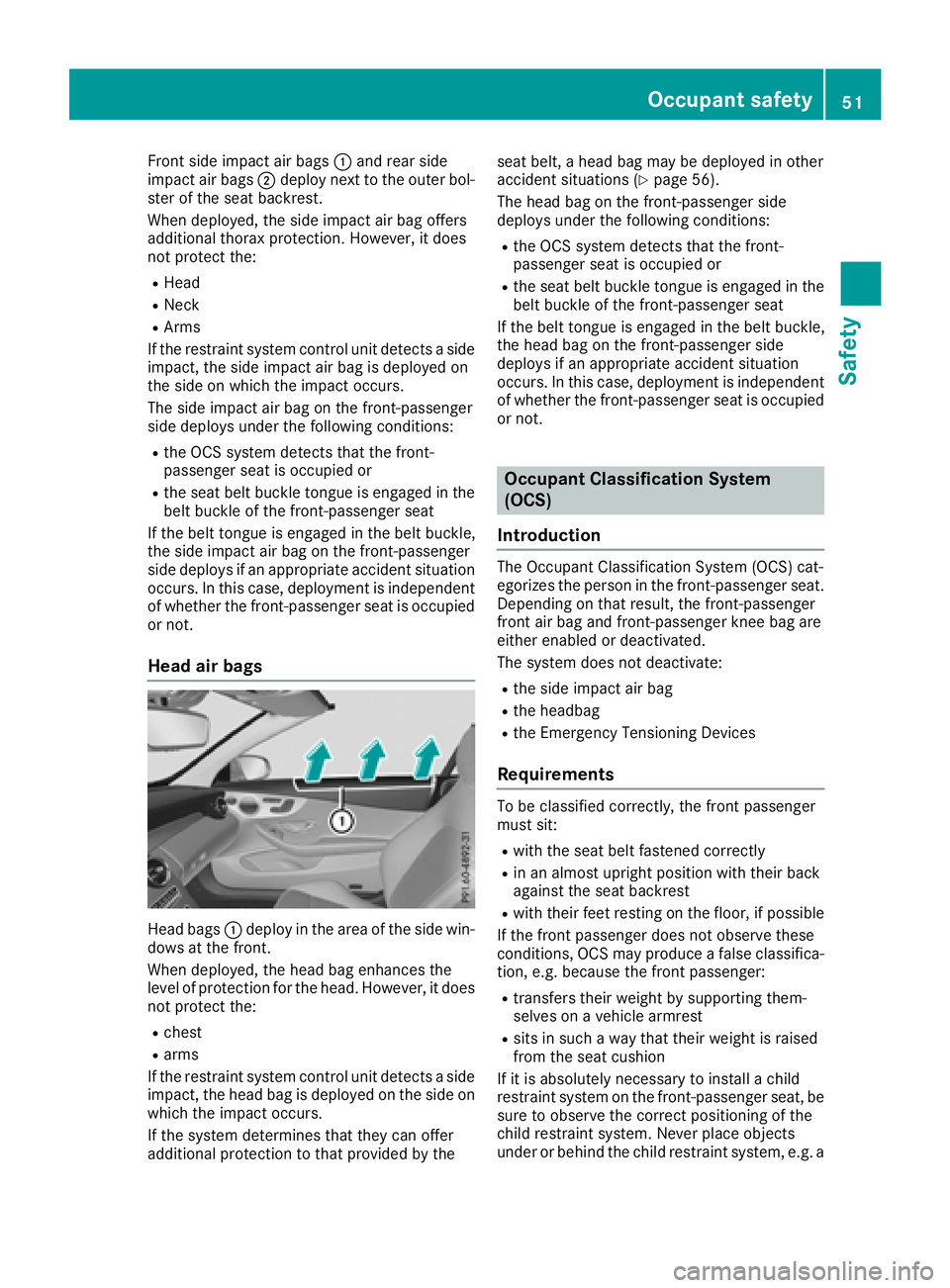
Front side impact air bags:and rear side
impact air bags ;deploy next to the outer bol-
ster of the seat backrest.
When deployed, the side impact air bag offers
additional thorax protection. However, it does
not protect the:
RHead
RNeck
RArms
If the restraint system control unit detects a side
impact, the side impact air bag is deployed on
the side on which the impact occurs.
The side impact air bag on the front-passenger
side deploys under the following conditions:
Rthe OCS system detects that the front-
passenger seat is occupied or
Rthe seat belt buckle tongue is engaged in the belt buckle of the front-passenger seat
If the belt tongue is engaged in the belt buckle,
the side impact air bag on the front-passenger
side deploys if an appropriate accident situation
occurs. In this case, deployment is independent
of whether the front-passenger seat is occupied
or not.
Head air bags
Head bags :deploy in the area of the side win-
dows at the front.
When deployed, the head bag enhances the
level of protection for the head. However, it does
not protect the:
Rchest
Rarms
If the restraint system control unit detects a side impact, the head bag is deployed on the side on
which the impact occurs.
If the system determines that they can offer
additional protection to that provided by the seat belt, a head bag may be deployed in other
accident situations (
Ypage 56).
The head bag on the front-passenger side
deploys under the following conditions:
Rthe OCS system detects that the front-
passenger seat is occupied or
Rthe seat belt buckle tongue is engaged in the belt buckle of the front-passenger seat
If the belt tongue is engaged in the belt buckle,
the head bag on the front-passenger side
deploys if an appropriate accident situation
occurs. In this case, deployment is independent
of whether the front-passenger seat is occupied
or not.
Occupant Classification System
(OCS)
Introduction
The Occupant Classification System (OCS) cat-
egorizes the person in the front-passenger seat.
Depending on that result, the front-passenger
front air bag and front-passenger knee bag are
either enabled or deactivated.
The system does not deactivate:
Rthe side impact air bag
Rthe headbag
Rthe Emergency Tensioning Devices
Requirements
To be classified correctly, the front passenger
must sit:
Rwith the seat belt fastened correctly
Rin an almost upright position with their back
against the seat backrest
Rwith their feet resting on the floor, if possible
If the front passenger does not observe these
conditions, OCS may produce a false classifica-
tion, e.g. because the front passenger:
Rtransfers their weight by supporting them-
selves on a vehicle armrest
Rsits in such a way that their weight is raised
from the seat cushion
If it is absolutely necessary to install a child
restraint system on the front-passenger seat, be
sure to observe the correct positioning of the
child restraint system. Never place objects
under or behind the child restraint system, e.g. a
Occupant safety51
Safety
Z
Page 63 of 350
GWARNING
If the child restraint system is installed incor-
rectly on a suitable seat, it cannot protect as
intended. The child cannot then be restrained
in the event of an accident, heavy braking or
sudden changes of direction. There is an
increased risk of injury, possibly even fatal.
Make sure that you observe the child restraint
system manufacturer's installation instruc-
tions and the notes on use. Please ensure,
that the base of the child restraint system is
always resting completely on the seat cush-
ion. Never place objects, e.g. cushions, under or behind the child restraint system. Only use
child restraint systems with the original cover
designed for them. Only replace damaged
covers with genuine covers.
GWARNING
If the child restraint system is installed incor-
rectly or is not secured, it can come loose in
the event of an accident, heavy braking or a
sudden change in direction. The child
restraint system could be thrown about, strik-
ing vehicle occupants. There is an increased
risk of injury, possibly even fatal.
Always install child restraint systems prop-
erly, even if they are not being used. Make
sure that you observe the child restraint sys-
tem manufacturer's installation instructions.
You will find further information on stowing
objects, luggage or loads under "Loading guide-
lines" (
Ypage 263).
GWARNING
Child restraint systems or their securing sys-
tems which have been damaged or subjected
to a load in an accident can no longer protect
as intended. The child cannot then be
restrained in the event of an accident, heavy
braking or sudden changes of direction. There is an increased risk of injury, possibly even
fatal.
Replace child restraint systems which have
been damaged or subjected to a load in an
accident as soon as possible. Have the secur-
ing systems on the child restraint system
checked at a qualified specialist workshop,
before you install a child restraint system
again.
The securing systems of child restraint systems
are:
Rthe seat belt system
Rthe LATCH-type (ISOFIX) securing rings
Rthe Top Tether anchorages
If it is absolutely necessary to carry a child on
the front-passenger seat, be sure to observe the
information on the "Occupant Classification
System (OCS)" (
Ypage 51). There you will also
find information on deactivating the front-
passenger front air bag.
All child restraint systems must meet the fol-
lowing standards:
RU.S. Federal Motor Vehicle Safety Standards
213 and 225
RCanadian Motor Vehicle Safety Standards
213 and 210.2
Confirmation that the child restraint system cor-
responds to the standards can be found on an
instruction label on the child restraint system.
This confirmation can also be found in the instal-
lation instructions that are included with the
child restraint system.
Observe the warning labels in the vehicle inte-
rior and on the child restraint system.
LATCH-type (ISOFIX) child seat secur-
ing system
GWARNING
LATCH-type (ISOFIX) child restraint systems
do not offer sufficient protection for children
whose weight combined with the child
restraint system is greater than 65 lbs (29 kg) and who are secured using the safety belt
integrated in the child restraint system. In the
event of an accident, a child might not be
restrained correctly. This poses an increased
risk of injury or even fatal injury.
If the child and the child restraint system
together weigh more than 65 lbs (29 kg), only
use LATCH-type (ISOFIX) child restraint sys-
tems with which the child is also secured with
Children in the vehicle61
Safety
Z
Page 65 of 350
XFold the rear seat backrest forwards
(Ypage 265).
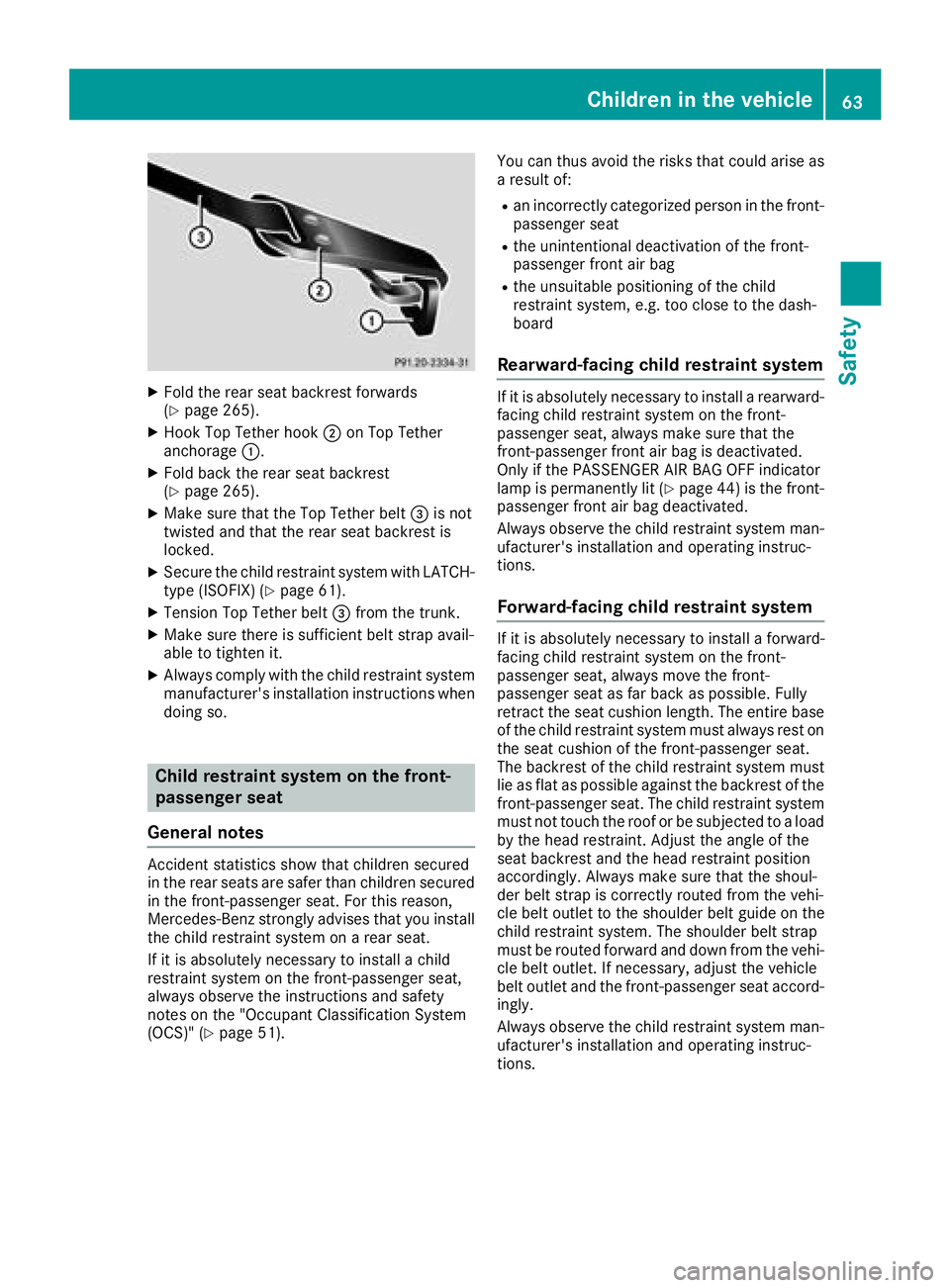
XHook Top Tether hook;on Top Tether
anchorage :.
XFold back the rear seat backrest
(Ypage 265).
XMake sure that the Top Tether belt =is not
twisted and that the rear seat backrest is
locked.
XSecure the child restraint system with LATCH-
type (ISOFIX) (Ypage 61).
XTension Top Tether belt =from the trunk.
XMake sure there is sufficient belt strap avail-
able to tighten it.
XAlways comply with the child restraint system
manufacturer's installation instructions when
doing so.
Child restraint system on the front-
passenger seat
General notes
Accident statistics show that children secured
in the rear seats are safer than children secured
in the front-passenger seat. For this reason,
Mercedes-Benz strongly advises that you install
the child restraint system on a rear seat.
If it is absolutely necessary to install a child
restraint system on the front-passenger seat,
always observe the instructions and safety
notes on the "Occupant Classification System
(OCS)" (
Ypage 51). You can thus avoid the risks that could arise as
a result of:
Ran incorrectly categorized person in the front-
passenger seat
Rthe unintentional deactivation of the front-
passenger front air bag
Rthe unsuitable positioning of the child
restraint system, e.g. too close to the dash-
board
Rearward-facing child restraint system
If it is absolutely necessary to install a rearward-
facing child restraint system on the front-
passenger seat, always make sure that the
front-passenger front air bag is deactivated.
Only if the PASSENGER AIR BAG OFF indicator
lamp is permanently lit (
Ypage 44 )is the front-
passenger front air bag deactivated.
Always observe the child restraint system man-
ufacturer's installation and operating instruc-
tions.
Forward-facing child restraint system
If it is absolutely necessary to install a forward-
facing child restraint system on the front-
passenger seat, always move the front-
passenger seat as far back as possible. Fully
retract the seat cushion length. The entire base of the child restraint system must always rest on
the seat cushion of the front-passenger seat.
The backrest of the child restraint system must
lie as flat as possible against the backrest of thefront-passenger seat. The child restraint system
must not touch the roof or be subjected to a load
by the head restraint. Adjust the angle of the
seat backrest and the head restraint position
accordingly. Always make sure that the shoul-
der belt strap is correctly routed from the vehi-
cle belt outlet to the shoulder belt guide on the
child restraint system. The shoulder belt strap
must be routed forward and down from the vehi-
cle belt outlet. If necessary, adjust the vehicle
belt outlet and the front-passenger seat accord-
ingly.
Always observe the child restraint system man-
ufacturer's installation and operating instruc-
tions.
Children in the vehicle63
Safety
Z