sensor MERCEDES-BENZ C-Class COUPE 2014 CL204 Owner's Manual
[x] Cancel search | Manufacturer: MERCEDES-BENZ, Model Year: 2014, Model line: C-Class COUPE, Model: MERCEDES-BENZ C-Class COUPE 2014 CL204Pages: 342, PDF Size: 4.55 MB
Page 8 of 342
Interior
........................................... 278
Matte finish ................................... 276
Notes ............................................. 273
Paint .............................................. 275
Plastic trim .................................... 278
Power washer ................................ 275
Rea rview camera .......................... 277
Roof lining ...................................... 279
Seat bel t........................................ 279
Seat cover ..................................... 279
Sensors ......................................... 277
Steering wheel ............................... 278
Tai lpipes ....................................... 278
Trim pieces .................................... 278
Washing by hand ........................... 274
Wheels ........................................... 275
Windows ........................................ 276
Wiper blades .................................. 276
Wooden trim .................................. 278
Cargo tie down rings .........................249
Car wash (care) ................................. 274
CD player/CD changer (on-board
computer) .......................................... 195
Center console Lowe rsection .................................. 33
Uppe rsection .................................. 32
Central locking
Automatic locking (on-board
computer) ...................................... 201
Locking/unlocking (SmartKey) ........72
Changing bulbs
Brake lamps ................................... 115
Cornering light function .................114
High-beam headlamps ...................114
Low-beam headlamps ....................113
Parking lamps ................................ 114
Reversing lamps ............................ 115
Standing lamps (front) ...................114
Children
In the vehicle ................................... 56
Restraint systems ............................ 56
Specia lseat belt retractor ...............59
Child seat
LATCH-type (ISOFIX) child seat
anchors ............................................ 60
Top Tether ....................................... 60
Cigarette lighter ................................ 253Cleaning
Mirro rturn signal ........................... 277
Climate control
Controlling automatically ...............124
Cooling with aird ehumidification..123
Defrosting the windows .................126
Defrosting the windshield ..............125
Dual-zone automatic climate
control ........................................... 121
Important safety notes ..................120
Indicator lamp ................................ 124
Maximum cooling .......................... 126
Notes on using dual-zone
automatic climate control ..............122
Overview of systems ......................120
Problems with cooling with air
dehumidification ............................ 124
Problem with the rear window
defroster ........................................ 127
Refrigerant ..................................... 339
Refrigerant filling capacity .............339
Setting the aird istribution.............124
Setting the airflow .........................125
Setting the airv ents...................... 127
Setting the temperature ................124
Switching air-recirculation mode
on/off ............................................ 127
Switching on/off ........................... 123
Switching the rear window
defroster on/off ............................ 126
Switching the ZONE function on/
off .................................................. 125
Cockpit
Overview .......................................... 28
see Instrument cluster
COMAND
see separate operating instructions
Combination switch ..........................108
Consumption statistics (on-board
computer) .......................................... 191
Convenience closing feature ..............85
Convenience opening feature ............85
Coolan t(engine)
Checkin gthe level ......................... 272
Display message ............................ 217
Filling capacity ............................... 338
Important safety notes ..................337
Temperature (on-board computer) .203 6
Index
Page 13 of 342
Instrumen
tcluster
Overview .......................................... 29
Settings ......................................... 199
Warning and indicator lamps ...........30
Instrument cluster lighting ..............188
Interior lighting ................................. 111
Automatic control ..........................112
Delayed switch-off (on-board
computer) ...................................... 201
Emergency lighting ........................112
Manual control ............................... 112
Overview ........................................ 111
Reading lamp ................................. 111J
Jack Storage location ............................ 282
Using ............................................. 321
Jump starting (engine) ......................288 K
KEYLESS-GO Convenience closing feature ............86
Display message ............................ 230
Locking ............................................ 73
Start/Stop button .......................... 132
Starting the engine ........................133
Unlocking ......................................... 73
Keyp ositions
KEYLESS-GO .................................. 132
SmartKey ....................................... 131
Kickdown
Driving tips .................................... 140
Manual drive program ....................144
Knee bag .............................................. 42L
Lamps see Warning and indicator lamps
Lane detection (automatic)
see Lane Keeping Assist
Lane Keeping Assist
Activating/deactivating .................198
Display message ............................ 221
Function/informatio n.................... 178
Lane Tracking package .....................176Lap time (RACETIMER)
......................204
LATCH-type (ISOFIX) child seat
anchors ................................................ 60
Light function ,active
Display message ............................ 216
Lighting
Ligh tswitc h................................... 106
Lights
Activating/deactivating the
interio rlighting delayed switch-off .201
Automatic headlamp mode ............107
Cornering light function .................109
Display message ............................ 214
Driving abroad ............................... 106
Fog lamps ...................................... 107
Hazard warning lamps ...................109
High beam flasher .......................... 109
High-beam headlamps ...................109
Low-beam headlamps ....................107
Parking lamps ................................ 108
Rea rfog lamp ................................ 108
Standing lamps .............................. 108
Switching Adaptive Highbeam
Assist on/off ................................. 200
Switching the daytime running
lamps on/off (on-board computer) 200
Switching the daytime running
lamps on/off (switch) ....................107
Switching the exterio rlighting
delayed switch-off on/off (on-
board computer )............................ 200
Switching the surround lighting
on/off (on-board computer) ..........200
Turn signals ................................... 108
see Interior lighting
see Replacing bulbs
Light sensor (display message) .......216
Loading guidelines ............................246
Locking see Centra llocking
Locking (doors)
Automatic ........................................ 78
Emergency locking ........................... 79
From inside (central locking
button) ............................................. 78
Locking centrally
see Centra llocking Index
11
Page 15 of 342
O
Occupant Classification System
(OCS) Faults .............................................. .49
Operation ........................................ .45
System self-test ............................... 47
Occupant safety
Childre ninthe vehicle ..................... 56
System overview .............................. 38
OCS
Faults ............................................... 49
Operation ........................................ .45
System self-test ............................... 47
Odometer ........................................... 191
Oil see Engine oil
On-board computer
AMG menu ..................................... 203
Assistance menu ........................... 197
Audi omenu ................................... 194
Convenience submenu ..................202
Displaying a service message ........268
Display messages ..........................206
DISTRONI CPLUS ........................... 163
Factory settings submenu .............203
Important safety notes ..................188
Instrument cluster submenu ..........199
Lighting submenu .......................... 200
Menu overview .............................. 191
Message memory .......................... 206
Navigation menu ............................ 193
Operation ....................................... 189
RACETIMER ................................... 204
Service menu ................................. 199
Settings menu ............................... 199
Standard displa y............................ 191
Telephone menu ............................ 195
Trip menu ...................................... 191
Vehicle submenu ........................... 201
Video DVD operatio n..................... 195
Opening and closing the side trim
panels ................................................. 115
Operating safety Declaratio nofconformity ................ 24
Important safety notes ....................23
Operating system
see On-board computer Operator's Manual
Vehicle equipment ...........................21
Outside temperature display ...........189
Overhead control panel ......................34 P
Pain tcode number ............................ 332
Paintwork (cleaning instructions) ...275
Panic alarm .......................................... 38
Panorama roof with power tilt/
sliding panel
Opening/closing .............................. 88
Opening/closing the roller
sunblind ........................................... 89
Problem (malfunction) .....................89
Resetting ......................................... 89
Panorama sliding sunroof
Important safety notes ....................87
Parking ............................................... 148
Important safety notes ..................148
Parking brake ................................ 149
Position of exterior mirror, front-
passenger side ............................... 102
Rea rview camera .......................... 175
see PARKTRONIC
Parking aid
Parking Guidance ........................... 172
see Exterior mirrors
see PARKTRONIC
Parking brake
Display message ............................ 208
Notes/function .............................. 149
Parking Guidance
Display message ............................ 222
Important safety notes ..................172
Parking lamps
Changing bulbs .............................. 114
Switching on/off ........................... 108
PARKTRONIC
Deactivating/activating .................171
Driving system ............................... 169
Function/notes ............................. 169
Important safety notes ..................169
Problem (malfunction) ...................172
Range of the sensors .....................170
Warning displa y............................. 170 Index
13
Page 16 of 342

PASSENGER AIR BAG OFF
Problem (malfunction) .....................49
Problems (malfunction) .................. 213
PASSENGE RAIR BAG OFF indicator
lamp ...................................................... 45
Plastic trim (cleaning instructions) .278
Power washers .................................. 275
Power windows see Side windows
PRE-SAFE ®
(anticipatory occupant
protection) Display message ............................ 209
Operation ........................................ .50
PRE-SAFE ®
Brake
Activating/deactivating .................198
Display message ............................ 210
Function/notes ................................ 67
Warning lamp ................................. 243
Program selector button ..................140
Protection of the environment General notes .................................. 20
Pulling away
Automatic transmission .................134 Q
Qualifie dspecialis tworkshop ...........24 R
RACE START (AMG vehicles) .............167
RACETIMER (on-board computer) ....204
Radar sensor system Activating/deactivating .................202
Display message ............................ 221
Radio
Selecting astation ......................... 194
see separate operating instructions
Radio-wave reception/
transmission in the vehicle
Declaratio nofconformity ................ 24
Reading lamp ..................................... 111
Rear compartment Setting the airv ents...................... 128
Rear fog lamp
Display message ............................ 215
Switching on/off ........................... 108Rear seat (folding the backrest
forwards/back)
................................. 248
Rear view camera Cleaning instructions .....................277
Function/notes ............................. 175
Rear-view mirror
Anti-glar e(manual) ........................ 100
Dipping (automatic) .......................102
Rear window defroster
Problem (malfunction) ...................127
Switching on/off ........................... 126
Refrigerant (air-conditioning
system)
Important safety notes ..................339
Refueling
Fuel gauge ....................................... 29
Important safety notes ..................145
Notes for AMG vehicles .................335
Refueling proces s.......................... 146
see Fuel
Releasing the parking lock
manually (automatic transmission) 145
Remote control Garage door opener .......................263
Programming (garage door opener) 263
Replacing bulbs
Important safety notes ..................112
Overview of bul btypes .................. 113
Reporting safety defects ....................25
Reserve (fuel tank) see Fuel
Reserve fuel
Display message ............................ 220
Warning lamp ................................. 240
see Fuel
Restraint system
see SRS (Supplemental Restraint
System)
Reverse gear
Engaging (automatic transmission) 138
Reversing feature
Panorama sliding sunroo f................ 87
Roller sunblind ................................. 88
Side windows ................................... 84
Trunk lid .......................................... .80
Roadside Assistance (breakdown) ....22 14
Index
Page 17 of 342
Rolle
rblind
see Roller sunblind
Roller sunblind
Opening/closin g.............................. 89
Panorama roof with power tilt/
sliding panel ..................................... 88
Roof carrier ........................................ 250
Roof lining and carpets (cleaning
guidelines) ......................................... 279
Roof load (maximum) ........................340
Route (navigation) see Route guidance (navigation)
Route guidance (navigation) ............193 S
Safety Childre ninthe vehicle ..................... 56
Child restraint systems ....................56
Occupant Classification System
(OCS) ............................................... 45
Overview of occupant safety
systems ........................................... 38
Safety system
see Driving safety systems
Seat belts
Adjusting the driver's and front-
passenger sea tbelt ......................... 54
Belt force limiters ............................ 55
Cleaning ......................................... 279
Correct usage .................................. 52
Emergency Tensioning Devices ....... .55
Fastening ......................................... 53
Important safety guidelines .............52
Releasing ......................................... 54
Safety guidelines ............................. 39
Switching belt adjustment on/off
(on-board computer) ......................202
Warning lamp ................................. 232
Warning lamp (function) ................... 55
Seats
Adjusting (electrically). ....................94
Adjusting (manually and
electrically). ..................................... 94
Adjusting the 4-way lumbar
support ............................................ 96
Adjusting the head restraint ............95
Cleaning the cover .........................279Correct driver's seat position ........... 92
Folding the backrests forward/
back ................................................
.95
Important safety notes ....................93
Seat backres tdisplay message .....229
Seat heating problem ......................98
Seat ventilation problem ..................98
Storing settings (memory function) 103
Switching sea theating on/off .........96
Switching sea tventilation on/off ....98
Sensors (cleaning instructions) .......277
Service menu (on-board computer) .199
Service products Brake fluid ..................................... 337
Coolant (engine) ............................ 337
Engine oil ....................................... 336
Fuel ................................................ 333
Important safety notes ..................333
Refrigerant (air-conditioning
system) .......................................... 339
Washer fluid .................................. .338
Settings
Factory (on-board computer) .........203
On-board computer .......................199
Setting the air distribution ...............124
Setting the airflow ............................125
SETUP (on-board computer) .............203
Side impact air bag .............................43
Side marker lamp (display
message) ............................................ 216
Side windows Cleaning ......................................... 276
Convenience closing feature ............85
Convenience opening feature ..........85
Important safety information ...........83
Opening/closing .............................. 84
Problem (malfunction) .....................86
Resetting ......................................... 86
Sliding sunroof
see Panorama roof with power
tilt/sliding panel
SmartKey
Changing the battery .......................75
Changing the programming .............73
Checking the battery .......................75
Convenience closing feature ............85
Convenience opening feature ..........85
Display message ............................ 230 Index
15
Page 22 of 342
Protection of the environment
General notes
H
Environmental note
Daimler's declared policy is one of
comprehensive environmental protection.
The objectives are for the natural resources
that form the basis of our existence on this
planet to be used sparingly and in a manner
that takes the requirements of both nature
and humanity into account.
You too can help to protect the environment
by operating your vehicle in an
environmentally responsible manner.
Fuel consumption and the rate of engine,
transmission, brake and tire wear are affected
by these factors:
R operating conditions of your vehicle
R your personal driving style
You can influence both factors. You should
bear the following in mind:
Operating conditions:
R avoid short trips as these increase fuel
consumption.
R always make sure that the tire pressures
are correct.
R do not carry any unnecessary weight.
R remove roof racks once you no longer need
them.
R a regularly serviced vehicle will contribute
to environmental protection. You should
therefore adhere to the service intervals.
R always have service work carried out at a
qualified specialist workshop.
Personal driving style:
R do not depress the accelerator pedal when
starting the engine.
R do not warm up the engine when the vehicle
is stationary.
R drive carefully and maintain a safe distance
from the vehicle in front.
R avoid frequent, sudden acceleration and
braking. R
change gear in good time and use each gear
only up to 0001of its maximum engine speed.
R switch off the engine in stationary traffic.
R keep an eye on the vehicle's fuel
consumption. Environmental concerns and
recommendations
Wherever the operating instructions require
you to dispose of materials, first try to
regenerate or re-use them. Observe the
relevant environmental rules and regulations
when disposing of materials. In this way you
will help to protect the environment. Genuine Mercedes-Benz parts
H
Environmental note
Daimler AG also supplies reconditioned major
assemblies and parts which are of the same
quality as new parts. They are covered by the
same Limited Warranty entitlements as new
parts.
! Air bags and Emergency Tensioning
Devices, as well as control units and
sensors for these restraint systems, may be
installed in the following areas of your
vehicle:
R doors
R door pillars
R door sills
R seats
R cockpit
R instrument cluster
R center console
Do not install accessories such as audio
systems in these areas. Do not carry out
repairs or welding. You could impair the
operating efficiency of the restraint
systems. 20
Introduction
Page 41 of 342
SRS (Supplemental Restraint System)
Introduction SRS consists of:
R
The 001E SRS warning lamp
R Air bags
R Air bag control unit (with crash sensors)
R Emergency Tensioning Devices
R Belt force limiters
SRS reduces the risk of occupants coming
into contact with the vehicle's interior in the
event of an accident. It can also reduce the
effect of the forces to which occupants are
subjected during an accident.
SRS warning lamp G
WARNING
If SRS is malfunctioning, child restraint
system components may be triggered
unintentionally or might not be triggered at all
in the event of an accident with a high rate of
vehicle deceleration. There is an increased
risk of injury, possibly even fatal.
Have SRS checked and repaired immediately
at a qualified specialist workshop.
SRS functions are checked regularly when
you switch on the ignition and when the
engine is running. Therefore, malfunctions
can be detected in good time.
The 001E SRS warning lamp in the instrument
cluster lights up when the ignition is switched
on. It goes out no later than a few seconds
after the engine is started.
The SRS components are in operational
readiness when the 001ESRS warning lamp
goes out while the engine is running. There is a malfunction if:
R
the 001E SRS warning lamp does not light
up when the ignition is switched on
R the engine is running and the 001ESRS
warning lamp does not go out after a few
seconds
R the engine is running and the 001ESRS
warning lamp lights up again
Safety guidelines for seat belts,
Emergency Tensioning Devices (ETDs)
and air bags G
WARNING
R Damaged seat belts or seat belts that have
been subjected to stress in an accident
must be replaced. Their anchoring points
must also be checked. Only use seat belts
installed or supplied by an authorized
Mercedes-Benz Center.
R Air bags and pyrotechnic Emergency
Tensioning Devices (ETDs) contain
perchlorate material, which may require
special handling and regard for the
environment. Check your national disposal
guidelines. California residents, see
www.dtsc.ca.gov/HazardousWaste/
Perchlorate/index.cfm .
R Air bags and ETDs are designed to function
on a one-time-only basis. An air bag or ETD
that has deployed must be replaced.
R Do not pass seat belts over sharp edges.
They could tear.
R Do not make any modification that could
change the effectiveness of the seat belts.
R Do not bleach or dye seat belts as this may
severely weaken them. In a crash they may
not be able to provide adequate protection.
R No modifications of any kind may be made
to any components or wiring of the SRS.
R Do not change or remove any component
or part of the SRS.
R Do not install additional trim material, seat
covers, badges, etc. over the steering
wheel hub, front-passenger front air bag Occupant safety
39Safety
Z
Page 44 of 342
i
After an ai rbag has been deployed, have
the vehicle towed to the neares tqualified
specialist workshop, eve nifyour vehicle is
ready to drive.
Front air bags The front air bags increase protection for the
driver's and front passenger's head and
chest.
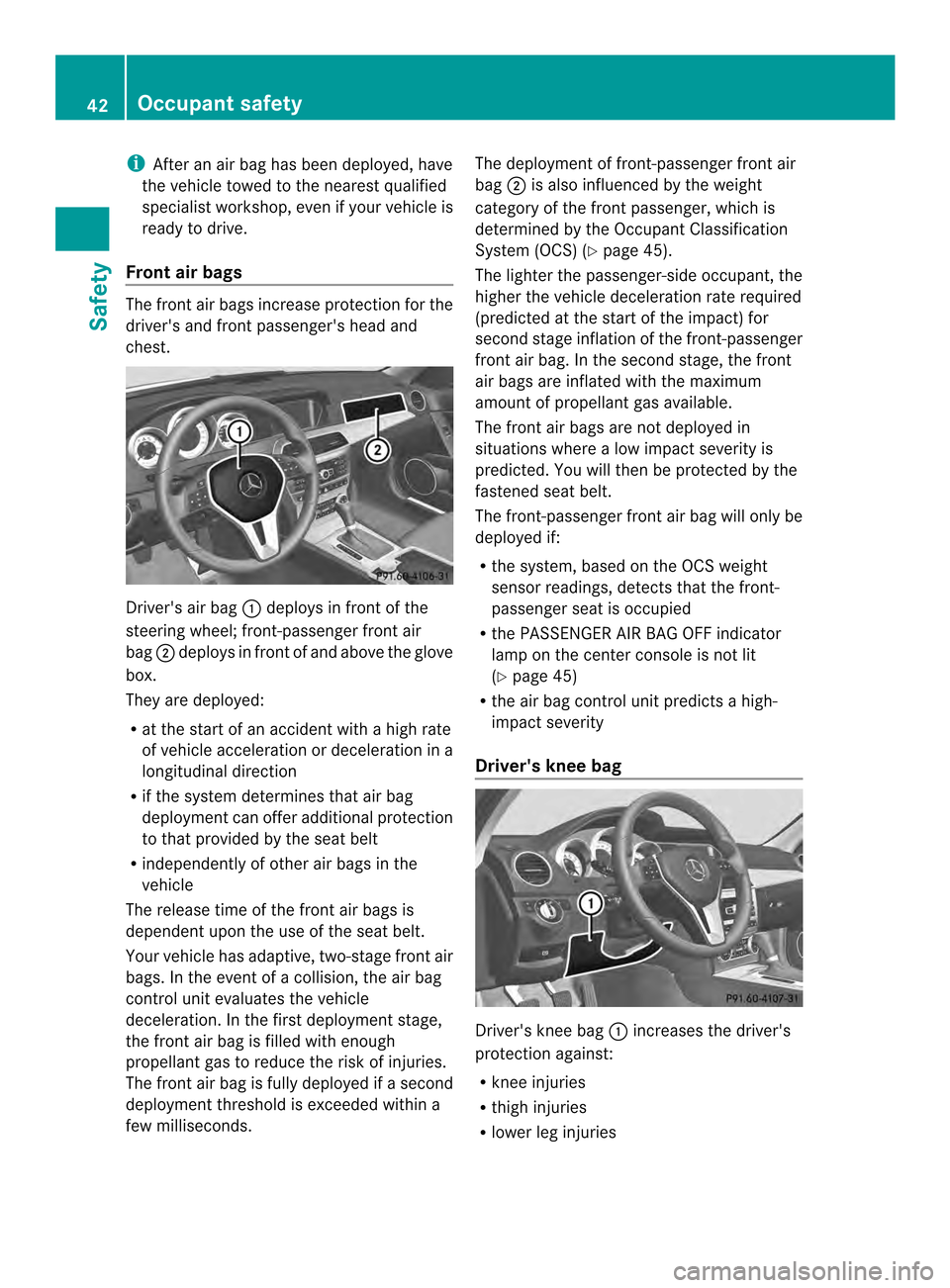
Driver's air bag
0002deploys in front of the
steering wheel; front-passenger front air
bag 0003deploys in front of and above the glove
box.
They are deployed:
R at the start of an accident with a high rate
of vehicle acceleration or deceleration in a
longitudinal direction
R if the system determines that air bag
deployment can offer additional protection
to that provided by the seat belt
R independently of other air bags in the
vehicle
The release time of the front air bags is
dependent upon the use of the seat belt.
Your vehicle has adaptive, two-stage front air
bags. In the event of a collision, the air bag
control unit evaluates the vehicle
deceleration. In the first deployment stage,
the front air bag is filled with enough
propellant gas to reduce the risk of injuries.
The front air bag is fully deployed if a second
deployment threshold is exceeded within a
few milliseconds. The deployment of front-passenger front air
bag
0003is also influenced by the weight
category of the front passenger, which is
determined by the Occupant Classification
System (OCS) (Y page 45).
The lighter the passenger-side occupant, the
higher the vehicle deceleration rate required
(predicted at the start of the impact) for
second stage inflation of the front-passenger
front air bag. In the second stage, the front
air bags are inflated with the maximum
amount of propellant gas available.
The front air bags are not deployed in
situations where a low impact severity is
predicted. You will then be protected by the
fastened seat belt.
The front-passenger front air bag will only be
deployed if:
R the system, based on the OCS weight
sensor readings, detects that the front-
passenger seat is occupied
R the PASSENGER AIR BAG OFF indicator
lamp on the center console is not lit
(Y page 45)
R the air bag control unit predicts a high-
impact severity
Driver's knee bag Driver's knee bag
0002increases the driver's
protection against:
R knee injuries
R thigh injuries
R lower leg injuries 42
Occupant safetySafety
Page 45 of 342
Driver's knee bag
0002deploys under the
steering column. If, during a frontal collision,
the syste mdetermines that air bag
deployment can offer additional protection to
that provided by the seat belt, driver's knee
bag 0002is deployed along with the driver's air
bag. Driver's knee bag 0002operates best in
conjunction with correctly positioned and
fastened seat belts.
Side impact air bags G
WARNING
Using unsuitable seat cover scould restric tor
even preven tdeployment of the air bags
integrated into the seats. Consequently, the
air bags cannot protec tvehicle occupants as
they are designed to do. In addition, the
function of the air bag deactivation system
could be restricted. This poses an increased
risk of injury or even fatal injury.
You should only use seat covers that have
been approved for the respective seat by
Mercedes-Benz. G
WARNING
Sensors to control the air bags are located in
the doors. Modifications or work not
performed correctly to the doors or door
paneling, as well as damaged doors, can lead
to the function of the sensors being impaired.
The air bags might therefore not function
properly any more. Consequently, the air bags
cannot protec tvehicle occupants as they are
designed to do. There is an increased risk of
injury.
Never modify the doors or parts of the doors.
Always have work on the doors or door
paneling carried out at a qualified specialist
workshop.
You should only use seat covers that have
been approved for your vehicle by Mercedes-
Benz .The seat covers must have a special
tear seam for side impact air bags. Otherwise,
the side impact air bags cannot deploy
correctly and therefore cannot provide the intended protection in the event of an
accident.
When deployed, the side impact air bags offer
additional protection for the thorax of the
vehicle occupants on the side of the vehicle
on which the impact occurs. However, they
do not protect the:
R
head
R neck
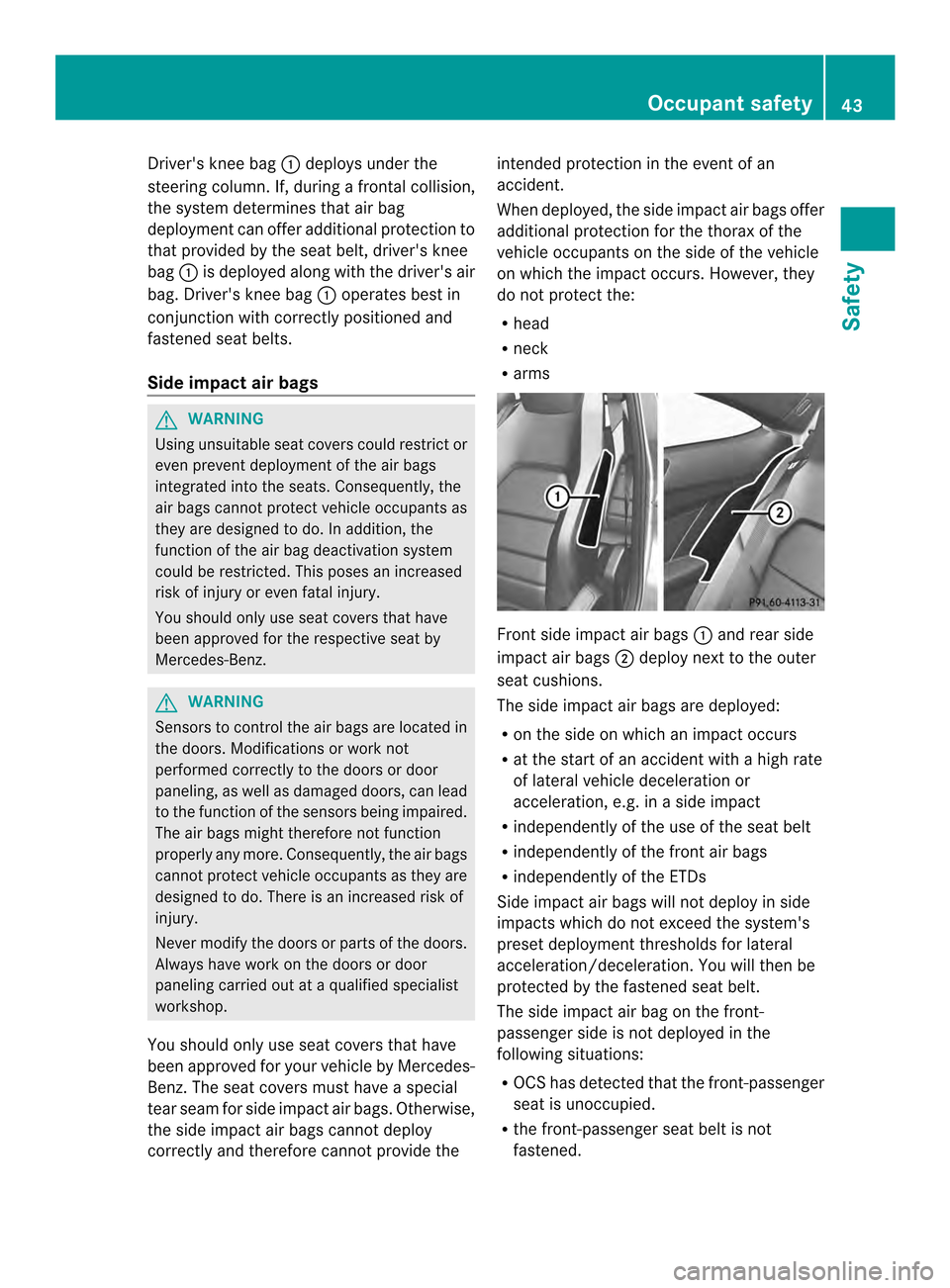
R arms Front side impact air bags
0002and rear side
impact air bags 0003deploy next to the outer
seat cushions.
The side impact air bags are deployed:
R on the side on which an impact occurs
R at the start of an accident with a high rate
of lateral vehicle deceleration or
acceleration, e.g. in aside impact
R independently of the use of the seat belt
R independently of the front air bags
R independently of the ETDs
Side impac tair bags will not deploy in side
impacts which do not exceed the system's
prese tdeployment thresholds for lateral
acceleration/deceleration .You will then be
protected by the fastened seat belt.
The side impact air bag on the front-
passenger side is not deployed in the
following situations:
R OCS has detected that the front-passenger
seat is unoccupied.
R the front-passenger seat belt is not
fastened. Occupant safety
43Safety Z
Page 47 of 342
vehicle acceleration/deceleration. You will
then be protected by the fastened seat belt. Occupant Classification System
(OCS)
How the Occupant Classification
System works The Occupant Classification System (OCS)
categorizes the occupant on the front-
passenger seat using a weight sensor. The
front-passenge rfront air bag is deactivated
automatically for certain weight categories.
The PASSENGER AIR BAG OFF indicator lamp
shows you the current status. If the
PASSENGER AIR BAG OFF indicator lamp is
lit, the passenger air bag is disabled.
The system does not deactivate:
R the side impact air bag
R the pelvis air bag
R the window curtai nair bag
R the Emergency Tensioning Devices
To be classified correctly, the front passenger
must sit:
R with the seat belt fastened correctly
R in a position that is as upright as possible
with their back against the seat backrest
R with their feet on the floor
The OCS weight sensor reading is affected if
the occupant's weight is transferred, e.g. by
leaning on the armrest.
If the front-passenger seat, the seat cover or
the seat cushio nare damaged, have the
necessary repair work carried out at a
qualified specialist workshop.
For safety reasons, Mercedes-Benz
recommends that you only use seat
accessories that have been approved by
Mercedes-Benz.
Both the drive rand the front passenger
should always observe the PASSENGER AIR
BAG OFF indicator lamp as an indication of
whethe rornot the front passenger is
positioned correctly. Observe also the air bag display messages that can be displayed in the
instrument cluster (Y
page 213). G
WARNING
If the 0019001B indicator lamp illuminates
when an adult or someone larger than a small
individual is in the front passenger seat, have
the front passenger reposition himself or
herself in the seat until the 0019001B
indicator lamp goes out.
In the event of a collision, the air bag control
unit will not allow front passenger front air bag
deployment when the OCS has classified the
front passenger seat occupant as weighing as
much as or less than a typical 12-month-old
child in a standard child restraint or if the front
passenger seat is classified as being empty.
When the OCS senses that the front
passenger seat occupant is classified as
being up to or less than the weight of a typical
12-month-old child in a standard child
restraint, the 0019001Bindicator lamp will
illuminate when the engine is started and
remain illuminated. This indicates that the
front passenger front air bag is deactivated.
When the OCS senses that the front
passenger seat is classified as being empty,
the 0019001B indicator lamp will illuminate
when the engine is started and remain
illuminated. This indicates that the front
passenger front air bag is deactivated.
When the OCS senses that the front
passenger seat occupant is classified as
being heavier than the weight of a typical 12-
month-old child seated in astandard child
restraint or as being a small individual (such
as a young teenager or asmall adult), the
0019001B indicator lamp will illuminate for
approximately 6seconds when the engine is
started. Depending on occupant weight
sensor readings from the seat, it will then
remain illuminated or go out. With the
0019001B indicator lamp illuminated, the
fron tpassenger fron tair bag is deactivated.
With the 0019001B indicator lamp out, the
front passenger front air bag is activated. Occupant safety
45Safety
Z