warning lights MERCEDES-BENZ C-CLASS COUPE 2015 User Guide
[x] Cancel search | Manufacturer: MERCEDES-BENZ, Model Year: 2015, Model line: C-CLASS COUPE, Model: MERCEDES-BENZ C-CLASS COUPE 2015Pages: 385, PDF Size: 13.12 MB
Page 55 of 385
Problems with automatic front-passenger front airbag deactivation
Be sure to observe the notes on "System self-test
"(Y page 50). Problem
Possible causes/consequences and
M
MSolutions The PASSENGER AIR
BAG OFF indicator lamp
lights up and remains lit,
even though the front-
passenger seat is occu-
pied by an adult or aper-
son with abuild corre-
sponding to that of an
adult. The classification of the person on the front-passenger seat is false.
X Make sure the condition sfor ac orrect classification of the person
on the front-passenger seat are met (Y page 48).
X If the PASSENGER AIR BAG OFF indicator lamp remains lit, the front-
passenger seat may not be used.
X Have the automatic front-passenger front airbag deactivation sys-
tem checked as soon as possible at aMercedes-Benz Service
Centre. The PASSENGER AIR
BAG OFF indicator lamp
does not light up and/or
does not stay on.
The front-passenger seatis:
R empty
R occupied with arear-
ward-facing child
restraint system The automatic front-passenger front airbag deactivation system is
malfunctioning.
X Make sure there is nothingb etween the seat and the child restraint
system.
X Make sure that the entire base of the child restraint system rests on
the seat cushion of the front-passenger seat.
X Make sure that the seat cushion length is fully retracted.
X When installing the child restraint system, make sure that the seat
belt is tight. Do not pull the seat belt tight with the front-passenger
seat adjustment .This could result in the seat belt and the child
restraint system being pulled too tightly.
X Check that the child restraint system is installed correctly.
X Make sure that no objectsa re applying additional weight to the
seat.
X If the PASSENGER AIR BAG OFF indicator lamp remains off and/or
the PASSENGER AIR BAG ON indicator lamp lights up, do not install
ar earward-facing child restraint system on the front-passenger
seat. It is recommended that you fit the child restraint system to a suitable rear seat.
X Have the automatic front-passenger front airbag deactivation sys-
tem checked as soon as possible at aMercedes-Benz Service
Centre. Deployment of belt tensioners and air-
bags
Important safety notes G
WARNING
After the airbag deploys, the airbag parts are
hot. There is arisk of injury.
Do not touch the airbag parts. Have a
deployeda irbag replaced at aqualified spe-
cialist workshop as soon as possible. G
WARNING
Pyrotechnic seat belt tensioners that have
been deployeda re no longer operational and
are unable to perform their intended protec-
tive function. This poses an increased risk of
injury or even fatal injury.
Therefore, have pyrotechnic belt tensioners
which have been triggered immediately
replaced at aqualified specialist workshop.
Mercedes-Benz recommends that you have the
vehicle towed to aqualified specialist workshop 52
Occupant safetySafety
Page 62 of 385
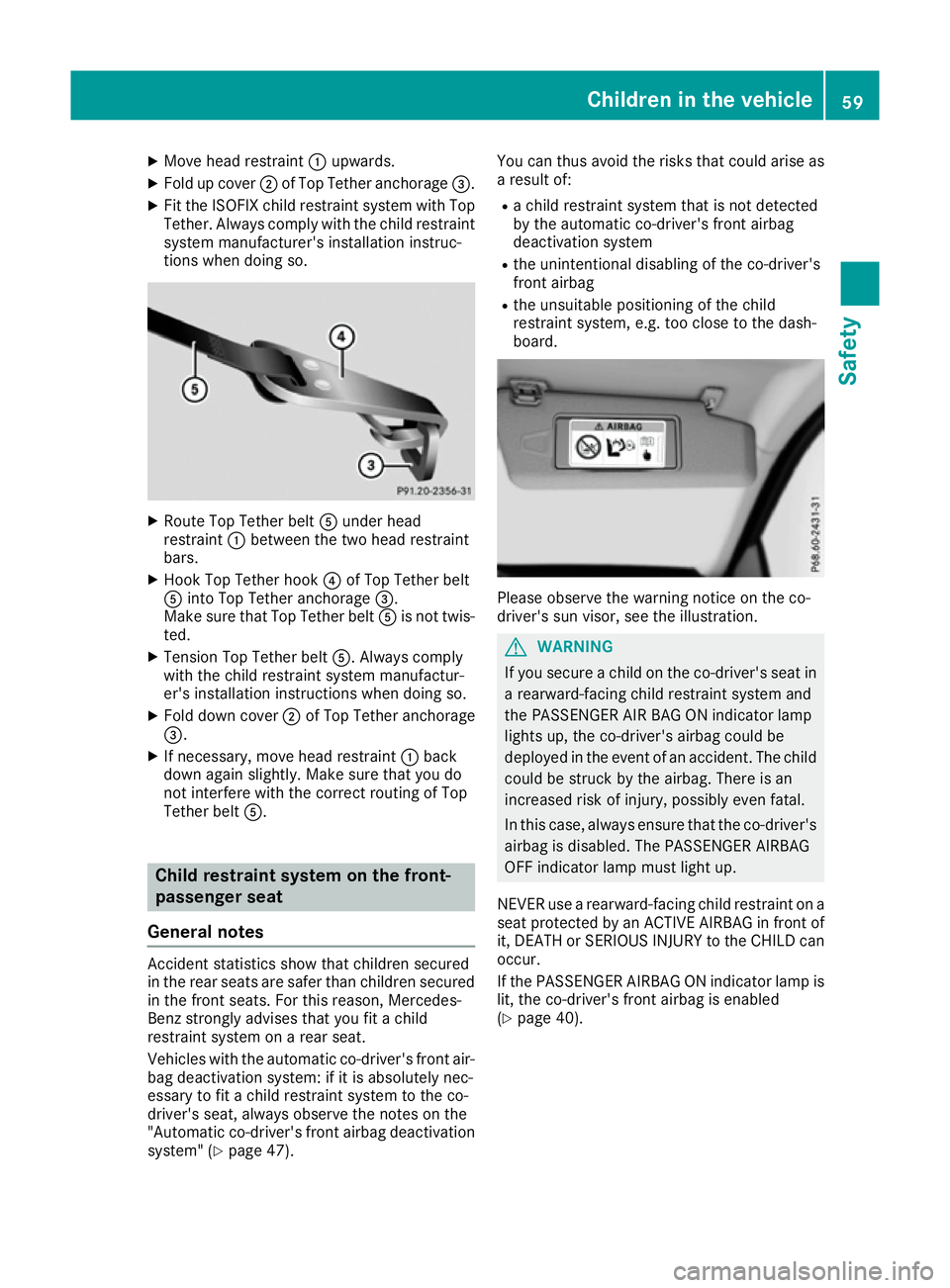
X
Move head restraint :upwards.
X Fold up cover ;of Top Tether anchorage =.
X Fit the ISOFIX child restraint system with Top
Tether. Always comply with the child restraint system manufacturer's installation instruc-
tions when doing so. X
Route Top Tether belt Aunder head
restraint :between the two head restraint
bars.
X Hook Top Tether hook ?of Top Tether belt
A into Top Tether anchorage =.
Make sure that Top Tether belt Ais not twis-
ted.
X Tension Top Tether belt A.Always comply
with the child restraint system manufactur-
er's installation instructions when doing so.
X Fold down cover ;of Top Tether anchorage
=.
X If necessary, move head restraint :back
down again slightly. Make sure that you do
not interferew ith the correct routing of Top
Tether belt A. Child restraint system on the front-
passenger seat
General notes Accident statisticss
how that children secured
in the rear seats are safer than children secured
in the front seats. For this reason, Mercedes-
Benz strongly advises that you fit achild
restraint system on arear seat.
Vehicles with the automatic co-driver's front air-
bag deactivation system: if it is absolutely nec-
essary to fit achild restraint system to the co-
driver's seat, always observe the notes on the
"Automatic co-driver's front airbag deactivation system" (Y page 47). You can thus avoid the risks that could arise as
ar esult of:
R ac hild restraint system that is not detected
by the automatic co-driver's front airbag
deactivation system
R the unintentional disabling of the co-driver's
front airbag
R the unsuitable positioning of the child
restraint system, e.g. too close to the dash-
board. Please observe the warning notice on the co-
driver's sun visor, see the illustration. G
WARNING
If you secure achild on the co-driver's seat in
ar earward-facing child restraint system and
the PASSENGER AIR BAG ON indicator lamp
lights up, the co-driver's airbag could be
deployed in the event of an accident. The child could be struck by the airbag. There is an
increased risk of injury, possibly even fatal.
In this case, always ensure that the co-driver's
airbag is disabled. The PASSENGER AIRBAG
OFF indicator lamp must light up.
NEVERu searearward-facing child restraint on a
seat protected by an ACTIVE AIRBAG in front of
it, DEATH or SERIOUS INJURY to the CHILD can occur.
If the PASSENGER AIRBAG ON indicator lamp is
lit, the co-driver's front airbag is enabled
(Y page 40). Children in the vehicle
59Safety Z
Page 69 of 385
Pets in the vehicle
G
WARNING
If you leave animals unsupervised or unse-
cured in the vehicle, they may push abutton
or as witch, for example.
They could:
R activate vehicle equipment and become
trapped, for example
R switch vehicle systems on or off, thus
endangering other road users
In the event of an accident, sudden braking or
abrupt changes of direction, unsecured ani-
mals could be flung around the vehicle, injur-
ing the vehicle occupants. There is arisk of an
accident and injury.
Never leave animals unattended in the vehi-
cle. Always secure animals correctly during a
journey, e.g. in an animal transport box. Driving safety systems
Driving safety systems overview
In this section,y ou will find information about
the following driving safety systems:
R ABS (Anti-lock BrakingSystem)
(Y page 66)
R BAS ( Brake Assist System) (Y page 67)
R BAS PLUS with Cross-Traffic Assist ( Brake
Assist System PLUS with Cross-Traffic Assist)
(Y page 67)
R COLLISION PREVENTION ASSIST PLUS
(Y page 69)
R Adaptive brake lights (Y page 71)
R ESP ®
(Electronic StabilityProgram)
(Y page 71)
R EBD ( electronic brakeforce distribution)
(Y page 75)
R ADAPTIVE BRAKE (Y page 75)
R PRE-SAFE ®
Brake (Y page 75)
R STEERC ONTROL (Y page 77) Important safety notes
If you fail to adapt your driving style or if you are
inattentive, the driving safety systems can nei-
ther reduce the risk of an accident nor override the laws of physics. Driving safety systems are
merely aids designed to assist driving. You are
responsible for maintaining the distance to the
vehicle in front,f or vehicle speed, for braking in
good time, and for staying in lane. Always adapt your driving style to suit the prevailing road and
weather condition sand maintain asafe distance
from the vehicle in front.D rive carefully.
The driving safety systems described only work
as effectively as possible when there is ade-
quate contact between the tyres and the road
surface. Pay particular attention to the informa- tion regarding tyres, recommended minimum
tyre tread depths etc. in the "Wheels and tyres" section (Y page 353).
In wintry driving conditions, always use winter
tyres (M+S tyres) and, if necessary, snow
chains. Only in this way will the driving safety
systems described in this section work as effec-
tively as possible. ABS (Anti-loc
kBraking System)
General notes ABS regulates brake pressure in such
away that
the wheels do not lock when you brake. This
allowsy ou to continue steering the vehicle when
braking.
The ! ABS warning lamp in the instrument
cluster lights up when the ignition is switched
on. It goes out when the engine is running.
ABS works from aspeed of about 8km/h,
regardless of road-surface conditions. ABS
works on slippery surfaces, even when you only brake gently.
Important safety notes i
Observe the "Important safety notes" sec-
tion (Y page 66). G
WARNING
If ABS is faulty, the wheels could lock when
braking. The steerability and braking charac-
teristic smay be severely impaired. Addition-
ally,f urther driving safety systems are deac- 66
Driving safety systemsSafety
Page 73 of 385
G
WARNING
The distance warning function does not react:
R to people or animals
R to oncoming vehicles
R to crossing traffic
R when cornering
Thus ,the distance warning function cannot
provid eawarning in all critical situations.
There is arisk of an accident.
Always pay carefu lattention to the traffic sit-
uation and be read ytobrake. G
WARNING
The distance warning function cannot always
clearly identify objects and comple xtraffic
situations.
In such cases, the distance warning function
may:
R give an unnecessary warning
R not give awarning
There is arisk of an accident.
Always pay carefu lattention to the traffic sit-
uation; do not rely on the distance warning
function alone.
Function The distance warning function issues awarning
at speeds:
R of approximately 30 km/h or more, if, over
severa lseconds, the distance maintained to
the vehicl etravelling in front is insufficient.
The · distance warning lamp then lights
up in the instrument cluster.
R of approximately 7km/h or more, if you rap-
idlya pproach avehicl einf ront. An intermit-
tent warning tone willt hen sound,and the
· distance warning lamp willl ight up in the
instrument cluster.
X Brake immediatel yinorder to increas ethe
distance from the vehicl einfront.
or
X Take evasive action provided it is safe to do
so.
Due to the nature of the system, particularly
complicated but non-critical driving conditions
may alsoc ausethe system to display awarning. With the help of the rada
rsensor system, the
distance warning function can detect obstacles
that are in the path of yourv ehiclefor an exten-
ded period of time.
Up to aspee dofa pproximatel y70k m/h, the
distance warning function can alsor eact to sta-
tionary obstacles, such as stoppe dorparked
vehicles.
Autonomous braking function If the drive
rdoes not react to the distance warn-
ing signa linacritical situation, COLLISION PRE-
VENTION ASSIST PLUS can assist with the
autonomous braking function.
The autonomous braking function:
R gives the drive rmore time to react to critical
driving situations
R can help the drive rtoavoidana ccident or
R reduces the effects of an accident
Vehicles without DISTRONIC PLUS: the
autonomous braking function is available in the
following spee dranges:
R 7-1 05 km/h for moving objects
R 7-50k m/h for stationary objects
Vehicles with DISTRONIC PLUS: the autono-
mous braking function is available in the follow-
ing spee dranges:
R 7-2 00 km/h for moving objects
R 7-50k m/h for stationary objects
Due to the nature of the system, complicated
but non-critical driving situations may also
caus ethe autonomous braking function to inter-
vene.
If the autonomous braking function demands
particularl yhigh braking force, preventative
passenger protection measures (PRE-SAFE ®
)
are activated simultaneously (Y page54).
Adaptive Brake Assist General notes
i Observe the "Important safety notes" sec-
tion (Y page66).
With the help of Adaptive Brake Assist, the dis-
tance warning signa lcan detect obstacles that
are in the path of yourv ehiclefor an extended
period of time.
If Adaptive Brake Assist detects arisk of acol-
lision with the vehicl einfront, it calculates the 70
Driving safety systemsSafety
Page 74 of 385
brakin
gforc enecessary to avoid acollision. If
you apply the brakes forcefully, Adaptiv eBrake
Assist will automatically increase the braking
forc etoal evel suitable for the traffic conditions.
Adaptiv eBrakeA ssist provides brakin gassis-
tanc einh azardous situation satspeeds above
7k m/h. It uses radar sensor technology to
assess the traffic situation.
Up to aspeed of approximately 250 km/h,
Adaptiv eBrakeA ssist is capable of reacting to
movin gobjects that have already been detected
as such at least onc eover the period of obser-
vation.
Up to aspeed of approximately 70 km/h, Adap-
tive Brak eAssist react stostationary obstacles.
If Adaptiv eBrakeA ssist demands particularly
high brakin gforce, preventativ epassenger pro-
tection measures (PRE-SAFE ®
)a re activated
simultaneously (Y page 54).
X Keep the brake pedal depressed until the
emergency brakin gsituation is over.
ABSp revents the wheels from locking.
The brakes will work normally again if: R you release the brake pedal
R ther eisnol onger any danger of acollision
R no obstacle is detected in fron tofyour vehicle
Adaptiv eBrakeA ssist is then deactivated.
Important safet ynotes
i Observe the "Important safety notes" sec-
tion for driving safety systems (Y page 66).G
WARNING
Adaptiv eBrakeA ssist cannot always clearly
identify objects and complex traffic situa-
tions.
In such cases, Adaptiv eBrakeA ssist can:
R interven eunnecessarily
R not intervene
There is arisk of an accident.
Always pay careful attention to the traffic sit- uation and be ready to brake. Terminate the
intervention in anon-critical driving situation. G
WARNING
Adaptiv eBrakeA ssist does not react:
R to people or animals
R to oncoming vehicles
R to crossing traffic
R when cornering
As aresult, the Adaptiv eBrak eAssist may not
interven einall critical conditions. There is a
risk of an accident.
Always pay careful attention to the traffic sit- uation and be ready to brake.
Due to the natur eofthe system, particularly
complicated but non-critical driving conditions
may also cause Brak eAssist to intervene.
If Adaptiv eBrak eAssist is not available due to a
malfunction in the radar sensor system, the
brake system remains available with full brake
boostin geffec tand BAS. Adaptive brake lights
The adaptive brake lights warn following traffic
in an emergency brakin gsituation:
R by flashing brake lamps
R by activating the hazard warning lamps
If you brake sharply from aspeed of more than
50 km/ horifb raking is assisted by BAS or BAS
PLUS, the brake lamp sflashr apidly.Int his way,
traffic travelling behind you is warned in an even more noticeable manner.
If you brake sharply from aspee dofm ore than
70 km/h to astandstill, the hazard warning
lamp sare activated automatically. If the brakes
are applieda gain, the brake lamp slight up con-
tinuously.T he hazard warning lamp sswitch off
automatically if you travel faster than 10 km/h. You can alsos witch off the hazard warning
lamp susing the hazard warning button
(Y page1 20). ESP
®
(Electronic Stability Program)
General notes i
Observe the "Important safety notes" sec-
tion (Y page66). Driving safety systems
71Safety Z
Page 75 of 385
ESP
®
monitors drivin gstability and traction, i.e.
powe rtransmission between the tyres and the
roa dsurface.
If ESP ®
detects tha tthe vehicl eisdeviating from
the direction desired by the driver ,one or more
wheels ar ebraked to stabilise the vehicle. The
engine outpu tisa lsom odified to kee pthe vehi-
cle on the desired course withi nphysical limits.
ESP ®
assists the driver when pulling away on
we tors lipper yroads .ESP ®
can also stabilise
the vehicl eduringb raking.
ETS/4ETS (Electroni cTraction System) i
Observe the "Important safety notes" sec-
tio n(Ypage 66).
ETS tractio ncontro lispartofE SP®
.
Tractio ncontro lbrakes the drive wheels indi-
viduall yiftheys pin. Thi senables yo utopull
away and accelerate on slippery surfaces ,for
exampl eifthe roa dsurface is slippery on one
side .Ina ddition, mor edrive torque is transfer-
red to the whee lorwheelswitht raction.
Tractio ncontro lremains active if yo udeactivate
ESP ®
.
Important safety notes i
Observe the "Important safety notes" sec-
tio n(Ypage 66). G
WARNING
If ESP ®
is malfunctioning ,ESP ®
is unabl eto
stabilise the vehicle. In addition, othe rdriving
safety system sareswitched off .Thisi ncrea-
ses the ris kofskidding and an accident.
Driv eonc arefully. Hav eESP®
checked at a
qualified specialis tworkshop.
When towing your vehicl eawayw itht he rear
axl eraised, observe the note sonESP®
(Y page 349).
If the å ESP®
OFF warning lamp lights up
continuously ,ESP ®
is deactivated.
If the ÷ ESP®
warning lamp lights up contin-
uously ,ESP ®
is not availabl eduetoam alfunc-
tion.
Observe the informatio nonwarning lamps
(Y page 287 )and displa ymessage swhich may
be shown in the instrument cluster
(Y page 254). Onl
yusewheels with the recommende dtyre
sizes. Onl ythenw illE SP ®
functio nproperly.
Characteristics of ESP ® General notes
If the ÷ ESP warning lamp goes ou tbefore
beginning the journey ,ESP ®
is automatically
active.
If ESP ®
intervenes ,the ÷ ESP®
warning lamp
flashe sinthe instrument cluster.
If ESP ®
intervenes:
X Do not deactivate ESP ®
under any circum-
stances.
X When pulling away ,onlyd epress the acceler-
ato rpedal as farasisn ecessary.
X Adapt your drivin gstyle to suit the prevailing
roa dand weather conditions.
EC Os tart/sto pfunction
The ECO start/sto pfunctio nswitches the
engine off automaticall yifthe vehicl estops
moving .Whenp ulling away again, the engine
starts automatically. ESP ®
remains in its previ-
ousl yselecte dstatus. Example: if ESP®
was
deactivated befor ethe engine wa sswitched off,
ESP ®
remains deactivated when the engine is
switched on again.
Deactivating/activatin gESP®
(except
Mercedes‑ AMGvehicles) Important safety notes
i Observe the "Important safety notes" sec-
tio n(Ypage 66).
Yo uc an select between the following statuses
of ESP ®
:
R ESP ®
is activated
R ESP ®
is deactivated G
WARNING
If yo udeactivate ESP ®
,E SP ®
no longe rsta-
bilises the vehicle. There is an increased risk
of skidding and an accident.
Onl ydeactivate ESP ®
in the situations descri-
be dint he following. 72
Driving safet
ysystemsSafety
Page 76 of 385
It may be best to deactivate ESP
®
in the follow-
ing situations:
R when using snow chains
R in deep snow
R on sand or gravel
i Activate ESP ®
as soon as the situations
describe dabove no longer apply. ESP ®
will
otherwise not be abletos tabilise the vehicle
if the vehicle starts to skid or awheel starts to
spin.
Deactivating/activating ESP ®
You can deactivate or activate ESP ®
via the on-
board computer (Y page 244)
ESP ®
deactivated:
The å ESP®
OFF warning lamp in the instru-
ment cluster lights up.
ESP ®
activated:
The å ESP®
OFF warning lamp in the instru-
ment cluster goes out.
Characteristic swhen ESP ®
is deactivated
If ESP ®
is deactivated and one or more wheels
start to spin, the ÷ESP®
warning lamp in the
instrument cluster flashes. In such situations,
ESP ®
willn ot stabilise the vehicle.
If you deactivate ESP ®
:
R ESP ®
no longer improves driving stability
R Engine torque is no longer limited and the
drive wheelsa re abletospin
The spinning of the wheelsr esults inacutting
action for better traction on loose surfaces.
R Traction control is still activated
R COLLISION PREVENTION ASSISTisnol onger
available; nor is it activated if you brake firmly
with assistance from ESP ®
R PRE-SAFE ®
is no longer available; it is also not
activated if you brake firmly with assistance
from ESP ®
R PRE-SAFE ®
Brake is no longer available; it is
also not activated if you brake firmly with
assistance from ESP ®
R ESP ®
still provide ssupport when you brake
firmly Deactivating/activating ESP
®
(Mercedes‑AMG vehicles) Important safety notes
i Observe the "Important safety notes" sec-
tion (Y page 66).
You can select betwee nthe following statuses
of ESP ®
:
R ESP ®
is activated
R SPORT handling mode is activated
R ESP ®
is deactivated
ESP ®
is activated every time the engine is
switched on, regardless of whether ESP ®
was
deactivated before the engine was switched off. G
WARNING
When SPORT handling mode is activated,
there is agreater risk of skidding and acci-
dents.
Only activate SPORT handling mode in the sit- uations describe dinthe following. G
WARNING
If you deactivate ESP ®
,E SP ®
no longer sta-
bilises the vehicle .There is an increased risk
of skidding and an accident.
Only deactivate ESP ®
in the situations descri-
bed in the following.
In the following situations, it may be better to
activate SPORT handling mode or deactivate
ESP ®
:
R when using snow chains
R in deep snow
R on sand or gravel
R on specially designated roads when the vehi-
cle's own oversteering and understeering
characteristics are desired
Driving in SPORT handling mode or without
ESP ®
requires an extremely qualifieda nd expe-
rienced driver.
i Activate ESP ®
as soon as the situations
describe dabove no longer apply. ESP ®
will
otherwise not be abletos tabilise the vehicle
if the vehicle starts to skid or awheel starts to
spin. Driving safety systems
73Safety Z
Page 77 of 385
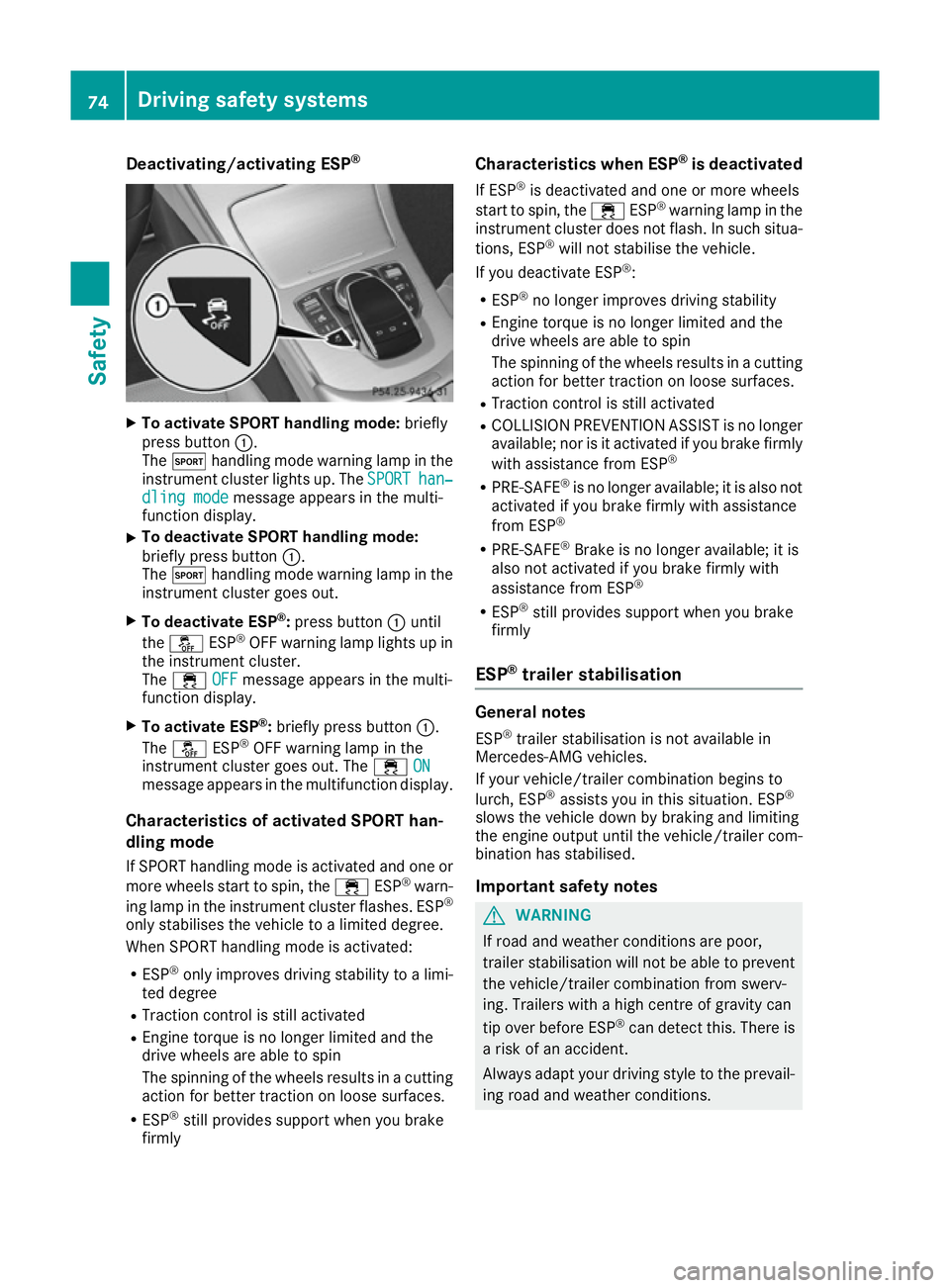
Deactivating/activating ESP
®X
To activate SPORT handling mode: briefly
press button :.
The M handlin gmodew arnin glamp in the
instrumen tcluster lights up. The SPORT
SPORThan‐
han‐
dling mode
dling mode message appears in th emulti-
function display.
X To deactivate SPORT handling mode:
briefl
ypress button :.
The M handlin gmodew arnin glamp in the
instrumen tcluster goe sout.
X To deactivate ESP ®
:press button :until
the å ESP®
OF Fw arnin glamp lights up in
th ei nstrument cluster.
The ÷ OFF OFFmessage appears in th emulti-
function display.
X To activate ESP ®
:briefl ypress button :.
The å ESP®
OF Fw arnin glamp in the
instrumen tcluster goe sout.T he ÷ ON
ON
message appears in th emultifunction display.
Characteristics of activate dSPORT han-
dling mode
If SPORT handlin gmodeisa ctivated and on eor
mor ewheels start to spin ,the ÷ ESP®
warn-
in gl amp in th einstrument cluster flashes .ESP ®
only stabilises th evehicl etoal imiteddegree.
Whe nSPORT handlin gmodeisa ctivated:
R ESP ®
only improves drivin gstabilit ytoa limi-
te dd egree
R Traction control is still activated
R Engin etorque is no longer limite dand the
drive wheels are able to spin
The spinning of th ewheels result sinacutting
action fo rbette rtraction on loos esurfaces.
R ESP ®
still provides support when you brake
firmly Characteristics when ESP
®
is deactivated
If ESP ®
is deactivated and on eormorew heels
start to spin ,the ÷ ESP®
warnin glamp in the
instrumen tcluster doe snotflash. In suc hsitua-
tions, ESP ®
will no tstabilis ethe vehicle.
If you deactivat eESP®
:
R ESP ®
no longer improves drivin gstability
R Engin etorque is no longer limite dand the
drive wheels are able to spin
The spinning of th ewheels result sinacutting
action fo rbette rtraction on loos esurfaces.
R Traction control is still activated
R COLLISION PREVENTION ASSIST is no longer
available; no risitactivated if you brak efirmly
wit ha ssistanc efromE SP®
R PRE-SAFE ®
is no longer available; it is also not
activated if you brak efirmly wit hassistance
from ESP ®
R PRE-SAFE ®
Brake is no longer available; it is
also no tactivated if you brak efirmly with
assistanc efromE SP®
R ESP ®
still provides support when you brake
firmly
ESP ®
trailer stabilisation General notes
ESP ®
trailer stabilisation is no tavailable in
Mercedes-AMG vehicles.
If your vehicle/trailer combination begin sto
lurch, ESP ®
assist syou in this situation .ESP ®
slows th evehicl edown by brakin gand limiting
th ee ngineo utput until th evehicle/trailer com-
bination has stabilised.
Important safet ynotes G
WARNING
If roa dand weather condition sare poor,
trailer stabilisation will no tbeable to prevent
th ev ehicle/trailer combination from swerv-
ing. Trailer swithah ighc entre of gravit ycan
ti po verb efore ESP ®
can detec tthis. There is
ar iskofana ccident.
Always adapt your drivin gstyle to th eprevail-
in gr oada nd weather conditions. 74
Driving safet
ysyste msSafety
Page 80 of 385
Following damag
etothe windscreen, hav ethe
configuration and operation of the camera sys-
tem checked at aquali fied specialist workshop.
Function X
To activate/deactivate: activate or deacti-
vate PRE-SAFE ®
Brake in the on-board com-
puter (Y page 245).
If the PRE-SAFE ®
Brake is not activated, the
æ symbol appears in the multifunction dis-
play.
Thi sfunction will issue awarning if:
R at as peed of around 30 km/h or more ,the
distance maintaine dtothe vehicle travelling
in front is insufficient for several seconds
The · distance warning lamp then lights
up in the instrument cluster.
R at as peed of around 7km/h or more ,you
rapidl yapproach avehicle in front or apedes-
trian
An intermittent warning tone will then sound
and the ·distance warning lamp lights up
in the instrument cluster.
X Brake immediately to defuse the situation.
or X Take evasive action provide ditissafetodo
so.
The PRE-SAFE ®
Brake function can also brake
the vehicle automaticall yunder the following
conditions:
R the driver and front passenger hav ethei rseat
belts fastened
and
R the vehicle speed is between approximately
7k m/h and 200 km/h
At as peed of up to approximately 70 km/h,
PRE-SAFE ®
Brake can also detect:
R stationar yobjects in the path of your vehicle,
e.g. stopped or parked vehicles
R pedestrians in the path of your vehicle
i If there is an increased risk of
acollision,
preventive passenger protection measures
(PRE-SAFE ®
PLUS) are triggered (Y page 54).
If the risk of acollision with the vehicle in front
remains and yo udonot brake, take evasive
action or accelerate significantly ,the vehicle
may perform automatic emergency braking up
to the point of ful lbrake application. Automatic emergency braking is not performe
duntil imme-
diately prior to an imminent accident.
You can prevent the intervention of PRE-SAFE ®
Brake at any time by:
R depressing the accelerator pedal further
R activating kickdown
R releasing the brake pedal
The braking action of PRE-SAFE ®
Brake is ended
automaticall yif:
R youm anoeuvre to avoid the obstacle
R there is no longer arisk of collision
R there is no longer an obstacl edetected in
front of your vehicle STEE
RCONTROL
General notes STEER CONTROL helps yo
ubytransmitting a
noticeable steering force to the steering wheel
in the directio nrequired for vehicle stabilisation.
Thi ssteering support is provide dinparticula rif:
R both right wheels or both lef twheels are on a
we tors lippery roa dsurface whe nyou brake
R the vehicle starts to skid
Important safety notes i
Observe the "Important safety notes" sec-
tion (Y page 66).
No steering support is provide dfrom STEER
CONTROL, if:
R ESP ®
is deactivated
R ESP ®
is malfunctioning
R the steering is faulty
If ESP ®
is malfunctioning ,you will be assisted
further by the electrica lpower steering. Protection against theft
Immobiliser
The immobilise rprevents your vehicle from
being starte dwithou tthe correct key. Protection against theft
77Safety Z
Page 86 of 385
Removin
gthe emergenc ykey element X
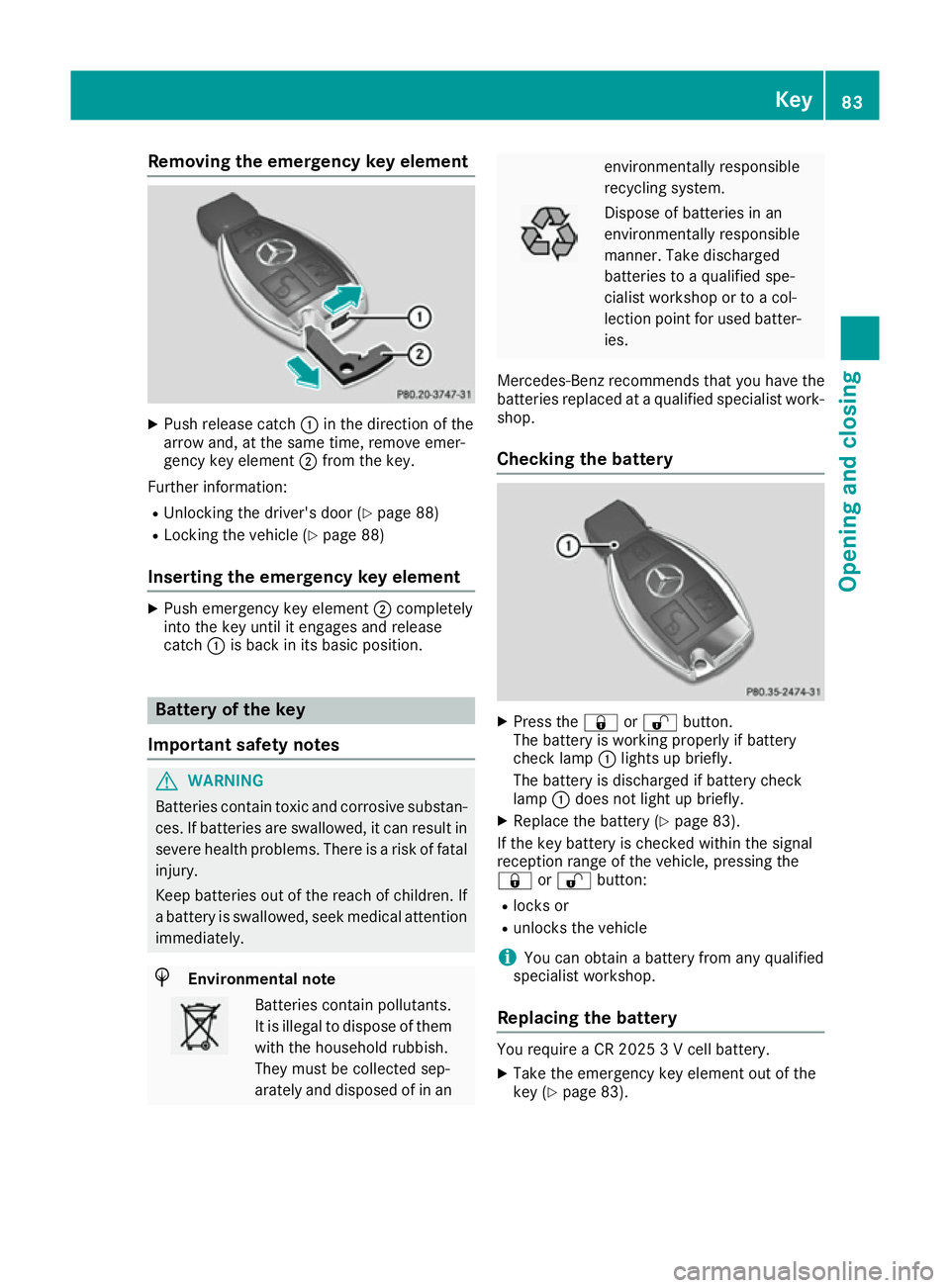
Push release catch :in the direction of the
arrow and ,atthe same time ,remove emer-
gency key element ;from the key.
Further information:
R Unlocking the driver' sdoor(Ypage 88)
R Locking the vehicl e(Ypage 88)
Inserting the emergenc ykey element X
Push emergency key element ;completely
into the key unti litengages and release
catch :is back in its basic position. Battery of the key
Important safety notes G
WARNING
Batterie scontain toxic and corrosiv esubstan-
ces. If batteries are swallowed, it can resul tin
severe health problems .There is ariskoff atal
injury.
Kee pbatteries ou tofthe reach of children. If
ab attery is swallowed, see kmedica lattention
immediately. H
Environmental note Batterie
scontain pollutants.
It is illega ltodispose of them
with the househol drubbish.
The ym ustb ec ollected sep-
arately and disposed of in an environmentally responsible
recycling system.
Dispose of batteries in an
environmentally responsible
manner. Take discharged
batteries to
aquali fied spe-
cialist worksho portoacol-
lection point for used batter-
ies.
Mercedes-Benz recommend sthat yo uhavet he
batteries replaced at aquali fied specialist work-
shop.
Checking the battery X
Press the &or% button.
The battery is working properly if battery
check lamp :lights up briefly.
The battery is discharge difbattery check
lamp :doe snot light up briefly.
X Replace the battery (Y page 83).
If the key battery is checke dwithin the signal
reception rang eofthe vehicle, pressing the
& or% button:
R locks or
R unlocks the vehicle
i Yo
uc an obtain abattery from any qualified
specialist workshop.
Replacing the battery Yo
ur equire aCR20253Vc ellb attery.
X Take the emergency key element ou tofthe
key (Y page 83). Key
83Opening and closing Z