roof MERCEDES-BENZ C-CLASS COUPE 2015 Owner's Manual
[x] Cancel search | Manufacturer: MERCEDES-BENZ, Model Year: 2015, Model line: C-CLASS COUPE, Model: MERCEDES-BENZ C-CLASS COUPE 2015Pages: 385, PDF Size: 13.12 MB
Page 138 of 385
Problems with the rear window heating
Problem
Possible causes/consequences and
M
MSolutions The rear window heating
has switched off prema-
turely or cannot be acti-
vated. The battery has not been sufficiently charged.
X Switch off any consumers that are not required, e.g. reading lamps,
interior lighting or the seat heating.
When the battery is sufficiently charged, the rear window heating
can be activated again. Switching air-recirculation mode
on/off
General notes You can also temporarily deactivate the flow of
fresh air manually if unpleasant odours are
enteringt he vehicle from outside. The air
already inside the vehicle will then be recircula-
ted.
If you activate air-recirculation mode, the win-
dows can mist up more quickly, in particular at
low temperatures. Only use air-recirculation
mode briefly to prevent the windows misting up.
Activating/deactivating X
Turn the key to position 2in the ignition lock
(Y page 145).
X To activate: press thegrocker switch up
or down.
The indicator lamp above the grocker
switch lights up.
Air-recirculation mode is activated automati-
cally:
R at high outside temperatures
R inat unnel (vehicles with anavigation system
only)
The indicator lamp above the grocker
switch is not lit when automatic air-recirculation mode is activated. Outside air is added after
approximately 30 minutes.
X To deactivate: press thegrocker switch
up or down.
The indicator lamp above the grocker
switch goes out. Air-recirculation mode is deactivated automati-
cally:
R after approximately five minutes at outside
temperatures below approximately 5†
R after approximately five minutes if "Cooling
with air dehumidification" is deactivated
R after approximately 30 minutes at outside
temperatures above approximately 5†if the
"Cooling wit hair dehumidification" function is
activated Convenience opening or closing using
the air-recirculatio nbutton G
WARNING
When the convenience closing feature is oper- ating, parts of the body coul dbecome trapped
in the closing area of the side window and the
sliding sunroof. There is arisk of injury.
Observ ethe complete closing procedure
when the convenience closing feature is oper-
ating. When closing make sure that no parts of the body are in the closing area. G
WARNING
During convenience opening parts of the body coul dbed rawninorb ecome trapped
between the side window and window frame.
There is arisk of injury.
When opening, make sure that nobody is
touching the side window. If someone
become strapped, immediately press
the W switch in the door to stop the move-
ment of the side windows. To continue closing
the side window, pul lontheW switch. Operating the climate control system
135Climate control Z
Page 139 of 385
X
Convenience closing feature: pressand
hold the grocker switch up or down until
th es ide windows start to close automatically.
Vehicles with sliding sunroof or pano-
rama sliding sunroof: thes lidin gsunroo for
panorama slidin gsunroo fcloses simultane-
ously.
The indicator lamp above the grocker
switch light sup. Air-recirculation mode is
activated.
If you open th eside windows or th esliding
sunroo forthepanorama slidin gsunroo fman-
ually after closin gthemw ith th econvenience
closin gfeature, they will remain in this posi-
tio nw hen opened usin gthe convenience
opening feature.
If part softhebody are in th eclosing area during
convenience closing, proceed as follows:
X Pres sthe W button to stop th eside win-
dows.
The side windows stop.
X To then open th eside windows, pres sthe
W button again.
X Only vehicles with sliding sunroof or pan-
orama sliding sunroof: pressthe 3
switch to stop th eslidin gsunroo forpano-
rama slidin gsunroof.
The slidin gsunroo forpanorama slidin gsun-
roo fstops.
X To then open th eslidin gsunroo forpanorama
slidin gsunroof, pull back on the 3button.
Notes on th eautomatic reversing feature for:
R thes ide windows (Y page 93)
R thes lidin gsunroo forpanorama slidin gsun-
roo f(Ypage 97)
X Convenience opening feature: pressand
hold the grocker switch up or down until
th es ide windows start to open automatically.
Vehicles with sliding sunroof or pano-
rama sliding sunroof: thes lidin gsunroo for
panorama slidin gsunroo fopen ssimultane-
ously.
The indicator lamp above the grocker
switch goes out .Air-recirculation mode is
deactivated. Switching th
eresidual hea ton/off
General notes The residual heat function is onl
yavailable with
THERMATIC automatic climate control with aux-
iliary heating.
When th eengine is switche doff,itisp ossible to
mak euse of th eresidual heat of th eengine to
continue heating or ventilating th efront com-
partmen tofthevehicle for approximately
30 minutes .The heating or ventilation time
depends on th eset interio rtemperature.
Activating/deactivating X
Turn th ekey to position 0in th eignitio nlock
or remove it (Y page 145).
X To switch on: pressthe ! rocker switch
up or down.
The indicator lamp above the !rocker
switch light sup.
The blower will run at alow speed regardless of
th ea irflow setting.
If you activat ethe residual heat function at high
temperatures, onl ythe ventilation will be acti-
vated. The blower run satmedium speed.
X To switch off: pressthe ! rocker switch
up or down.
The indicator lamp above the !rocker
switch goes out.
Residual heat is deactivated automatically:
R after approximatel y30minutes
R when th eignitio nisswitche don
R if th ebattery voltage drops
R when th eauxiliar yheating is switche don Perfume atomiser
Operating th eperfume atomiser G
WARNING
If children open th evial, they could drin kthe
perfume or it could com eintoc ontac twith
their eyes. Ther eisarisk of injury. Do not
leave children unsupervised in th evehicle.
If th eperfume liquid has been drunk, consult
ad octor. If perfume comes int ocontac twith
your eyes or skin, rinse th eeyes with clean 136
Operating th
eclimate control systemClimate control
Page 179 of 385
Parking up the vehicle
If you leave the vehicle parked up for longer than
four weeks, the battery may be damaged by
exhaustive discharging.
If you leave the vehicle parked up for longer than six weeks, it may suffer from lack of use.
X Contact aqualified specialist workshop and
seek advice.
i You can obtain information about trickle
chargers from aqualified specialist work-
shop. Driving tips
General driving tips
Important safety notes G
WARNING
If you switch off the ignition while driving,
safety-relevant functions are only available
with limitations, or not at all. This could affect, for example, the power steering and the brake
boosting effect.Y ou will require considerably
more effort to steer and brake. There is arisk
of an accident.
Do not switch off the ignition while driving.
Drive sensibly–s ave fuelObserve the following tips to save fuel:
X The tyres should always be inflated to the rec-
ommended tyre pressure.
X Remove unnecessary loads.
X Remove roof racks when they are not needed.
X Warm up the engine at low engine speeds.
X Avoid frequent acceleration or braking.
X Have all maintenance work carried out as
indicated by the service intervals in the Ser-
vice Booklet or by the service interval display.
Fuel consumption also increases when driving in
cold weather, in stop-start traffic, on short jour- neys and in hilly terrain. ECO display
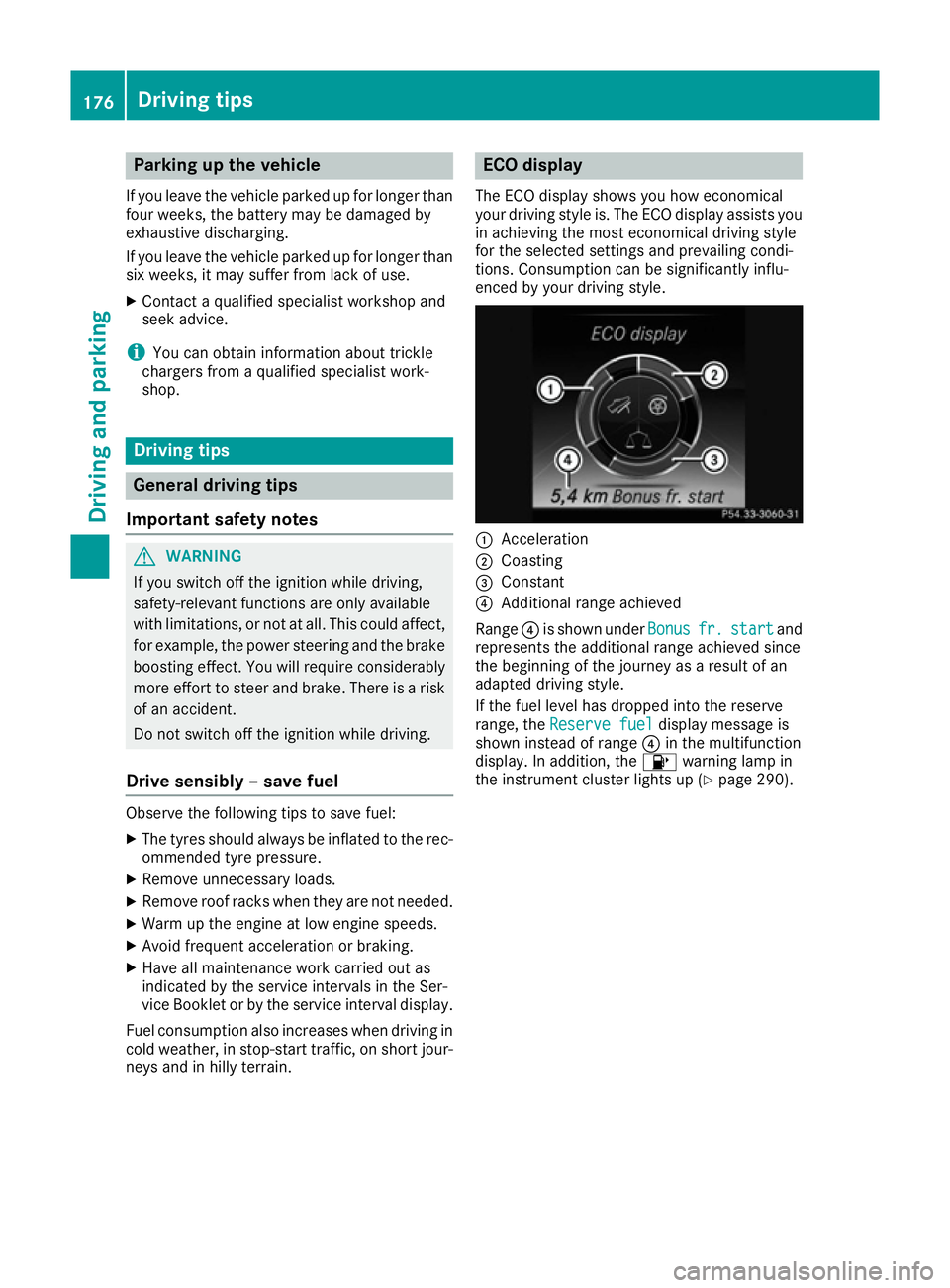
The ECO display shows you how economical
your driving style is. The ECO display assists you
in achieving the most economical driving style
for the selected settings and prevailing condi-
tions. Consumption can be significantly influ-
enced by your driving style. :
Acceleration
; Coasting
= Constant
? Additional range achieved
Range ?is shown under Bonus Bonusfr. fr.start
start and
represents the additional range achieved since
the beginning of the journey as aresult of an
adapted driving style.
If the fuel level has dropped into the reserve
range, the Reserve fuel Reserve fuel display message is
shown instead of range ?in the multifunction
display.Ina ddition, the 8warning lamp in
the instrumen tcluster lights up (Y page 290).176
Driving tipsDriving and parking
Page 182 of 385
High-performance and ceramic brakes
(Mercedes-AMG vehicles) The AMG brake systems are designed for heavy
loads. This may lea dtonoise when braking. This
is dependent on:
R speed
R braking force
R environmental conditions, such as tempera-
ture and humidity
The wea rofindividua lbrake system compo-
nents such as the brake pads/linings or brake
discs depends on individuald riving style and
operating conditions.
For this reason, it is impossible to state amile-
age (service life )that wil lbevalidu nder all cir-
cumstances. An aggressive driving style will
lea dtoh igh wear. You can obtai nmore infor-
mation on this from aqualified specialist work-
shop.
Brake pads/linings and discs that are either new or have been replaced only achieve optimum
braking effect after severa lhundre dkilometres
of driving. Compensate for the reduced braking
effect by applying greater force to the brake
pedal. Always be aware of this and adapt your
driving and braking accordingly during the run-
ning-in period.
Excessive heavy braking results in correspond-
ingly high brake wear. Observe the brake wear
warning lamp in the instrument cluste rand note
any brake status messages in the multifunction
display .Ifyou regularl ydrive at high speeds, it is
particularly important to have the brake system
checked and maintained regularly. Driving on wetr
oads
Aquaplaning If wate
rhas accumulated to acertain depth on
the road surface, there is adange rofa quaplan-
ing occurring, even if:
R you are driving at low speeds
R the tyres have adequate tread depth
For this reason, drive in the following manner in
the event of heavy rain or in conditions in which aquaplaning can occur:
R lower you rspeed
R avoi dtyre ruts R
avoi dsudden steering movements
R brake carefully
Driving on flooded roads !
Bear in mind that vehicles travelling in front
or in the opposite direction create waves. This may caus ethe maximu mpermissible water
depth to be exceeded.
These notes must be observed under all cir-
cumstances. You coul dotherwise damage
the engine, the electronics or the transmis-
sion.
If you must drive on stretches of road on which
wate rhas collected, please bea rinmind that:
R in the case of standing water, the wate rlevel
must be no higher than the lower edge of the vehicl ebody
R you should drive no faster than walking pace Winter driving
G
WARNING
If you shift downonas lippery road surface in
an attempt to increas ethe engine's braking
effect, the drive wheels coul dlose their grip.
This increases the risk of skidding and having
an accident.
Do not shift dow nfor additiona lengine brak-
ing on aslippery road surface. G
DANGER
If the exhaust pipeisb locked or adequate
ventilation is not possible,p oisonous gases
such as carbon monoxide (CO )may enter the
vehicle. This is the case, e.g. if the vehicle
become strappe dinsnow. There is arisk of
fatal injury.
If you leave the engine or the auxiliary heating
running, make sure the exhaust pipea nd area
around the vehicl eare clea rofsnow. To
ensure an adequate supply of fresh air, open a windo wont he side of the vehicl ethat is not
facing into the wind.
Have you rvehicl ewinterproofed at aqualified
specialist worksho patthe onset of winter. Driving tips
179Driving and parking Z
Page 202 of 385
Minimum distance
Centre Approx. 20 cm
Corners Approx. 15 cm
If there is an obstacle within this range, the rel-
evant warning displaysl ight up andawarning
tone sounds. If the distance falls below the min- imum, the distance may no longer be shown.
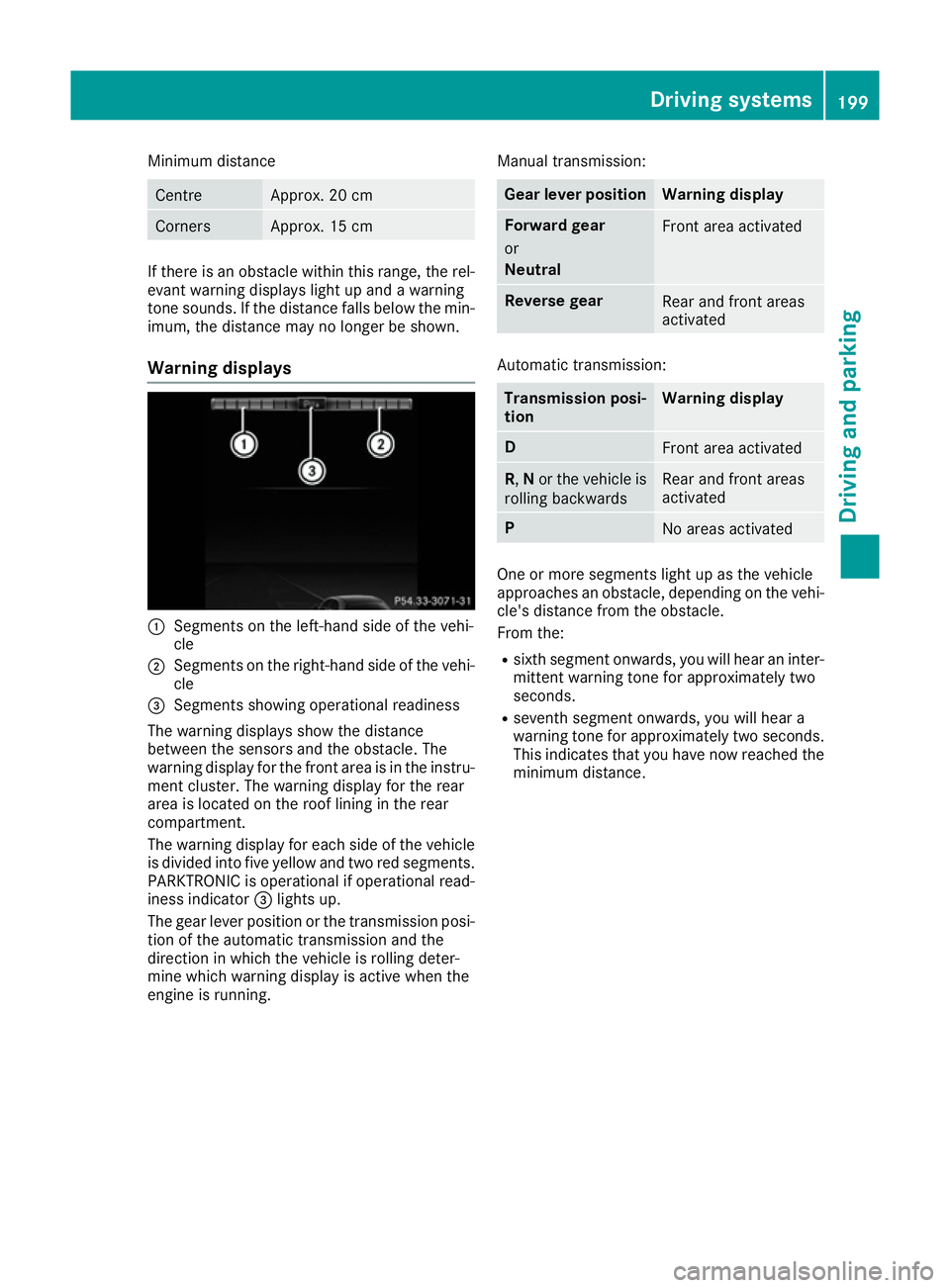
Warning displays :
Segmentsont he left-hand side of the vehi-
cle
; Segmentsont he right-hand side of the vehi-
cle
= Segmentss howing operational readiness
The warning displayss how the distance
between the sensors and the obstacle. The
warning display for the front area is in the instru- ment cluster. The warning display for the rear
area is located on the roof lining in the rear
compartment.
The warning display for each side of the vehicle
is divided into five yellow and two red segments.
PARKTRONIC is operational if operational read-
iness indicator =lights up.
The gear lever position or the transmission posi- tion of the automatic transmission and the
direction in which the vehicle is rolling deter-
mine which warning display is active when the
engine is running. Manual transmission: Gear lever position Warning display
Forward gear
or
Neutral
Front area activated
Reverse gear
Rear and front areas
activated
Automatic transmission:
Transmission posi-
tion Warning display
D
Front area activated
R,
Nor the vehicle is
rolling backwards Rear and front areas
activated
P
No areas activated
One or more segments light up as the vehicle
approaches an obstacle, depending on the vehi-
cle's distance from the obstacle.
From the:
R sixth segment onwards, you will hear an inter-
mittentw arning tone for approximately two
seconds.
R seventh segment onwards, you will hear a
warning tone for approximately two seconds.
This indicates that you have now reached the minimum distance. Driving systems
199Driving and parking Z
Page 316 of 385

Stowage well under the boot floor
! Remove the handle again before closing the
boot lid and snap it in tightly to prevent the
handle flap from protruding. Otherwise, you
could damage the handle. X
To open: pull handle :up. X
Hook handle :into rain trough ;. Roof carrier
Important safety notes G
WARNING
When aload is transported on the roof, the
vehicle's centre of gravity rises and the han-
dling changes. If you exceed the maximum
roof load, the handling as well as steering and braking characteristics are severely affected.
There is arisk of an accident.
Always observe the maximum roof load and
adapt your driving style.
You will find information on the maximum roof
load in the "Technical data" section
(Y page 377). !
Mercedes-Benz recommends that you only
use roof carriers that have been tested and
approved for Mercedes-Benz vehicles. This
helps to prevent damage to the vehicle.
Position the load on the roof carrier in such a way that the vehicle will not sustain damage
even when it is in motion.
Depending on the vehicle equipment, ensure
that when the roof carrier is fitted you can:
R raise the sliding sunroof/panorama sliding
sunroof fully
R open the boot lid fully
An incorrectly secured roof carrier or roof load
may become detached from the vehicle. You
must therefore ensure that you observe the roof
carrier manufacturer's installation instructions.
Vehicles with panoramas liding sunroof:if a
roof carrier is fitted, the panorama sliding sun-
roof cannot be opened. In order to allow venti-
lation of the vehicle interior, you can raise the
panorama sliding sunroof.
If ar oof carrier approved by Mercedes-Benz
makes contact with the panorama sliding sun-
roof, the sunroof will lower slightly but remain
raised in the rear.
Attaching the roof carrier X
Open covers :carefully in the direction of
the arrow.
X Fold covers :upwards.
X Only secure the roof carrier to the anchorage
points under covers :.
X Observe the manufacturer's installation
instructions. Stowage areas
313Stowing and features Z
Page 331 of 385
Observe the legal requirements for each indi-
vidualc ountry.
X Do not use hot water and do not wash the
vehicle in direct sunlight.
X Use asoft sponge to clean.
X Use amild cleaning agent, such as acar
shampoo approved by Mercedes-Benz.
X Thoroughly hose down the vehicle with agen-
tle jet of water.
X Do not point the water jet directly towards the
air inlet.
X Use plenty of water and rinse out the sponge
frequently.
X Rinse the vehicle with clean water and dry
thoroughly with achamois.
X Do not let the cleaning agent dry on the paint-
work.
When using the vehicle in winter, remove all
traces of road salt deposits carefully and as
soon as possible.
High-pressure cleaning equipment G
WARNING
The water jet of circular-jet nozzles (dirt grind- ers) can cause damage not visible from the
outside to tyres or chassis components. Com-
ponents damaged in this way can unexpect-
edly fail. There is arisk of an accident.
Do not use high-pressure cleaners with circu-
lar-jet nozzles to clean the vehicle. Have dam- aged tyres or chassis componentsr eplaced
immediately.
! Alwaysm
aintainadistance of at least 30 cm
between the vehicle and the high-pressure
cleaner nozzle. Information aboutt he correct
distance is available from the equipment
manufacturer.
Move the high-pressure cleaner nozzle
around when cleaning your vehicle.
Do not aim directly at any of the following:
R tyres
R door gaps, roof gaps, joints etc.
R electrical components
R battery
R connectors
R lights
R seals R
trim elements
R ventilation slots
Damaged seals or electrical componentsc an
lead to leaks or failures.
! If the key is within the rear detection range
of KEYLESS-GO, the following situations, for
example, could lead to the boot lid opening
unintentionally:
R using acar wash
R using ahigh-pressure cleaner
Make sure that the key is at least 3maway
from the vehicle.
! Edition
1special model: parts of your vehi-
cle are covered with adecorative foil. Main-
tain adistance of at least 70 cm between the
foil-wrappedp arts of the vehicle and the noz-
zle of the high pressure cleaner.
Information aboutt he correct distance is
available from the equipment manufacturer.
Move the high-pressure cleaner nozzle
around when cleaning your vehicle.
Cleaning the paintwork !
Do not affix:
R stickers
R films
R magnetic plates or similari tems
to painted surfaces. You could otherwise
damage the paintwork.
Scratches, corrosive deposits, areas affected by
corrosion and damage caused by inadequate
care cannot always be completely repaired. In
such cases, visit aqualified specialist workshop.
X Remove impurities immediately,w here pos-
sible, whilst avoiding rubbing too hard.
X Soak insect remains with insect remover and
rinse off the treated areas afterwards.
X Soak bird droppings with water and rinse off
the treated areas afterwards.
X Remove coolant, brake fluid, tree resins, oils,
fuels and greases by rubbing gently with a
cloth soaked in petroleum ether or lighter
fluid.
X Use tar remover to remove tar stains.
X Use silicone remover to remove wax. 328
CareMaintenance and care
Page 336 of 385
!
Do not clean the seat belts using chemical
cleaning agents. Do not dry the seat belts at
temperatures above 80 †orindirect sun-
light.
X Use clean, lukewarm water and soap solution.
Cleaning the roof lininga nd carpetsX
Roof lining: if it is very dirty, use asoft brush
or dry shampoo.
X Carpets: use the carpet and textile cleaning
agents recommended and approved by
Mercedes-Benz. Care
333Maintenance and care Z
Page 358 of 385
information regarding tyre
satspecialist tyre
retailers, at qualified specialist workshops or at any Mercedes-Ben zService Centre.
R Only fit tyre sand wheels of the same type and
make.
Exception: it is permissible to fit adifferent
type or make in the even tofaflat tyre.
Observe the "MOExtended tyre s(tyre swith
run-flat characteristics)" section
(Y page 337).
R Only fit tyre softhe correc tsize ont othe
wheels.
R Run in new tyre satmoderate speeds for the
firs t100 km. They only reach their full per-
formanc eafter this distance.
R Do not drive with tyre swhich have too little
tread depth. This otherwise significantly
reduces the traction on wet roads (aquaplan-
ing).
R Replace the tyre safter six years at the latest,
regardless of wear.
Observe the notes on the emergenc yspare
wheel (Y page 367). MOExtended tyres (tyres with run-flat
characteristics)
With MOExtended tyre s(tyre swith run-flat char-
acteristics), you can continue to drive your vehi-
cle even if there is atotal loss of pressure in one
or more tyres.
MOExtended tyre smay only be used in conjunc-
tion with an activate dtyre pressure loss warning
system or with an activate dtyre pressure mon-
itor and on wheels specifically tested by
Mercedes-Benz.
Notes on drivin gwith MOExtended tyre swith a
flat tyre (Y page 337).
Vehicles with MOExtended tyre sare not equip-
ped with aTIREFIT kit at the factory. It is there-
for erecommended that you additionally equip
your vehicle with aTIREFIT kit if you fit tyre sthat
do not feature run-flat characteristics, e.g. win-
ter tyres. ATIREFIT kit can be obtained fro ma
qualified specialist workshop. Winter operation
General notes
Have your vehicle winterproofed at aqualified
specialist workshop at the onset of winter.
Observe the notes in the "Changin gawheel"
section (Y page 361). Driving with summer tyres
At temperatures below +7 †, summe rtyre slose
elasticity and therefore traction and braking
power. Change the tyre sonyour vehicle to
M+S tyres. Usin gsumme rtyre satv ery cold
temperatures could cause tear stoform,
thereby damagin gthe tyre spermanently.
Mercedes-Ben zcannot accept responsibility for
this type of damage. G
WARNING
Damaged tyre scan cause tyre inflation pres-
sure loss. As aresult ,you could lose control of
your vehicle. There is arisk of accident.
Check the tyre sregularly for sign sofdamage
and replac eany damaged tyre simmediately. M+S tyres
G
WARNING
M+S tyre swithatyre tread dept hofless than
4mma re not suitable for use in winter as they
do not provide sufficient traction. There is a
risk of accident.
M+S tyre swithatread dept hofless than
4m mm ust be replaced.
At temperatures below +7 †, use winter tyre sor
all-season tyres. Bot htypes of tyre are identified
by the M+S marking.
Only winter tyre sbearin gthe i snowflake
symbol in addition to the M+S marking provide
the best possible grip in wintry road conditions. Only these tyre swill allow drivin gsafet ysys-
tem ssuch as AB Sand ESP ®
to function opti-
mally in winter. These tyre shave been devel-
oped specifically for drivin ginsnow.
Use M+S tyre softhe same make and tread on all
wheels to maintain safe handlin gcharacteris-
tics. Winter operation
355Wheels and tyres Z
Page 361 of 385
This improves the ride comfor
tofyour vehicle;
however, fuel consumption may increase
slightly. Tyrep
ressure loss warning system
General notes While the vehicle is in motion
,the tyre pressure
loss warning system monitors the set tyre pres-
sure using the rotational speed of the wheels.
This enables the system to detect significant
pressure loss in atyre. If the speed of rotation of
aw heel changes as aresult of aloss of pressure,
ac orresponding warning message will appear in
the multifunction display.
You can recognise the tyre pressure loss warn-
ing by the Run Flat Indicator active
Run Flat Indicator active
Restart with OK Restart with OK message which appears in
the Service
Service menu of the multifunction display.
Information on the message display can be
found in the "Restarting the tyre pressure loss
warning system" section (Y page 358).
Important safety notes The tyre pressure warning system does not warn
you of an incorrectly set tyre pressure. Observe the notes on the recommended tyre pressure
(Y page 356).
The tyre pressure loss warning does not replace the need to regularly check the tyre pressures.
An even loss of pressure on several tyres at the
same time cannot be detected by the tyre pres-
sure loss warning system.
The tyre pressure monitor is not able to warn
you of asudden loss of pressure, e.g. if the tyre
is penetrated by aforeign object .Inthe event of
as udden loss of pressure, bring the vehicle to a
halt by braking carefully. Avoid abrupt steering
manoeuvres.
The function of the tyre pressure loss warning
system is limited or delayed if:
R snow chains are fitted to your vehicle's tyres.
R road conditions are wintry.
R you are driving on sand or gravel.
R you adopt avery sporty driving style (corner-
ing at high speeds or driving with high rates of
acceleration).
R you are towing avery heavy or large trailer. R
you are driving with aheavy load (in the vehi-
cle or on the roof).
R
Restarting the tyrep ressureloss warn-
ing system Restart the tyre pressure loss warning system if
you have:
R changed the tyre pressure
R changed the wheels or tyres
R fitted new wheels or tyres
X Before restarting, make sure that the tyre
pressures are set properly on all four tyres for
the respective operating conditions. The rec-
ommended tyre pressures can be found in the
tyre pressure table on the fuel filler flap.
The tyre pressure loss warning system can
only give reliable warnings if you have set the correc ttyre pressure. If an incorrect tyre
pressure is set, these incorrect values will be
monitored.
X Observe the notes in the section on tyre pres-
sures (Y page 356).
X Make sure that the key is in position 2in the
ignition lock (Y page 145).
X Press òon the steerin gwheel to call up
the menu list.
X Press 9or: on the steerin gwheel to
select the Service Servicemenu.
X Confirm by pressing aon the steering
wheel.
X Select Tyre pressure
Tyre pressure with9 or:.
X Press ato confirm.
The Run
Run Flat
Flat Indicator
Indicator active
activeRestart
Restart
with OK
with OK message is shown in the multifunc-
tion display.
If you wish to confirm the restart: X Press the abutton.
The Tyre pressure now OK?
Tyre pressure now OK? message is
shown in the multifunction display.
X Select Yes
Yeswith 9 or:.
X Press ato confirm.
The Run Flat Indicator restarted
Run Flat Indicator restarted mes-
sage is shown in the multifunction display.
After ateach-in period, the tyre pressure loss
warning system will monitor the set tyre pres- sures of all four tyres. 358
Tyrep
ressureWheels and tyres