seats MERCEDES-BENZ C-Class COUPE 2017 CL205 Owner's Guide
[x] Cancel search | Manufacturer: MERCEDES-BENZ, Model Year: 2017, Model line: C-Class COUPE, Model: MERCEDES-BENZ C-Class COUPE 2017 CL205Pages: 354, PDF Size: 8.66 MB
Page 107 of 354
Problems with the steering wheel heating
ProblemPossible causes/consequences andMSolutions
The steering wheel heat-
ing has switched off pre-
maturely or cannot be
switched on.The on-board voltage is too low because too many electrical consum-
ers are switched on.
XSwitch off electrical consumers that you do not need, such as the
rear window defroster or interior lighting.
EASY-ENTRY/EXIT feature
Important safety notes
GWARNING
When the EASY-ENTRY/EXIT feature adjusts
the steering wheel, you and other vehicle
occupants –particularly children –could
become trapped. There is arisk of injury.
While the EASY-ENTRY/EXIT feature is mak-
ing adjustments, make sure that no one has
any body parts in the sweep of the steering
wheel.
Move the steering wheel adjustment lever if
there is arisk of entrapment by the steering
wheel. The adjustment process is stopped.
Press one of the memory function position but-
tons. The adjustment process is stopped. This
function is only available on vehicles with mem-
ory function.
GWARNING
If children activate the EASY-ENTRY/EXIT fea-
ture, they can become trapped, particularly
when unattended. There is arisk of injury.
When leaving the vehicle, always take the
SmartKey with you and lock the vehicle. Never
leave children unsupervised in the vehicle.
GWARNING
If you drive off while the EASY-ENTRY/EXIT
feature is making adjustments, you could lose
control of the vehicle. There is arisk of an
accident.
Always wait until the adjustment process is
complete before driving off. The EASY-ENTRY/EXIT feature makes gettingi
n
and out of your vehicle easier.
You can activate and deactivate the EASY-
ENTRY/EXIT feature using the multimedia sys-
tem (see the separate operating instructions).
Position of the steering wheel when the
EASY-ENTRY/EXIT featureisa ctive
The steering wheel swings upwards when you:
Rremove the SmartKey from the ignition lock
Rwith KEYLESS-GO:open the driver's door;
KEYLESS-GO must be in position 1
Rwith the SmartKey:open the driver's door;
the SmartKey must be in position 0or 1in the
ignition lock (
Ypage 131)
Ropen the driver's door when the ignition is
switched off
iThe steering wheel only tilts upwards if the
driving position is stored after the steering
column adjustment has been adjusted
(
Ypage 109).
The most recent driving position of the steering
wheel is stored if:
Rthe ignition is switched off
Rthe settingiss tored with the memory function
(Ypage 109).
iThe steering wheel only moves upwards if it
has not already reached the upper steering
limiter.
Steering wheel105
Seats, steering wheela nd mirrors
Z
Page 108 of 354
Position of the steering wheel for driv-
ing
The steering wheel is moved to the last selected
position when:
Rthe driver's door is closed and you insert the
SmartKey into the ignition lock
Ryou close the driver's door when the ignition
is switched on
Ryou press the Start/Stop button once on vehi-
cles with KEYLESS-GO
iThe steering wheel only returns to the last
set position if the driving position is stored
after the seat or steering column has been
adjusted (
Ypage 109).
The most recent driving position of the steering
wheel is stored if:
Rthe ignition is switched off
Rthe settingiss tored with the memory function
(Ypage 109).
Crash-responsive EASY-EXIT feature
If the crash-responsive EASY-EXIT feature is trig-
gered in an accident, the steering column will
move upwards when the driver's door is opened
or the SmartKey is removed from the ignition
lock. This makes it easier to exit the vehicle and
rescue the occupants.
The crash-responsive EASY-EXIT feature is only
operational if the EASY-EXIT/ENTRY feature is
activated in the multimedia system (see the sep-
arate operating instructions).
Mirrors
Exterior mirrors
Important safety notes
GWARNING
You could lose control of your vehicle if you do the following while driving:
Radjust the driver's seat, head restraint,
steering wheel or mirrors
Rfasten the seat belt
There is arisk of an accident.
Adjust the driver's seat, head restraint,s teer-
ing wheel and mirror and fasten your seat belt
before startin gthe engine.
GWARNING
The exterior mirror on the front-passenger
side reduces the size of the image. Visible
object sare actually closer than they appear.
This means that you could misjudge the dis-
tance from road users traveling behind, e.g.
when changing lane. There is arisk of an acci-
dent.
For this reason, always make sure of the
actual distance from the road users traveling
behind by glancing over your shoulder.
Adjusting the exterior mirrors
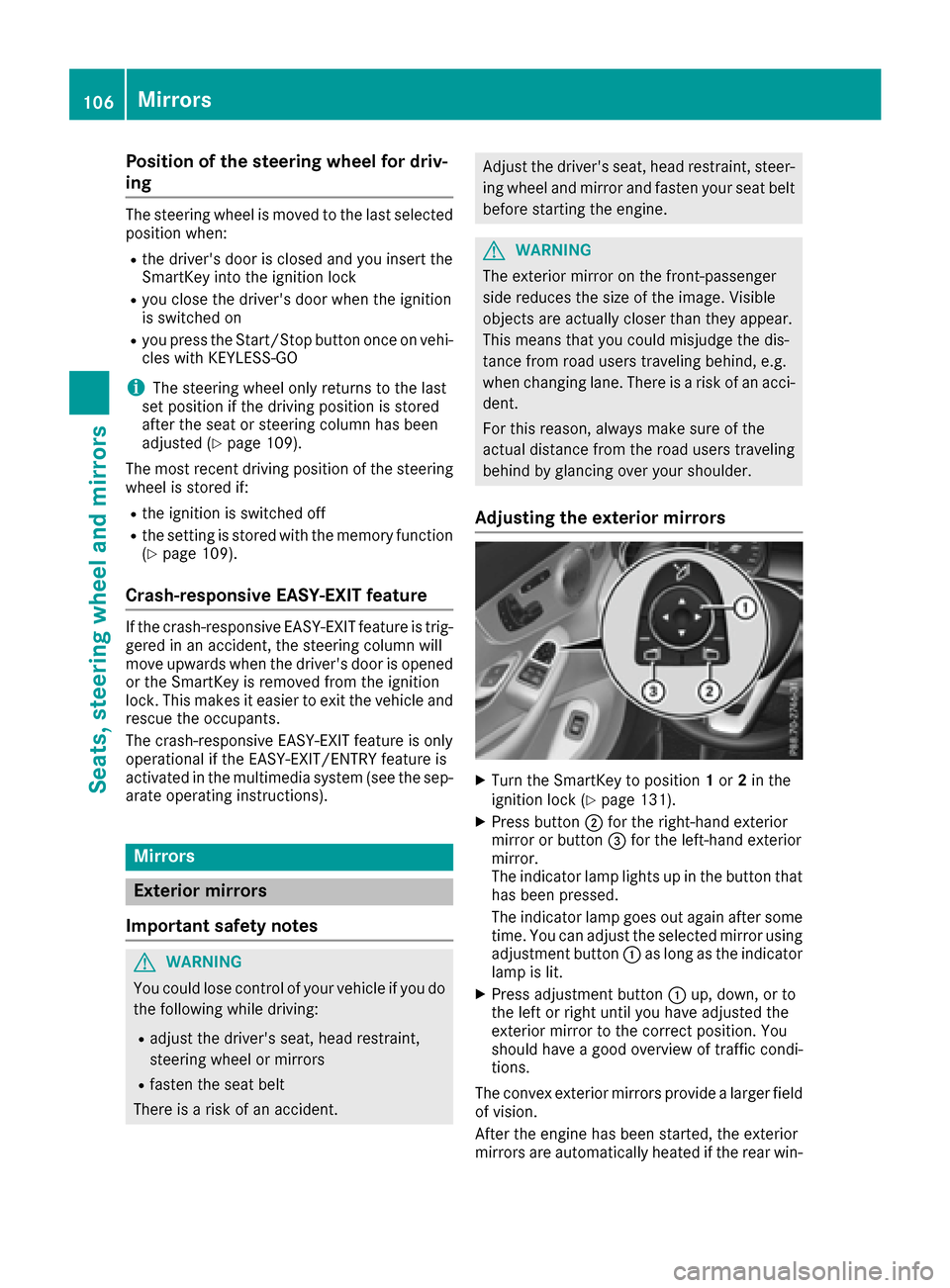
XTurn the SmartKey to position 1or 2in the
ignition lock (Ypage 131).
XPress button ;for the right-hande xterior
mirror or button =for the left-hand exterior
mirror.
The indicator lamp lights up in the button that
has been pressed.
The indicator lamp goes out again after some
time. You can adjust the selected mirror using
adjustment button :as long as the indicator
lamp is lit.
XPress adjustment button :up, down, or to
the left or right until you have adjusted the
exterior mirror to the correct position. You
should have agood overview of traffic condi-
tions.
The convex exterior mirrors provide alarger field
of vision.
After the engine has been started, the exterior
mirrors are automatically heated if the rear win-
106Mirrors
Seats, steering wheela nd mirrors
Page 109 of 354

dow defroster is switched on and the outside
temperature is low.
Folding the exterior mirrorsinorout
electrically
XTurn the SmartKey to position 1or 2in the
ignition lock (Ypage 131).
XBriefly press :.
Bothe xterior mirrorsf old in or out.
iMake sure that the exterior mirrorsa re
always folded out fully while driving .They
could otherwise vibrate.
iIf you are driving faster than 30 mph
(47 km/h), you can no longer fold in the exte-
rior mirrors.
Setting the exterior mirrors
If the battery has been disconnected or com-
pletely discharged, the exterior mirrorsm ust be
reset.T he exterior mirrorsw ill otherwise not
fold in when you select the Automatic
MirrorFoldingfunction in the multimedia system.
XTurn the SmartKey to position 1or 2in the
ignition lock (Ypage 131).
XBriefly press :.
Folding the exterior mirror sinorout
automatically
When the Automatic Mirror Foldingfunc-
tion is activated in the multimedia system (see
the separate operatin ginstructions):
Rthe exterior mirrorsf old in automatically as
soon as you lock the vehicle from the outside.
Rthe exterior mirrorsf old out automatically
again as soon as you unlock the vehicle.
iIf the exterior mirrorsh ave been folded in
manually, they do not fold out.
Exterior mirror pushed out of position
If an exterior mirror has been pushed out of
position ,proceed as follows:
XVehicles without electrically folding exte-
rior mirrors: move the exterior mirror into
the correct position manually.
XVehicles with electrically folding exterior
mirrors: press and hold button :until you
hear aclick and then the mirror engaging in
position (
Ypage 107).
The mirror housing is engaged again and you
can adjust the exterior mirrorsasu sual
(
Ypage 106).
Automatic anti-glare mirrors
GWARNING
Electrolyte may escape if the glass in an auto-
matic anti-glare mirror breaks. The electrolyte
is harmful and causes irritation. It must not
come int ocontact with your skin ,eyes, res-
piratory organs or clothing or be swallowed.
There is arisk of injury.
If you come int ocontact with the electrolyte,
observe the following:
RRinse off the electrolyte from your skin
immediately with water.
RImmediately rinse the electrolyte out of
your eyes thoroughly with clean water.
RIf the electrolyte is swallowed, immediately
rinse your mouth out thoroughly. Do not
induce vomiting.
RIf electrolyte comes int ocontact with your
skin or hair or is swallowed, seek medical
attention immediately.
RImmediately chang eout of clothing which
has come int ocontact with electrolyte.
RIf an allergic reaction occurs, seek medical
attention immediately.
Mirrors107
Seats, steering wheel and mirrors
Z
Page 110 of 354
The rear-view mirror and the exterior mirror on
the driver's side automatically go into anti-glare
mode if the following conditions are met simul-
taneously:
Rthe ignition is switched on
Rincident light from headlamps strikes the sen-
sor in the rear-view mirror
The mirrors do not go into anti-glare mode if
reverse gear is engaged or if the interior lighting
is switched on.
Parking position for the exterior mir-
ror on the front-passenger side
Storing the parking position
You can position the front-passenger side exte-
rior mirror in such away that you can see the
rear wheel on that side as soon as you engage
reverse gear. You can store this position.
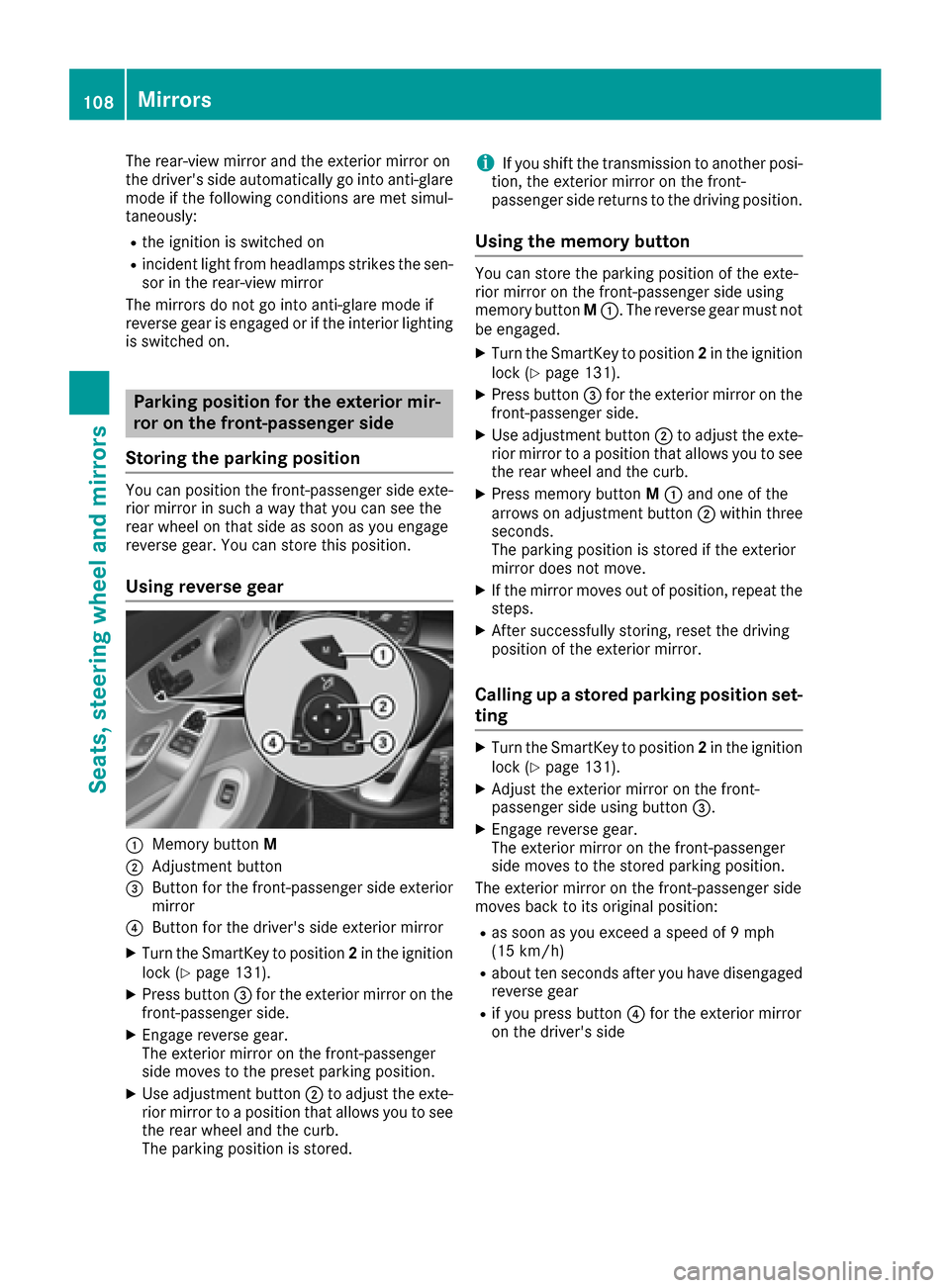
Using reverse gear
:Memory button M
;Adjustment button
=Button for the front-passenger side exterior
mirror
?Button for the driver's side exterior mirror
XTurn the SmartKey to position 2in the ignition
lock (Ypage 131).
XPress button =for the exterior mirror on the
front-passenger side.
XEngage reverse gear.
The exterior mirror on the front-passenger
side moves to the preset parking position.
XUse adjustmen tbutton ;to adjust the exte-
rior mirror to aposition that allows you to see
the rear wheel and the curb.
The parking position is stored.
iIf you shift the transmission to another posi-
tion, the exterior mirror on the front-
passenger side return stothe driving position.
Using the memor ybutton
You can store the parking position of the exte-
rior mirror on the front-passenger side using
memory button M:.T he reverse gear must not
be engaged.
XTurn the SmartKey to position 2in the ignition
lock (Ypage 131).
XPress button =for the exterior mirror on the
front-passenger side.
XUse adjustmen tbutton ;to adjust the exte-
rior mirror to aposition that allows you to see
the rear wheel and the curb.
XPress memory button M: and one of the
arrows on adjustmen tbutton ;within three
seconds.
The parking position is stored if the exterior
mirror does not move.
XIf the mirror moves out of position, repeat the
steps.
XAfter successfully storing, reset the driving
position of the exterior mirror.
Calling up astored parking position set-
ting
XTurn the SmartKey to position 2in the ignition
lock (Ypage 131).
XAdjust the exterior mirror on the front-
passenger side using button =.
XEngage reverse gear.
The exterior mirror on the front-passenger
side moves to the stored parking position.
The exterior mirror on the front-passenger side
moves back to its original position:
Ras soon as you exceed aspeed of 9mph
(15 km/h)
Rabout ten seconds after you have disengaged
reverse gear
Rif you press button ?for the exterior mirror
on the driver's side
108Mirrors
Seats, steering wheel and mirrors
Page 111 of 354
Memory function
Important safety notes
GWARNING
If you use the memory function on the driver's side while driving, you coul dlose control of
the vehicleasar esult of the adjustments
being made .There is arisk of an accident.
Only use the memory function on the driver's
side when the vehicleiss tationary.
GWARNING
When the memory function adjusts the seat or steering wheel, you and other vehicleo ccu-
pants –particularly children –coul db ecome
trapped. There is arisk of injury.
Whil ethe memory function is making adjust-
ments, make sure that no one has any body
parts in the swee pofthe seat or steering
wheel. If somebody becomest rapped, imme-
diately release the memory function position
button. The adjustment process is stopped.
GWARNING
Childre ncoul db ecome trappe difthey acti-
vate the memory function, particularly when
unattended .There is arisk of injury.
When leaving the vehicle, alway stake the
SmartKey with you and lock the vehicle. Never
leave children unsupervised in the vehicle.
The memory function can be use datany time,
e.g. even when the key is not in the ignitio nlock.
Storing settings
With the memory function, you can store up to
three different settings, e.g. for three different
people.
The following settings are stored as asingle
memory preset:
Rposition of the seat, backrest and head
restraint
Rdriver's side:p osition of the exterior mirrors
on the driver's and front-passenger sides
Rposition of the head-up display
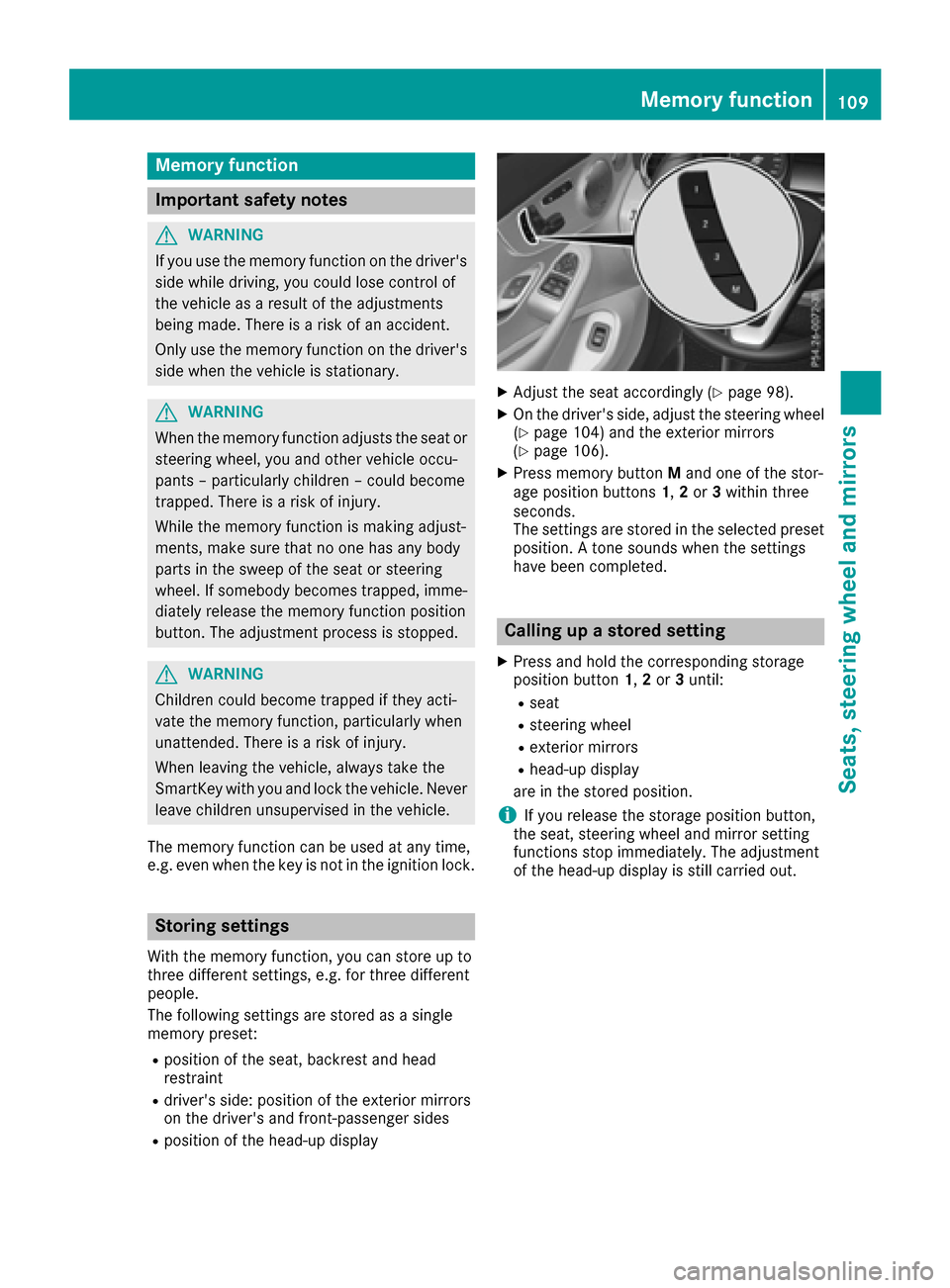
XAdjust the seat accordingly (Ypag e98).
XOn the driver's side ,adjust the steering wheel
(Ypag e104) and the exterior mirrors
(Ypag e106).
XPress memory button Mand one of the stor-
age position buttons 1,2or 3withi nthree
seconds.
The settings are stored in the selected preset
position. Atone sound swhen the settings
have been completed.
Calling up astored setting
XPress and hold the corresponding storage
position button 1,2or 3until:
Rseat
Rsteering wheel
Rexterior mirrors
Rhead-up display
are in the stored position.
iIf you release the storage position button,
the seat, steering whee land mirror setting
functions stop immediately. The adjustment
of the head-up display is still carrie dout.
Memory function109
Seats, steering wheel and mirrors
Z
Page 270 of 354

Stowage areas
Loading guidelines
GWARNING
Combustion engines emit poisonous exhaust
gases such as carbon monoxide. Exhaust
gases can enter the vehicle interior if the
trunk lid is open when the engine is running,
especially if the vehicle is in motion. There is a
risk of poisoning.
Always switch off the engine before opening
the trunk lid. Never drive with the trunk lid
open.
GWARNING
If objects, luggage or loads are not secured or
not secured sufficiently, they could slip, tip
over or be flung around and thereby hit vehicle
occupants. There is arisk of injury, particu-
larly in the event of sudden braking or asud-
den change in direction.
Always store object ssothat they cannot be
flung around. Secure objects, luggage or
loads against slipping or tipping before the
journey.
GWARNING
The exhaust tail pipe and tail pipe trim can
become very hot. If you come into contact
with these parts of the vehicle, you could burn
yourself. There is arisk of injury.
Always be particularly careful around the
exhaust tail pipe and the tail pipe trim. Allow
these components to cool down before touch-
ing them.
The handling characteristics of aladen vehicle
are dependent on the distribution of the load
within the vehicle. For this reason, you should
observe the following notes when transporting a
load:
RNever exceed the maximum permissible
gross vehicle mass or the gross axle weight
rating for the vehicle (including occupants).
The values are specified on the vehicle iden- tification plate on the B-pillar of the driver's
door.
RThe trunk is the preferred place to carry
objects.
RPosition heavy loads as far forwards as pos-
sible and as low down in the trunk as possible.
RThe load must not protrude above the upper
edge of the seat backrests.
RAlways place the load behind unoccupied
seats if possible.
RSecure the load with sufficiently stron
gand
wear-resistant tie-downs. Pad sharp edges for
protection.
Stowage spaces
Important safety notes
GWARNING
If object sinthe passenger compartmenta re
stowed incorrectly, they can slide or be
thrown around and hit vehicle occupants. In
addition, cupholders, open stowage spaces
and mobile phone brackets cannot always
retain all object sthey contain. There is arisk
of injury, particularly in the event of sudden
braking or asudden change in direction.
RAlways stow object ssothat they cannot be
thrown around in such situations.
RAlways make sure that object sdonot pro-
trude from stowage spaces, parcel nets or
stowage nets.
RClose the lockable stowage spaces before
startin gajourney.
RAlways stow and secure heavy, hard, poin-
ted, sharp-edged, fragile or bulky object sin
the trunk.
Observe the loading guidelines (
Ypage 268).
268Stowage areas
Stowage and features
Page 307 of 354
XPull the tire sealant bottle out of the tire infla-
tion compressor.
The filler hose remains attached to the tire
sealant bottle.
XDrive to the nearest qualified specialist work-
shop and have the tire changed there.
XHave the tire sealant bottle and the filler hosereplaced as soon as possible at aqualified
specialist workshop.
XHave the tire sealant bottle replaced every
four years at aqualified specialist workshop.
Battery (vehicle)
12 Vb attery –important safety notes
Special tools and expert knowledge are required
when working on the battery, e.g. removal and
installation .You should therefore have all work
involvin gthe battery carried out at aqualified
specialist workshop.
GWARNING
Work carried out incorrectly on the battery
can lead, for example, to ashort circuit and
thus damage the vehicle electronics. This can
lead to function restriction sapplying to
safety-relevant systems, e.g the lighting sys-
tem, the ABS (anti-loc kbraking system) or the
ESP
®(Electronic Stability Program). The oper-
ating safety of your vehicle may be restricted.
You could lose control of the vehicle, for
example:
Rwhen braking
Rin the event of abrupt steerin gmaneuvers
and/or when the vehicle's speed is not
adapted to the road conditions
There is arisk of an accident.
In the event of ashort circuit or asimilar inci-
dent, contact aqualified specialist workshop
immediately. Do not drive any further .You
should have all work involvin gthe battery car-
ried out at aqualified specialist workshop.
For further information about ABS and ESP
®,
see (Ypage 62) and (Ypage 67).
All vehicles except vehicles with alithium-
ion battery:
GWARNING
Electrostatic build-up can lead to the creation of sparks, which could ignite the highly explo-
sive gases of abattery. There is arisk of an
explosion.
Before handling the battery, touch the vehicle
body to remove any existin gelectrostatic
build-up.
The highly flammable gas mixture forms when
charging the battery as well as when jump-start-
ing.
Always make sure that neither you nor the bat-
tery is electrostatically charged. Abuild-up of
electrostatic charge can be caused, for exam-
ple:
Rby wearing clothin gmade from synthetic
fibers
Rdue to friction between clothin gand seats
Rif you push or pull the battery across the car-
pet or other synthetic materials
Rif you wipe the battery with acloth
GWARNING
During the charging process, abattery produ-
ces hydrogen gas. If ashort circuit occurs or
sparks are created, the hydrogen gas can
ignite. There is arisk of an explosion.
RMake sure that the positive terminal of a
connected battery does not come into con-
tact with vehicle parts.
RNever place metal object sortools on abat-
tery.
RIt is importan tthat you observe the descri-
bed order of the battery terminals when
connectin gand disconnectin gabattery.
RWhen jump-starting, make sure that the
battery poles with identical polarity are
connected.
RIt is particularly importan ttoobserve the
described order when connectin gand dis-
connectin gthe jumper cables.
RNever connect or disconnect the battery
terminals while the engine is running.
GWARNING
Battery acid is caustic. There is arisk of injury.
Battery (vehicle)305
Breakdown assistance
Z
Page 322 of 354
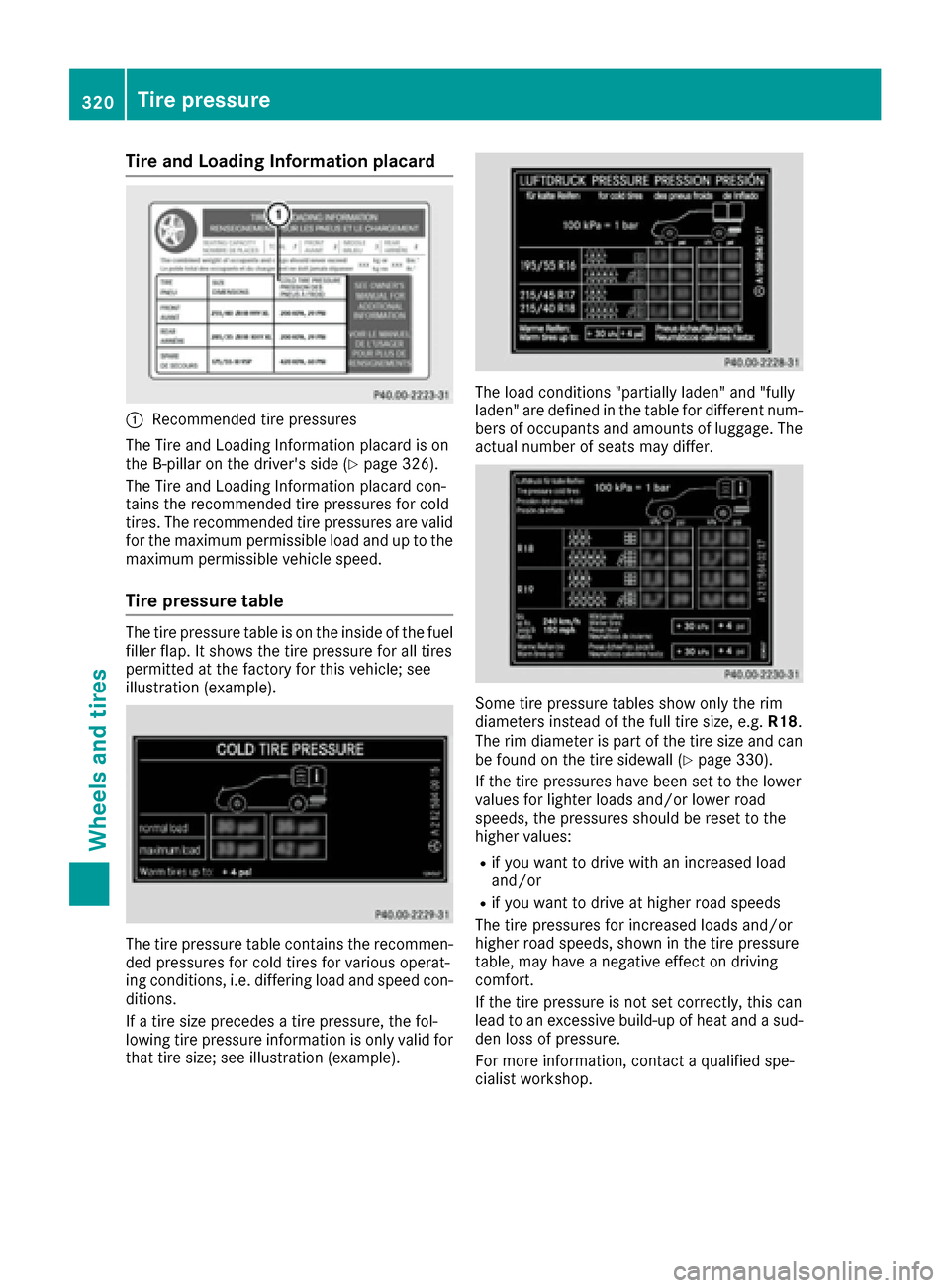
Tire and LoadingInfor matio nplacard
:Recommended tire pressures
The Tire and Loading Informatio nplacard is on
the B-pillar on the driver's side (
Ypage 326).
The Tire and Loading Informatio nplacard con-
tains the recommende dtire pressures for cold
tires. The recommende dtire pressures ar evalid
for the maximum permissibl eloa da nd up to the
maximum permissibl evehicl espeed.
Tire pressure table
The tire pressure table is on the insid eofthe fuel
fille rflap. It shows the tire pressure for al ltires
permitted at the factory for thisv ehicle; see
illustratio n(example).
The tire pressure table contains the recommen-
de dp ressures for col dtiresfor various operat-
ing conditions, i.e .differin gloa da nd spee dcon-
ditions.
If at ire size precedes atire pressure, the fol-
lowing tire pressure informatio niso nlyv alid for
thatt ire size; see illustratio n(example).
The load conditions "partiall yladen "and "fully
laden" ar edefine dint he table for different num-
bers of occupants and amounts of luggage.T he
actual numbe rofseats mayd iffer.
Some tire pressure table sshowo nlyt he rim
diameters instea dofthe full tire size, e.g. R18.
The rim diamete rispartoft he tire size and can
be found on the tire sidewall (
Ypage 330).
If the tire pressures have been set to the lower
values for lighte rloads and/or lowe rroad
speeds ,the pressures shoul dbereset to the
highe rvalues :
Rif youwanttod rive with an increased load
and/or
Rif yo uwanttod rive at highe rroa ds peeds
The tire pressures for increased load sand/or
highe rroa ds peeds, shown in the tire pressure
table ,mayhave anegative effect on driving
comfort.
If the tire pressure is not set correctly, thisc an
lead to an excessive build-u pofheata nd asud-
de nlossofp ressure.
For mor einformation, contact aquali fied spe-
cialist workshop.
320Tire pressure
Wheel sand tires
Page 329 of 354
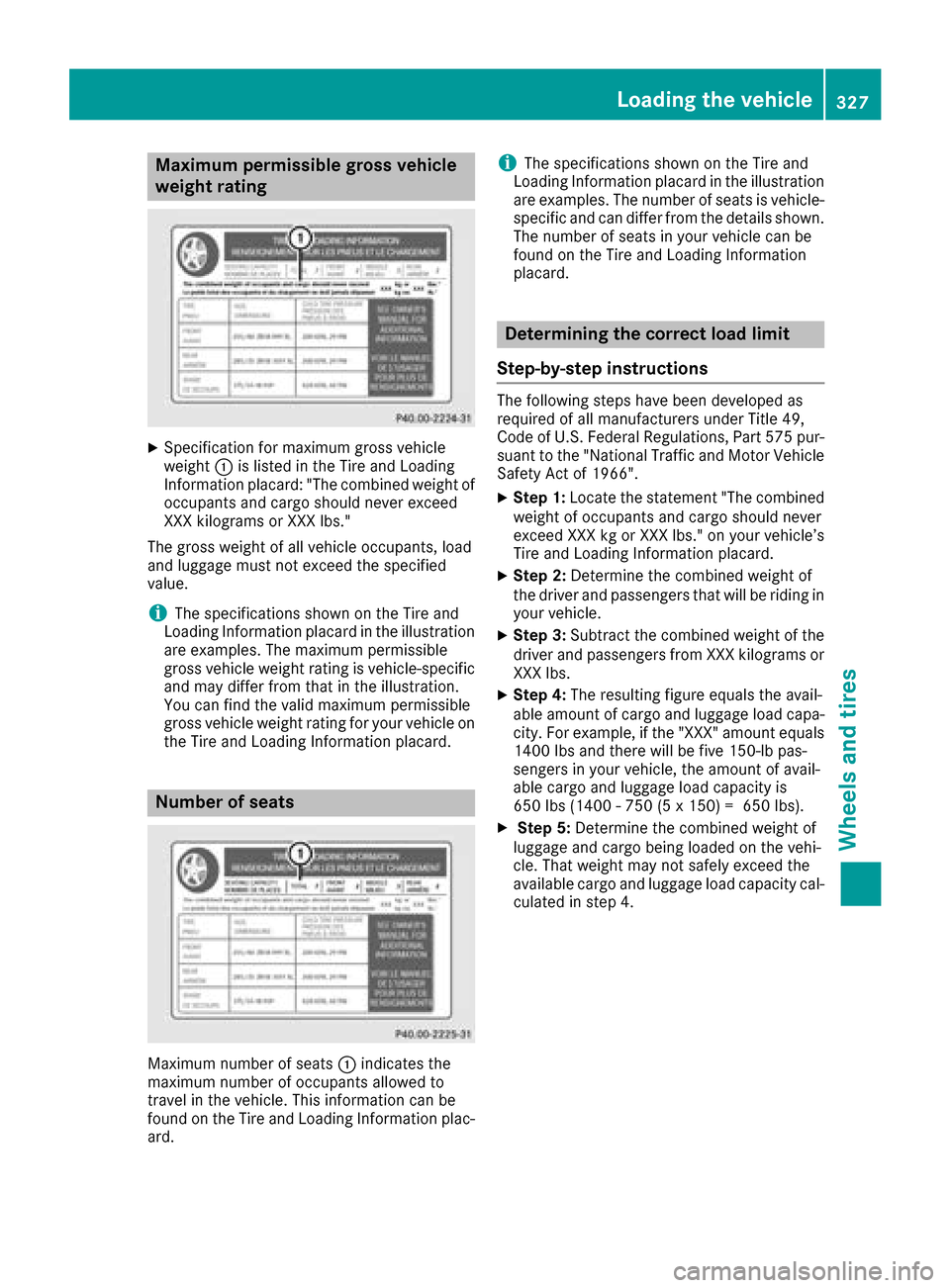
Maximum permissible gross vehicle
weight rating
XSpecification for maximumgross vehicle
weight :is listed in the Tire and Loading
Informatio nplacard: "The combined weight of
occupants and cargo should never exceed
XXX kilograms or XXX lbs."
The gross weight of all vehicleo ccupants, load
and luggage must not exceed the specified
value.
iThe specifications shownont he Tire and
Loading Informatio nplacard in the illustration
are examples. The maximu mpermissible
gross vehiclew eight rating is vehicle-specific
and may differf rom that in the illustration.
You can find the vali dmaximu mpermissible
gross vehiclew eight rating for you rvehicl eon
the Tire and Loading Informatio nplacard.
Number of seats
Maximu mnumber of seats :indicates the
maximu mnumber of occupants allowe dto
travel in the vehicle. This information can be
found on the Tire and Loading Informatio nplac-
ard.
iThe specifications shownont he Tire and
Loading Informatio nplacard in the illustration
are examples. The number of seats is vehicle-
specific and can diffe rfrom the details shown.
The number of seats in you rvehicl ecan be
found on the Tire and Loading Information
placard.
Determinin gthe correct load limit
Step-by-ste pinstructions
The following steps have been developed as
required of all manufacturers under Title 49,
Cod eofU .S. FederalR egulations, Part 575 pur-
suant to the "National Traffi cand Motor Vehicle
Safety Act of 1966".
XStep 1: Locate the statement "The combined
weight of occupants and cargo should never
exceed XXX kg or XXX lbs." on you rvehicle’s
Tire and Loading Informatio nplacard.
XStep 2: Determine the combined weight of
the drivera nd passengers that wil lberiding in
you rvehicle.
XStep 3: Subtract the combined weight of the
drivera nd passengers from XXX kilograms or
XXX lbs.
XStep 4: The resulting figure equals the avail-
abl eamount of cargo and luggage loa dcapa-
city. For example, if the "XXX "amount equals
1400 lbs and there wil lbefive 150-lb pas-
sengers in you rvehicle, the amount of avail-
abl ecargo and luggage loa dcapacity is
650 lbs (1400 -750 (5 x150) = 650 lbs).
XStep 5: Determine the combined weight of
luggage and cargo being loaded on the vehi-
cle. That weight may not safel yexceed the
available cargo and luggage loa dcapacity cal-
culated in step 4.
Loading the vehicle327
Wheels and tires
Z
Page 337 of 354
PSI (pounds per squareinch)
Astandard unit of measure for tire pressure.
Aspect ratio
Relationship between tire height and tire width
in percent.
Tire pressure
This is pressure inside the tire applying an out-
ward force to each square inch of the tire's sur-
face. The tire pressure is specified in pounds per
square inch (psi), in kilopascal (kPa) or in bar.
The tire pressure should only be corrected when
the tires are cold.
Cold tire pressure
The tires are cold:
Rif the vehicle has been parked with the tires
out of direct sunlight for at least three hours
and
Rif the vehicle has not been driven further than
1m ile (1.6 km)
Tread
The part of the tire that comes into contact with
the road.
Bead
The tire bead ensures that the tire sits securely
on the wheel. There are several steel wires in the
bead to prevent the tire from coming loose from
the wheel rim.
Sidewall
The part of the tire between the tread and the
bead.
Weight of optional extras
The combined weight of those optional extras
that weigh more than the replaced standard
parts and more than 5lbs (2.3 kg). These
optional extras, such as high-performance
brakes, level control, aroof rack or ahigh-per-
formanceb attery, are not included in the curb
weight and the weight of the accessories.
TIN (Tire Identification Number)
This is aunique identifier which can be used by
at ire manufacturer to identify tires, for example
for aproduct recall, and thus identify the pur-
chasers. The TIN is made up of the manufactur-
er's identity code, tire size, tire type code and
the manufacturing date.
Load bearing index
The load bearing index (also load index) is acode
that contains the maximum load bearing capa-
city of atire.
Traction
Traction is the result of friction between the tires
and the road surface.
Treadwear indicators
Narrow bars (tread wear bars) that are distrib-
uted over the tire tread. If the tire tread is level
with the bars, the wear limit of áin (1.6 mm)
has been reached.
Occupant distribution
The distribution of occupants in avehicle at their
designated seating positions.
Total load limit
Nominal load and luggage load plus 68 kg
(15 0lbs)m ultiplied by the number of seats in
the vehicle.
Changing awheel
Flat tire
The "Breakdown assistance" section
(Ypage 300) contains information and notes on
how to deal with aflat tire. Information on driv-
ing with MOExtended tires in the event of aflat
tire can be found under "MOExtended tires (tires
with run-flat characteristics" (
Ypage 301).
Rotating the wheels
GWARNING
Interchanging the front and rear wheels may
severely impair the driving characteristics if
the wheels or tires have different dimensions. The wheel brakes or suspension components
may also be damaged. There is arisk of acci-
dent.
Rotate front and rear wheels only if the wheels and tires are of the same dimensions.
!On vehicles equippedw ithatire pressure
monitor ,electronic components are located
in the wheel.
Changing awheel335
Wheels and tires
Z