child lock MERCEDES-BENZ C-CLASS ESTATE 2007 User Guide
[x] Cancel search | Manufacturer: MERCEDES-BENZ, Model Year: 2007, Model line: C-CLASS ESTATE, Model: MERCEDES-BENZ C-CLASS ESTATE 2007Pages: 377, PDF Size: 6.19 MB
Page 80 of 377
Opening and closing
77
The key now functions as follows:
X
To unlock the driver's door: press the
k button once.
X To unlock centrally :press the kbut-
ton twice.
X To lock centrally :press the jbutton.
Restoring the factory settings X
Press the kandj buttons simulta-
neously for approximately six seconds until
the battery check lamp flashes twice. KEYLESS GO key*
If you are carrying the KEYLESS GO key on
your person, you can use the KEYLESS GO
functions of your vehicle. The KEYLESS GO
key should not be more than one metre away
from the vehicle. However, you can also use
the KEYLESS GO key like a normal key with
remote control.
When you pull the door handle, the following
unlock centrally if the factory settings have
not been changed: R
The doors
R The boot lid/tailgate
R The fuel filler flap
If you press the button in the handle of the
boot lid/tailgate, only the boot/luggage com-
partment of your vehicle is unlocked. G
Risk of accident
Never leave children unsupervised in the
vehicle. They could :
R Open a door from the inside at any time,
even if it has been locked
R Start the vehicle if a valid KEYLESS GO
key is in the vehicle and they press the
KEYLESS GO button on the ignition lock
R Release the electric parking brak e
They could endanger themselves and oth-
ers. Switch off the engine and take the
KEYLESS GO key with you, even if you are
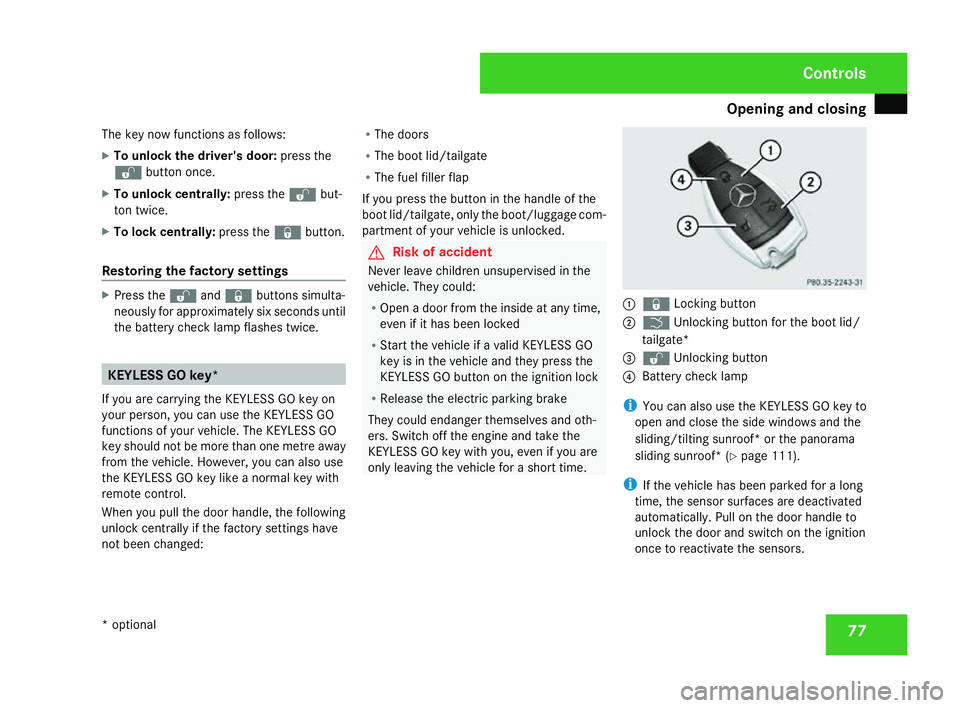
only leaving the vehicle for a short time. 1
j Locking button
2 i Unlocking button for the boot lid/
tailgate*
3 k Unlocking button
4 Battery check lamp
i You can also use the KEYLESS GO key to
open and close the side windows and the
sliding/tilting sunroof* or the panorama
sliding sunroof* (Y page 111).
i If the vehicle has been parked for a long
time, the sensor surfaces are deactivated
automatically. Pull on the door handle to
unlock the door and switch on the ignition
once to reactivate the sensors. Controls
* optional
204_AKB; 2; 3, en-GB
mkalafa
, 2007-06-26T23:11:51+02:00 - Seite 77
Page 83 of 377
Opening and closing
80
X
To switch off: press the1button until
you hear a tone.
X To switch on: press the2button until you
hear a tone. Locking/unlocking the vehicle from
the inside
You can centrally lock or unlock the vehicle
from the inside. This feature may be useful if,
for example, you wish to unlock the front-
passenger door from the inside or lock the
vehicle before you pull away. G
Risk of accident
Do not leave children unsupervised in the
vehicle. They could open a door from the
inside – even if it is locked – and thereby
endanger themselves and others.
i You cannot unlock the vehicle centrally
from the inside if the vehicle has been
locked from the outside using the key or
the KEYLESS GO key*.
i It is only possible to lock the vehicle cen-
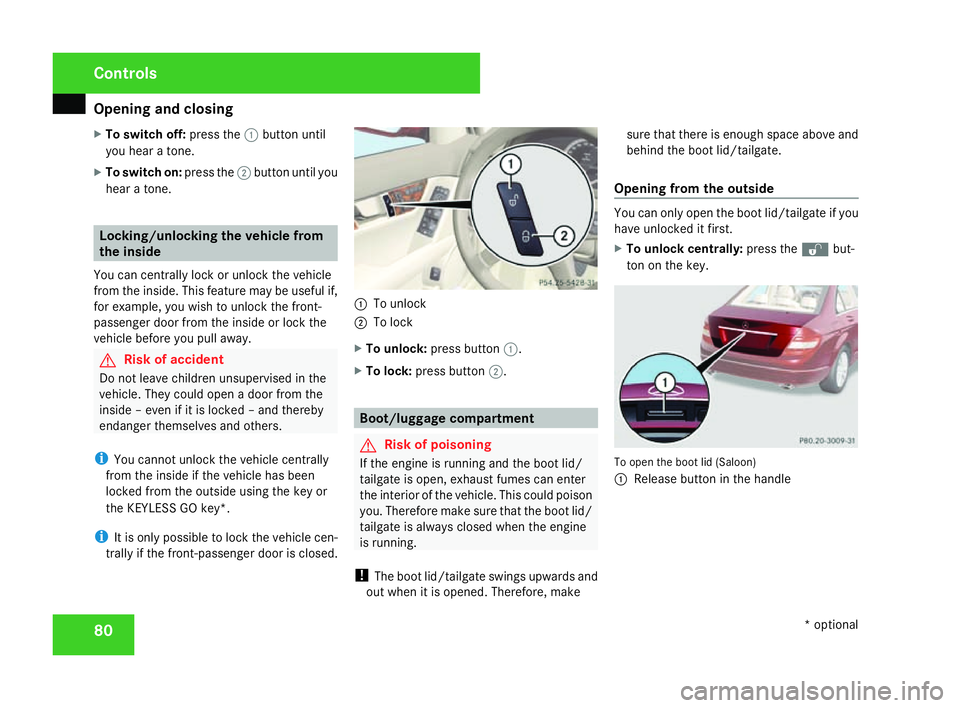
trally if the front-passenger door is closed. 1
To unlock
2 To lock
X To unlock: press button 1.
X To lock :press button 2. Boot/luggage compartmen
t G
Risk of poisoning
If the engine is running and the boot lid/
tailgate is open, exhaust fumes can enter
the interior of the vehicle. This could poison
you. Therefore make sure that the boot lid/
tailgate is always closed when the engine
is running.
! The boot lid/tailgate swings upwards and
out when it is opened. Therefore, make sure that there is enough space above and
behind the boot lid/tailgate.
Opening from the outside You can only open the boot lid/tailgate if yo
u
have unlocked it first.
X To unlock centrally :press the kbut-
ton on the key. To open the boot lid (Saloon)
1
Release button in the handle Cont
rols
* optional
204_AKB; 2; 3, en-GB
mkalafa,
2007-06-26T23:11:51+02:00 - Seite 80
Page 89 of 377
Seats
86
If you have not yet pressed KEYLESS GO but-
ton
1, this corresponds to position0or no
key in the ignition lock.
X Position 1: press KEYLESS GO button 1
once.
It is now possible to switch on the wind-
screen wipers, for example.
i If you now press KEYLESS GO button 1
twice, and the driver's door is open, the
power supply is disconnected again.
X Position 2 (ignition) :press KEYLESS GO
button 1twice.
i If you now press KEYLESS GO button 1
once and the driver's door is open, the
power supply is disconnected again.
Removing the KEYLESS GO button You can detach the KEYLESS GO button from
the ignition lock and start the vehicle with
a
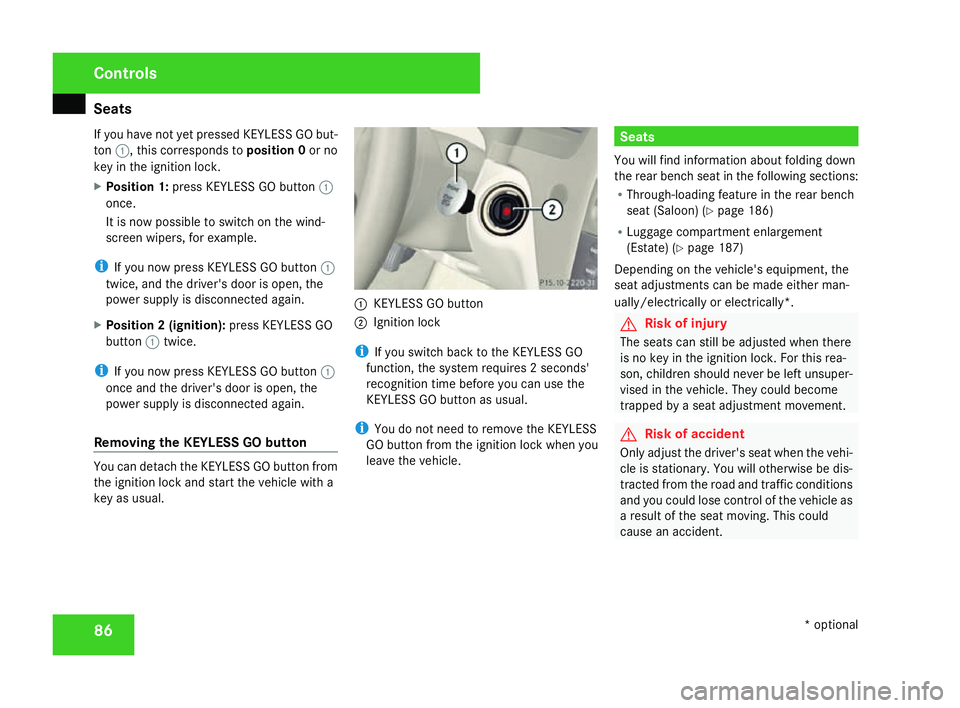
key as usual. 1
KEYLESS GO button
2 Ignition lock
i If you switch back to the KEYLESS GO
function, the system requires 2 seconds'
recognition time before you can use the
KEYLESS GO button as usual.
i You do not need to remove the KEYLESS
GO button from the ignition lock when you
leave the vehicle. Seat
s
You will find information about folding down
the rear bench seat in the following sections :
R Through-loading feature in the rear bench
seat (Saloon) (Y page 186 )
R Luggage compartment enlargement
(Estate) (Y page 187 )
Depending on the vehicle's equipment, the
seat adjustments can be made either man-
ually/electrically or electrically* . G
Risk of injury
The seats can still be adjusted when there
is no key in the ignition lock. For this rea -
son, children should never be left unsuper-
vised in the vehicle. They could become
trapped by a seat adjustment movement. G
Risk of accident
Only adjust the driver's seat when the vehi-
cle is stationary. You will otherwise be dis-
tracted from the road and traffic conditions
and you could lose control of the vehicle as
a result of the seat moving. This could
cause an accident. Control
s
* optional
204_AKB; 2; 3, en-GB
mkalafa,
2007-06-26T23:11:51+02:00 - Seite 86
Page 95 of 377
Steering wheel
92 Steering wheel
Depending on the vehicle equipment, you can
adjust the steering wheel either manually or
electrically*. G
Risk of injury
The electrically adjustable steering
wheel* can be adjusted when the key is
removed from the ignition lock. Therefore,
do not leave children unsupervised in the
vehicle as they could become trapped as
the steering wheel is adjusted. G
Risk of accident
Only adjust the steering wheel when the
vehicle is stationary and do not pull away
until the steering wheel adjustment mech -
anism is locked in position. You might oth-
erwise drive without the steering wheel
adjustment mechanism being locked in
position. As a result you could be distracte d
from road and traffic conditions by an unex-
pected movement of the steering wheel
and thereby cause an accident.
However, the steerability of the vehicle is
not affected .
When you adjust the steering wheel, make
sure that : R
the steering wheel can be reached with
your arms slightly bent
R you can move your legs freely
R you can see all the displays in the instru-
ment cluster clearly Adjusting the steering wheel man-
ually
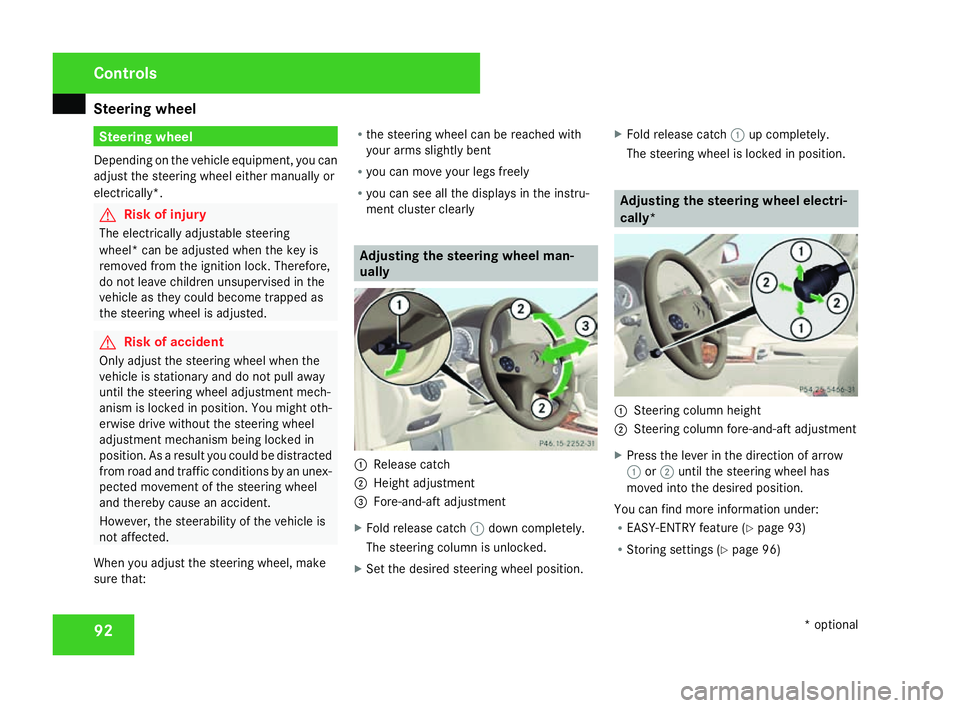
1
Release catch
2 Height adjustment
3 Fore-and-aft adjustment
X Fold release catch 1down completely.
The steering column is unlocked.
X Set the desired steering wheel position. X
Fold release catch 1up completely.
The steering wheel is locked in position . Adjusting the steering wheel electri
-
cally * 1
Steering column height
2 Steering column fore-and-aft adjustment
X Press the lever in the direction of arrow
1 or2 until the steering wheel has
moved into the desired position .
You can find more information under :
R EASY-ENTRY feature (Y page 93)
R Storing settings (Y page 96) Controls
* optional
204_AKB; 2; 3, en-GB
mkalafa,
2007-06-26T23:11:51+02:00 - Seite 92
Page 96 of 377

Mirrors
93Easy-entry/exit feature*
The EASY-ENTRY feature makes getting in
and out of your vehicle easier.
The steering wheel swings upwards whe n
you:
R remove the key from the ignition lock
R open the driver's door when the key is in
the ignition lock or in position 1
The steering wheel is moved automatically to
the position previously set when the key is
inserted into the ignition lock with the driver's
door closed. G
Risk of injury
Make sure that nobody can become trap -
ped when you activate the easy-entry/exit
feature.
If there is a risk of becoming trapped, stop
the adjustment procedure. To halt the pro-
cedure:
R press the steering-column adjustment
switc h
R press one of the memory function posi-
tion buttons
The steering column stops moving immedi-
ately. Never leave children unsupervised in the
vehicle. They could open the driver's door
and thereby unintentionally activate the
easy-entry feature and become trapped.
The most recent position of the steering
wheel is stored.
You can activate and deactivate the EASY-
ENTRY feature using the on-board computer
( Y page 144). Mirrors
Before starting off, adjust the mirrors in such
a way that you can get a good overview of
road and traffic conditions. Rear-view mirror
X Adjust the rear-view mirror manually.
Rear-view mirror (manual anti-dazzle) 1
Anti-dazzle switch
X Anti-dazzle mode: flick anti-dazzle switch
1 forwards or back. Controls
* optional
204_AKB; 2; 3, en-GB
mkalafa,
2007-06-26T23:11:51+02:00 - Seite 93
Page 99 of 377
Memory functions*
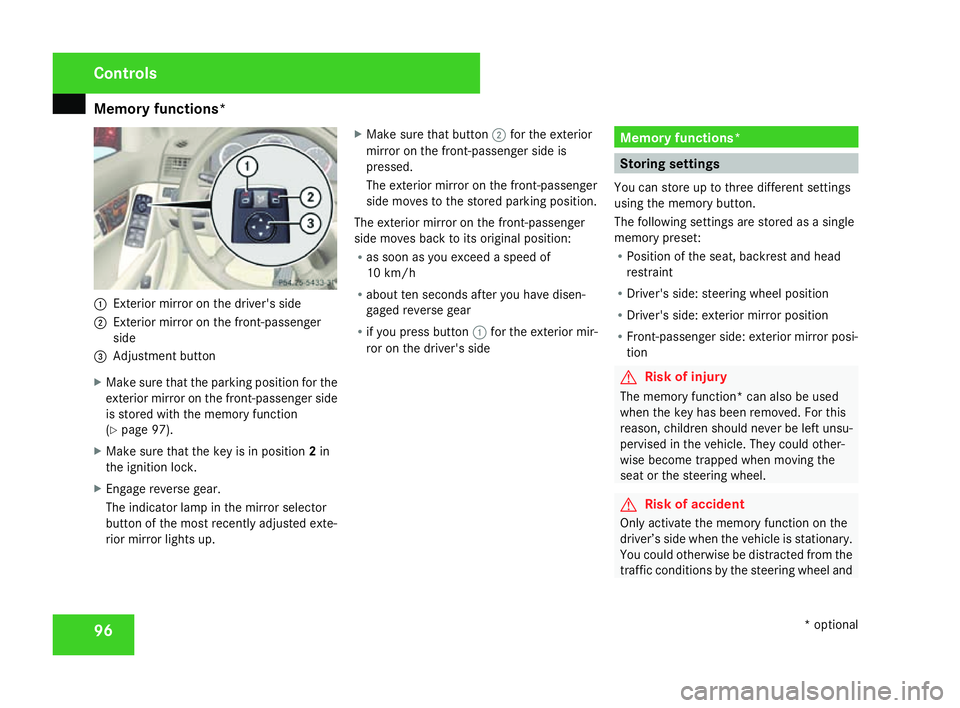
961
Exterior mirror on the driver's side
2 Exterior mirror on the front-passenge r
side
3 Adjustment button
X Make sure that the parking position for the
exterior mirror on the front-passenger side
is stored with the memory function
( Y page 97).
X Make sure that the key is in position 2in
the ignition lock .
X Engage reverse gear .
The indicator lamp in the mirror selector
button of the most recently adjusted exte-
rior mirror lights up. X
Make sure that button 2for the exterior
mirror on the front-passenger side is
pressed.
The exterior mirror on the front-passenger
side moves to the stored parking position.
The exterior mirror on the front-passenger
side moves back to its original position:
R as soon as you exceed a speed of
10 km/h
R about ten seconds after you have disen -
gaged reverse gear
R if you press button 1for the exterior mir-
ror on the driver's side Memory functions
* Storing settings
You can store up to three different settings
using the memory button.
The following settings are stored as a single
memory preset:
R Position of the seat, backrest and head
restraint
R Driver's side: steering wheel positio n
R Driver's side: exterior mirror positio n
R Front-passenger side: exterior mirror posi-
tion G
Risk of injury
The memory function* can also be used
when the key has been removed. For this
reason, children should never be left unsu-
pervised in the vehicle. They could other-
wise become trapped when moving the
seat or the steering wheel . G
Risk of accident
Only activate the memory function on the
driver’s side when the vehicle is stationary.
You could otherwise be distracted from the
traffic conditions by the steering wheel and Control
s
* optional
204_AKB; 2; 3, en-GB
mkalafa,
2007-06-26T23:11:51+02:00 - Seite 96
Page 101 of 377

Seat belts
98
X
Make sure that the vehicle is stationary and
that the key is in position 2in the ignition
lock .
X Press button 2for the exterior mirror on
the front-passenger side .
X Use adjustment button 3to adjust the
exterior mirror to a position which allows
you to see the rear wheel and the kerb .
X Press memory button M4 .
X Press one of the arrows on adjustment but-
ton 3within three seconds.
The parking position is stored if the exterior
mirror does not move.
i If the mirror moves out of position, repeat
the steps. You can adjust the exterior mir-
ror again after storing the setting . Seat belts
Seat belts are the most effective means of
restraining the movement of vehicle occu-
pants in the event of an accident. This
reduces the risk of vehicle occupants coming
into contact with the vehicle interior. Wearing seat belts
G
Risk of injury
A seat belt which is not worn correctly, or
which has not been engaged in the seat bel t
buckle correctly, cannot perform its inten-
ded protective function. Under certain cir-
cumstances this could cause severe or
even fatal injuries.
Make sure that all occupants – in particular,
pregnant women – wear their seat belt cor-
rectly at all times .
R The seat belt must pass closely over your
body and must not be twisted. You
should therefore avoid wearing bulky
clothing (e.g. a winter coat). The shoulder
belt section must be routed across the
middle of your shoulder – on no account
across your neck or under your arm – and
pulled tight against your upper body. The
lap belt must always pass across your lap as low down as possible, i.e. over your
hip joints – not across your abdomen. If
necessary, tighten the belt strap by pull-
ing it down slightly and retighten in the
direction of the inertia reel.
R Do not route the belt strap across sharp
or fragile objects, especially if these ar e
located on or in your clothing, e.g. spec -
tacles, pencils, keys, etc. The seat belt
strap could be damaged and tear in an
accident and you or other vehicle occu -
pants could be injured.
R Only one person should use each seat
belt at any one time. On no account
should children travel sitting on your lap
or the lap of another occupant, as it
would not be possible to restrain the
child in the event of an accident, braking
or a sudden change in direction, which
could result in severe or even fatal inju-
ries to the child and other occupants.
R Persons less than 1.50 m tall cannot
wear the seat belts correctly. For this
reason, secure persons less than 1.50 m
tall in specially designed, suitabl e
restraint systems .
R Children less than 1.50 m tall or under
12 years of age cannot wear the seat Control
s
204_AKB; 2; 3, en-GB
mkalafa,
2007-06-26T23:11:51+02:00 - Seite 98
Page 113 of 377
Side windows
110
X
To switch on :turn switch 1to positio n
& .
The symbol for the rear window wiper
appears in the instrument cluster.
X To switch off: turn switch1to positio n
( .
The symbol for the rear window wiper in the
instrument cluster goes out.
Wiping the rear window using washer
fluid X
Make sure that the key is in position 1in
the ignition lock .
X Turn switch 1to position %or posi-
tion )and hold it there until the rear
window has been cleaned.
The rear window is wiped for a further fiv e
seconds after the switch is released. Side windows
Opening/closing the side windows
G
Risk of injury
Make sure that nobody can become trap -
ped between the side window and the door
frame as a side window is opened. Do not
touch or lean against the side window dur-
ing the opening procedure. You could
become trapped between the side window
and the door frame as the window moves
down. If danger threatens, release the
switch or pull the switch upwards to close
the side window again. G
Risk of injury
Make sure that nobody can become trap -
ped as you close a side window. If danger
threatens, release the switch or press the
switch a second time to open the side win-
dow again. G
Risk of injury
Never leave children unsupervised in the
vehicle. Always take the key with you when
leaving the vehicle, even if you only leave it
for a short time . G
Risk of injury
Do not leave children unsupervised in the
vehicle, even if they are secured in a chil d
restraint system. The children could:
R be seriously or even fatally injured on
parts of the vehicle
R be seriously or even fatally injured by
prolonged exposure to extremely high or
extremely low temperatures
If children open a door, they could:
R seriously or even fatally injure other peo-
ple
R get out of the vehicle, thereby injuring
themselves or be seriously or even fatally
injured by a passing vehicle
Activate the child-proof locks if children are
travelling in the vehicle. They could other-
wise open doors or windows while the vehi-
cle is in motion and thereby injure them-
selves or others.
i It is also possible to open and close the
side windows from the outside using the
"Summer opening" (Y page 111 )and "Con-
venience closing" (Y page 112) features
respectively. Controls
204_AKB; 2; 3, en-GB
mkalafa,
2007-06-26T23:11:51+02:00 - Seite 110
Page 117 of 377
Driving and pa
rking11
4
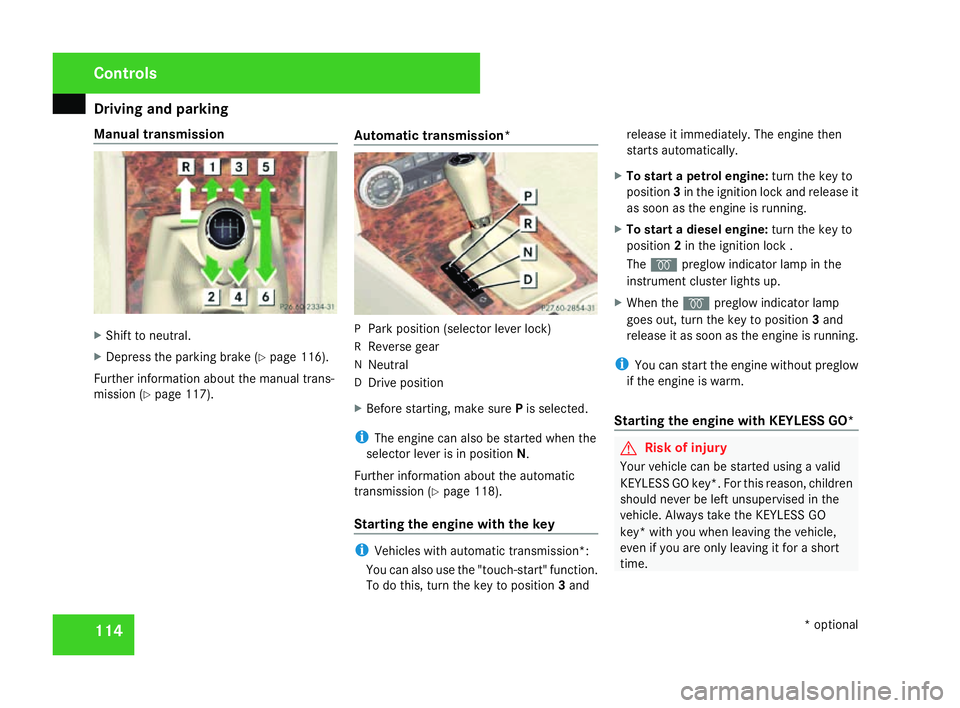
Manual transmission
X
Shift to neutral .
X Depress the parking brake (Y page 116).
Further information about the manual trans-
mission (Y page 117). Automatic transmission* P
Park position (selector lever lock)
R Reverse gear
N Neutral
D Drive positio n
X Before starting, make sure Pis selected.
i The engine can also be started when the
selector lever is in position N.
Further information about the automatic
transmission (Y page 118).
Starting the engine with the key i
Vehicles with automatic transmission*:
You can also use the "touch-start" function.
To do this, turn the key to position 3and release it immediately. The engine then
starts automatically.
X To start a petrol engine :turn the key to
position 3in the ignition lock and release it
as soon as the engine is running.
X To start a diesel engine :turn the key to
position 2in the ignition lock .
The q preglow indicator lamp in the
instrument cluster lights up.
X When the qpreglow indicator lamp
goes out, turn the key to position 3and
release it as soon as the engine is running.
i You can start the engine without preglow
if the engine is warm.
Starting the engine with KEYLESS GO* G
Risk of injury
Your vehicle can be started using a valid
KEYLESS GO key*. For this reason, childre n
should never be left unsupervised in the
vehicle. Always take the KEYLESS GO
key* with you when leaving the vehicle,
even if you are only leaving it for a short
time. Controls
* optional
204_AKB; 2; 3, en-GB
mkalafa,
2007-06-26T23:11:51+02:00 - Seite 114
Page 119 of 377

Driving and pa
rking11
6 Parking
G
Risk of accident
Only remove the key from the ignition lock
when the vehicle is stationary since yo u
cannot steer the vehicle with the key
removed .
Never leave children unsupervised in the
vehicle. They could release the parking
brake. This could lead to a serious or fatal
accident. G
Risk of fire
Make sure that the exhaust system doe s
not under any circumstances come into
contact with easily ignitable material such
as dry grass or petrol. The material could
otherwise ignite and set the vehicle on fire. Parking brake 1
Release handle
2 Parking brake
X To release: depress the brake pedal and
keep it depressed.
On vehicles with automatic transmission*
the selector lever lock is released .
X Pull release handle 1.
X The 3 indicator lamp in the instrumen t
cluster goes out.
X To apply :depress parking brake 2firmly .
The 3 indicator lamp in the instrumen t
cluster lights up if the engine is running.
i On steep slopes, turn the front wheels
towards the kerb. Stopping the engine
G
Risk of accident
If the engine is not running, there is no
power assistance for the steering and
brakes. Steering and braking then takes
much more effort.
As a result, you might lose control of the
vehicle, cause an accident and injure your-
self and others.
Do not switch off the engine while driving .
Vehicles with manual transmission X
Shift to either first or reverse gear.
X Turn the key to position 0in the ignition
lock and remove it.
The immobiliser is activated.
Vehicles with automatic transmission* X
Move the selector lever to P.
With the key
X Turn the key to position 0in the ignition
lock and remove it.
The immobiliser is activated. Controls
* optional
204_AKB; 2; 3, en-GB
mkalafa,
2007-06-26T23:11:51+02:00 - Seite 116