airbag off MERCEDES-BENZ C-CLASS ESTATE 2014 Owners Manual
[x] Cancel search | Manufacturer: MERCEDES-BENZ, Model Year: 2014, Model line: C-CLASS ESTATE, Model: MERCEDES-BENZ C-CLASS ESTATE 2014Pages: 489, PDF Size: 15.08 MB
Page 8 of 489
Airbag
Introduction .................................... .51
PASSENGER AIR BAG indicator
lamps ............................................... 46
Airbags
Display message ............................3 30
Front airbag (driver, front
passenger) ....................................... 52
Important safety guidelines ............. 51
Kneebag .......................................... .53
Sidebag ............................................ 53
Triggering ......................................... 60
Windowbag ...................................... 53
AIRMATIC
Display message ............................ 339
Function/note s............................. 238
AIRPANEL (cleaning instructions) .... 404
Alarm
ATA (Anti-Theft Alarm system) ......... 87
Switching off (ATA) .......................... 87
Switching the function on/off
(ATA) ................................................ 87
Alarm system
see ATA (Anti-Theft Alarm system)
Anti-glare film .................................... 391
Anti-lock braking system
see ABS (Anti-lock Braking System)
Anti-Theft Alarm system
see ATA (Anti-Theft Alarm system)
Aquaplaning ....................................... 218
Armrest
Stowage compartment .................. 372
Ashtray ............................................... 383
Assistance display (on-board com-
puter) .................................................. 308
Assistance menu (on-board com-
puter) .................................................. 309
ASSYST PLUS
Displaying a service message ........ 399
Hiding a service message .............. 399
Notes ............................................. 399
Resetting the service interval dis-
play ................................................ 399
Service message ............................ 399
Special service requirements ......... 400
ATA (Anti-Theft Alarm system)
Activating/deactivating ................... 87 Function ........................................... 87
Switching off the alarm .................... 87
ATTENTION ASSIST
Activating/deactivating ................. 311
Display message ............................ 339
Function/note s............................. 258
Authorised workshop
see Qualified specialist workshop
AUTO lights
Display message ............................ 334
see Lights
Automatic engine start (ECO start/
stop function) .................................... 191
Automatic engine switch-off (ECO
start/stop function) .......................... 190
Automatic front-passenger front
airbag deactivation
Display message ............................ 330
Automatic front-passenger front
airbag deactivation system
Operation ......................................... 54
Problems ......................................... 59
System self-test ............................... 57
Automatic headlamp mode .............. 135
Automatic transmission
Accelerator pedal position ............. 200
AGILITY SELECT switch .................. 201
Changing gear ............................... 200
DIRECT SELECT lever ..................... 197
Display message ............................ 347
Drive program display .................... 199
Drive programs .............................. 201
Driving tips .................................... 200
Emergency running mode .............. 204
Engaging drive position .................. 199
Engaging neutral ............................ 198
Engaging park position automati-
cally ............................................... 198
Engaging reverse gear ................... 198
Engaging the park position ............ 197
Kickdown ....................................... 200
Manual shifting .............................. 202
Overview ........................................ 197
Problem (fault) ............................... 204
Pulling away ................................... 189
Starting the engine ........................ 187
Steering wheel gearshift paddle s... 202
Trailer towing ................................. 200 Index
5
Page 15 of 489
Flat tyre
Changing a wheel/fitting the
spare wheel .................................. .441
MOExtended tyres ......................... 413
Preparing the vehicle ..................... 412
TIREFIT kit ...................................... 414
see Emergency spare wheel
Floormat ............................................. 391
Foglamps (extended range) .............. 139
Fording
On flooded roads ........................... 219
Frequencies
Mobile phone ................................. 468
Two-way radio ................................ 468
Front-passenger front airbag deac-
tivation
Display message ............................ 330
Front-passenger front airbag deac-
tivation system
Operation ......................................... 54
Problems ......................................... 59
System self-test ............................... 57
Fuel
Additives ........................................ 473
Consumption information .............. 474
Consumption statistics .................. 301
Displaying the current consump-
tion ................................................ 300
Displaying the range ..................... .300
Driving tips ................................... .215
E10 ................................................ 472
Fuel gauge ....................................... 34
Grade (petrol) ................................ 472
Important safety notes .................. 471
Low outside temperatures ............. 473
Problem (malfunction) ................... 207
Quality (diesel )............................... 473
Refuelling ....................................... 204
Tank content/reserve fue l............. 471
Fuel consumption (Audio 20) ........... 279
Fuel consumption (COMAND
Online) ................................................ 279
Fuel filler flap
Opening ......................................... 206
Fuel filter (white display message) .. 337Fuel level
Calling up the range (on-board
computer) ...................................... 300
Gaug e.............................................. 34
Fuel tank
Capacity ........................................ 471
Problem (malfunction) ................... 207
Fuses
Allocation chart ............................. 430
Before changing ............................. 428
Dashboard fuse box ....................... 429
Fuse box in the engine compart-
ment .............................................. 429
Fuse box in the front-passenger
footwell .......................................... 429
Fuse box in the luggage compart-
ment .............................................. 430
Important safety notes .................. 428 G
Generated electrical energy (Audio 20) ...................................................... 279
Generated electrical energy
(COMAND Online) .............................. 279
Genuine Mercedes-Benz parts ........... 24
Glove compartment .......................... 371 H
HANDS-FREE ACCESS ....................... 103
Hazard warning lamps ...................... 137
Head restraints
Adjusting ....................................... 121
Adjusting (electrically) ................... 122
Adjusting (manually) ...................... 122
Adjusting (rear) .............................. 122
Fitting/removing (rear) .................. 122
Head-up display
Adjusting the brightness ................ 312
Function/note s............................. 297
Important safety notes .................. 297
Setting the position ....................... 312
Storing settings (memory func-
tion) ............................................... 131
Switching on or off ......................... 298
Switching the display on/off ......... 312 12
Index
Page 28 of 489
!
Airbags and seat belt tensioners, as well
as control units and sensors for these
restraint systems, may be installed in the
following areas of your vehicle:
R doors
R door pillars
R door sills
R seats
R dashboard
R instrument cluster
R centre console
Do not install accessories such as audio
systems in these areas. Do not carry out
repairs or welding. You could impair the
operating efficiency of the restraint sys-
tems.
Have accessories retrofitted at a qualified
specialist workshop.
You could jeopardise the operating safety of
your vehicle if you use parts, tyres and wheels
as well as accessories relevant to safety
which have not been approved by Mercedes. This could lead to malfunctions in safety-rel-
evant systems, e.g. the brake system. Use
only genuine Mercedes-Benz parts or parts of
equal quality. Only use tyres, wheels and
accessories that have been specifically
approved for your vehicle.
Mercedes-Benz tests genuine parts and con-
version parts and accessories that have been specifically approved for your vehicle for their
reliability, safety and suitability. Despite
ongoing market research, Mercedes-Benz is
unable to assess other parts. Mercedes-Benz therefore accepts no responsibility for the
use of such parts in Mercedes-Benz vehicles, even if they have been officially approved or
independently approved by a testing centre.
In Germany, certain parts are only officially
approved for installation or modification if
they comply with legal requirements. This
also applies to some other countries. All gen-
uine Mercedes-Benz parts meet the approval
requirements. The use of non-approved parts may invalidate the vehicle's general operating
permit.
This is the case:
R if they cause a change of the vehicle type
from that for which the vehicle's general
operating permit was granted
R if other road users could be endangered
R if the emission or noise levels are adversely
affected
Always specify the vehicle identification num- ber (VIN) when ordering genuine Mercedes-
Benz parts (Y page 470). Owner's Manual
Vehicle equipment
This Owner's Manual describes all models
and all standard and optional equipment
available for your vehicle at the time of pub-
lication of the Owner's Manual. Country-spe-
cific differences are possible. Note that your
vehicle may not be fitted with all features
described. This is also the case for systems
and functions relevant to safety. Therefore,
the equipment on your vehicle may differ from that in the descriptions and illustrations.
The original purchase contract documenta-
tion for your vehicle contains a list of all of the
systems in your vehicle.
Should you have any questions concerning
equipment and operation, please consult a
Mercedes-Benz Service Centre.
The Owner's Manual and Service Booklet are important documents and should kept in the
vehicle. Operating safety
Important safety notes
G
WARNING
If you do not have the prescribed service/
maintenance work or necessary repairs car- Introduction
25 Z
Page 45 of 489
Useful information
i This Owner's Manual describes all mod-
els, series and optional equipment for your
vehicle that were available at the time of
going to press. National variations are pos- sible. Note that your vehicle may not be
equipped with all of the functions descri-
bed. This is also the case for systems and
functions relevant to safety.
i Read the information on qualified special-
ist workshops: (Y page 27). Hybrid vehicles
General notes
Hybrid technology combines a fuel-efficient
internal combustion engine with a powerful
electric motor. Important safety notes
Danger of electric shock G
DANGER
The vehicle's high voltage electrical system is under high voltage. If you modify components
in the vehicle's high-voltage electrical system or touch damaged components, you may be
electrocuted. The components in the vehi-
cle's high-voltage electrical system may be
damaged in an accident, although the damage
is not visible. There is a risk of fatal injury.
Do not touch any high-voltage components
after an accident and never modify the vehi-
cle's high-voltage electrical system. Have the vehicle towed away after an accident and the vehicle's high-voltage electrical system
checked by a qualified specialist workshop. When towing a vehicle after an accident, be
sure to observe the following sections:
R Transporting the vehicle (Y page 427)
R Towing the vehicle with the rear axle raised
(Y page 426)
R Towing the vehicle with both axles on the
ground (Y page 427)
Read the safety instructions on towing and
tow-starting (Y page 424). All components of the hybrid system are
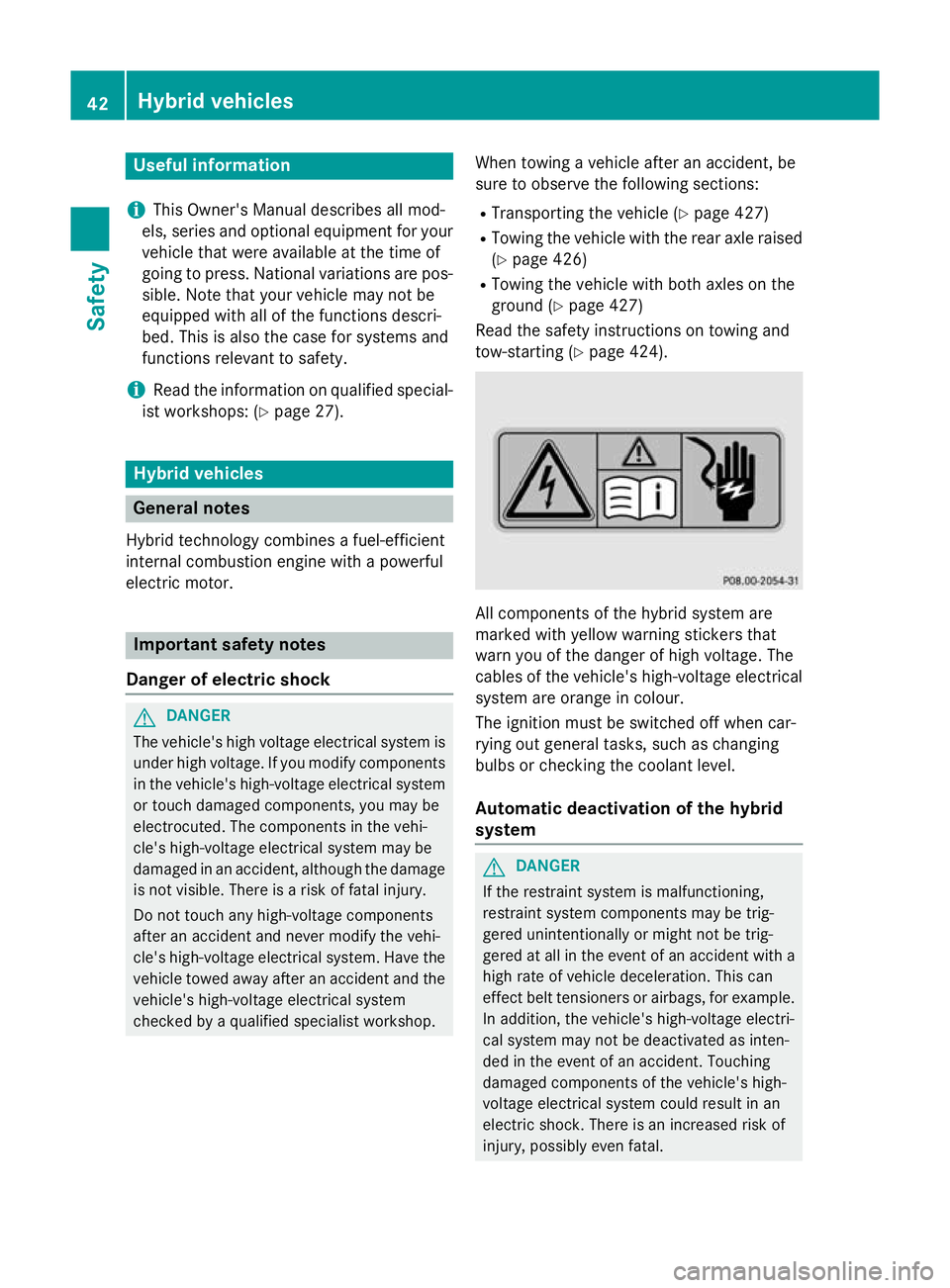
marked with yellow warning stickers that
warn you of the danger of high voltage. The
cables of the vehicle's high-voltage electrical
system are orange in colour.
The ignition must be switched off when car-
rying out general tasks, such as changing
bulbs or checking the coolant level.
Automatic deactivation of the hybrid
system G
DANGER
If the restraint system is malfunctioning,
restraint system components may be trig-
gered unintentionally or might not be trig-
gered at all in the event of an accident with a high rate of vehicle deceleration. This can
effect belt tensioners or airbags, for example. In addition, the vehicle's high-voltage electri-
cal system may not be deactivated as inten-
ded in the event of an accident. Touching
damaged components of the vehicle's high-
voltage electrical system could result in an
electric shock. There is an increased risk of
injury, possibly even fatal. 42
Hybrid vehiclesSafety
Page 48 of 489
The restraint system includes:
R seat belt system
R airbags
R child restraint system
R child seat securing systems
The components of the restraint system are
complementary. They can offer maximum
protection only when all vehicle occupants:
R secure their seat belts correctly
(Y page 48)
R adjust the seat and head restraints prop-
erly (Y page 119)
As the driver, you must also make sure that
the steering wheel is adjusted correctly.
Observe the information on the correct driv-
er's seat position (Y page 118).
Additionally, you must make sure that the air- bag can inflate without restriction if deployed
(Y page 51).
An airbag is supplementary to a correctly fas-
tened seatbelt. An airbag, as an additional
safety device, provides greater protection for vehicle occupants in an accident situation. If
the seat belts offer sufficient protection in the
event of an accident, for example, the airbags
will not be deployed. Also, only the airbags
which are deemed to offer protection in the
corresponding accident situation are
deployed. However, seat belts and airbags
generally do not protect against objects pen-
etrating the vehicle from the outside.
Information on how the restraint system
operates can be found in "Deployment of the seat belt tensioner and airbags"
(Y page 60).
See "Children in the vehicle" (Y page 63) for
further information on infants and children
travelling in the vehicle as well as on child
restraint systems. Important safety notes
G
WARNING
If the restraint system is modified, it may no
longer work as intended. The restraint system
may then not perform its intended protective function by failing in an accident or triggering
unexpectedly, for example. There is an
increased risk of injury, possibly even fatal.
Never modify parts of the restraint system. Do not attempt to modify the wiring as well as
electronic components or their software.
If it is necessary to modify an airbag system
for a person with physical disabilities, contact a Mercedes-Benz Service Centre for details. Restraint system warning lamp
The functions of the restraint system are
checked after the ignition is switched on and at regular intervals while the engine is run-
ning. Therefore, malfunctions can be detec-
ted in good time.
The 6 restraint system warning lamp in
the instrument cluster lights up when the igni- tion is switched on. It goes out no later than afew seconds after the vehicle is started. The
components of the restraint system are in
operational readiness.
A malfunction has occurred if the 6
restraint system warning lamp:
R does not light up after the ignition is
switched on
R does not go out after a few seconds with
the engine running
R lights up again while the engine is running
All vehicles, except hybrid vehicles: G
WARNING
If the restraint system is malfunctioning,
restraint system components may be trig-
gered unintentionally or might not be trig-
gered at all in the event of an accident with a high rate of vehicle deceleration. This can
effect belt tensioners or airbags, for example. Occupant safety
45Safety
Z
Page 49 of 489
There is an increased risk of serious or even
fatal injuries.
Have the restraint system checked and
repaired immediately at a qualified specialist
workshop.
Hybrid vehicles: G
DANGER
If the restraint system is malfunctioning,
restraint system components may be trig-
gered unintentionally or might not be trig-
gered at all in the event of an accident with a high rate of vehicle deceleration. This can
effect belt tensioners or airbags, for example. In addition, the vehicle's high-voltage electri-
cal system may not be deactivated as inten-
ded in the event of an accident. Touching
damaged components of the vehicle's high-
voltage electrical system could result in an
electric shock. There is an increased risk of
injury, possibly even fatal.
Have the restraint system checked and
repaired immediately at a qualified specialist
workshop. After an accident, immediately
switch the ignition off and remove the key
from the ignition lock. PASSENGER AIRBAG indicator lamp
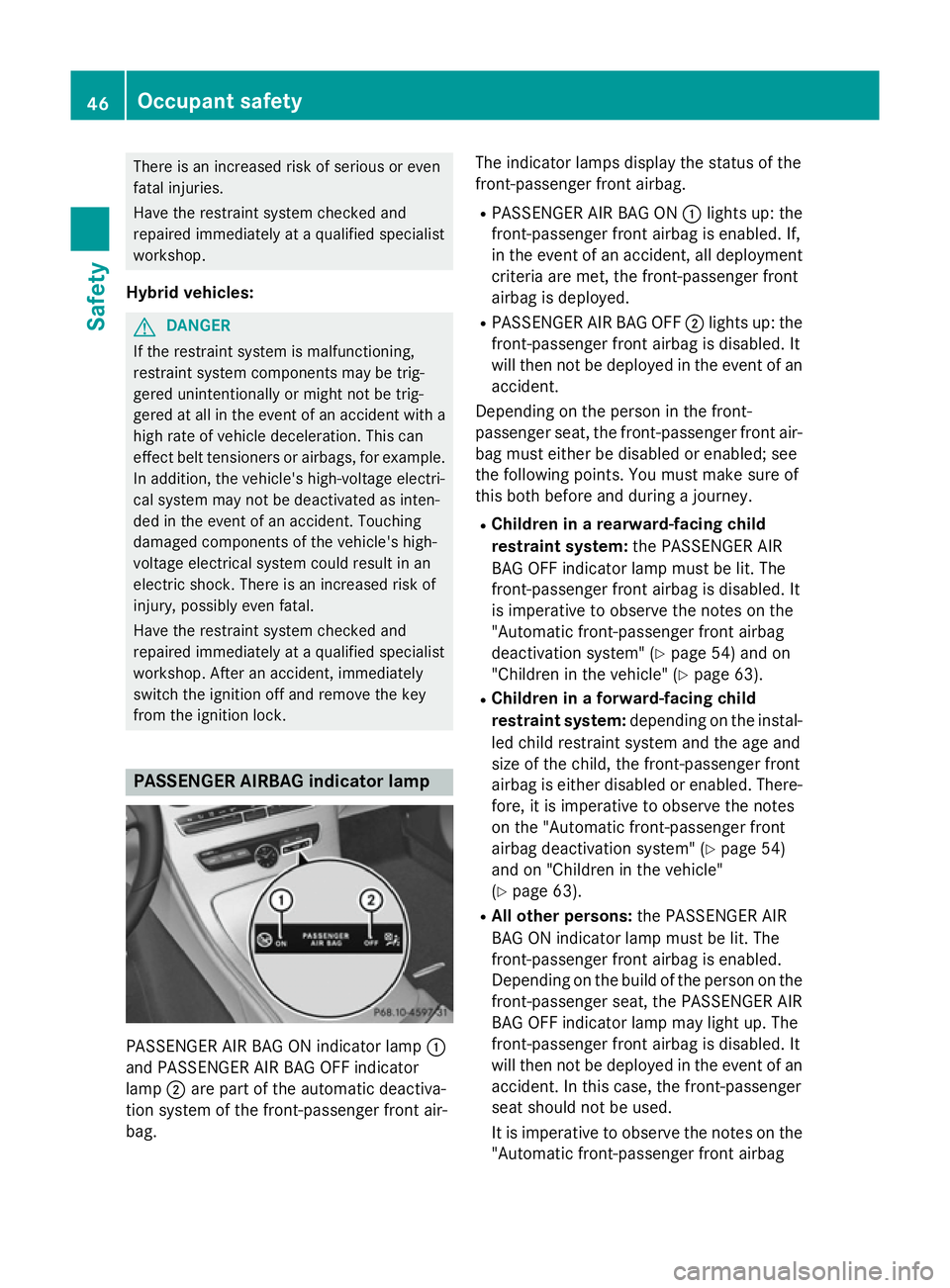
PASSENGER AIR BAG ON indicator lamp
:
and PASSENGER AIR BAG OFF indicator
lamp ;are part of the automatic deactiva-
tion system of the front-passenger front air-
bag. The indicator lamps display the status of the
front-passenger front airbag.
R PASSENGER AIR BAG ON :lights up: the
front-passenger front airbag is enabled. If,
in the event of an accident, all deployment
criteria are met, the front-passenger front
airbag is deployed.
R PASSENGER AIR BAG OFF ;lights up: the
front-passenger front airbag is disabled. It
will then not be deployed in the event of an
accident.
Depending on the person in the front-
passenger seat, the front-passenger front air-
bag must either be disabled or enabled; see
the following points. You must make sure of
this both before and during a journey.
R Children in a rearward-facing child
restraint system: the PASSENGER AIR
BAG OFF indicator lamp must be lit. The
front-passenger front airbag is disabled. It
is imperative to observe the notes on the
"Automatic front-passenger front airbag
deactivation system" (Y page 54) and on
"Children in the vehicle" (Y page 63).
R Children in a forward-facing child
restraint system: depending on the instal-
led child restraint system and the age and
size of the child, the front-passenger front
airbag is either disabled or enabled. There-
fore, it is imperative to observe the notes
on the "Automatic front-passenger front
airbag deactivation system" (Y page 54)
and on "Children in the vehicle"
(Y page 63).
R All other persons: the PASSENGER AIR
BAG ON indicator lamp must be lit. The
front-passenger front airbag is enabled.
Depending on the build of the person on the front-passenger seat, the PASSENGER AIR
BAG OFF indicator lamp may light up. The
front-passenger front airbag is disabled. It
will then not be deployed in the event of an
accident. In this case, the front-passenger
seat should not be used.
It is imperative to observe the notes on the
"Automatic front-passenger front airbag 46
Occupant safetySafety
Page 50 of 489
deactivation system" (Y
page 54) as well
as on "Seat belts" (Y page 47) and "Air-
bags" (Y page 51). There you can also find
information on the correct seat position. Seat belts
Introduction A correctly fastened seatbelt is the most
effective means of restraining the movement
of vehicle occupants in the event of a collision or if the vehicle overturns. This reduces the
risk of vehicle occupants coming into contact
with parts of the vehicle interior or being
thrown from the vehicle. Additionally, the
seat belt helps to keep the vehicle occupant
in the best position in relation to the airbag.
The seat belt system consists of:
R seat belts
R belt tensioners for the front seat belts and
the outer seat belts in the rear
R belt force limiters for the front seat belts
and the outer seat belts in the rear
If the seat belt is pulled too quickly or sud-
denly from the belt outlet, the inertia reel will lock. The belt strap cannot be pulled out fur-
ther.
In an impact, the belt tensioner tightens the
belt to pull it close to the body. It does not pull the vehicle occupants back in the direction of
the seat backrest.
The belt tensioner cannot compensate for the
seat position being incorrect or for a seat belt
being routed or worn incorrectly.
If the seat belt is also fitted with a belt force
limiter and this is triggered, the force exerted by the seat belt on the vehicle occupant is
reduced.
The belt force limiters on the front seats are
synchronised with the front airbags, which
take on a part of the deceleration force. This
reduces the forces to which vehicle occu-
pants are subjected during an accident. !
If the co-driver's seat is not occupied, do
not engage the seat belt tongue in the
buckle on the co-driver's seat. Otherwise,
the belt tensioner could be triggered in the
event of an accident and would have to be
replaced.
Important safety notes G
WARNING
The seat belt cannot perform its intended pro- tective function if it is not fastened correctly. Also, an improperly fastened seat belt can
cause additional injuries in the event of an
accident, sudden braking or abrupt changes
of direction. There is an increased risk of
injury, possibly even fatal.
Always make sure that all vehicle occupants
are wearing their seat belt properly and are
seated correctly. G
WARNING
The seat belt does not offer the intended level of protection if you have not moved the back-
rest to an almost vertical position. When brak-
ing or in the event of an accident, you could
slide underneath the seat belt and sustain
abdomen or neck injuries, for example. This
poses an increased risk of injury or even fatal injury.
Adjust the seat properly before beginning
your journey. Always ensure that the backrest
is in an almost vertical position and that the
shoulder section of your seatbelt is routed
across the centre of your shoulder. G
WARNING
Persons under 1.50 mtall cannot wear the
seat belts correctly without a suitable, addi-
tional restraint system. The seat belt cannot
perform its intended protective function if it is not fastened correctly. Also, an improperly
fastened seat belt can cause additional inju-
ries in the event of an accident, sudden brak-
ing or abrupt changes of direction. There is an increased risk of injury, possibly even fatal. Occupant safety
47Safety
Z
Page 54 of 489
If a rear seat passenger unfastens their seat
belt when travelling at a speed above
25 km/h, a short warning tone also sounds.
You can also cancel the rear seat belt status
indicator immediately (Y page 316).Airbags
Introduction The installation location of an airbag is iden-
tified by the AIRBAG symbol.
An airbag supplements a correctly worn seat
belt. It is not a replacement for the seat belt.
The airbag offers additional protection in
applicable accident situations.
Not all airbags are deployed in an accident.
The different airbag systems work independ-
ently of each other (Y page 60).
However, no system available today can com- pletely eliminate injuries and fatalities.
It is also not possible to completely rule out a
risk of injury caused by an airbag due to the
speed at which the airbag must be deployed.
Important safety notes G
WARNING
If you deviate from the correct seat position,
the airbag cannot perform its intended pro-
tective function and can even cause addi-
tional injuries when deployed. There is an
increased risk of serious or even fatal injuries.
In order to avoid such risks, always ensure
that all vehicle occupants:
R fasten their seatbelts correctly, including
pregnant women
R are seated correctly and maintain the fur-
thest possible distance from the airbags
R observe the following notes
Always ensure that there are no objects loca-
ted between the airbag and the vehicle occu-
pant.
R Adjust the seats properly before beginning
your journey. Always make sure that the seat is in an almost upright position. The
centre of the head restraint must support
the head at about eye level.
R Move the driver's and front-passenger
seats as far back as possible. The driver's
seat position must allow the vehicle to be
driven safely.
R Only hold the steering wheel on the out-
side. This allows the airbag to be fully
deployed.
R Always lean against the backrest while driv-
ing. Do not lean forwards or lean against
the door or side window. You may other-
wise be in the deployment area of the air-
bags.
R Always keep your feet in the footwell in
front of the seat. Do not put your feet on the
dashboard, for example. Your feet may oth-
erwise be in the deployment area of the
airbag.
R Always secure persons less than 1.50 mtall
in suitable restraint systems. Up to this
height, the seat belt cannot be worn cor-
rectly.
If a child is travelling in your vehicle, also
observe the following notes:
R Always secure children under 12 years of
age and less than 1.50 m tall in suitable
child restraint systems.
R Child restraint systems should be fitted to
the rear seats.
R Only secure a child to the front-passenger
seat when the front-passenger front airbag
is disabled, and only then in a rearward-
facing child restraint system. If the
PASSENGER AIR BAG OFF indicator lamp is permanently lit, the front-passenger front
airbag is disabled (Y page 46).
R Always observe the instructions and safety
notes on the automatic front-passenger
front airbag deactivation system
(Y page 54) and on "Children in the vehi-
cle" (Y page 63) in addition to the child
restraint system manufacturer's installa-
tion instructions. Occupant safety
51Safety Z
Page 55 of 489
Objects in the vehicle interior may pre-
vent the airbag from functioning cor-
rectly. Before starting your journey and to
avoid risks resulting from the speed of the
airbag as it deploys, make sure that:
R there are no people, animals or objects
between the vehicle occupants and an air-
bag.
R there are no objects between the seat, door
and B-pillar.
R no hard objects, e.g. coat hangers, are
hanging on the grab handles or coat hooks.
R no accessories, such as cup holders, are
attached to the vehicle within the deploy-
ment area of an airbag, e.g. to doors, side
windows, rear side trim or side walls.
R no heavy, sharp-edged or fragile objects
are in the pockets of your clothing. Store
such objects in a suitable place. G
WARNING
If you modify an airbag cover or affix objects
such as stickers to it, the airbag can no longer function correctly. There is an increased risk
of injury.
Never modify an airbag cover or affix objects
to it. G
WARNING
Sensors to control the airbags are located in
the doors. Modifications or work not per-
formed correctly to the doors or door panel-
ling, as well as damaged doors, can lead to the function of the sensors being impaired. The
airbags might therefore not function properly any more. Consequently, the airbags cannot
protect vehicle occupants as they are
designed to do. This poses an increased risk
of injury.
Never modify the doors or parts of the doors.
Always have work on the doors or door pan-
elling carried out at a qualified specialist
workshop. Front airbags !
Do not place heavy objects on the front-
passenger seat. This could cause the sys-
tem to identify the seat as being occupied. In the event of an accident, the restraint
systems on the front-passenger side may
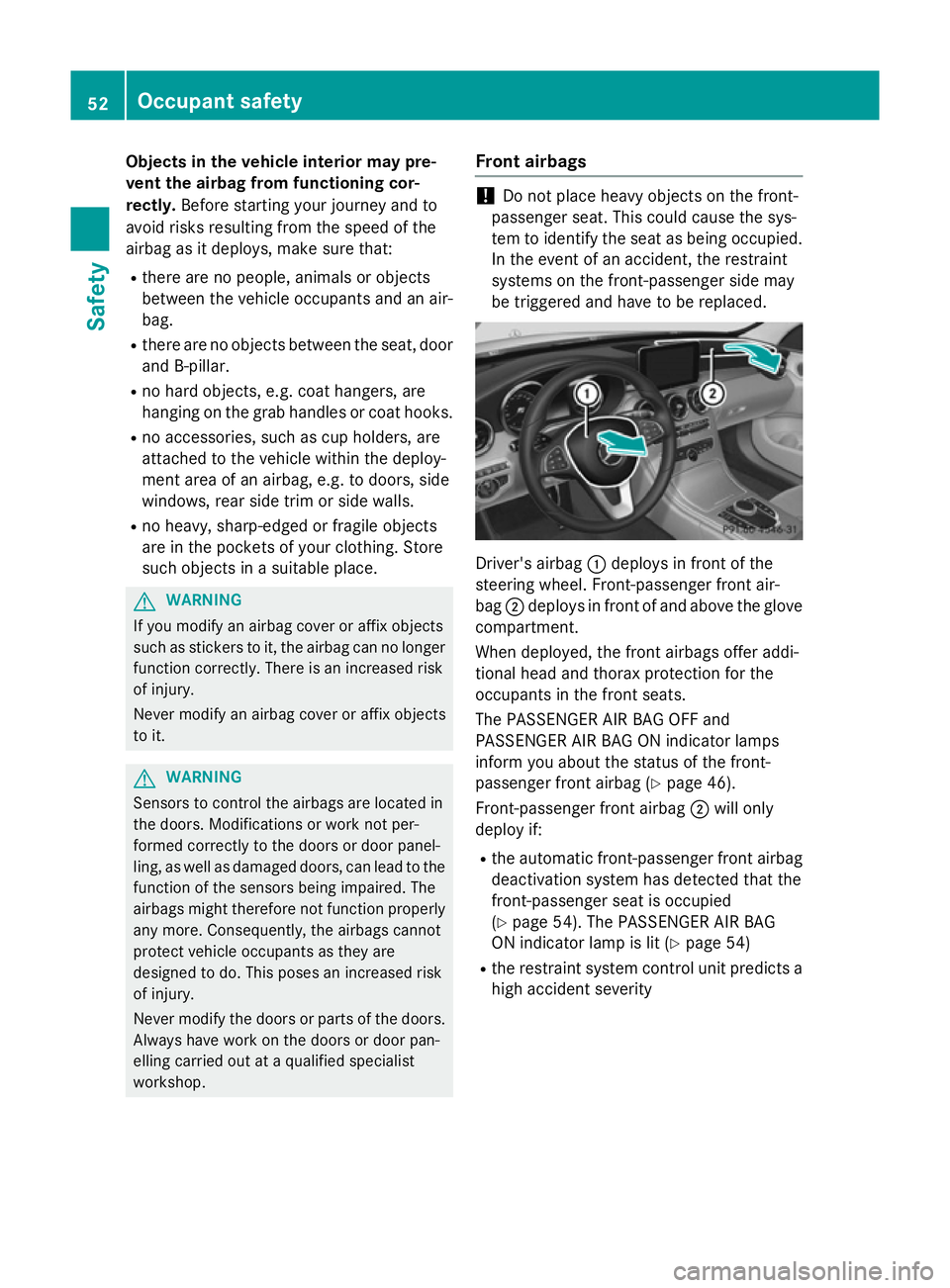
be triggered and have to be replaced. Driver's airbag
:deploys in front of the
steering wheel. Front-passenger front air-
bag ;deploys in front of and above the glove
compartment.
When deployed, the front airbags offer addi-
tional head and thorax protection for the
occupants in the front seats.
The PASSENGER AIR BAG OFF and
PASSENGER AIR BAG ON indicator lamps
inform you about the status of the front-
passenger front airbag (Y page 46).
Front-passenger front airbag ;will only
deploy if:
R the automatic front-passenger front airbag
deactivation system has detected that the
front-passenger seat is occupied
(Y page 54). The PASSENGER AIR BAG
ON indicator lamp is lit (Y page 54)
R the restraint system control unit predicts a
high accident severity 52
Occupant safetySafety
Page 56 of 489
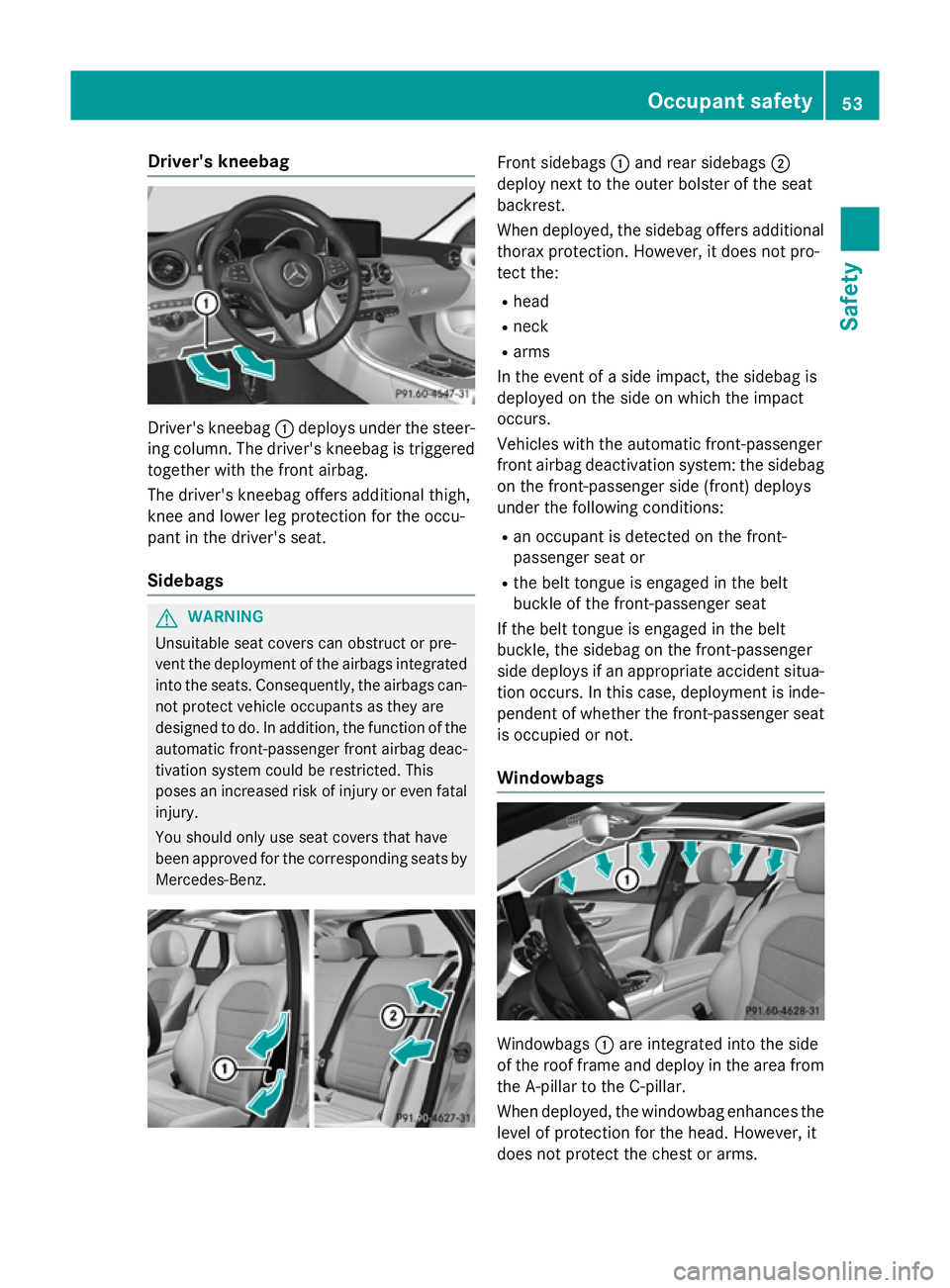
Driver's kneebag
Driver's kneebag
:deploys under the steer-
ing column. The driver's kneebag is triggered
together with the front airbag.
The driver's kneebag offers additional thigh,
knee and lower leg protection for the occu-
pant in the driver's seat.
Sidebags G
WARNING
Unsuitable seat covers can obstruct or pre-
vent the deployment of the airbags integrated into the seats. Consequently, the airbags can-
not protect vehicle occupants as they are
designed to do. In addition, the function of the automatic front-passenger front airbag deac-
tivation system could be restricted. This
poses an increased risk of injury or even fatal
injury.
You should only use seat covers that have
been approved for the corresponding seats by Mercedes-Benz. Front sidebags
:and rear sidebags ;
deploy next to the outer bolster of the seat
backrest.
When deployed, the sidebag offers additional thorax protection. However, it does not pro-
tect the:
R head
R neck
R arms
In the event of a side impact, the sidebag is
deployed on the side on which the impact
occurs.
Vehicles with the automatic front-passenger
front airbag deactivation system: the sidebag on the front-passenger side (front) deploys
under the following conditions:
R an occupant is detected on the front-
passenger seat or
R the belt tongue is engaged in the belt
buckle of the front-passenger seat
If the belt tongue is engaged in the belt
buckle, the sidebag on the front-passenger
side deploys if an appropriate accident situa- tion occurs. In this case, deployment is inde- pendent of whether the front-passenger seatis occupied or not.
Windowbags Windowbags
:are integrated into the side
of the roof frame and deploy in the area from the A-pillar to the C-pillar.
When deployed, the windowbag enhances the
level of protection for the head. However, it
does not protect the chest or arms. Occupant safety
53Safety Z