heating MERCEDES-BENZ C-CLASS SALOON 2007 User Guide
[x] Cancel search | Manufacturer: MERCEDES-BENZ, Model Year: 2007, Model line: C-CLASS SALOON, Model: MERCEDES-BENZ C-CLASS SALOON 2007Pages: 377, PDF Size: 6.19 MB
Page 170 of 377
Thermotronic*
16
7 Function Recommendation/information
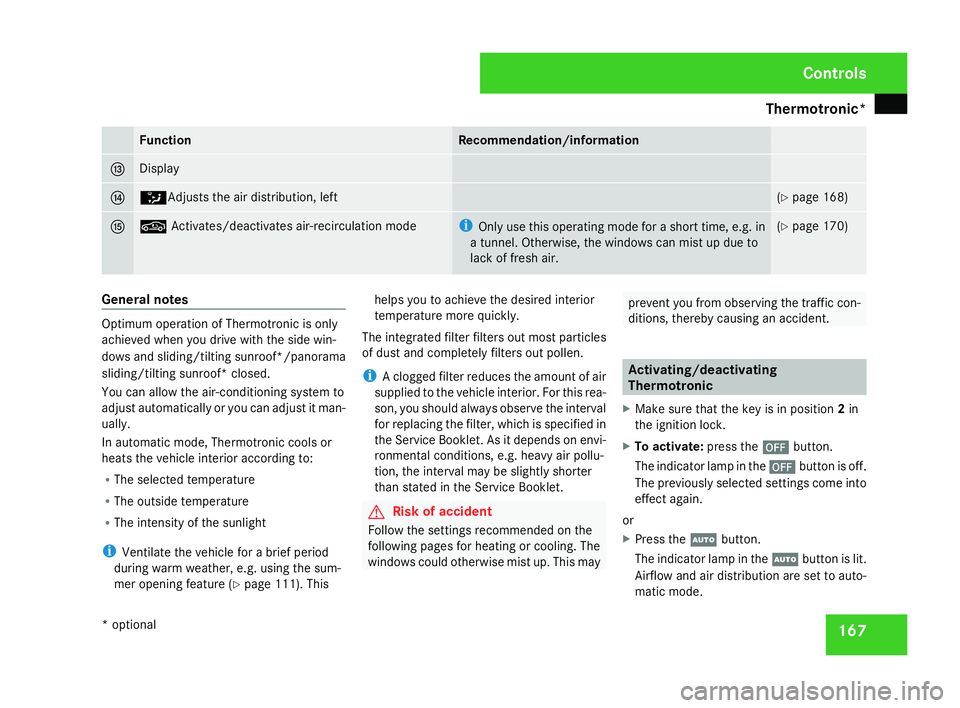
d Display
e Z
Adjusts the air distribution, left (
Y page 168 ) f ,
Activates/deactivates air-recirculation mod e i
Only use this operating mode for a short time, e.g. in
a tunnel. Otherwise, the windows can mist up due to
lack of fresh air. (
Y page 170 ) General notes
Optimum operation of Thermotronic is only
achieved when you drive with the side win-
dows and sliding/tilting sunroof*/panorama
sliding/tilting sunroof* closed
.
You can allow the air-conditioning system to
adjust automatically or you can adjust it man-
ually.
In automatic mode, Thermotronic cools or
heats the vehicle interior according to:
R The selected temperature
R The outside temperature
R The intensity of the sunlight
i Ventilate the vehicle for a brief period
during warm weather, e.g. using the sum-
mer opening feature (Y page 111). This helps you to achieve the desired interior
temperature more quickly.
The integrated filter filters out most particles
of dust and completely filters out pollen.
i A clogged filter reduces the amount of ai r
supplied to the vehicle interior. For this rea-
son, you should always observe the interval
for replacing the filter, which is specified in
the Service Booklet. As it depends on envi-
ronmental conditions, e.g. heavy air pollu-
tion, the interval may be slightly shorter
than stated in the Service Booklet. G
Risk of accident
Follow the settings recommended on the
following pages for heating or cooling. The
windows could otherwise mist up. This may prevent you from observing the traffic con-
ditions, thereby causing an accident. Activating/deactivatin
g
Thermotroni c
X Make sure that the key is in position 2in
the ignition lock .
X To activate :press the ´button.
The indicator lamp in the ´button is off.
The previously selected settings come int o
effect again.
or
X Press the Ubutton.
The indicator lamp in the Ubutton is lit.
Airflow and air distribution are set to auto-
matic mode. Controls
* optional
204_AKB; 2; 3, en-GB
mkalafa,
2007-06-26T23:11:51+02:00 - Seite 167
Page 174 of 377
Thermotronic*
17
1
sliding sunroof* move back into their pre-
vious position.
The indicator lamp in the ,button is off.
Air-recirculation mode is deactivated.
i If you open a side window or the sliding/
tilting sunroof* or panorama sliding sun-
roof* manually after closing using the con-
venience closing feature, it will remain in
this position when opened using the con-
venience opening feature. Residual heat/auxiliary ventilation
It is possible to make use of the residual heat
of the engine to continue heating the station-
ary vehicle for up to 30 minutes after the
engine has been switched off. The heating
time depends on the coolant temperature and
on the interior temperature that has been set.
i If you activate residual heat at high tem-
peratures, only the ventilation is activated.
i The blower will run at a low speed regard-
less of the airflow setting.
X Make sure the key is in position 0in the
ignition lock or that it has been removed. X
To activate :press the Tbutton.
The indicator lamp in the Tbutton is lit.
The REST display message in the display is
lit.
X To deactivate: press theTbutton.
The indicator lamp in the Tbutton is off.
The REST display message in the display is
not lit.
i The residual heat/auxiliary ventilation is
automatically deactivated after about 30
minutes, or when:
R the ignition is switched on
R the battery voltage drops
R the coolant temperature is too lo w Cooling with air-dehumidification
G
Risk of accident
If you deactivate the cooling function with
air dehumidification, the vehicle will not be
cooled in warm weather and the air will not
be dehumidified. The windows could mis t
up more quickly. This may prevent you from
observing the traffic conditions, thereby
causing an accident. H
Environmental not
e
The cooling system uses the refrigerant
R134A. This refrigerant does not damage
the earth's ozone layer.
i Condensation may drip from the under-
side of the vehicle when Thermatic is in
cooling mode.
Cooling with dehumidification is operational
when the engine is running, and cools accord -
ing to the interior temperature selected. The
air inside the vehicle is also dried, thereby
preventing the windows from misting up.
X To activate :press the œbutton.
The indicator lamp in the œbutton is lit.
The cooling with dehumidification function
is activated. Controls
* optional
204_AKB; 2; 3, en-GB
mkalafa,
2007-06-26T23:11:51+02:00 - Seite 171 Z
Page 176 of 377
Sliding sunroof
173Rear window heating
G
Risk of accident
Clear all windows of ice or snow before set-
ting off. Impaired visibility could otherwise
endanger yourself and others.
i The rear window heating has a high cur-
rent draw. Therefore, switch it off as soon
as the rear window is free of snow and ice,
as it only switches itself off automatically
after between fifteen and thirty minutes.
i If the battery voltage is too low, the rear
window heating may switch off.
X Make sure that the key is in position 2in
the ignition lock .
X To switch on/off :press the ¯button.
The indicator lamp in the ¯switch is lit
or off. Sliding sunroof
Sliding/tilting sunroof*
G
Risk of injury
Never leave children unsupervised in the
vehicle. They could operate the sliding/tilt-
ing sunroof and injure themselves. Alway s
take the key with you when leaving the
vehicle, even if you only leave it for a short
time. G
Risk of injury
Make sure that nobody can become trap -
ped when you are opening and closing the
sliding/tilting sunroof. If danger threatens,
release the switch and push it briefly in any
direction to stop the sliding/tilting sunroof . G
Risk of injury
The glass in the sliding/tilting sunroof
could break in an accident. If you are not
wearing a seat belt, there is a risk that yo u
could be thrown through the opening in the
event of the vehicle overturning. Therefore,
always wear a seat belt to reduce the ris k
of injuries. !
Only open the sliding/tilting sunroof if it
is free of snow and ice. Otherwise, mal-
functions may occur.
Do not allow anything to protrude from the
sliding/tilting sunroof. The seals could oth-
erwise be damaged.
i Resonance noises can occur in addition
to the usual airflow noises when the slid -
ing/tilting sunroof is open. They are caused
by minor pressure fluctuations in the vehi-
cle interior .
Change the position of the sliding/tilting
sunroof or open a side window slightly to
reduce or eliminate these noises .
i It is also possible to open and close the
sliding/tilting sunroof from the outsid e
using the "Summer opening" (Y page 111 )
and "Convenience closing" (Y page 112 )
features respectively .
i If PRE-SAFE ®
has been activated, the slid-
ing/tilting sunroof closes automatically ,
leaving a small gap open . Cont
rols
* optional
204_AKB; 2; 3, en-GB
mkalafa,
2007-06-26T23:11:51+02:00 - Seite 173
Page 201 of 377
Features
198
X
Press in cigarette lighter 2.
Cigarette lighter 2will pop out automati-
cally when the heating element is red-hot .12V socket
You can use the socket for accessories up to
a maximum of 180 W.
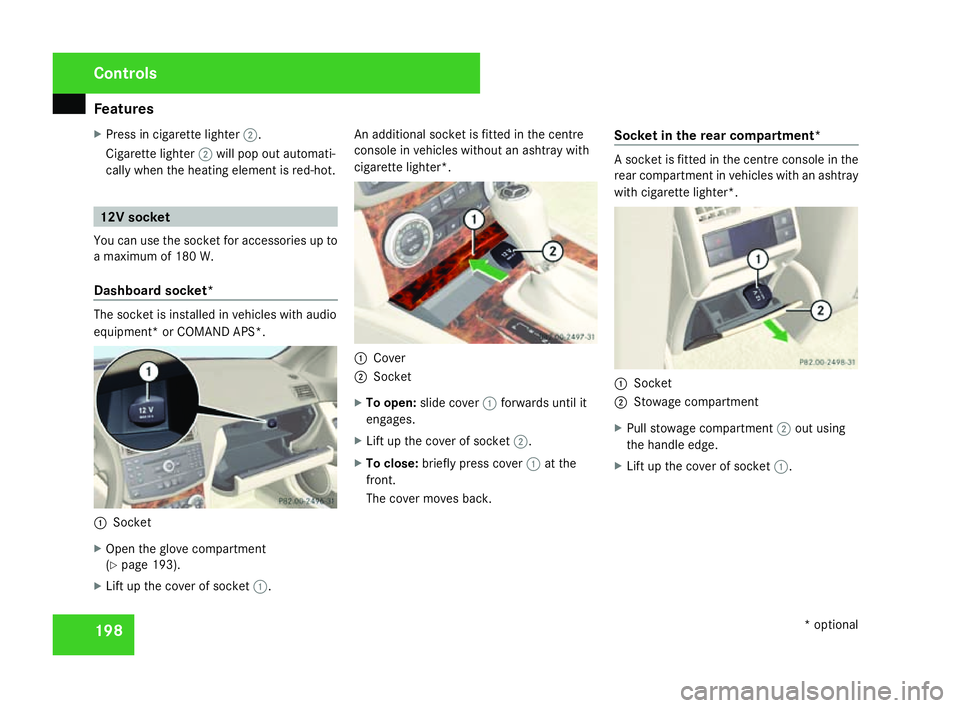
Dashboard socket* The socket is installed in vehicles with audio
equipment* or COMAND APS*.
1
Socket
X Open the glove compartment
(Y page 193).
X Lift up the cover of socket 1. An additional socket is fitted in the centre
console in vehicles without an ashtray with
cigarette lighter*.
1
Cove r
2 Socket
X To open: slide cover 1forwards until it
engages.
X Lift up the cover of socket 2.
X To close: briefly press cover 1at th e
front.
The cover moves back. Socket in the rear compartment* A socket is fitted in the centre console in the
rear compartment in vehicles with an ashtra
y
with cigarette lighter* . 1
Socket
2 Stowage compartment
X Pull stowage compartment 2out using
the handle edge.
X Lift up the cover of socket 1. Cont
rols
* optional
204_AKB; 2; 3, en-GB
mkalafa,
2007-06-26T23:11:51+02:00 - Seite 198
Page 208 of 377
Refuelling
20
5
X
Open the fuel filler flap.
X Turn the fuel filler cap to the left and
remove it.
X Insert the fuel filler cap into the holder
bracket on the inside of filler flap 2.
X Only fill the tank until the pump nozzle
switches off.
! Overfilling the tank could damage the fuel
system.
X Replace the fuel filler cap and turn it to th e
right. You will hear the fuel filler cap lock.
X Close the fuel filler flap.
i Vehicles with a diesel engine:
If you have run the tank completely dry, it
will be necessary to bleed the fuel system
( Y page 289). Petrol (EN 228)
! Refuel using only unleaded premium
grade petrol with a minimum octane num-
ber of 95 RON/85 MON conforming to
European standard EN 228 .
You could otherwise impair engine output
or damage the engine.
You will find further information about pet-
rol under "Technical data" in the index .
i As a temporary measure, only when the
recommended fuel is not available, yo u
may also use regular unleaded petrol,
91 RON/82.5 MON. This may reduce per-
formance and increase petrol consump-
tion. Avoid driving at full throttle.
In some countries, the available petrol qual-
ity may not be sufficient and could caus e
coking around the inlet valve. In thes e
cases, and in consultation with a
Mercedes-Benz Service Centre, the petrol
may be mixed with the additive recommen-
ded by Mercedes-Benz (part no.
A000989254510). You must observe the
notes and mixing ratios given on the con -
tainer. Diesel (EN 590)
! Only use diesel that complies with the
EN 590 European standard.
You could otherwise impair engine outpu t
or damage the engine.
You will find further information about die-
sel under "Technical data" in the index.
! When refuelling vehicles with a diesel par-
ticle filter in countries outside the EU, only
low-sulphur Euro diesel with less than
0.005 percent sulphur content by weight
should be used. In countries in which diesel
with a higher sulphur content is available
(e.g. 0.035 percent by weight), the engine
oil should be renewed at more frequent
intervals. More information about intervals
for changing the engine oil can be obtained
from any Mercedes-Benz Service Centre.
! Using fuel that does not comply with EN
590 can increase wear and damage the
engine and the exhaust system. Do not use
the following:
R Marine diesel
R Heating oil
R Bio-diesel Operation
204_AKB; 2; 3, en-G
B
mkalafa , 2007-06-26T23:11:51+02:00 - Seite 205 Z
Page 209 of 377
Engine compartment
206R
Vegetable oil
R Petrol
R Petroleum
R Kerosene
Do not add such fuels to diesel fuel and do
not use any special additives (exception:
flow improvers – see "Low outside temper-
atures").
Damage caused by the use of unapproved
fuels or additives is not covered by the war-
ranty.
Low outside temperatures The flow properties of diesel may be insuffi-
cient at low ambient temperatures.
To prevent operating problems, diesel fuel
with improved cold flow qualities is available
during the winter months. Your vehicle must
be refuelled with this winter diesel at temper-
atures of -5 °C or below.
You can use this winter diesel at tempera-
tures down to about -20 °C without problems.
If only summer diesel fuel or less cold-resist-
ant winter diesel fuel (e.g. in Mediterranean
regions) is available, you should add an
amount of flow improver to the fuel corre-
sponding to the outside temperature. Mix the additive with the diesel in good time,
before the flow properties of the diesel
become insufficient. Otherwise, malfunctions
can only be rectified by heating the entire fuel
system, e.g. by parking the vehicle in a heated
garage. G
Risk of fire
Do not use petrol to refuel vehicles with a
diesel engine. Never mix diesel with petrol.
This would damage the fuel system and
engine and could result in a vehicle fire.
Flow improver
The effectiveness of a flow improver is not
guaranteed with every fuel. Observe the infor -
mation provided by the manufacturer when
using a flow improver. Only use flow improv-
ers that have been tested and approved by
Mercedes-Benz. Information about flow
improvers that have been tested and
approved by Mercedes-Benz can be obtained
from any Mercedes-Benz Service Centre. Engine compartment
Bonne
t G
Risk of accident
Do not pull the release lever while the vehi-
cle is in motion. The bonnet could other-
wise open.
Opening G
Risk of injury
There is a risk of injury if the bonnet is open,
even if the engine is not running.
Some engine components can become
very hot.
To avoid the risk of burns, only touch thos e
components described in the Owner’s Man-
ual and observe the relevant safety notes. G
Risk of injury
The radiator fan between the radiator and
the engine can start automatically, even if
the key has been removed from the ignition
lock. For this reason you must not reach
into the turning area of the fan. You could
otherwise sustain an injury.
Vehicles with a petrol engine: Operatio
n
204_AKB; 2; 3, en-GB
mkalafa,
2007-06-26T23:11:51+02:00 - Seite 206
Page 221 of 377
Driving
tips 21
8
Downhill gradient
sOn long and steep downhill stretches, espe-
cially if the vehicle is laden or towing a trailer,
you must shift to a lower gear in good time or,
on vehicles with automatic transmission*,
select shift range 1,2 or 3.
i This also applies if you have activated
cruise control* or Speedtronic*.
This uses the braking effect of the engine and
you will not have to brake to such an exten t
to maintain the same speed. This relieves the
load on the brake system and prevents the
brakes from overheating and wearing too
quickly. If you need additional braking ,
depress the brake pedal repeatedly rather
than continuously.
Heavy and light loads If the brakes have been subjected to a heavy
load, do not stop the vehicle immediately, but
drive on for a short while. This allows the air-
flow to cool the brakes more quickly. G
Risk of accident
Never depress the brake pedal continu -
ously while the vehicle is in motion, e.g.
never cause the brakes to rub by applying constant slight pedal pressure. This causes
the brake system to overheat, increases
the braking distance and can lead to the
brakes failing completely.
If the brakes have been used only moderately,
you should occasionally test their effective-
ness. To do this, brake more firmly from a
higher speed. This improves the grip of the
brakes.
Wet roads If you drive for a long time in the rain without
braking, there may be a delayed reaction
when you first brake and you will have to
depress the pedal harder.
You must therefore maintain a greater dis-
tance from the vehicle in front.
Brake firmly after driving on a wet road. Thi
s
way the brake discs will become warm, dryin g
more quickly, which will protect them against
corrosion. Limited braking performance on salted
roads G
Risk of accident
The layer of salt on the brake discs and the
brake linings may cause a delay in the brak-
ing effect, resulting in a significantly longer
braking distance, which could lead to an
accident.
To avoid this danger, you should:
R occasionally brake carefully when you
are driving on salted roads, so that any
layer of salt that may have started to
build up on the brake discs and the brake
linings is removed without putting other
road users at risk.
R maintain a greater distance to the vehicl e
ahead and drive with particular car e
R carefully apply the brakes at the end of a
trip and immediately after commencing a
new trip, so that salt residues ar e
removed from the brake disc.
New brake linings For safety reasons, Mercedes-Benz recom
-
mends that you have only brake pads/linings
fitted to your vehicle that have been approved Operation
* optional
204_AKB; 2; 3, en-GB
mkalafa,
2007-06-26T23:11:51+02:00 - Seite 218
Page 226 of 377
Trailer towing*
22
3
R
has an increased braking distance
R is affected more by strong crosswinds
R demands more sensitive steering
R consumes more fue l
On long and steep downhill gradients you
must select a lower gear in good time, or on
vehicles with automatic transmission*, select
the shift range 1,2 or 3.
i This also applies if you have activated
cruise control* or Speedtronic*.
This uses the braking effect of the engine and
you will not have to brake to such an exten t
to maintain the same speed. This relieves the
load on the brake system and prevents the
brakes from overheating and wearing too
quickly. If you need additional braking ,
depress the brake pedal repeatedly rather
than continuously. G
Risk of accident
Never depress the brake pedal continu -
ously while the vehicle is in motion, e.g.
never cause the brakes to rub by applying
constant slight pedal pressure. This causes
the brake system to overheat, increases
the braking distance and can lead to the
brakes failing completely. Driving tips
R
Maintain a greater distance from the vehi-
cle in front than when driving without a
trailer.
R Avoid braking abruptly. If possible, brake
gently at first to allow the trailer to run on.
Then increase the braking force rapidly.
R The values given for gradient-climbing
capabilities from a standstill refer to sea
level. When driving in mountainous areas,
note that the power output of the engine
and with it its gradient-climbing capability
decrease with increasing altitude.
If the trailer swings from side to side:
X Do not accelerate.
X Do not counter-steer.
X Brake if necessary. G
Risk of accident
On no account should you attempt to dra w
the vehicle/trailer combination out by
increasing speed. Folding in the ball couplin
g
i Fold in the ball coupling when you are not
using the trailer tow hitch . G
Risk of injury
Make sure that no persons or animals are
in the pivoting range of the ball coupling.
Otherwise, they could be injured .
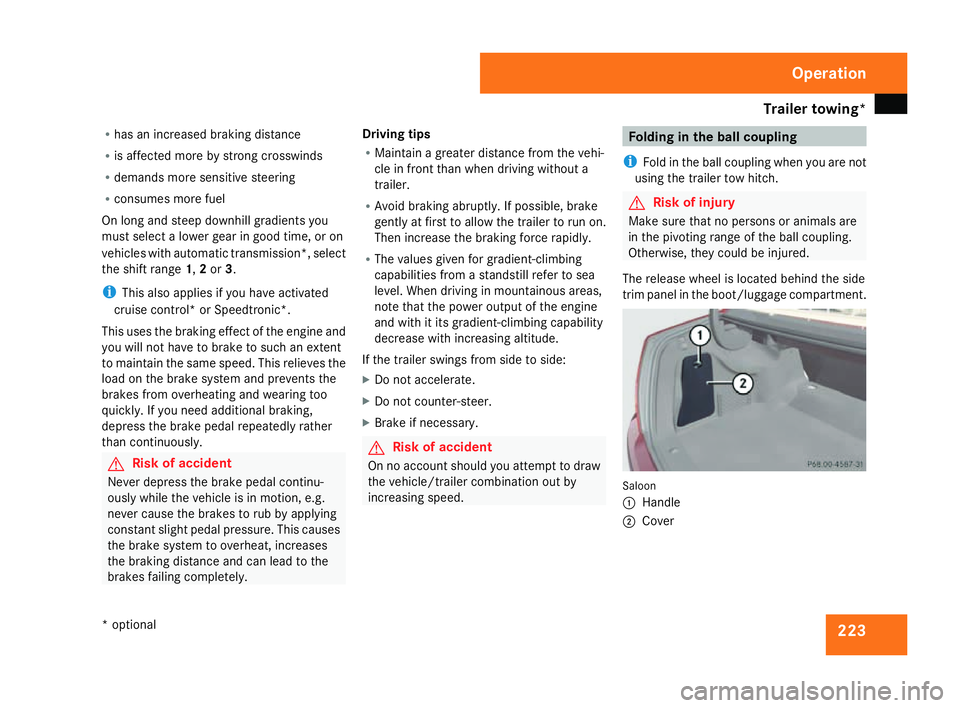
The release wheel is located behind the side
trim panel in the boot/luggage compartment. Saloon
1 Handl e
2 Cove r Operation
* optional
204_AKB; 2; 3, en-GB
mkalafa,
2007-06-26T23:11:51+02:00 - Seite 223
Page 231 of 377
Car
e 228
High-pressure cleaners G
Risk of accident
Do not use high-pressure cleaners with cir-
cular-jet nozzles (dirt grinders) to clean
your vehicle or - especially - the tyres. Yo u
could otherwise damage the tyres and
cause an accident.
! Observe the instructions issued by the
equipment manufacturer concerning the
distance to be maintained between the
nozzle of the high-pressure cleaner and the
vehicle (at least 30 cm).
Move the high-pressure cleaner nozzle
around when cleaning your vehicle .
Do not aim directly at any of the following:
R Tyres
R Door joint
R Electrical components
R Batter y
R Connectors
R Bulbs
R Seals
Damaged seals or electrical components
can lead to failures or leaks .Cleaning the wiper blades and the out
-
side of the windscreen G
Risk of injury
Turn the key to position 0in the ignition
lock before cleaning the windscreen or the
wiper blades. There is otherwise a risk of
the windscreen wipers being set in motion
and causing injury.
! Only fold the windscreen wipers away
from the windscreen when vertical, other-
wise you will damage the bonnet.
X Fold the wiper arms away from the wind-
screen until you feel them engage.
X Clean the windscreen and the wiper blades .
X Fold the windscreen wipers back agai n
before the ignition is switched on.
! Do not clean the wiper blades too often,
as otherwise the coating may come off.
This could cause wiper noise.
Cleaning the windows !
Do not use dry cloths, abrasive products,
solvents or cleaning agents containing sol-
vents to clean the inside of the windows. Clean the insides of the windows with
a
damp cloth or commercially-available glass
cleaner. Avoid touching the inside of the
rear windscreen and the side windows with
hard objects, e.g. ice scrapers or rings. You
could otherwise cause damage to the win-
dows, rear window heating or aerial on the
rear window.
i Anti-glare film retrofitted to the insides of
the windows could interfere with radio or
mobile phone reception, especially if it is
conductive or metal-coated film. Informa -
tion about anti-glare film can be obtained
from any Mercedes-Benz Service Centre.
Cleaning the headlamps X
Clean the headlamp lenses with a wet
sponge.
! Only use washer fluid which is suitable
for plastic lenses. Unsuitable washer fluid
could damage the plastic lenses of th e
headlamps.
Therefore, do not use the following:
R Dry cloths
R Abrasive cleaning agents Operatio
n
204_AKB; 2; 3, en-GB
mkalafa,
2007-06-26T23:11:51+02:00 - Seite 228
Page 244 of 377
Display
messages 24
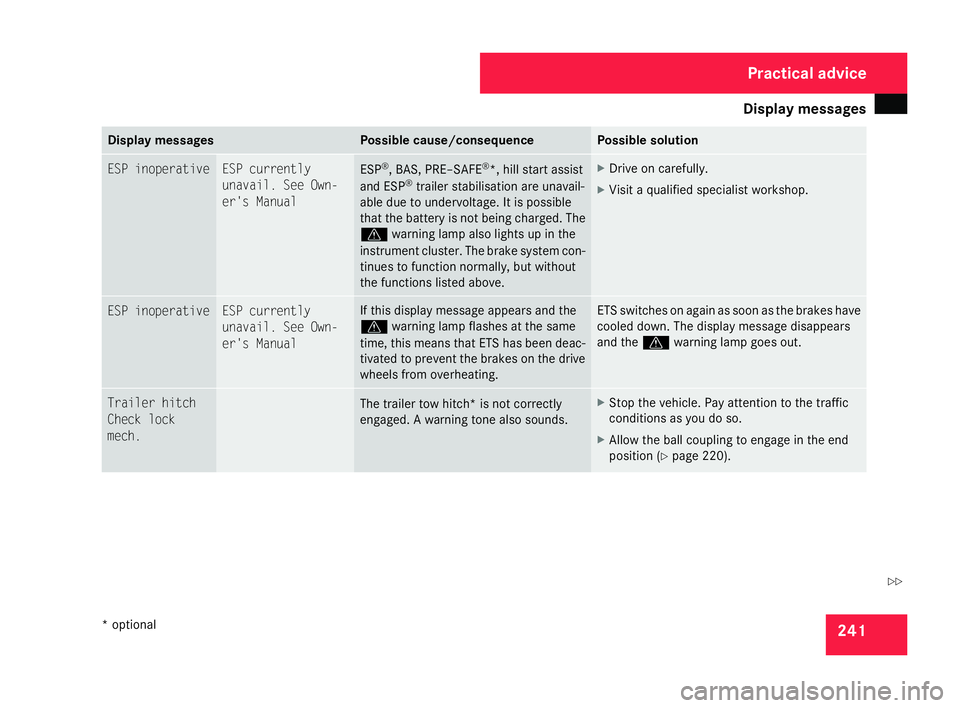
1 Display messages Possible cause/consequence Possible solution
ESP inoperative ESP currently
unavail. See Own
-
er's Manual ESP
®
, BAS, PRE–SAFE ®
*, hill start assist
and ESP ®
trailer stabilisation are unavail -
able due to undervoltage. It is possible
that the battery is not being charged. The
v warning lamp also lights up in th e
instrument cluster. The brake system con -
tinues to function normally, but without
the functions listed above . X
Drive on carefully.
X Visit a qualified specialist workshop. ESP inoperative ESP currently
unavail. See Own-
er's Manual If this display message appears and the
v
warning lamp flashes at the same
time, this means that ETS has been deac-
tivated to prevent the brakes on the driv e
wheels from overheating . ETS switches on again as soon as the brakes have
cooled down. The display message disappears
and the
vwarning lamp goes out. Trailer hitch
Check loc
k
mech. The trailer tow hitch* is not correctly
engaged. A warning tone also sounds. X
Stop the vehicle. Pay attention to the traffic
conditions as you do so.
X Allow the ball coupling to engage in the end
position (Y page 220). Practical advice
* optional
204_AKB; 2; 3, en-GB
mkalafa,
2007-06-26T23:11:51+02:00 - Seite 241 Z