lights MERCEDES-BENZ C-CLASS SALOON 2007 User Guide
[x] Cancel search | Manufacturer: MERCEDES-BENZ, Model Year: 2007, Model line: C-CLASS SALOON, Model: MERCEDES-BENZ C-CLASS SALOON 2007Pages: 377, PDF Size: 6.19 MB
Page 52 of 377
Occupant safet
y 49
ates rapidly in a longitudinal direction
during the initial stages of the collision
When the belt tensioners are triggered, you
will hear a bang, which will not cause any
harm to your hearing, and a small amount of
powder may also be released. The =warn-
ing lamp lights up. G
Risk of injury
If the seat belt tensioners have been trig -
gered, they provide no additional protec -
tion in the event of another accident.
Therefore, have belt tensioners which have
been triggered replaced at a qualified spe-
cialist workshop .
Comply with safety regulations when dis-
posing of belt tensioners. Any Mercedes-
Benz Service Centre can provide details of
these regulations.
Airbag s Airbag deployment slows down and restricts
the movement of the vehicle occupant.
When the airbags are triggered, you will hear
a bang, which will not cause any harm to your
hearing, and a small amount of powder ma y
also be released. The =warning lamp
lights up. The SRS/AIRBAG symbol indicates the loca-
tion of the airbags
. G
Risk of injury
Airbags provide additional protection; they
are not, however, a substitute for the sea t
belts.
Observe the following notes to reduce the
risk of serious or even fatal injury if an air-
bag is deployed:
R Vehicle occupants — in particular preg-
nant woman — must wear their seat belt
correctly at all times and lean back
against their backrest, which should be
positioned as close to the vertical as pos-
sible. The head restraint must support
the back of the seat occupant's head at
about eye level.
R Always secure children less tha n
1.50 mtall or under 12 years of age in
suitable child restraint systems.
R All vehicle occupants must select a sea t
position that is as far away from the air-
bag as possible. The driver's seat posi-
tion must allow the vehicle to be driven
safely. The driver's chest should be as far
away from the middle of the driver's fron t
airbag cover as possible. R
Move the front-passenger seat as far
back as possible, in particular, if a child
is secured in a child restraint system on
the seat.
R Vehicle occupants – in particular, chil-
dren – must not lean their head into the
area of the window in which the sidebag/
windowbag is deployed.
R Rearward-facing child restraint systems
must not be fitted to the front-passenger
seat unless the front-passenger front air-
bag has been disabled. On the front-
passenger seat, the front-passenger
front airbag is only deactivated if a child
restraint system with automatic child
seat recognition is fitted to the front-
passenger seat *.The 5 PASSENGER
AIRBAG OFF warning lamp must be li t
constantly .
If either the rearward-facing child
restraint system or the front-passenger
seat* of your vehicle does not have auto-
matic child seat recognition, childre n
must be secured in a child restraint sys-
tem on a suitable seat in the rear. If you
secure a forward-facing child restraint
system to the front-passenger seat, you Safety
* optiona l
204_AKB; 2; 3, en-GB
mkalafa,
2007-06-26T23:11:51+02:00 - Seite 49 Z
Page 59 of 377
Occupant safet
y561
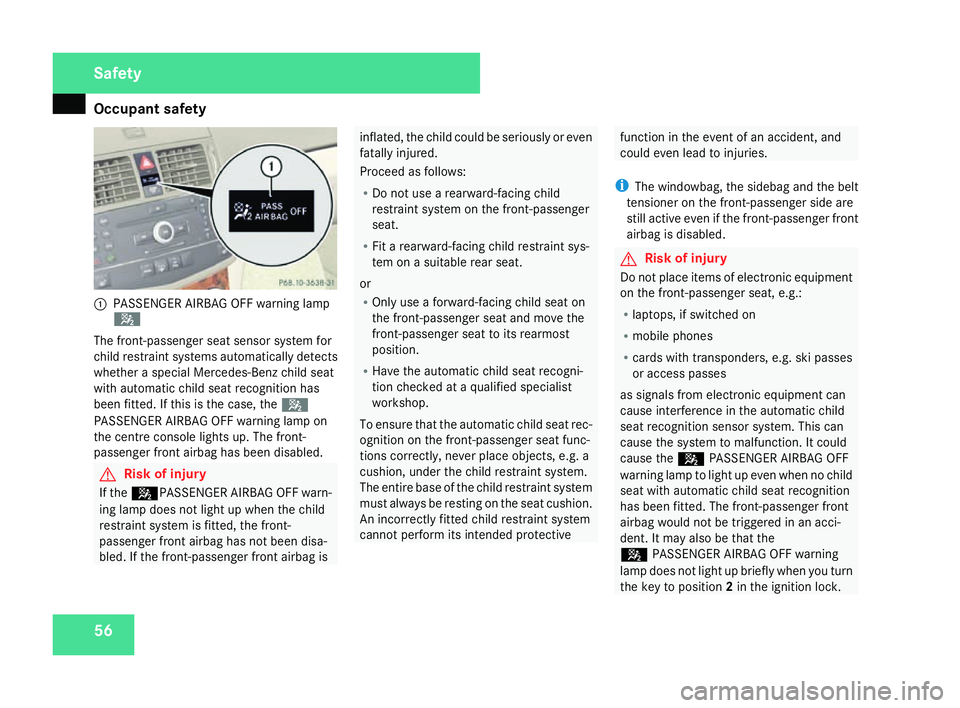
PASSENGER AIRBAG OFF warning lamp
5
The front-passenger seat sensor system for
child restraint systems automatically detect s
whether a special Mercedes-Benz child seat
with automatic child seat recognition has
been fitted. If this is the case, the 5
PASSENGER AIRBAG OFF warning lamp on
the centre console lights up. The front-
passenger front airbag has been disabled. G
Risk of injury
If the 5PASSENGER AIRBAG OFF warn-
ing lamp does not light up when the child
restraint system is fitted, the front-
passenger front airbag has not been disa-
bled. If the front-passenger front airbag is inflated, the child could be seriously or even
fatally injured.
Proceed as follows:
R
Do not use a rearward-facing child
restraint system on the front-passenge r
seat.
R Fit a rearward-facing child restraint sys-
tem on a suitable rear seat.
or
R Only use a forward-facing child seat on
the front-passenger seat and move the
front-passenger seat to its rearmost
position.
R Have the automatic child seat recogni-
tion checked at a qualified specialist
workshop .
To ensure that the automatic child seat rec-
ognition on the front-passenger seat func-
tions correctly, never place objects, e.g. a
cushion, under the child restraint system.
The entire base of the child restraint system
must always be resting on the seat cushion.
An incorrectly fitted child restraint system
cannot perform its intended protective function in the event of an accident, and
could even lead to injuries.
i The windowbag, the sidebag and the belt
tensioner on the front-passenger side are
still active even if the front-passenger front
airbag is disabled. G
Risk of injury
Do not place items of electronic equipment
on the front-passenger seat, e.g.:
R laptops, if switched on
R mobile phones
R cards with transponders, e.g. ski passe s
or access passes
as signals from electronic equipment can
cause interference in the automatic child
seat recognition sensor system. This can
cause the system to malfunction. It could
cause the 5PASSENGER AIRBAG OFF
warning lamp to light up even when no child
seat with automatic child seat recognition
has been fitted. The front-passenger front
airbag would not be triggered in an acci-
dent. It may also be that th e
5 PASSENGER AIRBAG OFF warning
lamp does not light up briefly when you turn
the key to position 2in the ignition lock .Safety
204_AKB; 2; 3, en-GB
mkalafa,
2007-06-26T23:11:51+02:00 - Seite 56
Page 70 of 377
Driving safety sys
tems 67vehicle is in motion, injuring themselves
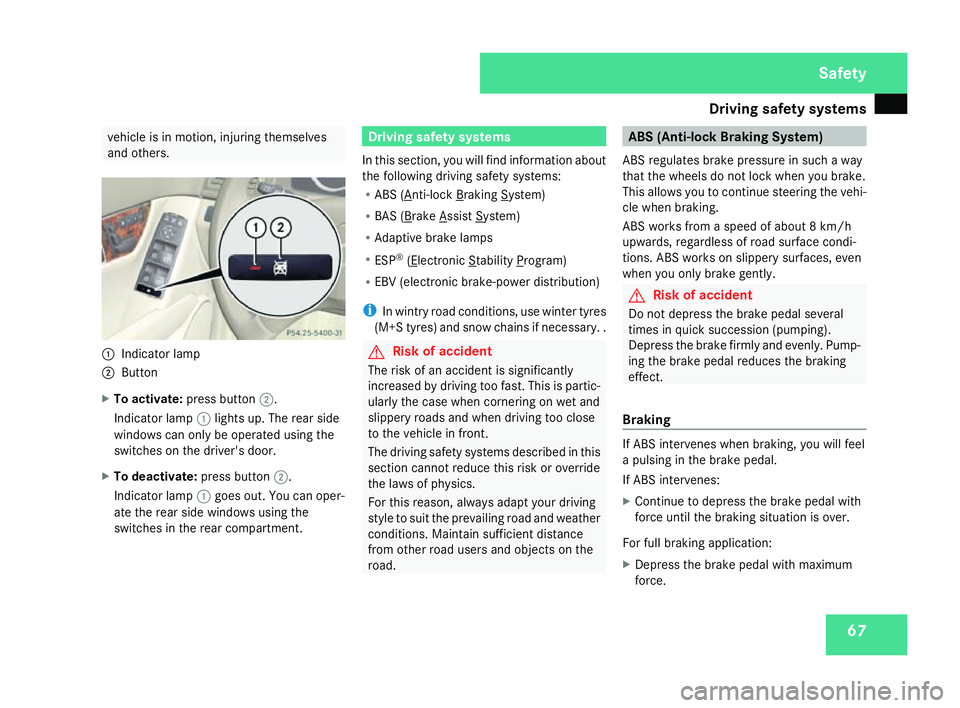
and others . 1
Indicator lamp
2 Button
X To activate :press button 2.
Indicator lamp 1lights up. The rear side
windows can only be operated using the
switches on the driver's door.
X To deactivate :press button 2.
Indicator lamp 1goes out. You can oper-
ate the rear side windows using the
switches in the rear compartment. Driving safety systems
In this section, you will find information about
the following driving safety systems:
R ABS ( Anti-lock Braking System)
R BAS ( Brake Assist System)
R Adaptive brake lamps
R ESP ®
( Electronic Stability Program)
R EBV (electronic brake-power distribution)
i In wintry road conditions, use winter tyres
(M+S tyres) and snow chains if necessary. . G
Risk of accident
The risk of an accident is significantl y
increased by driving too fast. This is partic-
ularly the case when cornering on wet and
slippery roads and when driving too clos e
to the vehicle in front.
The driving safety systems described in thi s
section cannot reduce this risk or override
the laws of physics.
For this reason, always adapt your driving
style to suit the prevailing road and weather
conditions. Maintain sufficient distance
from other road users and objects on the
road. ABS (Anti-lock Braking System)
ABS regulates brake pressure in such a way
that the wheels do not lock when you brake.
This allows you to continue steering the vehi-
cle when braking.
ABS works from a speed of about 8 km/h
upwards, regardless of road surface condi-
tions. ABS works on slippery surfaces, even
when you only brake gently. G
Risk of accident
Do not depress the brake pedal severa l
times in quick succession (pumping) .
Depress the brake firmly and evenly. Pump-
ing the brake pedal reduces the braking
effect.
Braking If ABS intervenes when braking, you will fee
l
a pulsing in the brake pedal.
If ABS intervenes:
X Continue to depress the brake pedal wit h
force until the braking situation is over.
For full braking application:
X Depress the brake pedal with maximum
force. Safety
204_AKB; 2; 3, en-G
B
mkalafa , 2007-06-26T23:11:51+02:00 - Seite 67
Page 73 of 377
Anti-theft syste
ms70
i
If ESP ®
is deactivated and one or mor e
wheels start to spin, the vwarning lamp
in the instrument cluster flashes. ES P®
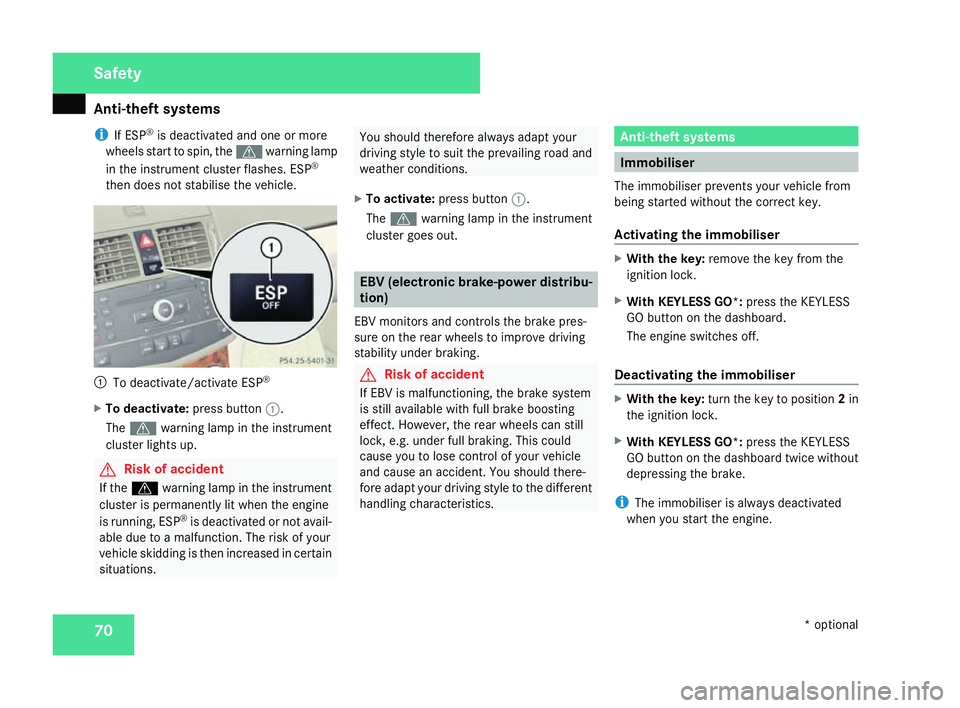
then does not stabilise the vehicle. 1
To deactivate/activate ESP ®
X To deactivate :press button 1.
The v warning lamp in the instrumen t
cluster lights up . G
Risk of accident
If the v warning lamp in the instrumen t
cluster is permanently lit when the engine
is running, ESP ®
is deactivated or not avail-
able due to a malfunction. The risk of your
vehicle skidding is then increased in certain
situations. You should therefore always adapt your
driving style to suit the prevailing road and
weather conditions.
X To activate :press button 1.
The v warning lamp in the instrumen t
cluster goes out. EBV (electronic brake-power distribu-
tion)
EBV monitors and controls the brake pres-
sure on the rear wheels to improve driving
stability under braking. G
Risk of accident
If EBV is malfunctioning, the brake system
is still available with full brake boosting
effect. However, the rear wheels can stil l
lock, e.g. under full braking. This could
cause you to lose control of your vehicle
and cause an accident. You should there-
fore adapt your driving style to the differen t
handling characteristics. Anti-theft systems
Immobiliser
The immobiliser prevents your vehicle from
being started without the correct key.
Activating the immobiliser X
With the key: remove the key from the
ignition lock.
X With KEYLESS GO*: press the KEYLESS
GO button on the dashboard.
The engine switches off.
Deactivating the immobiliser X
With the key: turn the key to position 2in
the ignition lock .
X With KEYLESS GO*: press the KEYLESS
GO button on the dashboard twice without
depressing the brake.
i The immobiliser is always deactivated
when you start the engine. Safety
* optional
204_AKB; 2; 3, en-GB
mkalafa,
2007-06-26T23:11:51+02:00 - Seite 70
Page 75 of 377
Anti-theft syste
ms72
Deactivate tow-away protection manually if
your vehicle:
R is being transported
R is being loaded, e.g. onto a ferry or car
transporter
R is being parked on a movable surface, e.g.
split-level garages
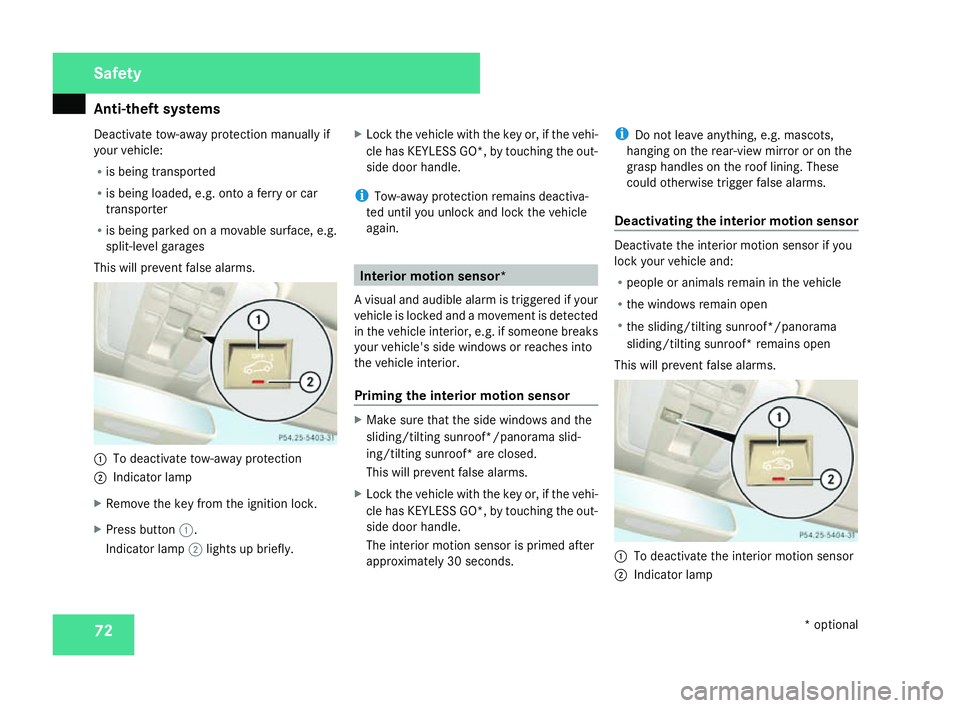
This will prevent false alarms. 1
To deactivate tow-away protection
2 Indicator lamp
X Remove the key from the ignition lock.
X Press button 1.
Indicator lamp 2lights up briefly. X
Lock the vehicle with the key or, if the vehi-
cle has KEYLESS GO*, by touching the out-
side door handle .
i Tow-away protection remains deactiva-
ted until you unlock and lock the vehicle
again. Interior motion sensor*
A visual and audible alarm is triggered if your
vehicle is locked and a movement is detected
in the vehicle interior, e.g. if someone breaks
your vehicle's side windows or reaches into
the vehicle interior.
Priming the interior motion sensor X
Make sure that the side windows and the
sliding/tilting sunroof*/panorama slid-
ing/tilting sunroof* are closed.
This will prevent false alarms.
X Lock the vehicle with the key or, if the vehi-
cle has KEYLESS GO*, by touching the out-
side door handle .
The interior motion sensor is primed after
approximately 30 seconds. i
Do not leave anything, e.g. mascots,
hanging on the rear-view mirror or on the
grasp handles on the roof lining. Thes e
could otherwise trigger false alarms.
Deactivating the interior motion senso r Deactivate the interior motion sensor if yo
u
lock your vehicle and:
R people or animals remain in the vehicle
R the windows remain open
R the sliding/tilting sunroof*/panorama
sliding/tilting sunroof* remains open
This will prevent false alarms. 1
To deactivate the interior motion sensor
2 Indicator lamp Safety
* optional
204_AKB; 2; 3, en-GB
mkalafa
, 2007-06-26T23:11:51+02:00 - Seite 72
Page 78 of 377
75
Opening and closing
...........................76
Key positions ...................................... .85
Seats .................................................... 86
Steering wheel .................................... 92
Mirrors ................................................. 93
Memory functions* .............................96
Seat belts ............................................ .98
Lights ................................................. 102
Windscreen wipers ...........................108
Side windows .................................... 110
Driving and parking ..........................113
Transmission ..................................... 117Instrument cluster
............................123
On-board computer (vehicles with
multi-function steering wheel, 4
buttons) ............................................. 125
On-board computer (vehicles with
the luxury multi-function steering
wheel*, 12 buttons) ..........................129
Driving systems ................................ 145
Air vents ............................................ 156
Thermatic .......................................... 158
Thermotronic* ................................... 165
Rear window heating ........................173
Sliding sunroof .................................. 173
Loading and stowing ........................179
Features ............................................. 195 Controls
204_AKB; 2; 3, en-GB
mkalafa,
2007-06-26T23:11:51+02:00 - Seite 75
Page 97 of 377
Mirrors
94 Exterior mirrors
G
Risk of accident
The exterior mirrors reduce the size of the
image. Objects are actually closer than
they appear. You could misjudge the dis-
tance from vehicles driving behind and
cause an accident, e.g. when changing
lane. For this reason, make sure of the
actual distance from the vehicle driving
behind by glancing over your shoulder .
The convex exterior mirrors give a larger field
of vision.
At low outside temperatures, the exterior mir-
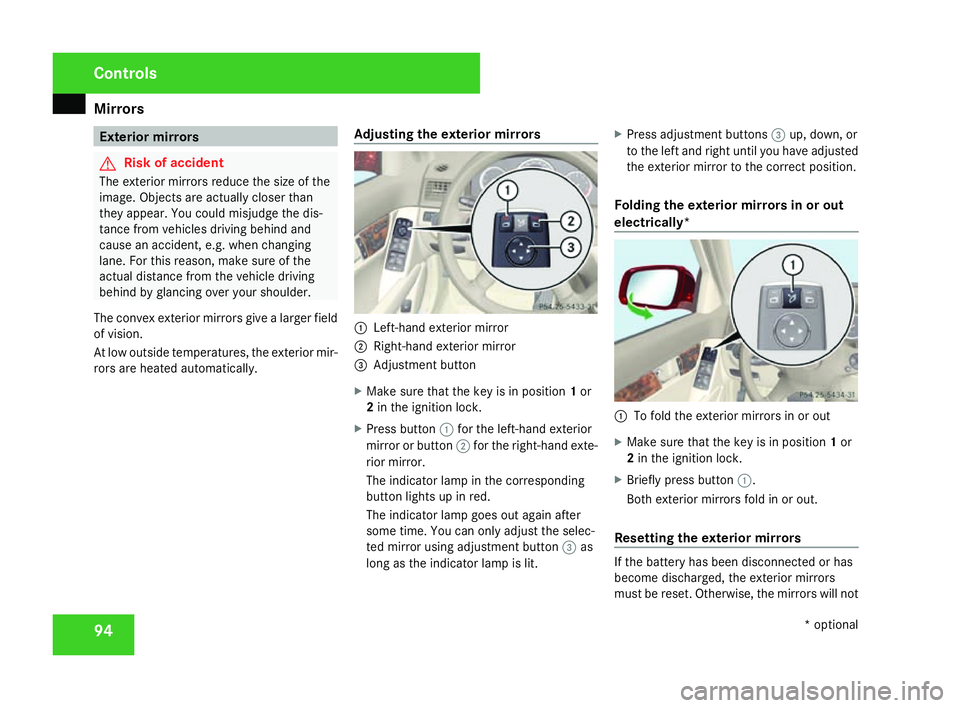
rors are heated automatically. Adjusting the exterior mirrors 1
Left-hand exterior mirror
2 Right-hand exterior mirror
3 Adjustment button
X Make sure that the key is in position 1or
2 in the ignition lock .
X Press button 1for the left-hand exterior
mirror or button 2for the right-hand exte-
rior mirror.
The indicator lamp in the corresponding
button lights up in red.
The indicator lamp goes out again after
some time. You can only adjust the selec-
ted mirror using adjustment button 3as
long as the indicator lamp is lit .X
Press adjustment buttons 3up, down, or
to the left and right until you have adjusted
the exterior mirror to the correct position .
Folding the exterior mirrors in or out
electrically * 1
To fold the exterior mirrors in or out
X Make sure that the key is in position 1or
2 in the ignition lock .
X Briefly press button 1.
Both exterior mirrors fold in or out.
Resetting the exterior mirrors If the battery has been disconnected or ha
s
become discharged, the exterior mirror s
must be reset. Otherwise, the mirrors will not Controls
* optional
204_AKB; 2; 3, en-GB
mkalafa,
2007-06-26T23:11:51+02:00 - Seite 94
Page 99 of 377
Memory functions*
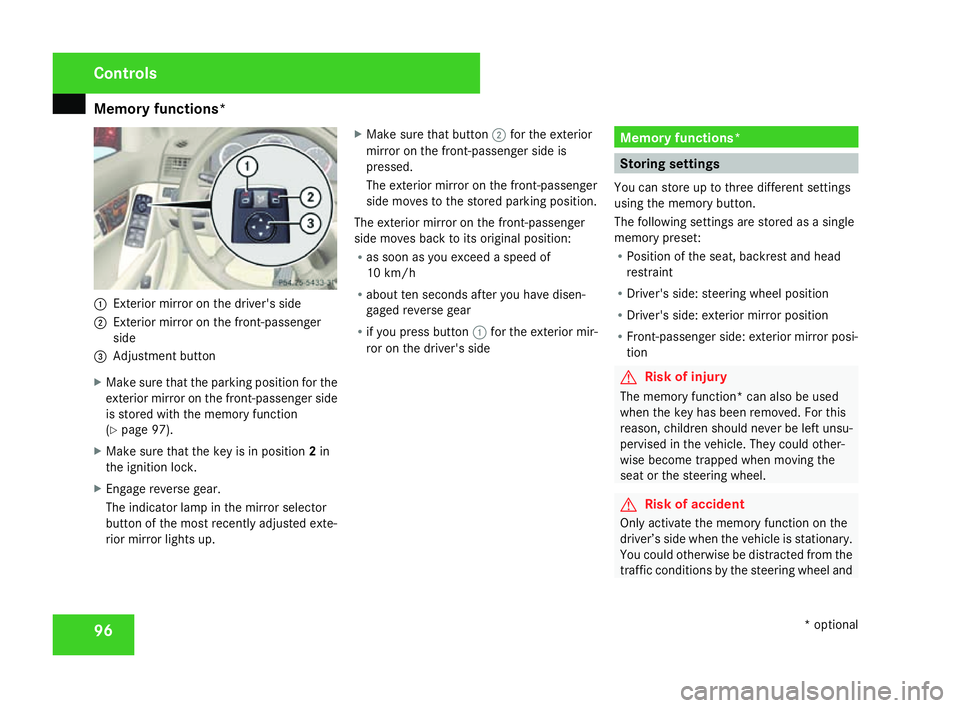
961
Exterior mirror on the driver's side
2 Exterior mirror on the front-passenge r
side
3 Adjustment button
X Make sure that the parking position for the
exterior mirror on the front-passenger side
is stored with the memory function
( Y page 97).
X Make sure that the key is in position 2in
the ignition lock .
X Engage reverse gear .
The indicator lamp in the mirror selector
button of the most recently adjusted exte-
rior mirror lights up. X
Make sure that button 2for the exterior
mirror on the front-passenger side is
pressed.
The exterior mirror on the front-passenger
side moves to the stored parking position.
The exterior mirror on the front-passenger
side moves back to its original position:
R as soon as you exceed a speed of
10 km/h
R about ten seconds after you have disen -
gaged reverse gear
R if you press button 1for the exterior mir-
ror on the driver's side Memory functions
* Storing settings
You can store up to three different settings
using the memory button.
The following settings are stored as a single
memory preset:
R Position of the seat, backrest and head
restraint
R Driver's side: steering wheel positio n
R Driver's side: exterior mirror positio n
R Front-passenger side: exterior mirror posi-
tion G
Risk of injury
The memory function* can also be used
when the key has been removed. For this
reason, children should never be left unsu-
pervised in the vehicle. They could other-
wise become trapped when moving the
seat or the steering wheel . G
Risk of accident
Only activate the memory function on the
driver’s side when the vehicle is stationary.
You could otherwise be distracted from the
traffic conditions by the steering wheel and Control
s
* optional
204_AKB; 2; 3, en-GB
mkalafa,
2007-06-26T23:11:51+02:00 - Seite 96
Page 103 of 377
Seat belts
100
X
Click belt tongue 2into buckle3 .
X If necessary, adjust the belt to the appro-
priate height (Y page 100).
X If necessary, pull upwards on the shoulder
section of the belt to tighten the belt across
your body.
Routing the belt X
Press release button 4and guide belt
tongue 2back towards belt sash guide
1 . Belt warning for driver and fron
t
passenge r
The < seat belt warning lamp in the instru-
ment cluster reminds you that all occupants
should fasten their seat belts. The
or it may flash. Additionally there may be a
warning tone.
The < seat belt warning lamp goes out and
the warning tone ceases when the driver and
the front passenger have fastened their seat
belt.
For certain countries only: independent of
whether the driver or the front passenger are already secured, the
has been started. The
front passenger have fastened their seat belt.
i Further information about the
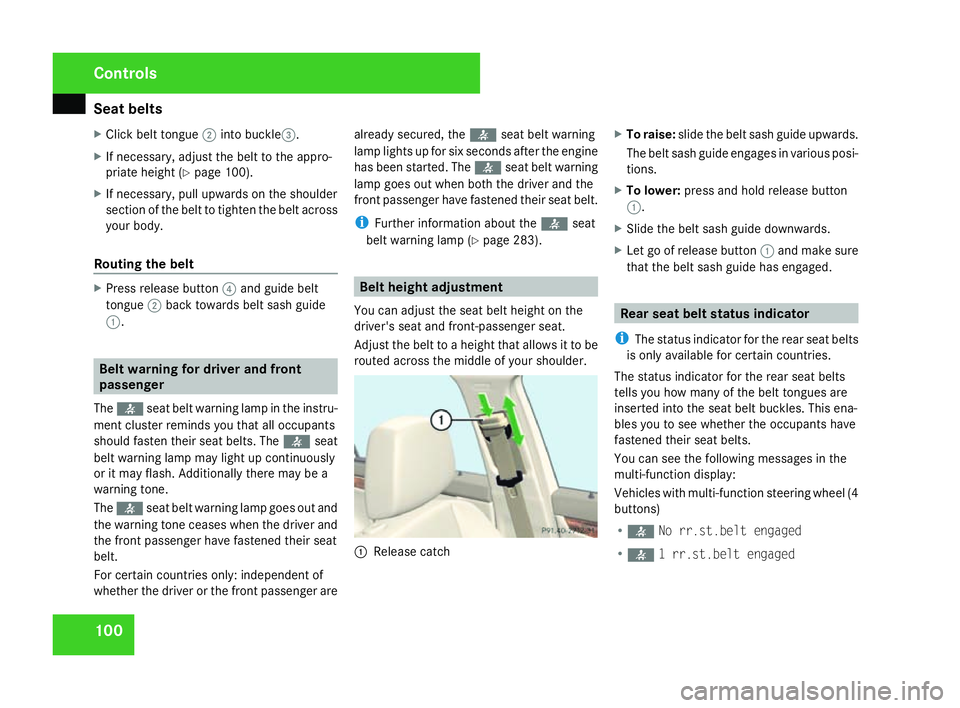
You can adjust the seat belt height on the
driver's seat and front-passenger seat.
Adjust the belt to a height that allows it to be
routed across the middle of your shoulder. 1
Release catch X
To raise: slide the belt sash guide upwards .
The belt sash guide engages in various posi-
tions.
X To lower: press and hold release button
1 .
X Slide the belt sash guide downwards .
X Let go of release button 1and make sure
that the belt sash guide has engaged . Rear seat belt status indicator
i The status indicator for the rear seat belts
is only available for certain countries.
The status indicator for the rear seat belts
tells you how many of the belt tongues are
inserted into the seat belt buckles. This ena-
bles you to see whether the occupants have
fastened their seat belts.
You can see the following messages in the
multi-function display :
Vehicles with multi-function steering wheel (4
buttons)
R < No rr.st.belt engaged
R < 1 rr.st.belt engaged Controls
204_AKB; 2; 3, en-GB
mkalafa,
2007-06-26T23:11:51+02:00 - Seite 100
Page 105 of 377
Light
s 102It should:
R
fit snugly across your body
R be routed across the middle of your
shoulder
R routed in your pelvic area across the hip
joints Lights
Light switch
For reasons of safety, Mercedes-Benz recom-
mends that you drive with the lights switched
on even during the daytime. In some coun-
tries, daytime use of headlamps varies due to
legal requirements and self-imposed obliga-
tions. In these countries, dipped-beam head-
lamps are switched on when the ignition is
switched on.
Vehicles with a luxury multi-function steering
wheel*: you can use the on-board computer
to change this setting in countries where day-
time driving lights are not legally required; se e
the section on daytime driving lights
( Y page 140).
i If you drive in countries in which traffic
drives on the opposite side of the road to
the country where the vehicle is registered ,
oncoming traffic may be dazzled by the
asymmetrical dipped-beam headlamps.
Have the headlamps changed to symmet-
rical dipped beam when driving in these
countries. You can obtain information
about this from any Mercedes-Benz Servic e
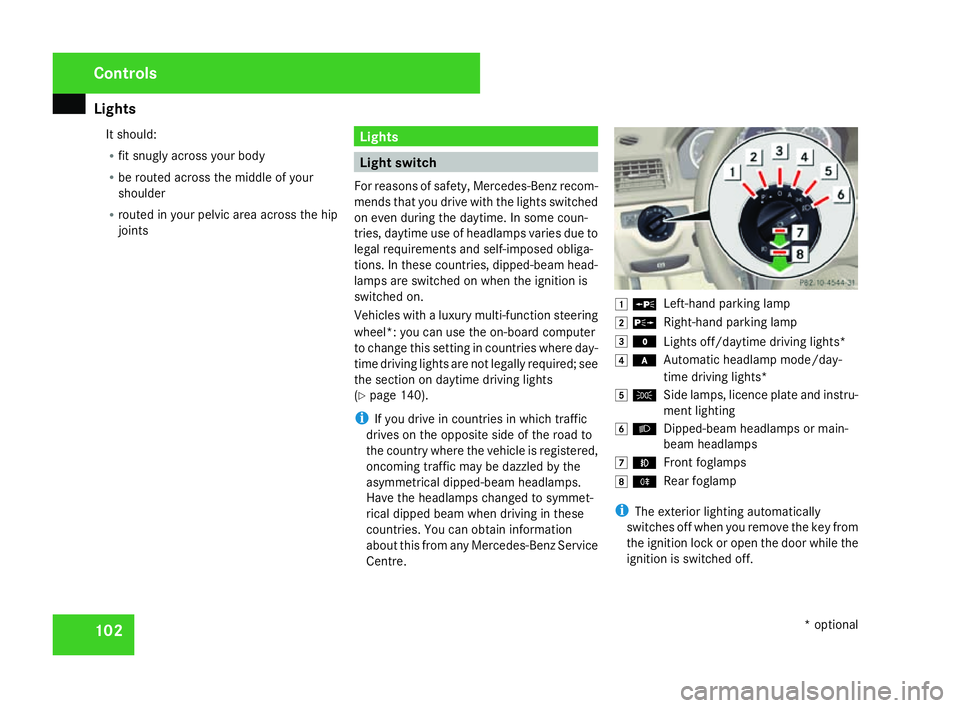
Centre. $
a
Left-hand parking lamp
% g
Right-hand parking lamp
& M
Lights off/daytime driving lights*
( *
Automatic headlamp mode/day -
time driving lights*
) C
Side lamps, licence plate and instru-
ment lighting
* B
Dipped-beam headlamps or main-
beam headlamps
, ¥
Front foglamp s
. †
Rear foglamp
i The exterior lighting automatically
switches off when you remove the key from
the ignition lock or open the door while the
ignition is switched off. Controls
* optional
204_AKB; 2; 3, en-GB
mkalafa,
2007-06-26T23:11:51+02:00 - Seite 102