warning light MERCEDES-BENZ C-CLASS SALOON 2007 Service Manual
[x] Cancel search | Manufacturer: MERCEDES-BENZ, Model Year: 2007, Model line: C-CLASS SALOON, Model: MERCEDES-BENZ C-CLASS SALOON 2007Pages: 377, PDF Size: 6.19 MB
Page 279 of 377
Troubleshooting
27
6 Troubleshooting
G
Risk of accident and injury
Always have maintenance work carried out at a qualified specialist workshop which has the necessary specialist knowledge and tools to
carry out the work required .
Mercedes-Benz recommends that you use a Mercedes-Benz Service Centre for this purpose.
In particular, work relevant to safety or on safety-related systems must be carried out at a qualified specialist workshop. The operating
safety of the vehicle can be affected if this work is carried out incorrectly. There is a risk of accident and injury. Indicator and warning lamps in switches and buttons
Problem Possible cause/consequence Suggested solutions
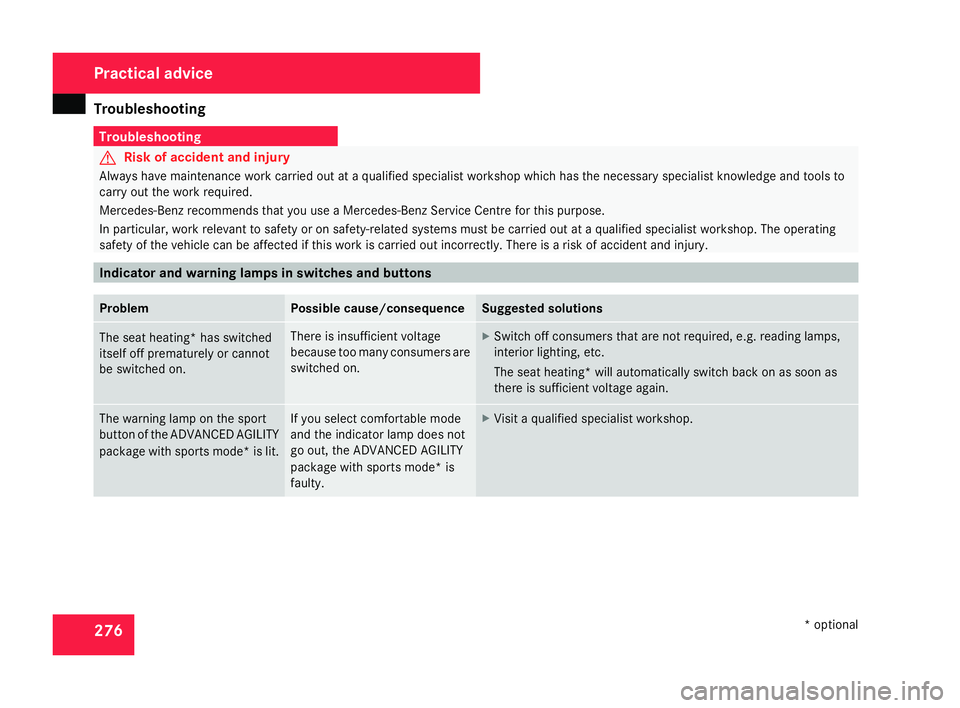
The seat heating* has switched
itself off prematurely or cannot
be switched on. There is insufficient voltage
because too many consumers are
switched on. X
Switch off consumers that are not required, e.g. reading lamps ,
interior lighting, etc .
The seat heating* will automatically switch back on as soon as
there is sufficient voltage again. The warning lamp on the sport
button of the ADVANCED AGILITY
package with sports mode* is lit. If you select comfortable mode
and the indicator lamp does not
go out, the ADVANCED AGILITY
package with sports mode* is
faulty. X
Visit a qualified specialist workshop. Practical advice
* optional
204_AKB; 2; 3, en-GB
mkalafa,
2007-06-26T23:11:51+02:00 - Seite 276
Page 282 of 377
Troubleshooting
27
9 Indicator and warning lamps in the instrument cluster
Problem Possible cause/consequence Suggested solutions
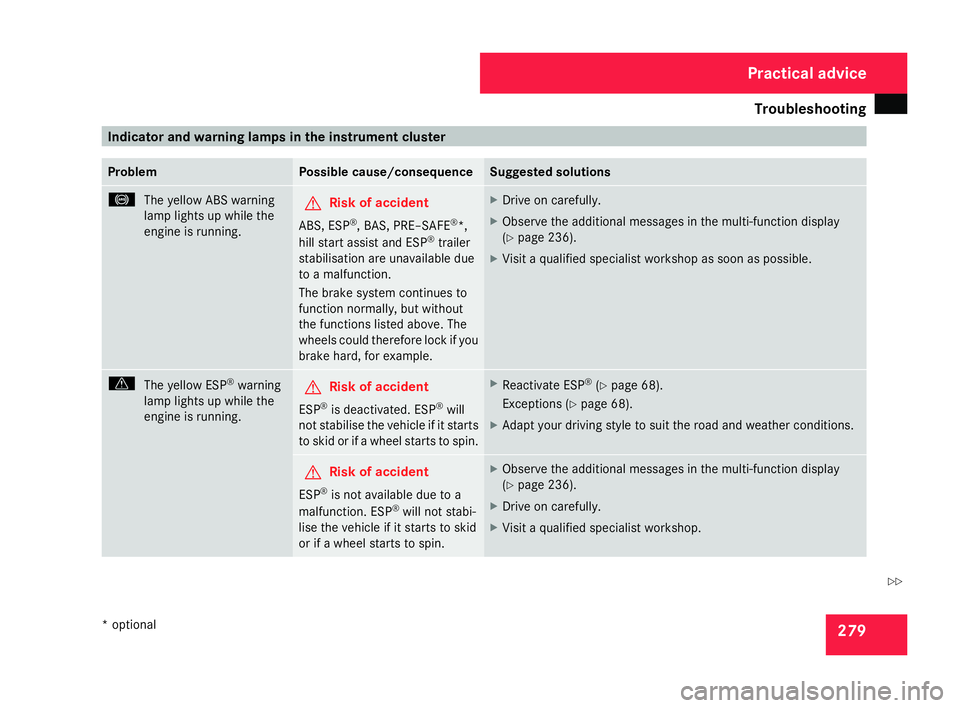
-
The yellow ABS warning
lamp lights up while the
engine is running. G
Risk of accident
ABS, ESP ®
, BAS, PRE–SAFE ®
*,
hill start assist and ESP ®
trailer
stabilisation are unavailable du e
to a malfunction.
The brake system continues to
function normally, but without
the functions listed above. Th e
wheels could therefore lock if you
brake hard, for example. X
Drive on carefully.
X Observe the additional messages in the multi-function display
(Y page 236).
X Visit a qualified specialist workshop as soon as possible. v
The yellow ESP ®
warning
lamp lights up while th e
engine is running. G
Risk of accident
ESP ®
is deactivated. ES P®
will
not stabilise the vehicle if it start s
to skid or if a wheel starts to spin. X
Reactivate ES P®
(Y page 68).
Exceptions (Y page 68).
X Adapt your driving style to suit the road and weather conditions. G
Risk of accident
ESP ®
is not available due to a
malfunction. ESP ®
will not stabi-
lise the vehicle if it starts to skid
or if a wheel starts to spin . X
Observe the additional messages in the multi-function display
(Y page 236).
X Drive on carefully.
X Visit a qualified specialist workshop. Practical advice
* optional
204_AKB; 2; 3, en-GB
mkalafa,
2007-06-26T23:11:51+02:00 - Seite 279 Z
Page 283 of 377
Troubleshooting
28
0 Problem Possible cause/consequence Suggested solutions
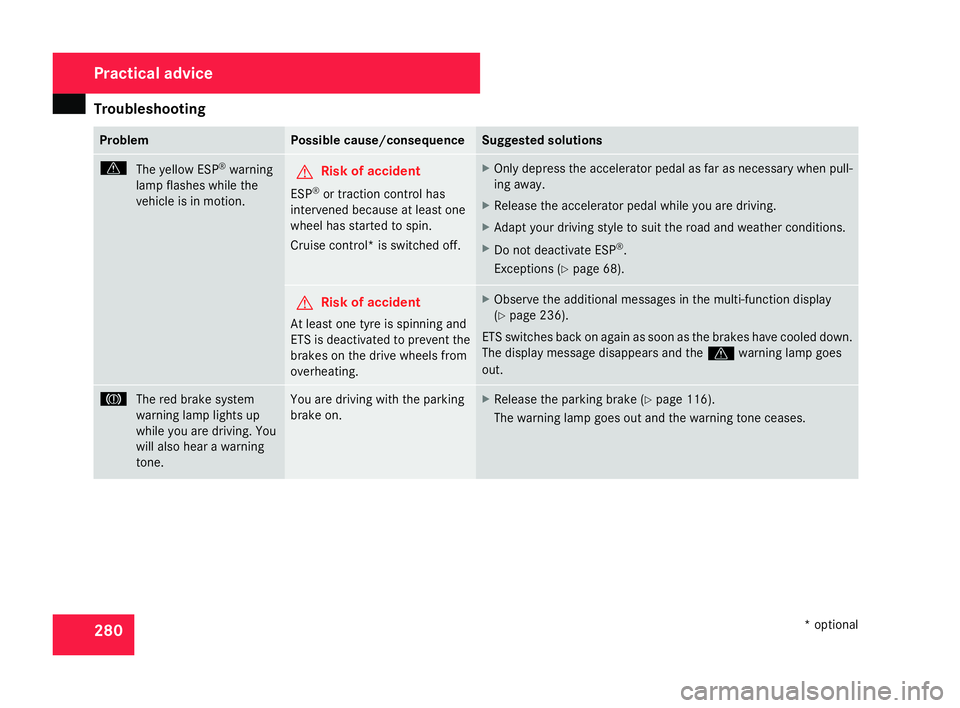
v
The yellow ESP ®
warning
lamp flashes while th e
vehicle is in motion. G
Risk of accident
ESP ®
or traction control has
intervened because at least one
wheel has started to spin.
Cruise control* is switched off. X
Only depress the accelerator pedal as far as necessary when pull-
ing away.
X Release the accelerator pedal while you are driving.
X Adapt your driving style to suit the road and weather conditions.
X Do not deactivate ESP ®
.
Exceptions (Y page 68). G
Risk of accident
At least one tyre is spinning and
ETS is deactivated to prevent the
brakes on the drive wheels from
overheating. X
Observe the additional messages in the multi-function display
(Y page 236).
ETS switches back on again as soon as the brakes have cooled down.
The display message disappears and the vwarning lamp goes
out. 3
The red brake system
warning lamp lights up
while you are driving. You
will also hear a warning
tone. You are driving with the parking
brake on. X
Release the parking brake (Y page 116).
The warning lamp goes out and the warning tone ceases. Practical advice
* optional
204_AKB; 2; 3, en-GB
mkalafa,
2007-06-26T23:11:51+02:00 - Seite 280
Page 284 of 377

Troubleshooting
28
1 Problem Possible cause/consequence Suggested solutions
3
The red brake system
warning lamp lights up
while the engine is run-
ning. You will also hear a
warning tone. G
Risk of accident
There is insufficient brake fluid in
the fluid reservoir. X
Do not continue driving under any circumstances .
X Consult a qualified specialist workshop immediately.
X Observe the additional messages in the multi-function display
(Y page 236).
X Under no circumstances should you top up the brake fluid. This will
not rectify the fault. D
The red coolant warning
lamp lights up while the
engine is running and the
coolant temperature
gauge is at the start of the
scale. The sensor for the coolant tem-
perature gauge is faulty.
The coolant is too hot. The engine
is not being cooled sufficiently
and may be damaged. X
Do not continue driving under any circumstances .
X Consult a qualified specialist workshop. Practical advice
204_AKB; 2; 3, en-GB
mkalafa,
2007-06-26T23:11:51+02:00 - Seite 28
1 Z
Page 285 of 377
Troubleshooting
28
2 Problem Possible cause/consequence Suggested solutions
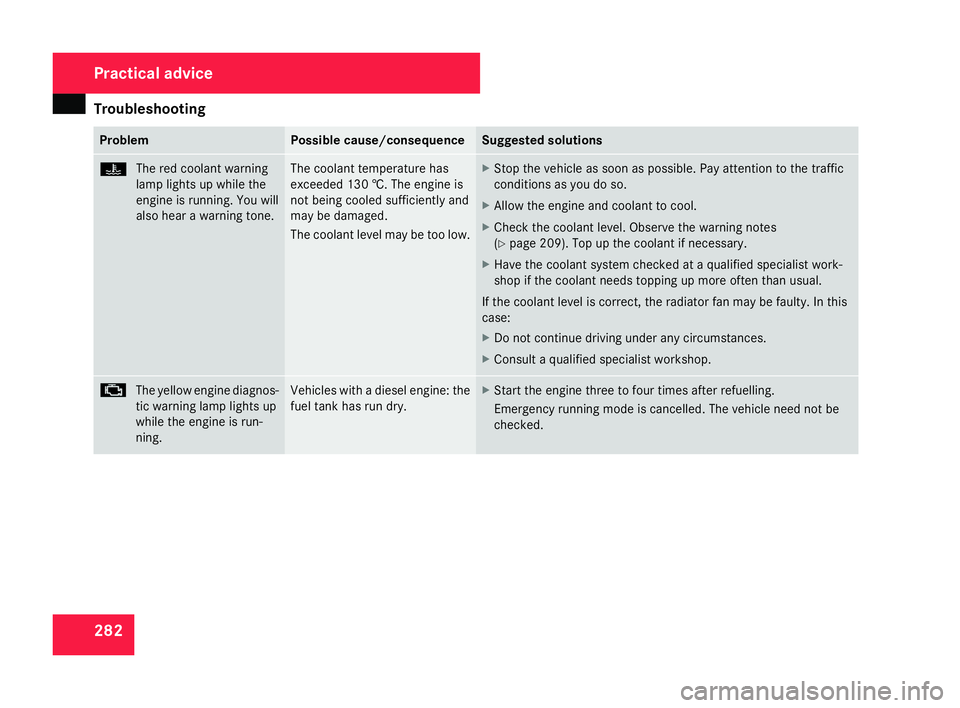
D
The red coolant warning
lamp lights up while the
engine is running. You will
also hear a warning tone. The coolant temperature has
exceeded 130
†. The engine is
not being cooled sufficiently and
may be damaged .
The coolant level may be too low. X
Stop the vehicle as soon as possible. Pay attention to the traffic
conditions as you do so.
X Allow the engine and coolant to cool.
X Check the coolant level. Observe the warning note s
( Y page 209). Top up the coolant if necessary.
X Have the coolant system checked at a qualified specialist work-
shop if the coolant needs topping up more often than usual .
If the coolant level is correct, the radiator fan may be faulty. In this
case:
X Do not continue driving under any circumstances .
X Consult a qualified specialist workshop. ±
The yellow engine diagnos-
tic warning lamp lights up
while the engine is run-
ning. Vehicles with a diesel engine: the
fuel tank has run dry. X
Start the engine three to four times after refuelling.
Emergency running mode is cancelled. The vehicle need not be
checked. Practical advice
204_AKB; 2; 3, en-G
B
mkalafa , 2007-06-26T23:11:51+02:00 - Seite 282
Page 286 of 377
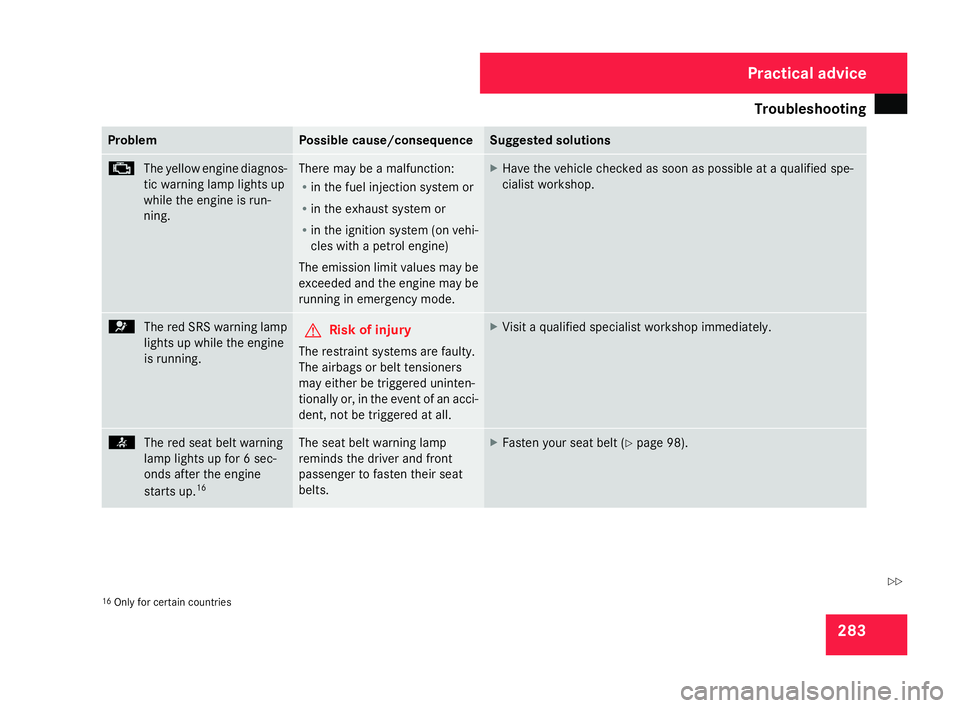
Troubleshooting
28
3 Problem Possible cause/consequence Suggested solutions
±
The yellow engine diagnos-
tic warning lamp lights up
while the engine is run-
ning. There may be a malfunction:
R
in the fuel injection system or
R in the exhaust system or
R in the ignition system (on vehi-
cles with a petrol engine)
The emission limit values may be
exceeded and the engine may be
running in emergency mode. X
Have the vehicle checked as soon as possible at a qualified spe -
cialist workshop. =
The red SRS warning lamp
lights up while the engine
is running. G
Risk of injury
The restraint systems are faulty .
The airbags or belt tensioners
may either be triggered uninten-
tionally or, in the event of an acci-
dent, not be triggered at all. X
Visit a qualified specialist workshop immediately. <
The red seat belt warning
lamp lights up for 6 sec-
onds after the engine
starts up. 16 The seat belt warning lamp
reminds the driver and front
passenger to fasten their seat
belts. X
Fasten your seat belt (Y page 98). 16
Only for certain countries Practical advice
204_AKB; 2; 3, en-GB
mkalafa,
2007-06-26T23:11:51+02:00 - Seite 283 Z
Page 287 of 377
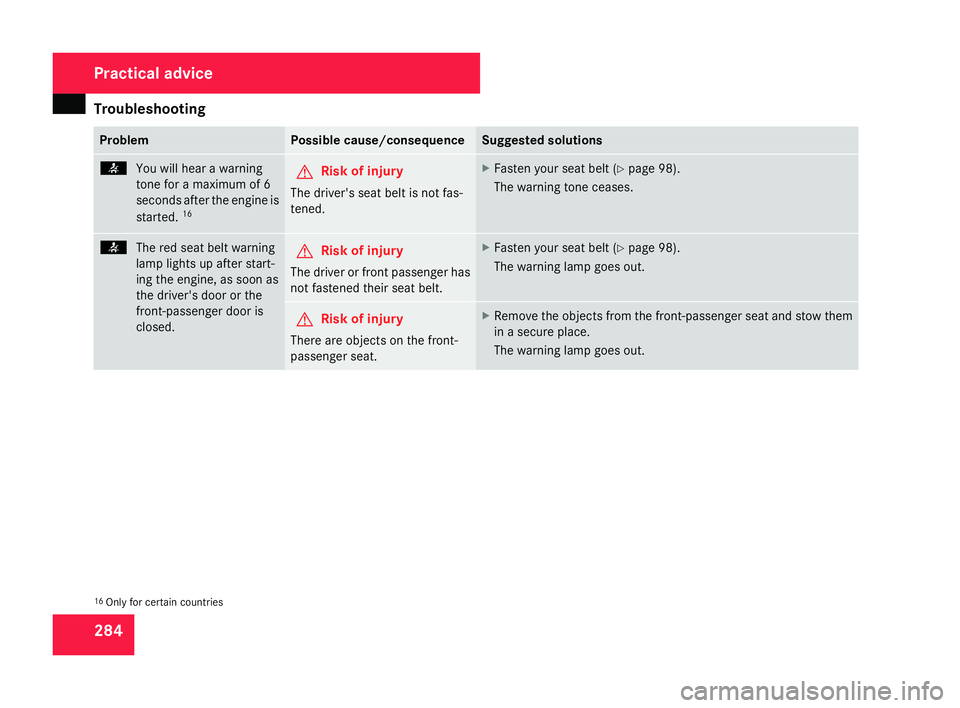
Troubleshooting
28
4 Problem Possible cause/consequence Suggested solutions
<
You will hear a warnin g
tone for a maximum of 6
seconds after the engine is
started. 16 G
Risk of injury
The driver's seat belt is not fas -
tened. X
Fasten your seat belt (Y page 98).
The warning tone ceases. <
The red seat belt warning
lamp lights up after start -
ing the engine, as soon as
the driver's door or the
front-passenger door is
closed. G
Risk of injury
The driver or front passenger ha s
not fastened their seat belt. X
Fasten your seat belt (Y page 98).
The warning lamp goes out. G
Risk of injury
There are objects on the front-
passenger seat. X
Remove the objects from the front-passenger seat and stow them
in a secure place.
The warning lamp goes out .16
Only for certain countries Practical advice
204_AKB; 2; 3, en-GB
mkalafa,
2007-06-26T23:11:51+02:00 - Seite 284
Page 288 of 377
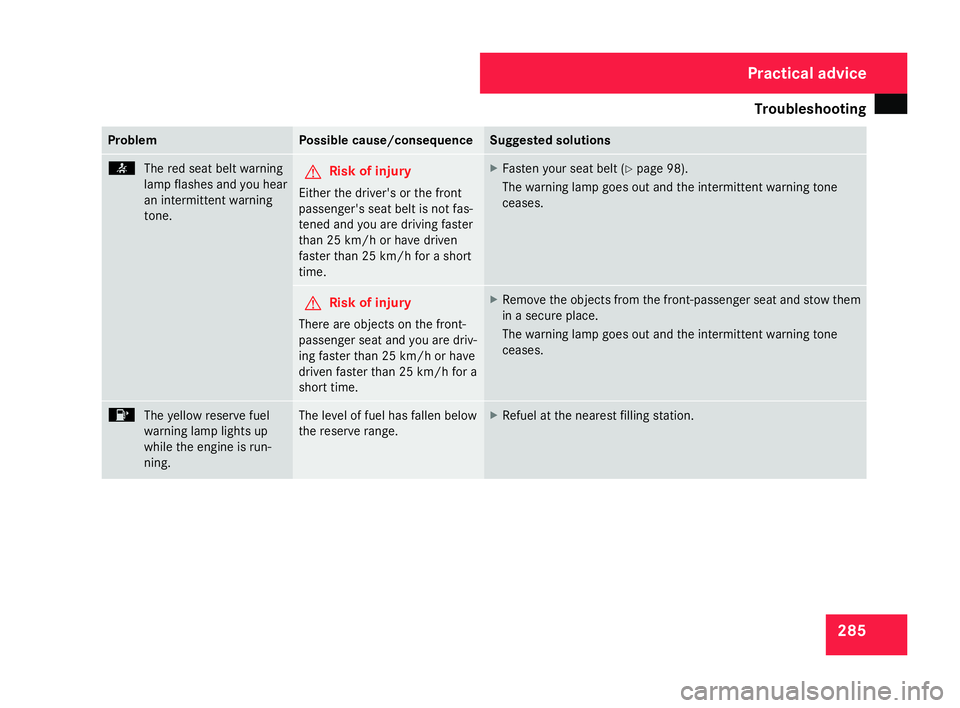
Troubleshooting
28
5 Problem Possible cause/consequence Suggested solutions
<
The red seat belt warning
lamp flashes and you hear
an intermittent warning
tone. G
Risk of injury
Either the driver's or the front
passenger's seat belt is not fas -
tened and you are driving faste r
than 25 km/h or have driven
faster than 25 km/h for a short
time. X
Fasten your seat belt (Y page 98).
The warning lamp goes out and the intermittent warning ton e
ceases . G
Risk of injury
There are objects on the front-
passenger seat and you are driv-
ing faster than 25 km/h or have
driven faster than 25 km/h for a
short time. X
Remove the objects from the front-passenger seat and stow them
in a secure place.
The warning lamp goes out and the intermittent warning tone
ceases . 4
The yellow reserve fuel
warning lamp lights up
while the engine is run-
ning. The level of fuel has fallen below
the reserve range. X
Refuel at the nearest filling station . Practical advice
204_AKB; 2; 3, en-GB
mkalafa,
2007-06-26T23:11:51+02:00 - Seite 285
Page 290 of 377
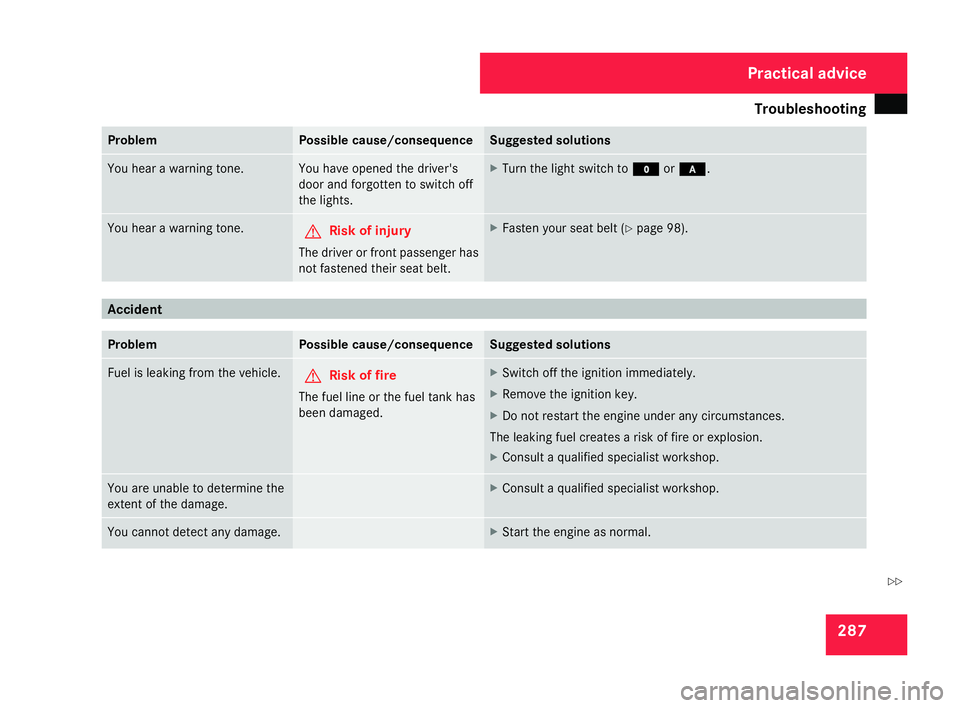
Troubleshooting
28
7 Problem Possible cause/consequence Suggested solutions
You hear a warning tone. You have opened the driver's
door and forgotten to switch off
the lights. X
Turn the light switch to Mor* . You hear a warning tone.
G
Risk of injury
The driver or front passenger ha s
not fastened their seat belt. X
Fasten your seat belt (Y page 98). Accident
Problem Possible cause/consequence Suggested solutions
Fuel is leaking from the vehicle.
G
Risk of fire
The fuel line or the fuel tank ha s
been damaged. X
Switch off the ignition immediately.
X Remove the ignition key.
X Do not restart the engine under any circumstances .
The leaking fuel creates a risk of fire or explosion.
X Consult a qualified specialist workshop. You are unable to determine th
e
extent of the damage. X
Consult a qualified specialist workshop. You cannot detect any damage. X
Start the engine as normal. Practical advice
204_AKB; 2; 3, en-G
B
mkalafa , 2007-06-26T23:11:51+02:00 - Seite 287 Z
Page 294 of 377
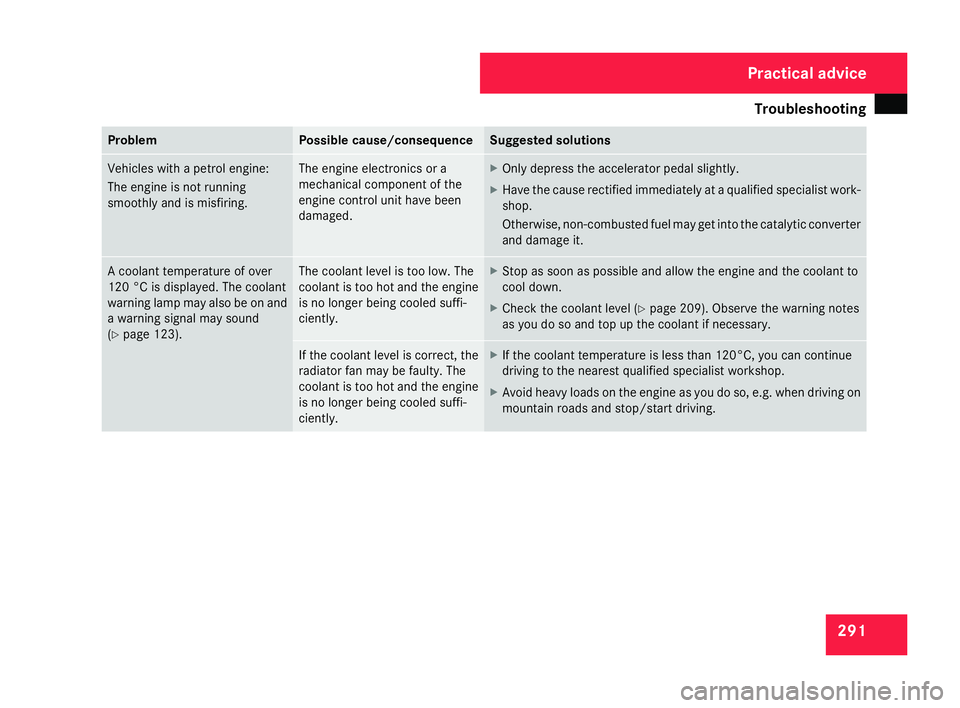
Troubleshooting
29
1 Problem Possible cause/consequence Suggested solutions
Vehicles with a petrol engine:
The engine is not running
smoothly and is misfiring. The engine electronics or
a
mechanical component of the
engine control unit have been
damaged. X
Only depress the accelerator pedal slightly.
X Have the cause rectified immediately at a qualified specialist work-
shop .
Otherwise, non-combusted fuel may get into the catalytic converter
and damage it. A coolant temperature of over
120 °C is displayed. The coolant
warning lamp may also be on and
a warning signal may sound
(
Y page 123). The coolant level is too low. The
coolant is too hot and the engin
e
is no longer being cooled suffi-
ciently. X
Stop as soon as possible and allow the engine and the coolant to
cool down.
X Check the coolant level (Y page 209). Observe the warning notes
as you do so and top up the coolant if necessary. If the coolant level is correct, the
radiator fan may be faulty. The
coolant is too hot and the engin
e
is no longer being cooled suffi-
ciently. X
If the coolant temperature is less than 120°C, you can continue
driving to the nearest qualified specialist workshop.
X Avoid heavy loads on the engine as you do so, e.g. when driving on
mountain roads and stop/start driving . Practical advice
204_AKB; 2; 3, en-GB
mkalafa,
2007-06-26T23:11:51+02:00 - Seite 291