lock MERCEDES-BENZ C-CLASS SALOON 2018 Manual PDF
[x] Cancel search | Manufacturer: MERCEDES-BENZ, Model Year: 2018, Model line: C-CLASS SALOON, Model: MERCEDES-BENZ C-CLASS SALOON 2018Pages: 609, PDF Size: 11.19 MB
Page 436 of 609
000A
WARNING Risk of accident due tothe
specified tyre pressure not being ach‐
ie ved
If th e specified tyre pressure is not achie ved
af te r a brief drive, the tyre is too badly dam‐
aged. The tyre sealant cannot repair the tyre
in this ins tance.
Dama ged tyres and a tyre pressure that is
to o low can significantly impair braking and
handling characteristics. 0007
Do not drive on. 0007
Consult a qualified specialist workshop. Countries
that ha veMercedes-Benz
Service24h: you will find a sticke r with thete le‐
phone number, e.g. on the B‑pillar on the driver's
side. 0007
Cor rect the tyre pressure if it is still at least
13 0 kPa (1.3 bar/19 psi). See the tyre pres‐
sure table on the fuel filler flap forva lues. 0007
Toincrease the ty repressure: switch on
th e tyre inflation compressor. 0007
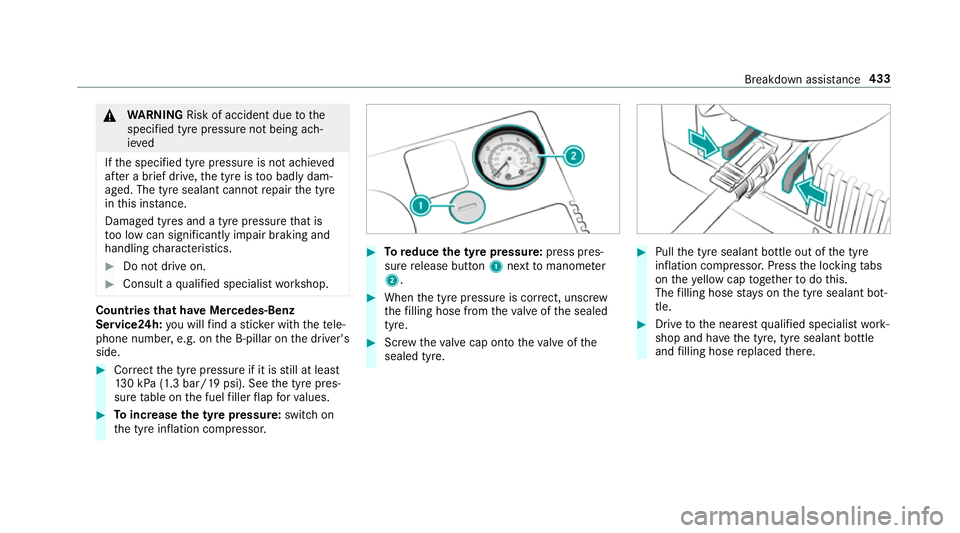
Toreduce the tyre pressure: press pres‐
su re re lease button 1next tomanome ter
2 . 0007
When the tyre pressure is cor rect, unscr ew
th efilling hose from theva lve of the sealed
tyre. 0007
Screw theva lve cap onto theva lve of the
sealed tyre. 0007
Pull the tyre sealant bottle out of the tyre
inflation compressor. Press the locking tabs
on theye llow cap toget her todo this.
The filling hose stay s on the tyre sealant bot‐
tle. 0007
Drive tothe nearest qualified specialist work‐
shop and ha vethe tyre, tyre sealant bottle
and filling hose replaced there. Breakdown assis
tance 433
Page 437 of 609
Battery (vehicle)
Note
s onthe12 V battery 000A
WARNING Risk of an accident due to
wo rkcar ried out incor rectly on the bat‐
te ry
Wo rkcar ried out incor rectly on the battery
can, forex ample, lead toa short circuit. This
can lead tofunction restrictions in saf ety-re l‐
eva nt sy stems, e.g. the lighting sy stem, ABS
(anti-lock braking sy stem) or ESP ®
(Elec‐
tronic Stability Prog ram). The operating
saf ety of your vehicle may be restricted.
Yo u could lose cont rol of theve hicle in the
fo llowing situations:
R when braking
R intheeve nt of ab rupt steering manoeu‐
vres and/or when theve hicle's speed is
not adap tedto thero ad conditions 0007
Intheeve nt of a sho rtcircuit or a simi‐
lar incident, contact a qualified special‐
ist workshop immediately. 0007
Do not continue driving. 0007
Alw ays ha vewo rkon the battery car ried
out at a qualified specialist workshop. R
Further information on ABS
(0013 page 203)
R Further information on ESP ®
(0013 page 204)
Fo r saf etyre asons, Mercedes-Benz recommends
th at you on lyuse bat teries which ha vebeen tes‐
te d and appr ovedfo ryo ur vehicle byMercedes-
Benz. These batteries pr ovide inc reased impact
pr otection topreve ntvehicle occupants from
suf fering acid bu rns should the battery be dam‐
aged in theeve nt of an accident.
All vehicles except vehicles with a lithium-
ion battery 000A
WARNING Risk ofexplosion due toelec‐
tros tatic charge
Electros tatic charge can cause spa rks which
may ignite the highly flammable gas mixture
in the batter y. 0007
Todischar geany electros tatic charge
th at may ha vebuilt up, touch the me tal
ve hicle body before handling the bat‐
te ry. The highly
flammable gas mixture is created
while the battery is charging and during starting
assis tance. 000A
WARNING Danger of chemical burns
from the battery acid
Battery acid is caustic. 0007
Avoid contact with the skin, eyes or
clo thing. 0007
Do not lean overth e batter y. 0007
Do not inhale battery gases. 0007
Keep children away from the batter y. 0007
Immedia tely rinse battery acid off thor‐
oughly with plenty of clean water and
seek medical attention immediately. 434
Breakdown assi stance
Page 444 of 609
0009
Vehicles with automatic transmission: if
th e automatic transmission cann otbe shif‐
te dto position 005C, orthe multifunction dis‐
play in the instrument clus ter does not show
anything, ha vetheve hicle transpor tedaw ay
( 0013 page442). A towing vehicle with lift‐
ing equipment is requ ired forve hicle trans‐
por tation.
000E NO
TEDama gedue to to wing away at
ex cessively high speeds or over long dis‐
ta nces The driv
etra in could be damaged when tow‐
ing at excessively high speeds or over long
dis tances. 0007
Atowing speed of 50 km/h must not
be exc eeded. 0007
Atowing dis tance of 50 km must not be
exc eeded. 000A
WARNING Risk of accident when towing
a ve hicle which is too heavy
If th eve hicle being tow- star ted or towed
aw ay is heavier than the permissible gross
mass, thefo llowing situations can occur:
R theto wing eye may become de tach ed.
R the car/t railer combination may swer ve
or eve nove rturn. 0007
If ano ther vehicle is tow- star ted or
to we daw ay, its weight must not exceed
th e permissible gross mass of your own
ve hicle. If a
vehicle must be tow star ted or towe daw ay,
its permissible gross mass must not exceed the
permissible gross mass of theto wing vehicle. 0007
Information on the permissible gross mass of
th eve hicle can be found on theve hicle iden‐
tification plate (0013 page473). 0007
Vehicles with automatic transmission: do
not open the driver's door or front passenger
door, otherwise the automatic transmission
automatically shifts toposition 005D. 0007
Fittheto wing eye (0013 page444). 0007
Fasten theto w bar.
000E NO
TEDama gedue toincor rect connec‐
tion 0007
Only connect theto w rope or tow bar to
th eto wing eyes. 0007
Deactivate the automatic locking mechanism
(0013 page81). 0007
Do not activate the HOLD function. 0007
Deactivate tow- aw ay protection
(0013 page 99). 0007
Deactivate Active Brake Assi st
( 0013 page214). 0007
Vehicles with automatic transmission:
shift the automatic transmission toposition
005C. 0007
Vehicles with manual transmission: shift
to neutral 005C. 0007
Release the electric parking brake. Breakdown assis
tance 441
Page 445 of 609
0007
Vehicles with manual transmission:
switch on the ignition, otherwise thesteering
wheel lock may engage. 000A
WARNING Risk of accident due tolimi‐
te d saf ety-re lated functions during the
to wing process
Saf ety-re lated functions are limited or no lon‐
ge rav ailable in thefo llowing situations:
R the ignition is switched off.
R the brake sy stem or po werst eering sys‐
te m is malfunctioning.
R the energy supply or the on-board electri‐
cal sy stem is malfunctioning.
When your vehicle is then towe daw ay, signif‐
icantly more ef fort may be requ ired tosteer
and brake than is no rmally requ ired. 0007
Use a tow bar. 0007
Make sure that thesteering wheel can
mo vefreely, before towing theve hicle
aw ay. 000E
NO
TEDama gedue toexcessive tracti ve
po wer If
yo u pull away sharpl y,the tractive po wer
may be too high and theve hicles could be
damaged. 0007
Pull away slowly and smoo thly. Loading the
vehicle for transport 0007
Obser vethe no tes on towing away
( 0013 page440). 0007
Connect theto w bar totheto wing eye in
order toload theve hicle.
0009 You can also attach theto w bar tothe trailer
hitch. 0007
Vehicles with automatic transmission:
shift the automatic transmission toposition
005C.
0009 Ve
hicles with automatic transmission:
th e automatic transmission may be loc ked in
position 005Dintheeve nt of dama getothe
electrical sy stem. Toshift to005C , pr ovide the on-board electrical sy
stem with po wer
( 0013 page 437). 0007
Vehicles with manual transmission: shift
to neutral. 0007
Load theve hicle onto the transpor ter. 0007
Vehicles with automatic transmission:
shift the automatic transmission toposition
005D. 0007
Vehicles with manual transmission:
engage firs t or reve rsege ar. 0007
Use the electric parking brake tosecure the
ve hicle against rolling away. 0007
Only secure theve hicle bythe wheels.
Ve hicles with ADS PLUS (Adaptive Damping
Sy stem PLUS) 000A
WARNING Risk of an accident when
transporting vehicles with Adaptive
Damping Sy stem PLUS
The reduced damping forc es on theve hicle
being transpor ted can cause theve hicle/
trailer combination tostart toswing. 442
Breakdown assis tance
Page 447 of 609
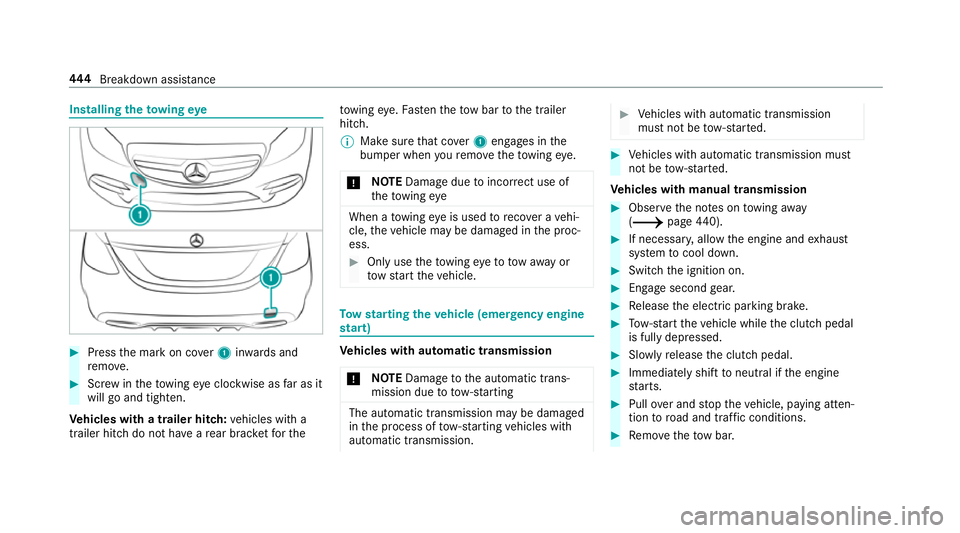
Installing
theto wing eye 0007
Press the mark on co ver1 inwa rds and
re mo ve. 0007
Screw intheto wing eyeclockwise as far as it
will go and tighten.
Ve hicles with a trailer hitch: vehicles with a
trailer hitch do not ha veare ar brac ketfo rthe to
wing eye. Fasten theto w bar tothe trailer
hitch.
0009 Make sure that co ver1 engages in the
bumper when youre mo vetheto wing eye.
000E NO
TEDama gedue toincor rect use of
th eto wing eye When a
towing eye is used toreco ver a vehi‐
cle, theve hicle may be damaged in the proc‐
ess. 0007
Only use theto wing eyeto to waw ay or
to w start theve hicle. To
w starting theve hicle (eme rgency engine
st art) Ve
hicles with automatic transmission
000E NO
TEDama getothe automatic trans‐
mission due to tow-starting The automatic transmission may be damaged
in the process of tow- starting vehicles with
automatic transmission. 0007
Vehicles with automatic transmission
must not be tow- star ted. 0007
Vehicles with automatic transmission must
not be tow- star ted.
Ve hicles with manual transmission 0007
Obser vethe no tes on towing away
( 0013 page440). 0007
If necessa ry, allow the engine and exhaust
sy stem tocool down. 0007
Switch the ignition on. 0007
Enga gesecond gear. 0007
Release the electric parking brake. 0007
Tow- start theve hicle while the clutch pedal
is fully depressed. 0007
Slowly release the clutch pedal. 0007
Immediately shift toneutral if the engine
st arts. 0007
Pull over and stop theve hicle, paying atten‐
tion toroad and traf fic conditions. 0007
Remo vetheto w bar. 444
Breakdown assis tance
Page 466 of 609
R
The vehicle is not on a slope.
R The vehicle is on solid, non-slippery and le vel
ground. 0007
Apply the electric parking brake manually. 0007
Movethe front wheels tothest ra ight-ahead
position. 0007
Vehicles with manual transmission:
engage firs t or reve rsege ar. 0007
Vehicles with automatic transmission:
shift into position 005D. 0007
Vehicles with le vel control sy stem: setthe
normal vehicle le vel (0013 page 234). 0007
Swit choff the engine. 0007
Make sure that the engine cann otbe star ted. 0007
Place choc ks orother suitable items under
th e front and rear of the wheel that is diago‐
nally opposite the wheel you wish tochange. 0007
Remo vethe hub caps if necessary
(0013 page 463). 0007
Raise theve hicle (0013 page 464). Re
moving and fitting hub caps Re
quirements:
R The vehicle is prepared for a wheel change
(0013 page 462).
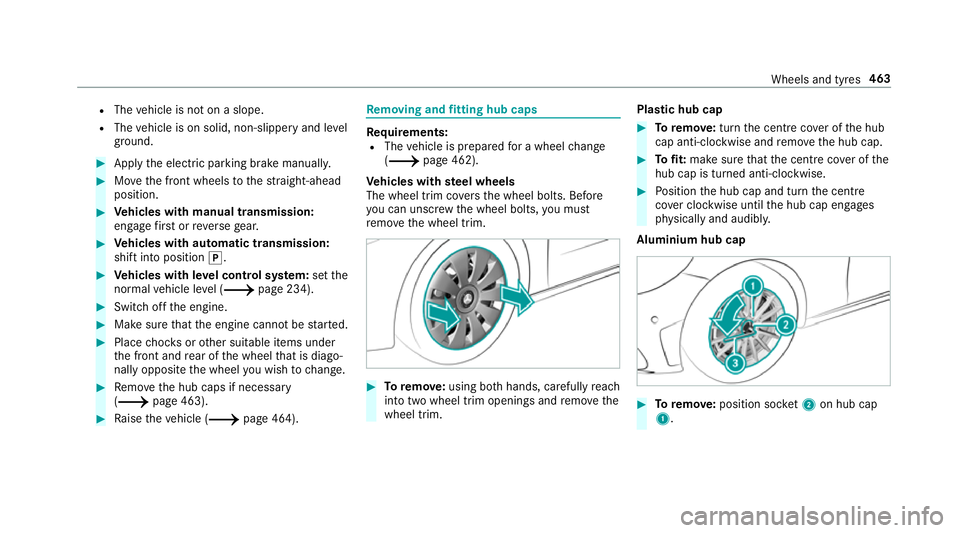
Ve hicles with steel wheels
The wheel trim co vers the wheel bolts. Before
yo u can unscr ewthe wheel bolts, you must
re mo vethe wheel trim. 0007
Toremo ve:using bo thhands, carefully reach
into two wheel trim openings and remo vethe
wheel trim. Plastic hub cap 0007
Toremo ve:turn the cent recover of the hub
cap anti-clockwise and remo vethe hub cap. 0007
Tofit: make sure that the cent recover of the
hub cap is turned anti-clockwise. 0007
Position the hub cap and turn the cent re
co ver clockwise until the hub cap engages
ph ysically and audibly.
Aluminium hub cap 0007
Toremo ve:position soc ket2 on hub cap
1. Wheels and tyres
463
Page 467 of 609
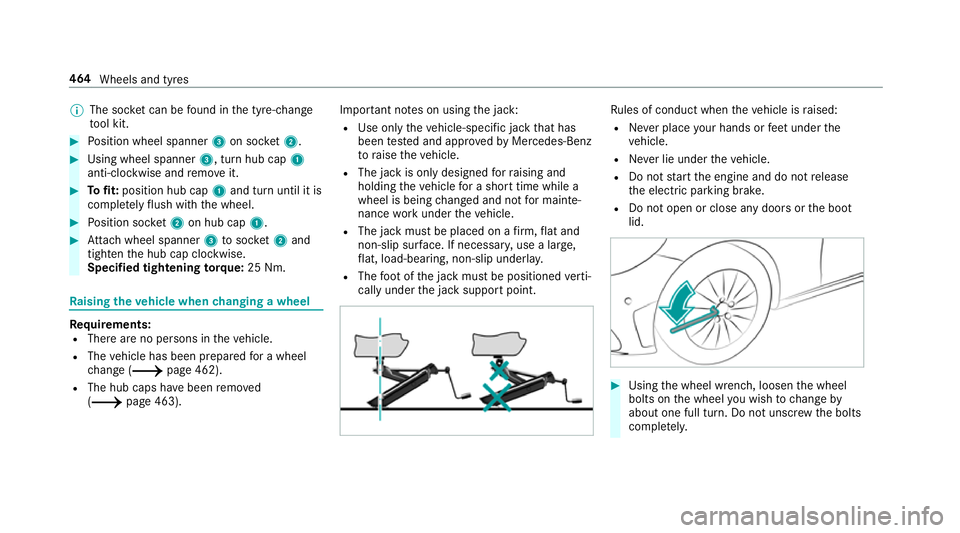
0009
The soc ket can be found in the tyre-change
to ol kit. 0007
Position wheel spanner 3on soc ket2. 0007
Using wheel spanner 3, turn hub cap1
anti-clo ckwise and remo veit. 0007
Tofit: position hub cap 1and turn until it is
comple tely flush with the wheel. 0007
Position soc ket2 on hub cap 1. 0007
Attach wheel spanner 3tosoc ket2 and
tighten the hub cap clockwise.
Specified tightening torq ue: 25 Nm. Ra
ising theve hicle when changing a wheel Re
quirements:
R There are no persons in theve hicle.
R The vehicle has been prepared for a wheel
ch ange (0013 page 462).
R The hub caps ha vebeen remo ved
( 0013 page 463). Impor
tant no tes on using the jack:
R Use only theve hicle-specific jack that has
been tested and appr ovedby Mercedes-Benz
to raise theve hicle.
R The jack is only designed forra ising and
holding theve hicle for a short time while a
wheel is being changed and not for mainte‐
nance workunder theve hicle.
R The jack must be placed on a firm ,fl at and
non-slip sur face. If necessar y,use a lar ge,
fl at, load-bearing, non-slip unde rlay.
R The foot ofthe jack must be positioned verti‐
cally under the jack support point. Ru
les of conduct when theve hicle is raised:
R Never place your hands or feet under the
ve hicle.
R Never lie under theve hicle.
R Do not start the engine and do not release
th e electric parking brake.
R Do not open or close any doors or the boot
lid. 0007
Using the wheel wrench, loosen the wheel
bolts on the wheel you wish tochange by
about one full turn. Do not unscr ewthe bolts
comple tely. 464
Wheels and tyres
Page 468 of 609
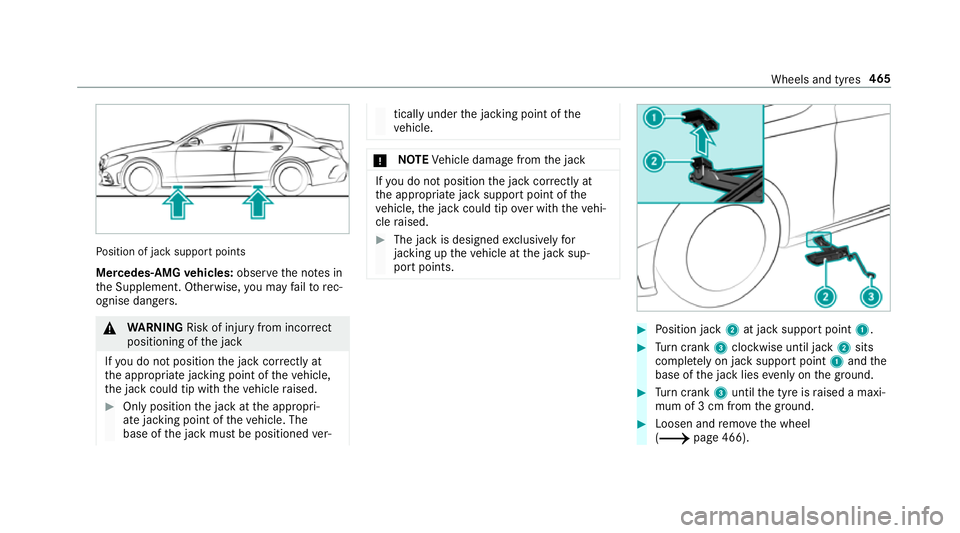
Po
sition of jack support points
Mercedes-AMG vehicles: observeth e no tes in
th e Supplement. Otherwise, you may failto rec‐
ognise dangers. 000A
WARNING Risk of inju ryfrom incor rect
positioning of the jack
If yo u do not position the jack cor rectly at
th e appropriate jacking point of theve hicle,
th e jack could tip with theve hicle raised. 0007
Only position the jack at the appropri‐
ate jacking point of theve hicle. The
base of the jack must be positioned ver‐ tically under
the jacking point of the
ve hicle. 000E
NO
TEVehicle damage from the jack If
yo u do not position the jack cor rectly at
th e appropriate jack support point of the
ve hicle, the jack could tip over with theve hi‐
cle raised. 0007
The jack is designed exclusively for
jacking up theve hicle at the jack sup‐
port points. 0007
Position jack 2at jack support point 1. 0007
Turn crank 3clockwise until jack 2sits
compl etely on jack support point 1and the
base of the jack lies evenly on the ground. 0007
Turn crank 3until the tyre is raised a maxi‐
mum of 3 cm from the ground. 0007
Loosen and remo vethe wheel
(0013 page 466). Wheels and tyres
465
Page 487 of 609

0007
Obser vethe instructions in the
Mercedes-Benz Specifications for Oper‐
ating Fluids 310.1. Ha
ve the coolant regularly replaced at a qualified
specialist workshop.
The proportion of cor rosion inhibitor/antifreeze
concentrate in the engine cooling sy stem should
be:
R a minimum of 50% (antifreeze pr otection
down toappr oximately -37 °C)
R a maximum of 55% (antifreeze pr otection
down to-45 °C) Note
s on windscreen washer fluid Obser
vethe no tes on operating fluids
(0013 page475). 000A
WARNING ‑ Risk of fire and injury due to
windscreen washer concentrate
Wi ndsc reen washer concentrate is highly
fl ammable. It could ignite if it comes into con
tact wi thhot engine component parts or
th eex haust sy stem. 0007
Make sure that no windsc reen washer
concentrate spills out next tothefiller
opening. 000E
NO
TEDama getotheex terior lighting
due tounsuitable windsc reen washer
fl uid Uns
uitable windsc reen washer fluids may
damage the plastic sur face of theex terior
lighting. 0007
Only use windscreen washer fluids
which are also suitable for use on plas‐
tic sur faces, e.g. MB SummerFit or MB
Wi nterFit. 000E
NO
TEBlocked spr aynozzles caused by
mixing windscreen washer fluids 0007
Do not mix MB SummerFit and MB Win‐
te rFit with other windscreen washer flu‐
ids. Do not use distilled or de-ionised
water asthefill
le ve l sensor may be triggered er roneously.
Re commended windscreen washer fluid:
R Abo vefreezing point: e.g. MB SummerFit
R Below freezing point: e.g. MB WinterFit
Fo rth e cor rect mixing ratio, referto the informa‐
tion on the antif reeze conta iner.
Mix thewa sher fluid with the windscreen washer
fl uid all year round. Ve
hicle data Ve
hicle dimensions The heights speci
fied may vary as a result of the
fo llowing factors:
R tyres
R load
R condition of the suspension
R optional equipment 484
Tech nical da ta
Page 494 of 609
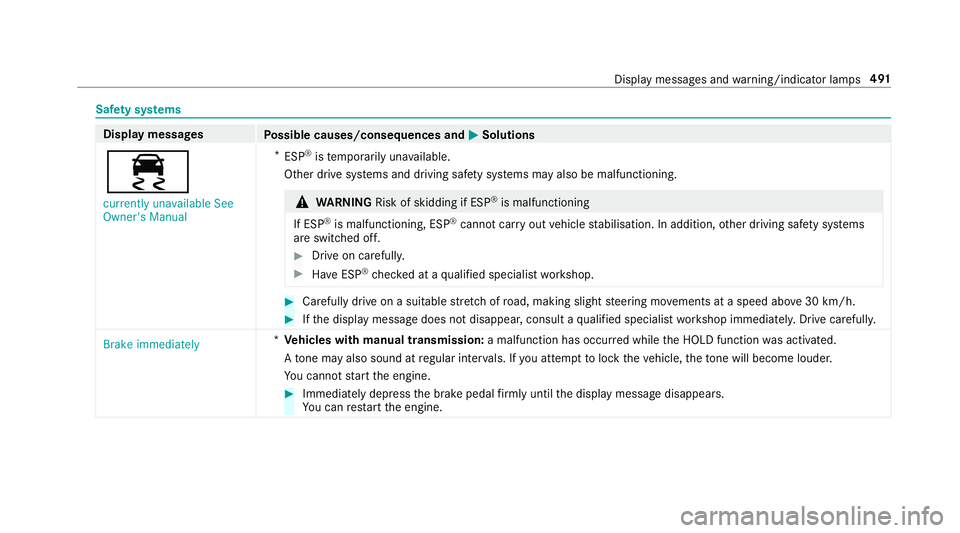
Saf
ety sy stems Display messages
Possible causes/consequences and 0050
0050Solutions
00E5 currently unavailable See
Owner's Manual *
ESP ®
is temp orarily una vailable.
Other drive sy stems and driving saf ety sy stems may also be malfunctioning. 000A
WARNING Risk of skidding if ESP ®
is malfunctioning
If ESP ®
is malfunctioning, ESP ®
cannot car ryout vehicle stabilisation. In addition, other driving saf ety sy stems
are switched off. 0007
Drive on carefull y. 0007
Have ESP ®
ch ecked at a qualified specialist workshop. 0007
Carefully drive on a suitable stre tch of road, making slight steering mo vements at a speed abo ve30 km/h. 0007
Ifth e display message does not disappear, consult a qualified specialist workshop immediately. Drive carefully.
Brake immediately *
Ve hicles with manual transmission: a malfunction has occurred while the HOLD function was activated.
A tone may also sound at regular inter vals. If you attem pttolock theve hicle, theto ne will become louder.
Yo u cannot start the engine. 0007
Immediately depress the brake pedal firm lyuntil the display message disappears.
Yo u can restart the engine. Display messages and
warning/indicator lamps 491