tire pressure MERCEDES-BENZ C240 2002 W203 Owner's Manual
[x] Cancel search | Manufacturer: MERCEDES-BENZ, Model Year: 2002, Model line: C240, Model: MERCEDES-BENZ C240 2002 W203Pages: 406
Page 8 of 406
5 ContentsSEAT BELT SYSTEM ...................299
ELEC. STABIL. PROG.
(Electronic stability program) ..300
COOLANT
(coolant level) ............................. 301
COOLANT
(coolant temperature) ................302
ENGINE OIL LEVEL ...................303
LIGHTING SYSTEM ....................304
LAMP SENSOR ...........................306
DOOR ............................................306
TRUNK OPEN .............................307
HOOD ...........................................307
TELEPHONE – FUNCTION .......308
TELE AID .....................................308
WASHER FLUID ..........................309
RESTRAINT SYSTEM ................. 310
KEY ............................................... 310
FUEL RESERVE .......................... 311
UNDERVOLTAGE ........................ 311
STEER. WHEEL ADJUST. ........... 312
Practical hintsFirst aid kit ...................................... 314
Stowing things in the vehicle ....... 314
Fuses ................................................ 315
Hood ................................................. 318
Adding engine oil .......................... 321
Automatic transmission
fluid level ................................... 322
Coolant level ................................... 322
Adding coolant ........................... 323
Windshield and
headlamp washer system ........ 323
Spare wheel, vehicle tools,
storage compartment ............... 325
TIREFIT, vehicle tools,
storage compartment
(C 32 AMG only) ....................... 326
Vehicle jack .................................... 327
Wheels ............................................ 328
Tire replacement ....................... 328
Rotating wheels ......................... 329Spare wheel ....................................330
Spare wheel bolts .......................330
Changing wheels ........................... 331
TIREFIT ...........................................337
Tire inflation pressure .................. 341
Battery .............................................342
Jump starting ..................................344
Towing the vehicle .........................347
Transmission selector lever,
manually unlocking ...................350
Exterior lamps ................................ 351
Replacing bulbs .......................... 351
Standby bulb function ...................356
Changing batteries in the
electronic main key ..................357
Synchronizing
remote control ............................359
Emergency engine shut-down .....359
Fuel filler flap, manual release ...360
Replacing wiper blade insert .......362
Roof rack .........................................363
OM_203.book Seite 5 Donnerstag, 31. Mai 2001 11:57 11
Page 264 of 406
261 Driving instructions
Te ch n i c a l
data Instruments
and controlsOperationDrivingInstrument
cluster displayPractical hints Car care Index Driving instructions
Drive sensibly – Save Fuel
Fuel consumption, to a great extent, depends on driving
habits and operating conditions.
To save fuel you should:
•keep tires at the recommended inflation pressures,
•remove unnecessary loads,
•remove roof rack when not in use,
•allow engine to warm up under low load use,
•avoid frequent acceleration and deceleration,
•have all maintenance work performed at regular
intervals by an authorized Mercedes-Benz Center.
Fuel consumption is also increased by driving in cold
weat her, i n stop -and -go traf f ic, on short trip s an d i n hilly
country.Drinking and driving
Ped al s
Wa r n i n g !
Drinking or taking drugs and driving can be a very
dangerous combination. Even a small amount of
alcohol or drugs can affect your reflexes,
perceptions and judgement.The possibility of a serious or even fatal accident is
sharply increased when you drink or take drugs
and drive.Please don’t drink or take drugs and drive or allow
anyone to drive after drinking or taking drugs.Wa r n i n g !
Keep driver’s foot area clear at all times. Objects
stored in this area may impair pedal movement.
OM_203.book Seite 261 Donnerstag, 31. Mai 2001 11:57 11
Page 269 of 406
266 Driving instructions
Te ch n i c a l
data Instruments
and controlsOperationDrivingInstrument
cluster displayPractical hints Car care Index
Specified tire pressures must be maintained. This
applies particularly if the tires are subjected to high
loads (e.g. high speeds, heavy loads, high ambient
temperatures).
Aq uaplaning
Depending on the depth of the water layer on the road,
aquaplaning may occur, even at low speeds and with
new tires. Reduce vehicle speed, avoid track grooves in
the road and apply brakes cautiously in the rain.Tire traction
The safe speed on a wet, snow covered or icy road is
always lower than on a dry road.
You should pay particular attention to the condition of
the road whenever the outside temperatures are close to
the freezing point.
We recommend M+S rated radial-ply tires for the winter
season for all four wheels to insure normal balanced
handling characteristics. On packed snow, they can
reduce your stopping distance as compared with
summer tires. Stopping distance, however, is still
considerably greater than when the road is not snow or
ice covered.
Wa r n i n g !
Do not drive with a flat tire. A flat tire affects the
ability to steer or brake the vehicle. You may lose
control of the vehicle. Continued driving with a flat
tire or driving at high speed with a flat tire will
cause excessive heat build-up and possibly a fire.
Wa r n i n g !
If ice has formed on the road, tire traction will be
substantially reduced. Under such weather
conditions, drive, steer and brake with extreme
caution.
OM_203.book Seite 266 Donnerstag, 31. Mai 2001 11:57 11
Page 278 of 406
275 Driving systems
Te ch n i c a l
data Instruments
and controlsOperationDrivingInstrument
cluster displayPractical hints Car care Index Brake assist system (BAS)
The BAS is designed to maximize the vehicle’s braking
capability during emergency braking maneuvers by
having maximum power boost applied to the brakes
more quickly in emergency braking conditions than
might otherwise be afforded solely by the driver’s
braking style. This can help reduce braking distances
over what ordinary driving and braking style might do.
The BAS complements the antilock brake system (ABS).Applying the brakes very quickly results in maximum
BAS assistance.
To receive the benefit of the system you must apply
continuous full braking power during the stopping
sequence. Do not reduce brake pedal pressure.
Once the brake pedal is released, the BAS is deactivated.
If the BAS warning message is displayed, a malfunction
has been detected in the system. The brake system
functions in the usual manner, but without BAS.
With the ABS malfunctioning, the BAS is also switched
off.
If a BAS warning message is displayed, have the BAS
checked at your authorized Mercedes-Benz Center as
soon as possible.
Wa r n i n g !
BAS cannot prevent the natural laws of physics
from acting on the vehicle, nor can it increase
braking efficiency beyond that afforded by the
condition of the vehicle brakes and tires or the
traction afforded. The BAS cannot prevent
ac c id ent s, i nc l udi ng t hose resul tin g from exc es si ve
speed in turns, following another vehicle too
closely, or aquaplaning. Only a safe, attentive, and
skillful driver can prevent accidents. The
capabilities of a BAS equipped vehicle must never
be exploited in a reckless or dangerous manner
which could jeopardize the user’s safety or the
safety of others.
OM_203.book Seite 275 Donnerstag, 31. Mai 2001 11:57 11
Page 286 of 406
283 What you should know at the gas station
Te ch n i c a l
data Instruments
and controlsOperationDrivingInstrument
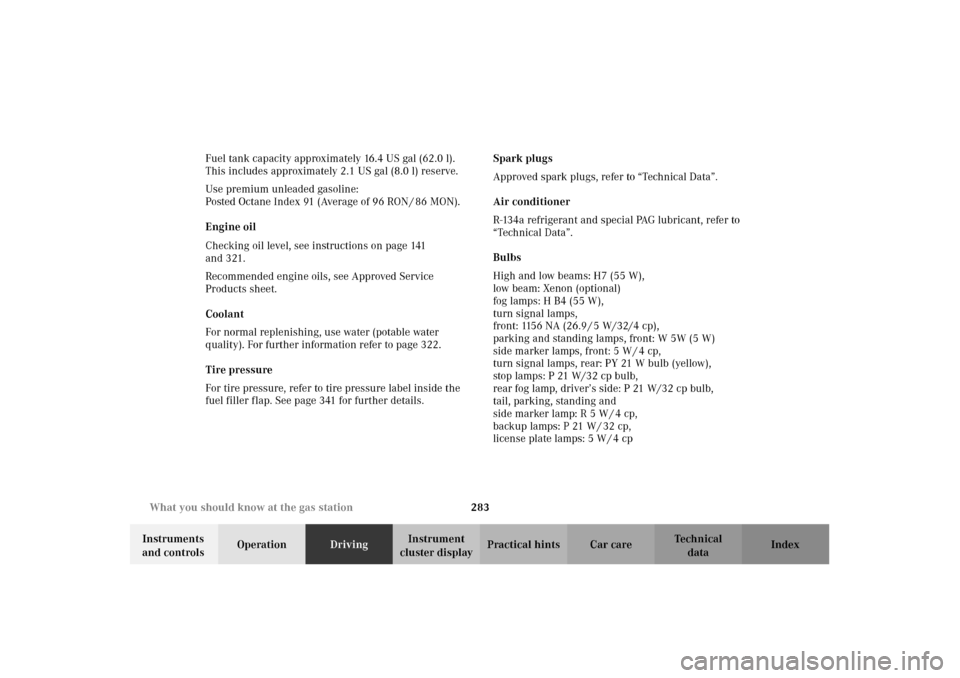
cluster displayPractical hints Car care Index Fuel tank capacity approximately 16.4 US gal (62.0 l).
This includes approximately 2.1 US gal (8.0 l) reserve.
Use premium unleaded gasoline:
Posted Octane Index 91 (Average of 96 RON / 86 MON).
Engine oil
Checking oil level, see instructions on page 141
and 321.
Recommended engine oils, see Approved Service
Products sheet.
Coolant
For normal replenishing, use water (potable water
quality). For further information refer to page 322.
Tire pressure
For tire pressure, refer to tire pressure label inside the
fuel filler flap. See page 341 for further details.Spark plugs
Approved spark plugs, refer to “Technical Data”.
Air conditioner
R-134a refrigerant and special PAG lubricant, refer to
“Technical Data”.
Bulbs
High and low beams: H7 (55 W),
low beam: Xenon (optional)
fog lamps: H B4 (55 W),
turn signal lamps,
front: 1156 NA (26.9 / 5 W/32/4 cp),
parking and standing lamps, front: W 5W (5 W)
side marker lamps, front: 5 W / 4 cp,
turn signal lamps, rear: PY 21 W bulb (yellow),
stop lamps: P 21 W/32 cp bulb,
rear fog lamp, driver’s side: P 21 W/32 cp bulb,
tail, parking, standing and
side marker lamp: R 5 W / 4 cp,
backup lamps: P 21 W / 32 cp,
license plate lamps: 5 W / 4 cp
OM_203.book Seite 283 Donnerstag, 31. Mai 2001 11:57 11
Page 316 of 406
313 Contents - Practical hints
Te ch n i c a l
data Instruments
and controlsOperation DrivingInstrument
cluster displayPractical hintsCar care Index
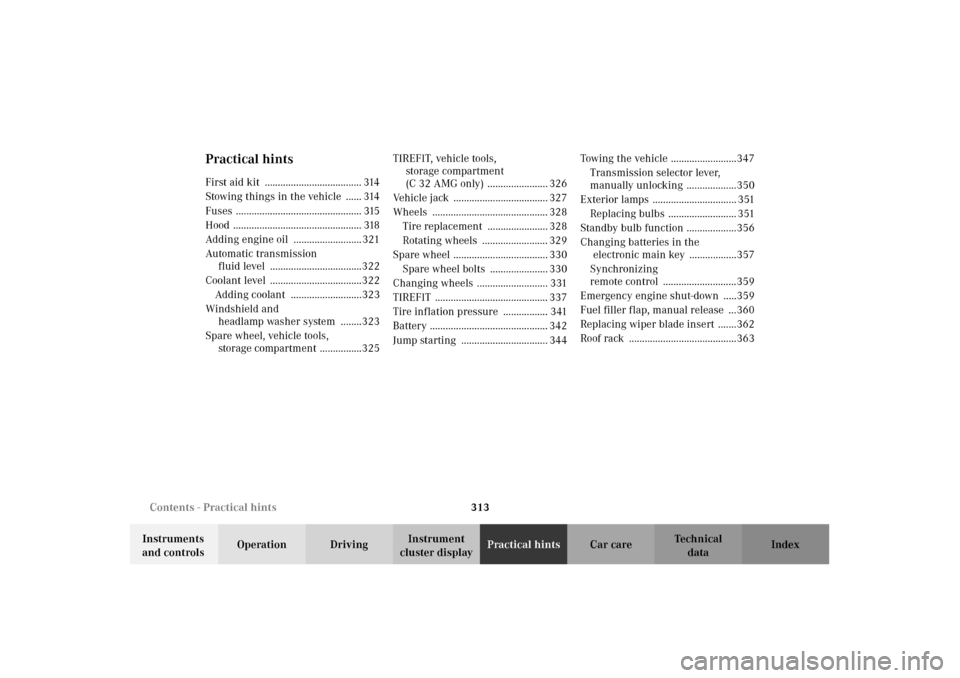
Practical hintsFirst aid kit ..................................... 314
Stowing things in the vehicle ...... 314
Fuses ................................................ 315
Hood ................................................. 318
Adding engine oil .......................... 321
Automatic transmission
fluid level ...................................322
Coolant level ...................................322
Adding coolant ...........................323
Windshield and
headlamp washer system ........323
Spare wheel, vehicle tools,
storage compartment ................325TIREFIT, vehicle tools,
storage compartment
(C 32 AMG only) ....................... 326
Vehicle jack .................................... 327
Wheels ............................................ 328
Tire replacement ....................... 328
Rotating wheels ......................... 329
Spare wheel .................................... 330
Spare wheel bolts ...................... 330
Changing wheels ........................... 331
TIREFIT ........................................... 337
Tire inflation pressure ................. 341
Battery ............................................. 342
Jump starting ................................. 344Towing the vehicle .........................347
Transmission selector lever,
manually unlocking ...................350
Exterior lamps ................................ 351
Replacing bulbs .......................... 351
Standby bulb function ...................356
Changing batteries in the
electronic main key ..................357
Synchronizing
remote control ............................359
Emergency engine shut-down .....359
Fuel filler flap, manual release ...360
Replacing wiper blade insert .......362
Roof rack .........................................363
OM_203.book Seite 313 Donnerstag, 31. Mai 2001 11:57 11
Page 332 of 406
329 Tires, Wheels
Te ch n i c a l
data Instruments
and controlsOperation DrivingInstrument
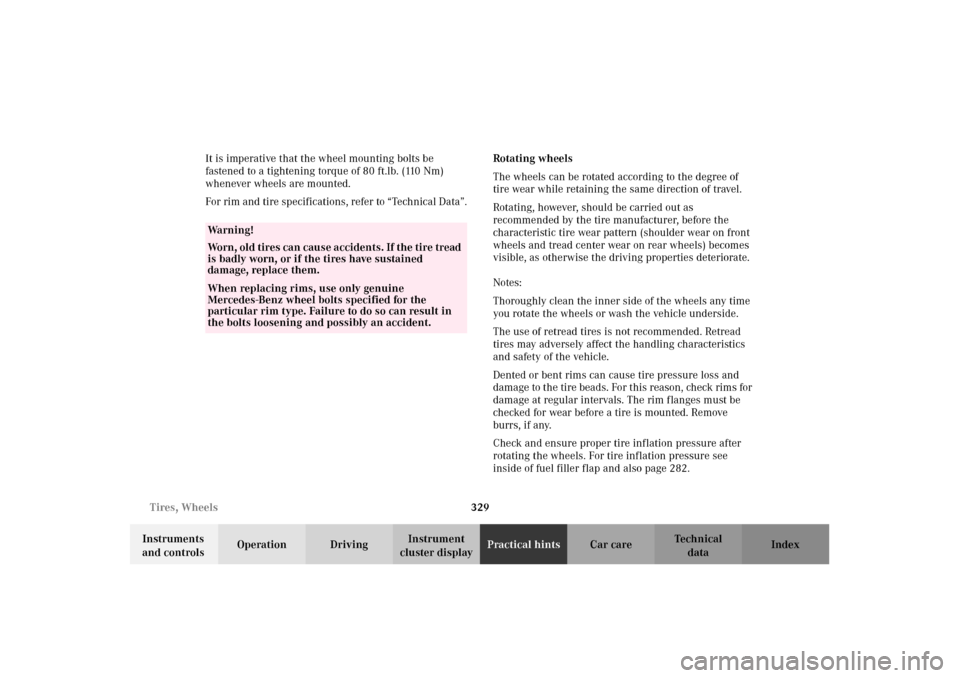
cluster displayPractical hintsCar care Index It is imperative that the wheel mounting bolts be
fastened to a tightening torque of 80 ft.lb. (110 Nm)
whenever wheels are mounted.
For rim and tire specifications, refer to “Technical Data”.Rotating wheels
The wheels can be rotated according to the degree of
tire wear while retaining the same direction of travel.
Rotating, however, should be carried out as
recommended by the tire manufacturer, before the
characteristic tire wear pattern (shoulder wear on front
wheels and tread center wear on rear wheels) becomes
visible, as otherwise the driving properties deteriorate.
Notes:
Thoroughly clean the inner side of the wheels any time
you rotate the wheels or wash the vehicle underside.
The use of retread tires is not recommended. Retread
tires may adversely affect the handling characteristics
and safety of the vehicle.
Dented or bent rims can cause tire pressure loss and
damage to the tire beads. For this reason, check rims for
damage at regular intervals. The rim flanges must be
checked for wear before a tire is mounted. Remove
burrs, if any.
Check and ensure proper tire inflation pressure after
rotating the wheels. For tire inflation pressure see
inside of fuel filler flap and also page 282.
Wa r n i n g !
Worn, old tires can cause accidents. If the tire tread
is badly worn, or if the tires have sustained
damage, replace them.When replacing rims, use only genuine
Mercedes-Benz wheel bolts specified for the
particular rim type. Failure to do so can result in
the bolts loosening and possibly an accident.
OM_203.book Seite 329 Donnerstag, 31. Mai 2001 11:57 11
Page 340 of 406
337 Tires, Wheels
Te ch n i c a l
data Instruments
and controlsOperation DrivingInstrument
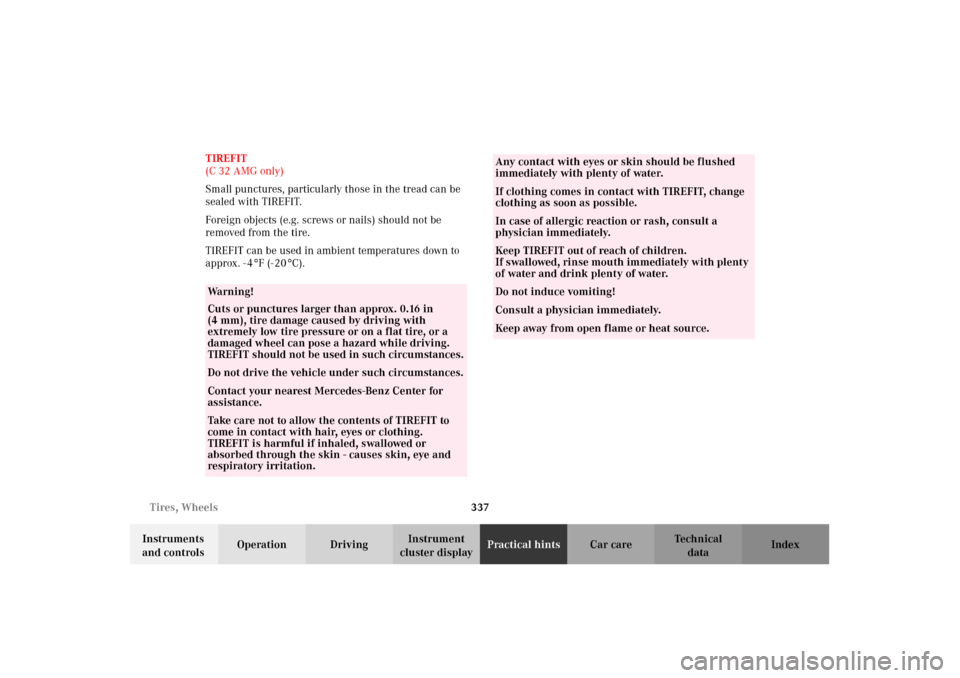
cluster displayPractical hintsCar care Index TIREFIT
(C 32 AMG only)
Small punctures, particularly those in the tread can be
sealed with TIREFIT.
Foreign objects (e.g. screws or nails) should not be
removed from the tire.
TIREFIT can be used in ambient temperatures down to
approx. - 4
°F (- 20
°C).
Wa r n i n g !
Cuts or punctures larger than approx. 0.16 in
(4 mm), tire damage caused by driving with
extremely low tire pressure or on a flat tire, or a
damaged wheel can pose a hazard while driving.
TIREFIT should not be used in such circumstances.Do not drive the vehicle under such circumstances.Contact your nearest Mercedes-Benz Center for
assistance.Take care not to allow the contents of TIREFIT to
come in contact with hair, eyes or clothing.
TIREFIT is harmful if inhaled, swallowed or
absorbed through the skin - causes skin, eye and
respiratory irritation.
Any contact with eyes or skin should be flushed
immediately with plenty of water.If clothing comes in contact with TIREFIT, change
clothing as soon as possible.In case of allergic reaction or rash, consult a
physician immediately.Keep TIREFIT out of reach of children.
If swallowed, rinse mouth immediately with plenty
of water and drink plenty of water.Do not induce vomiting!Consult a physician immediately.Keep away from open flame or heat source.
OM_203.book Seite 337 Donnerstag, 31. Mai 2001 11:57 11
Page 343 of 406
340 Tires, Wheels
Te ch n i c a l
data Instruments
and controlsOperation DrivingInstrument
cluster displayPractical hintsCar care Index
11. Remove air pump from storage compartment inside
trunk.
12. Pull out air hose with pressure gauge (5) and
electrical plug (6).
13. Screw filler hose (5) onto tire valve.
14. Plug air pump electrical plug (6) into vehicle cigar
lighter.
15. To switch on air pump, turn key in steering lock to
position 1.
Note:
After 5 minutes, pressure gauge must display
26 psi (1.8 bar). Do not exceed the maximum pressure
of 36 psi (2.5 bar)!
If pressure is not attained, drive vehicle
approx. 394 in (10 m), so that the sealing material is
evenly distributed inside the tire. Reconnect air pump
and inflate tire.Note:
Do not operate electric air pump longer that 6 minutes
wit hout interruption. Air pump could overheat! Af ter air
pump has cooled off, operate air pump again.
16. To switch off air pump, turn key in steering lock to
position 0.
17. Reinstall valve tire cap.
18. Drive vehicle to distribute the sealant evenly inside
the tire.
Wa r n i n g !
If a tire pressure of 26 psi (1.8 bar) is not attained,
tire is too severely damaged for TIREFIT to provide
a reliable tire repair.In this case TIREFIT can not properly seal the tire.Do not drive the vehicle.Contact the nearest Mercedes-Benz Center or call
Roadside Assistance.
OM_203.book Seite 340 Donnerstag, 31. Mai 2001 11:57 11
Page 344 of 406
341 Tires, Wheels
Te ch n i c a l
data Instruments
and controlsOperation DrivingInstrument
cluster displayPractical hintsCar care Index Notes:
If TIREFIT is liquid, clean water and a damp cloth will
remove the material from the vehicle or tire and wheel
components. Once TIREFIT sealing material had dried,
it can easily be peeled off and properly discarded.
Replace TIREFIT every 3 years.Tire inflation pressure
A table (see fuel filler flap) lists the tire inflation
pressures specified for Mercedes-Benz recommended
tires as well as for the varying operating conditions.
Important!
Tire pressure changes by approximately 1.5 psi (0.1 bar)
per 18
°F (10
°C) of air temperature change. Keep this in
mind when checking tire pressure inside a garage –
especially in the winter.
Example:
If garage temperature = approximately +68
°F (+20
°C)
and ambient temperature = approximately +32
°F (0
°C)
then the adjusted air pressure = specified air pressure
+3 psi (+0.2 bar).
Tire pressures listed for light loads are minimum values
offering high driving comfort. Increased inflation
pressures for heavy loads produce favorable handling
characteristics with lighter loads and are perfectly
permissible. The ride of the vehicle, however, will
become somewhat harder.
Tire temperature and pressure increase with the vehicle
speed. Tire pressure should therefore only be checked
and corrected on cold tires. Correct tire pressure in
Wa r n i n g !
Do not exceed vehicle speed of 50 mph (80 km / h).
A TIREFIT repair is not designed to operate at
higher speeds.Vehicle handling characteristics may change.After driving vehicle for an initial 10 minutes,
check tire pressure. If tire pressure has fallen
below 20 psi (1.3 bar) do not continue to drive the
vehicle.If tire pressure is at least 20 psi (1.3 bar), inflate
tire to correct pressure (see label on fuel filler
flap), and drive vehicle to nearest tire repair
facility to have tire repaired or replaced.Recommended duration of use: 300 miles (500 km)
at 50 mph (80 km / h) with the recommended tire
pressure.
OM_203.book Seite 341 Donnerstag, 31. Mai 2001 11:57 11