Malfunction display MERCEDES-BENZ C320 2001 W203 Owner's Manual
[x] Cancel search | Manufacturer: MERCEDES-BENZ, Model Year: 2001, Model line: C320, Model: MERCEDES-BENZ C320 2001 W203Pages: 381, PDF Size: 19.92 MB
Page 5 of 381

Contents
Trip and main odometer, FSS, coolant
temperature, vehicle speed,
engine oil level indicator ........... 96
Audio systems .................................. 98
Radio .............................................. 98
CD player ....................................... 99
Cassette player ........................... 100
Telephone ........................................ 101
Navigation system .......................... 106
Trip computer ................................. 107
Malfunction/warning
message memory ...................... 109
Individual settings ..........................111
Setting the audio volume .............. 123
Coolant temperature gauge .......... 124
Flexible service system
(FSS) ............................................ 125
Engine oil level indicator .............. 128
Engine oil consumption ................ 129
Exterior lamp switch ..................... 130
Headlamp mode ............................. 131Night security illumination ..........132
Locator lighting ...........................133
Headlamp cleaning system ...........133
Combination switch .......................134
Hazard warning flasher
switch ..........................................137
Climate control ...............................138
Automatic climate control ............ 146
Front center console storage
compartment ventilation ..........158
Rear passenger compartment
adjustable air outlets ................159
Operation Audio and telephone ...160
Operating safety .............................160
Operating and
display elements ........................ 161
Button and soft key operation ......163
Operation .........................................163
Power windows ...............................184
Sliding/pop-up roof ........................187
Interior lighting ..............................189
Rear window sunshade ................. 191Sun visors ....................................... 192
Vanity mirrors ................................ 192
Interior ............................................ 193
Storage compartments and
armrests ..................................... 193
Glove box ..................................... 194
Cup holder ...................................... 197
Ashtrays .......................................... 199
Lighter ............................................. 201
Parcel net in front passenger
footwell .......................................202
Ski sack ...........................................202
Enlarged cargo area .......................207
Split folding rear seat bench ........207
Loading instructions
(vehicle with enlarged
cargo area) ..................................209
Cellular telephone ......................... 210
Telephone, general ........................ 211
Garage door opener ....................... 212
Page 6 of 381

Contents
DrivingControl and operation of radio
transmitters ............................... 218
The first 1 000 miles
(1 500 km) ................................. 219
Maintenance ................................... 219
Tele Aid ...........................................220
Catalytic converter ........................228
Emission control ............................229
Starter switch .................................230
Starting and turning
off the engine ............................232
Manual transmission ....................233
Automatic transmission ...............234
Parking brake .................................243
Driving instructions ......................244
Drive sensibly – Save Fuel ........244
Drinking and driving .................244
Pedals ...........................................244Power assistance ........................ 245
Brakes .......................................... 245
Driving off ................................... 246
Parking ........................................ 246
Tires ............................................. 247
Snow chains ............................... 250
Winter driving
instructions ................................ 250
Deep water .................................. 252
Passenger compartment ........... 253
Traveling abroad ........................ 253
Cruise control ................................ 254
Brake assist system (BAS) ............ 257
Antilock brake system
(ABS) .......................................... 258
Electronic stability program
(ESP) ........................................... 260
What you should know at the gas
station ......................................... 264
Check regularly and before a long
trip .............................................. 266
Instrument cluster displayMalfunction and indicator lamps in
the instrument cluster .............268
On-board diagnostic system .........268
Check engine malfunction
indicator lamp .............................268
Brake warning lamp ..................270
Supplemental restraint system
(SRS) indicator lamp .................. 271
Fuel reserve warning ................. 271
ABS malfunction
indicator lamp .............................272
Electronic stability program
(ESP) — warning lamp ...............273
Seat belt nonusage
warning lamp ............................273
Malfunction and indicator lamp in
the center console .....................273
AIRBAG OFF indicator lamp .....273
Page 7 of 381

Contents
Malfunction and warning messages
in the multifunction display ... 274
DISPLAY DEFECTIVE ................275
BATTERY / ALTERNATOR ........ 276
ANTILOCK BRAKE SYSTEM .....277
BRAKE ASSIST ...........................277
BRAKE LINING WEAR ..............278
BRAKE FLUID .............................278
PARKING BRAKE .......................279
SEAT BELT SYSTEM ...................279
ELEC. STABIL. PROG.
(Electronic stability program) ..280
COOLANT (coolant level) .......... 281
COOLANT
(coolant temperature) ................282ENGINE OIL LEVEL ................... 283
LIGHTING SYSTEM ................... 284
LIGHT SENSOR .......................... 286
DOOR ........................................... 286
TRUNK OPEN ............................. 287
HOOD ........................................... 287
TELEPHONE – FUNCTION ....... 288
TELE AID ..................................... 288
WASHER FLUID ......................... 289
RESTRAINT SYSTEM ................ 290
KEY .............................................. 290
FUEL RESERVE .......................... 291
UNDERVOLTAGE ....................... 291
STEER. WHEEL ADJUST. .......... 292
ENTRANCE POSITION .............. 292
Practical hintsFirst aid kit .....................................294
Stowing things in the vehicle ......294
Fuses ................................................295
Hood .................................................297
Checking engine oil level .............300
Automatic transmission fluid
level ............................................. 301
Coolant level ................................... 301
Adding coolant ...........................302
Windshield and headlamp washer
system .........................................302
Spare wheel, vehicle tools, storage
compartment .............................304
Vehicle jack .....................................305
Page 29 of 381
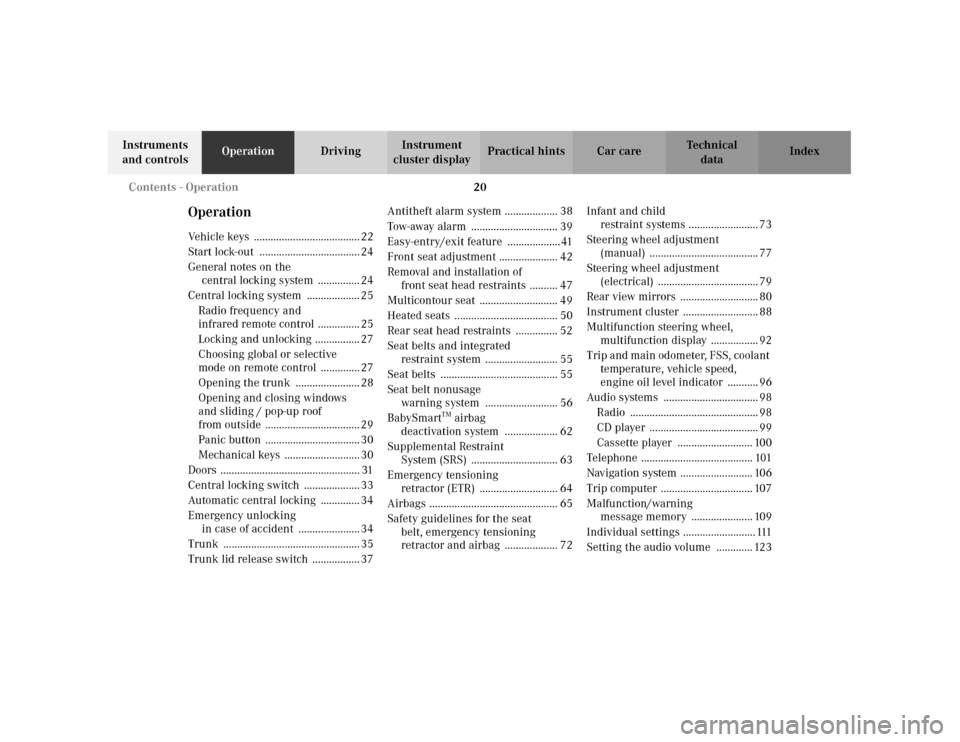
20 Contents - Operation
Te ch n i c a l
data Instruments
and controlsOperationDrivingInstrument
cluster displayPractical hints Car care Index
OperationVehicle keys ...................................... 22
Start lock-out .................................... 24
General notes on the
central locking system ............... 24
Central locking system ................... 25
Radio frequency and
infrared remote control ............... 25
Locking and unlocking ................ 27
Choosing global or selective
mode on remote control .............. 27
Opening the trunk ....................... 28
Opening and closing windows
and sliding / pop-up roof
from outside .................................. 29
Panic button .................................. 30
Mechanical keys ........................... 30
Doors .................................................. 31
Central locking switch .................... 33
Automatic central locking .............. 34
Emergency unlocking
in case of accident ...................... 34
Trunk ................................................. 35
Trunk lid release switch ................. 37Antitheft alarm system ................... 38
Tow-away alarm ............................... 39
Easy-entry/exit feature ................... 41
Front seat adjustment ..................... 42
Removal and installation of
front seat head restraints .......... 47
Multicontour seat ............................ 49
Heated seats ..................................... 50
Rear seat head restraints ............... 52
Seat belts and integrated
restraint system .......................... 55
Seat belts .......................................... 55
Seat belt nonusage
warning system .......................... 56
BabySmart
TM airbag
deactivation system ................... 62
Supplemental Restraint
System (SRS) ............................... 63
Emergency tensioning
retractor (ETR) ............................ 64
Airbags .............................................. 65
Safety guidelines for the seat
belt, emergency tensioning
retractor and airbag ................... 72Infant and child
restraint systems ......................... 73
Steering wheel adjustment
(manual) ....................................... 77
Steering wheel adjustment
(electrical) .................................... 79
Rear view mirrors ............................ 80
Instrument cluster ........................... 88
Multifunction steering wheel,
multifunction display ................. 92
Trip and main odometer, FSS, coolant
temperature, vehicle speed,
engine oil level indicator ........... 96
Audio systems .................................. 98
Radio .............................................. 98
CD player ....................................... 99
Cassette player ........................... 100
Telephone ........................................ 101
Navigation system .......................... 106
Trip computer ................................. 107
Malfunction/warning
message memory ...................... 109
Individual settings .......................... 111
Setting the audio volume ............. 123
Page 41 of 381
32 Central locking system
Te ch n i c a l
data Instruments
and controlsOperationDrivingInstrument
cluster displayPractical hints Car care Index
If the vehicle has previously been locked from the
outside, opening a door from the inside will trigger the
alarm. When opening a front door while the central
locking system is in the:
•selective unlocking mode, only that individual door
is unlocked. The remaining doors, the trunk and
fuel filler flap remain locked.
•global unlocking mode, all doors, the trunk and fuel
filler flap are unlocked.
Notes:
In case of a malfunction in the central locking system
the doors can be locked and unlocked individually.
To lock, push down lock buttons or turn mechanical key
in driver’s door lock to position 3. In addition lock the
trunk.To unlock, pull inside door handles or turn mechanical
key in driver’s door lock to position 2.
Rear doors can only be opened from inside by first
pulling up the door lock button.
When unlocking the driver’s door with the mechanical
key, the exterior lamps will flash and the alarm will
sound.
To cancel the alarm, insert the electronic key in the
starter switch or press buttonŒ or‹ on the
electronic main key.
Page 44 of 381
35 Central locking system
Te ch n i c a l
data Instruments
and controlsOperationDrivingInstrument
cluster displayPractical hints Car care Index Trunk
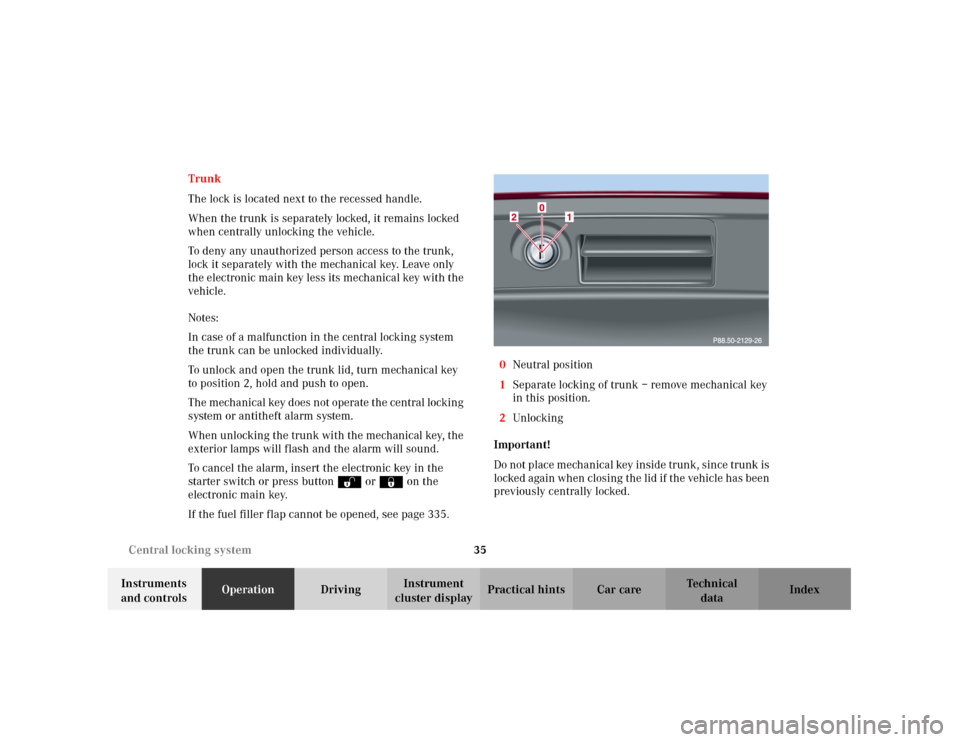
The lock is located next to the recessed handle.
When the trunk is separately locked, it remains locked
when centrally unlocking the vehicle.
To deny any unauthorized person access to the trunk,
lock it separately with the mechanical key. Leave only
the electronic main key less its mechanical key with the
vehicle.
Notes:
In case of a malfunction in the central locking system
the trunk can be unlocked individually.
To unlock and open the trunk lid, turn mechanical key
to position 2, hold and push to open.
The mechanical key does not operate the central locking
system or antitheft alarm system.
When unlocking the trunk with the mechanical key, the
exterior lamps will flash and the alarm will sound.
To cancel the alarm, insert the electronic key in the
starter switch or press buttonŒ or‹ on the
electronic main key.
If the fuel filler flap cannot be opened, see page 335.0Neutral position
1Separate locking of trunk – remove mechanical key
in this position.
2Unlocking
Important!
Do not p lac e m echan ical key in sid e tr un k , s in ce tr unk is
locked again when closing the lid if the vehicle has been
previously centrally locked.
Page 74 of 381
65 Restraint systems
Te ch n i c a l
data Instruments
and controlsOperationDrivingInstrument
cluster displayPractical hints Car care Index Airbags
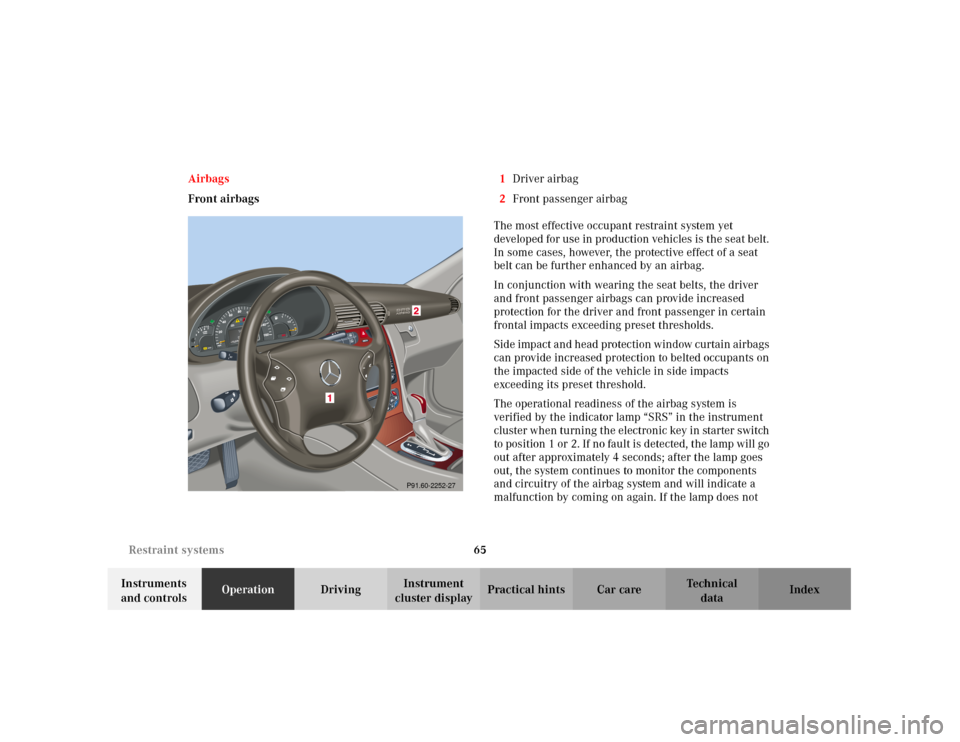
Front airbags1Driver airbag
2Front passenger airbag
The most effective occupant restraint system yet
developed for use in production vehicles is the seat belt.
In some cases, however, the protective effect of a seat
belt can be further enhanced by an airbag.
In conjunction with wearing the seat belts, the driver
and front passenger airbags can provide increased
protection for the driver and front passenger in certain
frontal impacts exceeding preset thresholds.
Sid e imp act an d head pro tec ti on win d ow curtai n air bags
can provide increased protection to belted occupants on
the impacted side of the vehicle in side impacts
exceeding its preset threshold.
The operational readiness of the airbag system is
verified by the indicator lamp “SRS” in the instrument
cluster when turning the electronic key in starter switch
to position 1 or 2. If no fault is detected, the lamp will go
out after approximately 4 seconds; after the lamp goes
out, the system continues to monitor the components
and circuitry of the airbag system and will indicate a
malfunction by coming on again. If the lamp does not
P91.60-2252-27
Page 75 of 381
66 Restraint systems
Te ch n i c a l
data Instruments
and controlsOperationDrivingInstrument
cluster displayPractical hints Car care Index
come on at all or if it fails to extinguish after
approximately 4 seconds or if it comes on thereafter,
a malfunction in the system has been detected.
The following system components are monitored or
undergo a self-check: crash-sensor(s), airbag ignition
circuits, front seat belt buckles, emergency tensioning
retractors, seat sensor.
Initially, when the electronic key is turned from starter
switch position 0 to position 1 or 2, malfunctions in the
crash sensor are detected and indicated (the “SRS”
indicator lamp stays on longer than 4 seconds or does
not come on).
Have the system checked at your authorized
Mercedes-Benz Center immediatelyIn the operational mode, after the indicator lamp has
gone out following the initial check, interruptions or
short circuits in the airbag ignition circuit and in the
driver and front passenger seat belt buckle harnesses,
and low voltage in the entire system are detected and
indicated.
Note:
See page 271 for information on the supplemental
restraint system (SRS) indicator lamp.
Wa r n i n g !
In the event a malfunction of the “SRS” is indicated
as outlined above, the “SRS” may not be
operational. For your safety, we strongly
recommend that you visit an authorized
Mercedes-Benz Center immediately to have the
system checked; otherwise the “SRS” may not be
activated when needed in an accident, which could
result in serious or fatal injury, or it might deploy
unexpectedly and unnecessarily which could also
result in injury.
Page 79 of 381
70 Restraint systems
Te ch n i c a l
data Instruments
and controlsOperationDrivingInstrument
cluster displayPractical hints Car care Index
Your vehicle was originally equipped with airbags
which are designed to activate in certain impacts
exceeding a preset threshold to reduce the potential
and severity of injury. It is important to your safety
and that of your passenger that you replace deployed
airbags and repair any malfunctioning airbags to
ensure the vehicle will continue to provide crash
protection for occupants.
Wa r n i n g !
Airbags are designed to reduce the potential of
injury in certain frontal (front airbags) impacts, or
side (side impact and head protection window
curtain airbags) impacts which may cause
significant injuries, however, no system available
today can totally eliminate injuries and fatalities.The activation of the “SRS” temporarily releases a
small amount of dust from the airbags. This dust,
however, is neither injurious to your health, nor
does it indicate a fire in the vehicle. The dust might
cause some temporary breathing difficulty for
people with asthma or other breathing trouble. To
avoid this, you may wish to get out of the vehicle as
soon as it is safe to do so. If you have any breathing
difficulty but cannot get out of the vehicle after the
airbag inflates, then get fresh air by opening a
window or door.The service life of the airbags extends to the date
indicated on the label located on the driver side
door latch post. To provide continued reliability
after that date, they should be inspected by an
authorized Mercedes-Benz Center at that time and
replaced when necessary.
Wa r n i n g !
To reduce the risk of injury when the front airbags
inflate, it is very important for the driver and front
passenger to always be in a properly seated
position and to wear your seat belt.For maximum protection in the event of a collision
always be in normal seated position with your back
against the backrest. Fasten your seat belt and
ensure that it is properly positioned on your body.Since the airbag inflates with considerable speed
and force, a proper seating and hands on steering
wheel position will help to keep you at a safe
distance from the airbag. Occupants who are
unbelted, out of position or too close to the airbag
can be seriously injured by an airbag as it inflates
with great force in the blink of an eye:
Page 87 of 381
78 Restraint systems
Te ch n i c a l
data Instruments
and controlsOperationDrivingInstrument
cluster displayPractical hints Car care Index
Unlocking:
Pull handle (1) out to its stop.
Adjusting:
Move steering wheel to the desired position.
Locking:
Push handle (1) in until it engages.Important!
Do not drive the vehicle until you have properly locked
the steering column.
See “STEERING WH. ADJUST” on page 292 for
malfunction and warning messages in the multifunction
display.