alarm MERCEDES-BENZ CL-CLASS 2000 User Guide
[x] Cancel search | Manufacturer: MERCEDES-BENZ, Model Year: 2000, Model line: CL-CLASS, Model: MERCEDES-BENZ CL-CLASS 2000Pages: 424, PDF Size: 26.09 MB
Page 65 of 424
62 Antitheft alarm system
Te ch n ica l
data Instruments
and controlsOperationDrivingInstrument
cluster displayPractical hints Car care Index
Antitheft alarm system
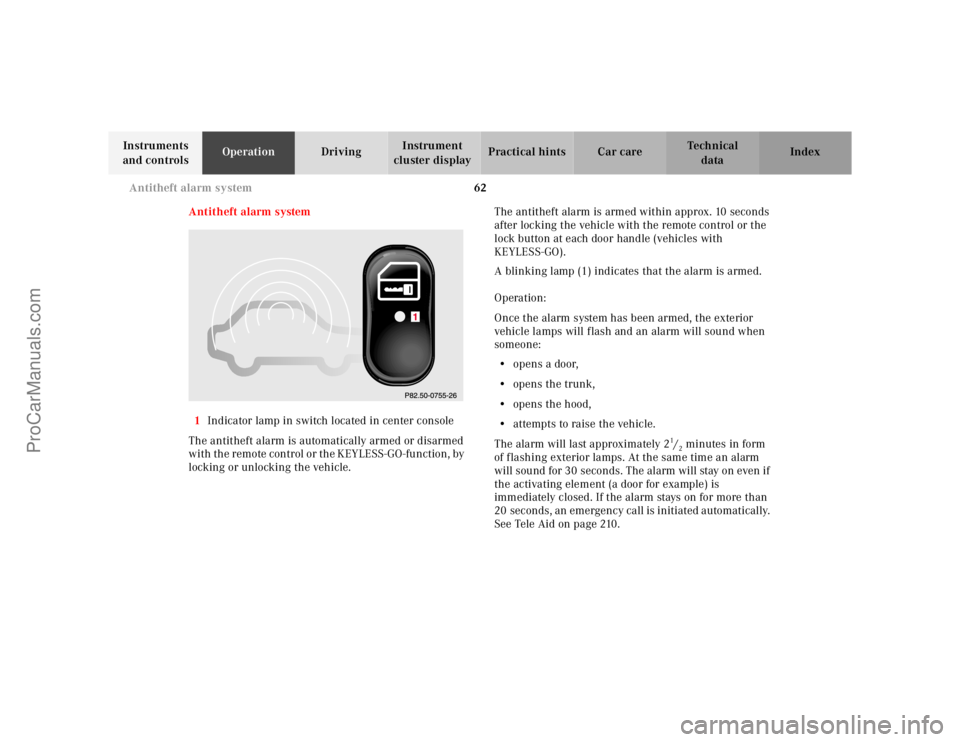
1Indicator lamp in switch located in center console
The antitheft alarm is automatically armed or disarmed
with the remote control or the KEYLESS-GO-function, by
locking or unlocking the vehicle.The antitheft alarm is armed within approx. 10 seconds
after locking the vehicle with the remote control or the
lock button at each door handle (vehicles with
KEYLESS-GO).
A blinking lamp (1) indicates that the alarm is armed.
Operation:
Once the alarm system has been armed, the exterior
vehicle lamps will flash and an alarm will sound when
someone:
•opens a door,
•opens the trunk,
•opens the hood,
•attempts to raise the vehicle.
The alarm will last approximately 2
1/2minutes in form
of f lashing exterior lamps. At the same time an alarm
will sound for 30 seconds. The alarm will stay on even if
the activating element (a door for example) is
immediately closed. If the alarm stays on for more than
20 seconds, an emergency call is initiated automatically.
See Tele Aid on page 210.
ProCarManuals.com
Page 66 of 424
63 Antitheft alarm system
Te ch n ica l
data Instruments
and controlsOperationDrivingInstrument
cluster displayPractical hints Car care Index Notes:
We recommend that you carry the electronic reserve
key plus mechanical key with you and keep it in a safe
place (e.g. your wallet) so that it is always handy. Never
leave the electronic reserve key in the vehicle.
When you unlock the driver’s door with the mechanical
key, the exterior lamps will flash and the alarm will
sound. To cancel the alarm, insert the electronic key in the
starter switch or press buttonŒ or‹ on the
electronic main key; or (vehicles with KEYLESS-GO)
when carrying the KEYLESS-GO-card, grasp the door
handle or press the start-/stop button on the gear
selector lever.
ProCarManuals.com
Page 67 of 424
64 Tow-away alarm
Te ch n ica l
data Instruments
and controlsOperationDrivingInstrument
cluster displayPractical hints Car care Index
Tow - aw ay al a rm
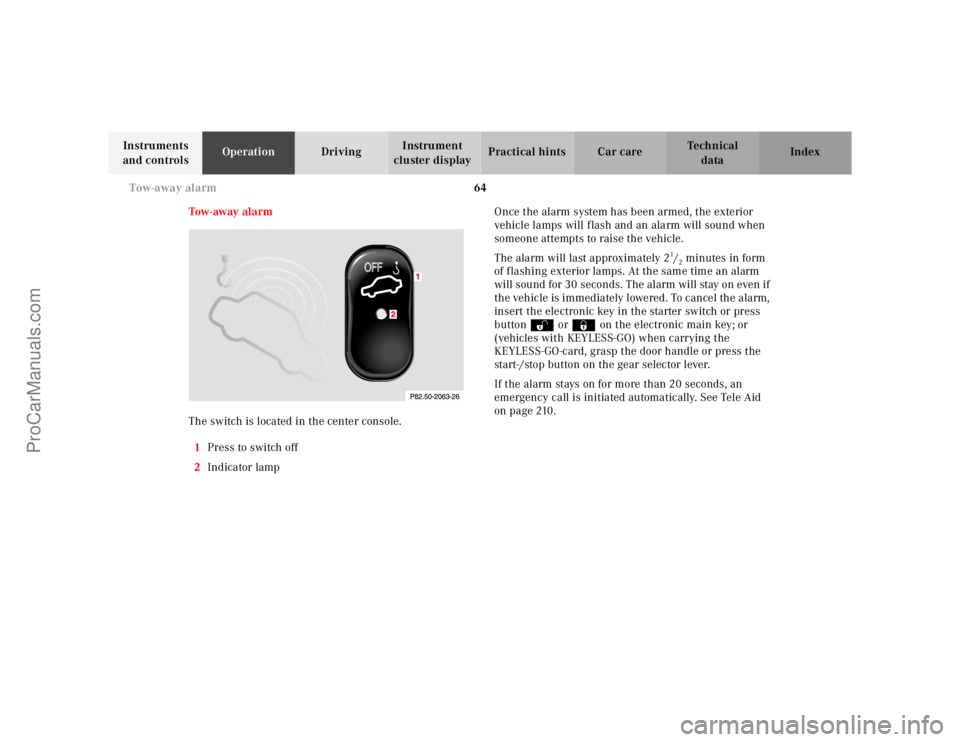
The switch is located in the center console.
1Press to switch off
2Indicator lampOnce the alarm system has been armed, the exterior
vehicle lamps will flash and an alarm will sound when
someone attempts to raise the vehicle.
The alarm will last approximately 2
1/2minutes in form
of f lashing exterior lamps. At the same time an alarm
will sound for 30 seconds. The alarm will stay on even if
the vehicle is immediately lowered. To cancel the alarm,
insert the electronic key in the starter switch or press
buttonŒ or‹ on the electronic main key; or
(vehicles with KEYLESS-GO) when carrying the
KEYLESS-GO-card, grasp the door handle or press the
start-/stop button on the gear selector lever.
If the alarm stays on for more than 20 seconds, an
emergency call is initiated automatically. See Tele Aid
on page 210.
ProCarManuals.com
Page 68 of 424
65 Tow-away alarm
Te ch n ica l
data Instruments
and controlsOperationDrivingInstrument
cluster displayPractical hints Car care Index To prevent triggering the tow-away alarm feature, switch
off the tow-away alarm before towing the vehicle, or
when parking on a surface subject to movement, such
as a ferry or auto train.
To do so, turn electronic key in starter switch to
position 1 or 0, or remove electronic key from starter
switch. Press tow-away alarm switch (1). The indicator
lamp (2) illuminates briefly.Exit vehicle, and lock vehicle with the electronic main
key or (vehicles with KEYLESS-GO) the lock button at
each door handle.
The tow-away alarm remains switched off until the
vehicle is locked again with the electronic main key or
the lock button at each door handle (vehicles with
KEYLESS-GO) at which time it is automatically
reactivated.
ProCarManuals.com
Page 215 of 424
210 Tele Aid
Te ch n ica l
data Instruments
and controlsOperationDrivingInstrument
cluster displayPractical hints Car care Index
Te l e A i d
Important!
The initial activation of the Tele Aid system may only be
performed by completing the subscriber agreement and
placing an acquaintance call using the “SOS” button.
Failure to complete either of these steps will result in a
system that is not activated. If the system is not
activated the indicator lamp in the “SOS” button stays
on after turning electronic key in starter switch to
position 2 (vehicles with KEYLESS-GO:
operating position, see page 224) and the message
“TELE AID – NOT ACTIVATED” will be shown in the
multifunction display for approx. 10 seconds.
If you have any questions regarding activation, please
call the Response Center at 1-800-756-9018 (in the USA)
or 1-888-923-8367 (in Canada).
(Te l ematic Alarm Identification on Demand)
The Tele Aid system consists of three types of response;
automatic and manual emergency, roadside assistance
and information.
The Tele Aid system is operational providing that the
vehicle’s battery is charged, properly connected, not
damaged and cellular and GPS coverage is available.The speaker volume of a Tele Aid call can be adjusted
when using the volume control on the multifunction
steering wheel, for raising press buttonæand for
lowering press buttonç.
To activate, press the “SOS” button, the Roadside
Assistance button• or the Information button¡,
depending on the type of response required.
Shortly after the completion of your Acquaintance Call,
you will receive a user ID and password via first call
mail. By visiting www.mbusa.com and selecting
“Tele Aid” (USA only), you will have access to account
information, remote door unlock, Info Services* profile
and more.
* Optional System self-check
Initially, after turning the electronic key in starter
switch to position 2, malfunctions are detected and
indicated (the indicator lamps in the “SOS” button, the
Roadside Assistance button• and the Information
button¡ stay on longer than 10 seconds or do not
come on). The message “TELE AID – VISIT
WORKSHOP” appears for approx. 10 seconds in the
multifunction display.
ProCarManuals.com
Page 216 of 424
211 Tele Aid
Te ch n ica l
data Instruments
and controlsOperationDrivingInstrument
cluster displayPractical hints Car care Index Important!
Always make sure that the indicator lamps in the
“SOS” button, in the “Roadside Assistance” button and
in the “Information” button do not remain illuminated
constantly in red and the message “TELE AID – VISIT
WORKSHOP” is not displayed in the multifunction
display after the system self check.
If a malfunction is indicated as outlined above, have the
system checked at the nearest Mercedes-Benz Center as
soon as possible.
Emergency calls
An emergency call is initiated automatically:
•following an accident in which the Emergency
Tensioning Retractors (ETR’s) or airbags deploy,
•if the antitheft alarm or the tow away alarm stays on
for more than 20 seconds, see pages 62 and 64.
An emergency call can also be initiated manually by
opening the cover next to the inside rear view mirror
labeled “SOS”, then pressing the button (for longer than
2 seconds) located under the cover. See below for
instructions on initiating an emergency call manually.Once the emergency call is in progress, the indicator
lamp in the “SOS” button will begin to f lash. The
message “EMERGENCY CALL – CONNECTING CALL”
appears in the multifunction display. When the
connection is established, the message “EMERGENCY
CALL – CALL CONNECTED” appears in the
multifunction display. All information relevant to the
emergency, such as the location of the vehicle
(determined by the GPS satellite location system),
vehicle model, identification number and color are
generated.
A voice connection between the Response Center and
the occupants of the vehicle will be established
automatically soon after the emergency call has been
initiated. When a voice connection is established the
audio system mutes and the message “TELE AID –
EMERGENCY CALL ACTIVE” appears in the
multifunction display. The Response Center will attempt
to determine more precisely the nature of the accident
provided they can speak to an occupant of the vehicle.
ProCarManuals.com
Page 359 of 424
353 Towing the vehicle
Te ch n ica l
data Instruments
and controlsOperation DrivingInstrument
cluster displayPractical hintsCar care Index We recommend that the vehicle be transported using
flat bed equipment. This method is preferable to other
types of towing.
Important!
To prevent damage during transport, do not tie down
vehicle by its chassis or suspension parts.
The vehicle may be towed with all wheels on the ground
and the selector lever in position “N” for distances up to
30 miles (50 km) and at a speed not to exceed 30 mph
(50 km/h). The electronic key must be in starter switch
position 2.
To be certain to avoid a possibility of damage to the
transmission, however, we recommend the drive shaft
be disconnected at the rear axle drive f lange for any
towing beyond a short tow to a nearby garage.
Do not tow with sling-type equipment. Towing with
sling-type equipment over bumpy roads will damage
radiator and supports.
Use wheel lift, dolly, or flat bed equipment, with
electronic key in starter switch turned to position 0.Note:
To signal turns while being towed with hazard warning
flasher in use, turn electronic key in starter switch to
position 2 and activate combination switch for left or
right turn signal in usual manner – only the selected
turn signal will operate.
Upon canceling the turn signal, the hazard warning
flasher will operate again.
Caution!
If the vehicle is towed with the front axle raised, the
engine must be shut off (electronic key in starter switch
position 0 or 1). Otherwise, the ESP will immediately be
engaged and will apply the rear wheel brakes.
Switch off the tow-away alarm (see “VEHICLE” under
“Individual settings” on page 144) as well as the ESP
(see page 273).
Wa r n i n g !
With the engine not running, there is no power
assistance for the braking and steering systems. In
this case, it is important to keep in mind that a
considerably higher degree of effort is necessary to
brake and steer the vehicle.
ProCarManuals.com
Page 407 of 424
401 Index
Te ch n ica l
data Instruments
and controlsOperation DrivingInstrument
cluster displayPractical hints Car careIndex
Index
AABS (Antilock brake system) .......................................269
Malfunction indicator lamp .....................................294
ACTIV E BODY CONTRO L -
malfunction and warning messages ...................... 310
Active body control (ABC) ............................................275
Active body control (ABC) fluid level .........................332
Air conditioner refrigerant ...........................................395
Air distribution, manual ............................................... 169
Air volume, manual ....................................................... 169
Airbag deactivation system ............................................ 88
Airbag OFF indicator lamp ...........................................296
Airbags .............................................................................. 92
Front airbags ............................................................... 92
Side impact airbags .................................................... 95
Window curtain airbags ............................................. 95
Alarm system ............................................................. 62, 64
Anticorrosion/antifreeze ................... 247, 333, 393, 398
Antiglare night position ............................................... 106
Antilock brake system (ABS) .......................................269
Malfunction indicator lamp .....................................294
Antitheft alarm system ................................................... 62Aquaplaning .................................................................. 244
Armrest, rear bench ....................................................... 195
Ashtrays ........................................................................... 196
Center console, front ................................................ 196
Rear seats ................................................................... 197
Audio systems .................................................................125
Cassette player ..........................................................127
CD player ....................................................................126
Radio ...........................................................................125
Automatic central locking ..............................................52
Automatic climate control ............................................ 164
Activated charcoal filter ...........................................172
Adjustable air outlets,
rear passenger compartment .............................177
Air distribution, manual .......................................... 169
Air recirculation ........................................................ 171
Air volume, manual .................................................. 169
Basic setting ............................................................... 168
Defogging windows ...........................................170, 171
Defrosting ...................................................................170
Display and controls ................................................. 166
Dust filter ................................................................... 167
Economy mode ..........................................................173
Front center console
storage compartment ventilation .......................175
Rear window defroster ............................................. 176
ProCarManuals.com
Page 418 of 424

412 Index
Te ch n ica l
data Instruments
and controlsOperation DrivingInstrument
cluster displayPractical hints Car careIndex
TTachometer ......................................................................119
Technical data ................................................................388
Electrical system ....................................................... 391
Main dimensions ......................................................392
Rims and tires ...........................................................389
Weights .......................................................................392
Tele Aid ........................................................................... 210
Emergency calls ........................................................ 211
Information ................................................................ 215
Initiating an emergency call manually ................. 213
Roadside Assistance ................................................. 214
TELE AID - malfunction
and warning messages ............................................ 317
Telephone ........................................................................ 128
General notes ............................................................. 201
Incoming call ............................................................. 131
Redialing .................................................................... 130
Telephone book ......................................................... 128
TELEPHONE - FUNCTION -
malfunction and warning messages ......................309
Telephones and two-way radios ...................................208
The first 1 000 miles (1 500 km) ................................209
Tire inflation pressure ..................................................345Tire inflation pressure monitor ................................... 150
Inquiry of present tire inflation pressure ............. 150
TIRE PRESSURE -
malfunction and warning messages ...................... 312
Tire traction ................................................................... 244
Tires ................................................................................ 399
Driving instructions ................................................ 243
Rims and tires .......................................................... 389
Rotating wheels ........................................................ 338
Tire inflation pressure ............................................ 345
Tire replacement ...................................................... 337
Winter driving instructions .................................... 247
Tow-away alarm ................................................................64
Towing the vehicle ......................................................... 351
Transmission ................................................................. 229
Traveling abroad ........................................................... 249
Trip computer ................................................................. 134
Trip odometer ................................................................. 119
Trunk .................................................................................53
Opening ........................................................................37
Power closing assist .................................................... 50
Release switch ............................................................. 57
Release/close system ..................................................58
Trunk lid closing feature ...........................................55
Trunk lamp ..................................................................... 371
ProCarManuals.com