belt MERCEDES-BENZ CL COUPE 2009 Owners Manual
[x] Cancel search | Manufacturer: MERCEDES-BENZ, Model Year: 2009, Model line: CL COUPE, Model: MERCEDES-BENZ CL COUPE 2009Pages: 421, PDF Size: 10.78 MB
Page 8 of 421
ATA (anti-theft alarm system)
. . . . ..54
Switching off the alarm . . . . . . . . . .55
Audio (COMAND)
AUX mode . . . . . . . . . . . . . . . . . . . .83
CD mod e.. . . . . . . . . . . . . . . . . . . .79
DVD mod e.. . . . . . . . . . . . . . . . . . .79
MP3 mode . . . . . . . . . . . . . . . . . . . .79
Audio DVD
Menu overview . . . . . . . . . . . . . . . . .79
Setting the audio format . . . . . . . . .82
Stop function . . . . . . . . . . . . . . . . . .81
AUTO lights
Display message . . . . . . . . . . . . . .344
Automatic car wash . . . . . . . . . . . ..307
Automatic transmission Display message . . . . . .318, 322, 330
Driving tips . . . . . . . . . . . . . . . . . . .208
Emergency running mode . . . . . . .359
Malfunction . . . . . . . . . . . . . . . . . .359
Program selector button . . . . . . . .210
Shift ranges . . . . . . . . . . . . . . . . . .209
AUX
Audi o.. . . . . . . . . . . . . . . . . . . . . . .83
Video . . . . . . . . . . . . . . . . . . . . . . . .83
Auxiliary heating . . . . . . . . . . . . . . ..270
Display message . . . . . . . . . . . . . .342
Notes . . . . . . . . . . . . . . . . . . . . . . .270
Remote control . . . . . . . . . . . . . . .271
Setting the departure time . . . . . . .172
Auxiliary ventilation . . . . . . . . . . . ..270 B
Back button COMAND . . . . . . . . . . . . . . . . . . . . .68
BAS (Brake Assist) . . . . . . . . . . . . . . ..49
BAS PLUS (Brake Assist System
Plus*) . . . . . . . . . . . . . . . . . . . . . . . . . .49
Batteries Changing (entertainment system
headphones) . . . . . . . . . . . . . . . . .369
Changing (entertainment system
remote control) . . . . . . . . . . . . . . .369
Battery
Changing (auxiliary heating
remote control) . . . . . . . . . . . . . . .368
Charging . . . . . . . . . . . . . . . . . . . . .384
Checking (key ).. . . . . . . . . . . . . . .367 Check lamp (key
).. . . . . . . . . . . . .367
Disconnecting . . . . . . . . . . . . . . . .385
Display message . . . . . . . . . .318, 331
Fitting the battery . . . . . . . . . . . . .386
Jump-starting . . . . . . . . . . . . . . . . .384
Maintenance (vehicle ).. . . . . . . ..382
Reconnecting . . . . . . . . . . . . . . . . .386
Removing the battery . . . . . . . . . . .385
Vehicle battery . . . . . . . . . . . . . . . .382
Voltage (on-board computer) . . . . .220
Belt force limiters
Activatio n.. . . . . . . . . . . . . . . . . . . .37
Belt tensioners
Activation . . . . . . . . . . . . . . . . . . . . .37
Belt warning . . . . . . . . . . . . . . . . . . . .193
Blind see Roller sunblind
Blind Spot Assist . . . . . . . . . . . . . . . .260
Activating/deactivating (on-
board computer) . . . . . . . . . . . . . .224
Display message . . . . . . . . . . . . . .329
Indicator lamp . . . . . . . . . . . . . . . .350
Warning lamp . . . . . . . . . . . . . . . . .350
Bluetooth ®
Authorising devices . . . . . . . . . . . .107
External authorisation . . . . . . . . . .109
Interface . . . . . . . . . . . .106, 109, 112
Telephony . . . . . . . . . . . . . . .106, 112
Bluetooth ®
telephony
Menu overview . . . . . . . . . . . . . . . .110
Bonnet
Bonnet catch . . . . . . . . . . . . . . . . .292
Display message . . . . . . . . . . . . . .330
Opening/closing . . . . . . . . . . . . . .292
Bonnet release lever
Release lever . . . . . . . . . . . . . . . . .292
Boot
Automatic opening . . . . . . . .181, 182
Emergency release . . . . . . . . . . . . .366
Limiting the opening angl e.. . . . ..168
Locking separatel y.. . . . . . . . . . ..181
Boot lid
Display message . . . . . . . . . . . . . .330
Opening/closing . . . . . . . . . . . . . .180
Boot lid opening limiter . . . . . . . . ..168 Index
5 216_AKB; 2; 3, en-GB
bjanott,
Version: 2.11.7.7 2009-02-27T14:54:17+01:00 - Seite 5Dateiname: 6515230602_buchblock.pdf; erzeugt am 04. Mar 2009 11:14:34; WK
Page 13 of 421

Fuse box
Dashboard . . . . . . . . . . . . . . . . . . .389
Engine compartment . . . . . . . . . . .390
Rea r.. . . . . . . . . . . . . . . . . . . . . . .390
Fuses . . . . . . . . . . . . . . . . . . . . . . . . . .389 G
Garage door Opening/closing (with the remote
control) . . . . . . . . . . . . . . . . . . . . .286
Garage door opener . . . . . . . . . . . . ..285
Clearing the memory . . . . . . . . . . .286
Frequencies . . . . . . . . . . . . . . . . . .408
Programming the remote control . .285
Gear indicator . . . . . . . . . . . . . . . . . .208
Gear indicator (on-board computer) 220
Genuine Mercedes-Benz parts . . . ..394
Glove compartment . . . . . . . . . . . . ..276 H
Hands-free system Switching on/off . . . . . . . . . . . . . .114
Switching to the mobile phone . . .116
Headlamp cleaning system . . . . . ..295
Headlamps Cleaning . . . . . . . . . . . . . . . . . . . . .309
Cleaning system . . . . . . . . . . . . . . .197
Misting up . . . . . . . . . . . . . . . . . . .360
Head restraints
Rear compartment . . . . . . . . . . . . .186
Heating
see Air conditioning
High-pressure cleaners . . . . . . . . . ..308
Hill start assist . . . . . . . . . . . . . . . . .204
HOLD . . . . . . . . . . . . . . . . . . . . . . . . . .245
Display message . . . . . . . . . . . . . .322
HomeLink ®
see Garage door opener I
Immobiliser . . . . . . . . . . . . . . . . . . . . .54
Indicator and warning lamp Automatic child seat recognition
(malfunction ).. . . . . . . . . . . . . . . .350
Brakes (red ).. . . . . . . . . . . . .352, 354
Brakes (yellow) . . . . . . . . . . . . . . . .354 Engine diagnostics . . . . . . . . . . . .
.354
ESP ®
. . . . . . . . . . . . . . . . . . . . . . .352
PASSENGER AIRBAG OFF . . . .44, 350
Reserve fuel . . . . . . . . . . . . . . . . . .356
Seat belt . . . . . . . . . . . . . . . . . . . . .355
SRS . . . . . . . . . . . . . . . . . . . . .37, 353
Indicator lamp
Display message . . . . . . . . . . . . . .344
see Indicator and warning lamp . . .351
Instrument cluster . . . . . . . . . . . . ..212
Overview . . . . . . . . . . . . . . . . . . . . .27
Intelligent Light System . . . . . . . . ..197
Display message . . . . . . . . . .323, 346
Menu (on-board computer) . . . . . .225
Tourist mode . . . . . . . . . . . . . . . . .225
Interior lighting
Ambient light (COMAND) . . . . . . . .166
Automatic control system . . . . . . .199
Emergency lighting . . . . . . . . . . . .199
Interior lighting . . . . . . . . . . . . . . . .166
Manual control . . . . . . . . . . . . . . . .198
Reading lamp . . . . . . . . . . . . . . . . .198
Interior motion sensor . . . . . . ..55, 167
ISOFIX child seat securing system ..47 J
Jack Operation . . . . . . . . . . . . . . . . . . . .378
Storage location . . . . . . . . . . . . . . .315
Jump-starting . . . . . . . . . . . . . . . . . . .384
Jump leads . . . . . . . . . . . . . . . . . . .384 K
Key . . . . . . . . . . . . . . . . . . . . . . . . . . .178
Checking the battery . . . . . . . . . . .367
Convenience closing . . . . . . . . . . .201
Convenience opening . . . . . . . . . . .201
Display message . . . . . . . . . . . . . .340
Loss . . . . . . . . . . . . . . . . . . . . . . . .363
Malfunction . . . . . . . . . . . . . . . . . .362
Modifying the programming . . . . . .179
KEYLESS GO
Button . . . . . . . . . . . . . . . . . . . . . .182
Changing the battery . . . . . . . . . . .368
Checking the battery . . . . . . . . . . .367
Convenience closing . . . . . . . . . . .202 10
Index 216_AKB; 2; 3, en-GB
bjanott,
Version: 2.11.7.7 2009-02-27T14:54:17+01:00 - Seite 10Dateiname: 6515230602_buchblock.pdf; erzeugt am 04. Mar 2009 11:14:35; WK
Page 17 of 421
Pulling away
. . . . . . . . . . . . . . . . . . . .203
PULSE see Massage function R
RACETIMER (on-board computer) ..2 20
Radar sensor system Country overview . . . . . . . . . . . . . .411
Display message . . . . . . . . . . . . . .326
Radar system sensors
Switching on/off (on-board com-
puter) . . . . . . . . . . . . . . . . . . . . . . .226
Radio
Menu overview . . . . . . . . . . . . . . . . .70
Mode . . . . . . . . . . . . . . . . . . . . . . . .70
Radio Data Syste m . . . . . . . . . . . . . .73
RDS frequency diversit y.. . . . . . . ..73
Selecting a station (COMAND) . . . . .71
Selecting a station (on-board
computer) . . . . . . . . . . . . . . . . . . .218
Storing stations . . . . . . . . . . . . . . . .72
Switching wavebands . . . . . . . . . . . .71
Radio-controlled equipment
Installation . . . . . . . . . . . . . . . . . . .284
Rain closing feature
Sliding/tilting sunroo f.. . . . . . . ..275
Range
Calling up (on-board computer) . . .216
RDS . . . . . . . . . . . . . . . . . . . . . . . . . . . .73
RDS (Radio Data System) . . . . . . . . ..73
RDS-TMC . . . . . . . . . . . . . . . . . . . . . . .155
Rear compartment Head restraints . . . . . . . . . . . . . . .186
Rear-compartment seats . . . . . . . ..186
Rear foglamp Display message . . . . . . . . . . . . . .345
Rear-view mirror
Anti-dazzle mode (automatic) . . . .189
Rear window blind
see Rear window roller sunblind
Rear window heating . . . . . . . . . . ..268
Redial . . . . . . . . . . . . . . . . . . . . . . . . .114
Refuelling . . . . . . . . . . . . . . . . . . . . . .290
Region code . . . . . . . . . . . . . . . . . . . . .84Remote control
Auxiliary heating . . . . . . . . . . . . . .271
Changing the batteries (auxiliary
heating) . . . . . . . . . . . . . . . . . . . . .368
Garage door opene r.. . . . . . . . . . .285
Programming (garage door
opener) . . . . . . . . . . . . . . . . . . . . . .285
Reserve
Warning lamp . . . . . . . . . . . . . . . . .356
Reserve fuel . . . . . . . . . . . . . . . . . . . .397
Display message . . . . . . . . . . . . . .348
Fuel tank . . . . . . . . . . . . . . . . . . . .397
Warning lamp . . . . . . . . . . . . . . . . .356
Reset (COMAND) . . . . . . . . . . . . . . ..163
Restraint systems For children . . . . . . . . . . . . . . . . . . .43
See SRS . . . . . . . . . . . . . . . . . . . . .37
Retaining hooks (boot) . . . . . . . . . ..280
Rev counter . . . . . . . . . . . . . . . . . . . .212
Reversing camera . . . . . . . . . . . . . ..257
Cleaning . . . . . . . . . . . . . . . . . . . . .310
Reversing lamps
Display message . . . . . . . . . . . . . .346
Roller sunblind
Rear window . . . . . . . . . . . . . . . . .281
Rear window (COMAND) . . . . . . . .165
Route info . . . . . . . . . . . . . . . . . . . . . .153 S
Seat Active multicontour sea t.. . . . . ..175
Adjusting . . . . . . . . . . . . . . . . . . . .183
Adjusting (rear compartment) . . . .186
Correct driver's seat position . . . . .193
Display message . . . . . . . . . . . . . .348
Storing settings . . . . . . . . . . . . . . .190
Seat backrest
Folding forwards/back . . . . . . . . .185
Seat belt
Fastening . . . . . . . . . . . . . . . . . . . .191
Warning lamp . . . . . . . . . . . . .193, 355
Seat covers
Cleaning . . . . . . . . . . . . . . . . . . . . .311
Seat heating . . . . . . . . . . . . . . . . . . . .187
Seat ventilation . . . . . . . . . . . . . . . . .186
Malfunction indicator lamp . . . . . .349
Selecting the route type . . . . . . . . ..131 14
Index 216_AKB; 2; 3, en-GB
bjanott,
Version: 2.11.7.7 2009-02-27T14:54:17+01:00 - Seite 14Dateiname: 6515230602_buchblock.pdf; erzeugt am 04. Mar 2009 11:14:35; WK
Page 20 of 421
Type identification plate
see vehicle identification plate . . .396
Tyre grip . . . . . . . . . . . . . . . . . . . . . . .305
Tyre pressure . . . . . . . . . . . . . . . . . .298
Calling up (on-board computer) . .300
Display message . . . . . . . . . .327, 348
Tyre pressure loss warning system
. . . . . . . . . . . . . . . . . . . . . . . . . . . . . . .299
Tyre pressure monitor
Warning lamp . . . . . . . . . . . . . . . . .354
Tyres
Direction of rotatio n.. . . . . . . . . . .297
General notes . . . . . . . . . . . . . . . . .296
Technical data . . . . . . . .403, 404, 406
Tyre tread . . . . . . . . . . . . . . . . . . . . . .298 U
Unladen weight see Technical data
Unlocking
Emergency unlocking . . . . . . . . . . .366
From the inside (central unlocking
button) . . . . . . . . . . . . . . . . . . . . . .179
Up (display message) . . . . . . . . . . ..220 V
Variable Speedtronic . . . . . . . . . . . ..243
Vehicle Emergency unlocking . . . . . . . . . . .366
Individual settings (on-board com-
puter) . . . . . . . . . . . . . . . . . . . . . . .225
Leaving parked up . . . . . . . . . . . . .365
Towing . . . . . . . . . . . . . . . . . . . . . .388
Transporting . . . . . . . . . . . . . . . . . .388
Vehicle battery . . . . . . . . . . . . . . . . .382
Vehicle dimensions see Technical data
Vehicle electronics . . . . . . . . . . . . ..394
Vehicle identification number
(VIN) . . . . . . . . . . . . . . . . . . . . . . . . . .396
Vehicle identification plate . . . . . ..396
Vehicle level Adjusting (Active Body Control )...2 48
Display messages . . . . . . . . . . . . .338
Setting (AIRMATIC) . . . . . . . . . . . .246
Vehicle tool kit . . . . . . . . . . . . . . . . . .315 Vehicle weights
see Technical data
Video
AUX mode . . . . . . . . . . . . . . . . . . . .83
DVD mod e.. . . . . . . . . . . . . . . . . . .84
Video DVD . . . . . . . . . . . . . . . . . . . . . .84
Fast forward/rewind . . . . . . . . . . . .86
Menu overview . . . . . . . . . . . . . . . . .85
Operation . . . . . . . . . . . . . . . . . . . . .85
Operation (COMAND) . . . . . . . . . . . .84
Pause function . . . . . . . . . . . . . . . . .86
Picture settings . . . . . . . . . . . . . . . .87
Selecting a film/titl e.. . . . . . . . . ..86
Selecting a mediu m.. . . . . . . . . . . .86
Selecting a scene/chapter . . . . . . .86
Setting the languag e.. . . . . . . . . ..88
Stop function . . . . . . . . . . . . . . . . . .86
Video game . . . . . . . . . . . . . . . . . . .89
Volume
Adjusting . . . . . . . . . . . . . . . . . . . . .63 W
Warning and indicator lamps . . . . ..351
ABS (yellow) . . . . . . . . . . . . . . . . . .351
Blind Spot Assist . . . . . . . . . . . . . .350
Distronic Plus (red ).. . . . . . . . . ..351
ESP ®
. . . . . . . . . . . . . . . . . . . .50, 353
ESP ®
OFF . . . . . . . . . . . . . . . . . . . .353
LIM (cruise control) . . . . . . . . . . . .228
LIM (Distronic) . . . . . . . . . . . . . . . .231
LIM (Distronic Plus) . . . . . . . . . . . .236
LIM (variable Speedtronic) . . . . . . .243
Tyre pressure monitor . . . . . . . . . .354
Warning tone . . . . . . . . . . . . . . . . . . .356
Warning triangle . . . . . . . . . . . . . . . .314
Washer fluid Display message . . . . . . . . . . . . . .348
Washer fluid reservoir . . . . . . . . . ..295
Wearing seat belts . . . . . . . . . . . . ..191
Wheel bolts Tightening torqu e.. . . . . . . . . . . . .381
Wheel chock
Use . . . . . . . . . . . . . . . . . . . . . . . . .316
Wheels
General notes . . . . . . . . . . . . . . . . .296
Interchanging . . . . . . . . . . . . . . . . .302
Technical data . . . . . . . .403, 404, 406 Index
17 216_AKB; 2; 3, en-GB
bjanott,
Version: 2.11.7.7 2009-02-27T14:54:17+01:00 - Seite 17Dateiname: 6515230602_buchblock.pdf; erzeugt am 04. Mar 2009 11:14:36; WK
Page 32 of 421
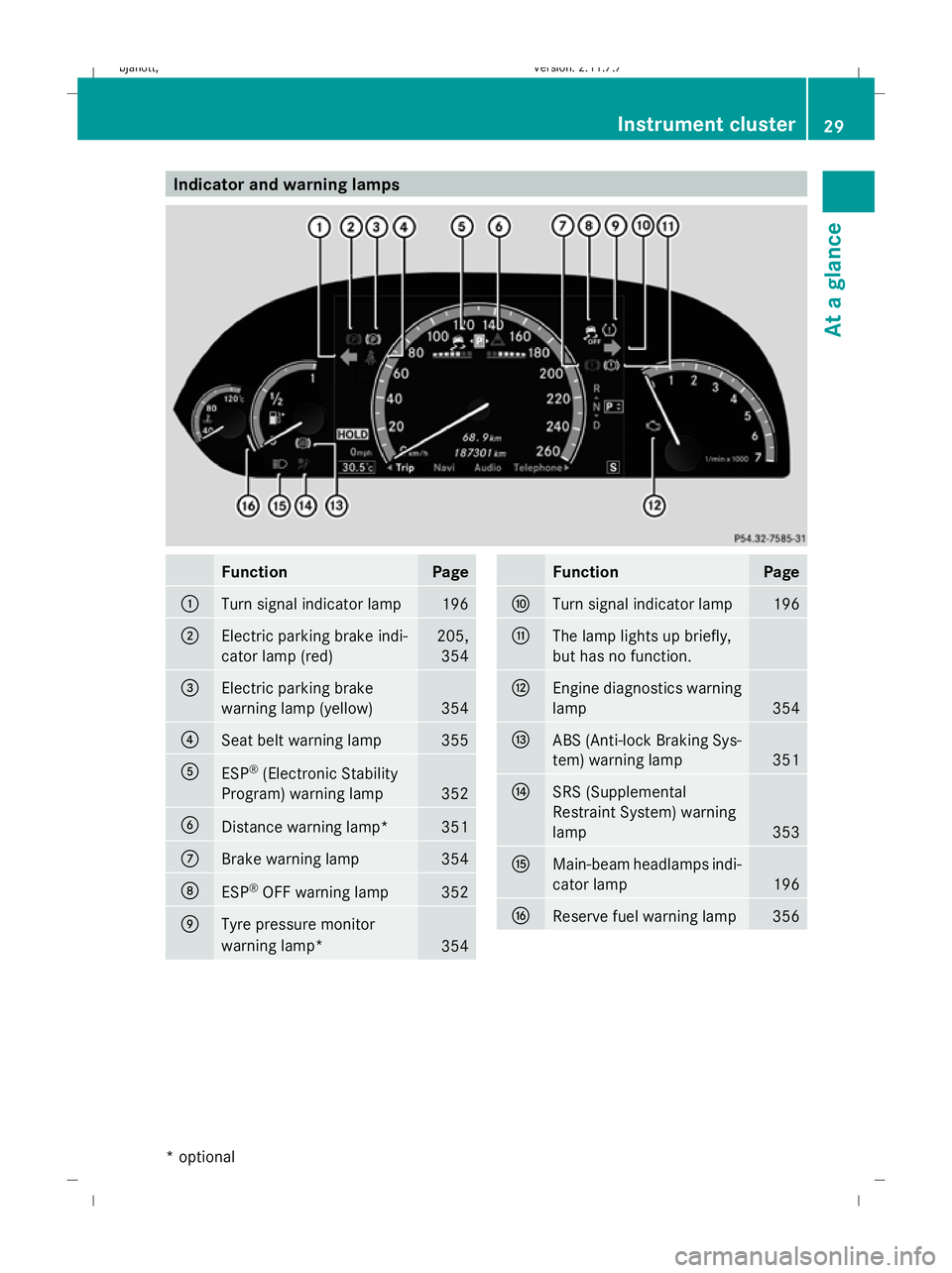
Indicator and warning lamps
Function Page
:
Turn signal indicator lamp 196
;
Electric parking brake indi-
cator lamp (red) 205,
354 =
Electric parking brake
warning lamp (yellow)
354
?
Seat belt warning lamp 355
A
ESP
®
(Electronic Stability
Program) warning lamp 352
B
Distance warning lamp* 351
C
Brake warning lamp 354
D
ESP
®
OFF warning lamp 352
E
Tyre pressure monitor
warning lamp*
354 Function Page
F
Turn signal indicator lamp 196
G
The lamp lights up briefly,
but has no function.
H
Engine diagnostics warning
lamp 354
I
ABS (Anti-lock Braking Sys-
tem) warning lamp
351
J
SRS (Supplemental
Restraint System) warning
lamp 353
K
Main-beam headlamps indi-
cator lamp 196
L
Reserve fuel warning lamp 356Instrument cluster
29At a glance
* optional
216_AKB; 2; 3, en-GB
bjanott
,V ersion: 2.11.7.7
2009-02-27T14:54:17+01:00 - Seite 29 Z
Dateiname: 6515230602_buchblock.pdf; erzeugt am 04. Mar 2009 11:14:41; WK
Page 39 of 421
Occupant safety
Notes on occupant safety
Seat belts, together with belt tensioners, belt
force limiters and airbags, are complemen-
tary, coordinated restraint systems. They
reduce the risk of injury in specific, pre-
defined types of accident situations and,
thereby, increase occupant safety. However,
seat belts and airbags generally do not pro-
tect against objects penetrating the vehicle
from the outside.
To ensure that the restraint systems can
deliver their full potential protection, you
should ensure that:
R the seat and head restraint are adjusted
properly (Y page 183).
R the seat belt has been fastened properly
(Y page 191).
R the airbags can inflate properly if they are
deployed (Y page 39).
R the steering wheel is adjusted properly
(Y page 187).
R the restraint systems have not been modi-
fied.
i An airbag increases the protection of
vehicle occupants wearing a seat belt.
However, airbags are only an additional
restraint system which complements, but
does not replace, the seat belt. All vehicle
occupants must wear their seat belt cor-
rectly at all times, even if the vehicle is
equipped with airbags. This is because – on
the one hand – airbags are not deployed in
all types of accident, as in some situations
airbag deployment would not increase the
protection afforded to vehicle occupants,
provided they are wearing their seat belt
correctly. On the other hand, airbag deploy-
ment only provides increased protection if
the seat belt is worn correctly because: R
the seat belt helps to keep the vehicle
occupant in the best position in relation
to the airbag.
R for example, in a head-on collision, the
seat belt can more adequately prevent
the occupant from being propelled
towards the point of the impact, and is
thus better suited to prevent injury.
Therefore, in accident situations where an
airbag is deployed, it only provides protec-
tion in addition to the seat belt if the seat
belt is being worn correctly. G
Risk of accident and injury
Always have maintenance work carried out at
a qualified specialist workshop which has the
necessary specialist knowledge and tools to
carry out the work required.
Mercedes-Benz recommends that you use a
Mercedes-Benz Service Centre for this pur-
pose.
In particular, work relevant to safety or on
safety-related systems must be carried out at
a qualified specialist workshop. If this work is
not carried out correctly, the operating safety
of your vehicle may be affected. There is a risk
of an accident and injury. G
Risk of injury
Modifications to or work performed incor-
rectly on the following parts can result in the
restraint systems not functioning as intended:
R the restraint system, consisting of seat
belts and their anchorage points, belt ten-
sioners, belt force limiters and airbags
R the wiring
R any networked electronic systems
Airbags and belt tensioners could fail, e.g. in
the event of an accident, the deceleration
force of which would normally be sufficient to
trigger the systems, or could be triggered
unintentionally. For this reason, never make
any modifications to the restraint systems. 36
Occupant safetySafety
216_AKB; 2; 3, en-GB
bjanott,
Version: 2.11.7.7 2009-02-27T14:54:17+01:00 - Seite 36
Dateiname: 6515230602_buchblock.pdf; erzeugt am 04. Mar 2009 11:14:46; WK
Page 40 of 421
You must not tamper with electronic compo-
nents or their software.
SRS (Supplemental Restraint System)
The SRS reduces the risk of occupants com-
ing into contact with the vehicle's interior in
the event of an accident. It can also reduce
the forces to which occupants are subjected
during an accident.
The SRS consists of:
R The 6 SRS warning lamp
R belt tensioners
R belt force limiters
R airbags
The 6 6 SRS warning lamp SRS functions are checked regularly when
you turn on the ignition and when the engine
is running. Therefore, malfunctions can be
detected in good time.
The 6 SRS warning lamp in the instrument
cluster lights up when the ignition is switched
on. It goes out no later than a few seconds
after the engine is started. G
Risk of injury
If SRS is malfunctioning, individual systems
may be activated unintentionally or not be
deployed in the event of an accident with
heavy braking.
A malfunction has occurred if the 6SRS
warning lamp:
R does not light up when you switch on the
ignition
R does not go out after the engine has been
running for a few seconds
R lights up again once the engine is running
In this case, have SRS checked immediately
at a qualified specialist workshop. Triggering of belt tensioners, belt force
limiters and airbags In the event of a collision, the sensor in the
airbag control unit evaluates important phys-
ical data such as duration, direction and force
of the vehicle deceleration or acceleration.
Based on the evaluation of this data and
depending on the vehicle's rate of longitudi-
nal deceleration in a collision, in the first
stage the airbag control unit pre-emptively
triggers the belt tensioners.
i
The front belt tensioners can only be trig-
gered if the belt tongue is correctly
engaged in the seat belt buckle.
The front airbags are only deployed if there is
an even higher rate of vehicle deceleration in
a longitudinal direction.
Your vehicle has adaptive, dual stage front
airbags. When the first activation threshold is
reached, the front airbag is filled with enough
propellant gas to reduce the risk of injuries.
The front airbag is only fully inflated if a sec-
ond threshold is reached within a few milli-
seconds, due to the control unit having detec-
ted further deceleration.
Criteria for triggering belt tensioners and
airbags
In the first stage of a collision, the airbag con-
trol unit evaluates the duration and direction
of vehicle acceleration or deceleration in
order to determine whether it is necessary to
trigger the belt tensioner and/or airbag.
The belt tensioner and airbag triggering
thresholds are variable and are adapted to the
rate of deceleration of the vehicle. This proc-
ess is pre-emptive in nature as the airbag
must be deployed during – and not at the end
of – the collision.
i Airbags are not deployed in all types of
accidents. They are controlled by complex
sensor technology and evaluation logic.
This process is pre-emptive in nature as
airbag deployment must take place during
the impact and must be adapted to provide Occupant safety
37Safety
216_AKB; 2; 3, en-GB
bjanott,V ersion: 2.11.7.7
2009-02-27T14:54:17+01:00 - Seite 37 Z
Dateiname: 6515230602_buchblock.pdf; erzeugt am 04. Mar 2009 11:14:46; WK
Page 41 of 421
calculated, additional protection for the
vehicle occupants. Not all airbags are
deployed in an accident.
The different airbag systems work inde-
pendently of each other. However, the
deployment of each individual system will
depend on the type of accident determined
by the control system in the first stages of
the collision (head-on collision, side impact
and overturn) and the extent of the acci-
dent (in particular, the vehicle's rate of
deceleration or acceleration).
The rate of vehicle deceleration or accelera-
tion and the direction of the force are basi-
cally determined by:
R the distribution of forces during the colli-
sion
R the collision angle
R the deformation characteristics of the vehi-
cle
R the characteristics of the object with which
the vehicle has collided, e.g. the other vehi-
cle
Factors which can only be seen and measured
after a collision has occurred do not play a
decisive role in the deployment of an airbag,
nor do they provide an indication of it.
The vehicle may be deformed significantly,
e. g. on the bonnet or the wing, without an
airbag being deployed. This is the case if only
parts which are relatively easily deformed are
affected and the necessary deceleration does
not occur. Conversely, airbags may be
deployed even though the vehicle suffers only
minor deformations. For example, this is the
case if very rigid vehicle parts such as longi-
tudinal body members are affected and suf-
ficient deceleration occurs as a result.
Belt tensioners, belt force limiters The seat belts are fitted with belt tensioners.
! Do not engage the seat belt tongue in the
buckle on the front-passenger seat if the
seat is not occupied. The belt tensioners could otherwise be triggered in an acci-
dent.
If the seat belt is also equipped with a belt
force limiter, the force exerted by the seat
belt on the seat occupant is reduced.
Belt tensioners tighten the seat belts in an
accident, pulling them close against the body.
i Belt tensioners do not correct incorrect
seat positions or incorrectly fastened seat
belts.
Belt tensioners do not pull occupants back
towards the backrest.
The front belt force limiters are synchronised
with the front airbags, which distribute a pro-
portion of the deceleration forces exerted on
the occupant over a greater area.
The front seat belts have an automatic com-
fort-fit feature. This reduces the retraction
force of the seat belts, which results in
increased seat belt comfort.
The belt tensioners cannot be triggered when
the ignition is switched on unless:
R the restraint systems are operational; see
6 SRS warning lamp.
R the belt tongue is engaged in the buckle on
each lap-shoulder belt in the front of the
vehicle.
Depending on the type and severity of an
accident, the belt tensioners may be trig-
gered:
R in the event of a head-on or rear-end colli-
sion if the vehicle decelerates or acceler-
ates rapidly in a longitudinal direction dur-
ing the initial stages of impact
R in the event of a side impact if the vehicle
is subjected to high lateral acceleration/
deceleration
R in certain situations if the vehicle over-
turns, and the system determines that it
can provide additional protection
If the airbags are deployed, you will hear a
bang and a small amount of powder may also
be released. Only in rare cases will the bang 38
Occupant safetySafety
216_AKB; 2; 3, en-GB
bjanott,
Version: 2.11.7.7 2009-02-27T14:54:17+01:00 - Seite 38
Dateiname: 6515230602_buchblock.pdf; erzeugt am 04. Mar 2009 11:14:46; WK
Page 42 of 421
affect your hearing. The powder that escapes
does not generally constitute a health hazard.
The 6 SRS warning lamp lights up. G
Risk of injury
If the seat belt tensioners have been trig-
gered, they provide no additional protection
in the event of another accident. Therefore,
have belt tensioners which have been trig-
gered replaced at a qualified specialist work-
shop.
Comply with safety regulations when dispos-
ing of belt tensioners. Any Mercedes-Benz
Service Centre can provide details of these
regulations.
Airbags Airbag deployment slows down and restricts
the movement of the vehicle occupant.
If the airbags are deployed, you will hear a
bang and a small amount of powder may also
be released. Only in rare cases will the bang
affect your hearing. The powder that escapes
does not generally constitute a health hazard.
The 6 SRS warning lamp lights up.
The SRS/AIRBAG identification indicates the
location of the airbags. G
Risk of injury
Airbags provide additional protection; they
are not, however, a substitute for seat belts.
Observe the following notes to reduce the risk
of serious or even fatal injury if an airbag is
deployed:
R all vehicle occupants ― in particular preg-
nant women ― must wear their seat belt
correctly at all times and lean back against
the backrest, which should be positioned
as close to the vertical as possible. The
head restraint must support the back of the
head at about eye level.
R always secure children less than 1.50 m tall
or under 12 years of age in suitable child
restraint systems. R
all vehicle occupants must select a seat
position that is as far away from the airbag
as possible. The driver's seat position must
allow the vehicle to be driven safely. The
driver's chest should be as far away from
the middle of the driver's front airbag cover
as possible.
R move the front-passenger seat as far back
as possible, especially if a child is secured
in a child restraint system on the seat.
R vehicle occupants – in particular, children
– must not lean their head into the area of
the window in which the sidebag/window-
bag is deployed.
R rearward-facing child restraint systems
must not be fitted to the front-passenger
seat unless the front-passenger front air-
bag has been disabled. The front-passenger
front airbag of a vehicle fitted with auto-
matic child seat recognition* is only disa-
bled when a child restraint system with
automatic child seat recognition is fitted to
the front-passenger seat. The 4
PASSENGER AIRBAG OFF warning lamp
must be continuously lit.
If the front-passenger seat of your vehicle
does not have automatic child seat recog-
nition*, or your rearward-facing child
restraint system does not have automatic
child seat recognition, children must be
secured in a child restraint system on a
suitable seat in the rear. If you secure a
forward-facing child restraint system to the
front-passenger seat, you must move the
front-passenger seat as far back as possi-
ble.
R make sure there are no heavy or sharp-
edged objects in pockets of clothing.
R do not lean forwards, e.g. over the cover of
the driver's/front-passenger front airbag,
particularly when the vehicle is in motion.
R do not put your feet on the dashboard. Occupant safety
39Safety
* optional
216_AKB; 2; 3, en-GB
bjanott
,V ersion: 2.11.7.7
2009-02-27T14:54:17+01:00 - Seite 39 Z
Dateiname: 6515230602_buchblock.pdf; erzeugt am 04. Mar 2009 11:14:46; WK
Page 43 of 421
R
only hold the steering wheel by the rim. This
allows the airbag to inflate fully. You could
be injured if the airbag is deployed and you
are holding the inside of the steering wheel.
R do not lean on the doors from inside the
vehicle.
R make sure that there are no people, ani-
mals or objects between the vehicle occu-
pants and the area of deployment of the
airbag.
R do not place any objects between the seat
backrest and the door.
R do not hang any hard objects, for example,
coat hangers, on the grab handles or coat
hooks.
R do not attach accessories, e.g. cup holders,
to the doors.
It is not possible to rule out a risk of injuries
caused by an airbag due to the high speed at
which the airbag is required to deploy. G
Risk of injury
The airbag's functionality can only be guaran-
teed if the following parts are not covered and
no badges or stickers are attached to them:
R padded steering wheel boss
R front-passenger front airbag cover
R outer side of front seats
R side panel next to the rear seat backrest G
Risk of injury
When an airbag deploys, a small amount of
powder is released. The powder may cause
short-term breathing difficulties to persons
suffering from asthma or other pulmonary
conditions.
In order to prevent potential breathing diffi-
culties, you should leave the vehicle as soon
as it is safe to do so. You can also open the
window to allow fresh air to enter the interior.
The powder generally does not constitute a
health hazard and does not indicate that there
is a fire in the vehicle. G
Risk of injury
The airbag parts are hot after the airbag has
been deployed. Do not touch them; other-
wise, you may burn yourself.
Have the airbags checked at a qualified spe-
cialist workshop. Otherwise, occupants are
not protected by the airbags in the event of
another accident.
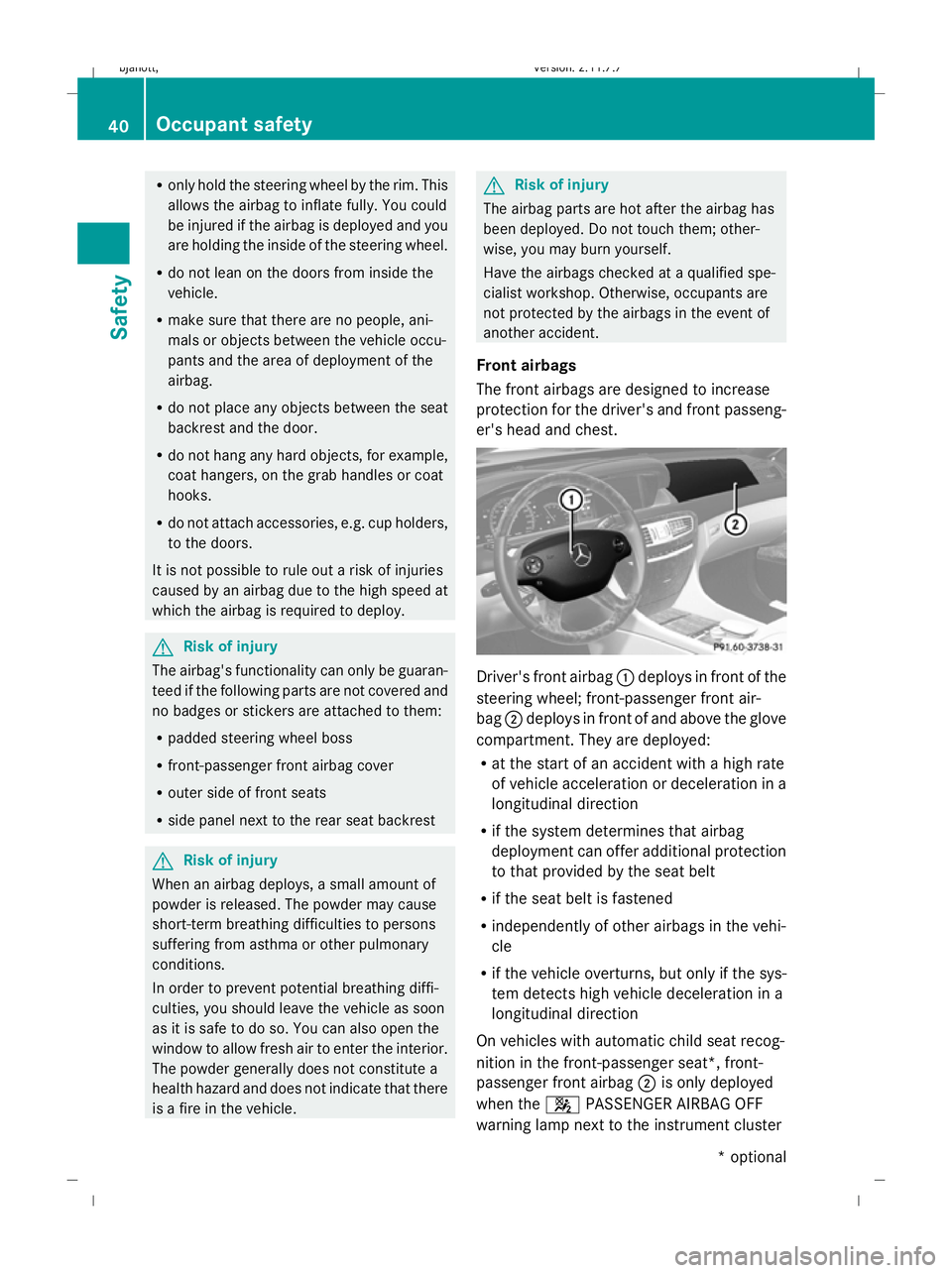
Front airbags
The front airbags are designed to increase
protection for the driver's and front passeng-
er's head and chest. Driver's front airbag
:deploys in front of the
steering wheel; front-passenger front air-
bag ;deploys in front of and above the glove
compartment. They are deployed:
R at the start of an accident with a high rate
of vehicle acceleration or deceleration in a
longitudinal direction
R if the system determines that airbag
deployment can offer additional protection
to that provided by the seat belt
R if the seat belt is fastened
R independently of other airbags in the vehi-
cle
R if the vehicle overturns, but only if the sys-
tem detects high vehicle deceleration in a
longitudinal direction
On vehicles with automatic child seat recog-
nition in the front-passenger seat*, front-
passenger front airbag ;is only deployed
when the 4PASSENGER AIRBAG OFF
warning lamp next to the instrument cluster 40
Occupant safetySafety
* optional
216_AKB; 2; 3, en-GB
bjanott
,V ersion: 2.11.7.7
2009-02-27T14:54:17+01:00 - Seite 40
Dateiname: 6515230602_buchblock.pdf; erzeugt am 04. Mar 2009 11:14:47; WK