battery MERCEDES-BENZ CL550 2010 W216 Service Manual
[x] Cancel search | Manufacturer: MERCEDES-BENZ, Model Year: 2010, Model line: CL550, Model: MERCEDES-BENZ CL550 2010 W216Pages: 500, PDF Size: 9.5 MB
Page 473 of 500
then uses very little power and the battery is
spared.
If
the
battery is discharged, you must use the
mechanical key to unlock the vehicle. Charging the battery
G
Warning!
Never charge a battery while still installed in
the vehicle unless the accessory battery
charge unit approved by Mercedes-Benz is
being used. Gases may escape during
charging and could cause an explosion that
may result
in personal injury, paint damage or
corrosion.
An accessory battery charge unit specially
adapted for Mercedes-Benz vehicles and
tested and approved by Mercedes-Benz is
available. It permits the charging of the
battery in its installed position. Contact an
authorized Mercedes-Benz Center for
information and availability.
Charge battery in accordance with the
separate instructions for the accessory
battery charger.
Have the battery charged at an authorized
Mercedes-Benz Center. If you charge the
battery yourself, follow the operating
instructions for your charging device.
Only use a battery charge unit with a
maximum charging voltage of 14.8 V.
X Charge battery in accordance with the
instructions of the battery charger
manufacturer. Jump starting
G
Warning!
Failure to follow these directions will cause
damage to the electronic components, and
can lead to a battery explosion and severe
injury or death. Never lean over batteries while connecting or
jump starting. You might get injured.
Battery fluid contains sulfuric acid. Do not
allow this fluid to come in contact with eyes,
skin or clothing. In case it does, immediately
flush affected area with water, and seek
medical help if necessary.
A battery will also produce hydrogen gas,
which is flammable and explosive. Keep
flames or sparks away from battery, avoid
improper connection of jumper cables,
smoking, etc.
Attempting
to
jump start a frozen battery can
result in it exploding, causing personal injury.
Read all instructions before proceeding.
! Do not tow-start the vehicle. You could
otherwise seriously damage the automatic
transmission which is not covered by the
Mercedes-Benz Limited Warranty.
! Jump starting should only be performed
using the jump-start terminals located in
the engine compartment.
Avoid repeated and lengthy starting
attempts.
Do not attempt to start the engine using a
battery quick-charge unit.
If the engine does not run after several
unsuccessful starting attempts, have it
checked at the nearest authorized
Mercedes-Benz Center.
Excessive unburned fuel generated by
repeated failed starting attempts may
damage the catalytic converter and may
present a fire risk.
Make sure the jumper cables do not have
loose or missing insulation.
Make sure the cable clamps do not touch
any other metal part while the other end is
still attached to a battery. Jump starting
471
Practical hints
216_AKB; 3; 90, en-US
d2ureepe, Version: 2.11.8.1 2009-05-15T11:47:50+02:00 - Seite 471 Z
Page 474 of 500
If the battery is discharged, the engine can be
started with jumper cables and the fully
charged battery of another vehicle or an
equivalent starter pack. Observe the
following:
R
Access to the battery is not possible on all
vehicles. If you cannot access the battery
of the other vehicle, provide jump start
power by an external battery or starter
pack.
R Jump starting should only be performed
when the engine and catalytic converter
are cold.
R Do not jump start the engine or charge the
battery if the battery is frozen. Let the
battery thaw out first.
R Only jump start from batteries with the
same voltage rating (12 V). Jump starting
with a more powerful battery could damage
the vehicle’s electrical system. Such damage will not be covered by the
Mercedes-Benz Limited Warranty.
R Only use jumper cables with sufficient
cross-section and insulated terminal
clamps.
R Always make sure the jumper cables are
not on or near pulleys, fans or other parts
that move when an engine is started or
running.
R Should the battery be drained completely,
let the donating power source charge the
vehicle for several minutes before
reattempting the starting process.
X Make sure the two vehicles do not touch.
X Switch off all electrical consumers.
X Engage the electronic parking brake.
X Make sure the automatic transmission is in
park position P.
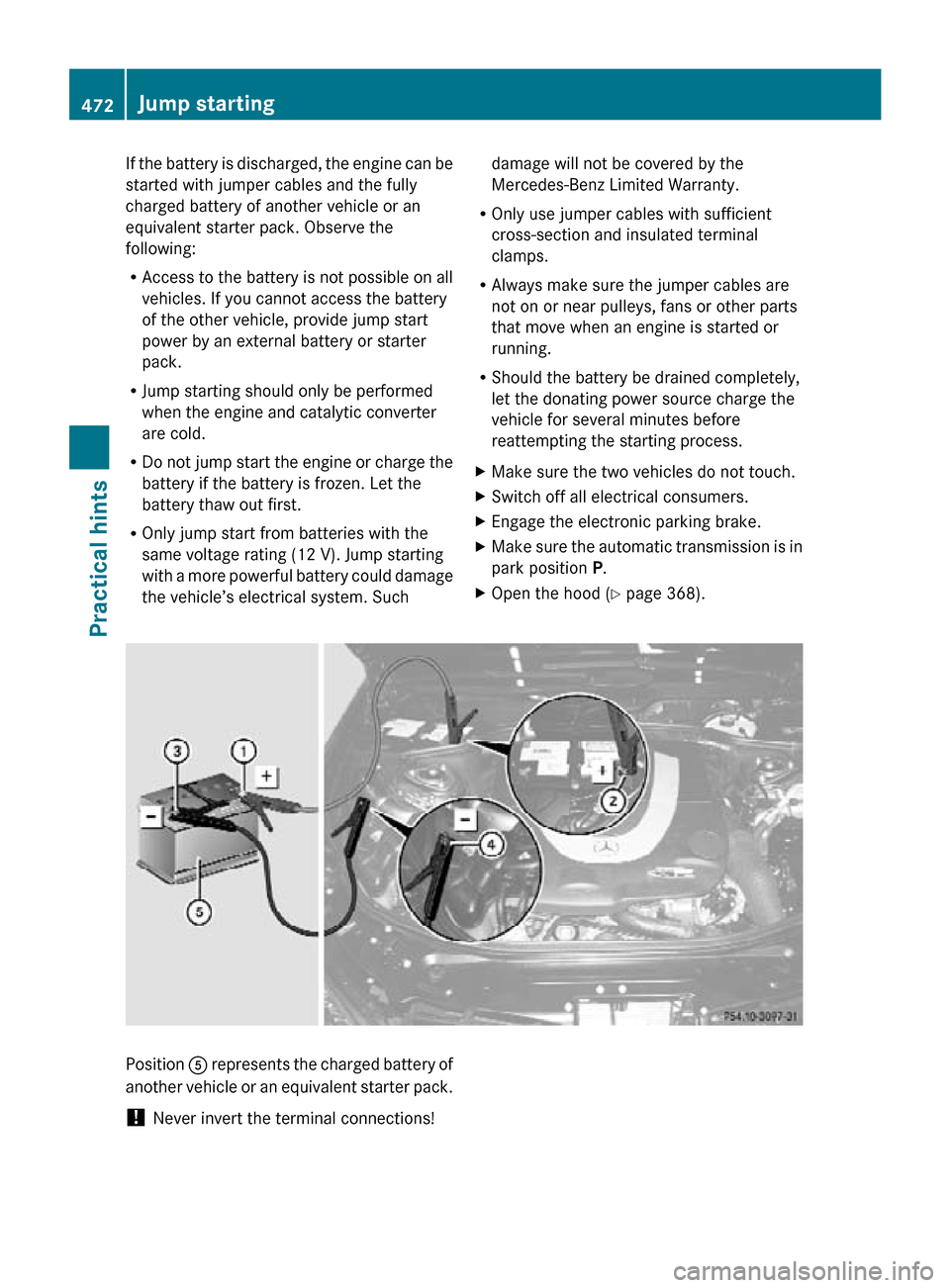
X Open the hood (Y page 368). Position
A represents the charged battery of
another vehicle or an equivalent starter pack.
! Never invert the terminal connections! 472
Jump startingPractical hints
216_AKB; 3; 90, en-US
d2ureepe,
Version: 2.11.8.1 2009-05-15T11:47:50+02:00 - Seite 472
Page 475 of 500
X
Connect positive terminal : of charged
battery A with
positive terminal ; with a
jumper cable. Clamp the cable to positive
terminal : of charged battery A first.
X Start engine of the vehicle with charged
battery A and run at idle speed.
X Connect negative terminal = of charged
battery A with negative terminal ? with
a jumper cable. Clamp the cable to
negative terminal = of charged battery
A first.
X Start engine of the vehicle with the
discharged battery and run at idle speed.
You can now turn on the electrical
consumers. Do not switch on the
headlamps under any circumstances.
X Remove the jumper cables from negative
terminals = and ? first.
X Remove the jumper cables from positive
terminals : and ;.
You can now switch on the headlamps.
X Have the battery checked at the nearest
authorized Mercedes-Benz Center. Towing the vehicle
Safety notes
G
Warning!
The vehicle is braked when the HOLD function
or DISTRONIC PLUS is activated. Therefore,
deactivate the HOLD function or DISTRONIC
PLUS if the vehicle is to be towed.
Mercedes-Benz recommends
that the vehicle
be transported with all wheels off the ground
using flatbed or appropriate wheel lift/dolly
equipment. This method is preferable to other
types of towing.
! To prevent damage during transport, do
not tie down vehicle by its chassis or
suspension parts.
If circumstances do not permit the
recommended towing methods, the vehicle
may be towed with all wheels on the ground or front axle raised (except vehicles with
4MATIC) only
so far as necessary to have the
vehicle moved to a safe location where the
recommended towing methods can be
employed.
! Before towing the vehicle observe the
following instructions:
R Do not tow-start the vehicle. You could
otherwise seriously damage the
automatic transmission which is not
covered by the Mercedes-Benz Limited
Warranty.
R Do not tow with sling-type equipment.
Towing with sling-type equipment over
bumpy roads will damage radiator and
supports.
R Towing of the vehicle should only be
done using the properly installed towing
eye bolt. Never attach a tow cable, tow
rope or tow rod to the vehicle chassis,
frame or suspension parts. G
Warning!
With the engine not running, there is no power
assistance for the brake and steering
systems. In this case, it is important to keep
in mind that a considerably higher degree of
effort is necessary to brake and steer the
vehicle. Adapt your driving accordingly.
! Avoid pulling the vehicle abruptly or
diagonally, since it could result in damage
to the chassis alignment.
! Do not use the towing eye bolt for
recovery, as
this could damage the vehicle.
If in doubt, recover the vehicle with a crane.
i If the battery is disconnected or
discharged
R the SmartKey will not turn in the starter
switch
R the automatic transmission will remain in
park position P Towing the vehicle
473
Practical hints
216_AKB; 3; 90, en-US
d2ureepe, Version: 2.11.8.1 2009-05-15T11:47:50+02:00 - Seite 473 Z
Page 476 of 500
For more information see “Battery”
(Y page 469) or “Jump starting”
(Y page 471).
Installing towing eye bolt
Depending on whether you are towing a
vehicle or you are being towed, the towing eye
bolt can be screwed into threaded holes
which are located behind covers on each
bumper.
The towing eye bolt is supplied with the
vehicle tool kit, located underneath the trunk
floor ( Y page 412).
X Take the vehicle tool kit out of the trunk.
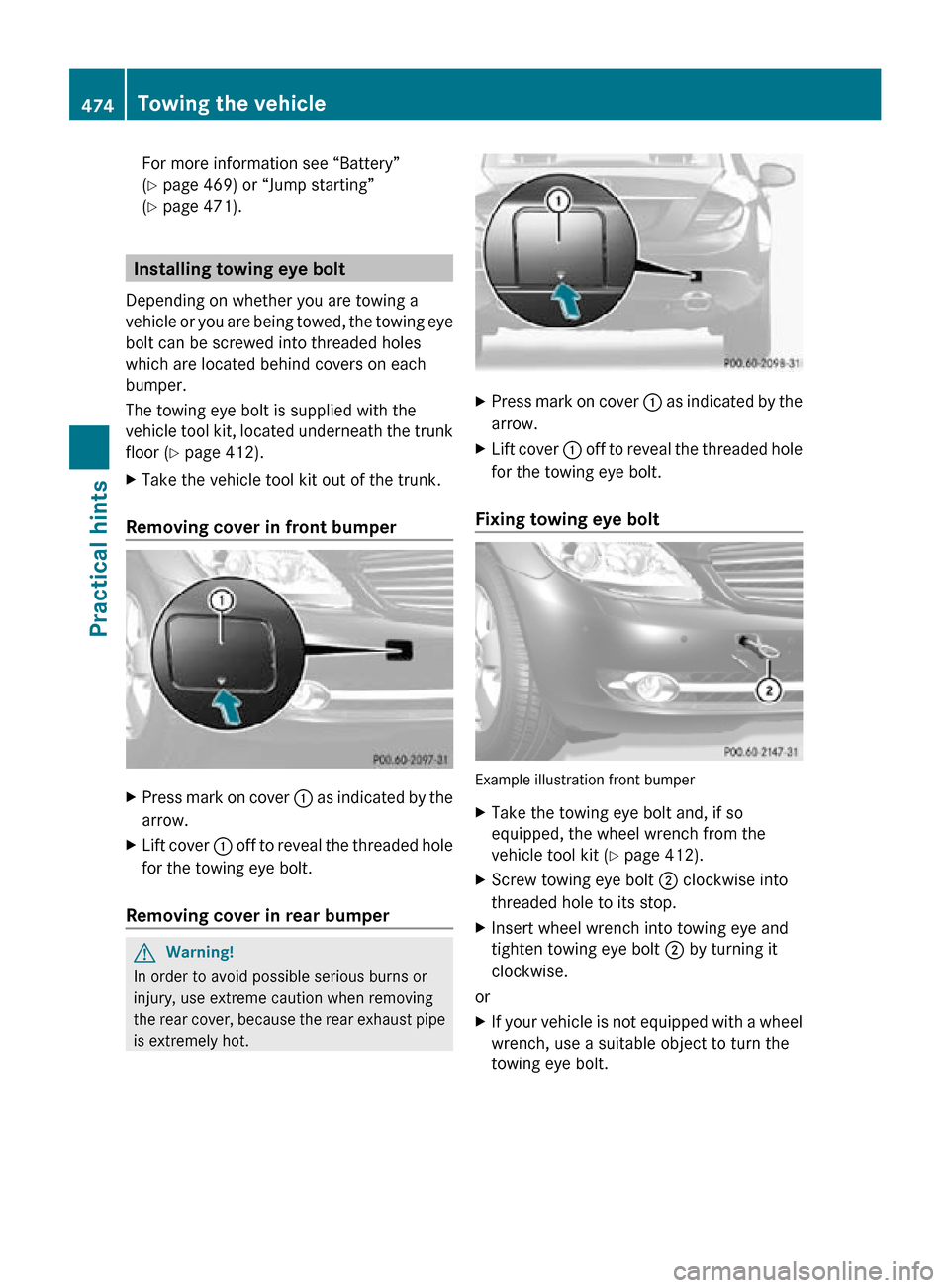
Removing cover in front bumper X
Press mark on cover : as indicated by the
arrow.
X Lift cover : off to reveal the threaded hole
for the towing eye bolt.
Removing cover in rear bumper G
Warning!
In order to avoid possible serious burns or
injury, use extreme caution when removing
the rear cover, because the rear exhaust pipe
is extremely hot. X
Press mark on cover : as indicated by the
arrow.
X Lift cover : off to reveal the threaded hole
for the towing eye bolt.
Fixing towing eye bolt Example illustration front bumper
X
Take the towing eye bolt and, if so
equipped, the wheel wrench from the
vehicle tool kit (Y page 412).
X Screw towing eye bolt ; clockwise into
threaded hole to its stop.
X Insert wheel wrench into towing eye and
tighten towing eye bolt ; by turning it
clockwise.
or
X If your vehicle is not equipped with a wheel
wrench, use a suitable object to turn the
towing eye bolt. 474
Towing the vehiclePractical hints
216_AKB; 3; 90, en-US
d2ureepe,
Version: 2.11.8.1 2009-05-15T11:47:50+02:00 - Seite 474
Page 485 of 500
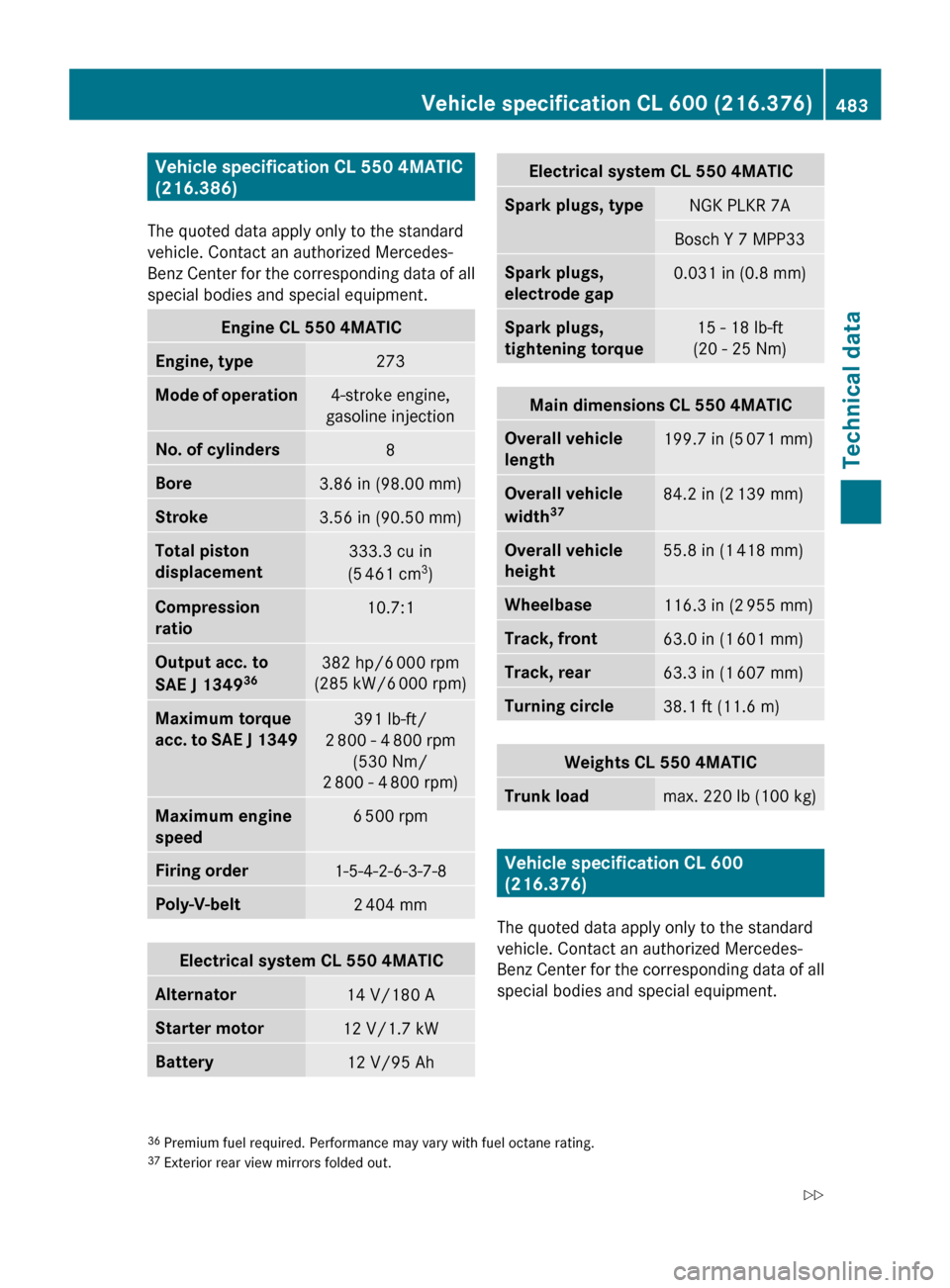
Vehicle specification CL 550 4MATIC
(216.386)
The quoted data apply only to the standard
vehicle. Contact an authorized Mercedes-
Benz Center
for the corresponding data of all
special bodies and special equipment. Engine CL 550 4MATIC
Engine, type
273
Mode of operation
4-stroke engine,
gasoline injection No. of cylinders
8
Bore
3.86 in (98.00 mm)
Stroke
3.56 in (90.50 mm)
Total piston
displacement
333.3 cu in
(5 461 cm 3
) Compression
ratio
10.7:1
Output acc. to
SAE J 1349
36 382 hp/6
000 rpm
(285 kW/6 000 rpm) Maximum torque
acc.
to
SAE J 1349 391 lb-ft/
2 800 - 4 800 rpm
(530 Nm/
2 800 - 4 800 rpm) Maximum engine
speed
6 500 rpm
Firing order
1-5-4-2-6-3-7-8
Poly-V-belt
2 404 mm
Electrical system CL 550 4MATIC
Alternator
14 V/180 A
Starter motor
12 V/1.7 kW
Battery
12 V/95 Ah Electrical system CL 550 4MATIC
Spark plugs, type
NGK PLKR 7A
Bosch Y 7 MPP33
Spark plugs,
electrode gap
0.031 in (0.8 mm)
Spark plugs,
tightening torque
15 - 18 lb-ft
(20 - 25 Nm) Main dimensions CL 550 4MATIC
Overall vehicle
length
199.7 in (5
071 mm) Overall vehicle
width
37 84.2 in (2
139 mm) Overall vehicle
height
55.8 in (1
418 mm) Wheelbase
116.3 in (2
955 mm) Track, front
63.0 in (1
601 mm) Track, rear
63.3 in (1
607 mm) Turning circle
38.1 ft (11.6 m)
Weights CL 550 4MATIC
Trunk load
max. 220 lb (100 kg)
Vehicle specification CL 600
(216.376)
The quoted data apply only to the standard
vehicle. Contact an authorized Mercedes-
Benz Center
for the corresponding data of all
special bodies and special equipment.
36 Premium fuel required. Performance may vary with fuel octane rating.
37 Exterior rear view mirrors folded out. Vehicle specification CL 600 (216.376)
483
Technical data
216_AKB; 3; 90, en-US
d2ureepe, Version: 2.11.8.1 2009-05-15T11:47:50+02:00 - Seite 483 Z
Page 486 of 500
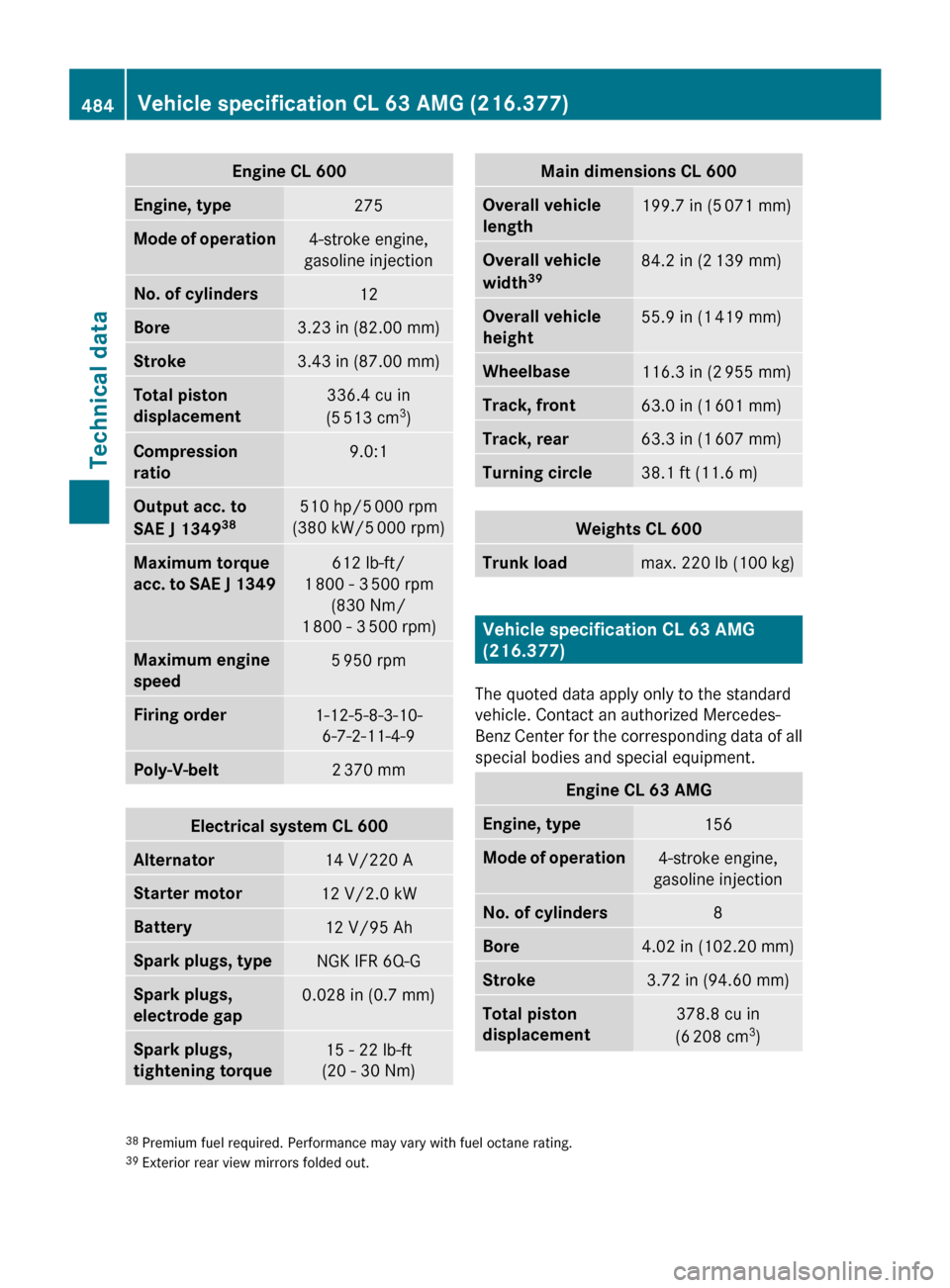
Engine CL 600
Engine, type
275
Mode of operation
4-stroke engine,
gasoline injection No. of cylinders
12
Bore
3.23 in (82.00 mm)
Stroke
3.43 in (87.00 mm)
Total piston
displacement
336.4 cu in
(5 513 cm 3
) Compression
ratio
9.0:1
Output acc. to
SAE J 1349
38 510 hp/5
000 rpm
(380 kW/5 000 rpm) Maximum torque
acc.
to
SAE J 1349 612 lb-ft/
1 800 - 3 500 rpm
(830 Nm/
1 800 - 3 500 rpm) Maximum engine
speed
5 950 rpm
Firing order
1-12-5-8-3-10-
6-7-2-11-4-9 Poly-V-belt
2 370 mm
Electrical system CL 600
Alternator
14 V/220 A
Starter motor
12 V/2.0 kW
Battery
12 V/95 Ah
Spark plugs, type
NGK IFR 6Q-G
Spark plugs,
electrode gap
0.028 in (0.7 mm)
Spark plugs,
tightening torque
15 - 22 lb-ft
(20 - 30 Nm) Main dimensions CL 600
Overall vehicle
length
199.7 in (5
071 mm) Overall vehicle
width
39 84.2 in (2
139 mm) Overall vehicle
height
55.9 in (1
419 mm) Wheelbase
116.3 in (2
955 mm) Track, front
63.0 in (1
601 mm) Track, rear
63.3 in (1
607 mm) Turning circle
38.1 ft (11.6 m)
Weights CL 600
Trunk load
max. 220 lb (100 kg)
Vehicle specification CL 63 AMG
(216.377)
The quoted data apply only to the standard
vehicle. Contact an authorized Mercedes-
Benz Center
for the corresponding data of all
special bodies and special equipment. Engine CL 63 AMG
Engine, type
156
Mode of operation
4-stroke engine,
gasoline injection No. of cylinders
8
Bore
4.02 in (102.20 mm)
Stroke
3.72 in (94.60 mm)
Total piston
displacement
378.8 cu in
(6 208 cm 3
) 38
Premium fuel required. Performance may vary with fuel octane rating.
39 Exterior rear view mirrors folded out. 484
Vehicle specification CL 63 AMG (216.377)
Technical data
216_AKB; 3; 90, en-US
d2ureepe,
Version: 2.11.8.1 2009-05-15T11:47:50+02:00 - Seite 484
Page 487 of 500
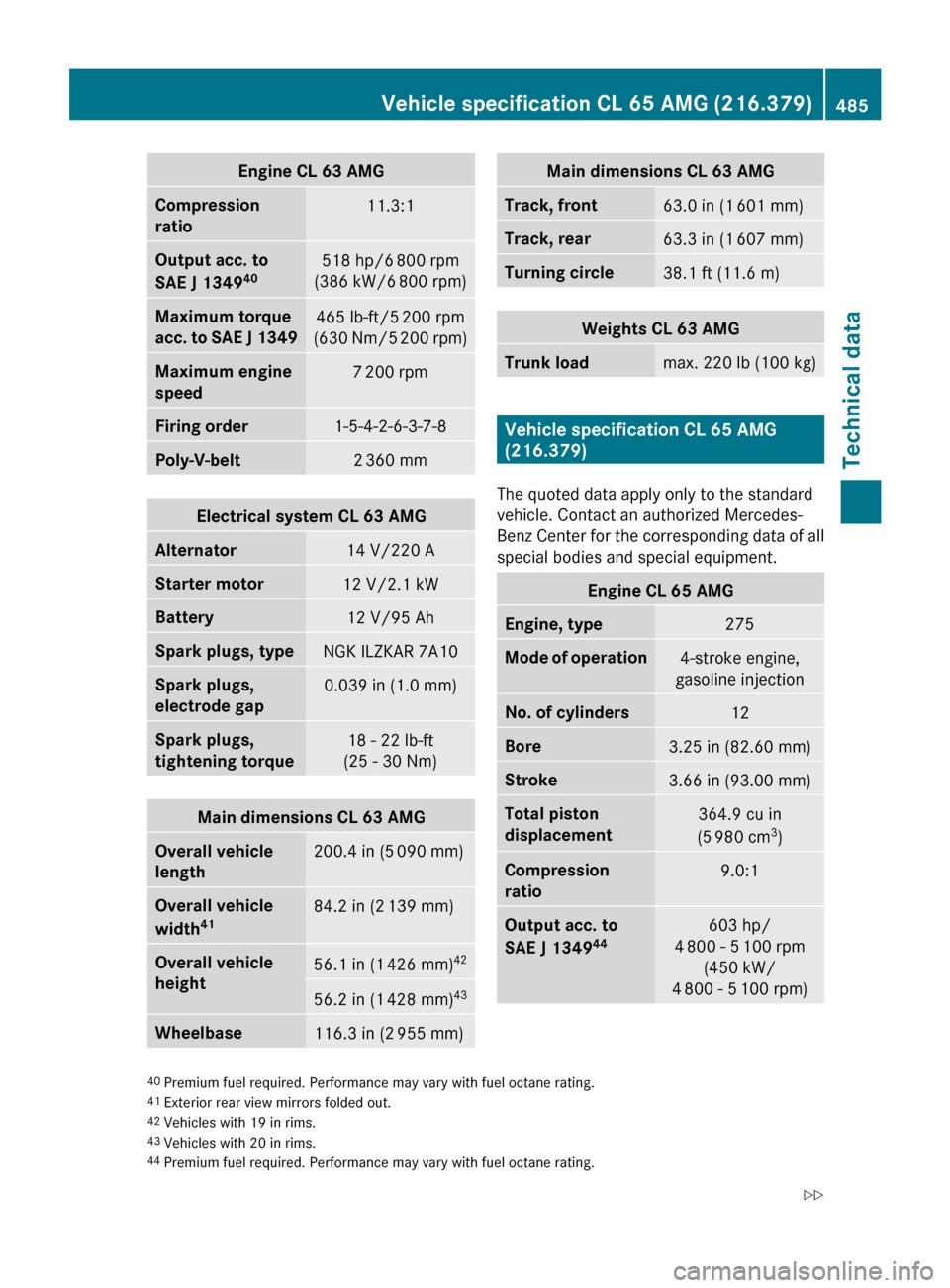
Engine CL 63 AMG
Compression
ratio
11.3:1
Output acc. to
SAE J 1349
40 518 hp/6
800 rpm
(386 kW/6 800 rpm) Maximum torque
acc. to
SAE J 1349 465 lb-ft/5
200 rpm
(630 Nm/5 200
rpm) Maximum engine
speed
7 200 rpm
Firing order
1-5-4-2-6-3-7-8
Poly-V-belt
2 360 mm
Electrical system CL 63 AMG
Alternator
14 V/220 A
Starter motor
12 V/2.1 kW
Battery
12 V/95 Ah
Spark plugs, type
NGK ILZKAR 7A10
Spark plugs,
electrode gap
0.039 in (1.0 mm)
Spark plugs,
tightening torque
18 - 22 lb-ft
(25 - 30 Nm) Main dimensions CL 63 AMG
Overall vehicle
length
200.4 in (5
090 mm) Overall vehicle
width
41 84.2 in (2
139 mm) Overall vehicle
height
56.1 in (1
426 mm) 42 56.2 in (1
428 mm) 43 Wheelbase
116.3 in (2
955 mm) Main dimensions CL 63 AMG
Track, front
63.0 in (1
601 mm) Track, rear
63.3 in (1
607 mm) Turning circle
38.1 ft (11.6 m)
Weights CL 63 AMG
Trunk load
max. 220 lb (100 kg)
Vehicle specification CL 65 AMG
(216.379)
The quoted data apply only to the standard
vehicle. Contact an authorized Mercedes-
Benz Center
for the corresponding data of all
special bodies and special equipment. Engine CL 65 AMG
Engine, type
275
Mode of operation
4-stroke engine,
gasoline injection No. of cylinders
12
Bore
3.25 in (82.60 mm)
Stroke
3.66 in (93.00 mm)
Total piston
displacement
364.9 cu in
(5 980 cm 3
) Compression
ratio
9.0:1
Output acc. to
SAE J 1349
44 603 hp/
4 800 - 5 100 rpm
(450 kW/
4 800 - 5 100 rpm) 40
Premium fuel required. Performance may vary with fuel octane rating.
41 Exterior rear view mirrors folded out.
42 Vehicles with 19 in rims.
43 Vehicles with 20 in rims.
44 Premium fuel required. Performance may vary with fuel octane rating. Vehicle specification CL 65 AMG (216.379)
485
Technical data
216_AKB; 3; 90, en-US
d2ureepe,Version: 2.11.8.1 2009-05-15T11:47:50+02:00 - Seite 485 Z
Page 488 of 500
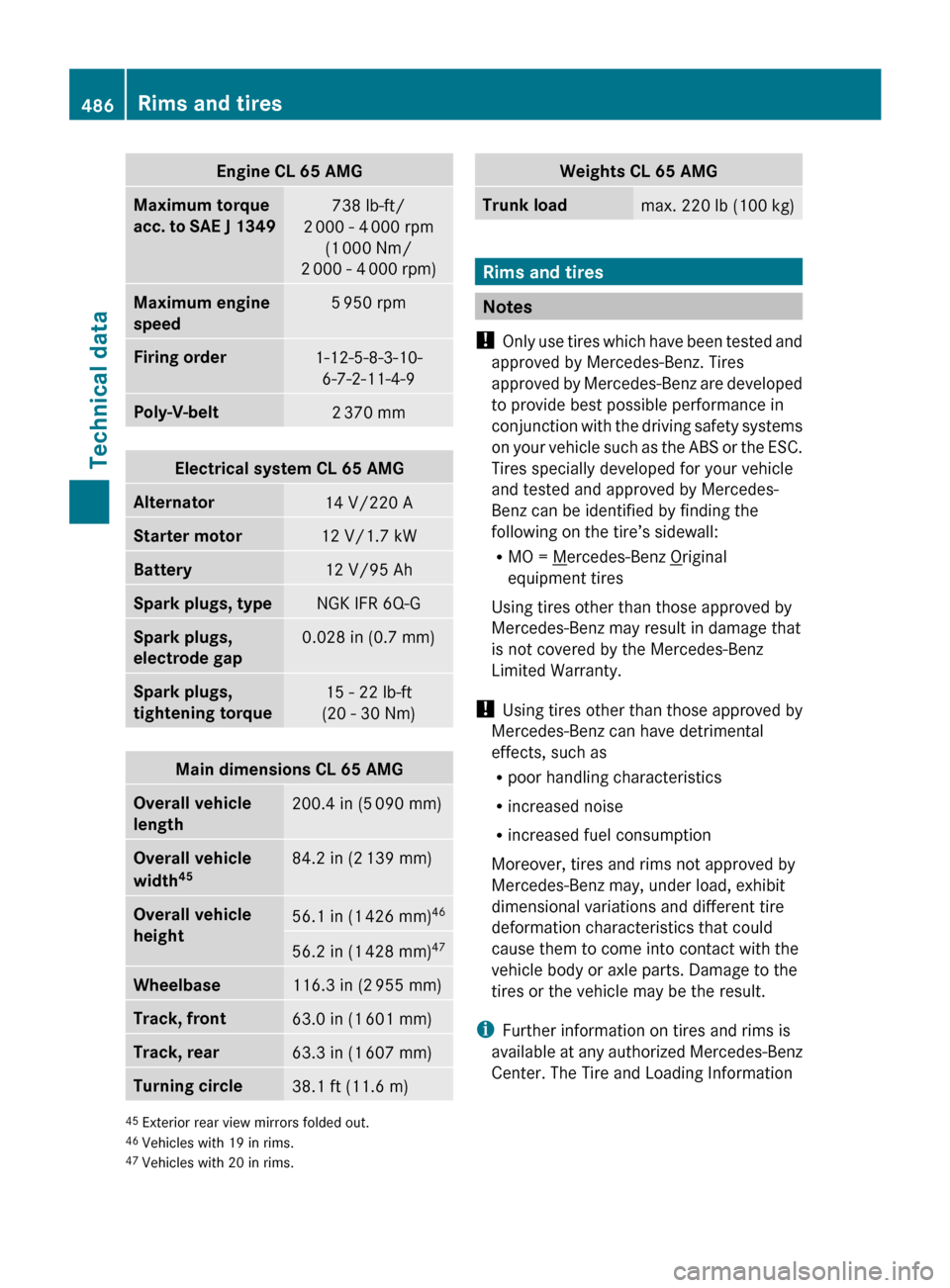
Engine CL 65 AMG
Maximum torque
acc.
to
SAE J 1349 738 lb-ft/
2 000 - 4 000 rpm
(1 000 Nm/
2 000 - 4 000 rpm) Maximum engine
speed
5 950 rpm
Firing order
1-12-5-8-3-10-
6-7-2-11-4-9 Poly-V-belt
2 370 mm
Electrical system CL 65 AMG
Alternator
14 V/220 A
Starter motor
12 V/1.7 kW
Battery
12 V/95 Ah
Spark plugs, type
NGK IFR 6Q-G
Spark plugs,
electrode gap
0.028 in (0.7 mm)
Spark plugs,
tightening torque
15 - 22 lb-ft
(20 - 30 Nm) Main dimensions CL 65 AMG
Overall vehicle
length
200.4 in (5
090 mm) Overall vehicle
width
45 84.2 in (2
139 mm) Overall vehicle
height
56.1 in (1
426 mm) 46 56.2 in (1
428 mm) 47 Wheelbase
116.3 in (2
955 mm) Track, front
63.0 in (1
601 mm) Track, rear
63.3 in (1
607 mm) Turning circle
38.1 ft (11.6 m) Weights CL 65 AMG
Trunk load
max. 220 lb (100 kg)
Rims and tires
Notes
! Only use
tires which have been tested and
approved by Mercedes-Benz. Tires
approved by Mercedes-Benz are developed
to provide best possible performance in
conjunction with the driving safety systems
on your vehicle such as the ABS or the ESC.
Tires specially developed for your vehicle
and tested and approved by Mercedes-
Benz can be identified by finding the
following on the tire’s sidewall:
R MO = Mercedes-Benz Original
equipment tires
Using tires other than those approved by
Mercedes-Benz may result in damage that
is not covered by the Mercedes-Benz
Limited Warranty.
! Using tires other than those approved by
Mercedes-Benz can have detrimental
effects, such as
R poor handling characteristics
R increased noise
R increased fuel consumption
Moreover, tires and rims not approved by
Mercedes-Benz may, under load, exhibit
dimensional variations and different tire
deformation characteristics that could
cause them to come into contact with the
vehicle body or axle parts. Damage to the
tires or the vehicle may be the result.
i Further information on tires and rims is
available at
any authorized Mercedes-Benz
Center. The Tire and Loading Information
45 Exterior rear view mirrors folded out.
46 Vehicles with 19 in rims.
47 Vehicles with 20 in rims. 486
Rims and tires
Technical data
216_AKB; 3; 90, en-US
d2ureepe,
Version: 2.11.8.1 2009-05-15T11:47:50+02:00 - Seite 486