battery MERCEDES-BENZ CL550 2010 W216 Owner's Guide
[x] Cancel search | Manufacturer: MERCEDES-BENZ, Model Year: 2010, Model line: CL550, Model: MERCEDES-BENZ CL550 2010 W216Pages: 500, PDF Size: 9.5 MB
Page 429 of 500
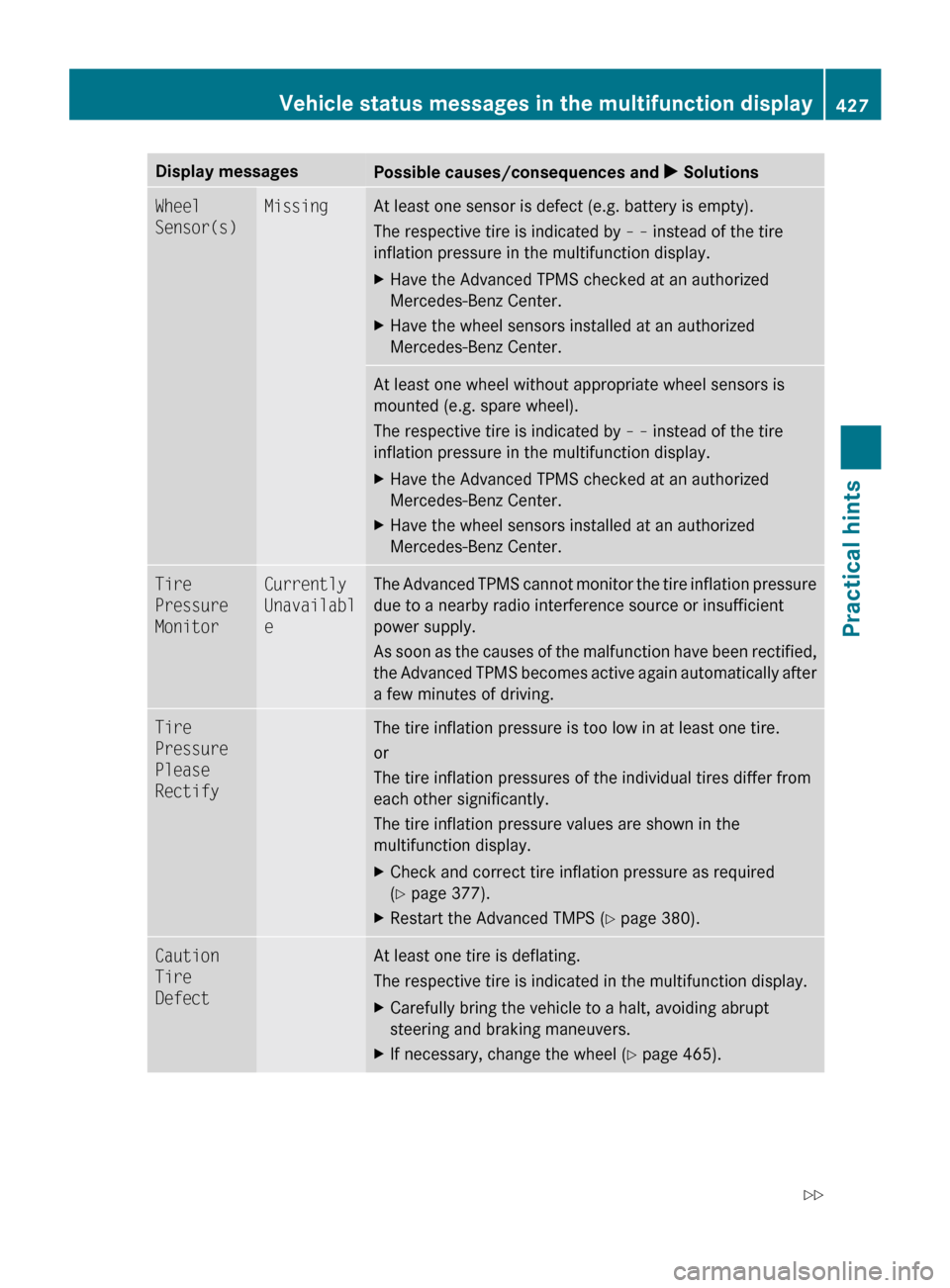
Display messages
Possible causes/consequences and
X SolutionsWheel
Sensor(s) Missing At least one sensor is defect (e.g. battery is empty).
The respective tire is indicated by
– – instead of the tire
inflation pressure in the multifunction display.
X Have the Advanced TPMS checked at an authorized
Mercedes-Benz Center.
X Have the wheel sensors installed at an authorized
Mercedes-Benz Center. At least one wheel without appropriate wheel sensors is
mounted (e.g. spare wheel).
The respective tire is indicated by
– – instead of the tire
inflation pressure in the multifunction display.
X Have the Advanced TPMS checked at an authorized
Mercedes-Benz Center.
X Have the wheel sensors installed at an authorized
Mercedes-Benz Center. Tire
Pressure
Monitor Currently
Unavailabl
e The Advanced TPMS cannot monitor the tire inflation pressure
due to a nearby radio interference source or insufficient
power supply.
As
soon
as the causes of the malfunction have been rectified,
the Advanced TPMS becomes active again automatically after
a few minutes of driving. Tire
Pressure
Please
Rectify The tire inflation pressure is too low in at least one tire.
or
The tire inflation pressures of the individual tires differ from
each other significantly.
The tire inflation pressure values are shown in the
multifunction display.
X
Check and correct tire inflation pressure as required
(Y page 377).
X Restart the Advanced TMPS ( Y page 380).Caution
Tire
Defect At least one tire is deflating.
The respective tire is indicated in the multifunction display.
X
Carefully bring the vehicle to a halt, avoiding abrupt
steering and braking maneuvers.
X If necessary, change the wheel (Y page 465). Vehicle status messages in the multifunction display
427
Practical hints
216_AKB; 3; 90, en-US
d2ureepe,Version: 2.11.8.1 2009-05-15T11:47:50+02:00 - Seite 427 Z
Page 432 of 500
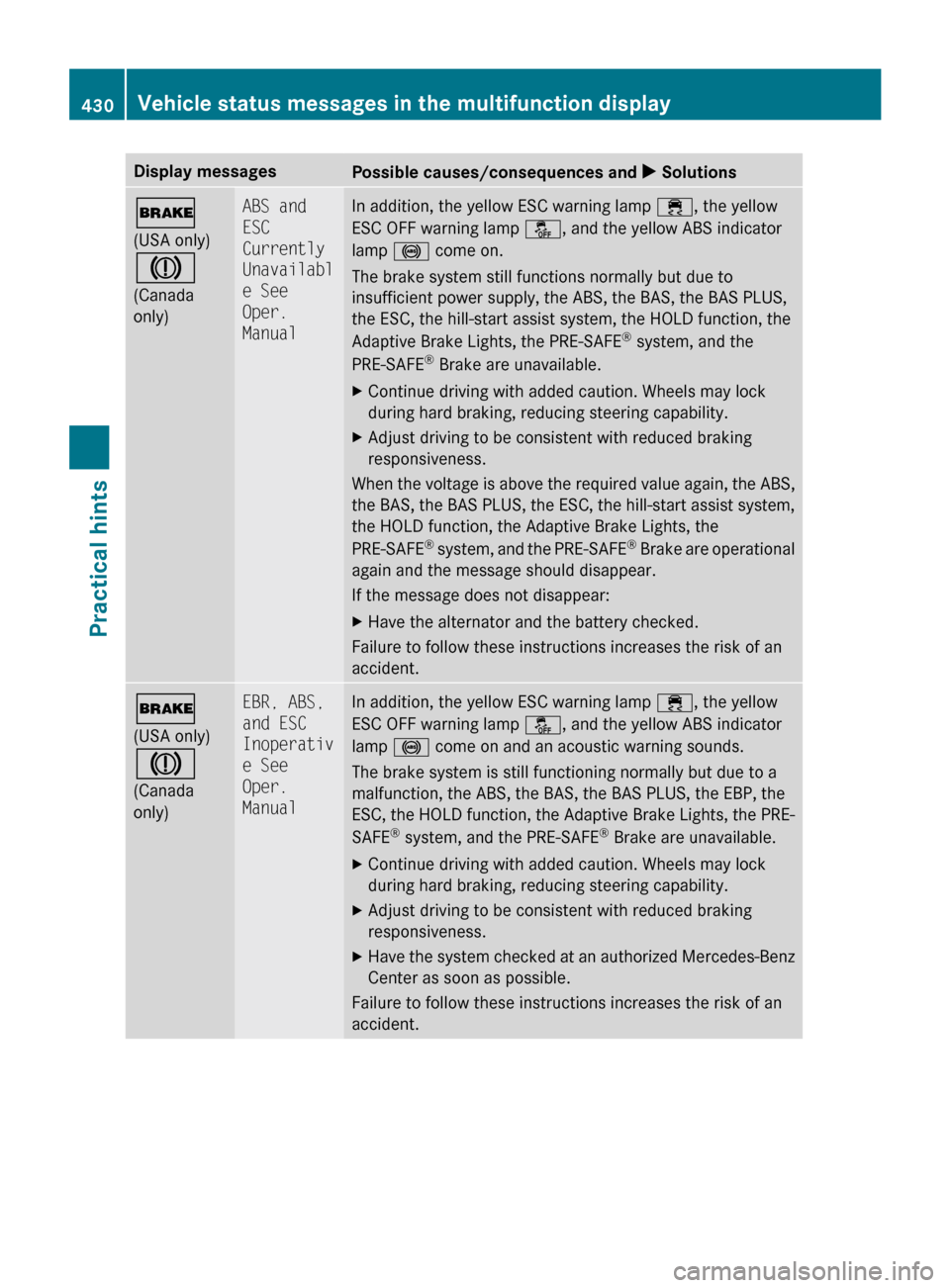
Display messages
Possible causes/consequences and
X Solutions$
(USA only)
J
(Canada
only) ABS and
ESC
Currently
Unavailabl
e See
Oper.
Manual In addition, the yellow ESC warning lamp
÷, the yellow
ESC OFF warning lamp å, and the yellow ABS indicator
lamp ! come on.
The brake system still functions normally but due to
insufficient power supply, the ABS, the BAS, the BAS PLUS,
the ESC, the hill-start assist system, the HOLD function, the
Adaptive Brake Lights, the PRE-SAFE ®
system, and the
PRE-SAFE ®
Brake are unavailable.
X Continue driving with added caution. Wheels may lock
during hard braking, reducing steering capability.
X Adjust driving to be consistent with reduced braking
responsiveness.
When the voltage is above the required value again, the ABS,
the BAS,
the BAS PLUS, the ESC, the hill-start assist system,
the HOLD function, the Adaptive Brake Lights, the
PRE-SAFE ®
system, and the PRE-SAFE ®
Brake are operational
again and the message should disappear.
If the message does not disappear:
X Have the alternator and the battery checked.
Failure to follow these instructions increases the risk of an
accident. $
(USA only)
J
(Canada
only) EBR, ABS,
and ESC
Inoperativ
e See
Oper.
Manual In addition, the yellow ESC warning lamp
÷, the yellow
ESC OFF warning lamp å, and the yellow ABS indicator
lamp ! come on and an acoustic warning sounds.
The brake system is still functioning normally but due to a
malfunction, the ABS, the BAS, the BAS PLUS, the EBP, the
ESC, the
HOLD function, the Adaptive Brake Lights, the PRE-
SAFE ®
system, and the PRE-SAFE ®
Brake are unavailable.
X Continue driving with added caution. Wheels may lock
during hard braking, reducing steering capability.
X Adjust driving to be consistent with reduced braking
responsiveness.
X Have the system checked at an authorized Mercedes-Benz
Center as soon as possible.
Failure to follow these instructions increases the risk of an
accident. 430
Vehicle status messages in the multifunction display
Practical hints
216_AKB; 3; 90, en-US
d2ureepe,
Version: 2.11.8.1 2009-05-15T11:47:50+02:00 - Seite 430
Page 435 of 500
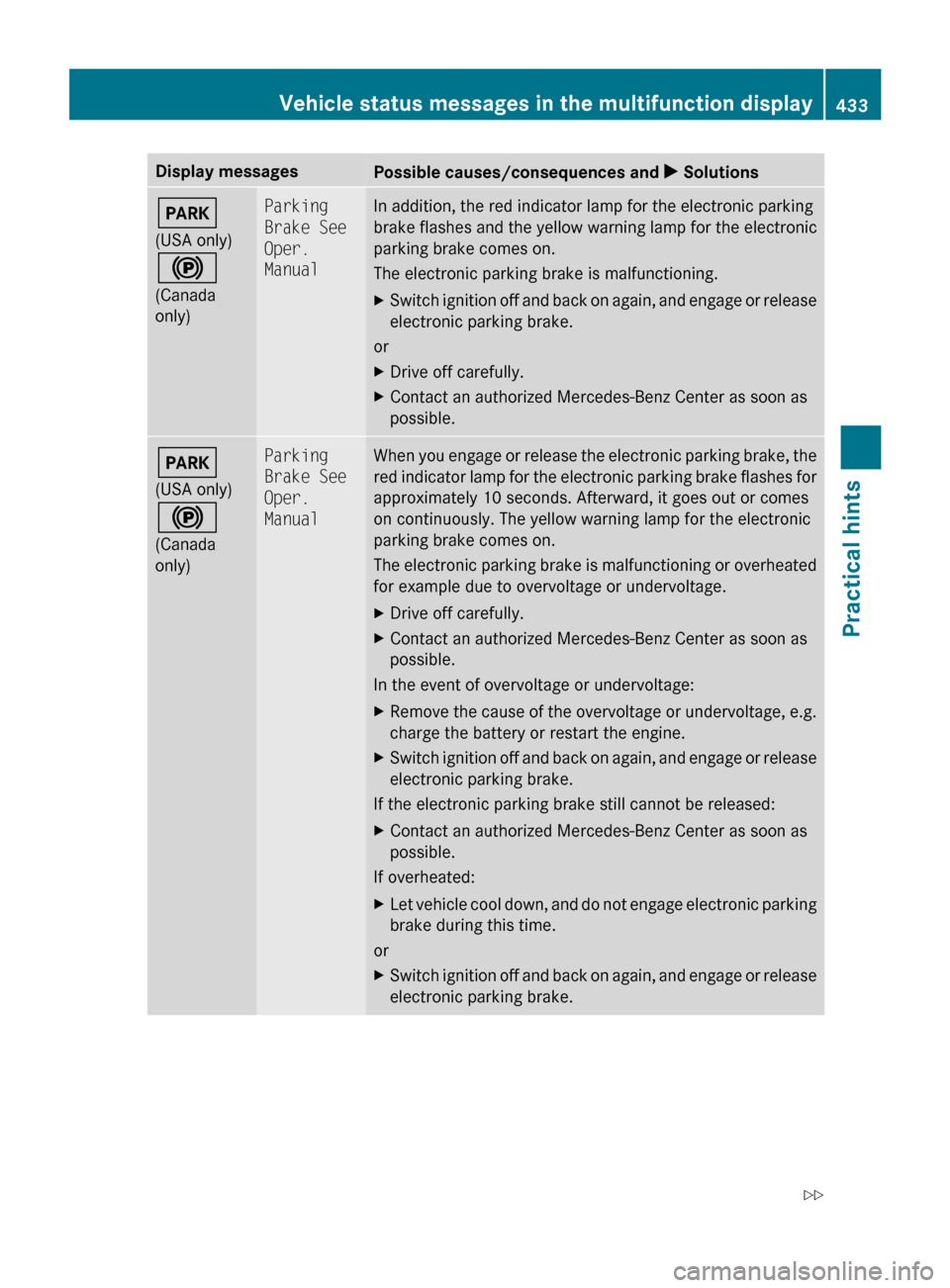
Display messages
Possible causes/consequences and
X SolutionsF
(USA only)
!
(Canada
only) Parking
Brake See
Oper.
Manual In addition, the red indicator lamp for the electronic parking
brake flashes and the yellow warning lamp for the electronic
parking brake comes on.
The electronic parking brake is malfunctioning.
X
Switch ignition off and back on again, and engage or release
electronic parking brake.
or
X Drive off carefully.
X Contact an authorized Mercedes-Benz Center as soon as
possible. F
(USA only)
!
(Canada
only) Parking
Brake See
Oper.
Manual When you engage or release the electronic parking brake, the
red
indicator
lamp for the electronic parking brake flashes for
approximately 10 seconds. Afterward, it goes out or comes
on continuously. The yellow warning lamp for the electronic
parking brake comes on.
The electronic parking brake is malfunctioning or overheated
for example due to overvoltage or undervoltage.
X Drive off carefully.
X Contact an authorized Mercedes-Benz Center as soon as
possible.
In the event of overvoltage or undervoltage:
X Remove the cause of the overvoltage or undervoltage, e.g.
charge the battery or restart the engine.
X Switch ignition off and back on again, and engage or release
electronic parking brake.
If the electronic parking brake still cannot be released:
X Contact an authorized Mercedes-Benz Center as soon as
possible.
If overheated:
X Let vehicle cool down, and do not engage electronic parking
brake during this time.
or
X Switch ignition off and back on again, and engage or release
electronic parking brake. Vehicle status messages in the multifunction display
433
Practical hints
216_AKB; 3; 90, en-US
d2ureepe,Version: 2.11.8.1 2009-05-15T11:47:50+02:00 - Seite 433 Z
Page 442 of 500
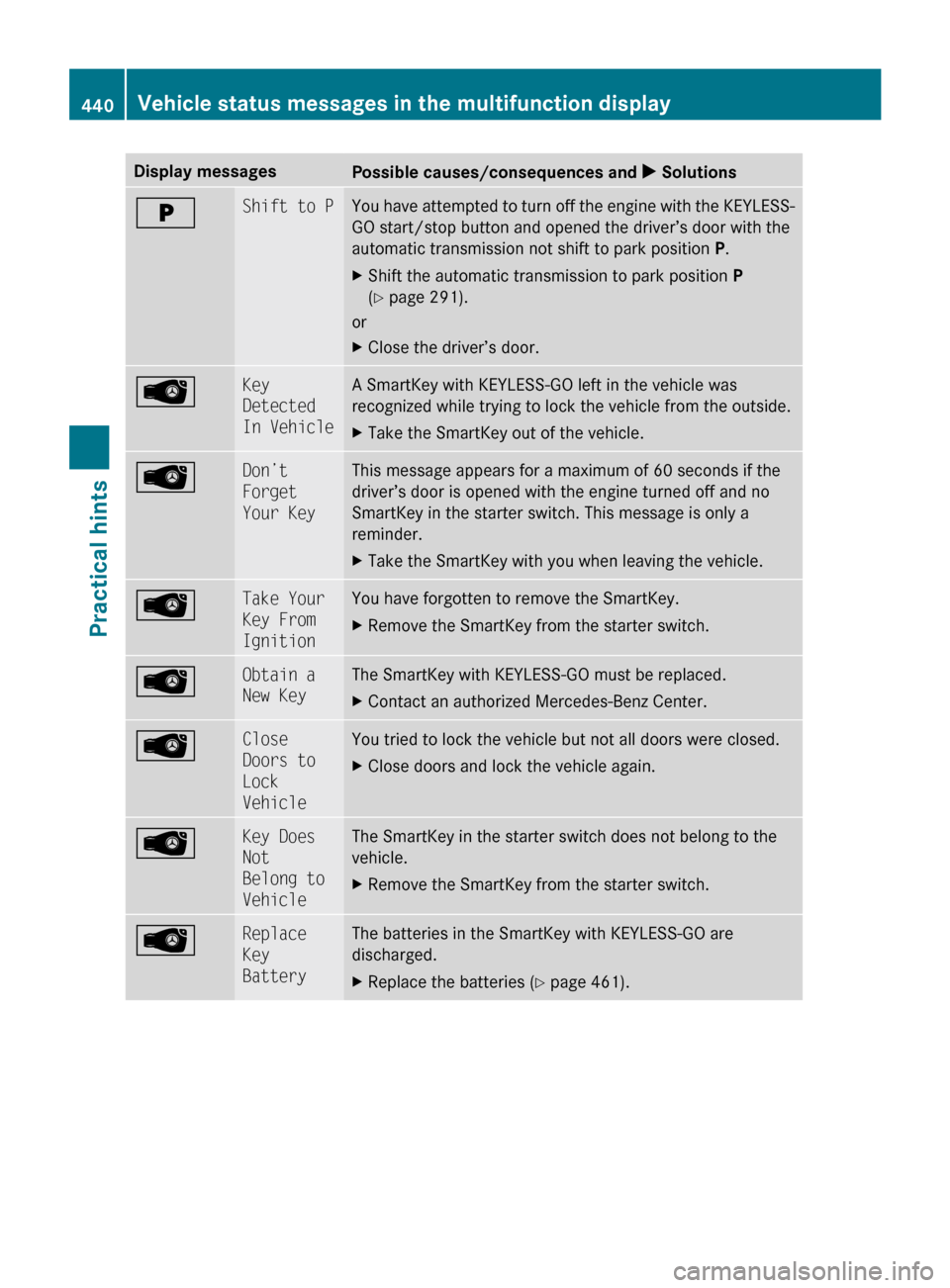
Display messages
Possible causes/consequences and
X SolutionsE Shift to P You have attempted to turn off the engine with the KEYLESS-
GO start/stop button and opened the driver’s door with the
automatic transmission not shift to park position
P.
X Shift the automatic transmission to park position P
(Y page 291).
or
X Close the driver’s door. Â Key
Detected
In Vehicle A SmartKey with KEYLESS-GO left in the vehicle was
recognized while trying to lock the vehicle from the outside.
X
Take the SmartKey out of the vehicle. Â Don’t
Forget
Your Key This message appears for a maximum of 60 seconds if the
driver’s door is opened with the engine turned off and no
SmartKey in the starter switch. This message is only a
reminder.
X
Take the SmartKey with you when leaving the vehicle. Â Take Your
Key From
Ignition You have forgotten to remove the SmartKey.
X
Remove the SmartKey from the starter switch. Â Obtain a
New Key The SmartKey with KEYLESS-GO must be replaced.
X
Contact an authorized Mercedes-Benz Center. Â Close
Doors to
Lock
Vehicle You tried to lock the vehicle but not all doors were closed.
X
Close doors and lock the vehicle again. Â Key Does
Not
Belong to
Vehicle The SmartKey in the starter switch does not belong to the
vehicle.
X
Remove the SmartKey from the starter switch. Â Replace
Key
Battery The batteries in the SmartKey with KEYLESS-GO are
discharged.
X
Replace the batteries ( Y page 461).440
Vehicle status messages in the multifunction displayPractical hints
216_AKB; 3; 90, en-US
d2ureepe,
Version: 2.11.8.1 2009-05-15T11:47:50+02:00 - Seite 440
Page 446 of 500
Display messages
Possible causes/consequences and
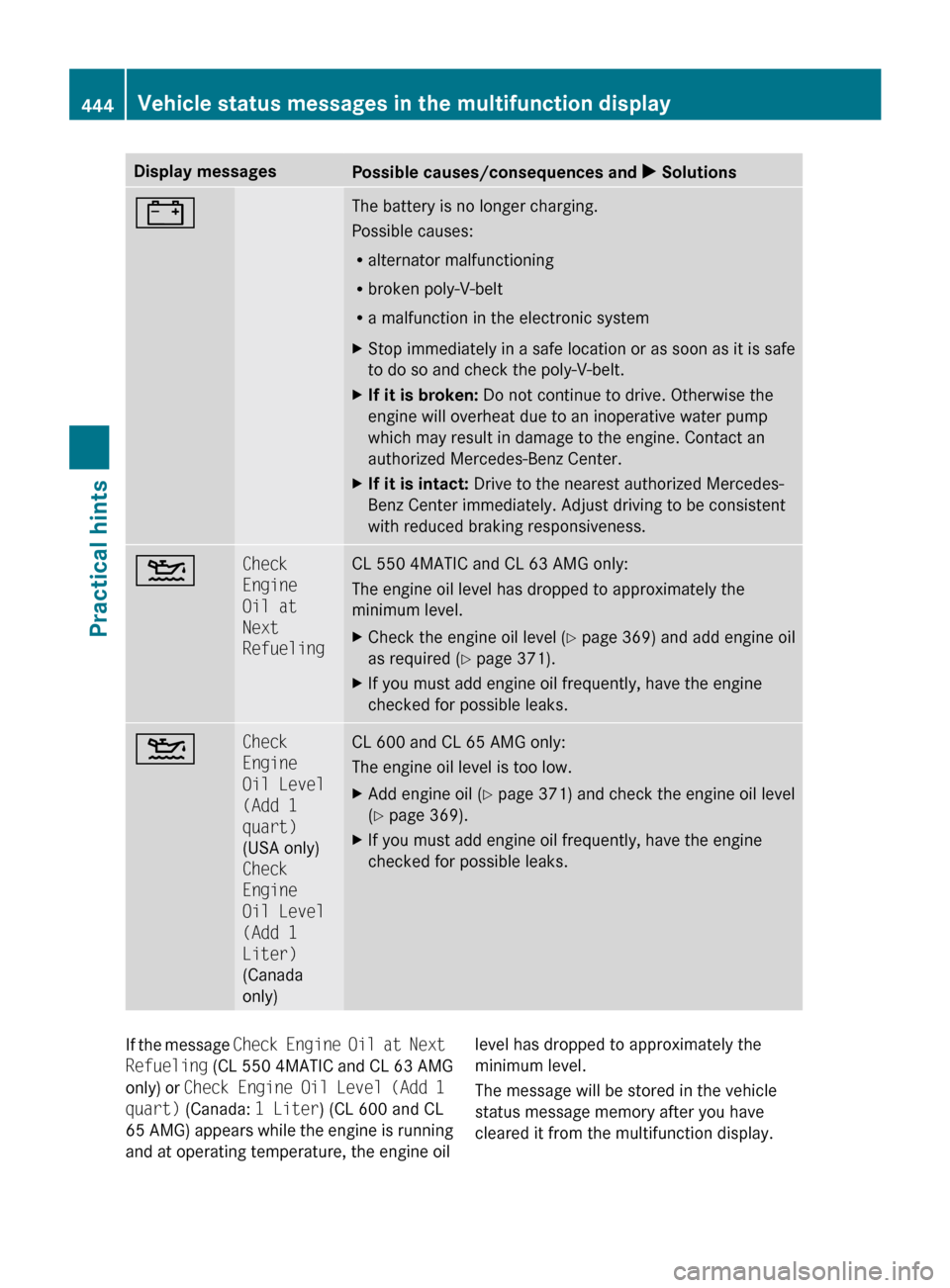
X Solutions# The battery is no longer charging.
Possible causes:
R
alternator malfunctioning
R broken poly-V-belt
R a malfunction in the electronic system
X Stop immediately in a safe location or as soon as it is safe
to do so and check the poly-V-belt.
X If it is broken: Do not continue to drive. Otherwise the
engine will overheat due to an inoperative water pump
which may result in damage to the engine. Contact an
authorized Mercedes-Benz Center.
X If it is intact: Drive to the nearest authorized Mercedes-
Benz Center immediately. Adjust driving to be consistent
with reduced braking responsiveness. 4 Check
Engine
Oil at
Next
Refueling CL 550 4MATIC and CL 63 AMG only:
The engine oil level has dropped to approximately the
minimum level.
X
Check the engine oil level ( Y page 369) and add engine oil
as required (Y page 371).
X If you must add engine oil frequently, have the engine
checked for possible leaks. 4 Check
Engine
Oil Level
(Add 1
quart)
(USA only)
Check
Engine
Oil Level
(Add 1
Liter)
(Canada
only) CL 600 and CL 65 AMG only:
The engine oil level is too low.
X
Add engine oil ( Y page 371) and check the engine oil level
(
Y page 369).
X If you must add engine oil frequently, have the engine
checked for possible leaks. If the message
Check Engine
Oil at Next
Refueling (CL 550 4MATIC and CL 63 AMG
only) or Check Engine Oil Level (Add 1
quart) (Canada: 1 Liter) (CL 600 and CL
65 AMG) appears while the engine is running
and at operating temperature, the engine oil level has dropped to approximately the
minimum level.
The message will be stored in the vehicle
status message memory after you have
cleared it from the multifunction display.444
Vehicle status messages in the multifunction display
Practical hints
216_AKB; 3; 90, en-US
d2ureepe,
Version: 2.11.8.1 2009-05-15T11:47:50+02:00 - Seite 444
Page 453 of 500
Brake
Problem
Possible causes/consequences and
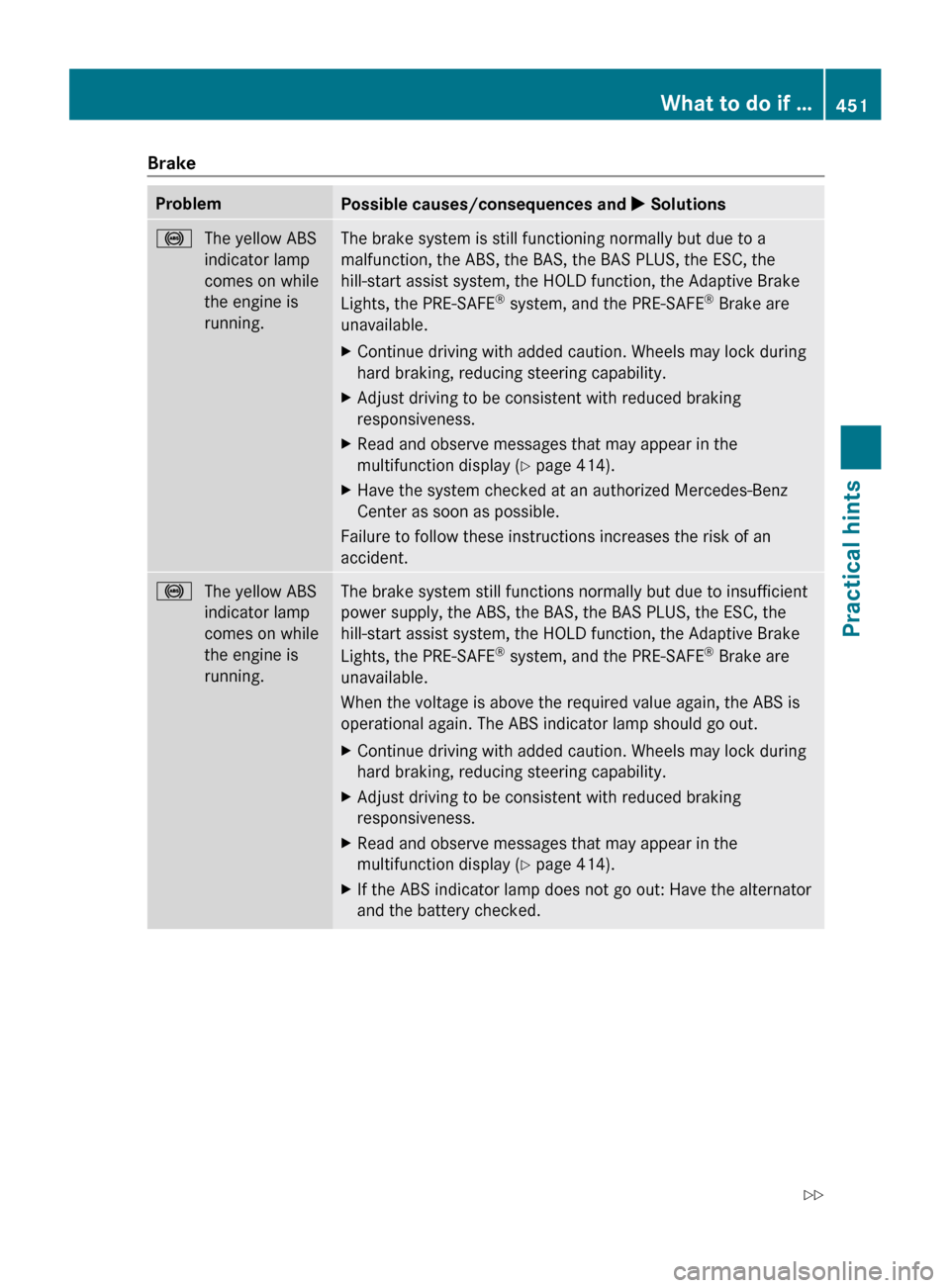
X Solutions!
The yellow ABS
indicator lamp
comes on while
the engine is
running. The brake system is still functioning normally but due to a
malfunction, the ABS, the BAS, the BAS PLUS, the ESC, the
hill-start assist system, the HOLD function, the Adaptive Brake
Lights, the PRE-SAFE
®
system, and the PRE-SAFE ®
Brake are
unavailable.
X Continue driving with added caution. Wheels may lock during
hard braking, reducing steering capability.
X Adjust driving to be consistent with reduced braking
responsiveness.
X Read and observe messages that may appear in the
multifunction display (Y
page 414).
X Have the system checked at an authorized Mercedes-Benz
Center as soon as possible.
Failure to follow these instructions increases the risk of an
accident. !
The yellow ABS
indicator lamp
comes on while
the engine is
running. The brake system still functions normally but due to insufficient
power supply, the ABS, the BAS, the BAS PLUS, the ESC, the
hill-start assist system, the HOLD function, the Adaptive Brake
Lights, the PRE-SAFE
®
system, and the PRE-SAFE ®
Brake are
unavailable.
When the voltage is above the required value again, the ABS is
operational again. The ABS indicator lamp should go out.
X Continue driving with added caution. Wheels may lock during
hard braking, reducing steering capability.
X Adjust driving to be consistent with reduced braking
responsiveness.
X Read and observe messages that may appear in the
multifunction display (Y
page 414).
X If the ABS indicator lamp does not go out: Have the alternator
and the battery checked. What to do if …
451
Practical hints
216_AKB; 3; 90, en-US
d2ureepe, Version: 2.11.8.1 2009-05-15T11:47:50+02:00 - Seite 451 Z
Page 464 of 500
G
Warning!
Batteries contain poisonous and corrosive
substances. Therefore, keep the batteries out
of reach of children.
If a battery is swallowed, seek medical help
immediately. G
Warning!
SmartKey batteries contain perchlorate
material, which may require special handling
and regard for the environment. Check with
your local government’s disposal guidelines.
California residents, see www.dtsc.ca.gov/
HazardousWaste/Perchlorate/
index.cfm.
Batteries contain materials that can harm the
environment if disposed of improperly.
Recycling of batteries is the preferred method
of disposal. Many states (USA only) or
provinces (Canada only) require sellers of
batteries to accept old batteries for recycling.
When inserting the batteries, make sure they
are clean and free of lint.
When replacing batteries, always replace
both batteries.
i The required replacement batteries are
available at any authorized Mercedes-Benz
Center.
Replacement batteries: Lithium, type
CR 2025 or equivalent.
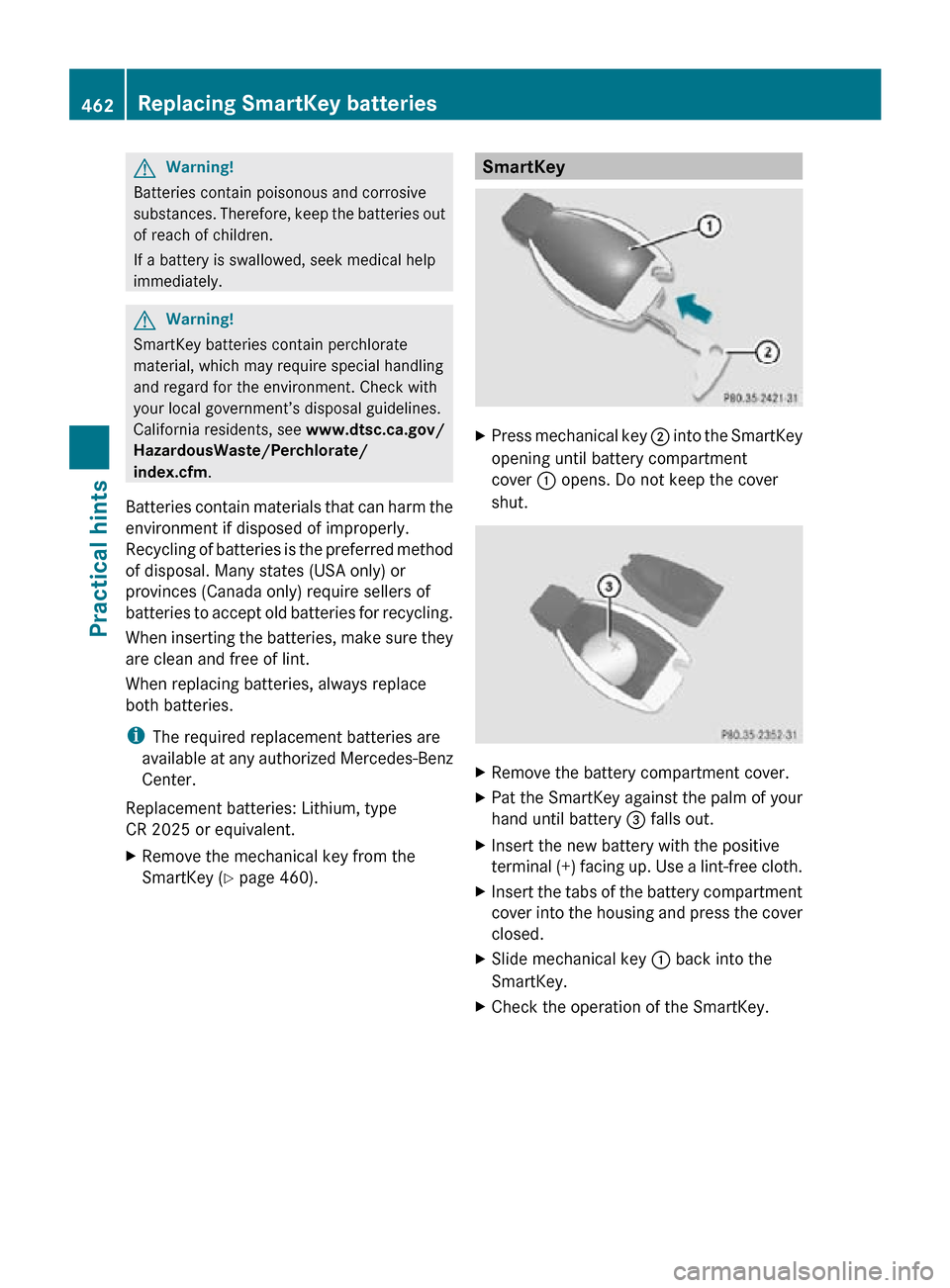
X Remove the mechanical key from the
SmartKey (Y page 460). SmartKey
X
Press mechanical key ; into the SmartKey
opening until battery compartment
cover : opens. Do not keep the cover
shut. X
Remove the battery compartment cover.
X Pat the SmartKey against the palm of your
hand until battery = falls out.
X Insert the new battery with the positive
terminal (+) facing up. Use a lint-free cloth.
X Insert the tabs of the battery compartment
cover into the housing and press the cover
closed.
X Slide mechanical key : back into the
SmartKey.
X Check the operation of the SmartKey. 462
Replacing SmartKey batteriesPractical hints
216_AKB; 3; 90, en-US
d2ureepe,
Version: 2.11.8.1 2009-05-15T11:47:50+02:00 - Seite 462
Page 465 of 500
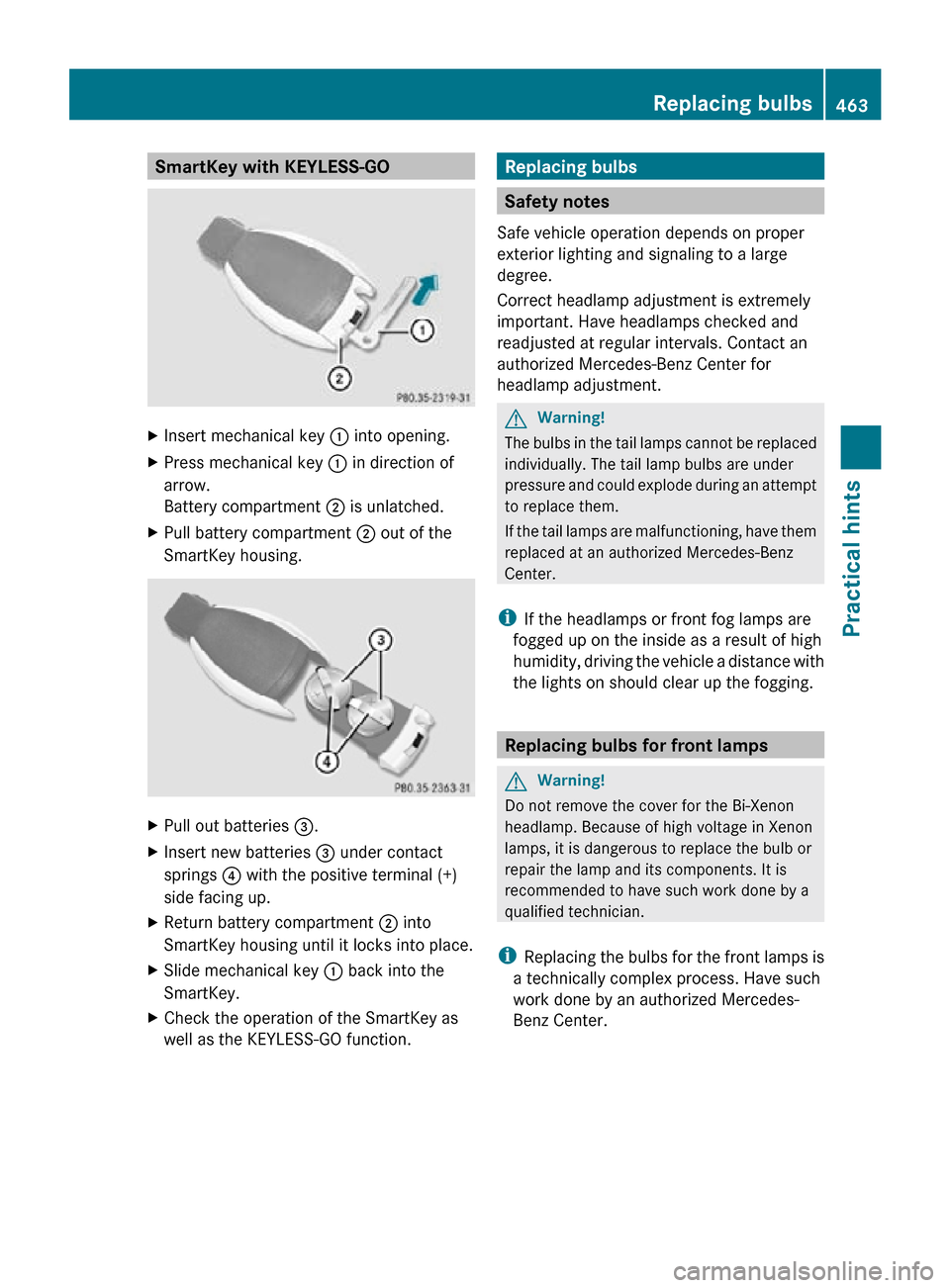
SmartKey with KEYLESS-GO
X
Insert mechanical key : into opening.
X Press mechanical key : in direction of
arrow.
Battery compartment ; is unlatched.
X Pull battery compartment ; out of the
SmartKey housing. X
Pull out batteries =.
X Insert new batteries = under contact
springs ? with the positive terminal (+)
side facing up.
X Return battery compartment ; into
SmartKey housing until it locks into place.
X Slide mechanical key : back into the
SmartKey.
X Check the operation of the SmartKey as
well as the KEYLESS-GO function. Replacing bulbs
Safety notes
Safe vehicle operation depends on proper
exterior lighting and signaling to a large
degree.
Correct headlamp adjustment is extremely
important. Have headlamps checked and
readjusted at regular intervals. Contact an
authorized Mercedes-Benz Center for
headlamp adjustment. G
Warning!
The bulbs in the tail lamps cannot be replaced
individually. The tail lamp bulbs are under
pressure and could explode during an attempt
to replace them.
If the tail lamps are malfunctioning, have them
replaced at an authorized Mercedes-Benz
Center.
i If the headlamps or front fog lamps are
fogged up on the inside as a result of high
humidity, driving the vehicle a distance with
the lights on should clear up the fogging. Replacing bulbs for front lamps
G
Warning!
Do not remove the cover for the Bi-Xenon
headlamp. Because of high voltage in Xenon
lamps, it is dangerous to replace the bulb or
repair the lamp and its components. It is
recommended to have such work done by a
qualified technician.
i Replacing the bulbs for the front lamps is
a technically complex process. Have such
work done by an authorized Mercedes-
Benz Center. Replacing bulbs
463Practical hints
216_AKB; 3; 90, en-US
d2ureepe, Version: 2.11.8.1 2009-05-15T11:47:50+02:00 - Seite 463 Z
Page 471 of 500
Lowering the vehicle
X
Lower the vehicle by turning the crank
counterclockwise until the vehicle is
resting fully on its own weight.
X Remove the jack. X
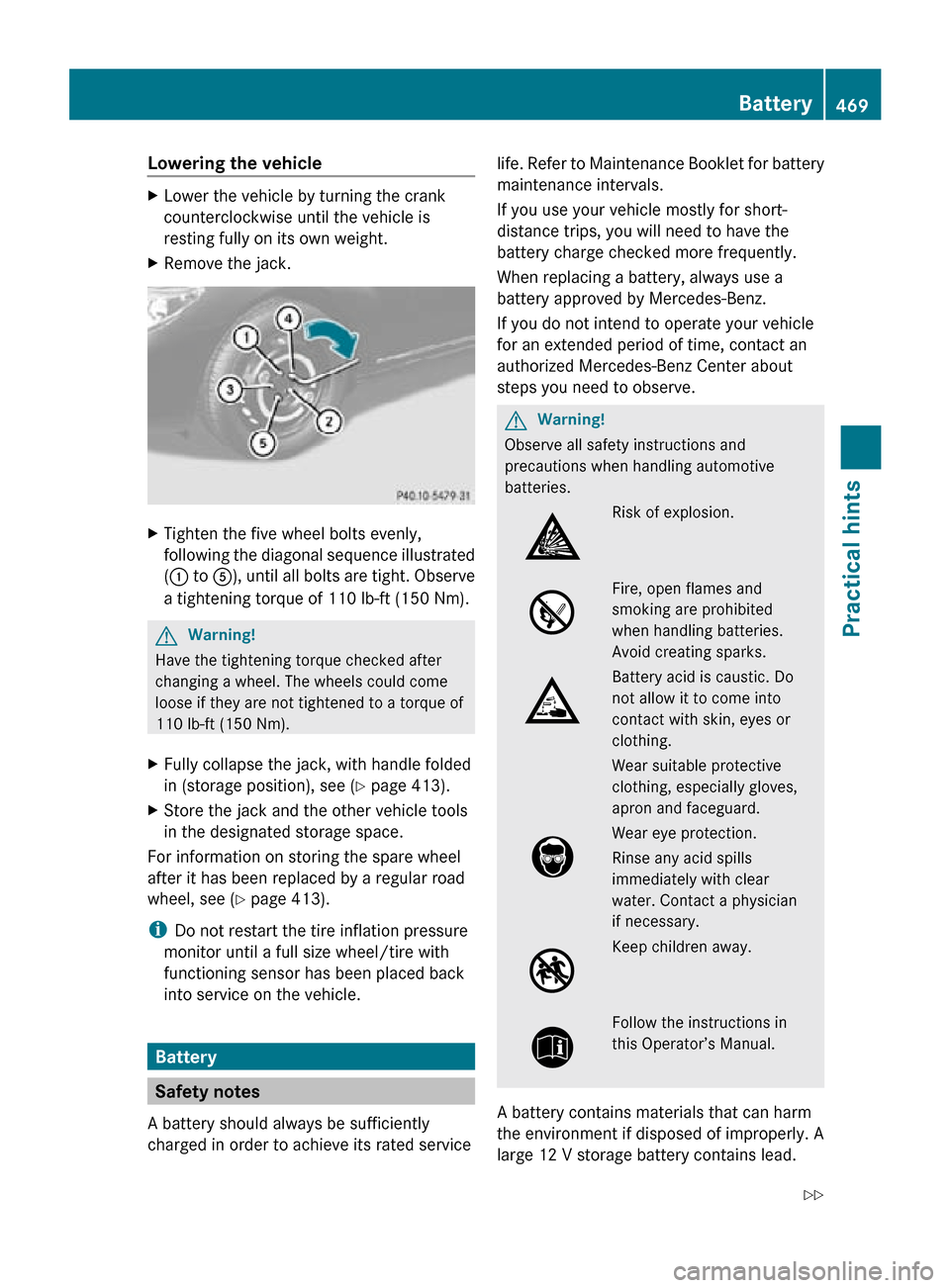
Tighten the five wheel bolts evenly,
following the diagonal sequence illustrated
(: to A), until all bolts are tight. Observe
a tightening torque of 110 lb-ft (150 Nm). G
Warning!
Have the tightening torque checked after
changing a wheel. The wheels could come
loose if they are not tightened to a torque of
110 lb-ft (150 Nm).
X Fully collapse the jack, with handle folded
in (storage position), see ( Y page 413).
X Store the jack and the other vehicle tools
in the designated storage space.
For information on storing the spare wheel
after it has been replaced by a regular road
wheel, see ( Y page 413).
i Do not restart the tire inflation pressure
monitor until a full size wheel/tire with
functioning sensor has been placed back
into service on the vehicle. Battery
Safety notes
A battery should always be sufficiently
charged in order to achieve its rated service life. Refer to Maintenance Booklet for battery
maintenance intervals.
If you use your vehicle mostly for short-
distance trips, you will need to have the
battery charge checked more frequently.
When replacing a battery, always use a
battery approved by Mercedes-Benz.
If you do not intend to operate your vehicle
for an extended period of time, contact an
authorized Mercedes-Benz Center about
steps you need to observe.
G
Warning!
Observe all safety instructions and
precautions when handling automotive
batteries. Risk of explosion.
Fire, open flames and
smoking are prohibited
when handling batteries.
Avoid creating sparks.
Battery acid is caustic. Do
not allow it to come into
contact with skin, eyes or
clothing.
Wear suitable protective
clothing, especially gloves,
apron and faceguard.
Wear eye protection.
Rinse any acid spills
immediately with clear
water. Contact a physician
if necessary.
Keep children away.
Follow the instructions in
this Operator’s Manual.
A battery contains materials that can harm
the environment if disposed of improperly. A
large 12 V storage battery contains lead. Battery
469Practical hints
216_AKB; 3; 90, en-US
d2ureepe, Version: 2.11.8.1 2009-05-15T11:47:50+02:00 - Seite 469 Z
Page 472 of 500
Recycling of the battery is the preferred
method of disposal. Many states (USA only)
or provinces (Canada only) require sellers of
batteries to accept the old battery for
recycling.
G
Warning!
Failure to follow these instructions can result
in severe injury or death.
Never lean over batteries while connecting.
You might get injured.
Battery fluid contains sulfuric acid. Do not
allow this fluid to come in contact with eyes,
skin or clothing. In case it does, immediately
flush affected area with water and seek
medical help if necessary.
A battery will also produce hydrogen gas,
which is flammable and explosive. Keep
flames or sparks away from battery, avoid
improper connection of jumper cables,
smoking etc. G
Warning!
Do not place metal objects on the battery as
this could result in a short circuit.
Use leak-proof
batteries only to avoid the risk
of acid burns in the event of an accident.
Take care that you do not become statically
charged, e.g. by wearing synthetic clothing or
rubbing against textiles. For this reason, you
also should not pull or push the battery over
carpets or other synthetic materials.
Never touch the battery first. First touch the
outside body of the vehicle in order to release
any possible electrostatic charges.
Do not rub the battery with rags or cloths. The
battery could explode if touched due to
electrostatic charge or due to spark
formation.
! The battery is a Valve- Regulated Lead
Acid (VRLA) battery, also referred to as
“fleece” battery.
Such
batteries
do not require topping-up of
the electrolyte level. VRLA batteries
therefore do not have cell caps and the battery cover is non-removable. Do not
attempt to open the battery as otherwise
the battery will be damaged.
VRLA batteries
do not require topping-up of
the electrolyte level. They cannot be
opened to check the electrolyte level.
However, the battery condition must be
checked periodically by performing a
battery conductance test. Refer to
Maintenance Booklet for battery condition
testing intervals.
The factory-equipped battery may only be
replaced with a battery that
R has the same security features
R is of identical size
R is of identical voltage
R is of identical capacity
! As any other battery, the battery may
discharge if you do not operate the vehicle
for an extended period of time. Have the
battery disconnected at a qualified
workshop or an authorized Mercedes-Benz
Center in such a case. You may also
connect an accessory battery charge unit
expressly approved by Mercedes-Benz for
your vehicle model to maintain the battery
charge. Contact an authorized Mercedes-
Benz Center for further information.
The battery, the battery ventilation hose
and the lateral plug must always be
securely installed when the vehicle is in
operation.
! Switch off the engine and switch off the
vehicle’s internal electrical functions
before you disconnect or remove the
battery’s terminal clamps. You could
otherwise destroy electronic assemblies
such as the generator.
Remove SmartKey from starter switch
(vehicles with KEYLESS-GO: Make sure the
vehicle’s on-board electronics have status 0)
when you turn off the engine and no longer
require any electrical consumers. The vehicle 470
Battery
Practical hints
216_AKB; 3; 90, en-US
d2ureepe,
Version: 2.11.8.1 2009-05-15T11:47:50+02:00 - Seite 470