tow MERCEDES-BENZ CLA 2016 Owner's Manual
[x] Cancel search | Manufacturer: MERCEDES-BENZ, Model Year: 2016, Model line: CLA, Model: MERCEDES-BENZ CLA 2016Pages: 374, PDF Size: 9.97 MB
Page 193 of 374
The damping is tuned individually to each
wheel and depends on: R
your driving style, e.g. sporty R
the road surface condition, e.g. bumps R
your individual selection of Sport or Com-
fort mode.
The suspension setting is adjusted using the
corresponding button in the center console.
i The mode can also be set using the AMG
DYNAMIC SELECT controller ( Y
page 156).
Each time you start the engine with the igni-
tion key or the Start/Stop button, Comfort
mode is activated. For further information
about starting the engine, see ( Y
page 149).
Sport mode
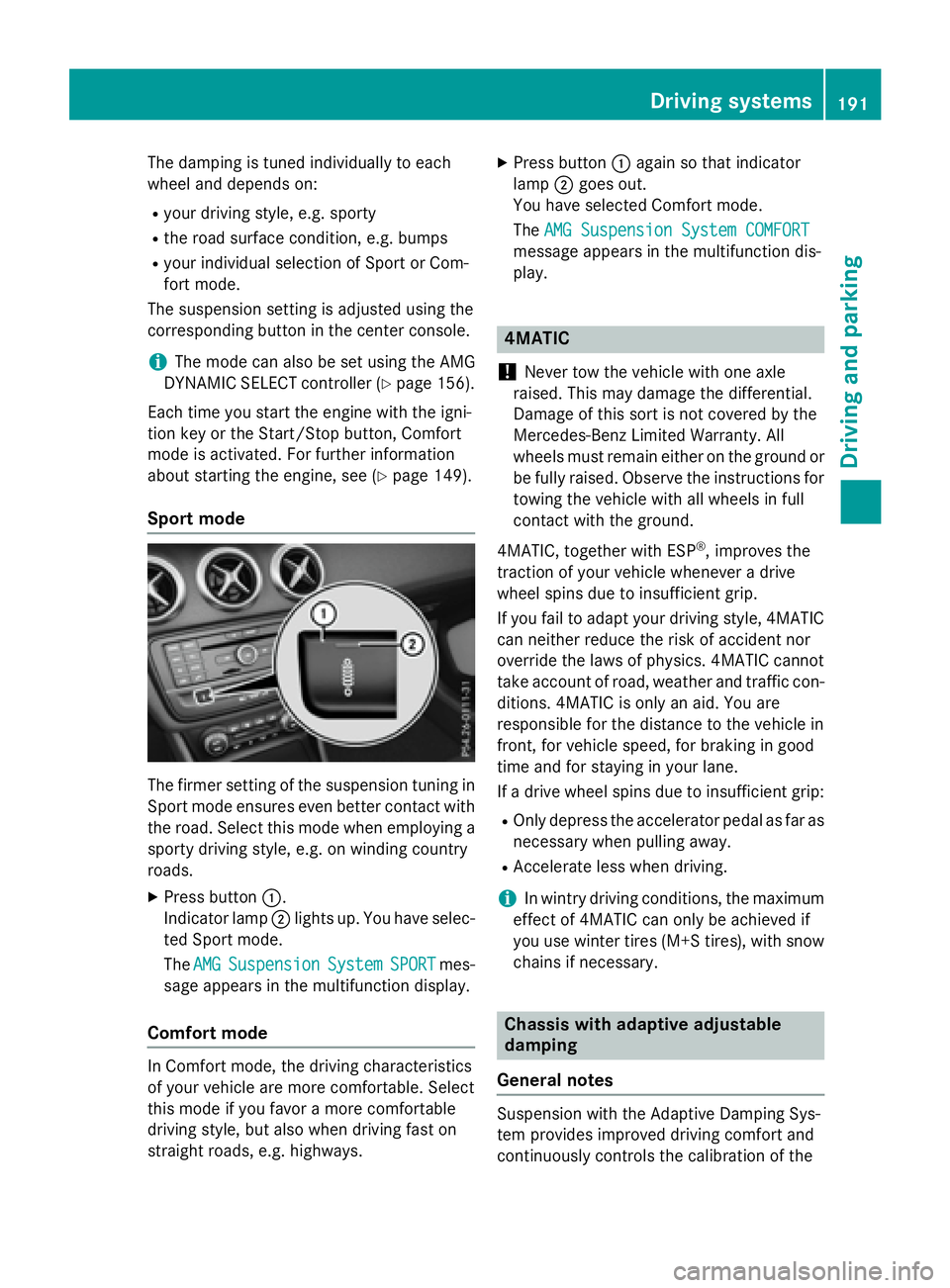
The firmer setting of the suspension tuning in
Sport mode ensures even better contact with
the road. Select this mode when employing a
sporty driving style, e.g. on winding country
roads. X
Press button C .
Indicator lamp D lights up. You have selec-
ted Sport mode.
The AMG Suspension System SPORT mes-
sage appears in the multifunction display.
Comfort mode
In Comfort mode, the driving characteristics
of your vehicle are more comfortable. Select
this mode if you favor a more comfortable
driving style, but also when driving fast on
straight roads, e.g. highways. X
Press button C again so that indicator
lamp D goes out.
You have selected Comfort mode.
The AMG Suspension System COMFORT
message appears in the multifunction dis-
play.
4MATIC
! Never tow the vehicle with one axle
raised. This may damage the differential.
Damage of this sort is not covered by the
Mercedes-Benz Limited Warranty. All
wheels must remain either on the ground or
be fully raised. Observe the instructions for
towing the vehicle with all wheels in full
contact with the ground.
4MATIC, together with ESP ®
, improves the
traction of your vehicle whenever a drive
wheel spins due to insufficient grip.
If you fail to adapt your driving style, 4MATIC
can neither reduce the risk of accident nor
override the laws of physics. 4MATIC cannot
take account of road, weather and traffic con-
ditions. 4MATIC is only an aid. You are
responsible for the distance to the vehicle in
front, for vehicle speed, for braking in good
time and for staying in your lane.
If a drive wheel spins due to insufficient grip: R
Only depress the accelerator pedal as far as
necessary when pulling away. R
Accelerate less when driving.
i In wintry driving conditions, the maximum
effect of 4MATIC can only be achieved if
you use winter tires (M +S tires), with snow
chains if necessary.
Chassis with adaptive adjustable
damping
General notes
Suspension with the Adaptive Damping Sys-
tem provides improved driving comfort and
continuously controls the calibration of the Driving systems 191
Driving and parking Z
Page 199 of 374
Active Parking Assist is switched on automat-
ically when driving forwards. The system is
operational at speeds of up to approximately
22 mph (35 km/h). While in operation, the
system independently locates and measures
parking spaces on both sides of the vehicle.
Active Parking Assist will only detect parking
spaces: R
that are parallel or at right-angles to the
direction of travel R
that are parallel to the direction of travel
and at least 59 in (1.5 m) wideR
that are parallel to the direction of travel
and at least 39.5 in (1.0 m) lo nger than your
vehicle R
that are at right angles to the direction of
travel and at least 39.5 in (1.0 m) wide r
than your vehicle
i Note that Active Parking Assist cannot
measure the length of a parking space if it
is at right angles to the direction of travel.
You will need to judge whether your vehicle
will fit into the parking space.
When driving at speeds below 19 mph
(30 km/h), you will see parking symbol D as
a status indicator in the instrument cluster.
When a parking space has been detected, an
arrow towards the right or the left also
appears. By default, Active Parking Assist
onl y d isplays parking spaces on the front-
p assenger side. Parking spaces on the driv-
er's side are displayed as soon as the turn
signal on the driver's side is activated. When
parking on the driver's side, this must remain
activated until you confirm the use of Active
Parking Assist by pressing the v button on
the multifunction steering wheel. The system
automatically determines whether the park-
ing space is parallel or at right-angles to the
direction of travel.
A parking space is displayed while you are
driving past it, and until you are approx-
imately 50 ft (15 m) away from it. Parking
G WARNING
If you leave the vehicle when it is only being
braked by Active Parking Assist it could roll
away if: R
there is a malfunction in the system or in
the voltage supply. R
the electrical system in the engine com-
partment, the battery or the fuses have
been tampered with. R
the battery is disconnected. R
the accelerator pedal has been depressed,
e.g. by a vehicle occupant.
There is a risk of an accident.
Before leaving the vehicle, always secure it
against rolling away.
i When PARKTRONIC detects obstacles,
Active Parking Assist brakes automatically
during the parking process. You are respon-
sible for braking in good time. X
Stop the vehicle when the parking space
symbol shows the desired parking space in
the instrument cluster. X
Shift the transmission to position R .
The Start Park Assist? Yes: OK No:
8 message appears in the multifunction
display. X
To cancel the procedure: press the 8
button on the multifunction steering wheel
or pull away.
or X
To park using Active Parking Assist:
press the v button on the multifunction
steering wheel.
The Park Assist Active Accelerate
and Brake Observe Surroundings mes-
sage appears in the multifunction display. X
Let go of the multifunction steering wheel. X
Back up the vehicle, being ready to brake at
all times. When backing up, drive at a speed
below approximately 6 mph (10 km/h). Driving system s 197
Dr ivi ng an d parking Z
Page 203 of 374
! Objects not at ground level may appear to
be further away than they actually are, e.g.: R
the bumper of a parked vehicle R
the drawbar of a trailer R
the ball coupling of a trailer tow hitch R
the rear section of an HGV R
a slanted post
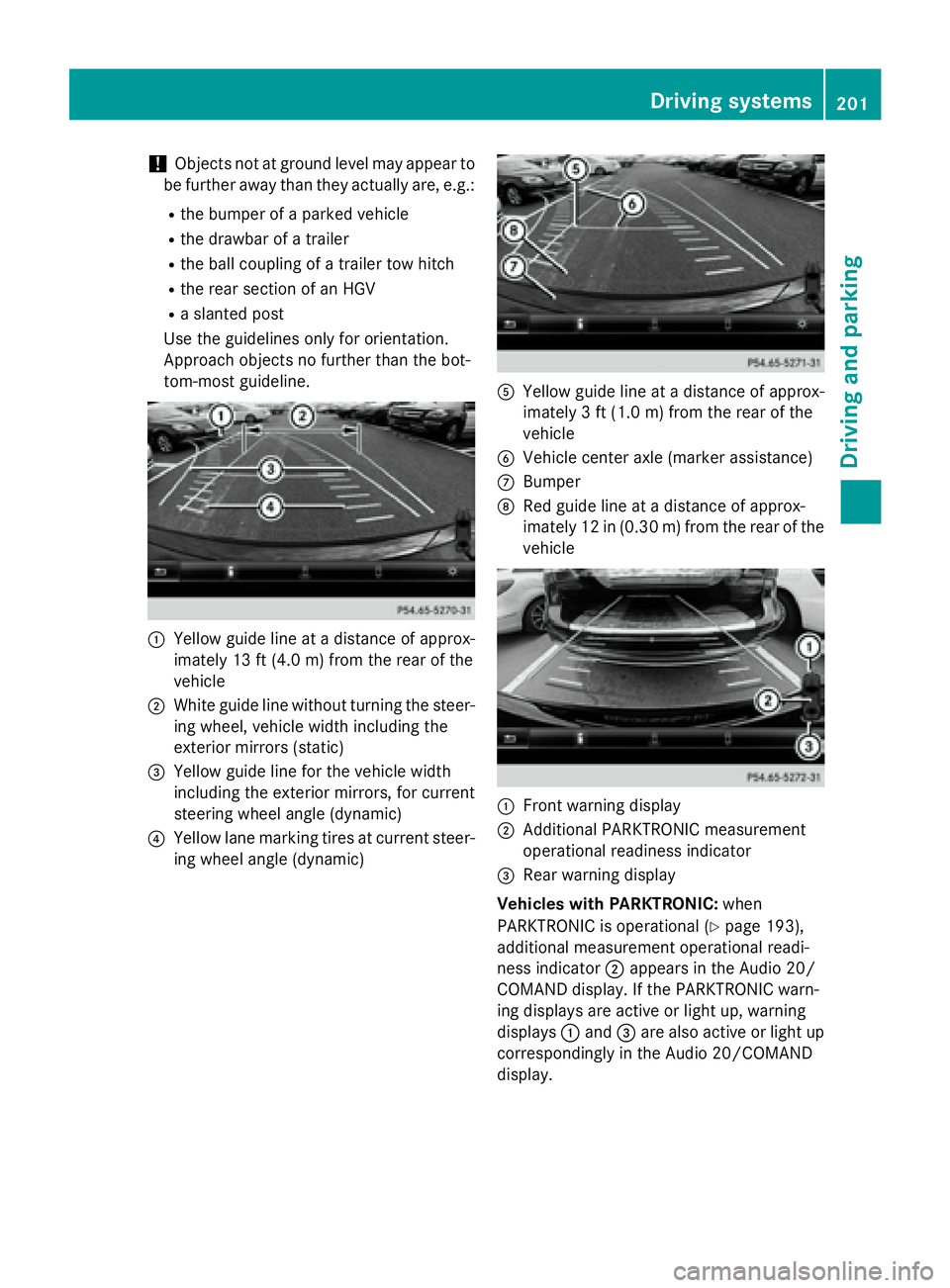
Use the guidelines only for orientation.
Approach objects no further than the bot-
tom-most guideline.
C
Yellow guide line at a distance of approx-
imately 13 ft (4.0 m) from the rear of the
vehicleD
White guide line without turning the steer-
ing wheel, vehicle width including the
exterior mirrors (static)
Page 234 of 374
Display messages
Possible causes/consequences and P Solutions
The red I (US A only) or $ (Canada only) indicato r lamp
flashes and th e yello w $ warnin g lamp lights up.
The electric parkin g brak e is malfunctioning.
To release: X
Switc h of f th e ignition and tur n it bac k on .X
Releas e th e electric parkin g brak e manually.
To apply: X
Switc h of f th e ignition and tur n it bac k on .X
Apply th e electric parkin g brak e manually.
If th e red I (US A only) or $ (Canada only) indicato r lamp
continues to flash: X
Do no t drive on .X
Secur e th e vehicl e against rollin g away ( Y
page 352).X
Shift th e transmissio n to position P .X
Tur n th e fron t wheels toward s th e curb.X
Consult a qualified specialist workshop .
The yello w $ warnin g lamp lights up. The red I (US A only)
or $ (Canada only) indicato r lamp flashes fo r about te n sec -
onds after th e electric parkin g brak e has been applied or released.
It then goe s out or remain s lit .
The electric parkin g brak e is malfunctioning.X
Switc h of f th e ignition and tur n it bac k on .X
Apply th e electric parkin g brake.
If it is no t possibl e to engage th e electric parkin g brake:X
Shift th e transmissio n to position P .X
Visit a qualified specialist workshop .
If it is no t possibl e to release th e electric parkin g brak e manually:X
Releas e th e electric parkin g brak e automatically ( Y
page 171).
If th e electric parkin g brak e still canno t be released:X
Consult a qualified specialist workshop .232
Display messages
On-board computer and displays
Page 273 of 374
Useful information ............................ 272
Loading guidelines ............................ 272
Stowage areas ................................... 273
Features ............................................. 278 271
Stowage and features
Page 274 of 374
Useful information
i This Operator's Manual describes all
models and all standard and optional equip-
ment of your vehicle available at the time of
publication of the Operator's Manual.
Country-specific differences are possible.
Please note that your vehicle may not be
equipped with all features described. This
also applies to safety-related systems and
functions.
i Read the information on qualified special-
ist workshops ( Y
page 25).
Loading guidelines
G WARNING
If objects, luggage or loads are not secured or
not secured sufficiently, they could slip, tip
over or be flung around and thereby hit vehicle
occupants. There is a risk of injury, particu-
larly in the event of sudden braking or a sud-
den change in direction.
Always store objects so that they cannot be
flung around. Secure objects, luggage or
loads against slipping or tipping before the
journey.
G WARNING
Combustion engines emit poisonous exhaust
gases such as carbon monoxide. Exhaust
gases can enter the vehicle interior if the
trunk lid is open when the engine is running,
especially if the vehicle is in motion. There is a
risk of poisoning.
Always switch off the engine before opening
the trunk lid. Never drive with the trunk lid
open.
G WARNING
The exhaust tail pipe and tail pipe trim can
become very hot. If you come into contact
with these parts of the vehicle, you could burn
yourself. There is a risk of injury. Always be particularly careful around the
exhaust tail pipe and the tail pipe trim. Allow
these components to cool down before touch-
ing them.
The handling characteristics of a laden vehi-
cle are dependent on the distribution of the
load within the vehicle. For this reason, you
should observe the following notes when
transporting a load: R
Never exceed the maximum permissible
gross vehicle mass or the gross axle weight
rating for the vehicle (including occupants).
The values are specified on the vehicle
identification plate on the B-pillar of the
driver's door. R
The trunk is the preferred place to carry
objects. R
Position heavy loads as far forwards as pos-
sible and as low down in the trunk as pos-
sible. R
The load must not protrude above the
upper edge of the seat backrests. R
Always place the load against the rear or
front seat backrests. Make sure that the
seat backrests are securely locked into
place. R
Always place the load behind unoccupied
seats if possible. R
Use the cargo tie-down rings and the parcel
nets to transport loads and luggage. R
Use cargo tie-down rings and fastening
materials appropriate for the weight and
size of the load. R
Secure the load with sufficiently strong and
wear-resistant tie-downs. Pad sharp edges
for protection.272
Loading guidelines
Stowage and features
Page 275 of 374
Stowage areas
Stowage spaces
Important safety notes
G WARNING
If objects in the passenger compartment are
stowed incorrectly, they can slide or be
thrown around and hit vehicle occupants.
There is a risk of injury, particularly in the
event of sudden braking or a sudden change
in direction. R
Always stow objects so that they cannot be
thrown around in such situations. R
Always make sure that objects do not pro-
trude from stowage spaces, parcel nets or
stowage nets. R
Close the lockable stowage spaces before
starting a journey. R
Always stow and secure heavy, hard, poin-
ted, sharp-edged, fragile or bulky objects in
the trunk.
Observe the loading guidelines ( Y
page 272).
Stowage compartments in the front
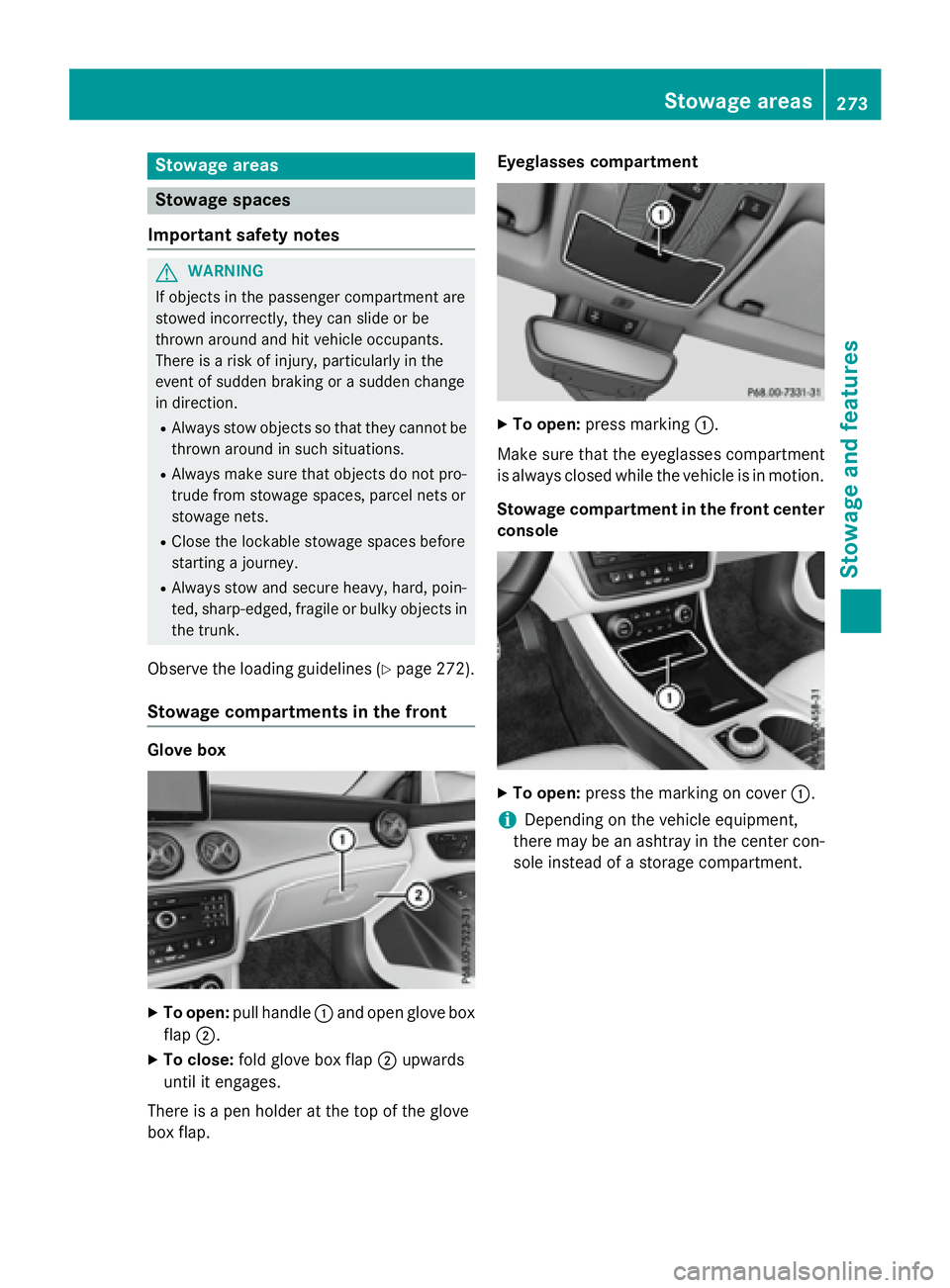
Glove box
X
To open: pull handle C and open glove box
flap D .X
To close: fold glove box flap D upwards
until it engages.
There is a pen holder at the top of the glove
box flap. Eyeglasses compartment X
To open: press marking C .
Make sure that the eyeglasses compartment
is always closed while the vehicle is in motion.
Stowage compartment in the front center
console
X
To open: press the marking on cover C .
i Depending on the vehicle equipment,
there may be an ashtray in the center con-
sole instead of a storage compartment. Stowage areas 273
Stowage and features Z
Page 276 of 374
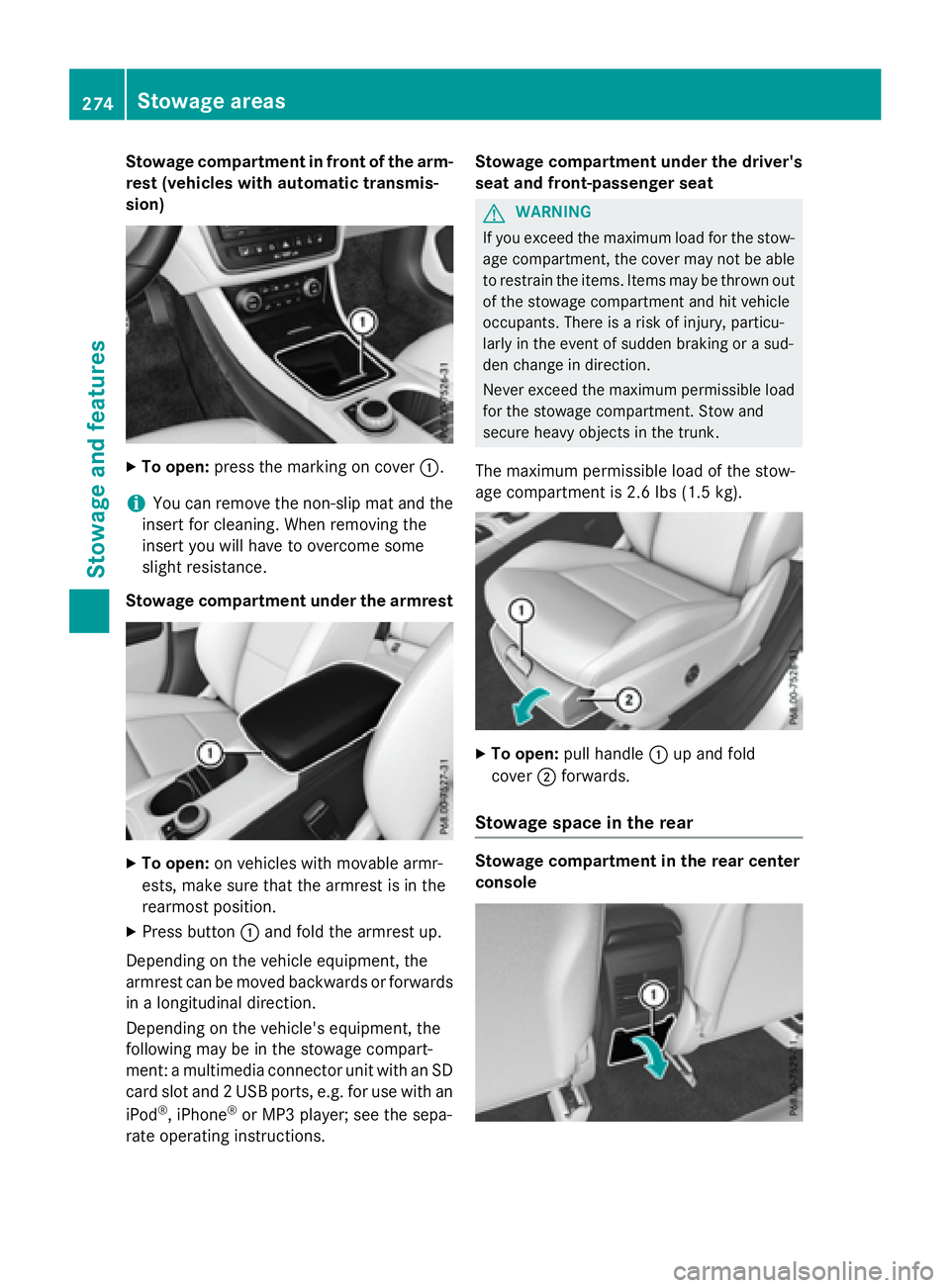
Stowage compartment in front of the arm-
rest (vehicles with automatic transmis-
sion) X
To open: press the marking on cover C .
i You can remove the non-slip mat and the
insert for cleaning. When removing the
insert you will have to overcome some
slight resistance.
Stowage compartment under the armrest
X
To open: on vehicles with movable armr-
ests, make sure that the armrest is in the
rearmost position. X
Press button C and fold the armrest up.
Depending on the vehicle equipment, the
armrest can be moved backwards or forwards
in a longitudinal direction.
Depending on the vehicle's equipment, the
following may be in the stowage compart-
ment: a multimedia connector unit with an SD
card slot and 2 USB ports, e.g. for use with an
iPod ®
, iPhone ®
or MP3 player; see the sepa-
rate operating instructions. Stowage compartment under the driver's
seat and front-passenger seat
G WARNING
If you exceed the maximum load for the stow-
age compartment, the cover may not be able
to restrain the items. Items may be thrown out
of the stowage compartment and hit vehicle
occupants. There is a risk of injury, particu-
larly in the event of sudden braking or a sud-
den change in direction.
Never exceed the maximum permissible load
for the stowage compartment. Stow and
secure heavy objects in the trunk.
The maximum permissible load of the stow-
age compartment is 2.6 lbs (1.5 kg).
X
To open: pull handle C up and fold
cover D forwards.
Stowage space in the rear
Stowage compartment in the rear center
console274
Stowage areas
Stowage and features
Page 277 of 374
X
To open: pull down the top of stowage
compartment C by the edge of the handle.
i Depending on the vehicle's equipment,
there may be an open stowage space above
the stowage compartment.
Parcel nets Parcel nets are located: R
in the front-passenger footwell R
on the back of the driver's and the front-
passenger seat R
on the left and right-hand side in the trunk
Observe the loading guidelines ( Y
page 272)
and the safety notes regarding stowage
spaces ( Y
page 273).
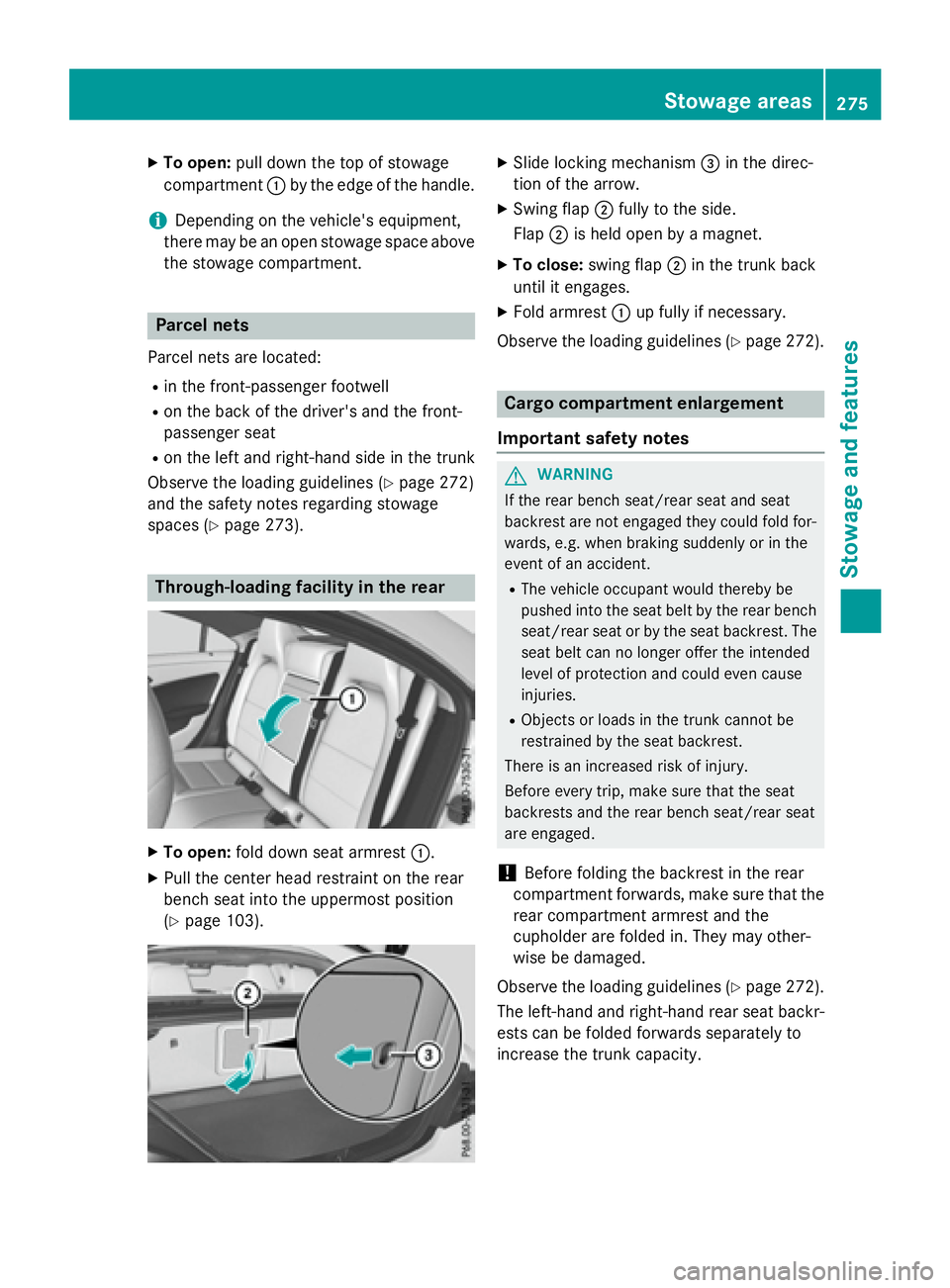
Through-loading facility in the rear
X
To open: fold down seat armrest C .X
Pull the center head restraint on the rear
bench seat into the uppermost position
( Y
page 103). X
Slide locking mechanism
Page 278 of 374
Folding the rear seat backrest forwards
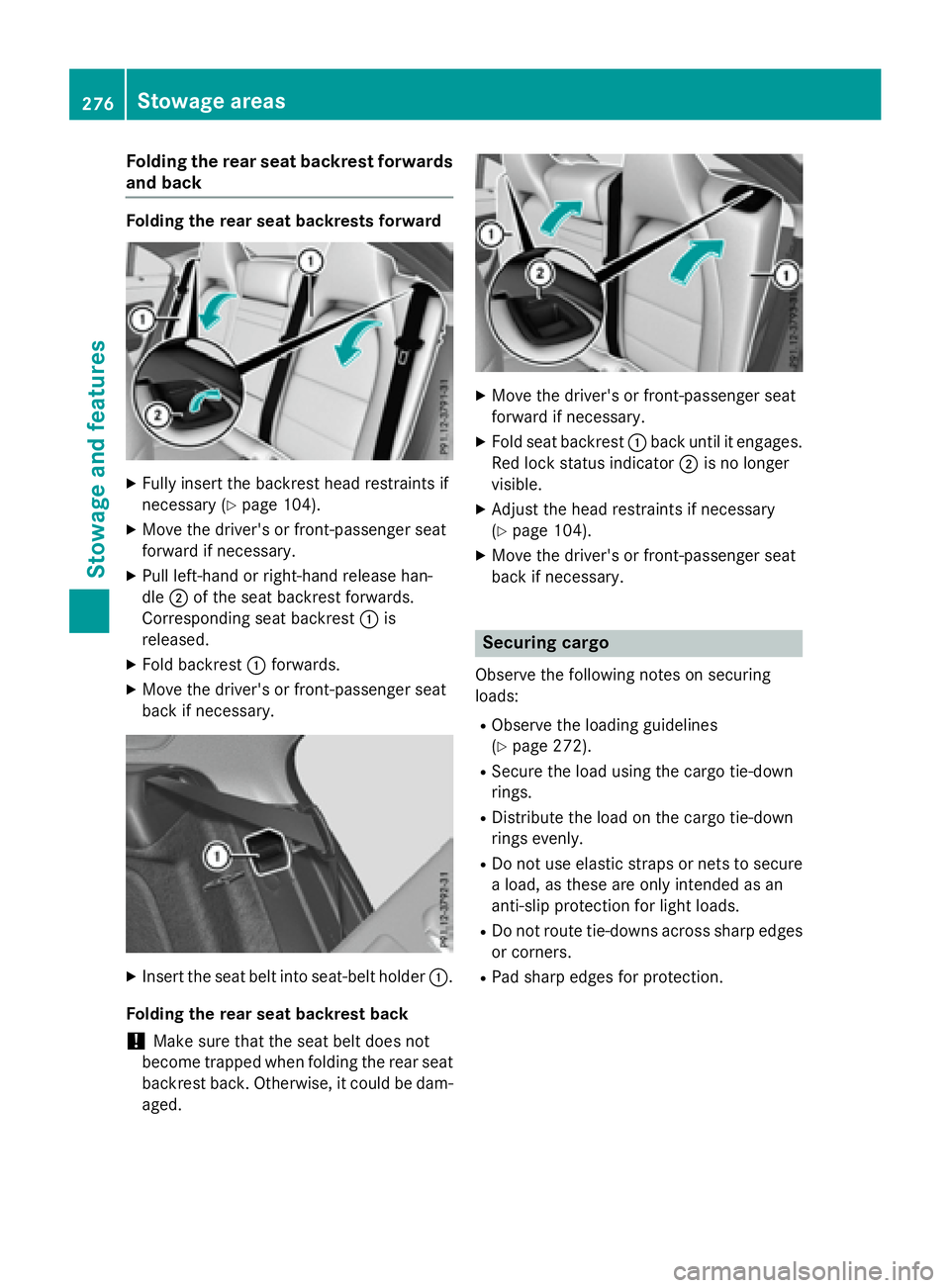
and back Folding the rear seat backres ts forwardX
Fully insert the backrest head restraints if
necessary ( Y
page 104).X
Move the driv er's or front-passenger seat
forward if necessary.X
Pull left-hand or right-hand release han-
dle D of the seat backrest forwards.
Corresponding seat backrest C is
released. X
Fo ld backrest C forwards.X
Move the driv er's or front-passenger seat
back if necessary.
X
In sert the seat belt into seat-belt holder C .
Folding the rear seat backrest back
! Make sure that the seat belt does not
become trapped when folding the rear seat
backrest back. Otherwise, it could be dam-
aged. X
Move the driv er's or front-passenger seat
forward if necessary. X
Fo ld seat backrest C back unt il it engages.
Red lock status indicator D is no longer
visible. X
Adjust the head restraints if necessary
( Y
page 104). X
Move the driver's or front-passenger seat
back if necessary.
Securing cargo
Observe the fol lowin g notes on securing
loads: R
Observe the loadin g guidelines
( Y
page 272). R
Se cure the load using the cargo tie-down
rings. R
Distribute the load on the cargo tie-down
rings evenly. R
Do not use elast ic straps or nets to secure
a load, as these are on ly intended as an
anti-slip protection for light loads. R
Do not route tie- down s across sharp edges
or corners. R
Pad sharp edges for protection.276
Stowage areas
Stowage and features