flat tire MERCEDES-BENZ CLA 2017 Owner's Manual
[x] Cancel search | Manufacturer: MERCEDES-BENZ, Model Year: 2017, Model line: CLA, Model: MERCEDES-BENZ CLA 2017Pages: 318, PDF Size: 9.9 MB
Page 292 of 318
Important safety notes
G WARNIN G
Eac h tire, includin g th e spar e (if provided),
should be checke d at least once every two
week s when cold and inflated to th e pressur e
recommended by th e vehicl e manufacturer
on th e Tir e and Loading Information placard
on th e driver' s door B-pillar or th e tire pres-
sur e label on th e inside of th e fuel filler flap . If
your vehicl e has tires of a differen t siz e than
th e siz e indicated on th e Tir e and Loading
Information placard or, if available, th e tire
pressur e label, you should determine th e
proper tire pressur e for those tires .
As an added safet y feature, your vehicl e has
been equipped wit h a tire pressur e monitoring
system (TPMS) that illuminate s a low tire pres-
sur e telltale when on e or mor e of your tires
are significantly underinflated. Accordingly,
when th e low tire pressur e telltale lights up,
you should stop and chec k your tires as soo n
as possible , and inflat e them to th e proper
pressure. Drivin g on a significantly underin-
flated tire causes th e tire to overheat and can
lead to tire failure.
Underinflation also reduce s fuel efficiency
and tire tread life , and may affec t th e vehicle's
handlin g and stopping ability. Pleas e note that
th e TPM S is no t a substitut e for proper tire
mainte
nance , a nd it is th e d river' s responsi-
bilit y to maintai n correc t tire pressure, eve n if
underinflation has no t reached th e level to
trigge r illumination of th e TPM S low tire pres-
sur e telltale.
Your vehicl e has also been equipped wit h a
TPM S malfunction indicator to indicat e when
th e system is no t operating properly. The
TPM S malfunction indicator is combined wit h
th e low tire pressur e telltale. When th e sys-
te m detects a malfunction , th e warning lamp
will flas h for approximately a minute and then
remain continuously illuminated. This
sequenc e will be repeated every time th e vehi-
cle is started as lon g as th e malfunction
exists. When th e malfunction indicator is illu- minated, th e system may no t be able to detec t
or signal low tire pressur e as intended.
TPM S malfunction s may occur for a variet y of
reasons, includin g th e installation of incom-
patible replacemen t or alternate tires or
wheels on th e vehicl e that preven t th e TPM S
from functioning properly. Always chec k th e
TPM S malfunction telltale after replacing on e
or mor e tires or wheels on your vehicl e to
ensur e that th e replacemen t or alternate Tires
and wheels allow th e TPM S to continue to
function properly.
It is th e driver' s responsibilit y to set th e tire
pressur e to that recommended for cold tires
whic h is suitable for th e operating situation
( Y
page 285). Not e that th e correc t tire pressur e
for th e curren t operating situation must first be
taught-in to th e tire pressur e monitor. If a sub-
stantial loss of pressur e occurs, th e warning
threshold for th e warning message is aligned to
th e taught-in referenc e values. Restart th e tire
pressur e monitor after adjusting th e pressur e of
th e cold tires ( Y
page 291). The curren t pres-
sures are saved as ne w referenc e values. As a
result , a warning message will appear if th e tire
pressur e drops significantly.
The tire pressur e monit or d oes no t w
arn you of
an incorrectl y set tire pressure. Observ e th e
note s on th e recommended tire pressur e
( Y
page 285).
The tire pressur e monitor is no t able to warn you
of a sudde n loss of pressure, e.g. if th e tire is
penetrated by a foreign object. In th e event of a
sudde n loss of pressure, brin g th e vehicl e to a
halt by braking carefully. Avoid abrup t steering
movements.
The tire pressur e monitor has a yellow warning
lamp in th e instrumen t cluste r for indicating
pressur e loss or a malfunction . Whether th e
warning lamp flashes or lights up indicates
whether a tire pressur e is to o low or th e tire
pressur e monitor is malfunctioning :R
if th e warning lamp is lit continuously, th e tire
pressur e on on e or mor e tires is significantly
to o low. The tire pressur e monitor is no t mal-
functioning . R
if th e warning lamp flashes for aroun d a
minute and then remain s lit constantly, th e
tire pressur e monitor is malfunctioning .
In addition to th e warning lamp , a message
appear s in th e multifunction display. Observ e290
Tire pressure
Wheels and tires
Page 298 of 318
Observe the legally required minimum tire tread
depth ( Y
page 283). Winter tires can reduce the
braking distance on snow-covered surfaces in
comparison with summer tires. The braking dis-
tance is still much further than on surfaces that
are not icy or covered with snow. Take appro-
priate care when driving.
Further information on winter tires (M+S tires)
( Y
page 284).
Temperature
G WARNING
The temperature grade for this tire is estab-
lished for a tire that is properly inflated and
not overloaded. Excessive speed, underinfla-
tion, or excessive loading, either separately or
in combination, can cause excessive heat
build-up and possible tire failure.
The temperature grades are A (the highest), B,
and C, representing the tire's resistance to the
generation of heat and its ability to dissipate
heat when tested under controlled conditions
on a specified indoor laboratory test wheel. Sus-
tained high temperature can cause the material
of the tire to degenerate and reduce tire life, and
excessive temperature can lead to sudden tire
failure. The grade C corresponds to a level of
performance which all passenger car tires must
meet under the Federal Motor Vehicle Safety
Standard No. 109. Grades B and A represent
higher levels of performance on the laboratory
test wheel than the minimum required by law. Tire labeling
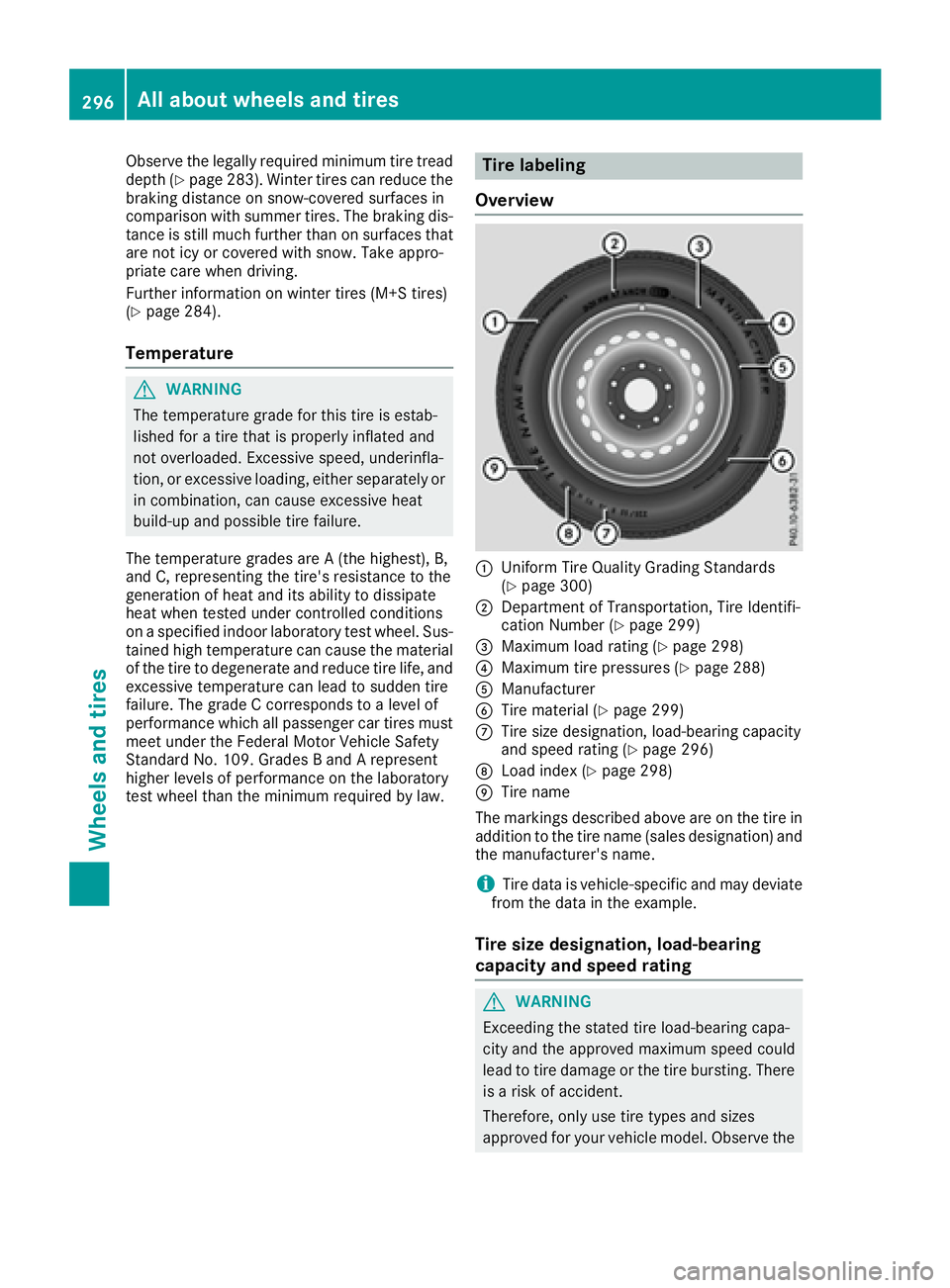
Overview
C
Uniform Tire Quality Grading Standards
( Y
page 300)D
Department of Transportation, Tire Identifi-
cation Number ( Y
page 299)
Page 308 of 318
Wheel and tire combinations
General notes You can ask for information regarding permitted
wheel/tire combinations at an authorized
Mercedes-Benz Center.
You should regularly check the pressure of the
emergency spare wheel, particularly prior to
long trips, and correct the pressure as neces-
sary ( Y
page 285). The value on the wheel is
valid.
! For safety reasons, Mercedes-Benz recom-
mends that you only use tires and wheels
which have been approved by Mercedes-Benz
specifically for your vehicle.
These tires have been specially adapted for
use with the control systems, such as ABS or
ESP ®
, and are marked as follows: R
MO = Mercedes-Benz Original R
MOE = Mercedes-Benz Original Extended
(tires featuring run-flat characteristics) R
MO1 = Mercedes-Benz Original (only cer-
tain AMG tires)
Mercedes-Benz Original Extended tires may
only be used on wheels that have been spe-
cifically approved by Mercedes-Benz.
Only use tires, wheels or accessories tested
and approved by Mercedes-Benz. Certain
characteristics, e.g. handling, vehicle noise
emissions or fuel consumption, may other-
wise be adversely affected. In addition, when
driving with a load, tire dimension variations
could cause the tires to come into contact
with the bodywork and axle components. This
could result in damage to the tires or the vehi-
cle.
Mercedes-Benz accepts no liability for dam-
age resulting from the use of tires, wheels or
accessories other than those tested and
approved.
Information on tires, wheels and approved
combinations can be obtained from any quali-
fied specialist workshop.
! Retreaded tires are neither tested nor rec-
ommended by Mercedes-Benz, since previ-
ous damage cannot always be detected on
retreaded tires. As a result, Mercedes-Benz
cannot guarantee vehicle safety if retreaded
tires are mounted. Do not mount used tires if
you have no informa tion a bout their previous
u
sage. The recommended pressures for various oper-
ating conditions can be found: R
on the Tire and Loading Information placard
on the B-pillar on the driver's side R
in the tire pressure table in the fuel filler flap
Observe the notes on recommended tire pres-
sures under various operating conditions
( Y
page 285).
Check tire pressures regularly, and only when
the tires are cold. Comply with the maintenance
recommendations of the tire manufacturer in
the vehicle document wallet.
Notes on the vehicle equipment – always equip
the vehicle: R
with tires of the same size on a given axle (left
and right) R
with the same type of tire (summer tires,
MOExtended tires, winter tires)
Exception: it is permissible to install a differ-
ent type or make in the event of a flat tire.
Observe the "MOExtended tires (tires with
run-flat characteristics" section ( Y
page 267).
Vehicles equipped with MOExtended tires are
not equipped with a TIREFIT kit at the factory. It
is therefore recommended that you additionally
equip your vehicle with a TIREFIT kit if you mount
tires that do not feature run-flat properties, e.g.
winter tires. A TIREFIT kit may be obtained from
a qualified specialist workshop.306
Wheel and tire combinations
Wheels and tires