belt MERCEDES-BENZ CLA 2018 User Guide
[x] Cancel search | Manufacturer: MERCEDES-BENZ, Model Year: 2018, Model line: CLA, Model: MERCEDES-BENZ CLA 2018Pages: 326, PDF Size: 7.97 MB
Page 46 of 326
Infants and childre nm ust never travel sitting
on the lap of av ehicle occupant. In the event
of an accident, they could be crushed
between the vehicle occupant and seat belt. R
objects are never secured with as eat belt if
the seat belt is also being used by one of the
vehicle's occupants
Also ensure that there are never objects
between ap erson and the seat, e.g. cushions.
Seat belts are only intended to secure and
restrain vehicle occupants. Alway so bserve the
"Loading guidelines" for securing objects, lug-
gage or load s( Y
page 237).
Fastening and adjusting the seat belts Observe the safety notes on the seat belt
( Y
page 42) and the notes on correct use of seat
belts ( Y
page 43).
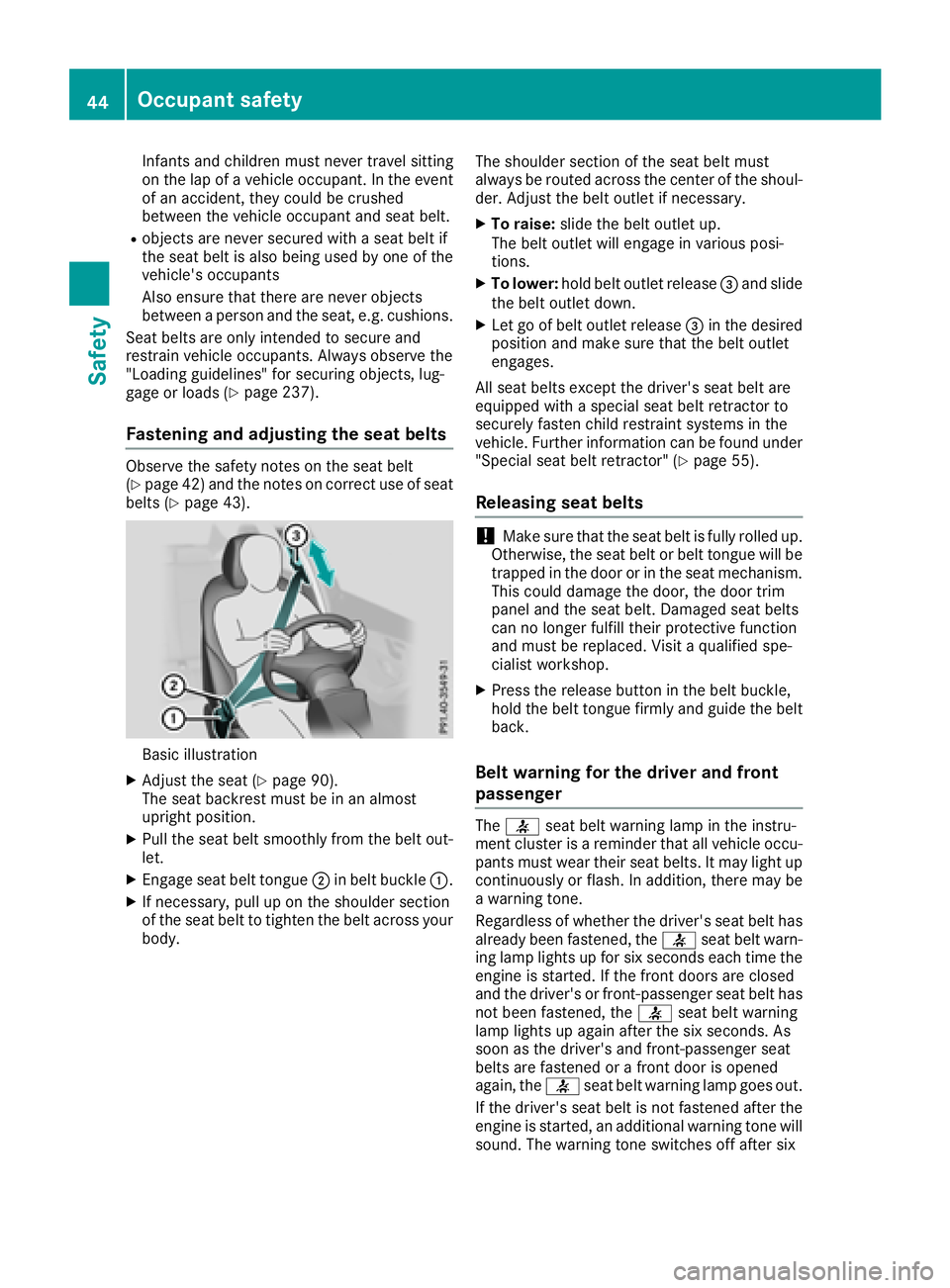
Basic illustration X
Adjust the seat ( Y
page 90).
The seat backrest must be in an almost
upright position. X
Pul lt he seat belt smoothly from the belt out-
let. X
Engage seat belt tongue D in belt buckle C .X
If necessary ,p ul lupont he shoulder section
of the seat belt to tighten the belt across your
body. The shoulder section of the seat belt must
always be routed across the center of the shoul-
der. Adjust the belt outlet if necessary. X
To raise: slid et he belt outlet up.
The belt outlet wil le ngage in variou sp osi-
tions. X
To lower: hold belt outlet release
Page 47 of 326
seconds or once the driver's seat belt is fas-
tened.
If the vehicle's speed exceeds 15 mph
(25 km/h) once and the driver's and front-
passenger seat belts are not fastened, aw arning
tone sounds. Aw arning tone also sounds with
increasing intensit yf or 60 seconds or until the
driver or front passenger have fastened their
seat belts.
If the driver or front passenger unfasten their
seat belts during the journey, the seat belt warn-
ing is activated again.
Air bags
Introduction The installation point of an air bag can be rec-
ognized by the AIRBAG marking.
An air bag complements the correctly fastened
seat belt. It is no substitute for the seat belt. The
air bag provides additional protection in appli-
cable accident situations.
Not all air bags are deployed in an accident. The
different air bag systems function independ-
ently from one another ( Y
page 52).
However, no system available today can com-
pletely eliminate injuries and fatalities.
It is also not possible to rule out ar isk of injury
caused by an air bag due to the high speed at
which the air bag must be deployed.
Important safety notes
G WARNING
If you do not sit in the correct seat position,
the air bag cannot protect as intended and
could even cause additional injury when
deployed. This poses an increased risk of
injury or even fatal injury.
To avoid hazardous situations, always make
sure that all of the vehicle's occupants: R
have fastened their seat belts correctly,
including pregnant women R
are sitting correctly and maintain the great-
est possible distance to the air bags R
follow the following instructions Always make sure that there are no objects
between the air bag and the vehicle's occu-
pants. R
Adjust the seats properly before beginning
your journey. Always make sure that the seat
is in an almost upright position. The center of
the head restraint must support the head at
about eye level. R
Move the driver's and front-passenger seats
as far back as possible .T he driver's seat posi-
tion must allow the vehicle to be driven safely. R
Only hold the steering wheel on the outside.
This allow st he air bag to be fully deployed. R
Always lean against the backrest while driv-
ing. Do not lean forward or lean against the
door or side window. You may otherwise be in
the deployment area of the air bags. R
Always keep your feet in the footwell in front
of the seat. Do not put your feet on the dash-
board, for example. Your feet may otherwise
be in the deployment area of the air bag. R
For this reason, always secure persons less
than 5f t( 1.50 m) tall in suitable restraint sys-
tems. Up to this height, the seat belt cannot
be worn correctly.
If ac hild is traveling in your vehicle ,a lso
observe the following notes: R
Always secure children under twelve years of
age and less than 5f t( 1.50 m) tal lins ui table
child restraint systems. R
Chil dr estraint systems shoul dbei nstalle do n
the rea rs ea ts. R
Onl ys ec ur eac hild in ar earward-facing child
restraint syste mont he front-passenge rs ea t
when the front-passenge rf ront ai rb ag is
deactivated .Ift he PASSENGER AIR BAG OFF
indicator lamp is permanentl yl it ,t he front-
passenge rf ront ai rb ag is deactivated
( Y
page 41). R
Alway so bser ve the instructions and safety
note sont he "Occupant Classification Syste m
( OCS) "( Y
page 47) and on "Children in the
vehicle" ( Y
page 54 )i na ddit io ntot he child
restraint syste mm an ufacturer's installation
and operating instructions.Occupant safety 45
Safety Z
Page 49 of 326
The driver's and front-passenger knee bags
offer additional thigh, knee and lower leg pro-
tection for the occupant sint he front seats.
Side impact air bags
G WARNING
Unsuitable seat covers can obstruct or pre-
vent deployment of the air bags integrated
into the seats. Consequently, the air bags
cannot protec tv ehicle occupant sast hey are
designed to do. In addition, the operation of
the occupant classification system (OCS)
could be adversely affected. This poses an
increased risk of injury or even fatal injury.
You should only use seat covers that have
been approved for the respective seat by
Mercedes-Benz.
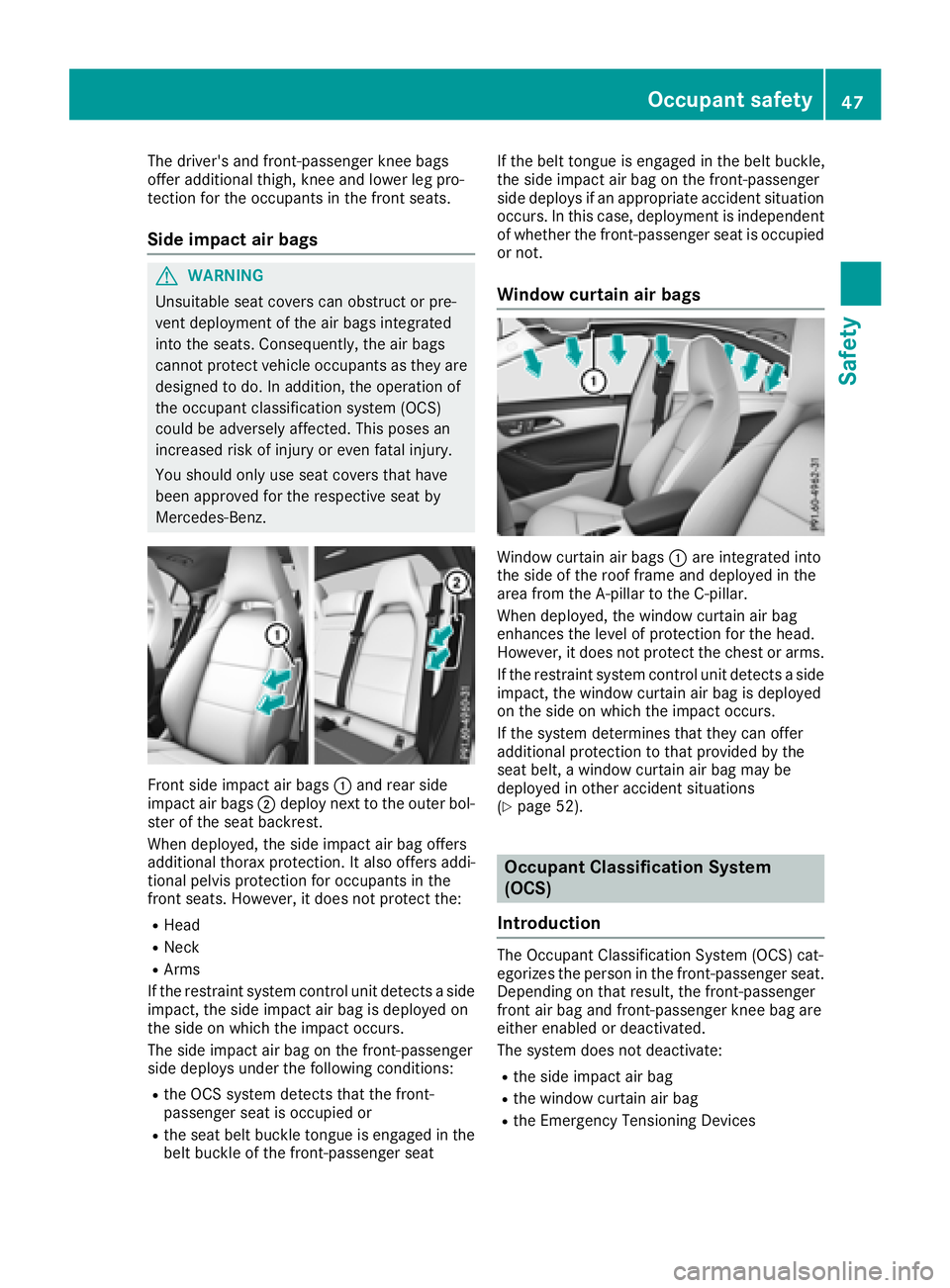
Fron ts ide impact air bags C and rear side
impact air bags D deploy next to the outer bol-
ster of the seat backrest.
When deployed, the side impact air bag offers
additional thorax protection. It also offers addi-
tional pelvis protection for occupant sint he
front seats. However, it does not protec tt he:R
Head R
Neck R
Arms
If the restraint system control unit detect sas ide
impact, the side impact air bag is deployed on
the side on which the impact occurs.
The side impact air bag on the front-passenger
side deploys under the following conditions: R
the OCS system detect st hat the front-
passenger seat is occupied or R
the seat belt buckle tongue is engaged in the
belt buckle of the front-passenger seat If the belt tongue is engaged in the belt buckle,
the side impact air bag on the front-passenger
side deploys if an appropriate accident situation
occurs. In this case, deployment is independent
of whether the front-passenger seat is occupied
or not.
Window curtain air bags
Window curtain air bags C are integrated into
the side of the roof frame and deployed in the
area from the A-pillar to the C-pillar.
When deployed, the window curtain air bag
enhances the level of protection for the head.
However, it does not protec tt he chest or arms.
If the restraint system control unit detect sas ide
impact, the window curtain air bag is deployed
on the side on which the impact occurs.
If the system determines that they can offer
additional protection to that provided by the
seat belt, aw indow curtain air bag may be
deployed in other accident situations
( Y
page 52).
Occupant Classification System
(OCS)
Introduction The Occupant Classification System (OCS) cat-
egorizes the person in the front-passenger seat.
Dependin gont hat result, the front-passenger
front air bag and front-passenger knee bag are
either enabled or deactivated.
The system does not deactivate: R
the side impact air bag R
the window curtain air bag R
the Emergency Tensionin gD evicesOccupant safety 47
Safety Z
Page 51 of 326
passenger fron ta ir bag is enabled or disa-
bled in accordance with the person in the
front-passenger seat R
the front-passenger seat has been moved
back as far back as possible. R
the person is seated correctly.
Make sure, both before and during the jour-
ney, that the status of the front-passenger
fron ta ir bag is correct.
G WARNING
If you secure ac hild in ar earward-facing child
restraint system on the front-passenger seat
and the PASSENGER AIR BA GO FF indicator
lamp is off, the front-passenger fron ta ir bag
can deploy in the event of an accident. The
child could be struck by the air bag. This poses
an increased risk of injury or even fatal injury.
Make sure that the front-passenger fron ta ir
bag has been deactivated. The PASSENGER
AIR BA GO FF indicator lamp must be lit.
NEVER use ar earward-facing child restraint
on as eat protected by an ACTIVE FRONT AIR-
BA Ginf ron tofi t; DEATH or SERIOUS INJURY
to the child can occur.
If the PASSENGER AIR BA GO FF indicator lamp
stays off, do not install ar earward-facing child
restraint system on the front-passenger seat.
You can find more information on OCS under
"Problems with the Occupant Classification Sys-
tem" ( Y
page 51).
G WARNING
If you secure ac hild in af orward-facin gc hild
restraint system on the front-passenger seat
and you position the front-passenger seat too
close to the dashboard, in the event of an
accident, the child could: R
come int oc ontact with the vehicle's inte-
rior if the PASSENGER AIR BA GO FF indi-
cator lamp is lit, for example R
be struck by the air bag if the PASSENGER
AIR BA GO FF indicator lamp is off
This poses an increased risk of injury or even
fatal injury. Always move the front-passenger seat as far
back as possible and fully retract the seat
cushion length. Always make sure that the
shoulder belt strap is correctly routed from
the vehicle belt sash guide to the shoulder
belt guide on the child restraint system. The
shoulder belt strap must be routed forwards
and downwards from the vehicle belt sash
guide. If necessary, adjust the vehicle belt
sash guide and the front-passenger seat
accordingly. Always observe the child
restraint system manufacturer's installation
instructions.
If OCS determines that: R
The front-passenger seat is unoccupied, the
PASSENGER AIR BA GO FF indicator lamp
lights up after the system self-test and
remains lit. This indicates that the front-
passenger fron ta ir bag is deactivated. R
The front-passenger seat is occupied by a
child of up to twelve months old, in as tandard
child restraint system, the PASSENGER AIR
BA GO FF indicator lamp lights up after the
system self-test and remains lit. This indi-
cates that the front-passenger fron ta ir bag is
deactivated.
But even in the case of at welve-month-old
child, in as tandard child restraint system, the
PASSENGER AIR BA GO FF indicator lamp can
go out after the system self-test. This indi-
cates that the front-passenger fron ta ir bag is
activated. The result of the classification is
dependen to n, among other factors, the child
restraint system and the child's stature. It is
recommended that you install the child
restraint system on as uitable rear seat.R
The front-passenger seat is occupied by a
person of smaller stature (e.g. at eenager or
small adult), the PASSENGER AIR BA GO FF
indicator lamp lights up and remains lit after
the system self-test dependin gont he result
of the classification or, alternatively, goes out. -
If the PASSENGER AIR BA GO FF indicator
lamp is off, move the front-passenger seatOccupant safety 49
Safety Z
Page 52 of 326
as far back as possible. Alternatively, ap er-
son of smaller statur ec an sit on ar ear seat.-
If th eP ASSENG ER AI RB AG OF Fi ndicator
lamp is lit ,ap erson of smaller stature
shoul dn ot use th ef ront-pa ssenger seat.R
The front-passenger seat is occupied by an
adult or ap erson of adult stature, the
PASSENGER AI RB AG OF Fi ndicator lamp
goes out after th es ystem self-test .T his indi-
cates that th ef ront-pa ssenger fron ta ir bag is
activated.
If childre na re travelin gint he vehicle ,bes ure to
observ et he note son" Children in th ev ehicle"
( Y
page 54).
When th eO cc upan tC lassification System
(OCS )ism alfunctioning, th er ed u restraint
system warning lamp on th ei nstrumen tc luster
and th eP ASSENG ER AI RB AG OF Fi ndicator
lamp light up simultaneously. The front-
passenger fron ta ir bag is deactivate dint hi s
cas ea nd does no td eplo yd urin gana ccident.
Hav et he Occupan tC lassification System (OCS)
checked and repaired immediately at aq ualified
specialist workshop .M ercedes-Ben zr ecom-
mends that you use an authorized Mercedes-
Ben zC enter for this purpose.
If th ef ront-pa ssenger seat ,t he seat cover or the
seat cushion are damaged, have th en ecessary
repai rw ork carried out at aq ualified specialist
workshop .M ercedes-Ben zr ecommend st ha t
you use an authorized Mercedes-Ben zC en ter
f or this purpose.
For safety reasons, Mercedes-Ben zr ecom-
mends that you only use seat accessories that
have been approved by Mercedes-Benz.
If th ed river' sa ir bag deploys, this does not
mean that th ef ront-pa ssenger fron ta ir bag will
also deploy. The Occupan tC lassification Sys-
te m( OCS )c ategorize st he occupant on the
front-passenger seat .D ep endin gont ha tr esult,
th ef ront-pa ssenger fron ta ir bag is either ena-
bled or deactivated.
System self-test
G DANGER
If bot ht he PASSENGER AI RB AG OF Fa nd
PASSENGER AI RB AG ON indicator lamps do
no tl ight up durin gt he system self-test ,t he
system is malfunctioning. The front-
passenger fron ta ir bag migh tbet ri ggered
unintentionally or migh tn ot be triggered at all in th ee ven tofana cciden tw ith high deceler-
ation. This pose sani ncreased risk of injury or
even fatal injury.
In this cas et he front-passenger seat may not
be used. Do no ti nstall ac hi ld restraint system
on th ef ront-pa ssenger seat .H av et he Occu-
pant Classification System (OCS )c he cked
and repaired immediately at aq ualified spe-
cialis tw orkshop.
G WARNING
If th eP ASSENG ER AI RB AG OF Fi ndicator
lamp remains lit after th es ystem self-test ,t he
front-passenger fron ta ir bag is disabled. It will
no tbed eployed in th ee ven tofana ccident. In
this case, th ef ront-pa ssenger fron ta ir bag
canno tp erform its intended protective func-
tion, e.g .w hen ap erson is seated in th ef ront -
passenger seat.
That person could, for example, com ei nto
contac tw ith th ev ehicle's interior, especially
if th ep erson is sittin gt oo close to th ed ash-
board .T his pose sani ncreased risk of injury or
even fatal injury.
When th ef ront-pa ssenger seat is occupied,
always ensure that: R
th ec lassification of th ep erson in th ef ront -
passenger seat is correc ta nd th ef ront -
passenger fron ta ir bag is enabled or disa-
bled in accordance with th ep erson in the
front-passenger seat R
th ep erson is seated properly with ac or-
rectly fastene ds eatbelt R
th ef ront-pa ssenger seat has been moved
as far back as possible
If th eP ASSENG ER AI RB AG OF Fi ndicator
lamp remains lit when it shoul dn ot ,t he front-
passenger seat may no tbeu sed. Do not
install ac hi ld restraint system on th ef ront -
passenger seat .H av et he Occupan tC lassifi-
cation System (OCS )c he cked and repaired
immediately at aq ualified specialist work-
shop.50
Occupant safety
Safety
Page 54 of 326
Problem
Possible causes/consequences and P Solutions
The PASSENGER AIR
BAG OFF indicator lamp
lights up and remains lit,
even though the front-
passenger seat is occu-
pied by an adult or ap er-
son of as tature corre-
sponding to that of an
adult. The classification of the person on the front-passenger seat is incor-
rect. X
Make sure the condition sf or ac orrect classification of the person
on the front-passenger seat are met ( Y
page 48).X
If the PASSENGER AIR BAG OFF indicator lamp remains lit, the front-
passenger seat may not be used. X
Have OCS checked as soon as possible at an authorized Mercedes-
Benz Center.
The PASSENGER AIR
BAG OFF indicator lamp
does not light up and/or
does not stay on.
The front-passenger seat
is: R
unoccupied R
occupied with the
weight of ac hild up to
twelve months old in a
child restraint system OCS is malfunctioning. X
Make sure there is nothin gb etween the seat cushion and the child
seat. X
Make sure that the entire base of the child restraint system rests on
the seat cushion of the front-passenger seat. The backrest of the
forward-facing child restraint system must lie as flat as possible
against the backrest of the front-passenger seat. If necessary,
adjust the position of the front-passenger seat. X
Make sure that the seat cushion length is fully retracted. X
When installing the child restraint system, make sure that the seat
belt is tight. Do not pull the seat belt tight using the front-passenger
seat adjustment .T his could result in the seat belt and the child
restraint system being pulled too tightly. X
Check for correct installation of the child restraint system.
Make sure that the head restraint does not apply al oad to the child
restraint system. If necessary, adjust the head restraint accord-
ingly. X
Make sure that no object sa re applying additional weight onto the
seat. X
If the PASSENGER AIR BAG OFF indicator lamp remains off and/or
the PASSENGER AIR BAG ON indicator lamp lights up, do not install
ac hild restraint system on the front-passenger seat. It is recom-
mended that you install the child restraint system on as uitable rear
seat. X
Have OCS checked as soon as possible at an authorized Mercedes-
Benz Center.
Deployment of Emergency Tensioning
Devices and air bags
Important safety notes
G WARNING
The air bag parts are hot after an air bag has
been deployed. There is ar isk of injury.
Do not touch the air bag parts. Have a
deploye da ir bag replaced at aq ualified spe-
cialist workshop as soon as possible. G WARNING
Ad eploye da ir bag no longer offers any pro-
tection and cannot provide the intended pro-
tection in an accident. There is an increased
risk of injury.
Have the vehicle towed to aq ualified special-
ist workshop in order to have ad eploye da ir
bag replaced.
It is important for your safety and that of your
passenger to have deploye da ir bags replaced52
Occupant safety
Safety
Page 55 of 326
and to have any malfunctionin ga ir bags
repaired. This will help to mak es ure th ea ir bags
continue to perform their protective function for
th ev ehicle occupant sint he even tofac ra sh.
G WARNING
Emergenc yT ensioning Devices that have
deployed pyrotechnically are no longer opera-
tional and are unabl etop erform their inten-
ded protective function .T his pose sa n
increased risk of injury or even fatal injury.
Hav ep yrotechnically triggered Emergency
Tensioning Devices replaced immediately at a
qualified specialist workshop.
If Emergenc yT ensioning Devices are triggered
or air bags are deployed, you will hear ab ang,
and as mall amoun tofp owder may also be
released. The u restraint system warning
lamp light su p.
Only in rar ec ases will th eb ang affect your hear-
ing .T he powder that is released generally does
no tc onstitut eah ealt hh azard, but it may cause
short-term breathin gd ifficulties in peopl ew ith
asthma or other respiratory problems .P rovided
it is safe to do so, you shoul dl eave th ev ehicle
immediately or open th ew indow in orde rtop re-
ven tb reathin gd ifficulties.
Air bags and pyrotechnic Emergenc yT ensioning
Devices (ETDs )c ontain perchlorate material,
whic hm ay require special handlin ga nd regard
for th ee nvironment. National guidelines must
be observed durin gd isposal. In California, see
www.dtsc.ca.gov/HazardousWaste/
Perchlorate/index.cfm .
Method of operation During th ef irst stage of ac ollision ,t he restraint
system control unit evaluates important physi-
cal dat ar elating to vehicle deceleratio nora ccel-
eration ,s uc ha s:R
duration R
direction R
intensity
Based on th ee valuation of this data, the
restraint system control unit trigger st he Emer-
gency Tensioning Devices durin gaf ront al or
rear collision. An Emergenc yT ensioning Devic ec an only be
triggered, if: R
th ei gnition is switched on R
th ec omponent soft he restraint system are
operational. You can fin df urther information
unde r" Restrain ts ystem warning lamp"
( Y
page 41) R
th es eat belt buckle tongue has engaged in
th eb elt buckle of th er espectiv ef ront seat
The Emergenc yT ensioning Devices in th er ear
compartmen ta re triggered independently of the
loc ks ta tus of th es eat belts.
If th er estraint system control unit detect sa
mor es evere accident, further component so f
th er estraint system are activated independ-
ently of each other in certain frontal collision
situations: R
Fron ta ir bags as well as driver' sa nd front-
passenger knee bags R
Window curtain air bag, if th es ystem deter-
mines that deploymen tc an offer additional
protection to that provided by th es eat belt
The front-passenger fron ta ir bag is activated or
deactivate dd ependin gont he person on t h
e
front-passenger seat .T he front-passenger front
air bag can only deplo yinana cciden tift he
PASSENGER AI RB AG OF Fi ndicator lamp is off.
Observ et he informatio nont he PASSENGER AIR
BA Gi ndicator lamps ( Y
page 41).
Your vehicle has two-stag ef ront air bags. In the
first deploymen ts ta ge, th ef ront air bag is filled
with propellan tg as. The fron ta ir bag is fully
deployed with th em aximum amoun tofp ropel-
lant gas if as econ dd eploymen tt hr eshold is
reached within af ew milliseconds.
The activation threshold of th eE me rgenc yT en-
sioning Devices and th ea ir bags is determined
by evaluating th er at eofv ehicle deceleratio no r
acceleratio nw hic ho ccurs at various points in
th ev ehicle .T his process is pre-emptive in
nature. Deployment shoul dt ak ep lace in good
tim eatt he start of th ec ollision.
The rat eofv ehicle deceleratio nora cceleration
and th ed irection of th ef orce are essentially
determine db y: R
th ed istribution of forces durin gt he collisionR
th ec ollision angle R
th ed eformatio nc ha racteristics of th ev ehicleR
th ec ha racteristics of th eo bject with which
th ev ehicle has collided
Factors whic hc an only be seen and measured
after ac ollision has occurre ddon ot play ad eci-Occupant safety 53
Safety Z
Page 56 of 326
sive role in the deployment of an air bag. Nor do
they provide an indication of air bag deploy-
ment.
The vehicle can be deformed considerably, with-
out an air bag being deployed. This is the case if
only parts which are relatively easil yd eformed
are affected and the rate of deceleration is not
high. Conversely, air bags may be deployed even
though the vehicle suffers only minor deforma-
tion. This is the case if, for example, very rigid
vehicle parts such as longitudinal body mem-
bers are hit, and sufficient deceleration occurs
as ar esult.
If the restraint system control unit detects as ide
impact or if the vehicle rolls over, the applicable
component soft he restraint system are activa-
ted independently of each other depending on
the apparent type of accident. R
Side impact air bags on the side where the
impact takes place, independently of the
Emergenc yT ensioning Device and the use of
the seat belt on the driver's seat and outer
seats in the second row
The side impact air bag on the front-
passenger side deploy su nder the following
conditions: -
the OCS system detects that the front-
passenger seat is occupied or -
the seat belt buckle tongue is engaged in
the belt buckle of the front-passenger seat R
Window curtain air bag on the side of impact,
independently of the use of the seat belt and
independently of whether the front-
passenger seat is occupied R
Emergenc yT ensioning Devices, if the system
determines that deployment can offer addi-
tional protection in this situation R
Window curtain air bags on the driver's and
front-passenger side in certain situations
when the vehicle rolls over, if the system
determines that deployment can offer addi-
tional protection to that provided by the seat
belt
i Not all air bags are deployed in an accident.
The different air bag systems work independ-
ently of each other. How the air bag system works is determined
by the severity of the accident detected,
especially the vehicle deceleration or accel-
eration and the apparent type of accident: R
Frontal collision R
Side impact R
Rollover
Automatic measures after an acci-
dent Immediately after an accident, the following
measures are implemented, depending on the
type and severity of the impact: R
the hazard warning lamps are activated R
the emergency lighting is activated R
the vehicle doors are unlocked R
the front side windows are lowered R
the engine is switched off and the fuel supply
is cut off R
vehicles with mbrace: automatic emergency
call
Children in the vehicle
Important safety notes Accident statistics show that children secured
in the rear seats are safer than children secured
in the front-passenger seat. For this reason,
Mercedes-Benz strongly advises that you install
ac hild restraint system on ar ear seat. Children
are generally better protected there.
If ac hild younger than twelve years old and
under 5ft( 1.50 m) in height is traveling in the
vehicle: R
always secure the child in ac hild restraint
system suitable for Mercedes-Benz vehicles.
The child restraint system must be appropri-
ate to the age, weight and size of the child R
be sure to observe the instructions and safety
notes in this section in addition to the child
restraint system manufacturer's installation
instructions R
be sure to observe the instructions and safety
notes on the "Occupant classification system
(OCS)" ( Y
page 47)54
Children in the vehicle
Safety
Page 57 of 326
G WARNING
If you leave children unsupervised in the vehi-
cle, they coul ds et it in motion by, for example:R
release the parking brake. R
shift the automatic transmission out of the
parking position P .R
start the engine.
In addition, they may operate vehicl ee quip-
ment and become trapped. There is ar isk of
an accident and injury.
When leaving the vehicle, alway st ake the
SmartKey with you and lock the vehicle. Never
leave children unsupervised in the vehicle.
G WARNING
If persons, particularl yc hildren are subjected
to prolonged exposure to extreme hea to r
cold, there is ar isk of injury ,p ossibly even
fatal .N ever leave children unattended in the
vehicle.
G WARNING
If the child restraint system is subjected to
direct sunlight, parts may get very hot. Chil-
dren may burn themselves on these parts,
particularl yont he metal parts of the child
restraint system. There is ar isk of injury.
If you leave the vehicle, taking the child with
you ,a lway se nsure that the child restraint
system is not expose dtod irect sunlight. Pro-
tect it with ab lanket, for example. If the child
restraint system has been expose dtod irect
sunlight, let it cool dow nb efore securing the
child in it. Never leave children unattended in
the vehicle.
Always ensure that all vehicl eo ccupants have
their seat belts fastened correctly and are sitting
properly .P articular attention must be pai dt o
children.
Observe the safety notes on the seat belt
( Y
pag e4 2) and the notes on correct use of seat
belts ( Y
pag e4 3).
Ab ooster seat may be necessary to achieve
prope rs eat bel tp ositioning for children over
41 lbs (18 kg )u ntil they reach ah eight where a three-point seat bel tc an be properly fastened
without ab ooster seat.
Special seatbelt retractor
G WARNING
If the seat bel tisr eleased while driving, the
child restraint system wil lnol onger be
secure dp roperly .T he special seat bel tr etrac-
tor is disable da nd the inertia real draw sina
portion of the seat belt. The seat bel tc annot
be immediatel yr efastened. There is an
increased risk of injury ,p ossibly even fatal.
Stop the vehicl ei mmediately, paying atten-
tion to road and traffic conditions. Reactivate
the special seat bel tr etractor and secure the
child restraint system properly.
All seat belts in the vehicle, except the driver's
seat belt, are equipped with as pecial seat belt
retractor. When activated, the special seat belt
retractor ensure st hat the seat bel tc annot
slacken once the child seat is secured.
Installing ac hild restraint system: X
Make sure you observe the child restraint
system manufacturer's installation instruc-
tions. X
Pul lt he seat bel ts moothly from the bel to ut-
let. X
Engage seat bel tt ongue in bel tb uckle.
Activating the special seat bel tr etractor:X
Pul lt he seat bel to ut full ya nd let the inertia
reel retract it again.
Whil et he seat bel tisr etracting, you should
hear ar atcheting sound .T he special seat belt
retractor is enabled. X
Push the child restraint system dow nsot hat
the seat bel tist ight and does not loosen.
Removing the child restraint system and deac-
tivating the special seat bel tr etractor:X
Make sure you observe the child restraint
system manufacturer's installation instruc-
tions. X
Press the release button of the seat belt
buckle and guide the seat bel tt ongue back
toward st he bel ts ash guide.
The special seat bel tr etractor is deactivated.Children in the vehicle 55
Safety Z
Page 58 of 326
Child restraint system The use of seat belt sa nd child restraint systems
is required by law in: R
all 50 states R
th eU .S .t erri toriesR
th eD istrict of ColumbiaR
all Canadian provinces
If you install ar earward-facing child restraint
system on th ec ente rr ear seat ,t he rear arm rest
must be folded back as far as possible.
You can obtain further informatio na bout the
correc tc hi ld restraint system from any author-
ize dM ercedes-Ben zC enter.
G WARNING
If th ec hi ld restraint system is installed incor-
rectly on as uitable seat ,itc anno tp rotect as
intended. The child canno tt he nber estrained
in th ee vent of an accident, heav yb raking or
sudde nc ha nges of direction .T her eisa n
increased ris kofi njury, possibly eve nf atal.
Mak es ure that you observ et he child restraint
system manufacturer' si nstallatio ni nstruc-
tions and th en otes on use. Pleas ee ns ure,
that th eb ase of th ec hi ld restraint system is
always restin gc ompletely on th es eat cush-
ion .N ever plac eo bjects, e.g .c ushions, under
or behin dt he child restraint system. Only use
child restraint systems wit ht he original cover
designe df or them. Only replace damaged
covers wit hg enuine covers.
G WARNING
If th ec hi ld restraint system is installed incor-
rectly or is no ts ecured, it can com el oos ei n
th ee vent of an accident, heav yb raking or a
sudde nc ha ng eind irection .T he child
restraint system coul dbet hr own about ,s tr ik-
ing vehicle occupants. Ther eisani ncreased
ris kofi njury, possibly eve nf atal.
Always install child restraint systems prop-
erly, eve nift he ya re no tb ein gu sed. Make
sure that you observ et he child restraint sys-
te mm anufacturer' si nstallatio ni nstructions.
You will fin df urther informatio nons to wing
objects, luggag eorl oads unde r" Loading guide-
lines" ( Y
page 237). G WARNING
Child restraint systems or their securin gs ys-
tems whic hh ave been damaged or subjected
to al oad in an acciden tc an no longer protect
as intended. The child canno tt he nb e
restraine dint he event of an accident, heavy
braking or sudde nc ha nges of direction .T here
is an increased ris kofi njury, possibly even
fatal.
Replac ec hi ld restraint systems whic hh ave
been damaged or subjected to al oad in an
acciden tass oon as possible. Hav et he secur-
ing systems on th ec hi ld restraint system
checked at aq ualified specialist workshop,
before you install ac hi ld restraint system
again.
The securin gs ystems of child restraint systems
are: R
th es eat belt system R
th eL AT CH-type (ISOFIX) securin gr ingsR
th eT op Tether anchorages
If it is absolutely necessary to carry ac hi ld on
th ef ront-pa ssenger seat ,bes ure to observ et he
informatio nont he "Occupan tC lassification
Syste m( OCS)" ( Y
page 47) .T her ey ou will also
fin di nformatio nond eactivatin gt he front-
passenger fron ta ir bag.
All child restraint systems must mee tt he fol-
lowin gs ta ndards: R
U.S. Federal Motor Vehicle Safet yS ta ndards
21 3a nd 225 R
Canadian Motor Vehicle Safet yS ta ndards
21 3a nd 210.2
Confirmation that th ec hi ld restraint system cor-
responds to th es ta ndards can be foun dona n
ins truc tion label on th ec hi ld
restraint system.
This confirmation can also be foun dint he instal-
lation instruction st ha ta re included wit ht he
child restraint system.
Observ et he warning labels in th ev ehicle inte-
rior and on th ec hi ld restraint system.56
Children in th ev ehicle
Safety