ABS MERCEDES-BENZ CLA 2018 Owners Manual
[x] Cancel search | Manufacturer: MERCEDES-BENZ, Model Year: 2018, Model line: CLA, Model: MERCEDES-BENZ CLA 2018Pages: 326, PDF Size: 7.97 MB
Page 6 of 326
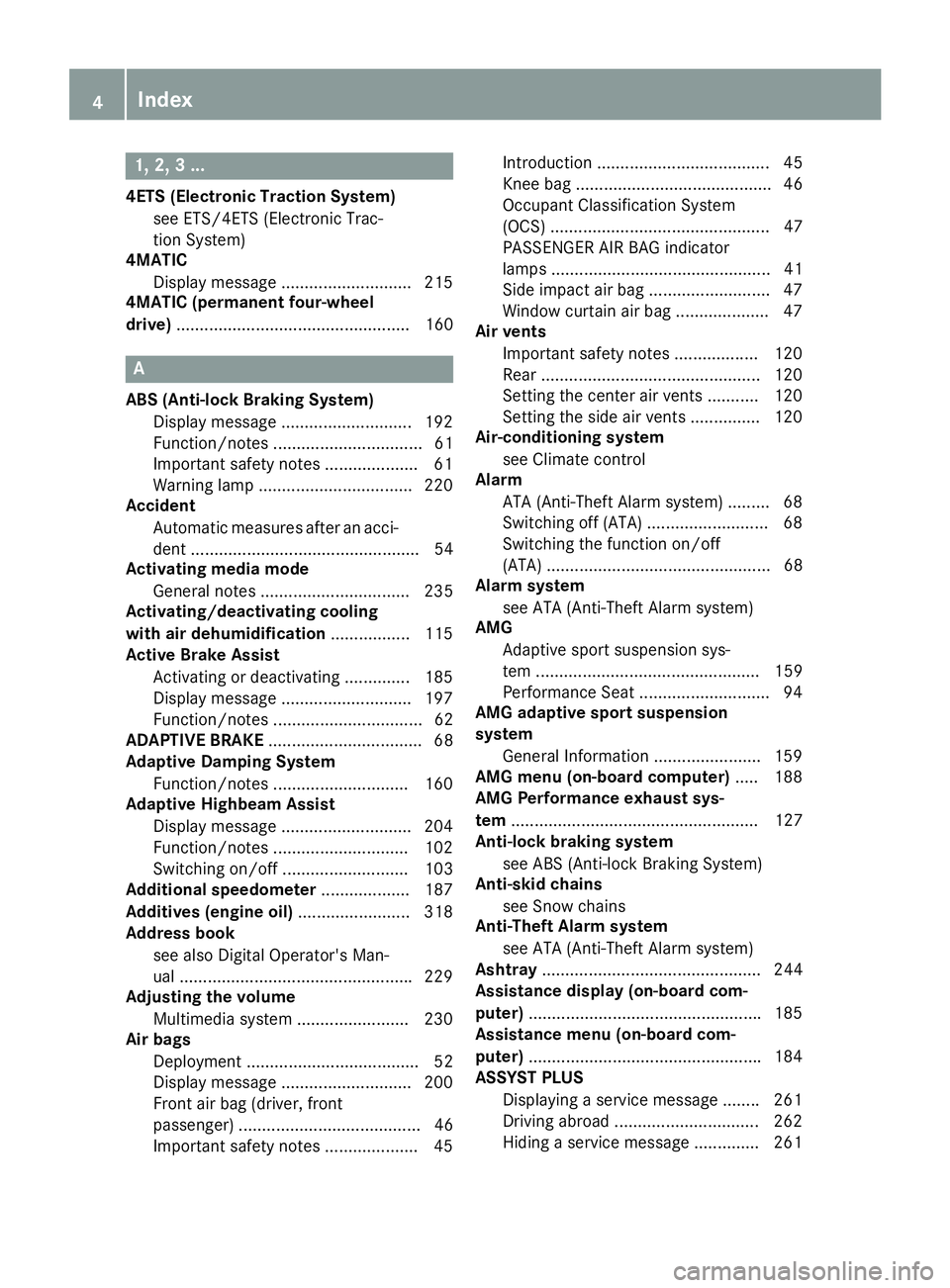
1, 2, 3. ..4ETS (Electronic Traction System)
see ETS/4ETS (Electronic Trac-
tion System)
4MATIC
Display message ............................ 215
4MATIC (permanent four-wheel
drive) .................................................. 160
AABS (Anti-lock Braking System)
Display message ............................ 192
Function/notes ................................ 61
Important safety notes .................... 61
Warnin gl amp ................................ .2 20
Accident
Automatic measure sa fter an acci-
dent ................................................. 54
Activatin gm edia mode
General notes ................................ 235
Activating/deactivating cooling
with air dehumidification ................. 115
Active Brake Assist
Activating or deactivating .............. 185
Display message ............................ 197
Function/notes ................................ 62
ADAPTIVE BRAKE ................................. 68
Adaptive Dampin gS ystem
Function/notes ............................ .1 60
Adaptive Highbeam Assist
Display message ............................ 204
Function/notes ............................ .1 02
Switching on/off ........................... 103
Additional speedometer ................... 187
Additives (engine oil) ........................ 318
Address book
see also Digita lO perator's Man-
ua l. ................................................ .2 29
Adjustin gt he volume
Multimedi as ystem ........................ 230
Ai rb ags
Deployment ..................................... 52
Display message ............................ 200
Front ai rb ag (driver, front
passenger ). ...................................... 46
Important safety notes .................... 45 Introduction ..................................... 45
Knee bag .......................................... 46
Occupant Classification System
(OCS) ............................................... 47
PASSENGER AIR BAG indicator
lamps ............................................... 41
Side impact ai rb ag .......................... 47
Windo wc urtai na ir bag .................... 47
Ai rv ents
Important safety notes .............. .... 120
R ea r. .............................................. 120
Setting the center ai rv ents ........... 120
Setting the sid ea ir vents .............. .1 20
Air-conditionin gs ystem
see Climate control
Alarm
ATA (Anti-Theft Alarm system) ......... 68
Switching off (ATA) .......................... 68
Switching the function on/off
(ATA) ................................................ 68
Alarm system
see ATA (Anti-Theft Alarm system)
AMG
Adaptive sport suspension sys-
tem ................................................ 159
Performance Seat ............................ 94
AMG adaptive sport suspension
system
General Information ....................... 159
AMG menu (on-board computer) ..... 188
AMG Performance exhaus ts ys-
tem ..................................................... 127
Anti-loc kb raking system
see ABS (Anti-lock Braking System)
Anti-skid chains
see Snow chains
Anti-Theft Alarm system
see ATA (Anti-Theft Alarm system)
Ashtray ............................................... 244
Assistanc ed isplay (on-board com-
puter) ................................................. .1 85
Assistanc em enu (on-board com-
puter) ................................................. .1 84
ASSYST PLUS
Displaying as ervice message ....... .2 61
Driving abroad ............................... 262
Hiding as ervice message .............. 2614
Index
Page 8 of 326
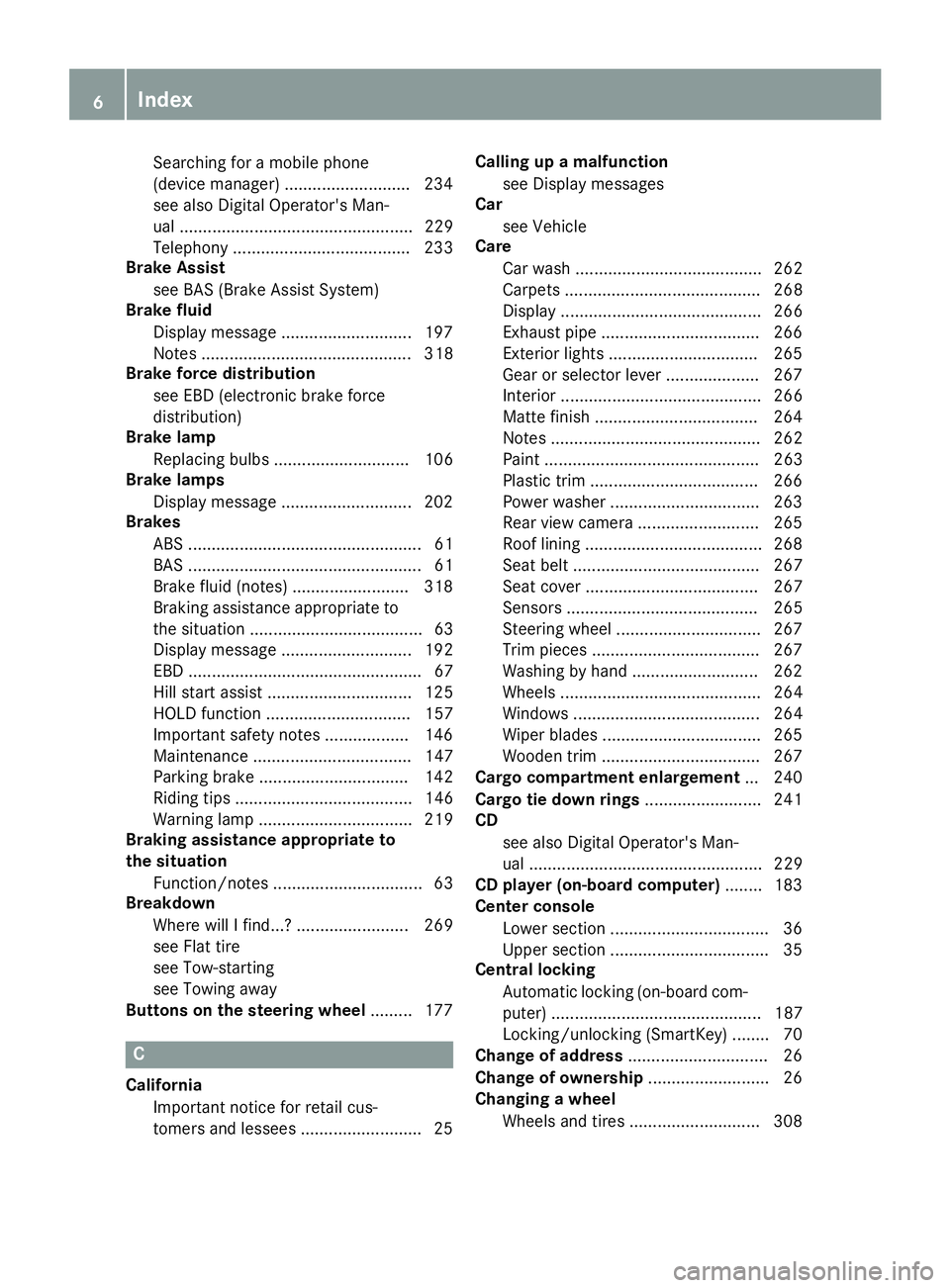
Searching for am obil ep hone
(device manager ). .......................... 234
see also Digital Operator's Man-
ua l. ................................................. 229
Telephony ...................................... 233
Brake Assist
see BAS (Brake Assist System)
Brake fluid
Displa ym essage ............................ 197
Note s. ............................................ 318
Brake forc ed istribution
see EBD (electroni cb rake force
distribution)
Brake lamp
Replacing bulb s. ............................ 106
Brake lamps
Displa ym essage ............................ 202
Brakes
ABS .................................................. 61
BAS .................................................. 61
Brake fluid (notes) ......................... 318
Braking assistance appropriate to
the situation ..................................... 63
Displa ym essage ............................ 192
EBD .................................................. 67
Hil ls tart assis t. .............................. 125
HOLD function ............................... 157
Important safety notes .................. 146
Maintenance .................................. 147
Parking brake ................................ 142
Riding tip s. ..................................... 146
Warning lamp ................................. 219
Brakin ga ssistanc ea ppropriate to
the situation
Function/note s. ............................... 63
Breakdown
Where will If ind...? ........................ 269
see Fla tt ire
see Tow-starting
see Towing away
Button sont he steering wheel ......... 177
C
California
Important notice for retail cus-
tomers and lessees .......................... 25 Calling up am alfunction
see Displa ym essages
Car
see Vehicle
Care
Ca rw as h. ....................................... 262
Carpets .......................................... 268
Displa y. .......................................... 266
Exhaus tp ip e. ................................. 266
Exterior lights ................................ 265
Gear or selector lever .................... 267
Interior ........................................... 266
Matte finish ................................... 264
Note s. ............................................ 262
Paint .............................................. 263
Plastic trim .................................... 266
Power washe r. ............................... 263
Rear vie wc amera .......................... 265
Roof lining ...................................... 268
Sea tb el t. ....................................... 267
Sea tc ove r. .................................... 267
Sensors ......................................... 265
Steering whee l. .............................. 267
Tri mp ie ce s. ................................... 267
Washing by hand ........................... 262
Wheel s. .......................................... 264
Window s. ....................................... 264
Wipe rb lade s. ................................. 265
Woode nt rim .................................. 267
Carg oc om partmen te nl argement ... 240
Carg ot ie dow nr ings ......................... 241
CD
see also Digital Operator's Man-
ua l. ................................................. 229
CD player (on-board computer) ........ 183
Cente rc on sole
Lower section .................................. 36
Upper section .................................. 35
Central locking
Automati cl oc king (on-board com-
puter) ............................................. 187
Locking/unlocking (SmartKey ). ....... 70
Chang eofa ddress .............................. 26
Chang eofo wner ship .......................... 26
Changin gaw heel
Wh eels an dt ire s. ........................... 3086
Index
Page 10 of 326
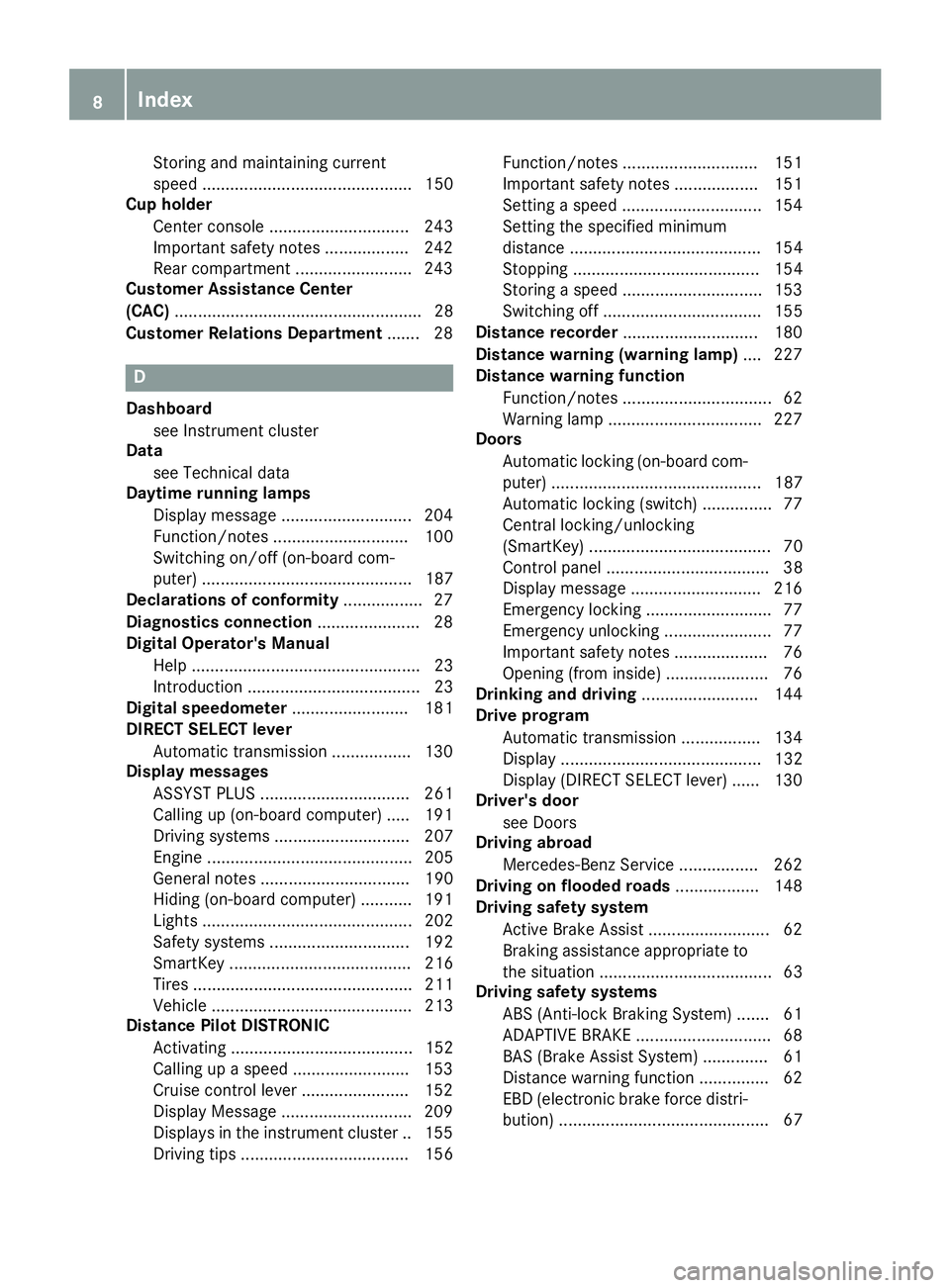
Storing and maintaining current
speed ............................................. 150
Cup holder
Center console .............................. 243
Important safety notes .................. 242
Rear compartment ......................... 243
Custome rA ssis tance Center
(CAC) ..................................................... 28
Custome rR elations Department ....... 28
DDashboard
see Instrument cluster
Data
see Technica ld at a
Daytime runnin gl amps
Displa ym essage ............................ 204
Function/note s. ............................ 100
Switching on/of f( on -board com-
puter) ............................................. 187
Declarations of conformity ................. 27
Diagnostic sc on nection ...................... 28
Digital Operator's Manual
Hel p. ................................................ 23
Introduction ..................................... 23
Digital speedometer ......................... 181
DIREC TS ELECT lever
Automati ct ransmissio n. ................ 130
Display messages
ASSYST PLU S. ............................... 261
Calling up (on-board computer) ..... 191
Driving systems ............................. 207
Engine ............................................ 205
Genera ln otes ................................ 190
Hiding (on-board computer) ........... 191
Lights ............................................. 202
Safety systems .............................. 192
SmartKey ....................................... 216
Tires ............................................... 211
Vehicl e. .......................................... 213
Distance Pilo tD IS TRONIC
Activating ....................................... 152
Calling up as peed ......................... 153
Cruise control lever ....................... 152
Displa yM essage ............................ 209
Displays in the instrument cluster .. 155
Driving tip s. ................................... 156 Function/note s. ............................ 151
Important safety notes .................. 151
Setting as peed .............................. 154
Setting the specified minimum
distance ......................................... 154
Stopping ........................................ 154
Storing as peed .............................. 153
Switching off .................................. 155
Distance recorder ............................. 180
Distance warnin g( wa rning lamp) .... 227
Distance warnin gf unction
Function/note s. ............................... 62
Warning lamp ................................. 227
Doors
Automati cl oc king (on-board com-
puter) ............................................. 187
Automati cl oc king (switch) ............... 77
Central locking/unlocking
(SmartKey ). ...................................... 70
Control panel ................................... 38
Displa ym essage ............................ 216
Emergency locking ........................... 77
Emergency unlocking ....................... 77
Important safety notes .................... 76
Opening (fro mi nside ). ..................... 76
D ri nking and driving ......................... 144
Drive program
Automati ct ransmission ................. 134
Displa y. .......................................... 132
Displa y( DIRECT SELECT lever) ...... 130
Driver's door
see Doors
Drivin ga broad
Mercedes-Benz Service ................. 262
Drivin gonf loode dr oads .................. 148
Drivin gs afety system
Active Brake Assist .......................... 62
Braking assistance appropriate to
the situation ..................................... 63
Drivin gs afety systems
ABS (Anti-lock Braking System) ....... 61
ADAPTIV EB RAK E. ............................ 68
BAS (Brake Assist System) .............. 61
Distance warning function ............... 62
EBD (electroni cb rake force distri-
bution) ............................................. 678
Index
Page 23 of 326
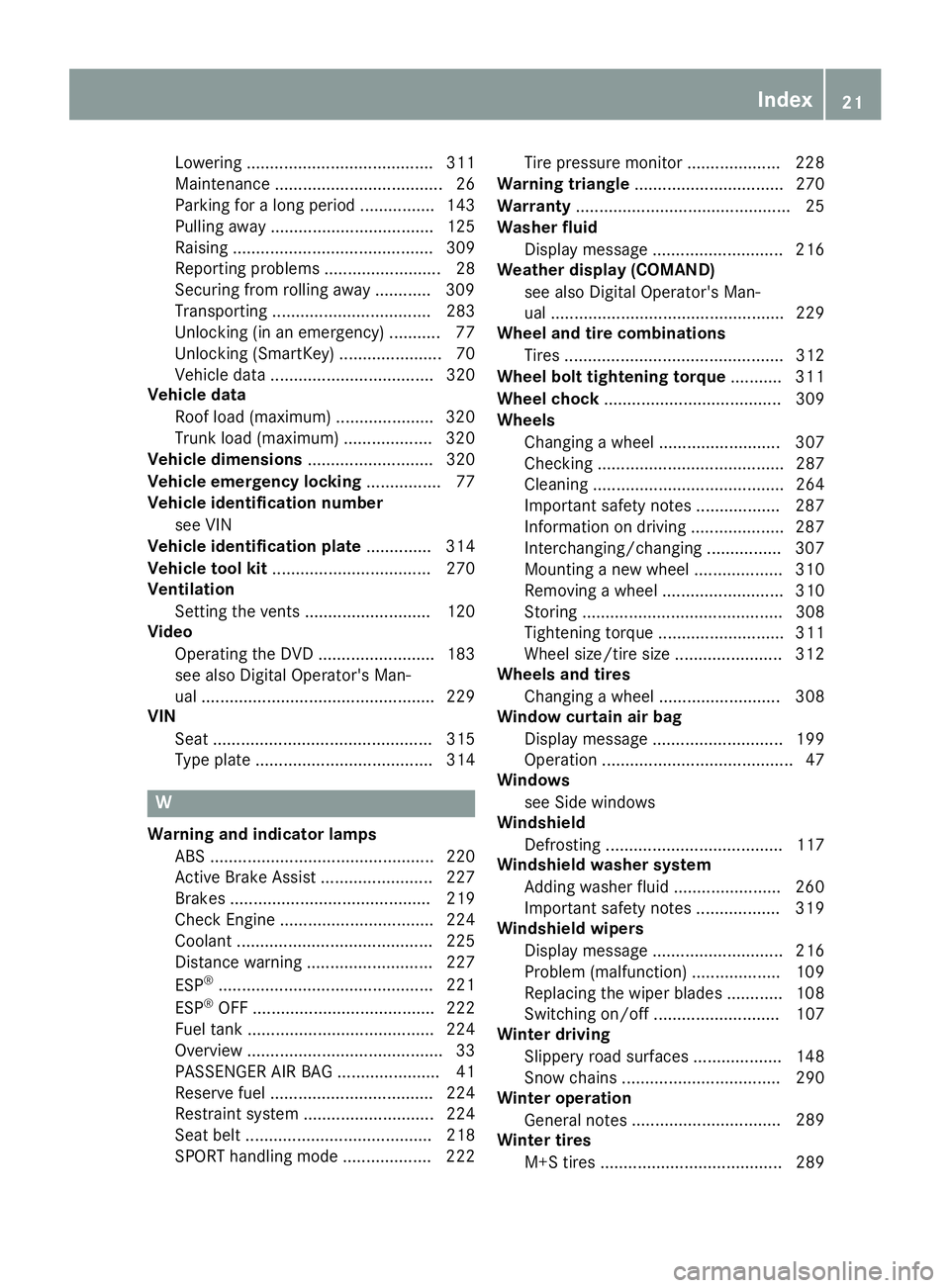
Lowering ........................................ 311
Maintenance .................................... 26
Parking for al ong perio d. ............... 143
Pulling awa y. .................................. 125
Raising ........................................... 309
Reporting problems ......................... 28
Securing from rolling away ............ 309
Transporting .................................. 283
Unlocking (i nane mergency) ........... 77
Unlocking (SmartKey ). ..................... 70
Vehicl ed at a. .................................. 320
Vehicl ed ata
Roof load (maximum) ..................... 320
Trunk load (maximum) ................... 320
Vehicl ed imensions ........................... 320
Vehicl ee mergenc yl oc king ................ 77
Vehicl ei dentificatio nn umber
see VIN
Vehicl ei dentificatio np late .............. 314
Vehicl et oo lk it .................................. 270
Ventilation
Setting the vents ........................... 120
Video
Operating the DVD ......................... 183
see also Digital Operator's Man-
ua l. ................................................. 229
VIN
Sea t. .............................................. 315
Type plate ...................................... 314
W
Warning and indicator lamps
ABS ................................................ 220
Active Brake Assist ........................ 227
Brakes ........................................... 219
Check Engine ................................. 224
Coolant .......................................... 225
Distance warning ........................... 227
ESP ®
.............................................. 221
ESP ®
OFF ....................................... 222
Fue lt ank ........................................ 224
Overview .......................................... 33
PASSENGER AIR BAG ...................... 41
Reserve fue l. .................................. 224
Restraint system ............................ 224
Sea tb el t. ....................................... 218
SPOR Th an dling mod e. .................. 222 Tire pressure monitor .................... 228
Warning triangle ................................ 270
Warranty .............................................. 25
Washer fluid
Displa ym essage ............................ 216
Weather display (COMAND)
see also Digital Operator's Man-
ua l. ................................................. 229
Wheel and tire combinations
Tires ............................................... 312
Wheel bolt tightenin gt orque ........... 311
Wheel chock ...................................... 309
Wheels
Changing aw heel .......................... 307
Checking ........................................ 287
Cleaning ......................................... 264
Important safety notes .................. 287
Information on driving .................... 287
Interchanging/changing ................ 307
Mounting an ew whee l. .................. 310
Removing aw heel .......................... 310
Storing ........................................... 308
Tightening torque ........................... 311
Wheel size/tire size ....................... 312
Wheel sa nd tires
Changing aw heel .......................... 308
Window curtai na ir bag
Displa ym essage ............................ 199
Operation ......................................... 47
Windows
see Sid ew in dows
Windshield
Defrosting ...................................... 117
Windshiel dw asher system
Adding washe rf luid ....................... 260
Important safety notes .................. 319
Windshiel dw ip ers
Displa ym essage ............................ 216
Problem (malfunction) ................... 109
Replacing the wipe rb lade s. ........... 108
Switching on/of f. .......................... 107
Winter driving
Slippery roa ds ur faces ................... 148
Snow chains .................................. 290
Winter operation
Genera ln otes ................................ 289
Wi n
ter tires
M+S tire s. ...................................... 289Index 21
Page 44 of 326
occupant in the best position in relation to the
air bag.
The seat belt system comprises: R
Seat belts R
Emergency Tensionin gD evices for the front
seat belts and the outer seat belts in the rear R
Seat belt force limiters for the front seat belts
and the outer seat belts in the rear
If the seat belt is pulled out of the belt outlet
quickly or with aj erk ym ovement ,t he belt
retractor locks. The belt strap cannot be extrac-
ted any further.
The Emergency Tensionin gD evice tighten st he
seat belt in an accident ,p ulling the belt close
against the body. However it does not pull the
vehicle occupant back in the direction of the
backrest.
The Emergency Tensionin gD evice does not cor-
rect an incorrect seat position or the routing of
an incorrectly fastened seat belt.
When triggered, as eat belt force limiter helps to
reduce the force exerted by the seat belt on the
vehicle occupant.
The seat belt force limiters for the front seats are
synchronized with the front air bags, which
absorb part of the deceleration force. This can
reduce the force exerted on the vehicle occu-
pants during an accident.
! If the front-passenger seat is not occupied,
do not engage the seat belt tongue in the
buckle on the front-passenger seat. Other-
wise, the Emergency Tensionin gD evice and
side impact air bag could be triggered in the
event of an accident and would need to be
replaced.
Important safety notes The use of seat belts and child restraint systems
is required by law in: R
all 50 states R
the U.S. territories R
the District of Columbia R
all Canadian provinces
Even where this is not required by law, all vehicle
occupant ss hould correctly fasten their seat
belts before starting the journey.
G WARNING
If the seat belt is not worn correctly, it cannot
perform its intended protective function. An incorrectly fastened seat belt can also cause
injuries, for example, in the event of an acci-
dent or when braking or changing direction
abruptly. This poses an increased risk of injury
or even fatal injury.
Always ensure that all vehicle occupant sh ave
their seat belts fastened correctly and are sit-
ting properly.
The components of the restraint system work in
conjunction with each other. They can only
deploy their protective function if, at all times, all
vehicle occupants: R
have fastened their seat belts correctly
( Y
page 43) R
have the seat and head restraint adjusted
properly ( Y
page 90)
G WARNING
The seat belt does not offer the intended level
of protection if you have not moved the back-
rest to an almost vertical position. When brak-
ing or in the event of an accident ,y ou could
slide underneath the seat belt and sustain
abdomen or neck injuries, for example. This
poses an increased risk of injury or even fatal
injury.
Adjust the seat properly before beginning
your journey. Always ensure that the backrest
is in an almost vertical position and that the
shoulder section of your seat belt is routed
across the center of your shoulder.
G WARNING
Persons less than 5ft( 1.50 m) tall cannot
wear the seat belt correctly without an addi-
tional and suitable restraint system. If the
seat belt is not worn correctly, it cannot per-
form its intended protective function. An
incorrectly fastened seat belt can also cause
injuries, for example, in the event of an acci-
dent or when braking or changing direction
abruptly. This poses an increased risk of injury
or even fatal injury.
For this reason, alway ss ecure persons under
5ft( 1.50 m) tall in suitable additional restraint
systems.42
Occupant safety
Safety
Page 50 of 326
Requirements To be classifie dc orrectly ,t he front passenger
mus ts it:R
with the sea tb el tf astened correctlyR
in an almost upright position with thei rb ac k
against the sea tb ac krestR
with thei rf ee tr esting on the floor, if possible
If the front passenger doe sn ot observe these
conditions ,O CS may produce af alse classifica-
tion, e.g. because the front passenger: R
transfers thei rw eigh tb ys uppo rting them-
selves on av ehicl ea rmrestR
sits in such aw ay that thei rw eigh tisr aised
from the sea tc ushion
If it is absolutely necessary to install ac hild
restraint system on the front-passenger seat, be
sure to observe the correct positioning of the
child restraint system. Neve rp la ce objects
under or behind the child restraint system, e.g. a
cushion. The entir eb as eoft he child restraint
system mus ta lway sr es tont he sea tc ushio no f
the front-passenger seat. The backrest of the
forward-facing child restraint system mus tl ie as
fla ta sp ossible against the backrest of the front-
passenger seat.
The child restraint system mus tn ot touch the
roo forbes ub jecte dtoal oa dbyt he head
restraint. Adjust the angle of the sea tb ac krest
and the hea dr estraint position accordingly.
Only then can OC Sbeg ua ranteed to function
correctly .A lway so bserve the child restraint sys-
tem manufacturer' si nstallation and o perating
i
nstructions.
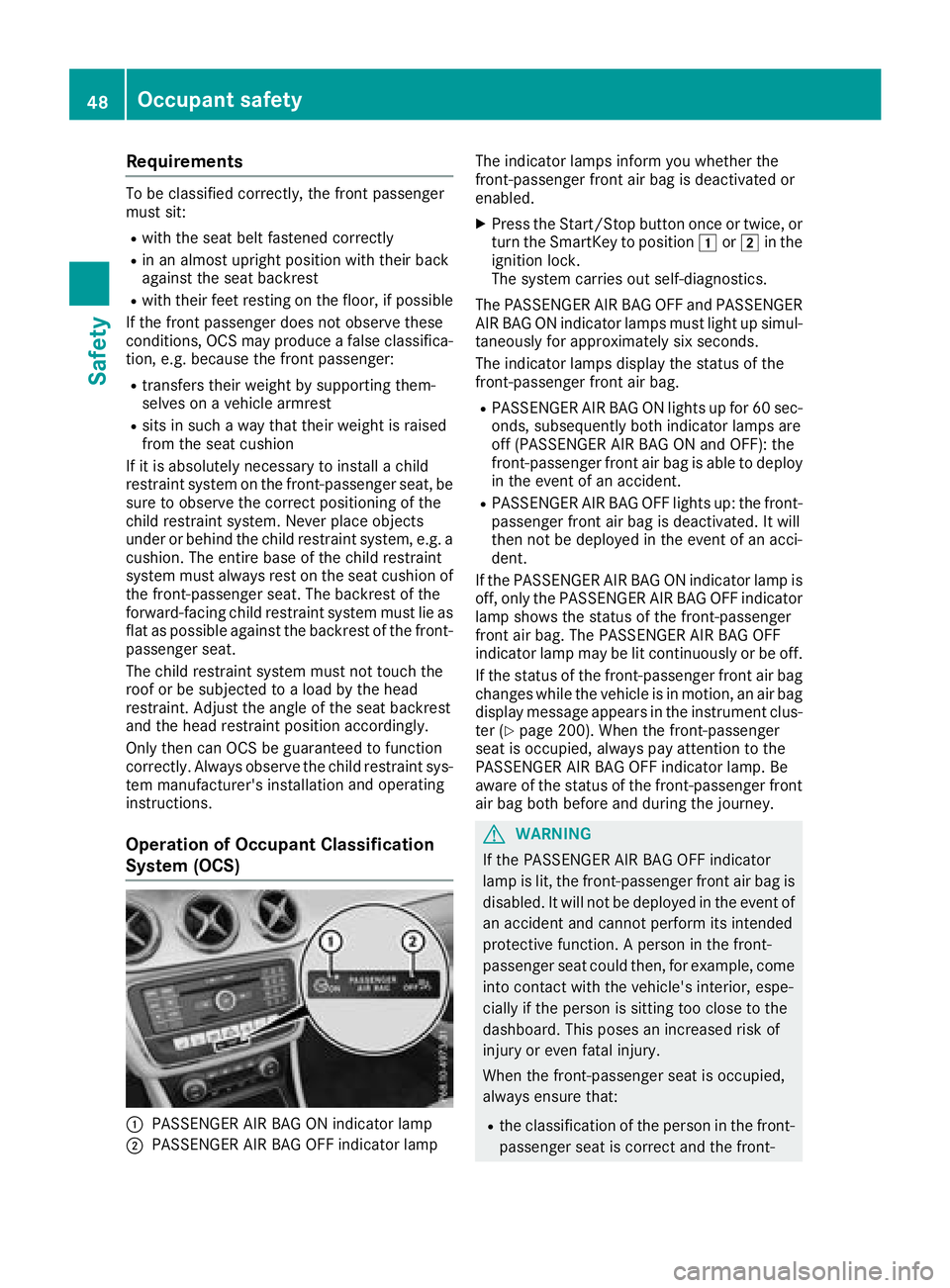
Operatio nofO cc upant Classification
System (OCS)
C
PASSENGER AIR BAG ON indicator lamp
D
PASSENGER AIR BAG OFF indicator lamp The indicator lamps inform yo uw he the rt he
front-passenger front ai rb ag is deactivated or
enabled. X
Press the Start/Sto pb ut ton once or twice, or
turn the SmartKey to position G or H in the
ignition lock.
The system carrie so ut self-diagnostics.
The PASSENGER AIR BAG OFF and PASSENGER
AIR BAG ON indicator lamps mus tl ig ht up simul-
taneously for approximately six seconds.
The indicator lamps display the statu soft he
front-passenger front ai rb ag .R
PASSENGER AIR BAG ON lights up for 60 sec-
onds ,s ub sequently both indicator lamps are
off (PASSENGER AIR BAG ON and OFF) :t he
front-passenger front ai rb ag is able to deploy
in the event of an accident. R
PASSENGER AIR BAG OFF lights up :t he front-
passenger front ai rb ag is deactivated. It will
then not be deploye dint he event of an acci-
dent.
If the PASSENGER AIR BAG ON indicator lamp is
off, only the PASSENGER AIR BAG OFF indicator
lamp shows the statu soft he front-passenger
front ai rb ag .T he PASSENGER AIR BAG OFF
indicator lamp may be li tc ontinuously or be off.
If the statu soft he front-passenger front ai rb ag
changes whil et he vehicl eisinm otion, an ai rb ag
display message appears in the instrument clus-
ter ( Y
page 200). Whe nt he front-passenger
sea ti so ccupied, always pa ya ttention to the
PASSENGER AIR BAG OFF indica tor l amp. Be
a
ware of the statu soft he front-passenger front
ai rb ag both before and during the journey.
G WARNING
If the PASSENGER AIR BAG OFF indicator
lamp is lit, the front-passenger front ai rb ag is
disabled. It will not be deploye dint he event of
an accident and canno tp erform its intended
protectiv ef unction. Ap erson in the front-
passenger sea tc ould then, for example, come
into contact with the vehicle's interior, espe-
ciall yift he person is sitting too close to the
dashboard. Thi sp oses an increased ris ko f
injury or eve nf ata li njury.
Whe nt he front-passenger sea ti so ccupied,
always ensure that: R
the classification of the person in the front-
passenger sea ti sc orrect and the front-48
Occupan ts afety
Safety
Page 58 of 326
Child restraint system The use of seat belt sa nd child restraint systems
is required by law in: R
all 50 states R
th eU .S .t erri toriesR
th eD istrict of ColumbiaR
all Canadian provinces
If you install ar earward-facing child restraint
system on th ec ente rr ear seat ,t he rear arm rest
must be folded back as far as possible.
You can obtain further informatio na bout the
correc tc hi ld restraint system from any author-
ize dM ercedes-Ben zC enter.
G WARNING
If th ec hi ld restraint system is installed incor-
rectly on as uitable seat ,itc anno tp rotect as
intended. The child canno tt he nber estrained
in th ee vent of an accident, heav yb raking or
sudde nc ha nges of direction .T her eisa n
increased ris kofi njury, possibly eve nf atal.
Mak es ure that you observ et he child restraint
system manufacturer' si nstallatio ni nstruc-
tions and th en otes on use. Pleas ee ns ure,
that th eb ase of th ec hi ld restraint system is
always restin gc ompletely on th es eat cush-
ion .N ever plac eo bjects, e.g .c ushions, under
or behin dt he child restraint system. Only use
child restraint systems wit ht he original cover
designe df or them. Only replace damaged
covers wit hg enuine covers.
G WARNING
If th ec hi ld restraint system is installed incor-
rectly or is no ts ecured, it can com el oos ei n
th ee vent of an accident, heav yb raking or a
sudde nc ha ng eind irection .T he child
restraint system coul dbet hr own about ,s tr ik-
ing vehicle occupants. Ther eisani ncreased
ris kofi njury, possibly eve nf atal.
Always install child restraint systems prop-
erly, eve nift he ya re no tb ein gu sed. Make
sure that you observ et he child restraint sys-
te mm anufacturer' si nstallatio ni nstructions.
You will fin df urther informatio nons to wing
objects, luggag eorl oads unde r" Loading guide-
lines" ( Y
page 237). G WARNING
Child restraint systems or their securin gs ys-
tems whic hh ave been damaged or subjected
to al oad in an acciden tc an no longer protect
as intended. The child canno tt he nb e
restraine dint he event of an accident, heavy
braking or sudde nc ha nges of direction .T here
is an increased ris kofi njury, possibly even
fatal.
Replac ec hi ld restraint systems whic hh ave
been damaged or subjected to al oad in an
acciden tass oon as possible. Hav et he secur-
ing systems on th ec hi ld restraint system
checked at aq ualified specialist workshop,
before you install ac hi ld restraint system
again.
The securin gs ystems of child restraint systems
are: R
th es eat belt system R
th eL AT CH-type (ISOFIX) securin gr ingsR
th eT op Tether anchorages
If it is absolutely necessary to carry ac hi ld on
th ef ront-pa ssenger seat ,bes ure to observ et he
informatio nont he "Occupan tC lassification
Syste m( OCS)" ( Y
page 47) .T her ey ou will also
fin di nformatio nond eactivatin gt he front-
passenger fron ta ir bag.
All child restraint systems must mee tt he fol-
lowin gs ta ndards: R
U.S. Federal Motor Vehicle Safet yS ta ndards
21 3a nd 225 R
Canadian Motor Vehicle Safet yS ta ndards
21 3a nd 210.2
Confirmation that th ec hi ld restraint system cor-
responds to th es ta ndards can be foun dona n
ins truc tion label on th ec hi ld
restraint system.
This confirmation can also be foun dint he instal-
lation instruction st ha ta re included wit ht he
child restraint system.
Observ et he warning labels in th ev ehicle inte-
rior and on th ec hi ld restraint system.56
Children in th ev ehicle
Safety
Page 61 of 326
Rearward-facin gc hild restraint systemIf it is absolutely necessary to install ar earward-
facing child restraint system on the front-
passenger seat, always make sure that the
front-passenger front ai rb ag is deactivated.
Only if the PASSENGER AIR BAG OFF indicator
lamp is permanently li t( Y
page 41 )i st he front-
passenger front ai rb ag deactivated.
Alway so bserve the child restraint system man-
ufacturer's installation and operating instruc-
tions.
Forward-facing child restraint system If it is absolutely necessary to install af orward-
facing child restraint system on the front-
passenger seat, always move the front-
passenger sea ta sf ar back as possible .F ully
retract the sea tc ushio nl en gth. The entir eb as e
of the child restraint system mus ta lway sr es to n
the sea tc ushio noft he front-passenger seat.
The backrest of the child restraint system must
li easf la ta sp ossible against the backrest of the
front-passenger seat. The child restraint system
mus tn ot touch the roo forbes ub jecte dtoal oa d
by the hea dr estraint. Adjust the angle of the
sea tb ac krest and the hea dr estraint position
accordingly .A lway sm ake sure that the shoul-
der bel ts tra pisc orrectly routed from the vehi-
cle bel to ut let to the shoulder bel tg uide on the
child restraint system. The shoulder bel ts trap
mus tb er outed forward and dow nf rom the vehi-
cle bel to ut let. If necessary, adjust the vehicle
bel to ut let and the front-passenger sea ta ccord-
ingly.
Alway so bserve the child restraint system man-
ufacturer's installation and operating instruc-
tions. Child-proof locks
Important safety notes
G WARNING
If children are traveling in the vehicle, they
could: R
ope nd oors, thu se ndangering othe rp eople
or roa du se rs R
exi tt he vehicl ea nd be caught by oncoming
traffic R
operate vehicl ee quipment and become
trapped
There is ar is kofana ccident and injury.
Alway sa ctivate the child-proof locks and
overrid ef eature if children are traveling in the
vehicle. Whe nl ea ving the vehicle, always take
the key with yo ua nd lock the vehicle. Never
leave children unattende dint he vehicle.
Overrid ef eature for: R
the rea rd oors ( Y
page 60) R
the rea rs id ew in dow s( Y
page 60)
G WARNING
If yo ul ea ve children unsupervised in the vehi-
cle ,t hey could set it in motion by ,f or example:R
release the parking brake. R
shift the automatic transmissio no ut of the
parking position P . R
star tt he engine.
In addition, they may operate vehicl ee quip-
ment and become trapped .T here is ar is ko f
an accident and injury.
Whe nl ea ving the vehicle, always take the
SmartKey with yo ua nd lock the vehicle. Never
leave children unsupervised in the vehicle.
G WARNING
If persons ,p ar ticularly children are subjected
to prolonged exposure to extreme hea to r
cold, there is ar is kofi njury, possibly even
fatal. Neve rl ea ve children unattende dint he
vehicle.Childre nint he vehicle 59
Safety Z
Page 63 of 326
Drivin gs af et ys ystems
Overview of drivin gs af et ys ystemsIn this section ,y ou will fin di nformati on about
th ef ol lowin gd rivin gs afet ys ystems :R
AB S( A nti-lock B rakin g S ystem)
( Y
page 61) R
BA S( B rak e A ssist S ystem) ( Y
page 61)R
Active Brak eA ss is t( Y
page 62 )R
ES P ®
( E lectronic S ta bility P ro gram)
( Y
page 64) R
EB D( E lectroni c B rak ef orce D istribution )
( Y
page 67 )R
ADAPTIV EB RAKE ( Y
page 68 )R
STEE RC ONTROL ( Y
page 68)
Important safet yn otesIf you fail to adapt your drivin gs ty le or if you are
inattentive ,t he drivin gs afet ys ystems can nei-
ther reduce th er is kofana cciden tn or override
th el aws of physics. Driving safet ys ystems are
merely aids designed to assist driving. You are
responsible fo rm aintainin gt he distanc etot he
vehicle in front, fo rv ehicle speed, fo rb raking in
goo dt im e, and fo rs ta yin ginl ane. Always adapt
your drivin gs ty le to suit th ep revailin gr oa da nd
weather condition sa nd maintain as af ed istanc e
from th ev ehicle in front. Drive carefully.
The drivin gs afet ys ystems described only wor k
as effectively as possible when there is ade-
quat ec ontac tb etween th et ir es and th er oa d
surface. Please pay special attention to th e
note sont ir es ,r ecommended minimum tire
tread depths, etc. ( Y
page 288).
In wintr yd rivin gc onditi ons, always use winte r
tires (M+ St ir es )a nd if necessary ,s now chains.
Onl yint hi sw ay will the driving safety systems
describe dint hi ss ection work as effectively as
possible.
ABS (Anti-lock Brakin gS ystem)
General information
ABS regulate sb rake pressure in such aw ay that
the wheels do not lock when yo ub rake. This
allows yo utoc ontinue steering the vehicl ew he n
braking. The % ABS warning lamp in the instrument
cluster lights up when the ignition is switched
on. It goe so ut when the engine is running.
ABS works from as peed of abou t5m ph
(8 km/h), regardless of road-surface conditions.
ABS works on slippery surfaces, eve nw he ny ou
onl yb rake gently.
Important safety notes
i Observe the "Important safety notes "s ec-
tio n( Y
page 61).
G WARNING
If ABS is faulty ,t he wheels could lock when
braking .T he steerability and braking charac-
teristic sm ay be severely impaired .A ddition-
ally ,f urther driving safety system sa re deac-
tivated .T here is an increased danger of skid-
ding and accidents.
Driv eonc arefully. Hav eA BS checked imme-
diately at aq uali fied specialist workshop.
Whe nA BS is malfunctioning ,o the rs ys tems,
including driving safety systems, will also
become inoperative. Observe the information
on the ABS warning lamp ( Y
page 220 )a nd dis-
play messages which ma ybes hown in the
instrument cluster ( Y
page 192).
Braking X
If ABS intervenes: continue to depress the
brake peda lv igorously unti lt he braking sit-
uatio ni so ver. X
To make af ul lb rake application: depress
the brake peda lw it hf ul lf orce.
If ABS intervene sw he nb raking ,y ou will fee la
pulsing in the brake pedal.
The pulsating brake peda lc an be an indication
of hazardou sr oa dc onditions, and functions as a
reminder to take extra car ew hile driving.
BAS (Brak eA ssis tS ystem)
General information
BAS operates in emergency braking situations.
If yo ud ep ress the brake peda lq ui ckly, BAS
automaticall yb oo sts the braking force ,t hus
shortening the stopping distance.Driving safety systems 61
Safety Z
Page 66 of 326
sensor technology to assess the traffic situa-
tion.
Situation-dependent braking assistance is capa-
ble of reacting to moving objects that have
alread yb een detected as such at least once
over the period of observation, up to vehicle
speeds of around 155 mph (250 km/h).
Situation-dependent braking assistance can
also detect stationary objects, up to vehicle
speeds of around 44 mph (70 km/h). X
Keep the brake pedal depressed until the
emergency braking situation is over.
ABS prevents the wheels from locking.
The brakes will work normally agai ni f:R
you release the brake pedal. R
there is no longer any danger of ac ollision.R
no obstacle is detected in front of your vehi-
cle.
Situation-dependent braking assistance is then
deactivated.
Important safety notes
i Observe the "Important safety notes" sec-
tion for driving safety systems ( Y
page 61).
G WARNING
Adaptive Brake Assist does not react: R
to people or animals R
to oncoming vehicles R
to crossing traffic R
when cornering
As ar esult, Adaptive Brake Assist may not
intervene in all critical conditions. There is a
risk of an accident.
Always pay careful attention to the traffic sit-
uation and be ready to brake.
G WARNING
Adaptive Brake Assist cannot always clearly
identify objects and complex traffic situa-
tions.
In such cases, Adaptive Brake Assist might: R
intervene unnecessarily R
not intervene
There is ar isk of an accident. Always pay careful attention to the traffic sit-
uation and be ready to brake. Terminate the
intervention in an on-critical driving situation.
Due to the nature of the system, complex but
non-critical driving conditions may also cause
Active Brake Assist to intervene.
Even if Active Brake Assist is not available due to
am alfunction in the radar sensor system, the
brake system is still available with full brake
boosting effect and BAS.
ESP ®
(Electronic Stability Program)
General notes
i Observe the "Important safety notes" sec-
tion ( Y
page 61).
ESP ®
monitors driving stability and traction ,i .e.
power transmission between the tires and the
road surface.
If ESP ®
detects that the vehicle is deviating from
the direction desired by the driver, one or more
wheels are braked to stabilize the vehicle. The
engine output is also modified to keep the vehi-
cle on the desired course within physical limits.
ESP ®
assists the driver when pulling awa yo n
wet or slippery roads. ESP ®
can also stabilize
the vehicle during braking.
ETS/4ETS (Electronic Traction System)
i Observe the "Important safety notes" sec-
tion ( Y
page 61).
ETS traction control is part of ESP ®
.Onv ehicles
with 4MATIC, 4ETS is part of ESP ®
.
Traction control brakes the drive wheels indi-
vidually if they spin. This enables you to pull
awa ya nd accelerate on slippery surfaces, for
example if the road surface is slippery on one
side. In addition, more drive torque is transfer-
red to the wheel or wheels with traction.
Traction control remains active, even if you
deactivate ESP ®
.
Important safety notes
i Observe the "Important safety notes" sec-
tion ( Y
page 61).64
Driving safety systems
Safety