seats MERCEDES-BENZ CLA 2018 Owners Manual
[x] Cancel search | Manufacturer: MERCEDES-BENZ, Model Year: 2018, Model line: CLA, Model: MERCEDES-BENZ CLA 2018Pages: 326, PDF Size: 7.97 MB
Page 4 of 326
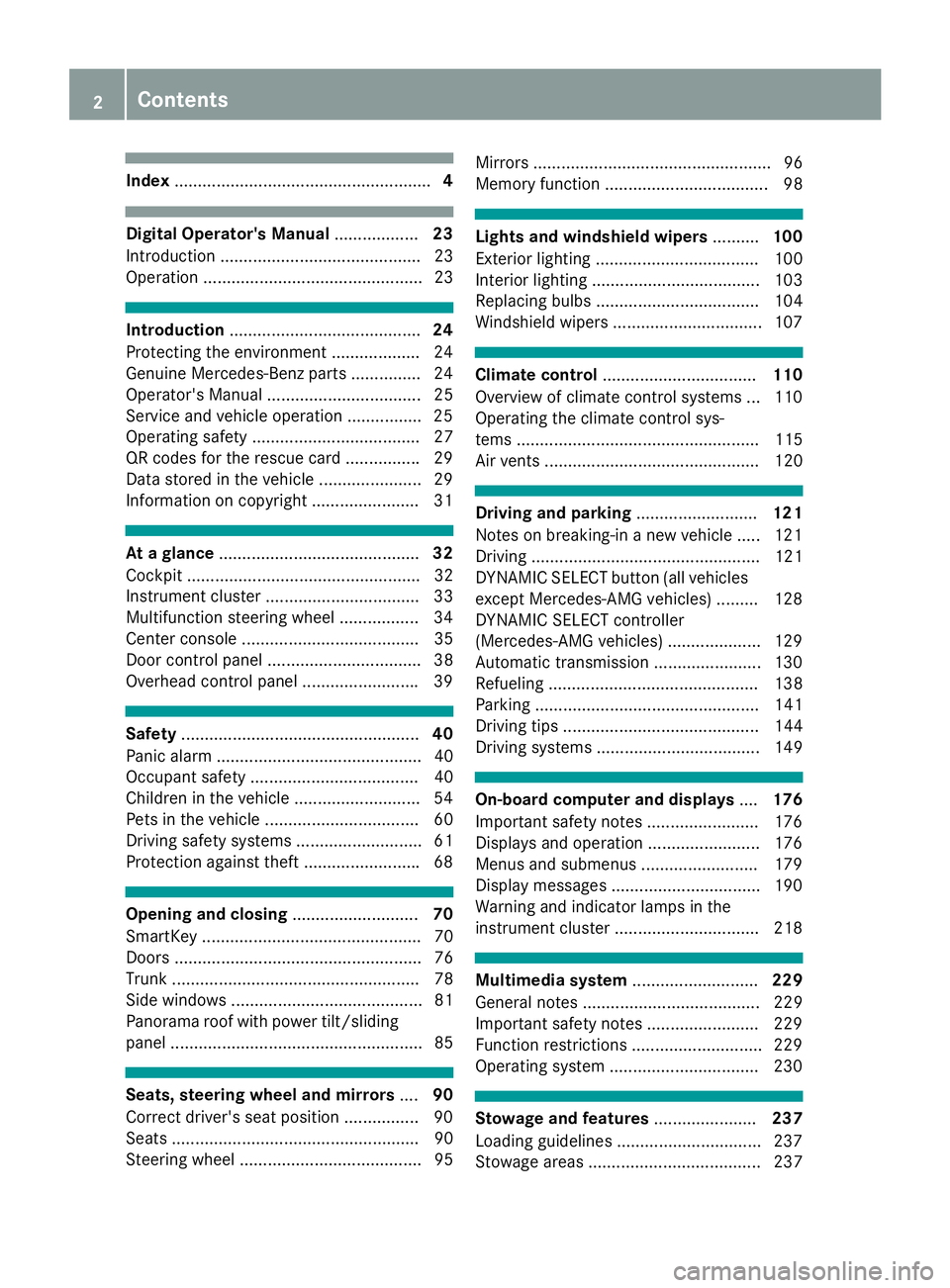
Index ....................................................... 4
Digital Operator's Manual .................. 23
Introductio n. .......................................... 23
Operation ............................................... 23
Introduction ......................................... 24
Protecting the environment .................. .2 4
Genuine Mercedes-Ben zp art s. .............. 24
Operator's Manual ................................. 25
Service and vehicle operation ............... .2 5
Operating safety .................................... 27
QR codes for the rescue card ............... .2 9
Data stored in the vehicl e. ..................... 29
Informatio nonc opyright ....................... 31
At ag la nce ........................................... 32
Cockpi t. ................................................. 32
Instrument cluste r. ................................ 33
Multifunctio ns teering whee l. ................ 34
Center consol e. ..................................... 35
Doo rc ontro lp an el ................................. 38
Overhead contro lp an el ........................ .3 9
Safety ................................................... 40
Panic alarm ............................................ 40
Occupant safety .................................... 40
Children in the vehicle ........................... 54
Pets in the vehicle ................................. 60
Driving safety systems ........................... 61
Protection against theft ........................ .6 8
Opening and closing ........................... 70
SmartKey ............................................... 70
Doors ..................................................... 76
Trunk ..................................................... 78
Side windows ......................................... 81
Panorama roof with power tilt/sliding
panel ...................................................... 85
Seats, steering wheel and mirrors .... 90
Correct driver's seat position ............... .9 0
Seats ..................................................... 90
Steering wheel ....................................... 95 Mirror s. .................................................. 96
Memory function ................................... 98
Lights and windshield wipers .......... 100
Exterior lighting ................................... 100
Interior lighting .................................... 103
Replacing bulb s. .................................. 104
Windshield wipers ................................ 107
Climate control ................................. 110
Overview of climate control systems ... 110
Operating the climate control sys-
tems .................................................... 115
Air vents .............................................. 120
Drivin ga nd parking .......................... 121
Note sonb reaking-in an ew vehicl e. .... 121
Driving ................................................. 121
DYNAMIC SELECT button (all vehicles
excep tM ercedes-AM Gv ehicles) ......... 128
DYNAMIC SELECT controller
(Mercedes-AM Gv ehicles) .................... 129
Automati ct ransmissio n. ...................... 130
Refueling ............................................. 138
Parking ................................................ 141
Driving tip s. ......................................... 144
Driving systems ................................... 149
On-board computer and displays .... 176
Important safety notes ........................ 176
Displays and operation ........................ 176
Menu sa nd submenus ......................... 179
Displa ym essages ................................ 190
Warning and indicator lamps in the
instrument cluster ............................... 218
Multimedi as ystem ........................... 229
Genera ln otes ...................................... 229
Important safety notes ........................ 229
Function restrictions ............................ 229
Operating system ................................ 230
Stowag ea nd features ...................... 237
Loading guideline s. .............................. 237
Stowag ea reas ..................................... 2372
Contents
Page 17 of 326
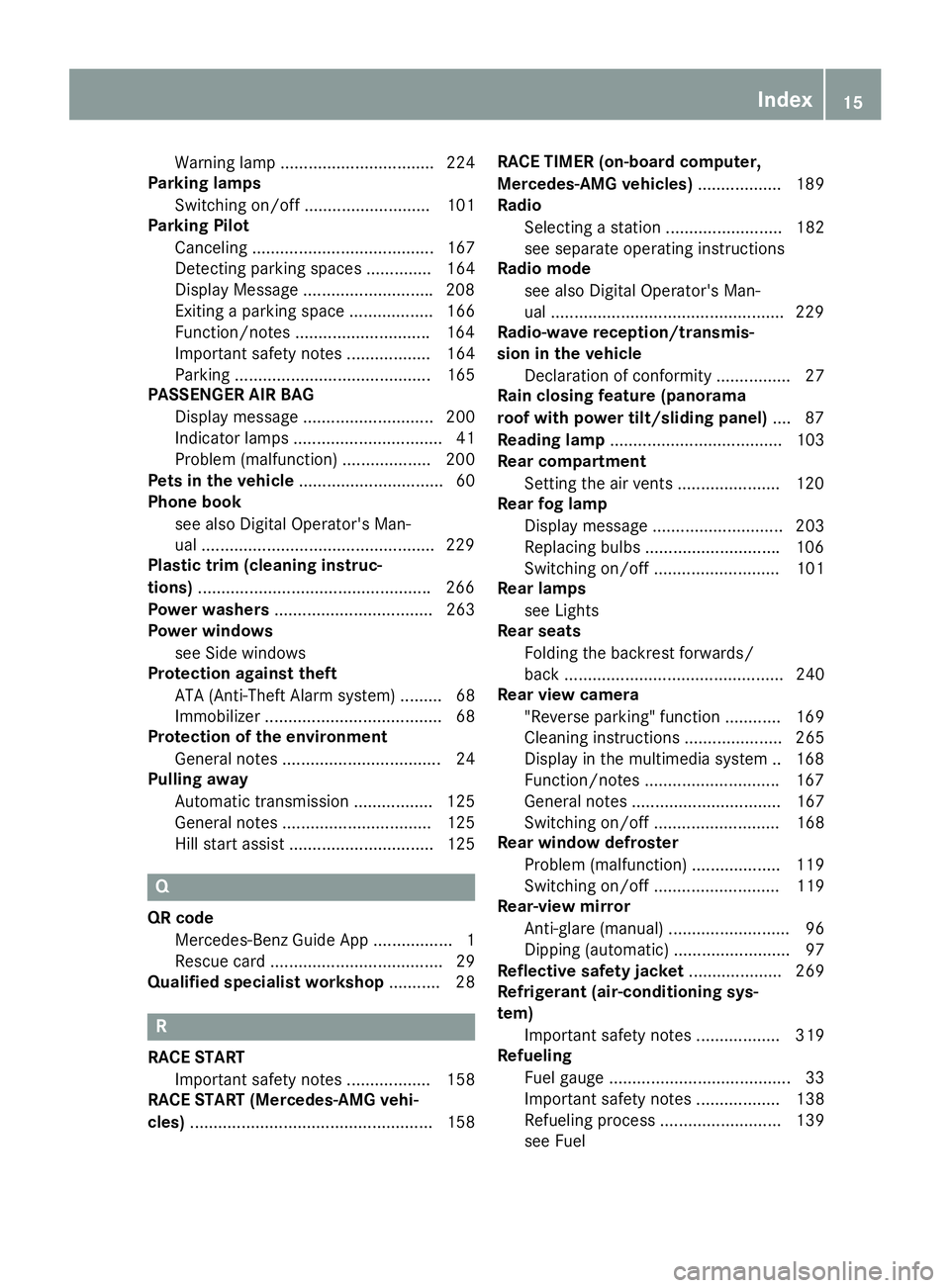
Warning lamp ................................. 224
Parking lamps
Switching on/off ........................... 101
Parking Pilot
Canceling ....................................... 167
Detecting parking spaces .............. 164
Display Message ........................... .2 08
Exiting ap arking space .................. 166
Function/notes ............................ .1 64
Important safety notes .................. 164
Parking .......................................... 165
PASSENGE RA IR BAG
Display message ............................ 200
Indicator lamps ................................ 41
Problem (malfunction) ................... 200
Pets in the vehicle ............................... 60
Phon eb ook
see also Digita lO perator's Man-
ua l. ................................................ .2 29
Plastic trim (cleaning instruc-
tions) ................................................. .2 66
Power washers .................................. 263
Power windows
see Side windows
Protection against theft
ATA (Anti-Theft Alarm system) ......... 68
Immobilize r. ..................................... 68
Protection of the environment
General notes .................................. 24
Pulling away
Automatic transmission ................. 125
General notes ................................ 125
Hill start assist ............................... 125
Q
QR code
Mercedes-Benz Guide App ................. 1
Rescue card ..................................... 29
Qualifie ds pecialist workshop ........... 28
R
RAC ES TART
Important safety notes .................. 158
RAC ES TART (Mercedes-AMG vehi-
cles) .................................................... 158 RAC ET IMER (on-board computer,
Mercedes-AMG vehicles) .................. 189
Radio
Selecting as tatio n. ........................ 182
see separate operating instructions
Radio mode
see also Digita lO perator's Man-
ua l. ................................................ .2 29
Radio-wave reception/transmis-
sio nint he vehicle
Declaratio nofc onformity ................ 27
Rain closing feature (panorama
roof with power tilt/sliding panel) .... 87
Readin gl amp ..................................... 103
Rear compartment
Setting the ai rv ents ..................... .1 20
Rear fog lamp
Display message ............................ 203
Replacing bulbs ............................ .1 06
Switching on/off ........................... 101
Rear lamps
see Lights
Rear seats
Folding the backres tf orwards/
back ............................................... 240
Rear vie wc amera
"Reverse parking" function ............ 169
Cleaning instructions ..................... 265
Display in the multimedi as ystem .. 168
Function/notes ............................ .1 67
General notes ................................ 167
Switching on/off ........................... 168
Rear window defroster
Problem (malfunction) ................... 119
Switching on/off ........................... 119
Rear-vie wm irror
Anti-glare (manual ). ......................... 96
Dipping (automatic) ......................... 97
Reflectiv es afety jacket .................... 269
Refrigerant (air-conditioning sys-
tem)
Important safety notes .................. 319
Refueling
Fuel gauge ....................................... 33
Important safety notes .................. 138
Refueling proces s. ......................... 139
see Fuel Index 15
Page 18 of 326
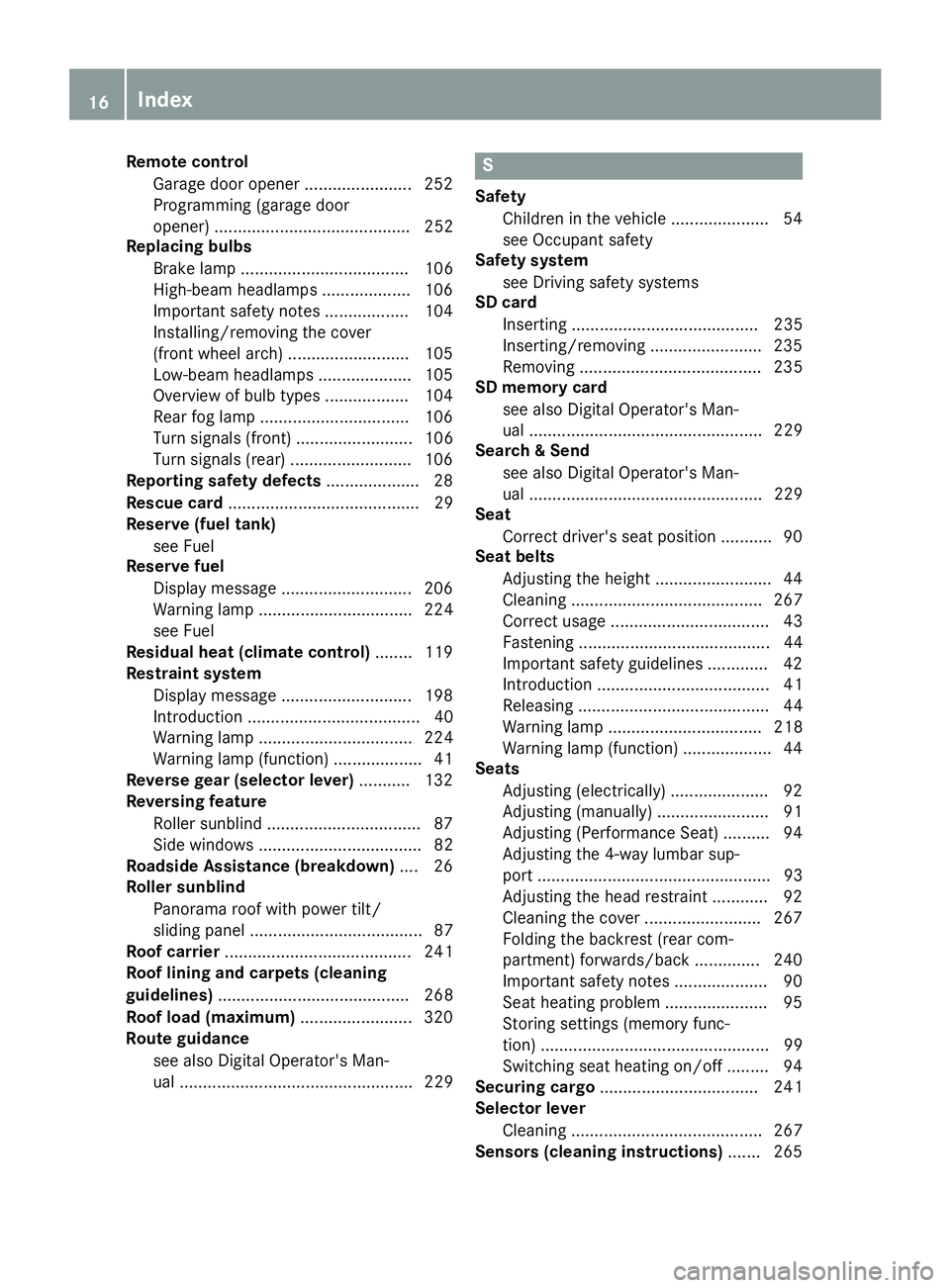
Remote control
Garag ed oo ro pener ....................... 252
Programming (garag ed oor
opener) .......................................... 252
Replacing bulbs
Brake lamp .................................... 106
High-beam headlamp s. .................. 106
Important safety notes .................. 104
Installing/removing the cover
(front whee la rch ). ......................... 105
Low-bea mh eadlamp s. ................... 105
Overview of bulb types .................. 104
Rear fog lamp ................................ 106
Turn signal s( front) ......................... 106
Turn signal s( rear) .......................... 106
Reporting safety defects .................... 28
Rescue card ......................................... 29
Reserve (fuel tank)
see Fuel
Reserve fuel
Displa ym essage ............................ 206
Warning lamp ................................. 224
see Fuel
Residual hea t( clim ate control) ........ 119
Restrain ts ystem
Displa ym essage ............................ 198
Introduction ..................................... 40
Warning lamp ................................. 224
Warning lamp (function) ................... 41
Revers eg ea r( selecto rl ever ) ........... 132
Reversin gf eature
Roller sunblind ................................. 87
Sid ew in dow s. .................................. 82
Roadside Assistance (breakdown) .... 26
Rolle rs unblind
Panorama roo fw it hp ower tilt/
sliding panel ..................................... 87
Roo fc arrier ........................................ 241
Roo fl inin ga nd carpets (cleaning
guidelines) ......................................... 268
Roo fl oa d( maximum) ........................ 320
Route guidance
see also Digital Operator's Man-
ua l. ................................................. 229 S Safety
Childre nint he vehicl e. .................... 54
see Occupant safety
Safety system
see Driving safety systems
SD card
Inserting ........................................ 235
Inserting/removing ........................ 235
Removing ....................................... 235
SD memory card
see also Digital Operator's Man-
ua l. ................................................. 229
Search &S en d
see also Digital Operator's Man-
ua l. ................................................. 229
Seat
Correct driver' ss ea tp osition ........... 90
Seat belts
Adjusting the height ......................... 44
Cleaning ......................................... 267
Correct usag e. ................................. 43
Fastening ......................................... 44
Important safety guideline s. ............ 42
Introduction ..................................... 41
Releasing ......................................... 44
Warning lamp ................................. 218
Warning lamp (function) ................... 44
Seats
Adjusting (electrically) ..................... 92
Adjusting (manually) ........................ 91
Adjusting (Performance Seat) .......... 94
Adjusting the 4-wa yl um ba rs up -
por t. ................................................. 93
Adjusting the hea dr estraint ............ 92
Cleaning the cove r. ........................ 267
Folding the backres t( rear com-
partment) forwards/back .............. 240
Important safety notes .................... 90
Sea th eating problem ...................... 95
Storing settings (memory func-
tion) ................................................. 99
Switching sea th eating on/of f. ........ 94
Securing cargo .................................. 241
Selecto rl ever
Cleaning ......................................... 267
Sensors (cleaning instructions) ....... 26516
Index
Page 44 of 326
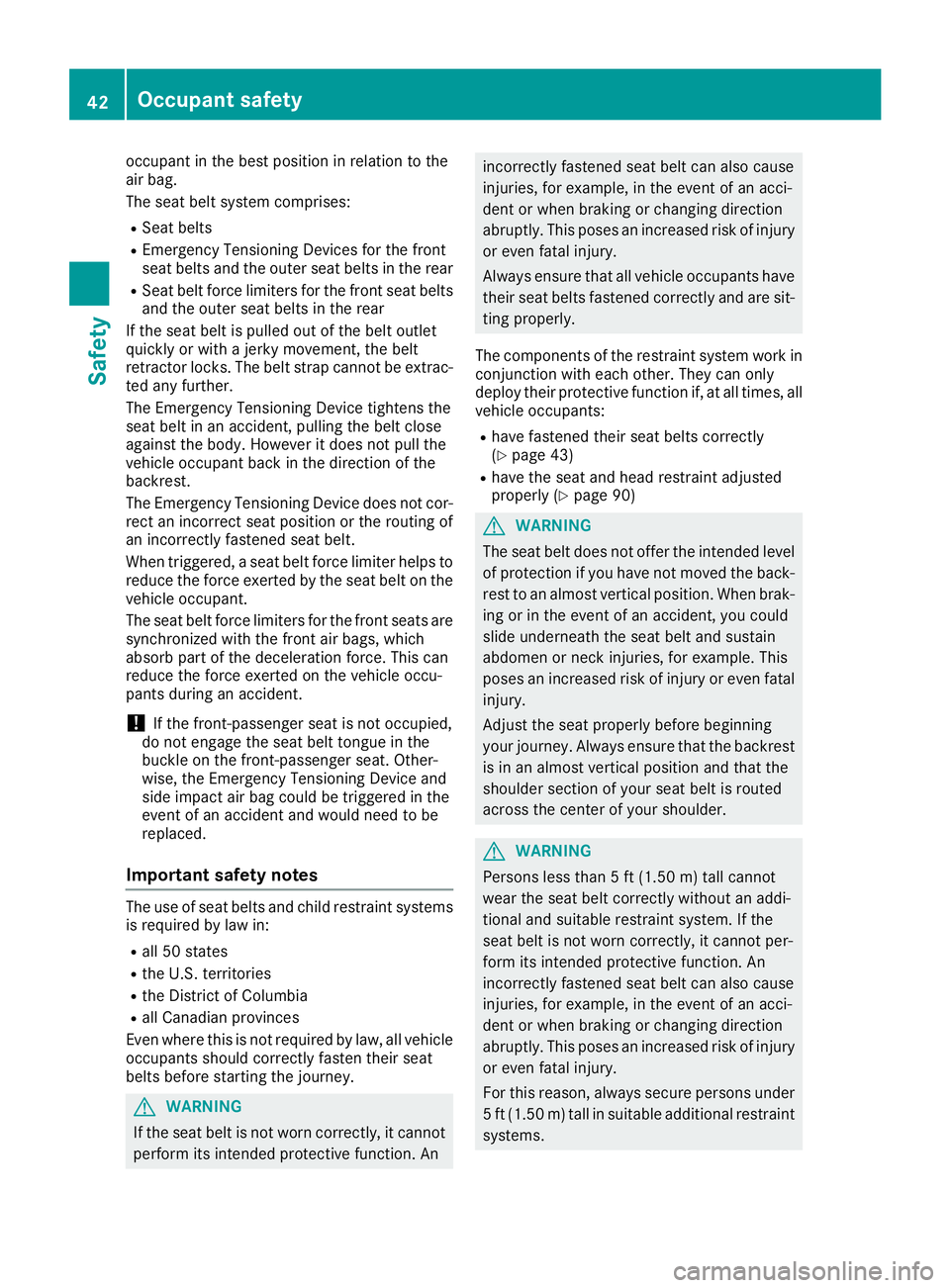
occupant in the best position in relation to the
air bag.
The seat belt system comprises: R
Seat belts R
Emergency Tensionin gD evices for the front
seat belts and the outer seat belts in the rear R
Seat belt force limiters for the front seat belts
and the outer seat belts in the rear
If the seat belt is pulled out of the belt outlet
quickly or with aj erk ym ovement ,t he belt
retractor locks. The belt strap cannot be extrac-
ted any further.
The Emergency Tensionin gD evice tighten st he
seat belt in an accident ,p ulling the belt close
against the body. However it does not pull the
vehicle occupant back in the direction of the
backrest.
The Emergency Tensionin gD evice does not cor-
rect an incorrect seat position or the routing of
an incorrectly fastened seat belt.
When triggered, as eat belt force limiter helps to
reduce the force exerted by the seat belt on the
vehicle occupant.
The seat belt force limiters for the front seats are
synchronized with the front air bags, which
absorb part of the deceleration force. This can
reduce the force exerted on the vehicle occu-
pants during an accident.
! If the front-passenger seat is not occupied,
do not engage the seat belt tongue in the
buckle on the front-passenger seat. Other-
wise, the Emergency Tensionin gD evice and
side impact air bag could be triggered in the
event of an accident and would need to be
replaced.
Important safety notes The use of seat belts and child restraint systems
is required by law in: R
all 50 states R
the U.S. territories R
the District of Columbia R
all Canadian provinces
Even where this is not required by law, all vehicle
occupant ss hould correctly fasten their seat
belts before starting the journey.
G WARNING
If the seat belt is not worn correctly, it cannot
perform its intended protective function. An incorrectly fastened seat belt can also cause
injuries, for example, in the event of an acci-
dent or when braking or changing direction
abruptly. This poses an increased risk of injury
or even fatal injury.
Always ensure that all vehicle occupant sh ave
their seat belts fastened correctly and are sit-
ting properly.
The components of the restraint system work in
conjunction with each other. They can only
deploy their protective function if, at all times, all
vehicle occupants: R
have fastened their seat belts correctly
( Y
page 43) R
have the seat and head restraint adjusted
properly ( Y
page 90)
G WARNING
The seat belt does not offer the intended level
of protection if you have not moved the back-
rest to an almost vertical position. When brak-
ing or in the event of an accident ,y ou could
slide underneath the seat belt and sustain
abdomen or neck injuries, for example. This
poses an increased risk of injury or even fatal
injury.
Adjust the seat properly before beginning
your journey. Always ensure that the backrest
is in an almost vertical position and that the
shoulder section of your seat belt is routed
across the center of your shoulder.
G WARNING
Persons less than 5ft( 1.50 m) tall cannot
wear the seat belt correctly without an addi-
tional and suitable restraint system. If the
seat belt is not worn correctly, it cannot per-
form its intended protective function. An
incorrectly fastened seat belt can also cause
injuries, for example, in the event of an acci-
dent or when braking or changing direction
abruptly. This poses an increased risk of injury
or even fatal injury.
For this reason, alway ss ecure persons under
5ft( 1.50 m) tall in suitable additional restraint
systems.42
Occupant safety
Safety
Page 47 of 326
seconds or once the driver's seat belt is fas-
tened.
If the vehicle's speed exceeds 15 mph
(25 km/h) once and the driver's and front-
passenger seat belts are not fastened, aw arning
tone sounds. Aw arning tone also sounds with
increasing intensit yf or 60 seconds or until the
driver or front passenger have fastened their
seat belts.
If the driver or front passenger unfasten their
seat belts during the journey, the seat belt warn-
ing is activated again.
Air bags
Introduction The installation point of an air bag can be rec-
ognized by the AIRBAG marking.
An air bag complements the correctly fastened
seat belt. It is no substitute for the seat belt. The
air bag provides additional protection in appli-
cable accident situations.
Not all air bags are deployed in an accident. The
different air bag systems function independ-
ently from one another ( Y
page 52).
However, no system available today can com-
pletely eliminate injuries and fatalities.
It is also not possible to rule out ar isk of injury
caused by an air bag due to the high speed at
which the air bag must be deployed.
Important safety notes
G WARNING
If you do not sit in the correct seat position,
the air bag cannot protect as intended and
could even cause additional injury when
deployed. This poses an increased risk of
injury or even fatal injury.
To avoid hazardous situations, always make
sure that all of the vehicle's occupants: R
have fastened their seat belts correctly,
including pregnant women R
are sitting correctly and maintain the great-
est possible distance to the air bags R
follow the following instructions Always make sure that there are no objects
between the air bag and the vehicle's occu-
pants. R
Adjust the seats properly before beginning
your journey. Always make sure that the seat
is in an almost upright position. The center of
the head restraint must support the head at
about eye level. R
Move the driver's and front-passenger seats
as far back as possible .T he driver's seat posi-
tion must allow the vehicle to be driven safely. R
Only hold the steering wheel on the outside.
This allow st he air bag to be fully deployed. R
Always lean against the backrest while driv-
ing. Do not lean forward or lean against the
door or side window. You may otherwise be in
the deployment area of the air bags. R
Always keep your feet in the footwell in front
of the seat. Do not put your feet on the dash-
board, for example. Your feet may otherwise
be in the deployment area of the air bag. R
For this reason, always secure persons less
than 5f t( 1.50 m) tall in suitable restraint sys-
tems. Up to this height, the seat belt cannot
be worn correctly.
If ac hild is traveling in your vehicle ,a lso
observe the following notes: R
Always secure children under twelve years of
age and less than 5f t( 1.50 m) tal lins ui table
child restraint systems. R
Chil dr estraint systems shoul dbei nstalle do n
the rea rs ea ts. R
Onl ys ec ur eac hild in ar earward-facing child
restraint syste mont he front-passenge rs ea t
when the front-passenge rf ront ai rb ag is
deactivated .Ift he PASSENGER AIR BAG OFF
indicator lamp is permanentl yl it ,t he front-
passenge rf ront ai rb ag is deactivated
( Y
page 41). R
Alway so bser ve the instructions and safety
note sont he "Occupant Classification Syste m
( OCS) "( Y
page 47) and on "Children in the
vehicle" ( Y
page 54 )i na ddit io ntot he child
restraint syste mm an ufacturer's installation
and operating instructions.Occupant safety 45
Safety Z
Page 49 of 326
The driver's and front-passenger knee bags
offer additional thigh, knee and lower leg pro-
tection for the occupant sint he front seats.
Side impact air bags
G WARNING
Unsuitable seat covers can obstruct or pre-
vent deployment of the air bags integrated
into the seats. Consequently, the air bags
cannot protec tv ehicle occupant sast hey are
designed to do. In addition, the operation of
the occupant classification system (OCS)
could be adversely affected. This poses an
increased risk of injury or even fatal injury.
You should only use seat covers that have
been approved for the respective seat by
Mercedes-Benz.
Fron ts ide impact air bags C and rear side
impact air bags D deploy next to the outer bol-
ster of the seat backrest.
When deployed, the side impact air bag offers
additional thorax protection. It also offers addi-
tional pelvis protection for occupant sint he
front seats. However, it does not protec tt he:R
Head R
Neck R
Arms
If the restraint system control unit detect sas ide
impact, the side impact air bag is deployed on
the side on which the impact occurs.
The side impact air bag on the front-passenger
side deploys under the following conditions: R
the OCS system detect st hat the front-
passenger seat is occupied or R
the seat belt buckle tongue is engaged in the
belt buckle of the front-passenger seat If the belt tongue is engaged in the belt buckle,
the side impact air bag on the front-passenger
side deploys if an appropriate accident situation
occurs. In this case, deployment is independent
of whether the front-passenger seat is occupied
or not.
Window curtain air bags
Window curtain air bags C are integrated into
the side of the roof frame and deployed in the
area from the A-pillar to the C-pillar.
When deployed, the window curtain air bag
enhances the level of protection for the head.
However, it does not protec tt he chest or arms.
If the restraint system control unit detect sas ide
impact, the window curtain air bag is deployed
on the side on which the impact occurs.
If the system determines that they can offer
additional protection to that provided by the
seat belt, aw indow curtain air bag may be
deployed in other accident situations
( Y
page 52).
Occupant Classification System
(OCS)
Introduction The Occupant Classification System (OCS) cat-
egorizes the person in the front-passenger seat.
Dependin gont hat result, the front-passenger
front air bag and front-passenger knee bag are
either enabled or deactivated.
The system does not deactivate: R
the side impact air bag R
the window curtain air bag R
the Emergency Tensionin gD evicesOccupant safety 47
Safety Z
Page 56 of 326
sive role in the deployment of an air bag. Nor do
they provide an indication of air bag deploy-
ment.
The vehicle can be deformed considerably, with-
out an air bag being deployed. This is the case if
only parts which are relatively easil yd eformed
are affected and the rate of deceleration is not
high. Conversely, air bags may be deployed even
though the vehicle suffers only minor deforma-
tion. This is the case if, for example, very rigid
vehicle parts such as longitudinal body mem-
bers are hit, and sufficient deceleration occurs
as ar esult.
If the restraint system control unit detects as ide
impact or if the vehicle rolls over, the applicable
component soft he restraint system are activa-
ted independently of each other depending on
the apparent type of accident. R
Side impact air bags on the side where the
impact takes place, independently of the
Emergenc yT ensioning Device and the use of
the seat belt on the driver's seat and outer
seats in the second row
The side impact air bag on the front-
passenger side deploy su nder the following
conditions: -
the OCS system detects that the front-
passenger seat is occupied or -
the seat belt buckle tongue is engaged in
the belt buckle of the front-passenger seat R
Window curtain air bag on the side of impact,
independently of the use of the seat belt and
independently of whether the front-
passenger seat is occupied R
Emergenc yT ensioning Devices, if the system
determines that deployment can offer addi-
tional protection in this situation R
Window curtain air bags on the driver's and
front-passenger side in certain situations
when the vehicle rolls over, if the system
determines that deployment can offer addi-
tional protection to that provided by the seat
belt
i Not all air bags are deployed in an accident.
The different air bag systems work independ-
ently of each other. How the air bag system works is determined
by the severity of the accident detected,
especially the vehicle deceleration or accel-
eration and the apparent type of accident: R
Frontal collision R
Side impact R
Rollover
Automatic measures after an acci-
dent Immediately after an accident, the following
measures are implemented, depending on the
type and severity of the impact: R
the hazard warning lamps are activated R
the emergency lighting is activated R
the vehicle doors are unlocked R
the front side windows are lowered R
the engine is switched off and the fuel supply
is cut off R
vehicles with mbrace: automatic emergency
call
Children in the vehicle
Important safety notes Accident statistics show that children secured
in the rear seats are safer than children secured
in the front-passenger seat. For this reason,
Mercedes-Benz strongly advises that you install
ac hild restraint system on ar ear seat. Children
are generally better protected there.
If ac hild younger than twelve years old and
under 5ft( 1.50 m) in height is traveling in the
vehicle: R
always secure the child in ac hild restraint
system suitable for Mercedes-Benz vehicles.
The child restraint system must be appropri-
ate to the age, weight and size of the child R
be sure to observe the instructions and safety
notes in this section in addition to the child
restraint system manufacturer's installation
instructions R
be sure to observe the instructions and safety
notes on the "Occupant classification system
(OCS)" ( Y
page 47)54
Children in the vehicle
Safety
Page 59 of 326
LATCH-typ e( ISOFIX) child seat secur-
ing system
G WARNING
LATCH-type (ISOFIX) child restraint systems
do not offer sufficient protection for children
whose weight combine dw ith th ec hild
restraint system is greater than 65 lbs (29 kg)
and who are secured usin gt he safety belt
integrated in th ec hild restraint system. In the
even tofana ccident, ac hild migh tn ot be
restrained correctly. This poses an increased
risk of injury or even fatal injury.
If th ec hild and th ec hild restraint system
together weigh mor et ha n65l bs (29 kg), only
use LATCH-type (ISOFIX) child restraint sys-
tem sw ith whic ht he child is also secured with
th ev ehicle seat belt .A ls os ecure th ec hild
restraint system with th eT op Tether belt ,i f
available.
Always comply with th em anufacturer' si nstal-
latio na nd operatin gi nstruction sf or th ec hild
restraint system used.
Before ever yt ri p, mak es ure that th eL AT CH-
type (ISOFIX) child restraint system is engaged
correctly in bot hL AT CH-type (ISOFIX) securing
rings
! When installing th ec hild restraint system,
mak es ure that th es eat belt for th em iddle
seat does not get trapped. The seat belt could
otherwise be damaged.
X
Install th eL AT CH-type (ISOFIX) child restraint
system on bot hL AT CH-type (ISOFIX) securing
rings C .
ISOFI Xisas ta ndardized securin gs ystem for
specially designed child restraint systems on
th er ear seats. LATCH-type (ISOFIX) securing rings for two LATCH-type (ISOFIX) child restraint
systems are installe dont he left and righ toft he
rear seats.
Non-LATCH-type (ISOFIX) child seat sm ay also
be used and can be installe du sin gt he vehicle's
seat belt system. Install th ec hild seat according
to th em anufacturer' si nstructions.
Top Tether
Introduction Top Tether provides an additional connection
between th ec hild restraint system secured with
aL AT CH-type (ISOFIX) system and th ev ehicle.
This helps reduc et he risk of injury even further.
If th ec hild restraint system is equipped with a
Top Tether belt ,t hi ss hould always be used.
Important safety notes
G WARNING
If th er ear seat backrests are not locked ,t he y
could fold forwards in th ee ven tofana cci-
dent, heavy braking or sudden changes of
direction. As ar esult, child restraint systems
cannot perform their intended protective
function .R ear seat backrests that are not
locked can also cause additional injuries ,e .g.
in th ee ven tofana ccident. This poses an
increased risk of injury or even fatal injury.
Always lock rear seat backrests after instal-
ling aT op Tether belt .O bserve th el oc kv eri-
ficatio ni ndicator. Adjust th er ear seat backr-
est ssot ha tt he ya re in an uprigh tp osition.
If th er ear backres tisn ot engaged and locked,
th er ed lock verificatio ni ndicator will be visible
( Y
page 240).Children in th ev ehicle 57
Safety Z
Page 93 of 326
motion. This could cause you to lose control of
the vehicle. There is ar isk of an accident.
Always make sure that the driver' ss eat is
engage db efore starting the vehicle.
G WARNING
You could lose control of you rv ehicl eify ou do
the following while driving: R
adjust the driver' ss eat, head restraint,
steering whee lorm irrorsR
fasten the seat belt
There is ar isk of an accident.
Adjust the driver' ss eat, head restraint, steer-
ing whee la nd mirror and fasten you rs eat belt
before starting the engine.
G WARNING
If you adjust the seat height carelessly ,y ou or
other vehicl eo ccupants could be trappe da nd
thereby injured. Children in particular could
accidentally press the electrica ls eat adjust-
ment buttons and become trapped. There is a
risk of injury.
Whil em oving the seats, make sure that your
hands or other body parts do not get under the
lever assembly of the seat adjustment sys-
tem.
! To avoi dd amage to the seats and the seat
heating, observe the following information: R
keep liquid sf rom spilling on the seats. If
liquid is spilled on the seats, dry them as
soon as possible. R
if the seat covers are damp or wet, do not
switch on the seat heating. The seat heat-
ing should als on ot be used to dry the seats.R
clean the seat covers as recommended;
see the "Interior care" section. R
do not transport heavy loads on the seats.
Do not place sharp objects on the seat
cushions, e.g. knives, nail sort ools. The
seats should only be occupied by passen-
gers, if possible. R
when the seat heating is in operation, do
not cover the seats with insulating materi-
als ,e .g. blankets, coats, bags ,s eat covers,
child seats or booster seats. ! Make sure that there are no objects in the
footwel lu nder or behind the seats when mov-
ing the seats back. There is ar isk that the
seats and/or the objects could be damaged.
i Further related subjects: R
cargo compartment enlargement (folding
down the rear seats) ( Y
page 240)
Adjusting the seats manually
Vehicles without the seating comfort
package
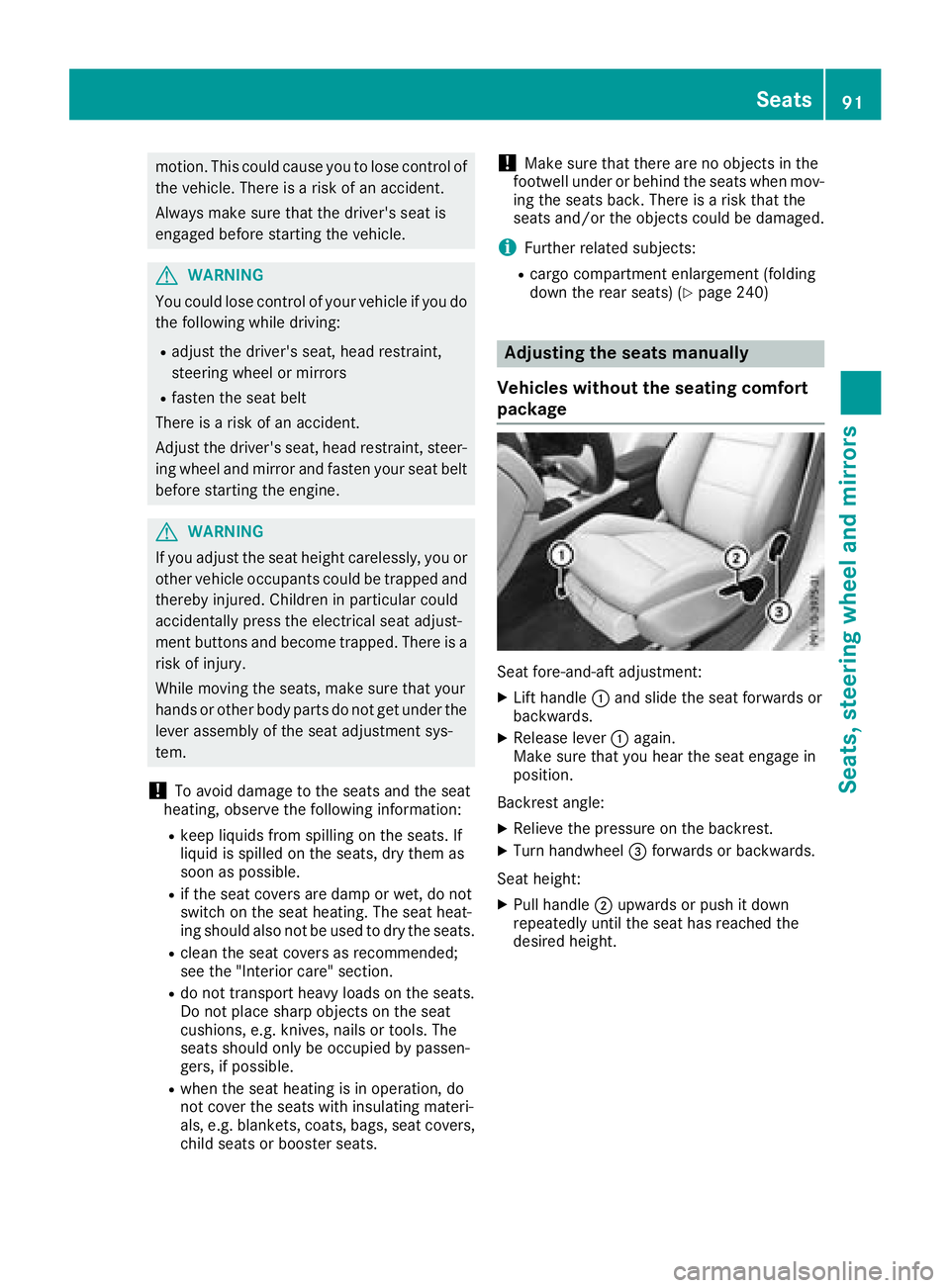
Seat fore-and-aft adjustment: X
Lift handle C and slid et he seat forwards or
backwards. X
Release lever C again.
Make sure that you hear the seat engage in
position.
Backrest angle: X
Relieve the pressure on the backrest. X
Turn handwheel
Page 95 of 326
Using the fore-and-aft adjustment, adjust the
head restraint so that it is as close as possible to
your head.
General notes For vehicles with sports seats you cannot adjust
the front head restraints or the outer rear head
restraints.
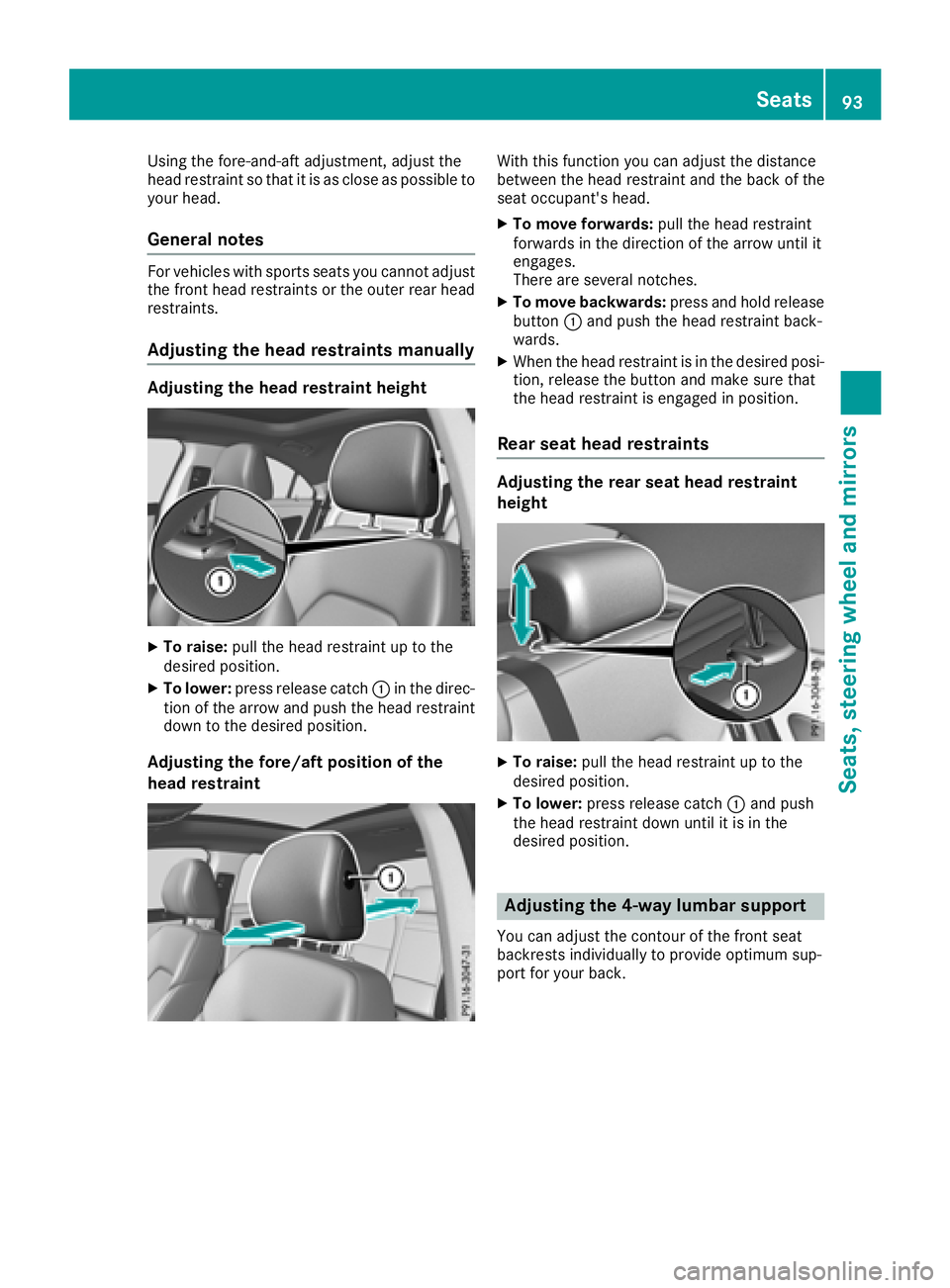
Adjusting the head restraints manually Adjusting the head restraint height
X
To raise: pull the head restraint up to the
desired position. X
To lower: press release catch C in the direc-
tion of the arrow and push the head restraint
down to the desired position.
Adjusting the fore/aft position of the
head restraint With this function you can adjust the distance
between the head restraint and the back of the
seat occupant's head. X
To move forwards: pull the head restraint
forwards in the direction of the arrow until it
engages.
There are several notches. X
To move backwards: press and hold release
button C and push the head restraint back-
wards. X
When the head restraint is in the desired posi-
tion, release the button and make sure that
the head restraint is engaged in position.
Rear seat head restraints Adjusting the rear seat head restraint
height
X
To raise: pull the head restraint up to the
desired position. X
To lower: press release catch C and push
the head restraint down until it is in the
desired position.
Adjusting the 4-way lumbar support You can adjust the contour of the front seat
backrests individually to provide optimum sup-
port for your back. Seats 93
Seats, steering whee la nd mirrors Z