belt MERCEDES-BENZ CLA 2019 Owner's Manual
[x] Cancel search | Manufacturer: MERCEDES-BENZ, Model Year: 2019, Model line: CLA, Model: MERCEDES-BENZ CLA 2019Pages: 330, PDF Size: 23.57 MB
Page 57 of 330
GWARNING
If you leave children unsupervised in the vehi-
cle, they could set it in motion by, for example:
Rrelease the parking brake.
Rshift the automatic transmission out of the
parking positionP.
Rstart the engine.
In addition, they may operate vehicle equip-
ment and become trapped. There is a risk of
an accident and injury.
When leaving the vehicle, always take the
SmartKey with you and lock the vehicle. Never
leave children unsupervised in the vehicle.
GWARNING
If persons, particularly children are subjected
to prolonged exposure to extreme heat or
cold, there is a risk of injury, possibly even
fatal. Never leave children unattended in the
vehicle.
GWARNING
If the child restraint system is subjected to
direct sunlight, parts may get very hot. Chil-
dren may burn themselves on these parts,
particularly on the metal parts of the child
restraint system. There is a risk of injury.
If you leave the vehicle, taking the child with
you, always ensure that the child restraint
system is not exposed to direct sunlight. Pro-
tect it with a blanket, for example. If the child
restraint system has been exposed to direct
sunlight, let it cool down before securing the
child in it. Never leave children unattended in
the vehicle.
Always ensure that all vehicle occupants havetheir seat belts fastened correctly and are sittingproperly. Particular attention must be paid tochildren.
Observe the safety notes on the seat belt(Ypage 42) and the notes on correct use of seatbelts (Ypage 43).
A booster seat may be necessary to achieveproper seat belt positioning for children over40 lbs (18 kg) until they reach a height where a
three-point seat belt can be properly fastenedwithout a booster seat.
Special seatbelt retractor
GWARNING
If the seat belt is released while driving, the
child restraint system will no longer be
secured properly. The special seat belt retrac-
tor is disabled and the inertia real draws in a
portion of the seat belt. The seat belt cannot
be immediately refastened. There is an
increased risk of injury, possibly even fatal.
Stop the vehicle immediately, paying atten-
tion to road and traffic conditions. Reactivate
the special seat belt retractor and secure the
child restraint system properly.
All seat belts in the vehicle, except the driver'sseat belt, are equipped with a special seat beltretractor. When activated, the special seat beltretractor ensures that the seat belt cannotslacken once the child seat is secured.
Installing a child restraint system:
XMake sure you observe the child restraintsystem manufacturer's installation instruc-tions.
XPull the seat belt smoothly from the belt out-let.
XEngage seat belt tongue in belt buckle.
Activating the special seat belt retractor:
XPull the seat belt out fully and let the inertiareel retract it again.While the seat belt is retracting, you shouldhear a ratcheting sound. The special seat beltretractor is enabled.
XPush the child restraint system down so thatthe seat belt is tight and does not loosen.
Removing the child restraint system and deac-tivating the special seat belt retractor:
XMake sure you observe the child restraintsystem manufacturer's installation instruc-tions.
XPress the release button of the seat beltbuckle and guide the seat belt tongue backtowards the belt sash guide.The special seat belt retractor is deactivated.
Children in the vehicle55
Safety
Z
Page 58 of 330
Child restraint system
The use of seat belts and child restraint systemsis required by law in:
Rall 50 states
Rthe U.S. territories
Rthe District of Columbia
Rall Canadian provinces
If you install a rearward-facing child restraintsystem on the center rear seat, the rear arm restmust be folded back as far as possible.
You can obtain further information about thecorrect child restraint system from any author-ized Mercedes-Benz Center.
GWARNING
If the child restraint system is installed incor-
rectly on a suitable seat, it cannot protect as
intended. The child cannot then be restrained
in the event of an accident, heavy braking or
sudden changes of direction. There is an
increased risk of injury, possibly even fatal.
Make sure that you observe the child restraint
system manufacturer's installation instruc-
tions and the notes on use. Please ensure,
that the base of the child restraint system is
always resting completely on the seat cush-
ion. Never place objects, e.g. cushions, under
or behind the child restraint system. Only use
child restraint systems with the original cover
designed for them. Only replace damaged
covers with genuine covers.
GWARNING
If the child restraint system is installed incor-
rectly or is not secured, it can come loose in
the event of an accident, heavy braking or a
sudden change in direction. The child
restraint system could be thrown about, strik-
ing vehicle occupants. There is an increased
risk of injury, possibly even fatal.
Always install child restraint systems prop-
erly, even if they are not being used. Make
sure that you observe the child restraint sys-
tem manufacturer's installation instructions.
You will find further information on stowingobjects, luggage or loads under "Loading guide-lines" (Ypage 239).
GWARNING
Child restraint systems or their securing sys-
tems which have been damaged or subjected
to a load in an accident can no longer protect
as intended. The child cannot then be
restrained in the event of an accident, heavy
braking or sudden changes of direction. There
is an increased risk of injury, possibly even
fatal.
Replace child restraint systems which have
been damaged or subjected to a load in an
accident as soon as possible. Have the secur-
ing systems on the child restraint system
checked at a qualified specialist workshop,
before you install a child restraint system
again.
The securing systems of child restraint systemsare:
Rthe seat belt system
Rthe LATCH-type (ISOFIX) securing rings
Rthe Top Tether anchorages
If it is absolutely necessary to carry a child onthe front-passenger seat, be sure to observe theinformation on the "Occupant ClassificationSystem (OCS)" (Ypage 47). There you will alsofind information on deactivating the front-passenger front air bag.
All child restraint systems must meet the fol-lowing standards:
RU.S. Federal Motor Vehicle Safety Standards213 and 225
RCanadian Motor Vehicle Safety Standards213 and 210.2
Confirmation that the child restraint system cor-responds to the standards can be found on aninstruction label on the child restraint system.This confirmation can also be found in the instal-lation instructions that are included with thechild restraint system.
Observe the warning labels in the vehicle inte-rior and on the child restraint system.
56Children in the vehicle
Safety
Page 59 of 330
LATCH-type (ISOFIX) child seat secur-
ing system
GWARNING
For LATCH-type (ISOFIX) child restraint sys-
tems in which the child is secured using the
safety belt integrated in the child restraint
system, the maximum permissible weight of
the child and child restraint system together
is 73 lbs (33 kg).
If the child and the child restraint system
together weigh more than 73 lbs (33 kg), the
LATCH-type (ISOFIX) child restraint system
with integrated safety belt no longer offers
sufficient protection. The LATCH-type (ISO-
FIX) child seat securing system may be over-
loaded, and the child may not be restrained in
an accident, for example. This poses an
increased risk of injury or even fatal injury.
If the child and the child restraint system
together weigh more than 73 lbs(33 kg),use
only a LATCH-type (ISOFIX) child restraint sys-
tem in which the child is also secured with the
vehicle seat belt. Also secure the child
restraint system with the Top Tether belt, if
available.
Regularly check that the permissible grossweight of the child together with the childrestraint system is still maintained.
Always comply with the manufacturer's instal-lation and operating instructions for the childrestraint system used.
Before every trip, make sure that the LATCH-type (ISOFIX) child restraint system is engagedcorrectly in both LATCH-type (ISOFIX) securingrings
!When installing the child restraint system,make sure that the seat belt for the middleseat does not get trapped. The seat belt couldotherwise be damaged.
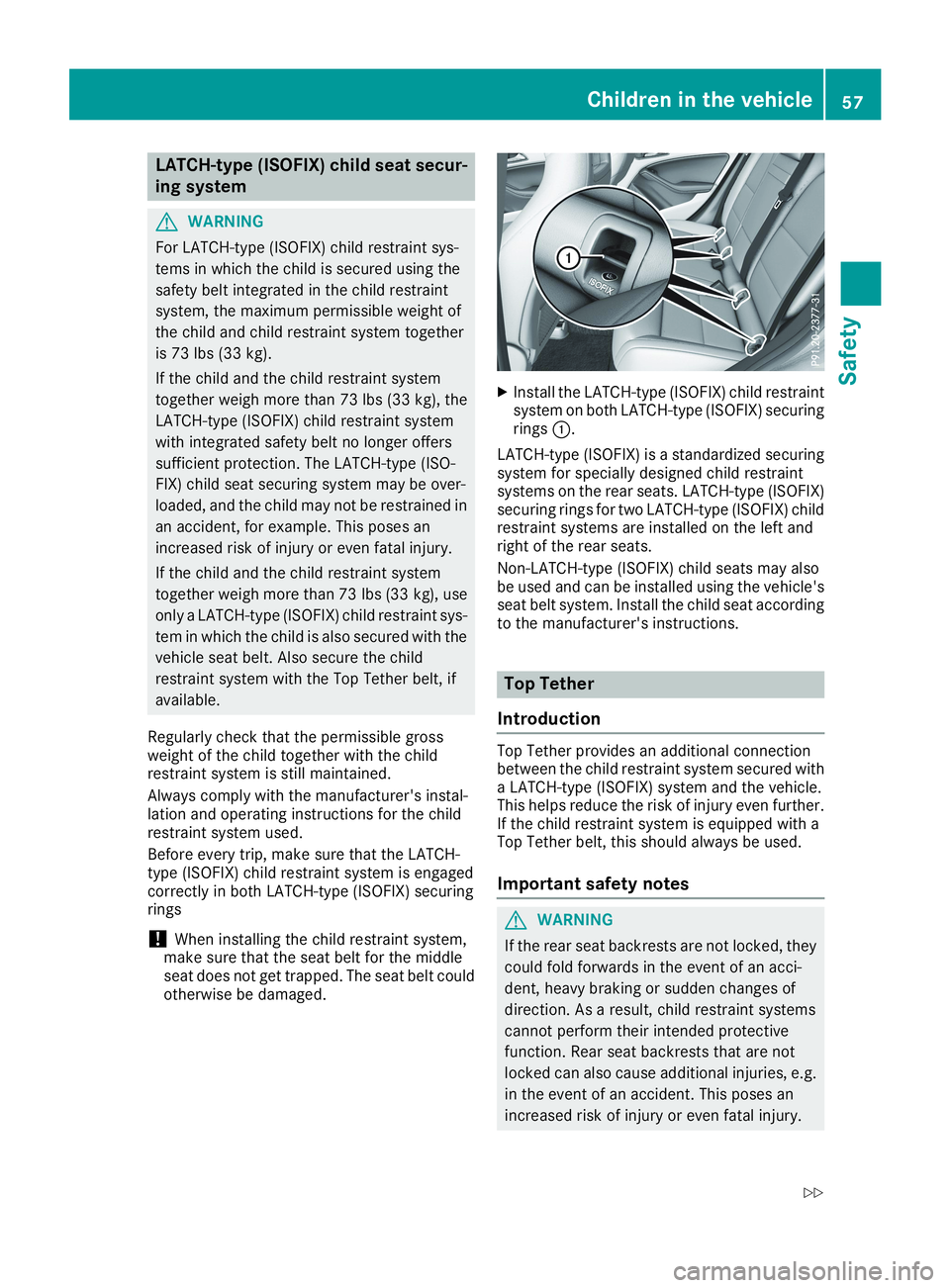
XInstall the LATCH-type (ISOFIX) child restraintsystem on both LATCH-type (ISOFIX) securingringsC.
LATCH-type (ISOFIX) is a standardized securingsystem for specially designed child restraintsystems on the rear seats. LATCH-type (ISOFIX)securing rings for two LATCH-type (ISOFIX) childrestraint systems are installed on the left andright of the rear seats.
Non-LATCH-type (ISOFIX) child seats may alsobe used and can be installed using the vehicle'sseat belt system. Install the child seat accordingto the manufacturer's instructions.
Top Tether
Introduction
Top Tether provides an additional connectionbetween the child restraint system secured witha LATCH-type (ISOFIX) system and the vehicle.This helps reduce the risk of injury even further.If the child restraint system is equipped with aTop Tether belt, this should always be used.
Important safety notes
GWARNING
If the rear seat backrests are not locked, they
could fold forwards in the event of an acci-
dent, heavy braking or sudden changes of
direction. As a result, child restraint systems
cannot perform their intended protective
function. Rear seat backrests that are not
locked can also cause additional injuries, e.g.
in the event of an accident. This poses an
increased risk of injury or even fatal injury.
Children in the vehicle57
Safety
Z
Page 60 of 330
Always lock rear seat backrests after instal-
ling a Top Tether belt. Observe the lock veri-
fication indicator. Adjust the rear seat backr-
ests so that they are in an upright position.
If the rear backrest is not engaged and locked,the red lock verification indicator will be visible(Ypage 242).
Top Tether anchorages
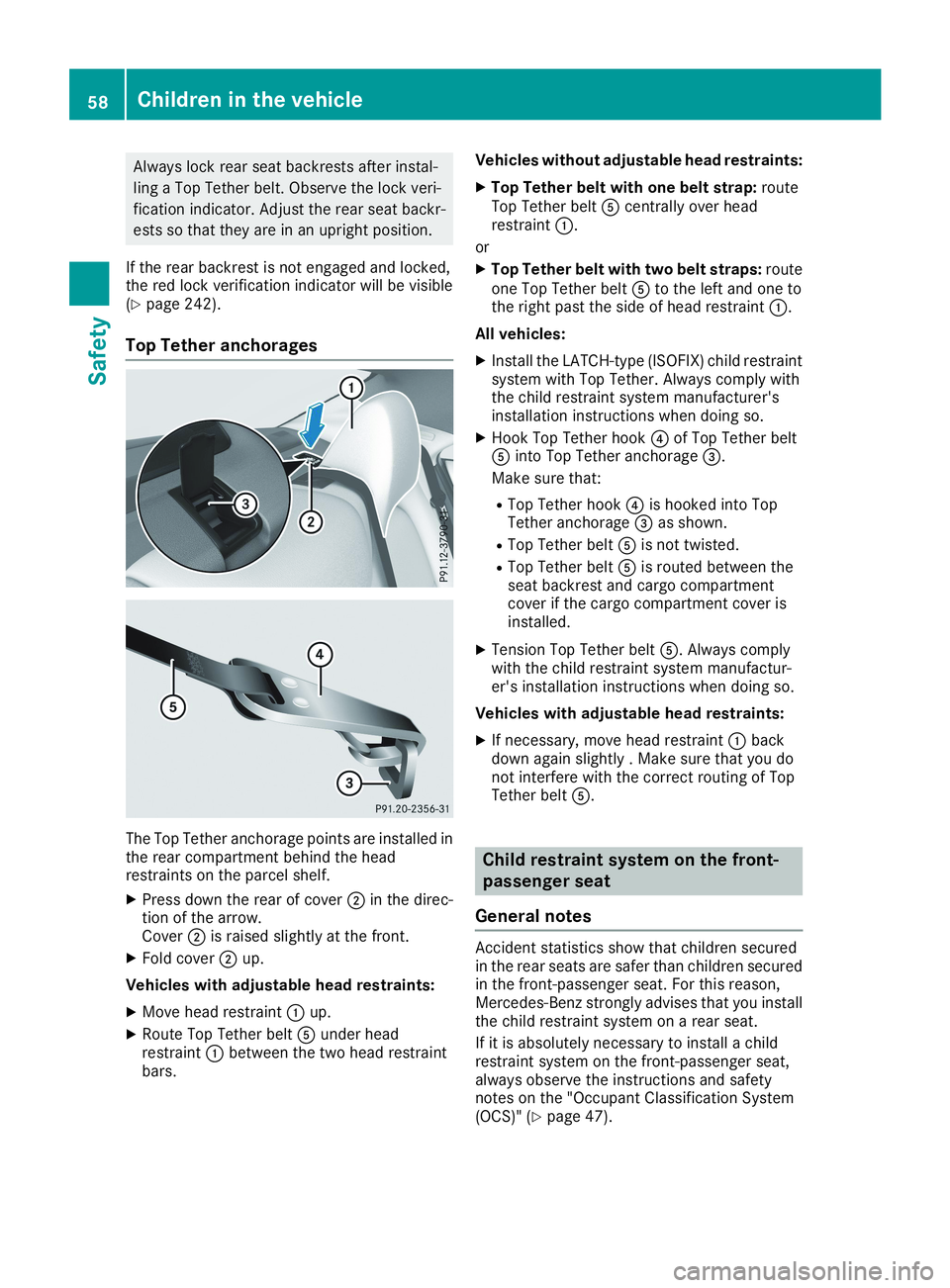
The Top Tether anchorage points are installed inthe rear compartment behind the headrestraints on the parcel shelf.
XPress down the rear of coverDin the direc-tion of the arrow.CoverDis raised slightly at the front.
XFold coverDup.
Vehicles with adjustable head restraints:
XMove head restraintCup.
XRoute Top Tether belt
Page 61 of 330
You can thus avoid the risks that could arise asa result of:
Ran incorrectly categorized person in the front-passenger seat
Rthe unintentional deactivation of the front-passenger front air bag
Rthe unsuitable positioning of the childrestraint system, e.g. too close to the dash-board
Rearward-facing child restraint system
If it is absolutely necessary to install a rearward-facing child restraint system on the front-passenger seat, always make sure that thefront-passenger front air bag is deactivated.Only if the PASSENGER AIR BAG OFF indicatorlamp is permanently lit (Ypage 41) is the front-passenger front air bag deactivated.
Always observe the child restraint system man-ufacturer's installation and operating instruc-tions.
Forward-facing child restraint system
If it is absolutely necessary to install a forward-facing child restraint system on the front-passenger seat, always move the front-passenger seat as far back as possible. Fullyretract the seat cushion length. The entire baseof the child restraint system must always rest onthe seat cushion of the front-passenger seat.The backrest of the child restraint system mustlie as flat as possible against the backrest of thefront-passenger seat. The child restraint systemmust not touch the roof or be subjected to a loadby the head restraint. Adjust the angle of theseat backrest and the head restraint positionaccordingly. Always make sure that the shoul-der belt strap is correctly routed from the vehi-cle belt outlet to the shoulder belt guide on thechild restraint system. The shoulder belt strapmust be routed forward and down from the vehi-cle belt outlet. If necessary, adjust the vehiclebelt outlet and the front-passenger seat accord-ingly.
Always observe the child restraint system man-ufacturer's installation and operating instruc-tions.
Child-proof locks
Important safety notes
GWARNING
If children are traveling in the vehicle, they
could:
Ropen doors, thus endangering other people
or road users
Rexit the vehicle and be caught by oncoming
traffic
Roperate vehicle equipment and become
trapped
There is a risk of an accident and injury.
Always activate the child-proof locks and
override feature if children are traveling in the
vehicle. When leaving the vehicle, always take
the key with you and lock the vehicle. Never
leave children unattended in the vehicle.
Override feature for:
Rthe rear doors (Ypage 60)
Rthe rear side windows (Ypage 60)
GWARNING
If you leave children unsupervised in the vehi-
cle, they could set it in motion by, for example:
Rrelease the parking brake.
Rshift the automatic transmission out of the
parking positionP.
Rstart the engine.
In addition, they may operate vehicle equip-
ment and become trapped. There is a risk of
an accident and injury.
When leaving the vehicle, always take the
SmartKey with you and lock the vehicle. Never
leave children unsupervised in the vehicle.
GWARNING
If persons, particularly children are subjected
to prolonged exposure to extreme heat or
cold, there is a risk of injury, possibly even
fatal. Never leave children unattended in the
vehicle.
Children in the vehicle59
Safety
Z
Page 93 of 330
Correct driver's seat position
GWARNING
You could lose control of your vehicle if you do
the following while driving:
Radjust the driver's seat, head restraint,
steering wheel or mirrors
Rfasten the seat belt
There is a risk of an accident.
Adjust the driver's seat, head restraint, steer-
ing wheel and mirror and fasten your seat belt
before starting the engine.
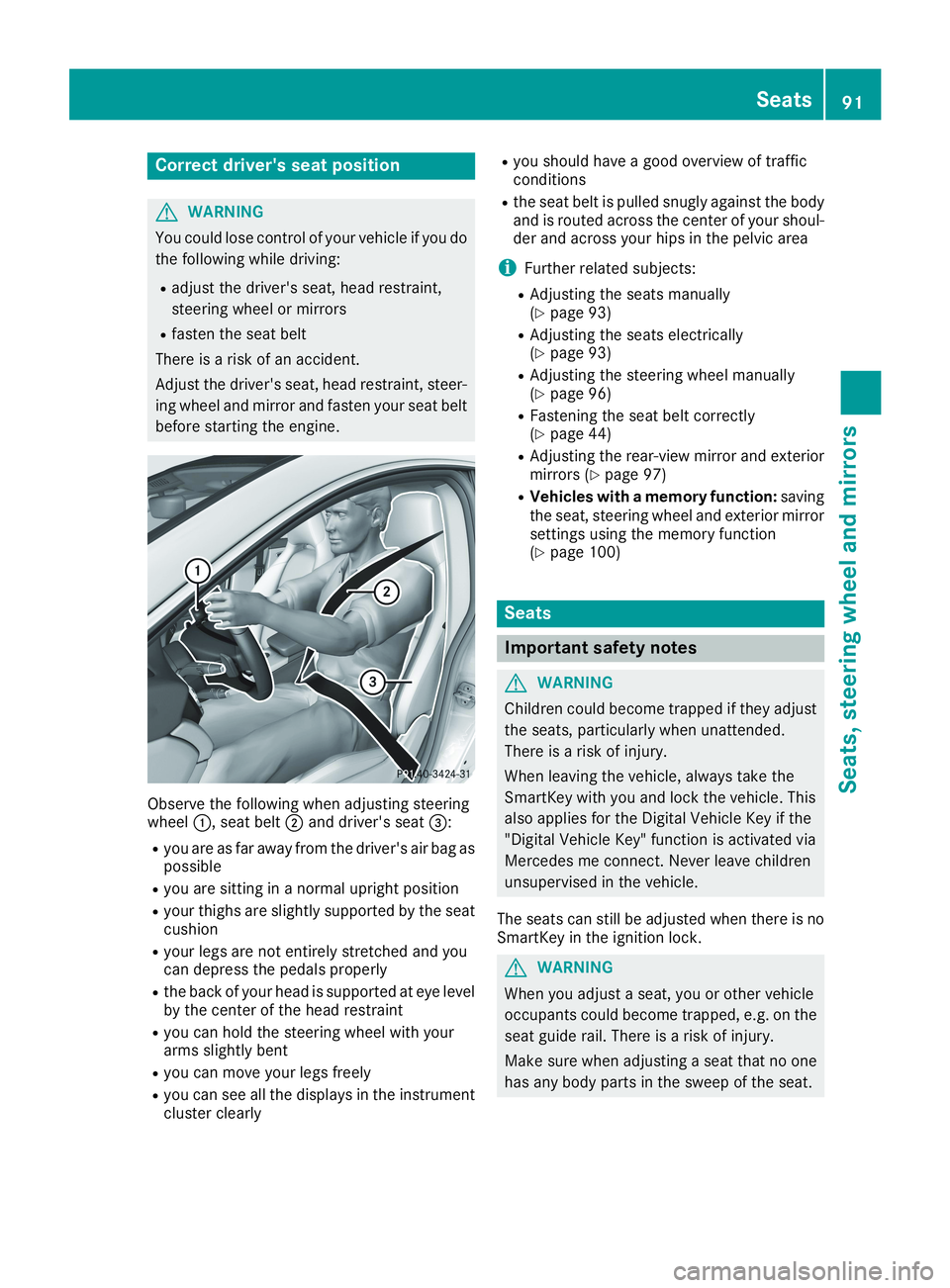
Observe the following when adjusting steeringwheelC, seat beltDand driver's seat
Page 94 of 330
GWARNING
If the driver's seat is not engaged, it could
move forwards as far as the next catch during
movement such as braking or abrupt changes
of direction. As a result, you would be pushed
against your seat belt by the unsecured driv-
er's seat.
This could cause you to lose control of the
vehicle. The seat belt cannot protect as inten-
ded and could result in additional injury.
There is a risk of an accident and injury.
Before every journey, make sure that the driv-
er's seat is fully engaged.
Observe the safety notes on "Air bags"(Ypage 45) and "Children in the vehicle"(Ypage 54).
GWARNING
If the driver's seat is not engaged, it could
move unexpectedly while the vehicle is in
motion. This could cause you to lose control of
the vehicle. There is a risk of an accident.
Always make sure that the driver's seat is
engaged before starting the vehicle.
GWARNING
You could lose control of your vehicle if you do
the following while driving:
Radjust the driver's seat, head restraint,
steering wheel or mirrors
Rfasten the seat belt
There is a risk of an accident.
Adjust the driver's seat, head restraint, steer-
ing wheel and mirror and fasten your seat belt
before starting the engine.
GWARNING
If you adjust the seat height carelessly, you or
other vehicle occupants could be trapped and
thereby injured. Children in particular could
accidentally press the electrical seat adjust-
ment buttons and become trapped. There is a
risk of injury.
While moving the seats, make sure that your
hands or other body parts do not get under the
lever assembly of the seat adjustment sys-
tem.
!To prevent damage to the seats and the seatheating, observe the following notes:
RDo not spill liquids onto the seats. Dry theseats as soon as possible if liquid does getspilled on the seats.
RIf the seat covers are damp or wet, do notswitch on the seat heating. Also, do not usethe seat heating to dry the seats.
RClean the seat covers as recommended;see the "Interior care" section.
RDo not transport heavy loads on the seats.Do not place pointed objects on the seatcushions such as knives, nails or tools.Where possible, use the seats only for car-rying passengers.
RWhen operating the seat heating, do notcover the seats with insulating materials,e.g. blankets, coats, bags, protective cov-ers, child seats or booster seats.
RWhen the seat heating is switched on, theseat surface can be damaged as a result ofobjects being placed on the seats, forexample, seat cushions, child seats andprotective covers not approved byMercedes-Benz.
!Make sure that there are no objects in thefootwell under or behind the seats when mov-ing the seats back. There is a risk that theseats and/or the objects could be damaged.
iFurther related subjects:
RCargo compartment enlargement (foldingdown the rear seats) (Ypage 242)
92Seats
Seats, steering wheel and mirrors
Page 96 of 330
Adjusting the head restraints
Important safety notes
GWARNING
You could lose control of your vehicle if you do
the following while driving:
Radjust the driver's seat, head restraint,
steering wheel or mirrors
Rfasten the seat belt
There is a risk of an accident.
Adjust the driver's seat, head restraint, steer-
ing wheel and mirror and fasten your seat belt
before starting the engine.
GWARNING
If the head restraints are not installed or not
adjusted correctly, they cannot provide pro-
tection as intended. There is an increased risk
of injury in the head and neck area, e.g. in the
event of an accident or when braking.
Always drive with the head restraints instal-
led. Before driving off, make sure for every
vehicle occupant that the center of the head
restraint supports the back of the head at
about eye level.
Using the fore-and-aft adjustment, adjust thehead restraint so that it is as close as possible toyour head.
General notes
For vehicles with sports seats you cannot adjustthe front head restraints or the outer rear headrestraints.
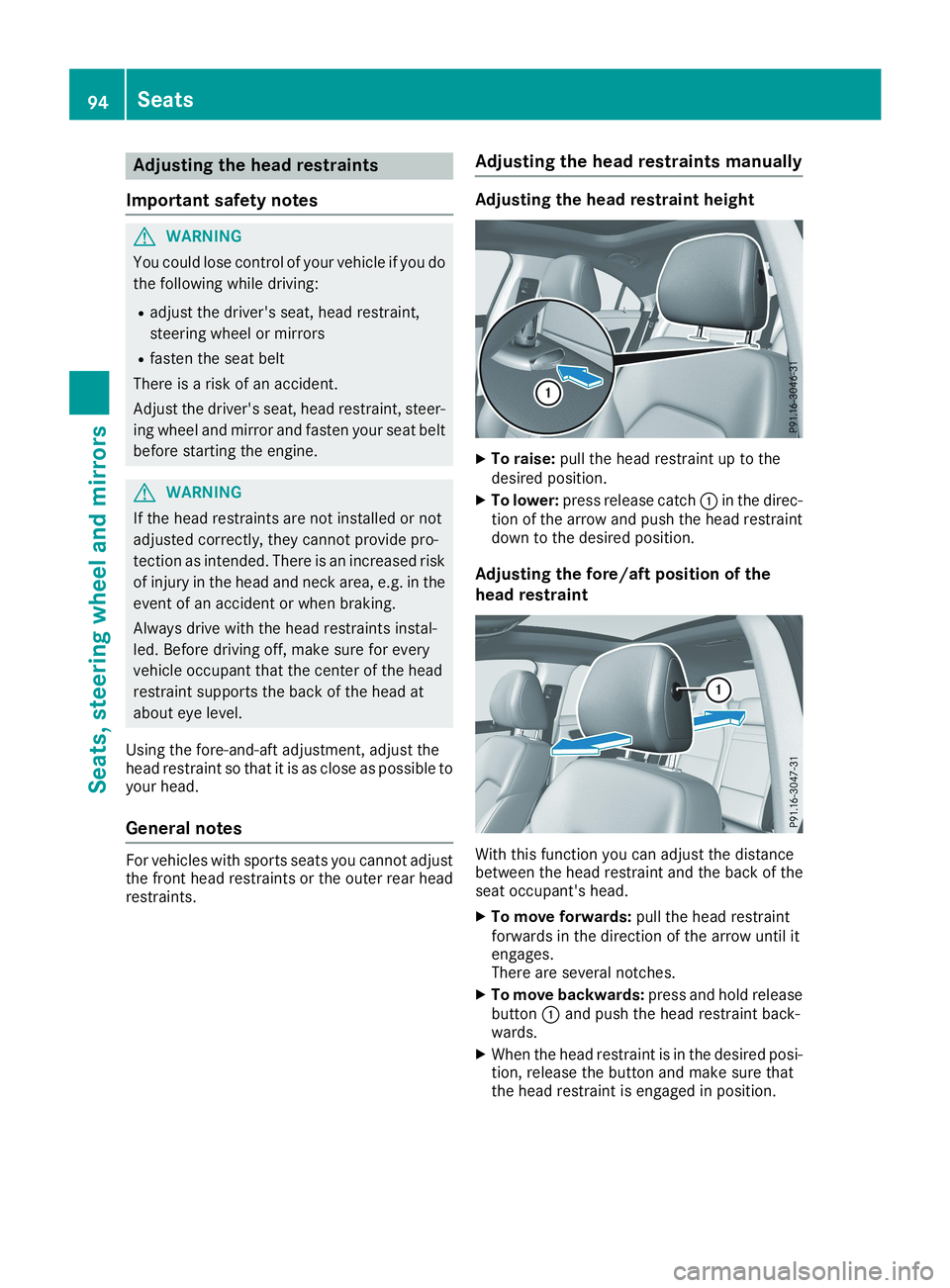
Adjusting the head restraints manually
Adjusting the head restraint height
XTo raise:pull the head restraint up to thedesired position.
XTo lower:press release catchCin the direc-tion of the arrow and push the head restraintdown to the desired position.
Adjusting the fore/aft position of the
head restraint
With this function you can adjust the distancebetween the head restraint and the back of theseat occupant's head.
XTo move forwards:pull the head restraintforwards in the direction of the arrow until itengages.There are several notches.
XTo move backwards:press and hold releasebuttonCand push the head restraint back-wards.
XWhen the head restraint is in the desired posi-tion, release the button and make sure thatthe head restraint is engaged in position.
94Seats
Seats , ste ering wheel and mirrors
Page 98 of 330
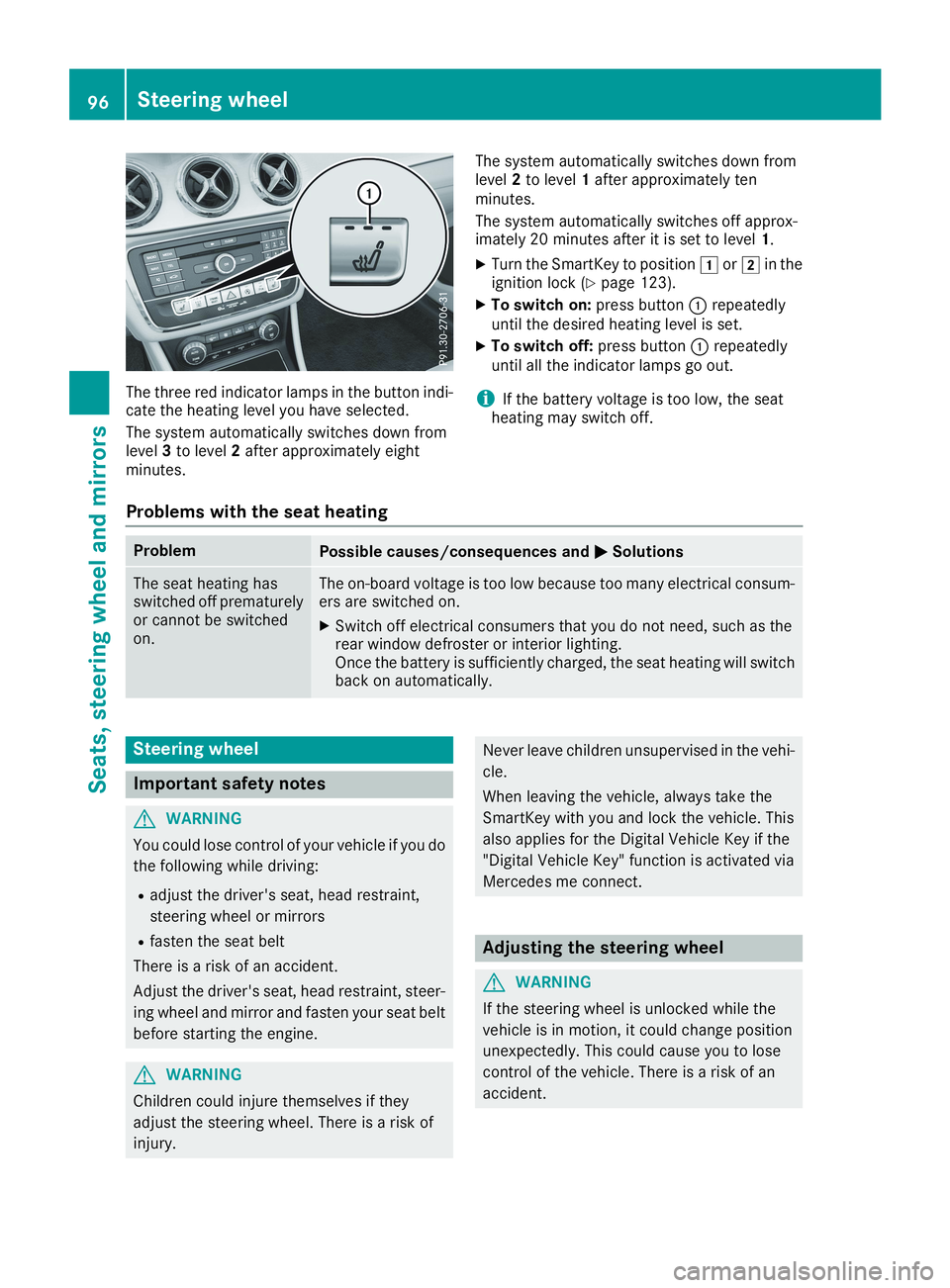
The three red indicator lamps in the button indi-cate the heating level you have selected.
The system automatically switches down fromlevel3to level2after approximately eightminutes.
The system automatically switches down fromlevel2to level1after approximately tenminutes.
The system automatically switches off approx-imately 20 minutes after it is set to level1.
XTurn the SmartKey to positionGorHin theignition lock (Ypage 123).
XTo switch on:press buttonCrepeatedlyuntil the desired heating level is set.
XTo switch off:press buttonCrepeatedlyuntil all the indicator lamps go out.
iIf the battery voltage is too low, the seatheating may switch off.
Problems with the seat heating
ProblemPossible causes/consequences andPPSolutions
The seat heating hasswitched off prematurelyor cannot be switchedon.
The on-board voltage is too low because too many electrical consum-ers are switched on.
XSwitch off electrical consumers that you do not need, such as therear window defroster or interior lighting.Once the battery is sufficiently charged, the seat heating will switchback on automatically.
Steering wheel
Important safety notes
GWARNING
You could lose control of your vehicle if you do
the following while driving:
Radjust the driver's seat, head restraint,
steering wheel or mirrors
Rfasten the seat belt
There is a risk of an accident.
Adjust the driver's seat, head restraint, steer-
ing wheel and mirror and fasten your seat belt
before starting the engine.
GWARNING
Children could injure themselves if they
adjust the steering wheel. There is a risk of
injury.
Never leave children unsupervised in the vehi-
cle.
When leaving the vehicle, always take the
SmartKey with you and lock the vehicle. This
also applies for the Digital Vehicle Key if the
"Digital Vehicle Key" function is activated via
Mercedes me connect.
Adjusting the steering wheel
GWARNING
If the steering wheel is unlocked while the
vehicle is in motion, it could change position
unexpectedly. This could cause you to lose
control of the vehicle. There is a risk of an
accident.
96Steering wheel
Seats, steering wheel and mirrors
Page 146 of 330
![MERCEDES-BENZ CLA 2019 Owners Manual Additionally, children could set the vehicle in
motion if, for example, they:
Rrelease the parking brake
Rshift the automatic transmission out of park
position]
Rstart the engine
There is a risk of a](/img/4/59041/w960_59041-145.png "MERCEDES-BENZ CLA 2019 Owners Manual Additionally, children could set the vehicle in
motion if, for example, they:
Rrelease the parking brake
Rshift the automatic transmission out of park
position]
Rstart the engine
There is a risk of a")
Additionally, children could set the vehicle in
motion if, for example, they:
Rrelease the parking brake
Rshift the automatic transmission out of park
position]
Rstart the engine
There is a risk of an accident and injury.
Never leave children or animals unattended in
the vehicle.
When leaving the vehicle, always take the
SmartKey with you and lock the vehicle. This
also applies for the Digital Vehicle Key if the
"Digital Vehicle Key" function is activated via
Mercedes me connect.
The function of the electric parking brake isdependent on the on-board voltage. If the on-board voltage is low or there is a malfunction inthe system, it may not be possible to apply thereleased parking brake.
XIf this is the case, only park the vehicle onlevel ground and secure it to prevent it rollingaway.
XShift the automatic transmission to position].
It may not be possible to release an appliedparking brake if the on-board voltage is low orthere is a malfunction in the system. Contact aqualified specialist workshop.
The electric parking brake performs a functiontest at regular intervals while the engine isswitched off. The sounds that can be heard whilethis is occurring are normal.
Applying or releasing manually
XTo engage:push handleC.When the electric parking brake is applied,the redI(USA only) or$(Canadaonly) indicator lamp lights up in the instru-ment cluster.
The electric parking brake can also be appliedwhen the SmartKey is removed.
XTo release:pull handleC.The redI(USA only) or$(Canadaonly) indicator lamp in the instrument clustergoes out.
The electric parking brake can only bereleased:
Rif the SmartKey is in positionGorHinthe ignition lock (Ypage 123) or
Rif the ignition was switched on using theStart/Stop button
Applying automatically
The electric parking brake is automaticallyapplied when the transmission is in position]and:
Rthe engine is switched off or
Rthe driver is not wearing a seat belt and thedriver's door is opened
To prevent the electric parking brake from beingautomatically applied, pull handleC.
The electric parking brake is also applied auto-matically if:
RActive Distance Assist DISTRONIC brings thevehicle to a standstill or
Rthe HOLD function is keeping the vehicle sta-tionary
RActive Parking Assist is keeping the vehiclestationary
In addition, at least one of the following condi-tions must be fulfilled:
Rthe engine is switched off
Rthe driver is not wearing a seat belt and thedriver's door is opened
Rthere is a system malfunction
Rthe power supply is insufficient
Rthe vehicle is stationary for a lengthy period
The redI(USA only) or$(Canada only)indicator lamp in the instrument cluster goesout.
The electric parking brake is not automaticallyapplied if the engine is switched off by the ECOstart/stop function.
144Parking
Driving an d parking